Corruption
News Type
News
Date
Paragraphs

The Program on Poverty and Governance (PovGov) at Stanford’s Center on Democracy, Development, and the Rule of Law received a $4.5 million grant from the U.S. Department of State’s Bureau of International Narcotics and Law Enforcement Affairs to launch a research project to examine the nature of police corruption in Mexico and make recommendations for reforming that country’s law enforcement institutions.

This new phase of research is expanding on the four-year project that PovGov has led to evaluate the use of police lethal force in Rio de Janeiro’s most dangerous slums. Over the course of three years, the new project will partner with law enforcement in Mexico to professionalize and improve its capacity, while strengthening the rule of law and enhancing transparency in a country rocked by insecurity and violence.

The project is led by PovGov Director and Principal Investigator Beatriz Magaloni together with co-investigator Alberto Diaz-Cayeros. Both have conducted cutting-edge research on crime and violence in Brazil, Mexico, and the United States at Stanford’s Freeman Spogli Institute for International Studies, where they launched the International Crime and Violence Lab.

To read more about the new Mexico project, please click here.


Hero Image
povgov grant photo logo
Mexican police forces, like these officers in Ciudad Juarez, will be the subject of a new Stanford research project led by political scientists Beatriz Magaloni and Alberto Diaz-Cayeros.
Frontpage / Shutterstock
All News button
1
News Type
News
Date
Paragraphs

In a video by PBS NewsHour, three Ukrainian alumni of the CDDRL's Draper Hills Summer Fellows Program provide comments on the struggle for political change and stability in their country two years after the Maidan protests drove President Yanukovych out of Ukraine. Alumni members Sergii Leshchenko, Mustafa Nayyem, and Svitlana Zalishchuk currently serve as Members of Parliament in Ukraine. Nayyem: "It was very easy to be heroes on the Maidan. It is much more difficult to be heroes in the Parliament."


Hero Image
Statue of the Founders of Kiev during the Maidan Revolution Reuters
All News button
1
News Type
News
Date
Paragraphs

Image
AUthoritarianism Goes Global
In a new book on authoritarianism's global rise, FSI Senior Fellow Larry Diamond, alongside a number of distinguished scholars, share fresh perspectives on the complicated issues surrounding the authoritarian resurgence and the implications of these systemic shifts for the international order. A collection of essays, Authoritarianism Goes Global provides critical insights for understanding emerging challenges to democratic development around the world.

For more information and to purchase the book, please click here

Hero Image
Putin speaking in front of Russian flags
Vladimir Putin addresses supporters during a rally in central Moscow on March 4, 2012.
REUTERS/Denis Sinyakov
All News button
1
Paragraphs

About the Book

Over the past decade, illiberal powers have become emboldened and gained influence within the global arena. Leading authoritarian countries—including China, Iran, Russia, Saudi Arabia, and Venezuela—have developed new tools and strategies to contain the spread of democracy and challenge the liberal international political order.

Meanwhile, the advanced democracies of Europe and the United States have retreated and failed to respond to the threat posed by the authoritarians. As undemocratic regimes become more assertive, they are working together to repress civil society while tightening their grip on cyberspace and expanding their reach in international media. These political changes have fostered the emergence of new counternorms—such as the authoritarian subversion of credible election monitoring—that threaten to further erode the global standing of liberal democracy.

In Authoritarianism Goes Global, a distinguished group of contributors present fresh insights on the complicated issues surrounding the authoritarian resurgence and the implications of these systemic shifts for the international order. This collection of essays is critical for advancing our understanding of the emerging challenges to democratic development.

All Publications button
1
Publication Type
Books
Publication Date
Journal Publisher
Johns Hopkins University Press
Authors
Larry Diamond
-

Abstract: In fragile states, regimes must cultivate military forces strong enough to ward off external threats, but loyal enough to resist launching a coup. This requires that leader distinguish the loyal from the untrustworthy, a particularly challenging exercise in post-conflict settings with weak institutions. In this study, I explore how Congolese soldiers operating in North Kivu, the largest operational theater in the Democratic Republic of Congo and the epicenter of one of the most violent conflicts in Africa, solve this crucial task. I argue that leaders use non-payment as a form of trial and tribulation that reveals commitment by driving non-loyal soldiers to defect and loyal soldiers to weather challenging times. Non-payments creates a dual-pronged screening process because unpaid soldiers engage in unit-managed extortion and violence against civilians, which is used to both test and generate loyalty. To detail and assess this argument, I couple thick description based on 100 open-ended qualitative interviews with a fine-grained quantitative analysis of 350 members of the armed forces of the Democratic Republic of Congo. This analysis provides a novel explanation for how leaders overcome classic screening dilemmas in ways that ultimately drives violence against civilians. 

 
About the Speaker: Grant Gordon is a PhD Candidate in international relations and comparative politics at Columbia University. His research examines the political economy of conflict, humanitarian intervention and institutions, and combines field experiments, original survey data, ethnography and unique administrative data.

His dissertation seeks to understand the logic of state violence during conflict. In a complementary set of empirical papers, he analyzes why simple strategies used to solve principal agent problems in states afflicted by war cause civilian abuse.

His work has been supported by the United States Institute for Peace, Abdul Latif Jameel Poverty Action Lab, and Texas A&M Center for Conflict and Development, among others. Grant is a 2015-2016 Mellon/ACLS Dissertation Completion Fellow and Resident Fellow at the Stanford Center on International Conflict and Negotiation.


Grant Gordon Resident Fellow Stanford Center on International Conflict and Negotiation
Seminars
-

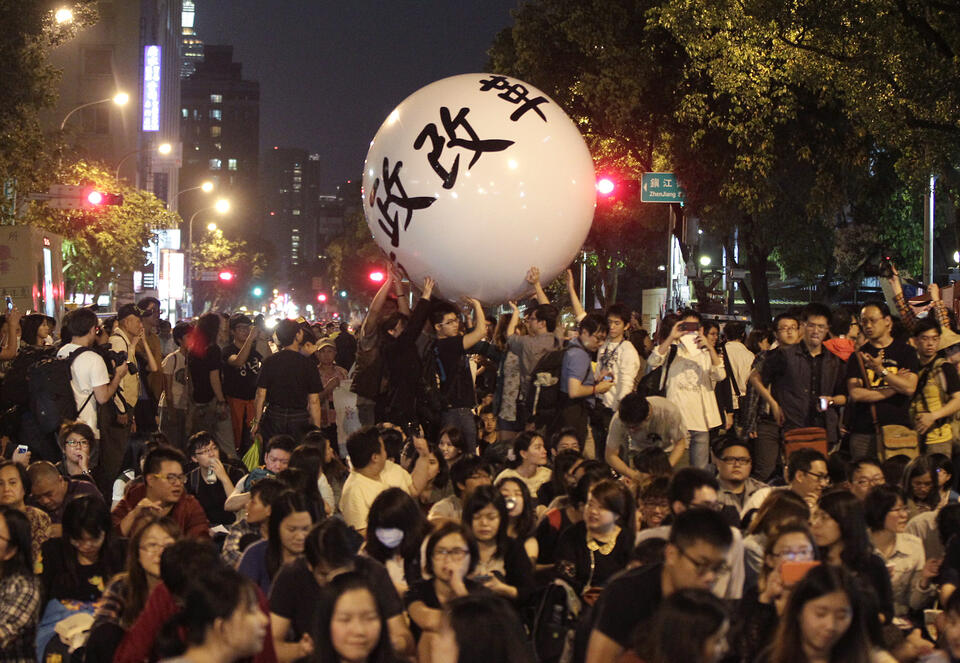
sunflower movement   constitution Activists push a ball reading "constitution reformation" during a sit-in to mark the one-year anniversary of the start of the Sunflower Movement outside the Legislative Yuan in Taipei March 18, 2015.

Activists push a ball reading "constitutional reform" during a sit-in to mark the one-year anniversary of the start of the Sunflower Movement outside the Legislative Yuan in Taipei March 18, 2015. Reuters/Pichi Chuang


These are unsettled times in Taiwanese politics. In recent months, prominent voices from across the spectrum have called for fundamental changes to the structure of Taiwan’s political system, ranging from simple reforms such as lowering the voting age to 18 to fundamental ones such as adopting a full presidential or parliamentary regime.

The impetus for constitutional reform has multiple sources. But at its core is a deeply problematic relationship between the executive and the legislature. When different parties controlled the two branches during the final years of the Chen Shui-bian administration, cooperation came to a standstill and governance suffered.  

More surprisingly, executive-legislative confrontation returned with a vengeance in President Ma Ying-jeou’s second term, even though the ruling Kuomintang (KMT) held both the executive and a majority in the legislature. The prolonged struggle over cross-Strait agreements is only the most prominent of a series of political conflicts that have blocked the adoption of new policies and threatened the legitimacy of those that do pass. And it is not clear that the next administration and legislature will fare any better than previous ones.

For the 10th Annual Conference on Taiwan Democracy, we will consider proposals for reforms in the context of the strengths and weaknesses of Taiwan’s current constitutional structure. Among the topics to be considered at the conference are:

  1. Diagnosing the problems: What have been the sources and implications of political strife in Taiwan in recent years, both under divided and unified one-party control? What reforms, if any, might make these conflicts easier to resolve and increase the legitimacy of government policy-making?
  2. Executive type: Would switching to a different type of executive—presidential, parliamentary, or another form of semi-presidentialism—mitigate some of the disadvantages of Taiwan’s current system?
  3. Electoral systems: What are the problems with Taiwan’s current electoral system? What changes might mitigate some of the disadvantages?
  4. Direct democracy: What functions do Taiwan’s referendum and recall laws serve in practice? How would changes to these laws affect Taiwan’s democracy?
  5. Accountability institutions: How have Taiwan’s judiciary, Control Yuan, and prosecutorial agencies performed during periods of partisan conflict between the executive and legislative branches? How might their effectiveness be improved?
  6. Comparative perspectives: How does Taiwan’s recent experience with divided government and institutional reform compare to other Third Wave democracies in the region (e.g. South Korea, SE Asia) and more broadly (e.g. Latin America, Eastern Europe)?

Conference participants will help to develop a set of recommendations for a non-partisan reform agenda for Taiwan, one that is informed by a clear understanding of both the most pressing challenges facing Taiwan’s democracy and of best practices in other successful young democracies. 


Conference Resources


Presentations

Conference Papers

Participant Bios
Small Parties in Taiwan's Party System
Decentralization in the Taiwanese Legislature
Goebel Presentation

CDDRL
Stanford University
Encina Hall, C147
616 Jane Stanford Way
Stanford, CA 94305-6055

(650) 724-6448 (650) 723-1928
0
Mosbacher Senior Fellow in Global Democracy at the Freeman Spogli Institute for International Studies
William L. Clayton Senior Fellow at the Hoover Institution
Professor, by courtesy, of Political Science and Sociology
diamond_encina_hall.png MA, PhD

Larry Diamond is the William L. Clayton Senior Fellow at the Hoover Institution, the Mosbacher Senior Fellow in Global Democracy at the Freeman Spogli Institute for International Studies (FSI), and a Bass University Fellow in Undergraduate Education at Stanford University. He is also professor by courtesy of Political Science and Sociology at Stanford, where he lectures and teaches courses on democracy (including an online course on EdX). At the Hoover Institution, he co-leads the Project on Taiwan in the Indo-Pacific Region and participates in the Project on the U.S., China, and the World. At FSI, he is among the core faculty of the Center on Democracy, Development and the Rule of Law, which he directed for six and a half years. He leads FSI’s Israel Studies Program and is a member of the Program on Arab Reform and Development. He also co-leads the Global Digital Policy Incubator, based at FSI’s Cyber Policy Center. He served for 32 years as founding co-editor of the Journal of Democracy.

Diamond’s research focuses on global trends affecting freedom and democracy and on U.S. and international policies to defend and advance democracy. His book, Ill Winds: Saving Democracy from Russian Rage, Chinese Ambition, and American Complacency, analyzes the challenges confronting liberal democracy in the United States and around the world at this potential “hinge in history,” and offers an agenda for strengthening and defending democracy at home and abroad.  A paperback edition with a new preface was released by Penguin in April 2020. His other books include: In Search of Democracy (2016), The Spirit of Democracy (2008), Developing Democracy: Toward Consolidation (1999), Promoting Democracy in the 1990s (1995), and Class, Ethnicity, and Democracy in Nigeria (1989). He has edited or coedited more than fifty books, including China’s Influence and American Interests (2019, with Orville Schell), Silicon Triangle: The United States, China, Taiwan the Global Semiconductor Security (2023, with James O. Ellis Jr. and Orville Schell), and The Troubling State of India’s Democracy (2024, with Sumit Ganguly and Dinsha Mistree).

During 2002–03, Diamond served as a consultant to the US Agency for International Development (USAID) and was a contributing author of its report, Foreign Aid in the National Interest. He has advised and lectured to universities and think tanks around the world, and to the World Bank, the United Nations, the State Department, and other organizations dealing with governance and development. During the first three months of 2004, Diamond served as a senior adviser on governance to the Coalition Provisional Authority in Baghdad. His 2005 book, Squandered Victory: The American Occupation and the Bungled Effort to Bring Democracy to Iraq, was one of the first books to critically analyze America's postwar engagement in Iraq.

Among Diamond’s other edited books are Democracy in Decline?; Democratization and Authoritarianism in the Arab WorldWill China Democratize?; and Liberation Technology: Social Media and the Struggle for Democracy, all edited with Marc F. Plattner; and Politics and Culture in Contemporary Iran, with Abbas Milani. With Juan J. Linz and Seymour Martin Lipset, he edited the series, Democracy in Developing Countries, which helped to shape a new generation of comparative study of democratic development.

Download full-resolution headshot; photo credit: Rod Searcey.

Former Director of the Center on Democracy, Development and the Rule of Law
Faculty Chair, Jan Koum Israel Studies Program
Date Label
Senior Fellow, FSI Center on Democracy, Development, and the Rule of Law
Program Manager Center on Democracy, Development, and the Rule of Law
Conferences
-

Abstract:

Both South Korea and Taiwan are considered consolidated democracies, but the two countries have developed very different sets of electoral campaign regulations. While both countries had highly restrictive election laws during their authoritarian eras, they have diverged after democratic transition. South Korea still restricts campaigning activities, including banning door-to-door canvassing, prohibiting pre-official period campaigning, and restricting the quantity and content of literature. Taiwan has removed most campaigning restrictions, except for finance regulations. This study explores the causes of these divergent trajectories through comparative historical process tracing, using both archival and secondary sources. The preliminary findings suggest that the incumbency advantage and the containment of the leftist or opposition parties were the primary causes of regulation under the soft and hard authoritarian regimes of South Korea and Taiwan. The key difference was that the main opposition party as well as the ruling party in South Korea enjoyed the incumbency advantage but that opposition forces in Taiwan did not. As a result, the opposition in Taiwan fought for liberalization of campaign regulations, but that in South Korea did not. Democratization in Taiwan was accompanied by successive liberalizations in campaign regulation, but in South Korea the incumbent legislators affiliated with the ruling and opposition parties were both interested in limiting campaigning opportunities for electoral challengers.


Bio:

Dr. Jong-sung You is a senior lecturer in the Department of Political and Social Change, Australian National University. His research interests include comparative politics and the political economy of inequality, corruption, social trust, and freedom of expression. He conducts both cross-national quantitative studies and qualitative case studies, focusing on Korea and East Asia. He recently published a book entitled Democracy, Inequality and Corruption: Korea, Taiwan and the Philippines Compared with Cambridge University Press. His publications have appeared at American Sociological Review, Political Psychology, Journal of East Asian Studies, Journal of Contemporary Asia, Asian Perspective, Trends and Prospects, and Korean Journal of International Studies. He obtained his Ph.D. in Public Policy from Harvard University and taught at UC San Diego. Before pursuing an academic career, he fought for democracy and social justice in South Korea.


Jong-sung You Senior Lecturer College of Asia and the Pacific, Australia National University
Seminars
-

The University of Cape Town’s Graduate School of Development Policy and Practice (GSDPP), in collaboration with the Leadership Academy for Development (LAD), an affiliate of Stanford University, will be offering a course in April 2015 that addresses some of the challenges faced by public sector leaders as they foster economic growth in politically-charged environments. 

This course was run successfully in both 2011 and 2013. The 2015 version – updated with new case studies – will also be facilitated by international and national trainers and experts. 

The course is a 5-day, intensive programme for a small number of high level government officials and business leaders from South Africa and other African countries (25-30 in total). It will explore how government can encourage and enable the private sector to play a more effective, productive role in economic growth and development. The curriculum is designed to reinforce and illustrate three critically important hypotheses about the role of public policy in private sector development.


Case studies for this course are available here.  

University of Cape Town and the Cape Milner Hotel

Johannesburg, South Africa

Workshops
Subscribe to Corruption