Addressing Inequalities in Health Care
Liang’s summer medical school project examined the prevalence of receiving annual eye screenings among South Korean adult patients with type 2 diabetes and how access to that care differed across demographic and socioeconomic groups over time. The goal was to investigate why screening rates for diabetic retinopathy, a complication of type 2 diabetes, remain low in South Korea, despite the country having universal health insurance coverage and guidelines that recommend annual eye screenings to prevent this leading cause of blindness.
He worked on this project with co-advisors Eggleston and Young Kyung Do, a professor in Seoul National University’s Department of Health Policy and Management and AHPP’s inaugural postdoctoral fellow. They found that lower-income patients with diabetes experienced barriers to quality diabetes care and had lower access to annual diabetes-related eye screenings.
For Liang, these results underscored a deeper lesson: even strong health systems with universal health insurance coverage have structural socioeconomic inequities that leave vulnerable groups behind. The findings helped solidify his conviction that improving health care requires more than clinical training alone.
The project culminated in Liang’s presentation of the findings at the 2021 AcademyHealth Annual Research Meeting and spurred a new sense of purpose. ”It grew into a life-changing journey at Stanford,” Liang says.
That journey has led him to collaborate with researchers from around the world, particularly in Japan, Korea, and China, utilizing large-scale data to advance population health and applying population health methods to research topics ranging from maternal and child health to mental health, aging, and inflammatory skin diseases.
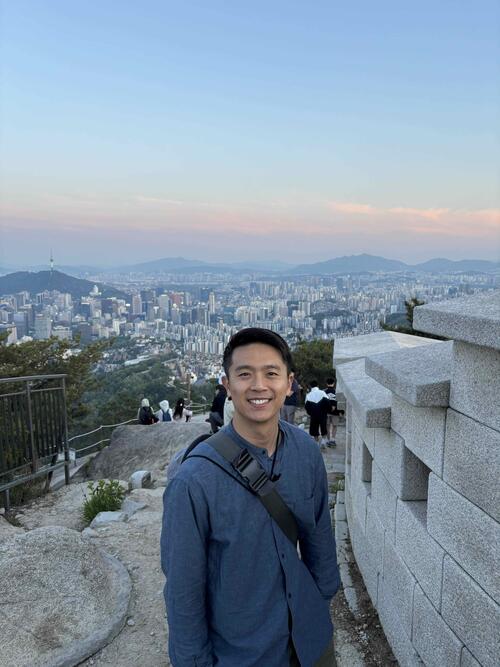
Liang in South Korea. Photo courtesy of Richard Liang.
From Research to Health Policy Impact
Over the years, Liang evolved from a mentee of Eggleston into a collaborator on projects in Korea and elsewhere. As COVID-19 disrupted health services worldwide, he joined Eggleston and a team of researchers in studying the impact of the pandemic on chronic disease care in India, China, Hong Kong, Korea, and Vietnam. Their findings showed that marginalized and rural communities in those countries were hit especially hard, with negative consequences for population health that reached far beyond those directly infected with the virus.
He and Eggleston also co-authored a study on preferences for telemedicine services among patients with diabetes and hypertension in South Korea during the early COVID-19 pandemic. The research drew the attention of the Prime Minister’s Office in Korea, which used it to guide national policy on telemedicine, a field still lacking a formal legal framework in the country.
For Liang, it was proof of the available opportunities to make tangible improvements in population health by combining rigorous research with policy engagement and drawing on insights across medicine, public health, and the social sciences.
“As a medical student researcher with experiences across different East Asian countries, I witnessed firsthand many pressing challenges in health and society, from rapidly aging populations to rising rates of chronic diseases,” he says. “To tackle these issues holistically, there is a growing need to bring together diverse perspectives, but regional collaborations in medical and public health research have been scarce, and rarer still between the biomedical and social sciences.”