Climate change
Paragraphs

Abstract


As an increasing number of California households install solar panels, the current approach to retail electricity pricing makes it harder for the state’s utilities to recover their costs. Unless policymakers change how they price grid-supplied electricity, a regulatory crisis where a declining number of less affluent customers will be asked to pay for a growing share of the costs is likely to occur.


All Publications button
1
Publication Type
Policy Briefs
Publication Date
Journal Publisher
Stanford Institute for Economic Policy Research (SIEPR)
Authors
Frank Wolak
Paragraphs

Abstract

Politicians in a number of jurisdictions with cap-and-trade markets for greenhouse gas (GHG) emissions or carbon taxes have argued that the evidence is in and the conclusion is clear: Carbon pricing doesn’t work. A number of journalists and environmental groups have jumped on the bandwagon, amplifying a misguided message.

A better understanding of how markets and price mechanisms work might change their minds — and the conversation — on the benefits of carbon pricing.


All Publications button
1
Publication Type
Policy Briefs
Publication Date
Journal Publisher
Stanford Institute for Economic Policy Research (SIEPR)
Authors
Frank Wolak
News Type
News
Date
Paragraphs

Marshall Burke, assitant professor of Earth system science and deptuy director at the Center on Food Security and the Enviroment shares his insights on how climate change is already impacting human behavior and what interventions are cost effective when it comes to combating the global change in climate.

Hero Image
dm6s9l7x4aajfea
All News button
1
Paragraphs

Crop responses to climate warming suggest that yields will decrease as growing-season temperatures increase. Deutsch et al. show that this effect may be exacerbated by insect pests (see the Perspective by Riegler). Insects already consume 5 to 20% of major grain crops. The authors' models show that for the three most important grain crops—wheat, rice, and maize—yield lost to insects will increase by 10 to 25% per degree Celsius of warming, hitting hardest in the temperate zone. These findings provide an estimate of further potential climate impacts on global food supply and a benchmark for future regional and field-specific studies of crop-pest-climate interactions.

All Publications button
1
Publication Type
Journal Articles
Publication Date
Journal Publisher
Science
Authors
Rosamond L. Naylor
Paragraphs

Solar radiation management is increasingly considered to be an option for managing global temperatures1,2, yet the economic effects of ameliorating climatic changes by scattering sunlight back to space remain largely unknown3. Although solar radiation management may increase crop yields by reducing heat stress4, the effects of concomitant changes in available sunlight have never been empirically estimated. Here we use the volcanic eruptions that inspired modern solar radiation management proposals as natural experiments to provide the first estimates, to our knowledge, of how the stratospheric sulfate aerosols created by the eruptions of El Chichón and Mount Pinatubo altered the quantity and quality of global sunlight, and how these changes in sunlight affected global crop yields. We find that the sunlight-mediated effect of stratospheric sulfate aerosols on yields is negative for both C4 (maize) and C3 (soy, rice and wheat) crops. Applying our yield model to a solar radiation management scenario based on stratospheric sulfate aerosols, we find that projected mid-twenty-first century damages due to scattering sunlight caused by solar radiation management are roughly equal in magnitude to benefits from cooling. This suggests that solar radiation management—if deployed using stratospheric sulfate aerosols similar to those emitted by the volcanic eruptions it seeks to mimic—would, on net, attenuate little of the global agricultural damage from climate change. Our approach could be extended to study the effects of solar radiation management on other global systems, such as human health or ecosystem function.

All Publications button
1
Publication Type
Journal Articles
Publication Date
Journal Publisher
Nature
Authors
Wolfram Schlenker
Authors
News Type
News
Date
Paragraphs

By comparing historical temperature and suicide data, researchers found a strong correlation between warm weather and increased suicides. They estimate climate change could lead to suicide rate increases across the U.S. and Mexico.

Suicide rates are likely to rise as the earth warms, according to new research published July 23 in Nature Climate Change. The study, led by Stanford economist Marshall Burke, finds that projected temperature increases through 2050 could lead to an additional 21,000 suicides in the United States and Mexico.

“When talking about climate change, it’s often easy to think in abstractions. But the thousands of additional suicides that are likely to occur as a result of unmitigated climate change are not just a number, they represent tragic losses for families across the country,” said Burke, assistant professor of Earth system science in the School of Earth, Energy & Environmental Sciences at Stanford.

Researchers have recognized for centuries that suicides tend to peak during warmer months. But, many factors beyond temperature also vary seasonally – such as unemployment rates or the amount of daylight – and up to this point it has been difficult to disentangle the role of temperature from other risk factors.

“Suicide is one of the leading causes of death globally, and suicide rates in the U.S. have risen dramatically over the last 15 years. So better understanding the causes of suicide is a public health priority,” Burke said.

Heat and suicide

To tease out the role of temperature from other factors, the researchers compared historical temperature and suicide data across thousands of U.S. counties and Mexican municipalities over several decades. The team also analyzed the language in over half a billion Twitter updates or tweets to further determine whether hotter temperatures affect mental well-being. They analyzed, for example, whether tweets contain language such as “lonely,” “trapped” or “suicidal” more often during hot spells.

The researchers found strong evidence that hotter weather increases both suicide rates and the use of depressive language on social media.

“Surprisingly, these effects differ very little based on how rich populations are or if they are used to warm weather,” Burke said.

For example, the effects in Texas are some of the highest in the country. Suicide rates have not declined over recent decades, even with the introduction and wide adaptation of air conditioning. If anything, the researchers say, the effect has grown stronger over time.

Effect of climate change

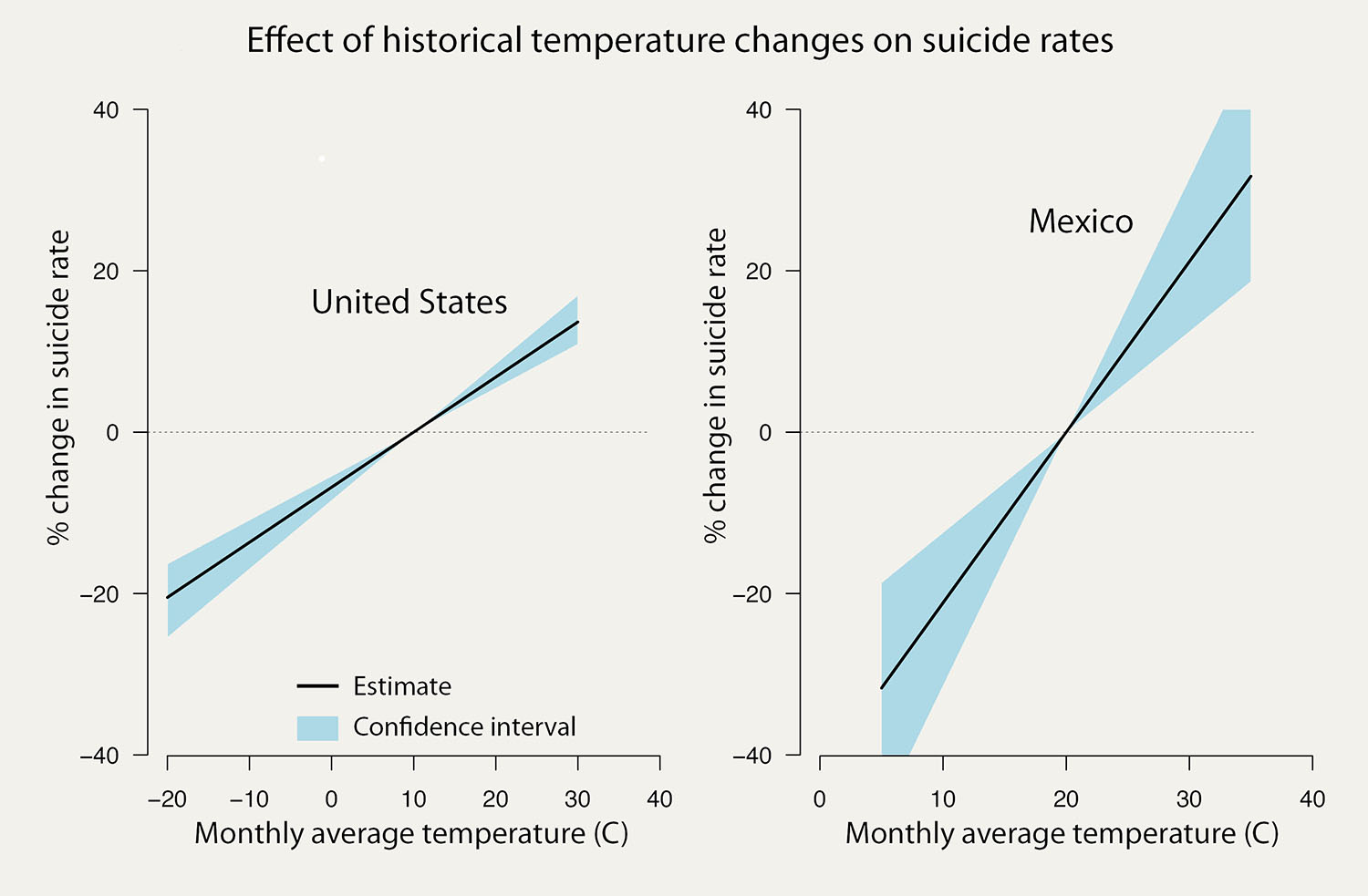
To understand how future climate change might affect suicide rates, the team used projections from global climate models. They calculate that temperature increases by 2050 could increase suicide rates by 1.4 percent in the U.S. and 2.3 percent in Mexico. These effects are roughly as large in size as the influence of economic recessions (which increase the rate) or suicide prevention programs and gun restriction laws (which decrease the rate).

Graph Showing Effects of historical temperature changes on suicide rates are shown for the U.S. and Mexico. Effects of historical temperature changes on suicide rates are shown for the U.S. and Mexico. (Image credit: Marshall Burke)
Effects of historical temperature changes on suicide rates are shown for the U.S. and Mexico. (Image credit: Marshall Burke)

“We’ve been studying the effects of warming on conflict and violence for years, finding that people fight more when it’s hot. Now we see that in addition to hurting others, some individuals hurt themselves. It appears that heat profoundly affects the human mind and how we decide to inflict harm,” said Solomon Hsiang, study co-author and associate professor at the University of California, Berkeley.

The authors stress that rising temperature and climate change should not be viewed as direct motivations for suicide. Instead, they point out that temperature and climate may increase the risk of suicide by affecting the likelihood that an individual situation leads to an attempt at self-harm.

“Hotter temperatures are clearly not the only, nor the most important, risk factor for suicide,” Burke emphasized. “But our findings suggest that warming can have a surprisingly large impact on suicide risk, and this matters for both our understanding of mental health as well as for what we should expect as temperatures continue to warm.”

Marshall Burke is also a fellow at the Center on Food Security and the EnvironmentStanford Woods Institute for the EnvironmentFreeman Spogli Institute for International Studies, and Stanford Institute for Economic Policy Research. Solomon Hsiang is also a faculty research fellow at the National Bureau of Economic Research. Other Stanford co-authors include Sanjay Basu, assistant professor of medicine, and Sam Heft-Neal, research scholar at the Stanford Center on Food Security and the Environment. Additional co-authors are from Pontificia Universidad Católica de ChileVancouver School of Economics, and the University of California, Berkeley. The research was partially supported by the Stanford Woods Institute for the Environment.

Hero Image
istock 682825852 copy iStockphoto/beer5020
All News button
1
Paragraphs

Linkages between climate and mental health are often theorized, but remain poorly quantified. In particular, it is unknown whether the rate of suicide, a leading cause of death globally, is systematically affected by climatic conditions. Using comprehensive data from multiple decades for both the United States and Mexico, we find that suicide rates rise 0.7% in US counties and 2.1% in Mexican municipalities for a 1 °C increase in monthly average temperature. This effect is similar in hotter versus cooler regions and has not diminished over time, indicating limited historical adaptation. Analysis of depressive language in > 600 million social media updates further suggests that mental well-being deteriorates during warmer periods. We project that unmitigated climate change (RCP8.5) could result in a combined 9–40 thousand additional suicides (95% confidence interval) across the United States and Mexico by 2050, representing a change in suicide rates comparable to the estimated impact of economic recessions, suicide prevention programs or gun restriction laws.

All Publications button
1
Publication Type
Journal Articles
Publication Date
Journal Publisher
Nature Climate Change
Authors
Sam Heft-Neal

Y2E2 Room 350
473 Via Ortega
Stanford, CA 94305

0
tanutama_headshot2.jpg

Vincent Tanutama is a research data analyst at the Center on Food Security and the Environment, where he supports the work of Marshall Burke on climate’s impact on economic outcomes such as workers' labor productivity and subnational economic output. Vincent's interest in the environment sprouts from investigating the distribution of rent among bureaucrats in their management of forest and oil palm resources in Indonesia, his country of origin. He has worked at the Indonesian Ministry for Economic Development Planning (Bappenas), The Abdul Latif Jameel Poverty Action Lab (JPAL Southeast Asia), Oxford Policy Management (OPM), and the United Nations Economic and Social Commission for Asia and the Pacific (UNESCAP).  He holds a B.A. in Ethics, Politics and Economics from Yale University.

Research Data Analyst
Paragraphs

Rising atmospheric carbon dioxide concentrations are anticipated to decrease the zinc and iron concentrations of crops. The associated disease burden and optimal mitigation strategies remain unknown. We sought to understand where and to what extent increasing carbon dioxide concentrations may increase the global burden of nutritional deficiencies through changes in crop nutrient concentrations, and the effects of potential mitigation strategies.

All Publications button
1
Publication Type
Journal Articles
Publication Date
Journal Publisher
PLOS Medicine
Authors
David Lobell
News Type
News
Date
Paragraphs

The rising level of carbon dioxide in the atmosphere means that crops are becoming less nutritious, and that change could lead to higher rates of malnutrition that predispose people to various diseases.

That conclusion comes from an analysis published Tuesday in the journal PLOS Medicine, which also examined how the risk could be alleviated. In the end, cutting emissions, and not public health initiatives, may be the best response, according to the paper's authors.

Research has already shown that crops like wheat and rice produce lower levels of essential nutrients when exposed to higher levels of carbon dioxide, thanks to experiments that artificially increased CO2 concentrations in agricultural fields. While plants grew bigger, they also had lower concentrations of minerals like iron and zinc.

Read the entire story at NPR

Hero Image
shutterstock 577538629
All News button
1
Subscribe to Climate change