Climate change
Paragraphs

Many international policy problems, including climate change, have been characterized as global public goods. We adopt this theoretical framework to identify the baseline determinants of individual opinion about climate policy. The model implies that support for climate action will be increasing in future benefits, their timing, and the probability that a given country's contribution will make a difference while decreasing in expected costs. Utilizing original surveys in France, Germany, the United Kingdom, and the United States, we provide evidence that expected benefits, costs, and the probability of successful provision as measured by the contribution of other nations are critical for explaining support for climate action. Notably, we find no evidence that the temporality of benefits shapes support for climate action. These results indicate that climate change may be better understood as a static rather than a dynamic public goods problem and suggest strategies for designing policies that facilitate climate cooperation.

All Publications button
1
Publication Type
Journal Articles
Publication Date
Journal Publisher
SSRN
Authors
Authors
Callista Wells
News Type
News
Date
Paragraphs

The Stanford Center at Peking University (SCPKU), the Center on Democracy, Development and the Rule of Law (CDDRL), and the APARC China Program jointly hosted a workshop on China’s Belt and Road Initiative (BRI) in early March. The workshop, held on March 2 and 3, welcomed researchers from around the world with expertise in the Initiative. Unfortunately, because of the rapidly developing health emergency related to the coronavirus, participants from not only China, but also Japan, were prevented from attending. As described by Professor Jean Oi, founding director of SCPKU and the China Program, and Professor Francis Fukuyama, director of CDDRL and the Ford Dorsey Master's in International Policy, who co-chaired the workshop, the meeting aimed to provide a global perspective on the BRI, consolidate knowledge on this opaque topic, and determine the best method and resources for future research.  

The workshop began with presentations from several of the invited guests. Dr. Atif Ansar from the University of Oxford’s Saïd Business School kicked off the first day by describing not only the tremendous opportunity that the BRI presents to developing economies, but also the serious pitfalls that often accompany colossal infrastructure projects. Pointing out the poor returns on investment of mega infrastructure projects, Ansar examined the frequest cost and schedule overruns, random disasters, and environmental degradation that outweigh the minimal benefits that they generally yield. China’s own track record from domestic infrastructure projects does little to mitigate fear of these risks, Ansar claimed. In response, he urged professional management of BRI investments, institutional reforms, and intensified deployment of technology in BRI projects. Dr. Ansar was followed by Dr. Xue Gong of the S. Rajaratnam School of International Studies, Nanyang Technological University, Singapore. Dr. Gong’s analysis centered on the extent to which China’s geopolitical motivations influenced its outward foreign direct investments (OFDI). Although her research was still in the early stages, her empirical analysis of China’s OFDI inflows into fifty BRI recipient countries from 2007-2018 nevertheless revealed that geopolitical factors often outweigh economic factors when it comes to China’s OFDI destinations.

Image
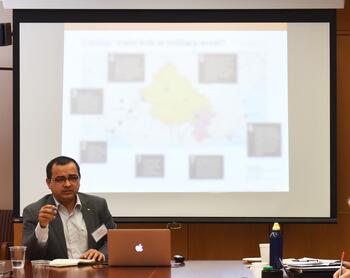
Amit Bhandari of Gateway House: Indian Council on Global Relations presents his research at the Belt and Road Workshop.
Participants then heard presentations from Amit Bhandari of Gateway House: Indian Council on Global Relations and Professor Cheng-Chwee Kuik of the National University of Malaysia. Mr. Bhandari’s talk focused on Chinese investments in India’s six neighboring countries, which tend to center more on energy rather than connectivity projects. He first found that the investments are generally not economical for the host countries because they come with high costs and high interest rates. Secondly, he argued that these projects often lacked a clear economic rationale, appearing instead to embed a geopolitical logic not always friendly to India. Professor Kuik, by contrast, provided a counterexample in his analysis of BRI projects in Southeast Asia. He described how, in Southeast Asia, host countries’ reception of the BRI has varied substantially; and how various stakeholders, including states, sub-states and other entities, have used their leverage to shape outcomes more or less favorable to themselves. Kuik’s analysis injected complexity into the often black-and-white characterizations of the BRI. He highlighted the multidimensional dynamics that play out among local and state-level players in pursuit of their goals, and in the process of BRI implementation.

Professor Curtis J. Milhaupt and Scholar-in-Residence Jeffrey Ball, both at Stanford Law School, followed with individual presentations on the role of State-Owned Enterprises (SOEs) in the BRI and the emissions impact of the BRI on climate change, respectively. Professor Milhaupt  characterized Chinese SOEs as both geopolitical and commercial actors, simultaneously charged with implementing Party policies and attaining corporate profits. Chinese SOEs are major undertakers of significant overseas BRI projects, acting not only as builders but also as investors, partners, and operators. This situation, Milhaupt asserted, carries significant risks for SOEs because these megaprojects often provide dismal returns, have high default rates, and can trigger political backlash in their localities. Milhaupt highlighted the importance of gathering firm-level data on businesses actually engaged in BRI projects to better infer geostrategic, financial, or other motivations. Jeffrey Ball turned the discussion to carbon emissions from BRI projects and presented preliminary findings from his four-country case studies. He concluded that, on aggregate, the emissions impact of the BRI is still “more brown than green.” Twenty-eight percent of global carbon emissions may be accounted for by BRI projects, Ball asserted, underscoring the importance of the BRI to the future of global climate change.

The day concluded with presentations by  Michael Bennon, Managing Director at the Stanford Global Projects Center, and Professor David M. Lampton, Oksenberg-Rohlen Fellow at the Freeman Spogli Institute for International Studies. Bennon first presented findings from two empirical case studies of BRI projects and then went on to describe how the BRI is now practically the “only game in town” for infrastructure funding for developing countries. Lengthy environmental review processes at Western multilateral banks have turned the World Bank, for example, from a lending bank into a “knowledge bank,” he argued. He also highlighted that, in general, economic returns on BRI projects for China are very poor, even though recipient countries may accrue macroeconomic benefits from these projects. Finally, Professor Lampton turned the discussion back to Southeast Asia, where China is currently undertaking massive cross-border high-speed rail projects through eight ASEAN countries. He described how each host country had varying capacity to negotiate against its giant neighbor, and how the sequential implementation of these cross-border rail projects also had varying impacts on the negotiating positions of these host countries. BRI played out differently in each country, in other words, eliciting different reactions, push-backs and negotiated terms.

The second day of the workshop was dedicated to working toward a collaborative approach to future BRI research. The group discussed the key gaps in the existing research, including how to know what China’s true intentions are, how to measure those intentions, who the main players and their interests in both China and the host countries are, and even what the BRI is, exactly. Some cautioned that high-profile projects may not be representative of the whole. Participants brainstormed about existing and future sources of data, and stressed the importance of diversifying studies and seeking empirical evidence.

Hero Image
Participants in the Belt and Road Initiative Workshop at Stanford University, March 2-3, 2020.
All News button
1
Paragraphs

Many mountainous and high‐latitude regions have experienced more precipitation as rain rather than snow due to warmer winter temperatures. Further decreases in the annual snow fraction are projected under continued global warming, with potential impacts on flood risk. Here, we quantify the size of streamflow peaks in response to both seasonal and event‐specific rain‐fraction using stream gage observations from watersheds across the western United States. Across the study watersheds, the largest rainfall‐driven streamflow peaks are >2.5 times the size of the largest snowmelt‐driven peaks. Using a panel regression analysis of individual precipitation and snowmelt events, we show that the empirical streamflow response grows approximately exponentially as the liquid precipitation input increases, with rain‐dominated runoff leading to proportionately larger streamflow increases than snowmelt or mixed rain‐and‐snow runoff. We find that the response to changes in rain percentage is largest in the wettest watersheds, where wet antecedent conditions are important for increasing runoff efficiency. Similarly, the effect of rain percentage is larger across watersheds in the Northwest and West regions compared to watersheds in the Northern Rockies and Southwest regions. Overall, as a higher percentage of precipitation falls as rain, increases in the size of rainfall‐driven and “rain‐on‐snow”‐driven floods have the potential to more than offset decreases in the size of snowmelt‐driven floods.

All Publications button
1
Publication Type
Journal Articles
Publication Date
Journal Publisher
American Geophysical Union Publications
Authors
Noah Diffenbaugh
Authors
Beth Duff-Brown
News Type
News
Date
Paragraphs

Global warming and more days of extreme heat are exacerbating the health risks of pregnancy, particularly among African-American women, according to new Stanford-led research.

The maternal mortality rate among all women in the United States is already the worst of any industrialized nation. And black women are three to four times more likely to die from pregnancy-related problems than white women.

“It is truly a crisis that in America, one of the wealthiest countries in the world, more women are dying from pregnancy or childbirth complications than in any other developed country,” said Maya Rossin-Slater, a core faculty member at Stanford Health Policy and a faculty fellow at the Stanford Institute for Economic Policy Research.

In a new working paper published by the National Bureau of Economic Research, Rossin-Slater and two other health economists underscore how little research is out there about the impact of rising temperatures on the health of mothers and their newborns.

Pregnant women, for example, are not able to regulate body temperature as efficiently as non-pregnant individuals due to the physiological changes they undergo during gestation. Heat exposure can alter blood flow in the placenta, which can weaken the placenta and lead to complications. And high heat can lead to other pregnancy complications, such as hypertension, preeclampsia and prolonged premature rupture of membranes.

“All of these issues can translate into women needing to be hospitalized during pregnancy and experiencing complications during childbirth,” wrote Rossin-Slater, an assistant professor of health research and policy at Stanford Medicine. Her co-authors are Jiyoon Kim, assistant professor of economics at Elon University, and Ajin Lee, an assistant professor of economics at Michigan State University.

The researchers said most of the discussion about maternal health focuses on the health-care system, but that other determinants of poor maternal health and racial disparities are much less understood, particularly when it comes to how the environment is impacting pregnancy.

So they launched what they believe is the first study to identify the causal effects of prenatal exposures to extreme temperatures on the health of the mothers themselves.

As the Earth Warms, So Does Exposure to Extreme Heat

Their paper focuses on an environmental factor that is becoming increasingly relevant due to the growing consensus that climate change is contributing to a gradual warming of the earth: exposure to extreme heat.

The researchers studied the effects of exposure to extreme temperatures during pregnancy on maternal and child hospitalizations, using inpatient discharge records from three U.S. states with different climates: Arizona, New York and Washington. Their data comes from the State Inpatient Databases from the Healthcare Cost and Utilization Project, including 2.7 million inpatient records of 2.7 million infants and 2.2 million mothers in those three states.

And to measure temperature exposure, the researchers obtained data from the National Oceanic and Atmospheric Administration (NOAA).

For every county in their data, the researchers calculated the average temperature for every month. Then for every given day in a specific month in that county, they looked at the historic average for how high or low that day’s temperature was relative to the overall temperature in that month in that county.

For example, a 90-degree day in Arizona in September would not be classified as extreme heat since it’s relatively common. But a 90-degree day in New York would be, since temperatures that high are much less common. They classified “extreme heat” as a given day when the temperature is more than three standard deviations (3SD) above that historic county mean.

Then, they compared the outcomes of women who are of the same race giving birth in the same county and calendar month, but in different years. These women are likely similar in terms of their demographics and socioeconomic status, but may be exposed to different temperatures during pregnancy. For example, consider a black woman giving birth in November 2011 in Queens County, New York, and a black woman giving birth in November 2012 in the same county. If there were a heat wave in Queens in the August 2012, then the latter woman is exposed to more extreme heat during pregnancy than the former. 

The economists found that each additional day with heat that is at least 3SDs — or substantially higher than the historic county-month average — during the second trimester of pregnancy increases the likelihood that a newborn is diagnosed with dehydration by .008 percentage points.

“Our results provide new estimates of the health costs of climate change and identify environmental drivers of the black-white maternal health gap,” they wrote. “Understanding the health consequences of this increase in extreme heat is critical information for discussions about the costs of climate change and the possible benefits of mitigating policies.”

The researchers found that each additional day of extreme heat exposure during pregnancy increases black women’s likelihood of hospitalization during pregnancy. Since black women on average are exposed to more extreme heat than white women — due to different residence patterns and access to mitigating technologies like air conditioning — extreme heat may contribute to exacerbating the already large gap in maternal health between black and white women.

Detrimental Consequences of Rising Temperatures

Scientists predict global average temperatures will continue to rise over the next 50 to 100 years as greenhouse gases continue to trap more heat in the Earth’s atmosphere. The U.N. Intergovernmental Panel on Climate Change last year warned that nations worldwide must quickly reduce fossil fuel use to keep the rise in global temperatures below 1.5°C by 2050. 

The panel also said the number of days with mean temperatures above 32°C in the average American county is forecasted to increase from about 1 to 43 days per year by 2070-2099.

That could have detrimental consequences for babies and mothers alike.

“Overall, our findings on infant health suggest that exposure to extreme heat during the second trimester increases the likelihood of the baby being dehydrated at the time of birth,” the researchers wrote. “This, in turn, appears to increase the likelihood of subsequent readmission to the hospital many months later for causes linked to dehydration.”

And these impacts are typically missed when researchers only measure infant health using more standard variables, such as birth weight.

The authors note dehydration is one of the leading causes of morbidity and mortality in children. Studies show that children under 5 years old who have an average of two episodes of gastroenteritis associated with dehydration per year leads to 2 to 3 million pediatric office visits and accounts for 10% of all pediatric hospital admissions in the United States. 

Experts believe black women are three- to four-times more likely to die from pregnancy-related causes due to lack of access to and the poor quality of health care, as well as clinicians not monitoring black women as closely — or actually dismissing their symptoms altogether.

“The fact that the adverse impacts on health during pregnancy are larger for black than for white mothers suggests that climate change may exacerbate the already large racial gap in maternal health,” the researchers said.

Hero Image
gettyimages thermometer Getty Images
All News button
1
Paragraphs

Truth to Power, the first-ever history of the U.S. National Intelligence Council (NIC), is told through the reflections of its eight Chairs in the period from the end of the Cold War until 2017. Co-editors Robert Hutchings and Gregory Treverton add a substantial introduction placing the NIC in its historical context going all the way back to the Board of National Estimates in the 1940s, as well as a concluding chapter that highlights key themes and judgments.

APARC Fellow Thomas Fingar, who chaired the NIC from 2005 to 2008, is one of the contributors to the book. In his chapter “New Mission, New Challenges”, Fingar discusses some of the challenges during his service with the agency. In particular, he reflects on two specific obstacles he faced during his tenure: executing the intelligence reforms drafted in the wake of 9/11, and repairing damage done to the NIC’s credibility by the failures of the National Intelligence Estimate (NIE) on Iraqi weapons of mass destruction (WMD).


All Publications button
1
Publication Type
Books
Publication Date
Authors
Thomas Fingar
Paragraphs

Efficient responses to climate change require accurate estimates of both aggregate damages and where and to whom they occur. While specific case studies and simulations have suggested that climate change disproportionately affects the poor, large-scale direct evidence of the magnitude and origins of this disparity is lacking. Similarly, evidence on aggregate damages, which is a central input into the evaluation of mitigation policy, often relies on country-level data whose accuracy has been questioned. Here we assemble longitudinal data on economic output from over 11,000 districts across 37 countries, including previously nondigitized sources in multiple languages, to assess both the aggregate and distributional impacts of warming temperatures. We find that local-level growth in aggregate output responds non-linearly to temperature across all regions, with output peaking at cooler temperatures (<10°C) than estimated in earlier country analyses and declining steeply thereafter. Long difference estimates of the impact of longer-term (decadal) trends in temperature on income are larger than estimates from an annual panel model, providing additional evidence for growth effects. Impacts of a given temperature exposure do not vary meaningfully between rich and poor regions, but exposure to damaging temperatures is much more common in poor regions. These results indicate that additional warming will exacerbate inequality, particularly across countries, and that economic development alone will be unlikely to reduce damages, as commonly hypothesized. We estimate that since 2000, warming has already cost both the US and the EU at least $4 trillion in lost output, and tropical countries are >5% poorer than they would have been without this warming.

All Publications button
1
Publication Type
Working Papers
Publication Date
Journal Publisher
National Bureau of Economic Research
Authors
Vincent Tanutama
Paragraphs

Understanding the causes of economic inequality is critical for achieving equitable economic development. To investigate whether global warming has affected the recent evolution of inequality, we combine counterfactual historical temperature trajectories from a suite of global climate models with extensively replicated empirical evidence of the relationship between historical temperature fluctuations and economic growth. Together, these allow us to generate probabilistic country-level estimates of the influence of anthropogenic climate forcing on historical economic output. We find very high likelihood that anthropogenic climate forcing has increased economic inequality between countries. For example, per capita gross domestic product (GDP) has been reduced 17–31% at the poorest four deciles of the population-weighted country-level per capita GDP distribution, yielding a ratio between the top and bottom deciles that is 25% larger than in a world without global warming. As a result, although between-country inequality has decreased over the past half century, there is ∼90% likelihood that global warming has slowed that decrease. The primary driver is the parabolic relationship between temperature and economic growth, with warming increasing growth in cool countries and decreasing growth in warm countries. Although there is uncertainty in whether historical warming has benefited some temperate, rich countries, for most poor countries there is >90% likelihood that per capita GDP is lower today than if global warming had not occurred. Thus, our results show that, in addition to not sharing equally in the direct benefits of fossil fuel use, many poor countries have been significantly harmed by the warming arising from wealthy countries’ energy consumption.

All Publications button
1
Publication Type
Journal Articles
Publication Date
Journal Publisher
Proceedings of the national Academy of Sciences of the United States of America
Authors
Noah Diffenbaugh
Paragraphs

Our Report draws attention to a complex but understudied issue: How will climate warming alter losses of major food crops to insect pests? Because empirical evidence on plant-insect-climate interactions is scarce and geographically localized, we developed a physiologically based model that incorporates strong and well-established effects of temperature on metabolic rates and on population growth rates. We acknowledged that other factors are involved, but the ones we analyzed are general, robust, and global (13).

Parmesan and colleagues argue that our model is overly simplistic and that any general model is premature. They are concerned that our model does not incorporate admittedly idiosyncratic and geographically localized aspects of plant-insect interactions. Some local effects, such as evidence that warmer winters will harm some insects but not others, were in fact evaluated in our sensitivity analyses and shown to be minor (see the Report's Supplementary Materials). Other phenomena, such as plant defenses that benefit some insects and threaten others, are relevant but are neither global nor directional. Furthermore, because Parmesan et al. present no evidence that such idiosyncratic and localized interactions will outweigh the cardinal and universally strong impacts of temperature on populations and on metabolic rates (13), their conclusion is subjective.

We agree with Parmesan and colleagues that the question of future crop losses is important and needs further study, that targeted experimental data are needed (as we wrote in our Report), and that our estimates are likely to be conservative (as we concluded, but for reasons different from theirs). However, we strongly disagree with their recommendation to give research priority to gathering localized experimental data. That strategy will only induce a substantial time lag before future crop losses can be addressed.

We draw a lesson from models projecting future climates. Those models lack the “complexity and idiosyncratic nature” of many climate processes, but by building from a few robust principles, they successfully capture the essence of climate patterns and trends (4). Similarly, we hold that the most expeditious and effective way to anticipate crop losses is to develop well-evidenced ecological models and use them to help guide targeted experimental approaches, which can subsequently guide revised ecological models. Experiments and models should be complementary, not sequential.

 
All Publications button
1
Publication Type
Journal Articles
Publication Date
Journal Publisher
Science
Authors
Rosamond L. Naylor

Y2E2
473 Via Ortega
Stanford,  California  94305 

0
1cf4c37a72b8ab44c40568c8cfa7f378.jpg

Dr. Noah Diffenbaugh is the Kara J Foundation Professor and Kimmelman Family Senior Fellow at Stanford University. He studies the climate system, including the processes by which climate change could impact agriculture, water resources, and human health. Dr. Diffenbaugh is currently Editor-in-Chief of the peer-review journal Geophysical Research Letters. He has served as a Lead Author for Working Group II of the Intergovernmental Panel on Climate Change (IPCC), and has provided testimony and scientific expertise to the White House, the Governor of California, and U.S. Congressional offices. Dr. Diffenbaugh is a recipient of the James R. Holton Award from the American Geophysical Union, a CAREER award from the National Science Foundation, and a Terman Fellowship from Stanford University. He has also been recognized as a Kavli Fellow by the U.S. National Academy of Sciences, and as a Google Science Communication Fellow.

Subscribe to Climate change