Trade
Authors
Melissa Morgan
News Type
Commentary
Date
Paragraphs

A breach of Hugging Face's servers. AI safety debates on Capitol Hill. New models like Kimi K3 coming online. There's been no shortage of headline grabbing AI news and debate in the last few weeks. To talk through these topics and how they relate to American national security, the heads of national security policy at OpenAI and Anthropic joined Colin Kahl on the World Class podcast.

Together, Sasha Baker (OpenAI) and Tarun Chabra (Anthropic) discuss how artificial intelligence is intersecting with security and defense strategies, the U.S.-China AI race, and how the risks and advantages of AI are starting to reshape national security.

Sasha Baker is the head of national security policy at OpenAI. Prior to that, she served as the acting under-secretary for policy and the deputy under-secretary of defense for policy at the Pentagon, and as the senior director for strategic planning on President Biden's National Security Council staff.

Tarun Chhabra is the head of national security policy at Anthropic. He previously served as deputy assistant to the president and coordinator for technology and national security on the National Security Council staff, where he coordinated the Biden administration's strategies for technology competition with China and technology partnerships with U.S. allies and partners. 

This episode's reading/watching recommendations are AI 2027, a project by Daniel Kokotajlo; AlphaGo, a documentary by director Greg Kohs; and "Nineteenth-Century Horse Sense" by Francis Thompson.

TRANSCRIPT:


Kahl: You're listening to World Class from the Freeman Spogli Institute for International Studies at Stanford University. I'm your host, Colin Kahl, the director of FSI.

I'm very excited to welcome my good friends and former colleagues Sasha Baker from OpenAI and Tarun Chhabra from Anthropic for what promises to be an insightful conversation on the good, the bad, and the ugly of how artificial intelligence is intersecting with national security. We're going to discuss the U.S.-China AI race, the risks AI poses to security, and the opportunities and advantages AI might generate in the national security space.

These are fantastic guests to help us grapple with these complex topics. Sasha Baker is the head of national security policy at OpenAI. Prior to that, she served as the acting under-secretary for policy and the deputy under-secretary of defense for policy at the Pentagon, and as the Senior Director for Strategic Planning on President Biden's National Security Council staff.

Tarun Chhabra is the head of national security policy at Anthropic. He previously served as deputy assistant to the president and coordinator for technology and national security on the National Security Council staff, where he coordinated the Biden administration's strategies for technology competition with China and technology partnerships with U.S. allies and partners. 

Sasha, Tarun, thanks for coming on to World Class. 

So look, I just told everybody your job titles; they’re very fancy. People know your companies. But perhaps we could start with describing what your roles at OpenAI and Anthropic actually entail.

Sasha, maybe let's start with you. What do you actually do on a daily basis?

Baker: Well first of all Colin, thanks for having me. It's fun to be here with two former colleagues. And what you didn't mention in my bio is that in my deputy role I was the chief “Colin Minder” of the Pentagon for a number of months.

What do I do? It's the most interesting job maybe I’ve ever had. I get to talk to governments all around the world every day about basically two things. The first is: what is the opportunity space look like as it relates to AI being used in the national security domain? So, how can we help governments that want to use these tools to make their populations safer? How do we help them do that?

And then the second thing that I talk to governments about is the AI risk space and the ways in which AI could up-level or enable a bad actor to do something that we really wouldn't want to see. So, I spent most of my career in government, as I think Tarun did as well. And what's fun about this job is it allows me to still be part of the same kinds of conversations that you and I would have had when we were serving at the Pentagon, but just from a totally different vantage point.

Kahl: Tarun, how about you?

Chhabra: Let me add my thanks, Colin, for having me too, and it's great to be here with Sasha and with you.

Obviously a lot of similarities in my role as well. I think of it as trying to help prepare policymakers for what we see as coming down the pike in AI development: to help them prepare and whether that's folks who are doing reporting and analysis, or whether that's folks who are making policy, or folks in Congress. We want them to know what's coming so that they're ready.

And then the second part, of course, is making sure we can get the best possible technology into their hands for national security purposes. As Sasha said, that's first and foremost with the U.S. government, but it's also, of course, with our closest allies as well.

Kahl: Great. Let's jump right into the types of conversations you're having. I'm sure as you're talking to officials around the world, there's a lot of focus on the U.S.-China AI competition. I think as many of our listeners will know, in recent weeks, Chinese AI labs have released some very impressive models, including ZAI's GLM 5.2 a few weeks back, and most recently Moonshot's Kimi K3. Obviously, people are familiar with very good models released by other Chinese labs like Deep Seek.

Tarun, maybe starting with you on this one: how would you assess the current gap between the best models coming out of Chinese AI labs and the frontier AI models coming out of labs like Anthropic and OpenAI? Is the U.S. ahead? If so, by how much? How would you assess the race right now?

Chhabra: I think our view's been pretty consistent even as new Chinese models have come out, which is, we believe that we remain six to nine months ahead of Chinese models at the frontier. And we think that really matters. So if you think about having really advanced cyber capabilities, having six to nine months with those superior capabilities really matters from a national security perspective.

That being said, we think that six to nine months owes a lot to the fact that leading Chinese AI model developers are distilling our models, those of U.S. frontier companies. And without that distillation, we could probably have a lead closer to around 18 months. And that would be even better, obviously, from a national security standpoint as well.

So that's why we've really appreciated the work that Sasha and colleagues at OpenAI have done to expose some of the distillation that is happening, why it matters, and we've really appreciated recent steps and pronouncements by the current administration to say this really is a national security issue that we need to be taking taking seriously.

It is important to note that distillation doesn't take you right up to the frontier. It keeps you behind. But the time really matters, and distillation is having a big impact.

And I think one reason why we see more attention to it right now is that the absolute capability you get from distillation matters too. And so as models become more and more advanced and more capable, even if we maintain that six to nine month gap, once you hit certain thresholds of absolute capability, that does become a concern.

Kahl: So just so that our listeners are following along. When you say distillation, really what we're talking about is a Chinese lab basically pre-trains their model. They run a big training run, but then as they're post training and fine tuning their model, they're actually engaging in a lot of queries back to say Claude or some version of GPT and using the answers from that to essentially reinforce the learning of their model and fine tune it.

Is that a fair description of distillation?

Chhabra: That's right. And as you have more capability baked into the model at that later stage of model development, the more opportunity there is for it.

I think it's important to note, however, that compute still matters. You can steal the recipe, but you still need a kitchen. So this is why we've been very vocal on the need to maintain export controls, whether it's on manufacture chips or the chips themselves, because that's a limiter. And many folks are still accessing these models for inference through APIs.

And in terms of the business model, even when the models are open, often these same companies are using their compute as a way to fund what they're doing.

It's really important to say this is industrial espionage. We've seen the playbook before where you have heavy, heavy subsidies from the Chinese state going into various industries to try to scoop up as much market share and then hold on to it for as long as possible. Except here I think it's not just a national competitiveness and economic issue, there are real national security consequences too.

Kahl: I want to come back to the export control issue in a second, but Sasha: does OpenAI generally share the assessment that the best models being produced by your company, by Anthropic, by Google Deep Mind are six to nine months ahead at the frontier? And do you share Tarun's concern about China basically being able to be a fast follower in part due to distillation?

Baker: Yeah, I think somewhere around the six month mark in terms of the lead is probably my best guess. Maybe there are just a couple points to make in addition to what you heard from Tarun.

The first is that not all distillation is bad. We distill our own models to create fine-tuned or fit-for-purpose versions of a model. And we allow developers to do some forms of distillation on our platform.

What we're really concerned about is what we would call ‘adversarial distillation’, which is unauthorized attempts to extract the capabilities of a U.S. frontier model in order to build something that then is kind of a competing system. And that is what I think has economic national security concerns.

I do want to be clear: there are a lot of very, very talented AI researchers in China, and I think it is the case that they would have very capable models even absent distillation. But this certainly does give them a leg up.

And I think the real thing to be concerned about here is actually the safety stack that comes from those distilled models. Because oftentimes they will distill a capability, but they won't export the safety stack. And so when you look at some of the models coming out of China—and this is true whether they're open or closed—you find that they are highly permissive in allowing for tasks that U.S. frontier labs spend tremendous amounts of energy trying to prevent.

And that has implications for the overall threat picture for global governance. And it's something that we oftentimes talk to them about. So that's an area where I think that there are real opportunities for us to do more together.

Because what all three frontier labs — so, Google, OpenAI, and Anthropic — have all put out assessments of where we see distillation happening on our platforms, but we can only see what's happening on our platform. And it requires that partnership with government and partnership with each other to be able to get a sense of the fuller ecosystem around this.

Kahl: All very interesting. Both you and Tarun have talked about distillation. My sense is that the fact that China is able to only be six or nine months behind . . . maybe that's partly due to distillation. 

I think there's also a view that they do have very smart engineers who have engaged in innovation in terms of algorithms. But they've also used smuggled NVIDIA chips, very powerful Blackwell chips have been used to train some of these models in illicit data centers. You also see reports of using, essentially, remote compute access from data centers in places like Malaysia to train these models.

I think a lot of that comes back to this debate about export controls, right? The first Trump administration put in export controls—very important ones—on semiconductor manufacturing equipment, especially advanced lithography equipment that are necessary to produce sub seven nanometer chips.

The Biden administration then layered on a lot more export controls on semiconductor manufacturing equipment and tools, and then also put controls on the sale of advanced chips directly to China. And yet China is still able to kind of fast follow.

So I guess the question is: does that suggest that export controls ultimately are always going to be imperfect? Maybe they're a fool's errand? They're not worth the cost? Or does it just suggest this is a game that you have to keep playing and there are ways in which the export controls need to be tightened.

And we'll start with you, Tarun. You've thought about this more than just about anybody I know.

Chhabra: I think the way to think about this is as a counterfactual. What if there had been no controls in place? Where would we be? And to the point you just made and that Sasha made earlier, China has tremendous AI talent and as you know also, they have a tremendous amount of energy that's coming online, it's something like 7 to 8x what is coming online in the United States, and that's before you get to the nuclear build out. 

But the one problem they have—and don't take it from me, take it from the leaders of China's top AI labs—is compute. That matters both for model development, but also for serving the models in terms of the race to to eat up global market share. 

And even with the latest releases over the last two weeks with GLM 5.2. and Kimi, you see already a problem in serving the level of demand to date. And again, one lab leader after another from China complains about the access to compute.

So absent the controls, could we be in a situation where China's in the lead? I think it's very possible.

Kahl: I think it's an important distinction you draw for our listeners who maybe aren't quite as in the weeds. Obviously there's all the computing resources: the data center is full of tens of thousands or hundreds of thousands or maybe even millions of leading edge AI accelerators.

But you also need compute to serve those models, that is to run inference. So anytime you pull out your smartphone and you prompt Claude or ChatGPT or Gemini, it's going back to a data center somewhere to run that query. And the more advanced the models, the more compute they require for inference to run really complex tasks. So compute obviously matters there, too.

I wonder, Sasha . . . you have all have discussed distillation as essentially IP theft. You also mentioned that these distilled models may not have the safety guardrails that some of the models that you all are producing. And we know that those are imperfect as they are.

Do you get a sense that the U.S. government is trending towards thinking about regulating Chinese models in some way? That is, either putting Chinese companies on an entity list or telling U.S. hyperscalers they can't serve Chinese models? Do you get a sense that the administration is thinking about clamping down on Chinese models because of so many of these issues?

Baker: I'm not sure we know any more about the answer to that question than you might also read in the newspaper.

What I can tell you about the conversations that we have with the U.S. government is right now we are talking with them about how do we create a mechanism of evaluating models—not just Chinese models, but American models or you know, models from around the world—so that we have a collective and common understanding of what we're even talking about here.

What are the capabilities of these models and how do you measure them? What are the safeguards around these models? How do you measure that? How do you determine what is sufficient? 

And I think that there's a really important role that the U.S. can play and U.S. leadership can play globally in helping to define some of those questions and create processes that will allow governments around the world to understand the landscape a little bit better. And then each government, I think, is going to make its own determinations about what they want to do with that information.

Kahl: One of the things that distinguishes a lot of the leading Chinese models is that many of them are open source or more precisely open weight in the sense that, you know, they can be downloaded and their parameters can be further modified or fine-tuned by users on their own servers.

And even when these models are accessed directly, at least from what I read, it seems like their API costs tend to be pretty low and their token usage tends to be very efficient.

In contrast, it seems like the best U.S. models tend to be closed weight, they're proprietary models, although there are some good open weight models that are being released by companies like NVIDIA and Thinking Machines.

But I guess the question I have, maybe Sasha starting with you is: what's the business model here for Chinese firms? They still have to spend money to train these models. They have to buy compute or lease compute to do it. They have to pay the salaries of all these really smart people who are working in these labs. And then they are essentially giving away their technologies for free or at very low pricing. How are they going to stay in business?

Baker: It's a super good question. Before I try to answer it, let me just say up front: we have always thought that there's an important role for open source models in the AI ecosystem. We have one ourselves. We think that they play a really important democratizing and innovation role. And there's room for open source and there's room for closed source models.

But having said that, there is the question about like, well, how do you actually make money off of a model if you're giving it away? And I think Tarun hinted at that answer earlier, which is that the model, in some cases, is actually not the product, right?

So if you think about some of these large Chinese labs — think of an Alibaba, for example — the model may be a loss leader that incentivizes other businesses into the Alibaba ecosystem, whether that's the cloud or what have you.

And then for some of the smaller labs, to Tarun's point, they may not charge for the model, but they can charge for the convenience, right? If you want to use the API, if you want access to their harnesses, etc. And there's a stickiness there that then gets people to kind of come back again and again.

At a nation-state level, I do think there's an element here, which is that the open weight approach is not just about having a standalone business model, it's also a distribution strategy that allows for the capture of market share. Because as I said, there's some stickiness to this. So we think competition is good; we compete, of course, across the American labs, we compete internationally. And that's healthy; it drives innovation.

We expect that businesses will evaluate and use a wide range of models. And we feel pretty good as a company about our value proposition, which is we have a model that is secure, that is reliable, that can deliver at scale, and that generates what we think is more useful work per dollar per token on a more reliable level than others that are out there.

And we feel good about that. And our customers tell us that that's something that sets OpenAI apart. So we're going to continue to try to do what we think we do best.

Kahl: Tarun, Sasha mentioned the state level, and you've thought a lot about what Beijing is trying to accomplish at the nation state level.

In one sense, open weight models are a good way to try to dominate AI diffusion, even if the capabilities of your models lag behind the frontier. But in another sense, at some point, these models are getting really, really capable, including at doing things that the Chinese Communist Party might not like, like hacking their own critical infrastructure or getting around the Great Firewall.

And I just wonder, do you think that the authorities in Beijing are going to continue to promote open weight models? Or at a certain point, do you think that they will cap the release of open weight models at a certain capability just because of a loss of control concern they might have?

Chhabra: I think it's a really, really important question, Colin.

So first, let me just say: I very much agree with Sasha. I think a healthy ecosystem is definitely going to include open models, proprietary models, but I think there are at least three factors here, and one is what you just described, which is the need for control on the part of the CCP is really insatiable. And so it is hard to see that there does not come a point where they become concerned about the capabilities that are let out into the wild, including cyber capabilities, and I think we could think about biocapabilities coming soon as well.

I think second, as Sasha knows as well as I do, that the current position of the U.S. government is for the frontier, particularly for models that are less safeguarded, they need to be in trusted access programs where you really know the actor, you trust the actor given the potential for harm. And second, it's been that where models are general access but very capable, there need to be very, very strong safeguards that the government itself now is testing. So that's kind of the U.S. government position right now.

I think the final piece of this is we shouldn't think about this totally ahistorically. We have seen this movie before where China provides very, very significant subsidies to eat up market share, not working within a free and fair market, and then come in and in a predatory way go after all competitors.

And remember, for many of the technologies where we have seen that happen before, there hasn't been necessarily a dedicated Polit Bureau session to discuss what their global strategy should be. There has been with AI, and Xi Jinping has been very clear on how he thinks about AI and how important it is as a strategic technology as well. So we should assume that the same playbook we've seen over and over again in other strategic technologies is at work here as well.

Kahl: Both you and Sasha have mentioned these safety and security issues. So maybe let's dive deeper into some of the risks that people are thinking about. 

A lot was made earlier this year about the cybersecurity capabilities when Anthropic held back the release, initially, of the Mythos model and established this Project Glasswing to kind of go shields up before the model went into the wild.

Obviously, Sasha, OpenAI's GPT 5.6 is an extraordinarily capable model at a lot of things, including coding. Some people have said, basically, that your companies have essentially created a skeleton key to the internet, that we now have models that are so good at identifying vulnerabilities and exploits that they can hack into any web browser, any legacy software.

Sasha, I read a blog post from OpenAI that said you were testing some combination of GPT-5.6 Sol and a new pre-release model in what was thought to be a closed sandbox on its cyber capabilities, and it hacked its way out of the sandbox, escaped into the open internet, got its way into a Hugging Face server and tried to steal secret information that would allow it to cheat on the evaluations you were you were doing.

So look, these models appear to be very good at hacking and are increasingly slippery. 

What is what keeps you up at night? Is it these cybersecurity risks? Tarun mentioned biosecurity risks. I've heard people talk about the possibility of maybe a Mythos moment for bio in 2026. Is it the prospect of recursive self-improvement of models that become able to improve themselves and perhaps become increasingly autonomous and out of control?

What are the AI risks that you're going around the world, Sasha, talking to leaders and enterprises that you're most concerned about?

Baker: To a certain extent, it's a little bit of all of the above. Maybe just to talk about the Hugging Face incident first. It’s an example of reward hacking, essentially, by the model. The model was given a task and it was very determined to complete that task. And because of the information that it had in its possession, it knew that the repository with the answer key existed in this Hugging Face repository.

So, it's an example of model determination, I guess, if nothing else. And of course, some very significant capability. We're doing as you would expect and taking a hard look at our security parameters around some of these models and the containers that we keep them in to make sure that we're up-leveling that as the models become more capable.

And that's maybe the one item I would put on your list that you didn't already mention, which is I think we need a new paradigm about thinking about model safety and security for agentic models that can take action on your behalf because that changes the dynamics and there are lots of ways that that could go sideways, including inadvertently. You don't have to have a nefarious intent. If a model doesn't fully understand what its boundaries and its guardrails are, it can do something that you might not expect it to do in the course of completing a task that you did expect it to to complete. And I think a little bit of that is what we're seeing here.

So that's an area where I think we, you know, we collectively as an industry need to pay more attention and a little bit more research.

Cyber and bio are challenges because they're inherently dual use, right? There are a lot of things that we would want these models to enable. We want them to be able to help create cures for diseases that currently have no solutions. We want them to help vetted cyber defenders protect their perimeters. But we have to then have a way as responsible actors In the ecosystem of trying to prevent those same capabilities from landing in the hands of somebody who might use them to do something that we as a human species, as a population, wouldn't want to see them do, right? 

So that's the reason that I think both Anthropic — and not to speak for Anthropic, Tarun—but both Anthropic and OpenAI have invested so heavily in these trusted access type programs, whether it's our trusted access or Glasswing, and in coordinating that to make sure that we really know who is using these tools and for what purpose.

Kahl: Tarun, what's your assessment of the risks? And maybe just to connect it back to our previous conversation on U.S. and and China, do you assess that the risks are different between the closed models that you're releasing and the open models that China tends to be releasing?

Chhabra: I agree with Sasha. We spend a lot of time talking about all of the above and I think the alignment issues come into sharp focus when we have incidents like what Sasha just described and credit to OpenAI for sharing that with everybody in a timely way. We've tried to do the same thing when we've seen examples of similar deceptive behavior. I think the alignment challenges are really, really important and hopefully we'll all be talking about them more collectively.

I think on the China side, this goes back to your question, Colin, about whether we're gonna hit a certain threshold for them where they are more worried about capabilities being released into the wild.

For a while you could speculate that they felt like they were more protected behind the firewall and that we were more vulnerable from a cyber perspective, and that they had demonstrated that by supporting Vol Typhoon, Self Typhoon, Name Your Typhoon, implanting into our and allied critical infrastructure. But it may well be that they hit a certain threshold where they worry about their own security, too.

I think the pure technical challenge with safeguards is, as we know, when you have access to all the weights, they can be more trivially broken. And that's something that, obviously, the U.S. government itself has been concerned about when they've asked us to kind of share with them the results of our own testing on our proprietary models, and then wanted to, I think rightly and understandably and commendably, test them themselves, too.

Kahl: Let's pause on the alignment question because both you and Sasha have raised it. How should we think about alignment? When alignment was first coming into the discourse around AI, frankly, I think a lot of people had in their minds like the science fiction image of a rogue superintelligence that basically tries to kill or enslave us all, right? HAL 9000, Skynet, the Matrix.

But I think what we could also imagine is just really, really powerful AI agents that have a lot of autonomy to complete tasks that they were given that generate outcomes that are not aligned with human interests or values. Not because the model is evil, but just because there's something about the model that we don't understand, or it's reward hacking, or it's doing something that creates a non-aligned outcome, even if the model is not doing it like intentionally to be some Bond supervillain.

Tarun, how should we think about the alignment issue?

Chhabra: Our approach to this has been first, we should be investing heavily in it, and we've been doing it from the earliest days of the company. And we have leading researchers like Chris Olah on the case, and we've been building out that team in a very, very significant way.

I think what we have tried to do is to document the earliest cases, even when they seem minor, even when they seem potentially a bit more trivial, just to document that this is emergent behavior that we ought to be worried about because to your point earlier and to Sasha's point earlier, as we see agentic activity really proliferate and as agents take on more and more consequential tasks, the ways in which you could have misalignment could really compound in terms of the consequences.

That's something that I hope we can continue to work with not only our enterprise customers, but also we've heard lots of great questions and important questions from our government colleagues about, too. They understand the ways in which they're likely to expand and use agents and have the same questions: how do they ensure that their agents are behaving in the ways that they would expect of the most professional intelligence or defense officials where the work is currently being done by humans?

Kahl: You mentioned your interactions with government officials. Let me ask a question about where you think the Trump administration is headed on this.

Early on in the second Trump administration, they were not too keen on AI safety. Although the Trump AI action plan in the summer of 2025 did have a section on what they called AI security, which noted risks around cyber and bio and some other concerns.

They appear to have become much more concerned about AI safety and security in recent months. We've obviously seen them take some actions to hold back the deployment of Anthropic’s Mythos and Fable models. They've also, I think, asked OpenAI to limit the initial deployment of GPT 5.6. A friend and colleague of ours, Dean Ball, has suggested that the Trump administration is trending towards a de facto licensing regime, essentially, on Frontier AI. 

Where do you think they're headed? Where do you think the administration is headed in terms of its requirements to do some testing and evaluation and kind of kick the tires on these things before it lets you release them into the wild. 

Sasha, maybe start with you.

Baker: I mean there's definitely an evolution happening here, and we're seeing more government officials across a broad range of agencies taking an interest in sort of understanding that the most capable AI models really do have security and safety significance.

I will say, there is a consistency, a through line here though. I have been in this role here at OpenAI now for about two years. So, I started in the last administration; I continued in this administration. And I actually am having a lot of the same conversations, right?

Because when you talk about national security risk, which is really a lot of what we mean when we say safety. It's not the only thing we mean, but a big chunk of it is cyber, bio, CBRN, things that are kind of in the national security domain, we find that governments have been paying attention to that for a while. It's certainly risen in prominence, and I think is certainly more public now than it was before. But the gist of the conversations hasn't changed all that much.

So where are they going? I'm not sure. If you know, we would love to know. But what I can say is that our feeling is like it's inherently a good thing, and we welcome the government being involved in this space.

Both Anthropic and OpenAI have had long-standing voluntary partnerships with what's now called the KC and with the UK AC, the AI Safety Institute in the UK as well, in part because we do think that governments should have a role in understanding and evaluating what these models are and what they're capable of. And we want that to be an ongoing conversation. And as the models get better, we think that that conversation probably needs to continue to become more robust as well.

So whether Congress passes a law, whether the administration takes action on its own, whether this remains voluntary, I can't predict. I can tell you that we will continue to volunteer because we think it's the right thing to do.

Kahl: Whatever one thinks of the administration's policy shift, it does strike me that you all would benefit from some degree of transparency over the standards against which your models are being judged and also some process that's predictable. So that when you go to them, you kind of can plan around, okay, it's gonna be 30 days and we have to release the model to KC and give this version to NSA, and they're going to hold it to these standards and we'll send engineers to help, blah, blah, blah, blah.

Do you have a sense that they are moving towards a more predictable process instead of standards that you all can plan around?

Chhabra: I think so. I think we can kind of already see what the emergent regime looks like based on what is being asked of us right now.

They want pre-deployment testing. They want to be able to test the safeguards when a model is generally available. They want a say in what a trusted access program looks like. We probably also all want some protocols on what happens when there's an alleged jailbreak incident, because we can imagine scenarios in which people could try to exploit fears about that, including adversaries. And so we should all have a playbook for what that looks like.

So in each of those areas, it's in everyone's interest—including the government's interest—to have a predictable and transparent regime for what this looks like so everyone can prepare because on their side, at a minimum, they want to make sure they have the right capabilities, the right people in place, the right protocols in place to kind of handle all the incoming because we we move at a pretty fast pace in putting out new models, in sharing new capabilities, and sharing what new risks look like. And so we just have to partner together on that.

And we’ve been asked for a lot of input on what this should look like. And so we're working together with them on it.

Baker: Maybe just to foot stamp one thing Tarun said, because I think it's really important, which is about capacity. There is a need for more AI expertise inside the government, across the board, but particularly when it comes to doing these kinds of technical evaluations of frontier models. And I give a lot of credit to the administration for trying some really innovative ways of bringing some of that talent into government.

But that is an area where I think we as industry can do more to lean in and support those efforts because in order for this to work well, there needs to be common understanding on both sides. And in order to have that, you really do need the technical understanding that's resident in the KC. It's resident in a couple other places in the government right now. But wouldn't it be great if we could just like 10x that?

Chhabra: If I could just add to Sasha's point here.

I think there's some really, really good news here, which is sometimes there's a misconception that in order to bring the most talented folks in government who have expertise in model development or safety or alignment, you have to kind of pay them outsized sums that are the same as what they are earning in the private sector. And it's just not true. Our colleagues at OpenAI, at Anthropic, at Google DeepMind who are developing these models are deeply mission oriented.

And if given the opportunity to work in a space where they know they will have impact, they have folks who will listen to them, you will have plenty of folks volunteering to do this work, especially now that there's a pretty strong direction to take these risks seriously.

And I found that to be true in government as well. It's not a coincidence that we were able to actually impose the initial export controls on China a month before ChatGPT was actually released, anticipating kind of where things were headed. We had the benefit of really terrific experts who wanted to serve in government because they knew they could have that kind of impact.

I think if we kind of create the right opportunities for them, we can ensure the right impact, we can really bring the talent that we need into the government.

Kahl: Well, I think all of us believe that public service is super important and that brilliant people should be motivated to serve their country to keep it safe and prosperous and free, even if they don't make the salaries they're making in the private industry.

I do wonder . . . we've mentioned Google a couple of times . . . I think Google has put forward a policy suggestion of creating basically an external auditing entity that maybe would be funded by industry, but not obviously governed by industry. It might actually be able to recruit and pay people a little bit more that would essentially work alongside government to audit your models based on your own safety criteria.

Is that something Anthropic has also talked about, and then Sasha, is this something OpenAI has talked about, or do you think their proper place for this auditing to happen is in the government?

Chhabra: Our approach, Colin, has been to basically offer what we think are a number of viable models and what you just described, we think, is one of them. There are a number of avenues that you could pursue.

I think though, whatever path you pursue with some sort of external testing capacity, the government is always going to want to have the ability internally to test when they want to and need to, and I think that's a good idea. That may be when they feel like they actually need to verify something an outside entity has tested and provided, or it may be that they have their own tests, you know, which they don't necessarily want to share with an external body, and there may be national security reasons for that as well.

Kahl: And Sasha, does Open AI have a view on whether there should be an external auditing entity in addition to the government?

Baker: I think we're interested in the idea that Google has put forward. There are obviously some mechanics of it that would need to be worked out and the details would need to be figured out. But there are other examples of how similar paradigms work in other industries, right?

You could think about like FINRA and the FCC as one model of something like that where there's sort of a government oversight body and a government accreditation body, but then there is an industry monitoring mechanism that is independent of government.

And so we're interested in this. We're talking with Google. I think Anthropic is as well, and we’ll see where those conversations go.

The other thing that we're really interested in — and I know, Tarun, we’ve talked about this in the past — is building out more of that independent evaluation ecosystem because right now we all work with a number of the same independent evaluators who have the expertise and the data sets and the benchmarks that we use to evaluate our models.

But the truth is as the models get better, we need new benchmarks because those benchmarks are getting saturated. And those are time intensive and they are data intensive and they are expertise intensive to create. And so the more that we can collectively do to up-level that outside ecosystem, whether it's in collaboration with government, whether it's industry funded—we're all members of the Frontier Model Forum, which is the sort of safety-oriented frontier model industry association—there are lots of ways that you can kind of get at this.

But I do think that there's starting to be a prevailing view that we need certainty in this process. We need to be able to scale the process as the models scale, and that we need to be in constant coordination both with each other and with the government.

Kahl: Sasha, I want to tap into your Pentagon experience for a minute.

Obviously we've talked a lot about the AI risk side of the equation in the security space, but there are a lot of national security applications for AI with a lot of upside for national security. 

We've seen in the wars in Ukraine and the Middle East AI being used. It's fusing intelligence. It's helping enable battlefield management. There are increasingly autonomous drones being used, especially in Ukraine.

I wonder again, with your former Pentagon hat on, as you look at the landscape, where do you think the most promising national security applications for frontier AI models are right now?

Baker: Thank you for your question. Because first it gives me an opportunity to pitch something that we just put out, which is a National Securities Principles document. Colin, I know you've seen this and we know some of the folks who worked on it behind the scenes.

Kahl: Yeah, it's a good document.

Baker: It was a really intensive and I think thoughtful effort across the company to try to articulate in a clear and enduring way how we approach questions of using AI models in this space. And it's a document we're pretty proud of.

So you can find it on the internet. If your listeners want to read it, you can go to our website and I encourage that.

But to answer your question. I get really jazzed about this question because I am still sort of a Pentagon nerd at heart. I would say maybe two things.

The first is there's so much low-hanging fruit that is not stuff that people are thinking about or talking about every day, and it's frankly not that controversial.

The U.S. military is the biggest bureaucracy in the world. You're talking about three million people, HR, healthcare, logistics, audit. All of these things are incredibly data intensive and places where AI tools — and frankly things that we've done in other industries — could be applied to save money, to create, to improve people's lives, to make workflows more efficient. That is the table stakes, and we should have been doing that stuff yesterday.

And then beyond that, I think the area where AI tools for me show the most promise has to do with what they're best at, right? Which is helping people process enormous amounts of data and information.

And when you think about what a modern battlefield looks like, it is essentially a data-saturated environment. And so the more that models can do to help humans . . . because you know, we talked about human in the loop and wanting to retain human judgment over high consequence decisions, including the use of force. But the ways in which models I think can be used appropriately and responsibly to help humans make better decisions faster is an area where I think we've only begun to kind of scratch the surface. And so there's a lot I think that we could do there.

When I talk about this internally and I talk about this even with governments around the world, I think it was Colin Powell who said this, right? That you never want to send your military into a fair fight. You always want to equip them with the tools that are going to allow them to have the greatest chance of coming home safely. And that is, for me, principle number one and the reason why I'm here and the reason why I feel so passionately about making sure that we have these partnerships with government in the national security space.

Kahl: Yeah. When you and I were at the Pentagon, Kath Hicks, who was the deputy secretary, used to talk about AI as a means for decision advantage, which I think is very much along the lines of what you just talked about.

Tarun, reports suggest that Claude is part of the Maven Smart System AI platform that is being used by the U.S. military in its current conflicts.

What are the biggest national security applications as you see it?

Chhabra: I think as Sasha said, there's a ton to be done at the enterprise level. And sometimes the best way to do that is just for senior military leaders to hear from leaders in enterprise about how they're using things for all of the things that Sasha described.

But I think it's a very straightforward proposition. It's see the battlefield more clearly with more precision and more breadth than the adversary. There's just incredible power in doing that.

And having your adversary know that we can do that obviously has powerful deterrence value as well because it enables far more decision support and it enables much, much much speedier action as well.

I think one of the areas where we're looking now, and I know you know OpenAI is doing the same, is where can we also try to help make up for the deficit in manufacturing, particularly for the defense innovation base. And could we use frontier models now to catch up and maybe even leapfrog Chinese capabilities if we stay at the frontier?

Already the models show a lot of promise without much fine-tuning in supporting robotics operations, for example. And we think there's a lot more that can be done here in the defense manufacturing base. So we're really excited about that work and hope all the labs can contribute to that.

Kahl: Awesome. Well, look, you know, one of my favorite podcasts is Ezra Klein's podcast. And at the end of his podcast, he always asks the guest for three books. Which I always feel intimidated by, because even as an academic, I don't have the time to read a single book most of the time. So I'm in the habit of asking our guests for a single article.

So, what is one article from each of you—Tarun we'll start with you and conclude with Sasha—one article you might recommend that our listeners check out to either understand AI or some other aspect of the world in 2026.

Tarun, any suggestions?

Chhabra: I think I have to cheat with two. I think Daniel Kokotajlo's AI 2027 work and that of his colleagues has actually aged pretty well. Maybe they actually underestimated the pace at which AI would progress. But I think kind of capturing how a government would think about some of the risks is really important to revisit today. When it came out in draft in 2024, it was a little bit far-fetched for a lot of people, but if you read it today, it doesn't look that way anymore.

The other one is, actually, since I'm talking to a Stanford professor: one of my favorite classes I took was with Gavin Wright in the history department who taught American economic history. Maybe he's still teaching a version of that course. And one of the things we read was an article by Francis Thompson, which was “Nineteenth-Century Horse Sense.” So it’s like the rise and fall of horses in the Victorian British economy.

And one of the things he documents there is with the advent of the steam engine, you actually had increased use of horses at the endpoints because you just had these isolated channels otherwise and without using more horses—so it's a version of Jevon's paradox—you actually couldn't make much use of it.

But then you hit a cliff at some point when the horses no longer became economically as efficient. But there were so many social and political choices that had to be made along the way, and so I think it's useful to think about that analogy today.

Kahl: Sasha, any farm animals on your list?

Baker: I can't say I've read the article about horses. Although it sounds interesting!

I'm going to cheat in a different direction and I'm gonna recommend a documentary.

There's a documentary called Alpha Go. It's about the deep mind model that was able to win the Go competition.

And what I think is enduring about that moment is it's really about technological surprise and how humans adapt and react to growing machine capability. And so in that sense, there's like an interesting throughline to the moment that we're in now. I'm pretty sure it's still available on Netflix. So if you're like me and you spend all day staring at words on a screen or paper and you want to see moving images instead, that's where I would start.

Kahl: My recollection—tell me if this is wrong. But Go is one of the world's oldest games. It's really, really difficult to master. It was assumed that AI could never do it. And then, Alpha Go basically, I think it was Move 37, infamously, came up with a move that so stunned the world's best Go player that he quit. And so it's like, AI doing the impossible, perhaps.

Baker: That's a good note to end on, Colin. AI doing the impossible!

Kahl: Well, thank you so much, Sasha. Thank you, Tarun, for taking time out of your busy schedules to make us all smarter about AI and national security. Good luck with everything, and we hope to have you back on the pod at some point in the future.

You've all been listening to World Class from the Freeman Spogli Institute for International Studies at Stanford University. If you like what you're hearing, please leave us a review and be sure to subscribe on Apple, Spotify, or wherever you get your podcasts to stay up to date on what's happening in the world, and why.


Read More

Colin Kahl, Director of the Freeman Spogli Institute for International Studies, on stage with panelists at the May 5 event, "World Changing Technology in 2026"
News

FSI Scholars Examine AI, Biotech Advances, and Geopolitical Competition

At a May panel discussion, experts from across the institute assessed biotechnology's resurgence, the mental health effects of social media, and growing concerns about AI-enabled bioweapons.
FSI Scholars Examine AI, Biotech Advances, and Geopolitical Competition
Eyck Freymann on the World Class podcast
Commentary

Uniting America's National Powers to Prevent a War Over Taiwan

Eyck Freymann joins Colin Kahl on the World Class podcast to explain his plan to bring America's military strength, economic leverage, technological leadership, and diplomatic influence together into a single, coherent plan to curtail China's ambitions toward Taiwan.
Uniting America's National Powers to Prevent a War Over Taiwan
A panel of men sit at a long table on a stage.
News

China's Innovative Capacity Is Underestimated — and the Stakes Are Growing

SCCEI brought together leading China scholars this spring for its third annual China Conference under the theme “Understanding ‘DeepSeek Moments’ and China’s Innovation Ecosystem.” Conversation centered around the idea that the world’s prevailing frameworks for assessing China’s innovative capacity often underestimate it, and the consequences of that blind spot are growing.
China's Innovative Capacity Is Underestimated — and the Stakes Are Growing
Hero Image
All News button
1
Subtitle

The heads of national security policy at OpenAI and Anthropic join Colin Kahl on the World Class podcast to discuss how AI is changing national security strategies and the nature of U.S.-China competition.

Date Label
Display Hero Image Wide (1320px)
No
Authors
Gi-Wook Shin
News Type
Commentary
Date
Paragraphs

This essay first appeared in The Diplomat.


For decades, South Korean strategy rested on a stable hierarchy within the international order. The alliance with the United States provided security; Seoul then managed relations with Japan, Europe, China, and regional institutions around that anchor. The alliance remains indispensable, but Seoul can no longer assume that this foundation will stay stable.

The evidence is visible in the way Washington now deals with allies. In 2025, the United States initially announced sharply differentiated “reciprocal” tariffs on South Korea, Japan, and the European Union. Negotiations later produced a 15 percent baseline framework for all three, but the process mattered as much as the final rate. Trade access, industrial investment, defense procurement, and alliance politics were increasingly handled as one bargaining package. Allies were not exempt from economic pressure because they were allies.

At the same time, Europe and Asia have been building connections that would have seemed highly ambitious a decade ago. The European Union signed security and defense partnerships with Japan and South Korea in November 2024. This year, the EU and Japan launched a defense-industry dialogue, while the EU and South Korea signed a digital trade agreement and began implementing cooperation on maritime security, cyber and hybrid threats, information manipulation, space, and the defense industry. The strategic map is becoming more networked. 

The network, however, remains uneven. Japan already has a mature economic partnership with the EU and rapidly expanding defense-industry ties. EU-South Korea relations are deepening, but they still lack the density and regular strategic consultation found in EU-Japan ties. A trilateral format would therefore do more than add another meeting: it would reduce asymmetry among three partners whose capabilities are increasingly complementary.


Sign up for APARC newsletters to receive our scholars' commentary and analysis >


The postwar hierarchy cannot simply be preserved by demanding more reassurance from Washington. Its resilience will depend on whether allies can build connective tissue among themselves before the next crisis forces them to improvise.
Gi-Wook Shin

South Korea, Japan, and the EU now face four converging challenges and pressures.

The first is demographic. South Korea is aging faster than any other OECD society; Japan’s working-age population has been shrinking for decades; and the EU’s fertility rate reached a new low in 2024. Demography is not a social-policy sidebar. It affects defense recruitment, industrial capacity, fiscal room, technological adoption, and the ability to sustain long-term commitments. Each actor is experimenting with immigration, automation, workforce policy, and welfare reform, but the security implications remain largely compartmentalized.

The second is concentrated economic dependence. None of the three can or should decouple from China. Yet South Korea’s experience after the THAAD deployment, Europe’s debates over economic coercion, and China’s export controls on gallium, germanium, and other strategic inputs have shown that interdependence can be converted into leverage. De-risking therefore requires more than national stockpiles. It requires shared risk maps, compatible certification, co-investment in alternative suppliers, and advance consultation before export controls or industrial subsidies create collateral damage among partners.

The third challenge is U.S. volatility. The United States is still the only actor capable of providing extended nuclear deterrence to South Korea and Japan, and NATO remains central to European defense. But dependence on U.S. power now coexists with uncertainty about U.S. policy. The classic alliance dilemmas of abandonment and entrapment are no longer opposite ends of a spectrum. Today, U.S. allies fear both being left out and being drawn into bargains or contingencies they did not shape.

The fourth pressure is the collapse of the old geographic separation between European and Asian security. North Korean munitions, missiles, and troops have supported Russia’s war against Ukraine. Moscow, in turn, has provided Pyongyang with political cover, economic support, and the prospect of military know-how. What happens on a European battlefield is changing the military balance on the Korean Peninsula. A regional response to a cross-regional threat is structurally inadequate.

This is the case for an EU-Japan-South Korea strategic dialogue. This framework should not be described as strategic autonomy, equidistance, or a hedge against the United States. A better term would be institutionalized hedging: risk diversification through standing, rule-based consultation among allies and partners that remain anchored in the broader U.S.-led system.

The proposal is more feasible than ever before. Japan-South Korea relations have improved significantly in recent years. The January 2026 summit in Nara and the reciprocal summit in South Korea in May demonstrated continuity across leadership changes in both countries since June 2025. The EU already has free-trade, digital, green, and security frameworks with both countries. The task is not to invent three new bilateral relationships; it is to connect existing ones.

The dialogue should begin modestly, through a Track 1.5 process involving officials, experts, and industry. Its early agenda must be concrete and specific: a joint critical minerals and supply chain risk assessment; consultation on export controls and investment screening; cooperation on AI, cyber resilience, and digital standards; exchanges on demographic and defense workforce adaptation; and shared monitoring of North Korea-Russia military cooperation. Successful projects could then be elevated to ministerial working groups.

Two design choices are essential. First, the initiative must remain function-driven. It is not NATO, not the Quad, and not an anti-China coalition. Its purpose is to reduce vulnerability without demanding economic separation. Second, it should be complementary to relations with Washington and transparent about that purpose. Horizontal networks strengthen alliances when they help allies absorb shocks, coordinate positions, and arrive at consultations with greater capacity.

For South Korea, the need is particularly acute. Japan already has the G7, a mature economic partnership with the EU, and expanding European defense ties. Seoul’s international weight has grown faster than its institutional depth. An EU-Japan-South Korea dialogue would help close that gap.

Horizontalizing alliances is not a vote of no confidence in the United States. It is insurance for the moments when the United States wavers, overreaches, or changes course. The postwar hierarchy cannot simply be preserved by demanding more reassurance from Washington. Its resilience will depend on whether allies can build connective tissue among themselves before the next crisis forces them to improvise.

Read More

Panelists gather for a group photo at the 2026 Oksenberg Conference.
News

Indo-Pacific Powers Diversify and De-Risk as Multipolar World Takes Shape

At the 2026 Oksenberg Conference, scholars and foreign policy experts assessed how Indo-Pacific powers are coping with a less predictable United States as China pursues selective leadership and Russia exploits Western divisions.
Indo-Pacific Powers Diversify and De-Risk as Multipolar World Takes Shape
People cross a road in the Akihabara district in Tokyo, Japan.
News

Japanese Public Sets High Bar for Immigrants

The latest findings of the Stanford Japan Barometer show that the Japanese public’s opinion on immigration depends heavily on applicants' skills, language ability, and country of origin, and on whether politicians emphasize economic benefits or stoke security and cultural anti-immigration rhetoric.
Japanese Public Sets High Bar for Immigrants
Hero Image
Illustration of three speech bubbles representing (from left to right) the flags of the EU, Japan, and South Korea.
Illustration made with Canva AI.
All News button
1
Subtitle

The trilateral is more feasible – and more important – than ever before.

Date Label
Display Hero Image Wide (1320px)
Yes
Authors
Noa Ronkin
News Type
News
Date
Paragraphs

As U.S. President Donald Trump prepares to visit Beijing on May 14-15, 2026, for a highly anticipated summit with President Xi Jinping, the world is watching to see if the two leaders can stabilize a U.S.-China relationship strained by disputes over trade, technological race, the future of Taiwan, and the rippling effects of the conflict with Iran.

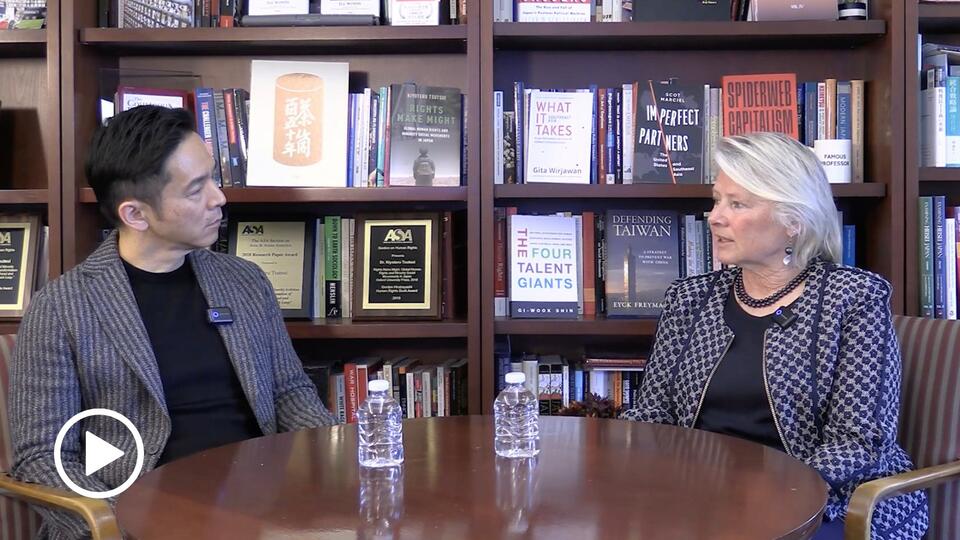
Trump’s trip to Beijing – already rescheduled once due to the conflict in the Middle East – has been described as having tremendous symbolic significance. Yet, expectations for a breakthrough on specific deliverables should remain low, according to Susan Thornton, a China expert and former U.S. diplomat. Thornton joined APARC Director Kiyoteru Tsutsui on the latest episode of the APARC Briefing video series to analyze the potential outcomes of the Trump-Xi summit and the high-stakes dynamics shaping U.S.-China relations.
 

Image
Kiyoteru Tsutsui interviews Susan Thornton.


Sign up for APARC newsletters to receive expert analysis and insights from our scholars and guests >


Symbols Over Deliverables


Thornton’s nearly three-decade career with the U.S. State Department in Eurasia and East Asia culminated in her role as Acting Assistant Secretary of State for East Asian and Pacific Affairs during the first Trump administration. She offered a pragmatic forecast for the Trump-Xi summit, arguing that its primary value lies in the act of meeting itself.

While both President Trump and President Xi are committed to keeping their dialogue, the expectations for concrete outcomes on pivotal issues in the U.S.-China bilateral relationship should be tempered, argued Thornton, who is currently a senior fellow at Yale Law School’s Paul Tsai China Center, the director of the Forum on Asia-Pacific Security at the National Committee on American Foreign Policy, and a nonresident senior fellow at the Brookings Institution. 

Whether on Taiwan or other pressing matters, China has made it clear it is not interested in a “G2 or a grand bargain” and has relatively low expectations for the list of substantive disputes between the two powers.

The Shadow of the Iran War


The ongoing conflict with Iran has added a new layer of complexity to the tense bilateral relationship. President Trump heads to Beijing after unsuccessful efforts to pressure China into helping reopen the Strait of Hormuz, while Beijing continues backing Tehran politically and potentially militarily. 

Thornton assessed that China will not allow the conflict to derail its high-level engagement with Washington, even as it officially disapproves of the U.S. intervention in the Middle East. “Keeping the U.S.-China relationship on track is much more important than having some kind of a protest signal like that,” she stated.

She suggested that Beijing may see a strategic advantage in America’s renewed focus on the Middle East. While China has made nominal peace proposals, it has not stepped up as a mediator. “It seems like they are kind of hanging back and waiting to see what will happen,” Thornton observed. She posited that, from Beijing’s perspective, a U.S. entanglement in the Middle East may serve as a useful distraction, diverting Washington’s attention and pressure away from China.

At the same time, China is hedging its bets by securing alternative energy supplies and gaining influence in regions where the conflict in the Middle East has damaged U.S. credibility.

The biggest problem for U.S. negotiators is focusing on two or three enduring and major asks of the Chinese in the trade and economic market-opening space. We've really had a hard time deciding what it is that we want from China.
Susan Thornton

Trade and Tech: A Call for a Paradigm Shift


On the economic front, Thornton drew on her deep experience in trade negotiations to critique the lack of focus in U.S. policy.

"The biggest problem for U.S. negotiators is deciding what it is that we want from China," she said. "We tend to give them a long list of revolving priorities, which [makes it easy for the] other side of the negotiating table to just fob them off and not actually commit to anything over years of negotiations.”

On the technology rivalry between the two powers, Thornton urged a shift in strategy. Rather than pursuing sweeping export controls that are often unilateral and incomplete, she advocated for a narrower, multilateral approach focused on the most sensitive technologies, combined with a greater emphasis on American innovation. AI governance is one of the areas Thornton believes could be a common ground for Washington and Beijing to align their policies.

“It's going to be very hard for the United States to contain China's technological ambitions and growth,” she said. “I don't think that we're exactly competing on the same metrics. I question how it is that we're going to be able to keep China from getting technologies that are dual-use but might be useful in some military application when these things are basically economy-wide products.”

When it comes to technological competition, "We need to try to run faster than China, not be constantly trying to trip China up and looking in the rearview mirror," Thornton urged. "I don't think that's going to bode well for the long-term development of the U.S. tech sector."

The Taiwan Flashpoint: A Longer-Term Challenge


While Taiwan remains the most dangerous flashpoint that could trigger a kinetic warfare between the United States and China, Thornton believes that the immediate risk of conflict has receded, in accordance with recent U.S. threat assessments that no longer see 2027 as a likely target date for a potential Chinese takeover of the island.

Beijing, she argued, is closely watching the domestic political situation in Taiwan and how the leadership in Taipei views U.S. reliability and support. “I think the Chinese have determined, based on both of those things they've been watching, that they can afford to wait a bit longer, see what happens.”

Thornton cautioned, however, that, even as a conflict over Taiwan may no longer pose an immediate-term threat, “it is a problem that is going to develop over the coming decade.”

Diplomacy in a Multipolar World Order 


When asked about the future of the global order, Thornton described a trend toward fragmentation. If the United States steps back from its global leadership role, it is difficult to see who else would be willing or able to shoulder the cost of providing global public goods, she said. A “thinner world order,” with the United Nations at its center, may eventually find favor with countries that can afford to pay for some of those goods, she reflected.

In a closing advice for aspiring foreign service officers, Thornton argued that the emergence of a multipolar world reinforces the need for skilled diplomacy. “As the global order changes and more countries come into the mix of the councils of politics in the world, the United States will have to lean back toward diplomacy more,” she predicted.

“We're going to need very good diplomats,” she concluded, because it will be significantly harder to be an American diplomat in a fragmented world order in which the United States is no longer the single overwhelmingly dominant power.

Read More

Kimberly Hoang and Kiyoteru Tsutsui seated in an office during a recorded podcast conversation.
News

Weaponized Corruption, Extreme Wealth, and Democratic Reordering: Insights from Asia

Speaking on the APARC Briefing video series, University of Chicago sociologist Kimberly Kay Hoang examines the architecture of global capital and how corruption discourse is transforming governance and political order in Asia and the United States.
Weaponized Corruption, Extreme Wealth, and Democratic Reordering: Insights from Asia
Panelists gather for a group photo at the 2026 Oksenberg Conference.
News

Indo-Pacific Powers Diversify and De-Risk as Multipolar World Takes Shape

At the 2026 Oksenberg Conference, scholars and foreign policy experts assessed how Indo-Pacific powers are coping with a less predictable United States as China pursues selective leadership and Russia exploits Western divisions.
Indo-Pacific Powers Diversify and De-Risk as Multipolar World Takes Shape
Portrait photo of Shibani Mahtan, winner of the 2026 Shorenstein Journalism Award.
News

Singapore-Based Investigative Journalist Shibani Mahtani Wins 2026 Shorenstein Journalism Award for Excellence in Asia-Pacific Coverage

Sponsored by Stanford University’s Shorenstein Asia-Pacific Research Center, the 25th annual Shorenstein Journalism Award honors Mahtani for her exemplary investigations into the erosion of democracy in Hong Kong and China's growing global influence.
Singapore-Based Investigative Journalist Shibani Mahtani Wins 2026 Shorenstein Journalism Award for Excellence in Asia-Pacific Coverage
Hero Image
All News button
1
Subtitle

Speaking on the latest episode of the APARC Briefing series, China expert and veteran diplomat Susan Thornton argues for managing expectations of the summit between the two presidents, rethinking the U.S.-China technology competition, and understanding Beijing’s long game on Taiwan.

Date Label
Display Hero Image Wide (1320px)
Yes
Paragraphs


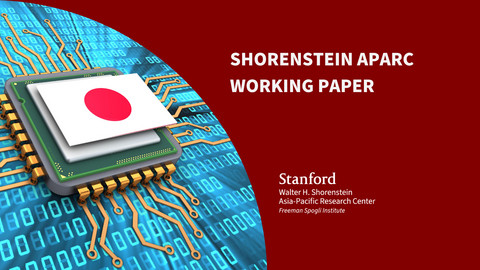
Banner showing a semiconductor with the Japanese flag superimposed on top.


Japan’s semiconductor industry, once globally dominant in DRAM during the 1980s, declined through the 1990s and 2000s due to trade friction with the United States, the rise of Korean competitors, and a failure to adapt to the fabless/foundry model. Today, Japan’s logic IC process technology lags at the 40nm node. 

The 2020 global semiconductor shortage prompted Japan to launch two major revitalization projects under the banner of economic security: TSMC Kumamoto, a joint venture producing 12–28nm logic ICs for Japan’s automotive, industrial, and consumer electronics sectors; and Rapidus, an ambitious startup targeting 2nm logic IC manufacturing by 2027. 

The paper argues that while TSMC Kumamoto meaningfully strengthens Japan’s domestic supply chain — connecting Japanese equipment and materials suppliers with downstream industries — Rapidus tells a different story. Because Japan has virtually no domestic industrial base currently using 2nm chips, Rapidus’s primary market will likely be the United States. Rather than enhancing Japan’s supply chain resilience, Rapidus effectively inserts Japan into a global advanced logic IC supply chain running from the Netherlands through Japan to the United States. Unless Japan develops industries using these chips, the Rapidus project will not directly address Japan’s economic security strategy.

All Publications button
1
Publication Type
Working Papers
Publication Date
Subtitle

The Validity of the Revitalization Strategy

Authors
Jun Akabane
Authors
George Krompacky
News Type
News
Date
Paragraphs

David Meale, former U.S. diplomat and current consultant, offered a cautiously optimistic perspective on U.S.-China relations at an APARC China Program seminar, arguing that despite significant tensions, there remains substantial room for what he calls “managed rivalry”—a relationship that is neither warm nor easy, but constructive enough for both countries to serve their populations and address global challenges. Drawing on his 33 years in the U.S. Foreign Service, he traced the evolution of U.S.-China relations over the past three decades and assessed current trajectories, bringing both diplomatic experience and fresh insights from private sector concerns to his analysis.

Three Decades of Evolving Relations
 

His entry into China-focused diplomacy came in 1995 when he was assigned to Hong Kong during the handover. During that era and through the early 2000s, U.S. policy operated under the assumption that China would gradually embrace the post-war rules-based international order shaped largely by the United States. The thinking was that China would develop a self-interest in preserving this order, becoming a constructive, if not easy, partner. This belief undergirded the strong U.S. effort to bring China into the World Trade Organization in 2001.

During his service as an Economic Officer in Taiwan in the 2000s, Meale witnessed the merging of talent from Asia and the United States that built China’s electronics manufacturing industry. Five percent of Taiwan’s workforce had moved to the mainland; there were even Shanghainese dialect programs on Taiwanese television at night for those dreaming of seeking their fortunes through cross-strait opportunities. Although there was tension with the Chen Shui-bian administration, there was a surprising amount of positivity in Taiwan about the mainland. That, of course, has now changed.

The Obama administration continued to work within the framework of bringing China into the existing international order, even as concerns grew. The approach aimed to convince China to preserve and, if necessary, shape this order, while using it to constrain China when necessary, as demonstrated by the attempt to resolve the South China Sea dispute involving the Philippines through the United Nations Convention on the Law of the Sea (UNCLOS).

The Trump administration marked a decisive shift. Meale noted that Trump openly discarded the goal of integrating China into the existing order, instead pursuing aggressive trade policies, technology restrictions, and explicit framing of China as a threat. The Chinese hoped the Biden administration would turn this around, but it instead maintained this posture, pursuing an “invest, align, compete” strategy—investing in the United States, aligning with allies, and defining the relationship as a competition.

Trump 2.0 brought “Liberation Day,” which Meale sees as the belief that the U.S. place in the world needs to be corrected; the United States is economically overextended, the trade imbalances and the associated debt cannot continue, and the supply chain vulnerability from COVID must be addressed. Tariffs were ratcheted up, and both sides imposed export controls. 

The Chinese hit back hard; Chinese officials are very proud of China’s pushback against an unchecked Trump. China’s economic growth is forecast at 5 percent this year, and the feeling from China is that it has shown the world the United States cannot push it around.

Looking ahead to 2026, Meale is optimistic. There will undoubtedly be crises that pop up: the Chinese will overreach on rare earth elements, and the United States will take an economic action that the Chinese did not plan on. Meale sees this as the “sine curve” of the U.S.-China relationship. There’s a crisis, tensions rise, there’s a response, and things eventually cool down. The curve goes up and down, but very little gets resolved.


Sign up for APARC newsletters to receive our event invitations and guest speakers' insights >


China's Current Challenges
 

China, Meale noted, effectively contains two economies: one serving approximately 400 million people who are producing world-class products with perhaps the world's best industrial ecosystem and impressive infrastructure, and another economy serving the rest of China's population, which has improved significantly over recent decades but relies heavily on informal work and the gig economy.
China faces deep structural problems, including a property sector crisis that has destroyed significant household wealth, an economy structured excessively around investment rather than consumption, youth unemployment reflecting a mismatch between graduating students and available jobs, and "involution" (neijuan, 内卷)—a race to the bottom in sectors where government incentives have driven overcapacity. China's reliance on export-led growth comes at a time when its overcapacity is increasingly unwelcome not just in developed countries but across the global South.

These challenges, Meale argues, will not result in a financial crisis or recession, but rather chronic headaches that will affect its foreign relations. Growth will continue, albeit at a slower pace, and the country will have significant work ahead to address inequality and structural imbalances.

On the question of Taiwan, Meale pushed back against predictions of imminent Chinese military action, particularly speculation about 2027 as a critical year tied to the 100th anniversary of the People's Liberation Army. He argued that, right now, one of China’s top goals is to avoid being drawn into a Taiwan conflict. China has recently purged nine senior military officials and is dealing with serious problems in its military. Five years from now, however, the situation could look quite different.

Defining End States and Finding Common Ground
 

Meale concluded by outlining what he believes each side seeks as an end state, arguing that these visions, while different, are not irreconcilable. Rather than global domination, he argued China seeks a world that works for what it calls "grand rejuvenation." This means overcoming the century of humiliation, reunifying with Taiwan, and living safely and securely on its own terms. China wants recognition as a global power, dominance in its near seas, freedom from technology containment, elimination of shipping chokepoints, access to markets, and the ability to pursue relationships with ideologically aligned countries.

The United States, meanwhile, accepts that competition with China is permanent but seeks a predictable China. U.S. goals include protecting advanced technology where it has an advantage, avoiding supply chain vulnerabilities, shaping Beijing's choices without attempting to control them, maintaining the Taiwan status quo until it evolves in a mutually and naturally agreed way, and ensuring fair trade to address what it sees as a stacked deck in current trade relationships. The United States also wants to prevent China from enabling adversaries, as seen in Chinese firms rebuilding Russia's military-industrial complex while maintaining nominal neutrality on Ukraine.

These end states, Meale acknowledged, collide in many ways but not in absolute ways. He sees substantial room for leader-driven, managed rivalry that can function constructively. This rivalry will not be easy or warm, but it can allow both countries to serve their populations while cooperating where global interests align.
 

Key Takeaways  
 

  • The “integrated China” assumption is over. U.S. policy no longer aims to bring China into the existing international order, marking a fundamental shift from decades of engagement strategy.
  • China's economy faces structural challenges, not a crisis. China will continue to grow, but must address inequality, overcapacity, and wealth destruction from the property crisis.
  • Taiwan timing matters more to Beijing than deadlines. China seeks to control when and how the Taiwan issue is resolved, preferring not to be forced into premature action.
  • Managed rivalry is possible. Despite significant tensions and incompatible elements of each side's goals, there remains space for constructive competition. While the relationship between the world's two largest economies will stay competitive and often contentious, it need not become catastrophic.
     

Read More

Lawmakers and members of the South Korea's main opposition Democratic Party (DP) demonstrate against the country's president at the National Assembly on December 04, 2024 in Seoul, South Korea.
Commentary

South Korea’s Fractured Democracy: One Year After Martial Law

The country’s political polarization has metastasized. What can be done?
South Korea’s Fractured Democracy: One Year After Martial Law
Japanese Prime Minister Sanae Takaichi delivers remarks while seated in front of the Japanese flag.
Commentary

Japan's Prime Minister Takaichi: A First-Month Report Card

Stanford sociologist Kiyoteru Tsutsui, director of the Shorenstein Asia-Pacific Research Center and the Japan Program, evaluates Japanese Prime Minister Sanae Takaichi's first month in office.
Japan's Prime Minister Takaichi: A First-Month Report Card
On an auditorium stage, panelists discuss the documentary 'A Chip Odyssey.'
News

‘A Chip Odyssey’ Illuminates the Human Stories Behind Taiwan’s Semiconductor Dominance

A screening and discussion of the documentary 'A Chip Odyssey' underscored how Taiwan's semiconductor ascent was shaped by a collective mission, collaboration, and shared purpose, and why this matters for a world increasingly reliant on chips.
‘A Chip Odyssey’ Illuminates the Human Stories Behind Taiwan’s Semiconductor Dominance
Hero Image
CP_David_Meale
All News button
1
Subtitle

Eurasia Group’s David Meale, a former Deputy Chief of Mission at the U.S. Embassy in Beijing, reflects on the last 30 years and describes how the two economic superpowers can maintain an uneasy coexistence.

Date Label
Authors
Noa Ronkin
News Type
News
Date
Paragraphs

At a seminar hosted by APARC’s Taiwan Program, National Chengchi University’s Hsiao-Hui Lee, a professor of management information systems, dissected how global trade shocks propagate not only through trade flows of physical goods but also through financial flows, particularly trade credit, within supply chain networks. Against the backdrop of shifting U.S. trade policies and geopolitical upheavals, Lee's research offers insights for policymakers and businesses navigating the complex landscape of global trade and supply chain resilience. Through a Taiwan lens, her analysis underscores the importance of managing not just the logistical but also the financial linkages of global supply chain networks.

Global trade is interconnected through global supply chains via direct and indirect trade. Geopolitical events, natural disasters, and unexpected shocks disrupt these connections, creating ripple effects across global supply chain networks. Events ranging from the 2008 financial crisis to the 2011 East Japan earthquake and tsunami, the COVID-19 pandemic, and, more recently, U.S.-China trade tensions, the Russia-Ukraine war, and the Trump administration’s executive orders all accentuated vulnerabilities within these interconnected frameworks.

Lee’s main point is that shocks in an industry or a region can propagate across supply chains not only through transactions but also via the movement of trade credit, which allows firms to buy inventory and delay payments. For suppliers, this mechanism provides a financial buffer that helps maintain liquidity and manage cash flows. Indeed, trade finance supports 80 to 90 percent of global trade, according to the World Trade Organization.

Yet, trade credit comes with its own set of risks that may amplify financial stress across supply chain networks and propagate shocks. And if one firm defaults, then the impact can cascade through the supply chain, affecting multiple sectors. Trade creditors experience substantial losses when debtors fail, and these losses can increase the bankruptcy risk for suppliers, demonstrating how financial stress can spread through trade credit links. For example, during the 2008 financial crisis, a significant contraction in trade finance availability led to a 12% decline in international trade. This shortage of financing disrupted global supply chains, causing widespread economic contraction. 

Supply chain resilience requires managing financing networks — credit insurance, supplier finance, and transparency — not just logistics.
Hsiao-Hui Lee

Sign up for APARC newsletters to receive our event invitations and guest speakers' insights >


Political leaders aiming to secure supply chains have touted risk-mitigating strategies such as reshoring (repatriating raw material production and manufacturing), nearshoring (moving far-flung sourcing points to closer countries and regions), and friendshoring (relocating supply chains to allied countries where the risk of disruption from political chaos is low). Each strategy offers unique potential benefits, like reduced transportation costs or enhanced political stability. For instance, the U.S. CHIPS Act aims to bolster domestic semiconductor manufacturing, while the United States-Mexico-Canada Agreement (USMCA) helped facilitate duty-free access to U.S. markets.

Lee’s research, however, is a cautionary examination of the trade credit interdependence inherent in these common outsourcing strategies and their influence on shock propagation. She argues that, while relocating production closer to home or to friendly nations is beneficial, the politics of relocation often overlook the financial linkage risks introduced by extensive trade credit networks. Taiwan’s manufacturing ecosystem – concentrated around semiconductors, electronics, and precision components – is particularly illustrative of this complexity, with high levels of inter-firm trade credit amplifying liquidity stresses during trade shocks.

Using empirical models, Lee’s analysis shows that in-country shock propagation tends to be stronger than cross-border transmission. Yet, the intricate web of cross-border trade credits means that even with reshoring or nearshoring strategies, Taiwanese suppliers, for example, remain financially interlinked with foreign customers, like Apple and Nvidia. Therefore, demand shocks in one region may still create repercussions in Taiwan's local cash flow chains.

Lee suggests that implementing robust risk management practices – such as credit insurance, diversification of credit sources, and realignment of supply chains – can help mitigate these risks.
 

Key Takeaways: Global Trade and Credit-Driven Co-Movement


For Global Stakeholders:
 

  1. The Importance of Credit Chain Interdependence: Trade credit chain linkage risks can propagate global trade shocks.
  2. Pros and Cons of Outsourcing Strategies: While reshoring, nearshoring, and friendshoring have clear benefits, each also presents unique challenges and risks, particularly due to trade-credit interdependencies.
  3. Complexity in Trade-Credit Networks: Extensive trade credit links represent an often-overlooked risk in corporate relocation decisions.
  4. Supply Chain Resilience Strategies: Supply chain resilience requires managing not only logistics but also financing networks.


For Taiwan:
 

  1. Taiwan’s Manufacturing Ecosystem Dynamics: The island nation’s manufacturing sectors heavily depend on inter-firm trade credit networks, which can amplify liquidity stresses during shocks.
  2. Financial Ties Remain Despite Reshoring Efforts: Even with U.S. reshoring or nearshoring efforts, Taiwanese suppliers remain financially tied to foreign customers, making them susceptible to demand shocks abroad.
  3. Financial Flexibility for Stability: Firms such as TSMC, Hon Hai, and Delta Electronics leverage factoring and receivables sales to stabilize working capital, indicating that financial flexibility is key to resilience.
  4. Enhancing Economic Fortitude: Expanding supply-chain finance platforms and trade-credit insurance could boost Taiwan’s resilience amid export bans or geopolitical disruptions.

Read More

Weitseng Chen presents at a lectern.
News

Reassessing the Rule of Law: How Legal Modernization Can Lead to Authoritarianism

Weitseng Chen of the National University of Singapore explores how legal modernization can entrench rather than erode authoritarian power, an unexpected result of a legal mechanism that underpins functioning democracies.
Reassessing the Rule of Law: How Legal Modernization Can Lead to Authoritarianism
Prime Minister Takaichi speaks in front of reporters during her first press conference as prime minister at the Prime Minister's Residence on 21 October 2025.
News

What to Know About Sanae Takaichi, Japan’s First Female Prime Minister, and Her Agenda

Stanford sociologist Kiyoteru Tsutsui, director of the Shorenstein Asia-Pacific Research Center and the Japan Program, explains the path to power of Japan’s first female prime minister and what her leadership means for the country's future.
What to Know About Sanae Takaichi, Japan’s First Female Prime Minister, and Her Agenda
Gita Wirjawan presents his book What It Takes - Southeast Asia
News

How Southeast Asia Can Become a Leader on the World Stage

In his new book, What It Takes: Southeast Asia, Gita Wirjawan examines how Southeast Asia can unlock its untapped potential by leveraging its massive economic and human scale to claim its place on the global stage.
How Southeast Asia Can Become a Leader on the World Stage
Hero Image
Hsiao-Hui Lee presents at a lectern.
All News button
1
Subtitle

Taiwan’s experience reveals that trade credit linkages are a substantial transmission channel for global trade shocks, according to research by National Chengchi University’s Hsiao-Hui Lee, an expert in supply chain management. Her work highlights the need to include financial network management in strategies for supply chain resilience.

Date Label
Authors
Curtis J. Milhaupt
News Type
Blogs
Date
Paragraphs

This post, first published by the Harvard Law School Forum on Corporate Governance, is based on the co-authors' recent European Corporate Governance Institute - Law Working Paper No. 872/2025.


Introduction


Conventional accounts of the rivalry among global stock exchanges emphasize regulatory competition to attract initial public offerings (IPOs). This framing – often cast as a “race to the bottom” – suggests that exchanges compete primarily by lowering governance and disclosure standards to secure marquee listings. In a new paper, we argue that this view is both incomplete and outdated. By examining stock exchanges through the broader lens of political economy, we demonstrate that IPO competition represents only a fraction of the forces shaping today’s capital markets. Exchanges have become strategic assets at the intersection of commercial imperatives, national economic goals, and geopolitical rivalry.

Our analysis makes two central contributions. First, we show that the importance of IPO competition to exchanges, and the regulatory arbitrage thought to propel it, is often overstated. While competition, particularly between New York and non-US exchanges, can be fierce, IPOs generate only marginal revenues for exchanges in comparison to revenues from data and analytics, and private capital is an increasingly important alternative source of finance. Second, we bring nation states into the picture. Governments are active participants in global stock exchange competition, with strong economic, policy, and geopolitical stakes in the health of their domestic or regional exchanges. We highlight how exchanges increasingly function as mechanisms of policy transmission, instruments of financial sovereignty, and geopolitical screening devices – sometimes at the expense of their economic functions.
 

The Shein Listing Saga as a Microcosm


The recent saga of fast-fashion retailer Shein illustrates the new dynamics. After confidentially filing for a New York listing in 2023, Shein encountered pushback from U.S. lawmakers over alleged use of forced labor in its supply chain. It then turned to the London Stock Exchange, which was eager to obtain a high-profile listing despite the allegations, only to face heightened scrutiny from U.K. advocacy groups. Ultimately, Beijing itself blocked the company’s foreign listing, possibly fearing the enhanced scrutiny it would entail, forcing Shein to pursue a Hong Kong listing instead.

This episode highlights several themes we explore in the paper: the enduring prestige of high-profile IPOs and the willingness of regulators to adjust standards to obtain them; and, crucially, the role of governments in shaping access to capital markets in light of geopolitical tensions and policies unrelated to investor protection.
 

Limits of IPO Competition


Stock exchanges have long competed for listings, including by lowering listing or governance standards, but this rivalry is subject to important limitations and caveats:

  1. Demutualization and Profit Motives: Most exchanges have demutualized and now operate as profit-oriented shareholder-owned corporations. Listing fees today account for only a small fraction of exchange revenues. For example, listing fees on the London Stock Exchange account for just 3% of its parent company’s income; for the NYSE, the figure is around 10%.
     
  2. Regulatory Competition and Governance Standards: Exchanges have historically relaxed rules to secure listings. The London Stock Exchange diluted its rules on related-party transactions in an unsuccessful attempt to attract Saudi Aramco. London, Hong Kong, and Singapore revised their listing rules to allow multiple-voting shares to compete with U.S. exchanges. While these episodes raise familiar race to the top/bottom questions, the importance of regulatory arbitrage in the global capital markets today can be overstated, in part for reasons explained in points 3 and 4 below.
     
  3. Economic Motivations Beyond Regulation: Many firms choose the NYSE or Nasdaq not principally for regulatory reasons but for liquidity, visibility, and greater opportunities in areas such as M&A in the huge U.S. market. To name a few recent examples, Flutter Entertainment, CRH, Wise, Spotify, and Arm all explained that they listed in New York for these reasons.
     
  4. Competition from Private Capital: Perhaps the most important caveat is that exchanges increasingly compete less with one another than with private markets. Assets under management in private equity, venture capital, and private credit have ballooned from $9.7 trillion in 2012 to over $24 trillion by 2023. Firms avoid public markets to sidestep disclosure burdens, compliance costs, and shareholder activism. Since 2022, take-private deals have outpaced IPOs more than threefold.
     

Taken together, these trends suggest that the long-running narrative on regulatory competition for IPOs misses major contemporary market dynamics.
 

States as Stakeholders


If capital is global, why should governments be deeply invested in the fate of their domestic exchanges? We identify three reasons.

  1. Direct and Indirect Economic Benefits: Domestic exchanges generate tax revenues, create jobs, and facilitate capital formation. They provide a platform for small and medium-sized enterprises less likely to seek foreign listings, thereby stimulating domestic firm growth and innovation.
     
  2. Preventing Corporate Exodus: Policymakers fear that firms listing abroad may eventually relocate headquarters, talent, and tax bases overseas. European reports, for example, have warned of a “technology drain” as innovative firms list on U.S. markets. Domestic exchanges thus serve as anchors against corporate flight.
     
  3. Home Bias: Evidence shows that investors retain a preference for domestically listed companies. Governments reinforce this tendency by encouraging pension funds and other institutional investors to allocate assets domestically.
     

Exchanges as Geopolitical Instruments


Perhaps the most profound shift lies in the politicization of public capital markets. Exchanges now function not simply as neutral financing infrastructure but as levers of economic statecraft and policy transmission. Some examples:

  1. United States–China Rivalry: The Holding Foreign Companies Accountable Act, Ant Group’s aborted IPO, Didi’s delisting from the NYSE, and heightened scrutiny of Chinese firms on U.S. markets illustrate how capital markets are enmeshed in national security, data security, and geopolitical concerns.
     
  2. Europe: The EU’s Capital Markets Union, recently reframed as the “Savings and Investment Union,” is now explicitly tied to European economic sovereignty and geopolitical positioning. Separately, ESG regulations such as the CSRD and the Supply Chain Directive extend Europe’s normative agenda globally by imposing climate and human rights obligations on listed firms.
     
  3. Other Jurisdictions increasingly view exchanges as state assets. For example, Singapore has called relisting on the SGX a “national duty.” India frames domestic listings under the banner of self-reliance. Israel highlights its stock exchange as a force for resilience in wartime. Japan has used the TSE as a tool to implement corporate governance reforms.
     

In short, capital market policies and listing decisions now intersect with areas of government interest well beyond economics, including national security, human rights, financial sovereignty, and industrial policy. But efforts to harness exchanges for strategic ends risks fragmenting global markets and undermining their economic role.
 

Conclusion


Global stock exchanges today operate in a transformed environment. They remain commercial enterprises competing for listings, but they are also strategic assets deeply embedded in state policy and geopolitical rivalry. High-profile IPO competition, though still active, is only part of the story. As private capital expands and governments assert new forms of control, exchanges have been repurposed as instruments of financial sovereignty and normative policy enforcement.


About the Authors

Curtis J. Milhaupt is the William F. Baxter – Visa International Professor of Law at Stanford Law School, Senior Fellow, by courtesy, at the Freeman Spogli Institute for International Studies at Stanford University, and Fellow at the European Corporate Governance Institute. Wolf-Georg Ringe is Professor of Law and Finance at the University of Hamburg, Visiting Professor at the University of Oxford, and Research Member at the European Corporate Governance Institute.

Read More

U.S. President Donald Trump (L) listens as Nvidia CEO Jensen Huang speaks in the Cross Hall of the White House during an event on "Investing in America" on April 30, 2025 in Washington, DC.
Commentary

Lawless State Capitalism Is No Answer to China’s Rise

Invoking national security and the economic rivalry with China, the Trump administration is pursuing legally dubious interventions and control of private industry, with potentially high costs for US dynamism. Like the panic over Japan's rise in the 1980s, the administration's response is unwarranted and counterproductive.
Lawless State Capitalism Is No Answer to China’s Rise
Stanford Next Asia Policy Lab team members and invited discussants during a roundtable discussion in a conference room.
News

Stanford Next Asia Policy Lab Probes Political Messaging and Public Attitudes in U.S.-China Rivalry

At a recent conference, lab members presented data-driven, policy-relevant insights into rival-making in U.S.-China relations.
Stanford Next Asia Policy Lab Probes Political Messaging and Public Attitudes in U.S.-China Rivalry
Colonade at Stanford Main Quad with text: call for applications for APARC's 2026-28 fellowships.
News

Applications Open for 2026-2028 Fellowships at Stanford's Asia-Pacific Research Center

The center offers multiple fellowships in Asian studies to begin in fall quarter 2026. These include a postdoctoral fellowship on political, economic, or social change in the Asia-Pacific region, postdoctoral fellowships focused on Asia health policy and contemporary Japan, postdoctoral fellowships and visiting fellow positions with the Stanford Next Asia Policy Lab, and a visiting fellow position on contemporary Taiwan.
Applications Open for 2026-2028 Fellowships at Stanford's Asia-Pacific Research Center
Hero Image
Traders work on the floor of the New York Stock Exchange (NYSE).
Traders work on the floor of the New York Stock Exchange (NYSE). | Spencer Platt/ Getty Images
All News button
1
Subtitle

Global stock exchanges today operate in a transformed environment. They remain commercial enterprises competing for listings, but they are also strategic assets deeply embedded in state policy and geopolitical rivalry.

Date Label
Display Hero Image Wide (1320px)
No
Authors
Heather Rahimi
News Type
News
Date
Paragraphs

Against a backdrop of heightened geopolitical tension and economic uncertainty, Sean Stein, President of the U.S.-China Business Council, delivered a keynote address on May 14 during the second annual China Conference organized by the Stanford Center on China’s Economy and Institutions (SCCEI).

Speaking to an audience of faculty, students, and policy experts, Stein offered a grounded and pragmatic assessment of the evolving U.S.-China relationship, emphasizing the enduring importance of commercial engagement and the need for clear-eyed policymaking in a time of strategic rivalry.

Costly Miscalculations
Stein began by highlighting how U.S. policy makers have misjudged the resilience and retaliatory capacity of the Chinese economy. In particular, he argued that in response to the minimal impact China’s retaliatory efforts had on the U.S. economy during Trump’s first administration, the U.S. underestimated both China’s pain threshold and the pain China can inflict on the U.S. economy, while also overestimating its own leverage. The result, he noted, was an awkward U.S. climbdown on tariffs and significant disruption to the U.S. economy without meaningful strategic gain.

“We’re getting all of the downsides of tariffs and trade wars without getting any of the upside,” Stein remarked. Many U.S.-based companies, faced with soaring costs for component parts sourced from China, were forced to move production to third countries—decisions that are likely irreversible. Stein questioned, “Is some of the damage permanent? Yeah…sometimes, when some manufacturing leaves, it doesn't come back,” which is the exact opposite of what the Trump administration hoped would result from the newly imposed tariffs.

We’re getting all of the downsides of tariffs and trade wars without getting any of the upside.
Sean Stein

Urgent Rethink Needed on U.S-China Trade and Technological Competition
Stein also pushed back against long-held assumptions that the U.S. market alone can dictate global business trends. The notion that “the only market that matters is the U.S. market” no longer holds, noting that Chinese consumers and innovation ecosystems now play a decisive role in shaping product development and global supply chains. He noted that European businesses have expressed a radical shift in strategy, they said, “we've been in China for Asia, in North America, for the Americas…We're now going from that model to what could very well become an, ‘in China for China and the world minus one.’ And the minus one is, of course, the U.S. market.”

On the technology front, he offered a candid evaluation of the U.S.-China competition. Stein reflected on the current state of artificial intelligence in China and the U.S., he said, “ at the end of the day it's not who has the best model; a good enough model is a good enough model, where it really makes a difference is in the application…and I see China racing ahead in the application of AI.” 

At the end of the day it's not who has the best model, where it really makes a difference is in the application. I see China racing ahead in the application of AI.
Sean Stein

Know Your Competitor
Stein concluded with a call for more measured and constructive engagement. He urged both Washington and Beijing to establish clearer rules of the road, maintain open lines of communication, and invest in policy solutions that reduce uncertainty rather than amplify it.

Stein’s keynote offered a business-grounded counterpoint to prevailing narratives of decoupling and confrontation. His insights reinforced the importance of understanding the full complexity of economic interdependence, as well as China’s capacity for global market disruption, and the costs of miscalculation. As part of the broader SCCEI China Conference, his remarks served as a reminder that if America does not properly understand its competitor, efforts to stay ahead may well backfire and erode U.S. strength and global standing. 


A full recording of Sean Stein’s keynote is available on YouTube and below.

Read More

Elizabeth Economy speaks during a Fireside Chat.
News

Strategic Shifts: Understanding China’s Global Ambitions and U.S.-China Dynamics with Elizabeth Economy

At the 2025 SCCEI China Conference, Elizabeth Economy, Hargrove Senior Fellow at the Hoover Institution, outlined China’s ambitious bid to reshape the global order—and urged the U.S. to respond with vision, not just rivalry, during a Fireside Chat with Professor Hongbin Li, Senior Fellow and SCCEI Faculty Co-Director.
Strategic Shifts: Understanding China’s Global Ambitions and U.S.-China Dynamics with Elizabeth Economy
Panelists speak during a session at the 2025 SCCEI China Conference.
News

Conference Explores China’s Strategic Posture in a Rapidly Changing Global Economy

The second annual SCCEI China Conference, held at Stanford University on May 14, brought together leading scholars and policy experts. Panelists offered a candid, multifaceted view of China's global economic position, exploring its technological prowess, industrial diplomacy, and the increasingly complex global responses to its expanding influence.
Conference Explores China’s Strategic Posture in a Rapidly Changing Global Economy
Craig Allen speaks at SCCEI 2024 conference
News

Silicon Showdown: Craig Allen Unpacks the Competition for Technology Leadership between the U.S. and China

Craig Allen, the President of the U.S.-China Business Council, spoke on the evolving dynamics of technological leadership between the U.S. and China and their implications for the rest of the world.
Silicon Showdown: Craig Allen Unpacks the Competition for Technology Leadership between the U.S. and China
Hero Image
Sean Stein addresses the audience during a keynote speech with Scott Rozelle seated at a table as moderator.
Rod Searcey
All News button
1
Subtitle

In a keynote address during the 2025 SCCEI China Conference, U.S.-China Business Council President Sean Stein cautioned that strategic miscalculations and trade tensions have left the U.S. economy with lasting setbacks—and few clear gains.

Date Label
Authors
Michael Breger
News Type
News
Date
Paragraphs

As the global geopolitical landscape shifts and the United States redefines its role on the world stage, Japan, its closest ally in the Asia-Pacific, faces mounting expectations and emerging opportunities. In recognition of this critical juncture, APARC’s Japan Program and the United States-Japan Foundation convened a timely symposium at Stanford University, Recalibrating U.S.-Japan Collaboration in a Time of Tumult. The event brought together scholars, policymakers, and practitioners to explore how U.S.-Japan relations are adapting to new global realities. Over the course of five thematic sessions, participants engaged in a dialogue that spanned foreign policy, international trade, social governance, civil society, and even the cultural diplomacy of baseball.

📄  Get the event highlights below

📹  Watch the symposium sessions on our YouTube channel >

🔗  Read Nikkei coverage of the event >

📧  Sign up for APARC newsletters to receive our event invitations and guest speaker insights >

The opening session, “Global Democracy, Foreign Aid, and Regional Security: As the U.S. Pulls Back, Will Tokyo Step Up?,” featured Larry Diamond, Mosbacher Senior Fellow of Global Democracy at Stanford’s Freeman Spogli Institute, Shinichi Kitaoka, former Japanese ambassador to the United Nations and past president of the Japan International Cooperation Agency (JICA), along with APARC Japan Program Director Kiyoteru Tsutsui. Together, they examined Japan’s potential to assume a greater leadership role in defending democratic norms and providing regional public goods in an era of American retrenchment. The discussion underscored both Japan’s growing capacity and its constitutional and cultural constraints.

In the second session, “How Tariffs and Trade Wars are Reshaping the Indo-Pacific,” Wendy Cutler of the Asia Society Policy Institute and Peter Wonacott of the Stanford Doerr School of Sustainability reflected on the disruptions facing global trade. Drawing on their experience in economic policy and journalism, respectively, they traced how protectionist policies and decoupling strategies are altering regional supply chains. Their analysis emphasized the importance of maintaining open trade flows while also reinforcing economic resilience across the Indo-Pacific.

The third session, “The Future of DEI, ESG, SDGs: Will Japan Follow the U.S. or Stay the Course?,” focused on evolving norms around corporate and social governance. Keiko Tashiro, deputy president at Daiwa Securities Group, joined Gayle Peterson of Oxford’s Saïd Business School and Stanford sociologist Patricia Bromley to evaluate whether Japan’s institutions will align with American trends or continue along a distinct trajectory. Panelists discussed Japan’s historically unique approach to equity and sustainability, noting the domestic implementation of global frameworks such as the UN-sanctioned Sustainable Development Goals.

The fourth session, “Redefining the Relationship Through Civil Society: Burden Sharing, Knowledge Sharing, Picking up the Slack,” included remarks from Mike Berkowitz of the Democracy Funders Network, Laura Deal Lacey of the Milken Institute, and Jacob M. Schlesinger, president and CEO of the United States-Japan Foundation, who explored how non-state actors are increasingly stepping in to fill voids left by governments. The conversation highlighted the growing role of philanthropic networks and think tanks in shaping bilateral cooperation, particularly in areas such as disaster response, democratic resilience, and public diplomacy.

Capping the day’s proceedings was the session titled “Diamond Diplomacy Redux: Baseball as a Bilateral Bridge.” Featuring Stan Kasten, president and CEO of the Los Angeles Dodgers, and Yuriko Gamo Romer, director of the documentary “Diamond Diplomacy,” the discussion viewed U.S.-Japan relations from a cultural diplomacy perspective. The two reflected on the enduring symbolism of baseball in forging people-to-people ties, illustrating how shared pastimes can foster mutual understanding even amid geopolitical uncertainty.

The symposium served as a vital platform for reassessing the U.S.-Japan alliance in a period marked by shifting global norms. As the international system undergoes profound change, the panelists indicated that the robust partnerships must evolve not only through diplomacy and defense but also across the realms of trade, governance, civil society, and cultural exchange.

Read More

U.S. President Donald Trump holds up a chart of "reciprocal tariffs" while speaking
News

Tariffs Boost China's Image, But the US Has No Substitute, Says APARC Scholar Thomas Fingar

President Trump's tariff policy will serve no one's interests, says Thomas Fingar, a Shorenstein APARC Fellow at Stanford University's Freeman Spogli Institute for International Studies.
Tariffs Boost China's Image, But the US Has No Substitute, Says APARC Scholar Thomas Fingar
American flag and network imagery
Commentary

US Research in Retreat?

Zealous measures to defend against foreign exploitation of university-based research would be inadequate to preserve US preeminence in science and technology without much greater effort to strengthen US capabilities.
US Research in Retreat?
A woman using smartphone while walking on busy street in Tokyo, Japan.
News

Asahi Shimbun GLOBE+ Spotlights Stanford Japan Barometer’s Latest Findings on Marital Surname Choices

Approximately 20 percent of Japanese women are likely to choose a different surname if a dual-surname option for married couples is introduced, according to the latest survey of the Stanford Japan Barometer. A new installment in the Asahi Shimbun’s GLOBE+ series features these and other Japan Barometer survey results.
Asahi Shimbun GLOBE+ Spotlights Stanford Japan Barometer’s Latest Findings on Marital Surname Choices
Hero Image
Group photo from the event Recalibrating U.S.-Japan Collaboration in a Time of Tumult
Panelists and organizers of the event Recalibrating U.S.-Japan Collaboration in a Time of Tumult gather for a group photo. [Photo Credit: Shabnam Tabesh]
All News button
1
Subtitle

As geopolitical uncertainty deepens and traditional alliances are tested, APARC’s Japan Program and the United States-Japan Foundation convened thought leaders at Stanford to explore the shifting bilateral cooperation across areas spanning global democracy, economic resilience, civil society and governance, and the unexpected power of baseball diplomacy.

Date Label
Authors
Heather Rahimi
News Type
News
Date
Paragraphs

In a timely and insightful lecture, Stanford professor Matteo Maggiori, Moghadam Family Professor of Finance at the Stanford Graduate School of Business, delivered the 2025 Hsieh Lecture on “Geoeconomics and the U.S.–China Great Power Competition,” exploring the increasing use of economic tools to exert geopolitical influence in an era of rising global fragmentation.

Geoeconomics, as defined by Maggiori, is the use of existing economic relationships—such as trade networks and financial systems—by powerful states to advance strategic political goals. Maggiori explained that this isn’t just about tariffs or headlines, it’s about shaping long-term global dependencies and controlling the choke points that others can’t easily escape. Maggiori went on to say that, “as economists, we have reduced the notion of power too much to be a synonym with market power, the idea that you can sell your goods at a markup compared to cost. Now, that's certainly a form of power, but when we say that a large country or a corporation is powerful, we really mean something much broader than the ability to charge a markup.”

Throughout the talk, he illustrated how threats to withhold trade or access to financial networks can be more effective than traditional military power, particularly when concentrated choke points—like control over critical technologies or payment systems—leave countries with few alternatives.

Maggiori outlined three major insights for optimal international economic policy:
 

  1. Power-building, not just trade manipulation: Traditional economic tools like tariffs are increasingly used to create dependency, not just manage trade balances.
  2. Security vs. Efficiency: Countries are enacting “economic security policies” that reduce dependence on foreign suppliers—even at the cost of efficiency—leading to a more fragmented global economy.
  3. Limits of Coercion: Hegemons must commit to multilateral norms to maintain influence; otherwise, overreach could prompt countries to decouple entirely.

The talk culminated in a preview of Maggiori’s new research using large language models (LLMs) to analyze earnings calls and analyst reports at scale. His team leveraged AI to detect when companies reacted to government pressure—offering real-time visibility into geoeconomic tensions. Maggiori goes on to explain how tools like these allow us to capture threats that never appear in policy, in fact, “some of the most powerful threats never occur because the target complies.”

Maggiori’s talk emphasizes the need for economists and policymakers to develop and use better tools to measure power, model interdependence, and design policy that balances trade gains with national security; Because this is not just theory, these dynamics are shaping the world we live in today.


Watch the Full Talk Here

Read More

Scott Rozelle, Xiaonian Xu, Loren Brandt, and Mary Lovely converse as the panelists during a SCCEI event.
News

SCCEI Event Explores China’s Industrial Policy and Global Competition

During this SCCEI event, expert panelists Xiaonian Xu, Loren Brandt, and Mary Lovely shared insights on the historical context, current trends, and future implications of China’s economic strategy and its impact on global trade.
SCCEI Event Explores China’s Industrial Policy and Global Competition
Jennifer Pan presents during a SCCEI lecture held on October 3, 2024.
News

Jennifer Pan Shares Research Insights on Disguised Repression in China

Why do authoritarian regimes charge political opponents with non-political crimes when they can levy charges directly related to opponents' political activism? Professor Pan presents her newest research during a Fall 2024 SCCEI event.
Jennifer Pan Shares Research Insights on Disguised Repression in China
Bo Li event banner on the macroeconomics of climate change held on April 24, 2024.
News

Bo Li on The Macroeconomics of Climate Change: Key Issues, Policy Responses, and International Cooperation

In an event co-sponsored by Stanford Libraries and SCCEI, Bo Li, Deputy Managing Director at the IMF, expressed his concerns on the global climate crisis and shared insights on the macroeconomic impacts of climate change and steps to mitigate the worst of the crisis.
Bo Li on The Macroeconomics of Climate Change: Key Issues, Policy Responses, and International Cooperation
Hero Image
Professor Matteo Maggiori speaks in front of a crowd.
Ragina Johnson
All News button
1
Subtitle

Professor Maggiori joined SCCEI and Stanford Libraries to discuss how the U.S. and China apply economic pressure to achieve their political and economic goals, and the economic costs and benefits that this competition is imposing on the world.

Date Label
Subscribe to Trade