
SIPR Krishna and Polsky
Introduction
Fiber optic cables, the coils of wire that run along the ocean floor and across land, are the most efficient tool to transmit data over long distances. Largely underground and unseen, fiber optic cables are the internet’s backbone. In India, this crucial spinal column is feeble and lacks vertebrae. Despite being one of the world’s fastest growing economies and a leading hub for information technology, India has comparatively underinvested in its internet infrastructure.
India presents massive potential growth for internet adoption. According to recent data, nearly 700 million users in India do not have an internet connection,[1] a figure which comprises nearly half of India’s population and 20 percent of the world’s unconnected citizens.[2] A number of global retailers, content providers, and other businesses have expanded to serve Indian markets or bought stakes in tech-enabled Indian companies. Digital mainstays such as Amazon, Facebook, and Uber have created India-specific products, signaling the importance of this market to these companies and, in turn, to the global digital economy.[3]
Fiber-to-home connections account for a mere 0.5 percent of broadband connections in the country.[4] Unsurprisingly, according to the Akamai Q1 2017 State of the Internet Report, the average internet connection speed in India is 6.5 Mbit/s and the average peak connection speed is 41.4 Mbit/s. Globally, India is ranked 89th out of 149 countries/regions by average internet connection speed and 97th by average peak connection speed. In the context of this relative under-investment, the question is whether India’s economic growth can be sustained in such conditions. If not, the more crucial question is whether India’s public and private sector are positioned fiscally and strategically to make the necessary investments to sustain the growth upon which India and the global economy rely.
Background
India’s internet debut was the 1986 launch of the Educational Research Network (ERNET), a collaborative project between the Department of Electronics of India and the United National Development Program.[5] This project, akin to several early projects on the internet in the United States, attempted to connect various universities and research institutions in India to share resources. Only nine years later, the internet was first made available to the public through the then state-owned entity Videsh Sanchar Nigam Limited (VSNL), one of two major state-run telecom entities at the time.[6] The internet in India owes its early growth to VSNL as well as a number of technology evangelists who were early adopters and drivers of internet growth in the 90s.[7]
The early days of India’s public internet service were rocky. The state-run VSNL had not planned for the number of users eager to access the internet, and traffic volume quickly outpaced capacity. The paltry initial investment of approximately $400,000 jeopardized the launch.[8] This investment was later increased to approximately $2 million to account for the high demand.[9] Priding itself on developing indigenous capabilities with limited foreign collaboration, India implemented an infrastructure development scheme with little input from private industry in the provision of public facilities. During this period, the country’s overall teledensity[10] grew by only 1.92 percent between 1948 and 1998.[11]
The 1990s brought significant changes to telecom policy in India. The government decided to retain a monopoly for certain services such as international calling, while opening the domestic telephony services to the private sector. This move galvanized investment in infrastructure, which the government was unable or unwilling to do on its own. These trends culminated in the New Telecom Policy of 1999 which opened the market for private companies through a licensing mechanism, creating competition for state-run telecom providers.
The private sector today has a much larger market share of internet subscribers than does the public sector, especially cellular internet.[12] Even in terms of technology, the private sector was much quicker to roll-out new protocols such as 4G compared to state-run telecom service provider BSNL, which provides cellular as well as fixed-line telephony and internet. India maintains BSNL for providing telecom services to far-flung areas and areas with low population densities which private companies could not find economically viable to service.
The new millennium saw significant progress in the adoption of the internet in India. Private internet service providers could build their own digital infrastructure including laying optical fiber and setting up mobile towers. Concurrently, the government established a license which private players could obtain to allow them to provide internet across the nation. The arrival of public internet in India contributed significantly to the growth of the service industry, a major factor in India’s economic growth between 2001 and 2010. Outsourcing of IT services from North American- and European-based firms was made possible only through stable telecommunication and internet infrastructure.
While more than a third of India’s population had access to fixed line communication in the early 2000s, cellular communication had not achieved similar levels of penetration. However, the base of cell phone users was growing quickly. By the end of 2002, the cellular subscriber base reached 10.53 million.[13] This figure rose to nearly 22 million by the end of 2003, an increase of 100 percent in a single year. At the time, internet was provided mostly through fixed-line connections to a limited subscriber base. Subscribers mostly resided in cities as rural populations relied on public telephones. Even within metropolitan cities, high speed internet connections were largely owned by corporations rather than households.
By 2010, cellular communication had replaced wired communication in most areas. Cellular teledensity[14] was estimated at 44 connections per 100 individuals, while urban teledensity crossed the 100 mark, denoting the fact that the number of mobile connections in urban areas are greater than urban population. Wireless subscribers comprised over 93 percent of all communication subscribers.[15] However, because the internet was still slow and prohibitively expensive via cellular networks, internet adoption remained low, with total internet subscribers amounting to a mere 15 million.[16] In the ensuing decade, India experienced a sizable increase in internet users thanks to the ubiquity of cellphones, and precipitous drop in the price of cellular connectivity. As telecom protocols and infrastructure increased, internet speeds and capacities improved on mobile phones.
More recently, the introduction of Reliance Jio in 2016 marked a revolutionary moment in India’s internet history. This service offered free internet to initial users for a period of six months, with unlimited free voice calls and text messages.[17] After the initial trial, the company charged a fifth of the then industry average for data to customers and made voice calls and text messages almost entirely free, switching India from a voice-call based telecom economy to a data-driven one. The Reliance model was quickly adopted by the rest of India’s telecom industry in order to compete. The result of this overhaul on Indian internet usage was staggering. Morgan Stanley reported that monthly data traffic per user jumped 570 percent in the two years since the launch of Reliance Jio, with India having more app downloads on the Google Play Store than did the United States in 2017.[18] This widespread adoption also led to a larger user base for technology firms such as Amazon and Uber, who now had millions of new customers to serve.
The nature of India’s internet usage provides insights into its telecommunications infrastructure. While most developed countries rely on broadband connections both at home and in public spaces for most of the data traffic, the same cannot be said for India. Broadband connections are restricted mostly to urban settings—with few public WiFi networks. Recently, there has been a push to bring public broadband networks to railway stations and other such locations, but this process has been slow, and the quality and reliability of these networks remain uncertain. Owing to the low cost and high accessibility of the internet over cellular networks, many have no choice but to use cellular to access the internet. This decision puts a potentially unsustainable infrastructural burden on the cellular network to provide high speed, reliable, and scalable data. As a result, telecom backhaul infrastructure[19] in India must be upgraded to support the demand for data on cellular networks. Historically, telecom backhaul has been done through copper cabling, an infrastructure unable to support growing demand and 5G bandwidth.
Governmental Policy on Optical Fiber Connectivity
The current Indian administration has repeatedly declared digitization as a key national objective for the central government. The Digital India initiative, launched in 2015, promises to ensure high-speed internet and digital infrastructure as a “core utility” available across geographical, social and economic strata.[20] The initiative aims to create capacity among the public as well as the private sector through research and development in the manufacturing of digital infrastructure, of which optical fiber cables are an integral part.[21]
New Delhi has since built on the vision set out by the Digital India policy in the National Digital Communications Policy of 2018. The government acknowledged that a 10 percent increase in broadband penetration could translate to a GDP growth of 1 percent, emphasizing the need to increase penetration in rural or far-flung regions of India.[22] The policy also acknowledged the existing Right of Way (RoW)[23] paradigm in India to connect more mobile towers through Optical Fiber Cable (OFC), enabling faster deployment of 5G throughout the nation. The document declares ambitious broadband speed objectives for villages, suggesting that the government consider OFCs as the primary mode of delivery. In giving OFC cables the status of a public utility under the policy, the government has committed itself to provide service at reasonable prices and quality.[24]
Implicit in the National Digital Communications Policy is a recognition of the barrier caused by reliance on cellular networks. Namely, less than a fourth of India’s cell towers are connected via OFC, whereas high-speed internet access on mobile networks requires 60 percent of towers to be connected by OFC.[25] It also guarantees universal access to broadband at download speeds of 50 Mbps by 2022. To achieve this goal, all villages in India will need to adopt OFC with large investments in related infrastructure, such as internet exchange points.[26]
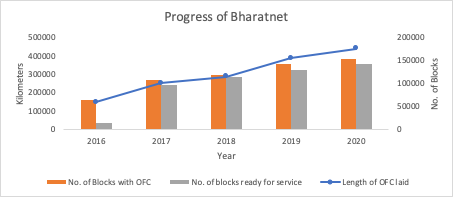
In 2011, the Indian Government announced the National Optical Fiber Network, an initiative aimed at providing broadband internet to over 200,000 rural localities in India. The project goal has since expanded to cover 250,000 localities in the country[27] using existing fiber laid by state-run companies.[28] Thus far, the project has not met 60 percent of the targeted 250,000 localities.[29] Though basic infrastructure has been laid down for over 100,000 localities, only in an estimated 5,000 localities have functioning networks.[30] Even for the fiber connections that are commercially available, the average monthly consumption of data stands at a mere 660 MB.[31] Policy goals have been hampered by bureaucratic red tape and compensation arrangements between municipal, state, and federal entities.
Right of Way (RoW) rules remain a major source of dispute between state governments and the Department of Telecommunication (DoT). The Telegraph Act empowers the local authority, in this case the State Government, to act as the permitting body for the laying of telegraphic cables on areas under their control. These rules allow each state government to create its own set of regulations over licenses to lay cables and compensation amounts. As a result, some state compensation practices have deterred private companies from building much needed infrastructure even after being granted an authorizing license form the DoT.
To solve these issues, DoT released a new set of regulations in 2016 simplifying the RoW regime.[32] The new rules are designed to ensure that the process of RoW compliance is transparent, uniform, and efficient for all states. The rules place a sixty-day limit on state authorities to either approve requests or deny them, provided they have given the applicant a chance to present their case first. The rules also place a uniform administrative fee for OFCs at Rs. 1000 per kilometer—payable to local authorities.
Industry analysts claim that a number of states and local authorities have yet to implement the uniform RoW rules, causing issues for the expansion of the OFC network.[33] These authorities seem to be unwilling to give up what were once healthy revenue sources and dispute the rule-making power of DoT on setting a ceiling on compensation. The High Court of Patna held that the state government could charge a “rent” from infrastructure providers for the laying of OFC cables on state-controlled land.[34] The same judgement also declared that the Court could not deem that the policy for charging rent is beyond the scope of powers of State Governments as State Governments have the ability to charge rent from other services using state-controlled land. Taking these factors into consideration, the status of RoW rules is unclear and remains a cause for concern for the OFC industry. While the DoT has attempted to curb states’ stifling interventions through top-down policy, with the current division of responsibilities, the final say still lies with local stakeholders.
Conclusion
Investments in OFC enable the government’s ambitious plans of strengthening Indian’s position as a knowledge- and service-oriented economy. An increase in broadband penetration to 60 percent in India is expected to translate into a 5-6 percent increase in the overall GDP.[35] These economic benefits are not viable without a fiber backbone that can sustain such growth. Before such investment can be made, individual states must engage municipal authorities to quell RoW concerns with the full support of the DoT. Rekindling the legacy of the 1990s, it is incumbent upon the national government to orchestrate a competitive bidding process and clear bureaucratic red tape that stymies expansion.
The anxiety and promise over 5G technology loom large in the debate over India’s internet infrastructure. India will be the third largest consumer of 5G services by 2025 but it will account for only five percent of global market share because of its “not so brilliant infrastructure.”[36] One estimate puts the investment cost for 5G in India at $70 billion, with a significant portion allocated to the development of fiber networks throughout the country, including both rural and urban locations. As a first principle, it would be prudent for New Delhi to rethink its aim of establishing universal wireline broadband. With changing trends of internet use, India should switch to the more realistic objective of gearing up cell phone towers for a 5G rollout enabling universal access through the cellular network.
[1] Telecom Regulatory Authority of India, “Highlights of Telecom Subscription Data as on 29th February, 2020,” June 29, 2020, https://trai.gov.in/sites/default/files/PR_No.44of2020_0.pdf.
[2] Rishi Iyengar, “The Future of the Internet is Indian,” CNN, November 27, 2018,
https://edition.cnn.com/interactive/2018/11/business/internet-usage-india-future/.
[3] Ibid.
[4] Muntazir Abbas, “India has only 1.25 million fibre-to-the-home connections: FTTH Council Asia-Pacific,” Economic Times, May 8, 2017,
[5] Leslie D’Monte, “Evolving Internet in India,” Mint, August 18, 2017, https://www.livemint.com/Opinion/gzWbpGZVD83W3iq3uOLD7O/Evolving-Internet-in-India.html.
[6] Ibid.
[7] Ibid.
[8] Shauvik Ghosh and Ashish Mishra, “The birth of the Internet in India”, Live Mint, June 30, 2015, https://www.livemint.com/Industry/R3kgewhIhKscbiELV1sHZM/The-birth-of-the-Internet-in-India.html.
[9] Ibid.
[10] Number of connections per 100 individuals.
[11] Piyush Jain and Varadharajan Sridhar, “Analysis of Competition and Market Structure of Basic Telecommunication Services in India,” Communications & Strategies 52, no. 4 (2003).
[12] Telecom Regulatory Authority of India, “Highlights of Telecom Subscription Data as on 29th February 2020,” June 29, 2020, https://trai.gov.in/sites/default/files/PR_No.44of2020_0.pdf.
[13] Telecom Regulatory Authority of India, “The Indian Telecom Services Performance Indicators Oct-Dec’03,” March 2004, https://main.trai.gov.in/sites/default/files/Report%20QE%20Dec-03-%203rd%20march%202004.pdf.
[14] Number of connections per 100 individuals.
[15] Telecom Regulatory Authority of India, “The Indian Telecom Services Performance Indicators October-December 2009,” April 6, 2010, https://main.trai.gov.in/sites/default/files/IndicatorReport6apr10.pdf
[16] Ibid.
[17] Newley Purnell, “Two Years Ago, India Lacked Fast, Cheap Internet—One Billionaire Changed All That,” The Wall Street Journal, September 5, 2018,
[18] Ibid.
[19] Telecom backhaul refers to the network connecting the cell towers which provide connectivity to cellular mobile phones. The infrastructure used to connect cell towers was traditionally constructed through copper wiring which is now being replaced by optical fiber and satellite connectivity.
[20] “Vision and Vision Areas,” Digital India, Accessed November 3, 2019, https://digitalindia.gov.in/content/vision-and-vision-areas.
[21] “Approach and Methodology,” Digital India, AccessedNovember 3, 2019, https://digitalindia.gov.in/content/vision-and-vision-areas.
[22] Department of Telecommunications, “National Digital Communications Policy 2018,” Accessed November 3, 2019, http://dot.gov.in/sites/default/files/EnglishPolicy-NDCP.pdf.
[23] Right of Way rules govern the laying down of underground cabling infrastructure required to enable Optical Fiber communication. They specify the requirements that need to be satisfied by entities wishing to excavate land in order to lay such infrastructure.
[24] Oil and Natural Gas Commission vs. Association of Natural Gas Consuming Industries of Gujarat, 1851 Supreme Court of India (May 1990).
[25] Ibid., 13.
[26] Internet Exchange Points (IXPs) are the physical nodes where switching between networks of various Internet Service Providers occurs. These points are also used to switch to networks of foreign internet service providers when data enters or leaves a country.
[27] “National Optical Fiber Network,” Bharat Broadband Network Limited, http://www.bbnl.nic.in/index1.aspx?lsid=249&lev=2&lid=21&langid=1.
[28] Ibid.
[29] Sumyesh Srivastava, “BHARATNET Implementation has been slow, riddled with shortcomings; needs urgent remedial action to democratise internet access,” FirstPost, December 26, 2019, https://www.firstpost.com/tech/news-analysis/bharat-net-implementation-has-been-slow-riddled-with-shortcomings-needs-urgent-remedial-action-to-democratise-internet-access-7827681.html.
[30] Manoj Gairola, “In 'Digital India', Not Even 2.5% Panchayats Have Commercial Broadband,” The Wire, November 19, 2018,
https://thewire.in/government/narendra-modi-government-digital-india-village-broadband-connections.
[31] Ibid.
[32] Department of Telecommunication, “Indian Telegraph Right of Way Rules,” 2016.
[33] Danish Khan and Tina Gurnaney, “Right of Way rules: The effects of implementation delay on India's telecom industry,” Economic Times, August 7, 2017, https://telecom.economictimes.indiatimes.com/news/right-of-way-rules-the-effects-of-implementation-delay-on-india-telecom-industry/59855964.
[34] Reliance Telecom Limited vs. State of Bihar, Patna High Court (Civil Writ Jurisdiction Case No. 8317 of 2009).
[35] “Broadband Infrastructure for Transforming India,” Deloitte, 2016.
[36] Global System for Mobile Communications (GSMA) Director General Mats Granryd.