Authors
News Type
News
Date
Paragraphs

Martin Hellman is not your average cryptography pioneer.

Hellman, who is known for his invention of public key cryptography (along with Whitfield Duffie and Ralph Merkle), has a life’s journey to share in story form, one that weaves together the most complex global flashpoints of our age with the deeply personal of any age. He and his wife’s new bookA New Map for Relationships: Creating True Love at Home and Peace on the Planet, spans far and wide, covering nuclear risks in North Korea, Iran, and America’s Middle Eastern wars.

But that is not all. He and his wife Dorothie Hellman open up about their marital struggles to show how they eventually reached a point of harmony and true love for each other. As Martin Hellman sees it, conflict in the international and interpersonal arenas has much in common.

“You can’t separate nuclear war from conventional war and conventional war from personal war,” he said in an interview. Hellman is a professor emeritus of electrical engineering and faculty affiliate at Stanford’s Center for International Security and Cooperation.  

Just as he and Dorothie (self-acknowledged polar opposites) often butted heads during the first 10 or 15 years of marriage, nations too navigate dangerously outmoded “maps” to protect their national security and interests. Yet these “maps” are soon outdated, whether on the global stage or in the home. Hellman said, however, that differences of opinion, which revolve around fights to prove who is “right,” could instead be transformed into opportunities to learn from one another – and to expand peace in the world.

“You have to believe in the seemingly impossible gifts of unconditional love and greater peace in the world, and then dedicate yourself to discovering how to achieve them,” he said.

Cultivating inner, outer peace

He said that society only truly changes based on individual changes, so he calls for action in how people live their everyday lives. When countries fail to respect each other – and ignore the influence of history on those countries – then conflict is more likely, and it is similar to a person disrespecting another.

“You will see an immediate payoff as your relationships flower,” he wrote in the book. “The small impact that each of us can have on changing the world does not feel concrete enough to most people, but seeing progress in your personal relationships is very concrete.”

That dedication to unconditional love, he said, is the way that individuals can become models for what is needed globally.

And the time is now, he suggests, for such change if our living generations are to leave a more peaceful world for those who follow us. From Afghanistan to Cuba, Russia, Iraq to North Korea and beyond, the countries of the world need a journey of healing and reconciliation, as he writes in the book.

Today, the stakes could not be higher, Hellman noted. Long-running strategies like nuclear deterrence are risky and illogical – over time, given probability theory and the chances of mistake or malice, they won’t work.

“The United States thinks it’s a superpower, but how can we be when Russia or China could destroy us in less than a hour?” he said. “How is that being a superpower?”

As William J. Perry, the former U.S. Secretary of Defense and Stanford professor emeritus at CISAC, said on behalf of the Hellmans’ book, “The struggle for interpersonal dominance can lead to the end of a marriage, but the struggle for geopolitical dominance can lead to the end of civilization.”


Hero Image
peace
A man adjusts a spotlight above the stage before world leaders' family picture during the Nuclear Security Summit in The Hague March 25, 2014. In his new book, CISAC's Martin Hellman writes that when nations and people get together to talk and learn from one another, peace can be the result.
REUTERS/Robin Van Lonkhuijsen/Pool.
All News button
1
Authors
News Type
News
Date
Paragraphs

The back-end of the nuclear fuel cycle has become the Achilles Heel of nuclear power, as CISAC’s Rodney Ewing writes in this new article. After more than 50 years of effort, no operating nuclear waste repositories exist in the U.S. for the spent nuclear fuel from commercial nuclear power plants – or for the high-level waste from the reprocessing of spent fuel. It is time to compare and evaluate the different strategies for nuclear disposal. Read more.

Hero Image
16041 waste news
A recovery worker obtains samples from a damaged drum after a safety incident in May 2014 at the Waste Isolation Pilot Plant in New Mexico.
(Image credit: U.S. Dept. of Energy
All News button
1
Authors
News Type
News
Date
Paragraphs

With each passing day, computer hacking against countries, organizations and people is forcing the subject of cybersecurity to the top of national security agendas.

An estimated 42.8 million cyber attacks will take place this year, according to experts. Scaling up to meet this challenge is why more than 140 people from science, politics, business and the military attended the fourth annual Cyber Security Summit at Stanford’s Center for International Security and Cooperation (CISAC) on Sept. 19-20.

The Munich Security Conference and Deutsche Telekom sponsored the event. CISAC is in the Freeman Spogli Institute for International Studies. Participants delved deep into issues associated with today’s online world, including how to balance privacy and civil liberties with the need for intelligence, for example. Discussions ranged on questions such as:

• What will the future of warfare look like – human soldiers or killer robots?

• How do we ensure that technological progress does not escape human control?

• What are the biggest challenges combatting the online activities of groups like the Islamic State?

• What are the possible cyberspace conflicts between the U.S., Russia and China?

• Are countries ready for cyber attacks against key infrastructure such as energy, water and utilities, or the U.S. election system, for example?

Electoral impact

In a talk on cyber attacks and the U.S. elections, panelists discussed how such electoral manipulation in the ongoing presidential campaign might happen, and what could be done about it. While it was noted that foreign adversaries could undermine the American public’s confidence in its election system, one expert pointed out that it’s unlikely to occur undetected on a widespread basis.

Credibility is now the battlefield, one panelist said. If hacking occurs, how will an election be validated? The track record shows that Russian has attempted to influence elections in Eastern Europe, so hacking into U.S. political entities is their way to sow doubt among voters.

The economic costs of cyber attacks – $400 to $500 billion a year was one participant’s estimate – and “cyberspace norms” were other issues explored. Countries and companies are grappling with the losses associated with these incursions, and with how – and who – should set the rules for the “digital game.”

On encryption, questions in one discussion revolved around how the public and private sectors can resolve such issues, how far data privacy could be compromised for effective intelligence work, and vice versa.

Online jihadism was another subject. The conference panelists talked about which tools are most effective in countering jihadist propaganda and recruitment on the Internet. Also, the need for Europe and the U.S. to work together on such fronts was mentioned.

CISAC and FSI participants included Amy Zegart, co-director of CISAC and senior fellow at the Hoover Institution; Michael McFaul, director of the Freeman Spogli Institute and senior fellow at the Hoover Institution; Martin Hellman, professor emeritus of electrical engineering; among others. Other attendees hailed from U.S. and European Union agencies and businesses, and local Silicon Valley companies.

Zegart said a collaborative spirit and drive for innovation characterizes Stanford. “In the past three years, we have built an exciting program dedicated to educating current and future cyber leaders, producing policy-driven knowledge, and convening leaders across sectors and borders,” she wrote in the program guide.

McFaul, in his opening statement, noted the origins of CISAC – it was created when there was a different technological concern – nuclear materials. Then, scientists and social scientists at CISAC got together to work on nuclear proliferation. Today, the threat is cyber attacks, and CISAC is confronting this challenge. He said the scariest briefing he had in his ambassador position at the U.S. Department of State was on cybersecurity.

For his discussion on terrorism, Hellman brought pages of pro-encryption quotes from government officials. He suggested end-to-end encryption was good for Americans.

Crossing borders

The Munich Security Conference is considered to be the most important informal meeting on security policy. Outside speakers included Michael Cherthoff, former secretary of Homeland Security; Jane Holl Lute, the under secretary general for the United Nations; and Christopher Painter, coordinator for cyber issues at the U.S. Department of State.

Wolfgang Ischinger, the chair of the Munich Security Conference, said at the press conference that, “cybersecurity has over the last few years evolved to be one of the most indispensable agenda items.”

The “quest for rules” in cyberspace, he noted, is overwhelmingly difficult and vitally important.

Thomas Kremer, board member for co-sponsor Deutsche Telekom AG, said, “cyber attacks don’t accept national borders.” Cybersecurity has become a global issue, he explained, with ramifications for countries, companies and everyday people.

He added, “Our chances to fight cyber crime are far better when we collaborate.”

Stanford and CISAC are at the forefront of the national discussion on cybersecurity. The university launched the Stanford Cyber Initiative; hosted President Obama’s cybersecurity summit and defense secretary Ashton Carter’s unveiling of a new U.S. cyber strategy; and CISAC and the Hoover Institution have teamed up in recent years for media roundtables and Congressional bootcamps on cybersecurity.

Finally, CISAC senior research scholar Joe Felter and other experts held Hacking for Defense & Diplomacy class for educators and sponsors on Sept. 7-9. (See the final class presentations here). In spring 2016, they held the first such class to train students in cybersecurity for defense purposes. Steve Blank, a consulting associate professor in the Stanford School of Engineering’s Department of Management Science and Engineering, helped develop the class. This fall, they will prototype a Hacking for Diplomacy course at Stanford.

Click here for the Munich Security Conference’s agenda for this event and a list of participants. 

Hero Image
cybersecurity summit
Michael McFaul, second from the left and the executive director of the Freeman Spogli Institute, talks with other panelists at the Cyber Security Summit on Sept. 19. On the far left is Amy Zegart, co-director of CISAC, and in the middle is Michael Chertoff, former director of the U.S. Department of Homeland Security. On the far right is Vinh Nguyen, a national intelligence officer for the U.S. federal government, and to his left is Dmitri Alperovich, co-founder of CrowdStrike.
Rod Searcey
All News button
1
News Type
Q&As
Date
Paragraphs

Stanford University’s Center on Democracy, Development and the Rule of Law (CDDRL) is proud to announce our four incoming fellows who will be joining us in the 2016-2017 academic year to develop their research, engage with faculty and tap into our diverse scholarly community. 

The pre- and postdoctoral program will provide fellows the time to focus on research and data analysis as they work to finalize and publish their dissertation research, while connecting with resident faculty and research staff at CDDRL. 

Fellows will present their research during our weekly research seminar series and an array of scholarly events and conferences.

Topics of the incoming cohort include electoral fraud in Russia, how the elite class impacts state power in China, the role of emotions in support for democracy in Zimbabwe, and market institutions in Nigeria. 

Learn more in the Q&A below.


Image
natalia embedded
Natalia Forrat

CDDRL Pre-Doctoral Fellow

Hometown: Tomsk, Russia

Academic Institution: Northwestern University

Discipline and expected date of graduation: Sociology, April 2017

Research Interests: authoritarianism, state capacity, social policy, civil society, trust, Russia and post-communist countries

Dissertation Title: The State that Betrays the Trust: Infrastructural State Power, Public Sector Organizations, and Authoritarian Resilience in Putin's Russia

What attracted you to the CDDRL Pre/post-doctoral program? I study the connection between state capacity and political regimes - the topic that is at the core of many research initiatives at CDDRL. Learning more about this work and receiving feedback for my dissertation will enrich and sharpen my analysis, while helping me to place it into a comparative context. I am looking forward to discussing my work with the faculty who study the post-Soviet region. I also will explore policy implications of my work with the help of policy experts at CDDRL.

What do you hope to accomplish during your nine-month residency at the CDDRL? Besides finishing writing my dissertation, I will workshop three working papers to prepare them for publication. The first one argues that Putin's regime used the school system to administer a large-scale electoral fraud in 2012 presidential elections; the second one shows how the networks of social organizations were used by subnational autocrats to strengthen the regime; and the third one will look at the factors that make the abuse of such organizations more difficult in some regions. In addition to these papers I will continue developing my post-graduation research project exploring the relationship between social trust and distrust, institutions, political competition, and democratization.

Fun fact: I have spent 25 years of my life in Siberia, and I can tell you: Chicago winters are worse!


Image
shelby embedded
Shelby Grossman

CDDRL Postdoctoral Fellow

Hometown: Reading, MA

Academic Institution: Harvard University

Discipline & Graduation Date:  Government, Summer 2016

Research interests: political economy of development, private governance, market institutions, Sub-Saharan Africa, survey methods

Dissertation Title: The Politics of Order in Informal Markets: Evidence from Lagos

What attracted you to the CDDRL post-doctoral program? I was attracted to CDDRL largely for its community of scholars. Affiliated faculty work on the political economy of development and medieval and modern market institutions, topics that are tied to my own interests.

What do you hope to accomplish during your nine-month residency at the CDDRL? I plan to prepare a book manuscript based on my dissertation, a project that explains variation in the provision of pro-trade institutions in private market organizations through the study of physical marketplaces in Nigeria. In addition, I will continue to remotely manage an on-going project in Nigeria (with Meredith Startz) investigating whether reputation alleviates contracting frictions. I also plan to work on submitting to journals a few working papers, including one on the politics of non-compliance with polio vaccination in Nigeria (with Jonathan Phillips and Leah Rosenzweig). 

Fun fact: Contrary to popular belief, not all cheese is vegetarian. I have a website to help people determine if a cheese is vegetarian or not: IsThisCheeseVegetarian.com. 


Image
daniel embedded
Daniel Mattingly

CDDRL Postdoctoral Fellow

Hometown: Oakland, California

Academic Institution: University of California, Berkeley

Discipline & Graduation Date: Political Science, Summer 2016

Research Interests: Governance, rule of law, state building, authoritarian politics, Chinese politics

Dissertation Title: The Social Origins of State Power: Democratic Institutions and Local Elites in China

What attracted you to CDDRL?  The Center has a fantastic community of scholars and practitioners who work on the areas that I'm interested in, including governance and the rule of law. I'm excited to learn from the CDDRL community and participate in the Center's events. The fellowship also provides me with valuable time to finish my book manuscript before I start teaching.

What do you hope to accomplish during your nine-month residency at the CDDRL? While at CDDRL, I plan to prepare my book manuscript and to work on some related projects on local elites and state power in China and elsewhere. 

Fun fact: I grew up on an organic farm in Vermont.


Image
lauren embedded
Lauren E. Young

CDDRL Postdoctoral Fellow

Hometown: Saratoga, CA

Academic Institution: Columbia University 

Discipline & Graduation Date: Political Science (Comparative Politics, Methods), May 2016 (defense), Oct 2016 (degree conferral)

Research Interests: political violence, political economy of development, autocratic persistence, democratization, protest, electoral violence

Dissertation Title: The Psychology of Repression and Dissent in Autocracy

What attracted you to the CDDRL post-doctoral program? As a graduate of the CISAC honors program when I was an undergraduate at Stanford, I have seen first-hand how intellectually stimulating, collaborative, and plugged into policy CDDRL is. While at the center I will be revising my dissertation work on the political psychology of participation in pro-democracy movements in Zimbabwe for submission as a book manuscript, and moving forward new projects that similarly seek to understand how different forms of violence by non-state actors affects citizens' preferences and decision-making. Because of its deep bench of experts on autocracy, narco-trafficking, and insurgency, CDDRL will add enormous value to these projects.

What do you hope to accomplish during your nine-month residency at the CDDRL?  During my fellowship year, my primary goal is to revise my research on Zimbabwe into a book manuscript. I defended my dissertation as three stand-alone articles, including two experiments showing that emotions influence whether opposition supporters in Zimbabwe express their pro-democracy preferences and a descriptive paper showing that repression has a larger effect on the behavior of the poor. To prepare the book manuscript during my fellowship, I will bring in additional quantitative and qualitative descriptive evidence and tie the three papers together into a cohesive argument about how opposition supporters make decisions about participation in protest, why emotions have such a large effect on these decisions, and how this affects variation across individuals and the strategic choices of autocrats and activists.

Fun fact: During my fieldwork I took an overnight train from Victoria Falls to a southern city in Zimbabwe and hitch-hiked into a national park. It got a little nerve-wracking when night started to fall, but ended with  an invitation to a barbecue! 



Hero Image
cddrl fellows 2016 logo
All News button
1
News Type
News
Date
Paragraphs

The Korea Program Prize for Writing in Korean Studies recognizes and rewards outstanding examples of writing in an essay, term paper, or thesis produced during the current academic year in any discipline within the area of Korean studies, broadly defined. This competition is open to both undergraduate and graduate students. The prize will be awarded at a special ceremony in the fall, and the winning essays will be published in the Stanford Journal of East Asian Affairs. The first place winner will receive a certificate, a copy of the Stanford Journal of East Asian Affairs, and $1,000; Honorable mention winner(s) will receive a certificate and a copy of the Stanford Journal of East Asian Affairs.

Application Deadline: Thursday, June 6, 2016
Eligible Students: All currently-enrolled Stanford students
Application Instructions: Submit the following items by email to John Groschwitz, CEAS Associate Director.

  • Current CV
  • One Korean Studies paper/essay (minimum 20 pages double-spaced, Times 12pt., 1″ margins)
  • One recommendation letter from a Stanford professor (emailed by the professor directly to John Groschwitz)


Hero Image
Encina Headline
All News button
1

China’s leaders now acknowledge the reality of much slower growth, and refer to it as the “new normal”.  But what does this mean, and what will be the consequences?  Exports have slowed, but can domestic consumption pick up the slack?  Will this slowdown lead to a rebalancing that will yield a more sustainable and robust growth?  How does the end of the “one child policy” fit into this equation, and will this be sufficient to address the demographic challenges that China faces?  What impact will Xi Jinping’s vigorous anti-corruption campaign have on this “new normal

-

A Lecture-Concert by

Professor Jindong Cai, Music Director and Conductor, Stanford Symphony Orchestra

In collaboration with members of

The Peking University Symphony Orchestra


NOV 12, 2015

19:30 – 21:00

Stanford Center at Peking University

At the turn of the twentieth century, the foundations of traditional Chinese society were crumbling. Many patriotic and idealistic young people went overseas to seek inspiration and education, determined to learn from the outside world and forge a new path forward for China. Beethoven was introduced to China during this period by a series of remarkable artists and intellectuals who learned about the composer while studying in Japan. The polymath artist, writer, and monk Li Shutong was the first Chinese to write about Beethoven in a short, but revealing, article called  “The Sage of Music.”  Xiao Youmei was the first Chinese to bring the sound of Beethoven to Chinese people.  After his studies in Japan and Germany, Xiao came back to China in 1921 and began promoting music education at Peking University, where he created the first Chinese symphony orchestra to perform Beethoven’s music. Since then, Beethoven has become an iconic figure in China and played a role in many major historical events from the May Fourth Movement to the normalization of US-China relations.  Beethoven became a hero to reformers, intellectuals, music lovers, and party cadres alike. The new Penguin Special “Beethoven in China,” by Stanford professor and orchestra conductor Jindong Cai and culture journalist Sheila Melvin tells the compelling story of Beethoven and the Chinese people.

In the first part of this special lecture-concert, Professor Cai will share his own experience of hearing Beethoven’s music for the first time in the midst of the Cultural Revolution. He will also briefly tell the story of how Beethoven and his music became so deeply rooted in modern China. The second part of the event will feature a 15-member ensemble of musicians from the Peking University Orchestra – a first-ever re-creation of the 1922 orchestra that premiered Beethoven in Beijing. The performance, conducted by Maestro Cai, will give the audience a unique historical experience and allow them to travel back in time and hear how Beethoven’s music sounded when it was first performed at Peking University.  


Stanford Center at Peking University, The Lee Jung Sen Building, Langrun Yuan, Peking University

Peking University is a closed campus, please bring a photo ID and enter PKU through the Northeast Gate. 

Jindong Cai Music Director and Conductor Stanford Symphony Orchestra
The Peking University Symphony Orchestra
Lectures
-

The brain works with electricity. Modulating the electrical function of the brain at different sites of the brain can give rise to information about how the brain works and how it may be broken in certain disorders. In the next decades of the century, we will be approaching the field of electriceuticals rather than pharmaceuticals in the treatment of many neuropsychiatric disorders. In this talk, Prof. Parvizi will give an overview of the lessons learned from the time of classical stimulations of the brain until the current technological advancements in this field.

Josef Parvizi MD PHD is an Associate Professor of Neurology and Neurological Sciences at Stanford University School of Medicine and director of Stanford Human Intracranial Cognitive Electrophysiology Program. He received his MD from the University of Oslo and PhD in neurosciences from the University of Iowa. He completed his medical internship at Mayo Clinic and Neurology Residency at BIDMC-Harvard before joining the UCLA for fellowship training in Clinical Epilepsy and Neurophysiology.  Prof. Parvizi moved to Stanford University in July 2007 and started the Human Intracranial Cognitive Electrophysiology Program (SHICEP). His research is now supported by NIH, Stanford NeuroVentures Program, and Stanford School of Medicine. His expertise is in functional mapping of the human brain using the three methods of electrocorticography, electrical brain stimulation, and functional imaging.

Stanford Center at Peking University, The Lee Jung Sen Building, Langrun Yuan, Peking University

Josef Parvizi Associate Professor of Neurology and Neurological Sciences Stanford University School of Medicine
Lectures
Authors
News Type
News
Date
Paragraphs

The Freeman Spogli Institute for International Studies has welcomed five new senior military fellows, including three active duty lieutenant colonels from the U.S. Air Force and two from the U.S. Army, who will spend the next academic year at Stanford pursuing self-directed study of important national issues.

Former U.S. Secretary of Defense and CISAC faculty member Bill Perry created the program to give military officers the opportunity to take a deep dive into an area of strategic interest.

The fellows will be considering a diverse range of topics, from how to adapt Silicon Valley’s innovative work culture to the Army, to China’s actions in the South China Sea, and the effectiveness of U.S. economic sanctions against North Korea.

You can learn more about our fellows’ military backgrounds and the intended focus of their studies from the brief bios below.

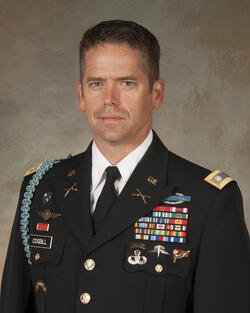
John Cogbill and Scott Maytan will be assigned to the Center for International Security and Cooperation.

John Chu, Ryan Blake and Jose Sumangil will be based at the Walter H. Shorenstein Asia-Pacific Research Center.


LTC John Cogbill

LTC John Cogbill was commissioned as an Infantry officer from the United States Military Academy in 1994 and has held a variety of positions in both conventional and special operations units. John’s first assignment was as a Platoon Leader and Executive Officer in the 82nd Airborne Division. John then served two years in the 1st Battalion, 75th Ranger Regiment as a Platoon Leader and Civil-Military Affairs Officer. Next, John served three years in Alaska as an Airborne Rifle Company Commander and the Aide-de-Camp to the Commanding General. After earning his MPA from the Harvard Kennedy School, John taught Economics in the Social Sciences Department at West Point. Following the Command and General Staff College, he spent two years as a Combined Arms Battalion Executive Officer in the 1st Cavalry Division. He then served as the Strategic Plans and Requirements Officer for the 75th Ranger Regiment. Most recently, John commanded the Reconnaissance and Surveillance Squadron for the U.S. Army Third Corps. John has deployed on three combat and two peacekeeping missions, including two tours in Iraq, one tour in Afghanistan, one tour in Haiti, and a recent tour in Kosovo. He will be exploring how the Army can encourage innovation and use emerging technologies to achieve and maintain a competitive advantage on the battlefield.


lt col scott maytan 5x7 Lt Col Scott Maytan, U.S. Air Force

Lt Col Scott Maytan was the commander of a B-52H operational bomb squadron, responsible for ensuring combat mission readiness for any worldwide nuclear or conventional tasking. Lt Col Maytan is a navigator with over 2500 flying hours, primarily in the B-52H, and is a graduate of both the Command and General Staff College (U.S. Army) and the U.S. Air Force Weapons School. He has served four operational assignments, as an advanced tactics instructor, and also a tour at the Pentagon where he developed Air Force positions concerning long-range strike and aircraft nuclear requirements. Lt Col Maytan has served three combat deployments for Operations Desert Fox (Southern Watch), Allied Force and Iraqi Freedom and has also deployed four times supporting USPACOM’s Continuous Bomber Presence mission. Maytan will be studying the “red-lines” that shape Western deterrence posture, and how strategic action and deterrence posture in one region affects others.


LTC John Chu, U.S. Army

LTC John Chu is an active duty officer in the United States Army. Chu has held a variety of leadership and staff positions in his 20 year career. Most recently, he served as the Chief of Intelligence Training at the Department of the Army. Chu has twice been deployed to Iraq and once to Bosnia, with multiple assignments to South Korea, Germany and Turkey. Born in Seoul, he grew up in California and graduated from West Point in 1995. At Stanford, Chu is researching the Korean armistice agreement and the United Nations mission to South Korea. He will also examine U.S. policy toward North Korea, particularly analyzing the “brink of war” tension and developing strategic deterrence measures to reduce risk of unwanted military escalation on the Korean Peninsula. For both research streams, Chu aims to produce analyses and recommendations that could inform a policy audience.


Lt Col Ryan Blake, U.S. Air Force

Lt Col Ryan Blake is an active duty officer in the United States Air Force. Blake was the commander of a flight test squadron where he was responsible for the flight test of new Air Force programs. He has over 2,400 flying hours in over 40 types of aircraft, and has held two operational F-15E assignments, including combat deployments in support of Operations Southern Watch, Iraqi Freedom and Enduring Freedom. He had also been positioned at the Pentagon in defense acquisition and the Office of Security Cooperation in Baghdad. At Stanford, Blake is researching the U.S. policy toward China and its relation to Northeast Asia. He aims to discover areas of cooperation between the U.S. and Chinese militaries.


Lt Col Jose “Ed” Sumangil, U.S. Air Force

Lt Col Jose “Ed” Sumangil is an active duty officer in the United States Air Force. During his career, Sumangil has served in a range of operational assignments, including joint staff officer at U.S. Strategic Command where he was a lead planner of the command’s space campaign. Before coming to Stanford, he was the commander of a B-1 squadron and led airmen through combat deployments in support of Operations Enduring Freedom, Inherent Resolve and Freedom’s Sentinel. At Stanford, Sumangil is examining China’s actions in the South China Sea and the Philippines arbitration case regarding Chinese actions there. He seeks to offer perspectives and policy and strategy options to maintain peace and stability in the South China Sea.


Hero Image
ennica hall exterior ws
All News button
1
Authors
News Type
News
Date
Paragraphs

Rodney Ewing, senior CISAC fellow and Frank Stanton professor in nuclear security, has been honored with three prestigious awards in the geological and mineralogical sciences.

Ewing will receive two medals at the Geological Society of America’s next annual meeting in Baltimore at the end of this month: the Ian Campbell Medal for Superlative Service to the Geosciences from the American Institute of Geosciences, and the Roebling Medal of the Mineralogical Society of America for scientific eminence.

He is being recognized for his groundbreaking research on nuclear materials and his contributions to nuclear waste management.

“Rod Ewing is a modern mineral scientist at the top of his field who has excelled in both science and service,” according to the citation for the Campbell Medal.

“Dr. Ewing has made seminal contributions to our knowledge of radiation damage in minerals and the design of waste forms for high-level nuclear waste. And he continues to have a major impact on the policies underlying nuclear waste management in the United States.”

The international impact of professor Ewing’s research into nuclear waste storage is also being recognized with the IMA Medal of Excellence in Mineralogical Sciences from the International Mineralogical Association, which will be awarded at a meeting in Rimini, Italy next September.

Hero Image
rod ewing cisac headshot
Rodney Ewing, Frank Stanton professor in nuclear security at Stanford's Center for International Security and Cooperation.
Rod Searcey
All News button
1
Subscribe to