
Democracy
Authors
Christian E. Ollano
News Type
News
Date
Paragraphs

The Center on Democracy, Development, and the Rule of Law proudly congratulates its graduating class of honors students for their outstanding original research conducted under the CDDRL Interdisciplinary Undergraduate Honors Program. Among those graduating includes Garima Sharma who was awarded the Firestone Medal for her thesis entitled "Factors Shaping Mothers' Aspirations for their Daughters in India: A Case Study of Forbesganj, Bihar." Sharma's project used both quantitative and qualitative methods to explore cultural, social and economic factors that shape female expectations in one of the poorest parts of India.

The Firestone Medal for Excellence in Undergraduate Research recognizes Stanford's top ten percent of honors theses in social science, science and engineering among the graduating senior class.

Initially struck by the high rates of early marriage upon her visit to northern India, Sharma conducted field interviews and surveys last summer, finding that exposure to educated and employed female role models produced an increase in mothers’ aspirations for their daughters.


cara and garima Cara Reichard (left) and Garima Sharma (right) both received awards under CDDRL for their outstanding theses projects.
"I think the most memorable experience in my research process was when I was interviewing the mothers in Forbesganj," said Sharma. "It was interesting to see that mothers coming from the same communities were saying very different things about their aspirations for their children." 


Sharma's research was conducted under the advisement of Associate Professor of Education and CDDRL Affiliated Faculty Member Christine Min Wotipka. In addition to the Firestone Award, Sharma received the 2015 Michelle Zimbalist Rosaldo Prize in the Social Sciences under the Program in Feminist, Gender, and Sexuality Studies.

Among other award winners, CDDRL honors student Cara Reichard received the CDDRL Best Thesis Award for her honors thesis "The Logic of International Courts: An Exploration of the East African Court of Justice," which analyzed the impact and legitimacy of rulings under the East African Court of Justice. Stefan Norgaard received a Firestone Medal under the Urban Studies program for his thesis entitled "Rainbow Junction: South Africa’s Born Free Generation and the Future of Democracy," which assessed democratic consolidation in South Africa via hyper-local civic interactions among the country's active youth.


"The CDDRL honors program has allowed us to write theses around issues that really matter," said Norgaard. "What sets the program apart is that it pushes us to pursue projects aimed at changing things and making an active contribution to scholarship around the world."


Norgaard, Sharma and Reichard are part of a cohort of ten graduating CDDRL honors students who have spent the past year working in consultation with CDDRL affiliated faculty members and attending honors research workshops to develop their theses projects. Many traveled abroad to collect data, conduct interviews, and spend time in the country they were researching. Collectively, their topics documented some of the most pressing issues impacting democracy today in South Africa, India, North Korea, Swaziland, Cuba and Uganda, among others.
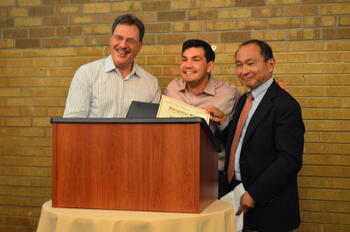

dsc 0247 Stefan Norgaard with CDDRL Director Larry Diamond (left) and FSI Olivier Nomellini Senior Fellow Francis Fukuyama (right).
"This year's CDDRL honors class produced an extraordinary range of thesis topics, from deliberative democracy in California to the role of courts in East Africa," said FSI Olivier Nomellini Senior Fellow Francis Fukuyama, advisor to the CDDRL Interdisciplinary Undergraduate Honors Program. "The class was particularly diverse in terms of majors, with students coming from human biology and statistics as well as economics and political science; their work benefited greatly from the exposure they received to a range of disciplinary approaches. Most of all they learned from each other."


In the upcoming 2015-2016 academic year, the program will bring in the new leadership of CDDRL Deputy Director Stephen Stedman who will advise a cohort of 15 honors students, one of the program's largest and most diverse classes to date.  

The CDDRL Interdisciplinary Undergraduate Honors Program trains students from any academic department at Stanford to prepare them to write a policy-relevant research thesis with global impact on a subject touching on democracy, development, and the rule of law. Honors students participate in research methods workshops; attend honors college in Washington, D.C.; connect to the CDDRL research community; and write their thesis in close consultation with a faculty advisor to graduate with a certificate of honors in democracy, development, and the rule of law.

A list of the 2015 graduating class of CDDRL honors students, their theses advisors, and a link to their theses can be found below:


NameMajorThesis
Monica DeyHuman Biology
Selamile DlaminiManagement Science & Engineering
Max JohnsonInternational Relations
Hamin KimHuman Biology

NGOs and Effective Aid Delivery in the Democratic People's Republic of Korea (Thesis not available for public.)

Advisor: Gary Schoolnik

Stefan NorgaardPublic Policy
Cara ReichardPolitical Science
Ashley SemanskeeHuman Biology

Community Engagement and Accountability in US Urban Public School Districts (Thesis not available.)

Advisor: Martin Carnoy and Susanna Loeb

Garima Sharma

Economics

Factors Shaping Mothers’ Aspirations for their Daughters in India: A Case Study of Forbesganj, Bihar 

Advisor: Christine Min Wotipka

Thuy TranEconomics
Shawn TutejaMathematics


Hero Image
cddrl2015honors
The graduating class of 2014-2015 CDDRL senior honors students take a group photo with CDDRL Director Larry Diamond and FSI Oliver Nomellini Senior Fellow and CDDRL Honors Program Advisor Francis Fukuyama. From left to right: Didi Kuo (CDDRL honors program teaching assistant); Stefan Norgaard; Monica Dey; Hamin Kim; Garima Sharma; Larry Diamond; Ashley Semanskee; Selamile Dlamini; Max Johnson; Cara Reichard; Thuy Tran; Shawn Tuteja; and Francis Fukuyama.
Lauren Weitzman
All News button
1
Authors
Christian E. Ollano
News Type
News
Date
Paragraphs

During a recent visit to Stanford, Rabih El Chaer (’07), an alumnus of the Draper Hills Summer Fellows Program (DHSFP) at Stanford’s Center on Democracy, Development and the Rule of Law, shared his thoughts on the pervasive 'culture of corruption' in Lebanon, highlighting the need for strong counteractions from civil society. Last year, El Chaer founded Sakker el Dekkene, a Lebanese NGO dedicated to developing platforms to bolster accountability and track bribes. Lebanon is rated 136 out of 175 countries in Transparency International's 2014 Corruption Perceptions Index. Before founding Sakker el Dekkene, El Chaer served as the political and media advisor to the Kuawaiti Minister of Information and Youth.


1) What are the top challenges facing Lebanon today?

In the political spectrum, Lebanon is facing one of its biggest challenges: an institutional vacuum by which the country has been without a president for more than a year. This matter is also linked to the cancellation of the parliamentary elections. With the absence of a clear budget in the public administration since 2005, the debt exceeds 105 percent, which has increased unemployment rates.

Another challenge is the omnipresence of corruption in both public and private sectors. Last year, Lebanon ranked 136 out of 175 countries in Transparency International's Corruption Perceptions Index, dropping from the 127th place it took in 2013. And in 2013, the World Bank's Control of Corruption Indicator was at its second lowest since 1996. With the absence of accountability and transparency, corruption became engrained in Lebanon's political, administrative and economic environment, hindering the rule law and good governance.

Last but not least, the existence of refugees and instability in the region has been a great promoter for instability, unemployment, and population overgrowth, which Lebanon cannot handle.


2) What is the government doing to address this culture of corruption?

In 2008, the Lebanese government took the initiative and signed the United Nations Convention against Corruption treaty. This treaty includes 51 articles on anti-corruption. The government had the goodwill to initiate three pillar projects: access to information; whistle blower protection; and the establishment of the national anti-corruption authority.

But in reality, no law was voted for and no anti-corruption national plan was adopted. Furthermore, the lack of accountability perpetuates the problem, given the rampant corruption across sectors - including the judicial system - which was ranked third in the number of bribes paid based on citizen reports submitted through Sakker El Dekkene.


3) Tell us about some of the anti-corruption projects you have been working on at your organization - Sakkar el Dekkene.

Investigation and research are critical for Sakker el Dekkene’s plan to produce substantive content and data related to corruption, which will be used to push for change. This information includes bribe data, surveys, investigations, and reports, among others.

The second critical project is legal work, ranging from producing draft laws to helping public authorities implement the rule of law and defend individuals’ rights, all the way to taking corruption cases to court.

The Ombudsman Law was voted for in 2005 in Lebanon, but until now, the government has yet to establish the office, yet alone appoint its leadership. At this moment, we serve the role of an ombudsman.

Additionally, partnership with various organizations and authorities has an amplifying effect on all our activities. Partners include ministries, public administrations and other public authorities willing to collaborate, as well as private sector entities and other local and international NGOs. Lobbying with public sector stakeholders, ministers, judiciary, the media and others on the elections monitoring process will push the pressure to fight corruption to its highest level.


4)  How do you engage the public in your work?

Awareness is done through a wide range of activities, including education at school and the university level; entertainment projects such as songs, cartoons, film festivals, award days; and other outside-the-box activities and events. We also have a strong public awareness campaign, engaging directly with the public in malls, fairs and events during our Kabseh (meaning "pressure") tours as well as on social media. Through our touring, we inform people about how they can use our platform to report deficiencies in public administration and identify system loopholes.


5) What challenges does the organization face today? How has the government responded to your projects?

Having a country where more than 50 percent of the nationals resort to corruption in order to have their needs met is very challenging. To top this off, many Lebanese do not report the corruption they witness, initiate, or are victims of. This makes it very challenging for us to receive an accurate number of reports.

Violence is another challenge we face. Some people react to our cause by resorting to violent means. Also, the fact that media in Lebanon can have a certain political affiliation is another challenge because the bias found in media does not help portray the earned image we have received in the public’s eye.


6) What advice would you give summer fellows alumni seeking to counter/combat corruption in their home countries?

It is important to always have the faith, willpower and patience to keep striving for a corruption-free country. A professional strategy based on facts, political neutrality, and transparency is key to making your argument more believable, feasible and durable.

Social media - including Facebook, Twitter and Instagram - are very important in helping spread your cause, vision, aim and activities.

Partnership and collaboration with civil society - including NGOs - is necessary to guarantee alliance and sustainability in spreading your vision. There is no prototype for combating corruption. Evolution – not revolution – is required. The fight against corruption is not with people; it is with the system. 


Hero Image
rabhih edited
Rabih El Chaer speaks during the 2013 Draper Hills Summer Fellows Program Alumni Reunion.
All News button
1
-

**LIVE WEBCAST WILL BE AVAILABLE HERE IMMEDIATELY PRIOR TO THE EVENT.**


[[{"fid":"219129","view_mode":"crop_870xauto","fields":{"format":"crop_870xauto","field_file_image_description[und][0][value]":"","field_file_image_alt_text[und][0][value]":"","field_file_image_title_text[und][0][value]":"","field_credit[und][0][value]":"","field_caption[und][0][value]":"","field_related_image_aspect[und][0][value]":"","thumbnails":"crop_870xauto","pp_lightbox":false,"pp_description":false},"type":"media","attributes":{"width":"870","class":"media-element file-crop-870xauto"}}]]

On June 2, 2015, the Taiwan Democracy Project at Stanford's Center on Democracy, Development and the Rule of Law (CDDRL) will host a special panel session featuring the President of the Republic of China (Taiwan), Ma Ying-jeou. President Ma will speak via live video feed to commemorate the 70th anniversary of the end of World War II and the long history of the U.S.-R.O.C. relationship. Following his prepared remarks, the president will engage in a question-and-answer session with the audience and a distinguished panel of leading Stanford faculty and fellows, chaired and moderated by the former Secretary of Defense of the United States, William J. Perry.


About the Speaker

Ma Ying-jeou has served as the President of the Republic of China (Taiwan) since May 2008. As president, Ma Ying-jeou has worked to address the repercussions of the global financial crisis, stepping up efforts to bring about a more diversified industrial structure and to jump-start new engines for economic growth in Taiwan. President Ma has also attached great importance to promoting energy conservation and carbon reduction, which has helped Taiwan’s energy efficiency to exceed two percent. In addition, his administration worked to craft a response to regional economic integration, successfully negotiating the landmark Economic Cooperation Framework Agreement (ECFA) with the People's Republic of China in 2010. President Ma's creative diplomacy has brought a significant improvement in cross-Strait relations while putting an end to a long and vituperative standoff between the two sides in the diplomatic sphere.


About the Panelists

William J. Perry is the Michael and Barbara Berberian Professor (emeritus) and a senior fellow at the Freeman Spogli Institute and the Hoover Institution, and serves as the director of the Preventive Defense Project at Stanford University. He was the Secretary of Defense for the United States from 1994-1997.


Lanhee J. Chen is the David and Diane Steffy Research Fellow at the Hoover Institution, as well as Lecturer in Public Policy and Law at Stanford University. He served as the chief policy adviser to 2012 U.S. presidential candidate Mitt Romney.


Karl Eikenberry is the William J. Perry Fellow in International Security at the Center for International Security and Cooperation at Stanford University.  He served as the U.S. Ambassador to Afghanistan and is a Lieutenant General, Retired, U.S. Army.


Thomas Fingar is the Oksenberg-Rohlen Distinguished Fellow in the Freeman Spogli Institute for International Studies at Stanford University. He served as the first deputy director of national intelligence for analysis and as chairman of the National Intelligence Council from 2005-2008.


Event Details

The live panel will take place in the Bechtel Conference Room of the Freeman Spogli Institute at Stanford University, at 616 Serra Street, from 5:45-7:00pm on June 2, 2015. An informal reception in the lobby of Encina Hall will follow.


This event is co-sponsored with the Taipei Economic and Cultural Office, San Francisco and the Office of the President of the Republic of China (Taiwan). It is free and open to the public. RSVP is required.


President Ma Ying-jeou
Lanhee J. Chen
Thomas Fingar
William J. Perry
Panel Discussions
Subscribe to Democracy