
Democracy
News Type
News
Date
Paragraphs

The Program on Arab Reform and Democracy at Stanford’s Center on Democracy, Development, and the Rule of Law is pleased to welcome Egyptian academic and Former Member of Parliament Amr Hamzawy as a visiting scholar for the 2015-16 academic year. Hamzawy, who teaches political science at Cairo University and the American University in Cairo, brings to the program a deep knowledge of Middle East politics and specific expertise on democratization and reform processes in the region. A former Senior Associate at the Carnegie Endowment for International Peace, Hamzawy’s research focuses on questions of political change, human rights, and the rule of law in Egypt. He is a daily columnist for Al-Sherouk, an independent Egyptian newspaper, and writes regularly on the role of civil society actors and parties in Egypt’s often restricted political arena. Hamzawy is a former member of the Egyptian National Council for Human Rights, and was elected to serve in Egypt’s first parliament after the outset of the January 25 Revolution before it was dissolved in the summer of 2012.

Hamzawy will spend his residency at CDDRL working on a research project on the liberal elite and reemergence of autocracy in Egypt. His residency is generously funded by a grant from the Carnegie Corporation to support scholars from the Arab world. In the interview below, Hamzawy describes his current project and research plans. Hamzawy will be sharing his research findings with the CDDRL community in a seminar on October 27.


What are your research goals and priorities?

While at CDDRL, my research objective is to analyze contemporary liberal discourses on democracy and human rights in Egypt. The fact that the majority of Egyptian liberals called on the military establishment - prior to the July 3, 2013 coup which deposed the elected president Mohamed Morsi - to interfere in politics and terminate the emerging pluralist dynamics warrants an in-depth examination. Equally puzzling, is the readiness of Egyptian liberals to allow the former minister of defense and current president Abdel-Fattah al-Sisi’s rise to power, to accept a subordinate role in an increasingly restricted public space, and to tolerate without any noticeable resistance the emergence of a new autocracy in Egypt.


What has your research uncovered?

The research journey has been going in some fascinating directions and yielding some interesting answers. For instance, one set of factors pertains to the formation of the modern Egyptian state and the long-standing dependency of liberal elites on successive autocratic rulers and governments. Another revolves around historical legacies of mistrust and fear towards religious-based social movements and political actors. These legacies have contributed to the tendency of liberals to side with autocrats against popular opposition currents. Finally, the predominance of rent-seeking tendencies inside the state bureaucracy and among economic elites has limited the integration of liberals into Egypt’s social fabric. While there are fascinating historical analogies between the current moment and previous experiences in Egypt from the nineteenth and twentieth centuries, my research will remains focused on the contemporary era.


How is your experience in Egyptian politics informing your current projects?

Throughout the last four years, and while putting on different institutional hats and operating in very different contexts, I have collected first-hand insights on liberal narratives on the formation of the Egyptian state and state-society relations. These experiences also deepened my understanding of liberals’ discourses on their historical encounters with religious forces, their social and political preferences, and their views on the wider public—which some key liberal figures have been willing to disenfranchise to avoid Islamist victories in the polls. These insights, as well as my own experiences as an elected member of the Egyptian People’s Assembly of 2012, the first legislature that was elected freely and without government manipulation, will inform the research.  


What are the most important factors that undermined the movement that supported the January 25, 2011 Revolution in Egypt?

That is a tough question. It is easy to state that neither the military establishment nor the vastly entrenched security apparatus wanted the January 25, 2011 Revolution. They feared that it could lead to a democratic transition in which their roles, benefits, and privileges would have been limited or at least subjected to greater scrutiny. Also, there is no doubt that the rent-seeking economic elites and various forces of the Mubarak regime were heavily invested in blocking an orderly transition to democracy. These are facts that have been well documented and researched.

However, no less significant is the recurrent retreat of liberal elites from pluralist processes and procedures. It appears as if Egyptian liberals have never been ready to support a democratic opening that could bring Islamists to power. Liberals have also been reluctant to shoulder the burden of standing against the autocratic ways of the military and the security establishment, or to help civil society and human rights groups garner more popular support. To explain the root causes and impacts of Egypt’s illiberal liberals is the task of my current research project.

Hero Image
5893917234 02bda8a077 z
Amr Hamzawy. Photo from Bündnis 90/Die Grünen flickr page
All News button
1
-

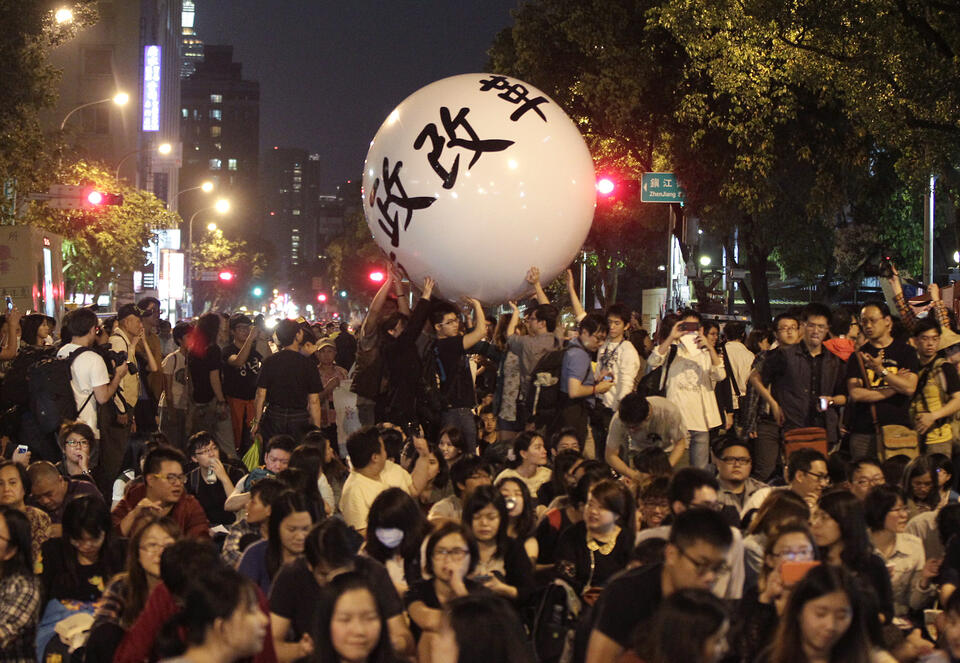
sunflower movement   constitution Activists push a ball reading "constitution reformation" during a sit-in to mark the one-year anniversary of the start of the Sunflower Movement outside the Legislative Yuan in Taipei March 18, 2015.

Activists push a ball reading "constitutional reform" during a sit-in to mark the one-year anniversary of the start of the Sunflower Movement outside the Legislative Yuan in Taipei March 18, 2015. Reuters/Pichi Chuang


These are unsettled times in Taiwanese politics. In recent months, prominent voices from across the spectrum have called for fundamental changes to the structure of Taiwan’s political system, ranging from simple reforms such as lowering the voting age to 18 to fundamental ones such as adopting a full presidential or parliamentary regime.

The impetus for constitutional reform has multiple sources. But at its core is a deeply problematic relationship between the executive and the legislature. When different parties controlled the two branches during the final years of the Chen Shui-bian administration, cooperation came to a standstill and governance suffered.  

More surprisingly, executive-legislative confrontation returned with a vengeance in President Ma Ying-jeou’s second term, even though the ruling Kuomintang (KMT) held both the executive and a majority in the legislature. The prolonged struggle over cross-Strait agreements is only the most prominent of a series of political conflicts that have blocked the adoption of new policies and threatened the legitimacy of those that do pass. And it is not clear that the next administration and legislature will fare any better than previous ones.

For the 10th Annual Conference on Taiwan Democracy, we will consider proposals for reforms in the context of the strengths and weaknesses of Taiwan’s current constitutional structure. Among the topics to be considered at the conference are:

  1. Diagnosing the problems: What have been the sources and implications of political strife in Taiwan in recent years, both under divided and unified one-party control? What reforms, if any, might make these conflicts easier to resolve and increase the legitimacy of government policy-making?
  2. Executive type: Would switching to a different type of executive—presidential, parliamentary, or another form of semi-presidentialism—mitigate some of the disadvantages of Taiwan’s current system?
  3. Electoral systems: What are the problems with Taiwan’s current electoral system? What changes might mitigate some of the disadvantages?
  4. Direct democracy: What functions do Taiwan’s referendum and recall laws serve in practice? How would changes to these laws affect Taiwan’s democracy?
  5. Accountability institutions: How have Taiwan’s judiciary, Control Yuan, and prosecutorial agencies performed during periods of partisan conflict between the executive and legislative branches? How might their effectiveness be improved?
  6. Comparative perspectives: How does Taiwan’s recent experience with divided government and institutional reform compare to other Third Wave democracies in the region (e.g. South Korea, SE Asia) and more broadly (e.g. Latin America, Eastern Europe)?

Conference participants will help to develop a set of recommendations for a non-partisan reform agenda for Taiwan, one that is informed by a clear understanding of both the most pressing challenges facing Taiwan’s democracy and of best practices in other successful young democracies. 


Conference Resources


Presentations

Conference Papers

Participant Bios
Small Parties in Taiwan's Party System
Decentralization in the Taiwanese Legislature
Goebel Presentation

CDDRL
Stanford University
Encina Hall, C147
616 Jane Stanford Way
Stanford, CA 94305-6055

(650) 724-6448 (650) 723-1928
0
Mosbacher Senior Fellow in Global Democracy at the Freeman Spogli Institute for International Studies
William L. Clayton Senior Fellow at the Hoover Institution
Professor, by courtesy, of Political Science and Sociology
diamond_encina_hall.png MA, PhD

Larry Diamond is the William L. Clayton Senior Fellow at the Hoover Institution, the Mosbacher Senior Fellow in Global Democracy at the Freeman Spogli Institute for International Studies (FSI), and a Bass University Fellow in Undergraduate Education at Stanford University. He is also professor by courtesy of Political Science and Sociology at Stanford, where he lectures and teaches courses on democracy (including an online course on EdX). At the Hoover Institution, he co-leads the Project on Taiwan in the Indo-Pacific Region and participates in the Project on the U.S., China, and the World. At FSI, he is among the core faculty of the Center on Democracy, Development and the Rule of Law, which he directed for six and a half years. He leads FSI’s Israel Studies Program and is a member of the Program on Arab Reform and Development. He also co-leads the Global Digital Policy Incubator, based at FSI’s Cyber Policy Center. He served for 32 years as founding co-editor of the Journal of Democracy.

Diamond’s research focuses on global trends affecting freedom and democracy and on U.S. and international policies to defend and advance democracy. His book, Ill Winds: Saving Democracy from Russian Rage, Chinese Ambition, and American Complacency, analyzes the challenges confronting liberal democracy in the United States and around the world at this potential “hinge in history,” and offers an agenda for strengthening and defending democracy at home and abroad.  A paperback edition with a new preface was released by Penguin in April 2020. His other books include: In Search of Democracy (2016), The Spirit of Democracy (2008), Developing Democracy: Toward Consolidation (1999), Promoting Democracy in the 1990s (1995), and Class, Ethnicity, and Democracy in Nigeria (1989). He has edited or coedited more than fifty books, including China’s Influence and American Interests (2019, with Orville Schell), Silicon Triangle: The United States, China, Taiwan the Global Semiconductor Security (2023, with James O. Ellis Jr. and Orville Schell), and The Troubling State of India’s Democracy (2024, with Sumit Ganguly and Dinsha Mistree).

During 2002–03, Diamond served as a consultant to the US Agency for International Development (USAID) and was a contributing author of its report, Foreign Aid in the National Interest. He has advised and lectured to universities and think tanks around the world, and to the World Bank, the United Nations, the State Department, and other organizations dealing with governance and development. During the first three months of 2004, Diamond served as a senior adviser on governance to the Coalition Provisional Authority in Baghdad. His 2005 book, Squandered Victory: The American Occupation and the Bungled Effort to Bring Democracy to Iraq, was one of the first books to critically analyze America's postwar engagement in Iraq.

Among Diamond’s other edited books are Democracy in Decline?; Democratization and Authoritarianism in the Arab WorldWill China Democratize?; and Liberation Technology: Social Media and the Struggle for Democracy, all edited with Marc F. Plattner; and Politics and Culture in Contemporary Iran, with Abbas Milani. With Juan J. Linz and Seymour Martin Lipset, he edited the series, Democracy in Developing Countries, which helped to shape a new generation of comparative study of democratic development.

Download full-resolution headshot; photo credit: Rod Searcey.

Former Director of the Center on Democracy, Development and the Rule of Law
Faculty Chair, Jan Koum Israel Studies Program
Date Label
Senior Fellow, FSI Center on Democracy, Development, and the Rule of Law
Program Manager Center on Democracy, Development, and the Rule of Law
Conferences
-

The Program on American Democracy in Comparative Perspective is holding a conference on Democracy and its Discontents on October 8-10 in Budapest, Hungary. The conference, co-hosted with Central European University, will bring together scholars of American and European politics to examine topics such as democratic backsliding, inequality, and money in politics. Saskia Sassen of Columbia University will deliver the keynote address. 

Democracy and its Discontents Agenda
Download pdf
Conferences
News Type
News
Date
Paragraphs

On Sept. 24, Stanford’s Center on Democracy, Development, and the Rule of Law, together with the Atlantic Council, hosted Estonian President Toomas Hendrik Ilves for a discussion on technology and elections. The conversation - moderated by CDDRL Director Francis Fukuyama – examined Estonia’s technological infrastructure and their use of electronic voting in eight of their past ten elections. The conversation provoked greater questions of security and privacy surrounding cyber governance, as well as the limits of transparency. 


For more information on CDDRL, please visit: cddrl.fsi.stanford.edu

For more information on the Atlantic Council, please visit: atlanticcouncil.org


Media Mentions

28 Sept. 2015. Ilves and political scientist Francis Fukuyama discussed IT future at Stanford University. Juhan Tere. The Baltic Course.

Facebook Album 


Slideshow

Hero Image
21841618145 9bd6198fad k Marju Randmer-Nellis
All News button
1
News Type
News
Date
Paragraphs

In a recent piece in Stanford News, FSI Senior Fellow Larry Diamond expresses his thoughts on the ebbing of global democratic expansion, highlighting that not all countries have equal opportunities at achieving democracy and that democratic change should be approached multilaterally.

Hero Image
12011158 881826491904431 3526552461415235585 n
Larry Diamond speaks on his new book "In Search of Democracy," at the National Endowment for Democracy (NED) in Washington, D.C.
National Endowment for Democracy
All News button
1
-

Since Iran's Green Revolution, technology has demonstrated its power to mobilize millions of people demanding political and social change in countries where authoritarian regimes remained untouchable for decades. The same technology and open networks have also been used by oppressive governments to surveil populations and thwart these social movements. In facing these tensions, activists and hackers share a common mission of challenging the status quo to improve existing systems - whether governments or networks. How do the two communities work together to defend civil liberties online and on the ground?
 

Image
rita zolotova
Rita Zolotova is a Director of Public Policy for Wickr Inc. and the Wickr Foundation where she leads a global effort to raise privacy awareness and provide security education to human rights activists, journalists, and policy-makers. Rita works closely with technology innovators and security experts to engage kids, particularly young girls, in learning about encryption, cyber security and white-hat hacking. Rita came to Wickr from Middlebury College's Center for Nonproliferation Studies, a policy research center focused on WMD security and terrorism issues. At CNS Rita managed online education initiatives, co-directed the development of a policy design framework for the U.S. State Department on ways to employ new media technology in addressing global arms control and nonproliferation threats. Rita has an extensive experience in political consulting and journalism in Russia. She has degrees in Political Science, Management and holds a Masters Degree in Terrorism and Nonproliferation Studies from the Graduate School of Middlebury College.
 

Wallenberg Theatre

450 Serra Mall #124

(The room is located in the main quad, across the road from Stanford Oval).

Authors
Larry Diamond
News Type
News
Date
Paragraphs

In an op-ed for The New York TimesLarry Diamond presents a timeline of democracy charting the spread, regression, and sometimes even collapse, of democracy in the last 40 years.

Hero Image
11115641744 973cd026aa k 2
Anti-government protesters wave national flags during a demonstration in Bangkok on November 25, 2013.
AFP Photo / Pornchai Kittiwongsakul
All News button
1
-

Sponsored by the Taiwan Democracy Project and the U.S. Asia Security Initiative at the Asia-Pacific Research Center (APARC)

Abstract

During the recent meeting between PRC President Xi Jinping and Taiwan President Ma Ying-jeou, the “1992 One China Consensus” served as a mutually acceptable paradigm for maintaining “peaceful and stable” conditions across the Taiwan Strait.  For Xi Jinping, the warmth of the visit thinly veiled a message to Taiwan’s leaders and electorate, as well as to onlookers in Washington.  Chinese officials and media clearly link the talks and confirmation of the 1992 Consensus to “the great rejuvenation of the Chinese nation”—a concept that is increasingly unpalatable to many in Taiwan.  Xi hopes to keep DPP presidential candidate Tsai Ing-wen (and perhaps even future KMT leaders) in the 1992 Consensus “box” and to co-opt the U.S. in this effort, but perhaps underestimates the political transformation underway on Taiwan. 

The Xi administration has also hardened its position regarding “core interests” such as Taiwan, embodied in a “bottom line principle” policy directive that eschews compromise.  Although many commentators and most officials across the region have shied away from stating that the PRC and Taiwan are at the crossroads of crisis, the collision of political transformation on Taiwan and the PRC’s “bottom line principle” will challenge the fragile foundations of peaceful cross-Strait co-existence.  Changes in the regional balance of military power brought about by a more muscular People’s Liberation Army compounds the potential for increased friction, providing Beijing with more credible options for coercion and deterrence.

This talk will consider the politics and principles involved in cross-Taiwan Strait relations in light of the upcoming 2016 Taiwan elections and the policies of the Xi Jinping administration; and will discuss some of the possible implications for China’s national security policy, regional stability, and the future of cross-Strait relations.

Bio

Image
Cortez Cooper
Mr. Cortez A. Cooper III joined RAND in April 2009, providing assessments of security challenges across political, military, economic, cultural, and informational arenas for a broad range of U.S. government clients.  Prior to joining RAND, Mr. Cooper was the Director of the East Asia Studies Center for Hicks and Associates, Inc.  He has also served in the U.S. Navy Executive Service as the Senior Analyst for the Joint Intelligence Center Pacific, U.S. Pacific Command.  As the senior intelligence analyst and Asia regional specialist in the Pacific Theater, he advised Pacific Command leadership on trends and developments in the Command’s area of responsibility.  Before his Hawaii assignment, Mr. Cooper was a Senior Analyst with CENTRA Technology, Inc., specializing in Asia-Pacific political-military affairs.  Mr. Cooper’s 20 years of military service included assignments as both an Army Signal Corps Officer and a China Foreign Area Officer.  In addition to numerous military decorations, the Secretary of Defense awarded Mr. Cooper with the Exceptional Civilian Service Award in 2001.

2016 Taiwan Elections and Implications for Cross-Strait and Regional Security
Download pdf
Cortez Cooper Senior International Policy Analyst RAND Corporation
Seminars
-

Abstract:

Both South Korea and Taiwan are considered consolidated democracies, but the two countries have developed very different sets of electoral campaign regulations. While both countries had highly restrictive election laws during their authoritarian eras, they have diverged after democratic transition. South Korea still restricts campaigning activities, including banning door-to-door canvassing, prohibiting pre-official period campaigning, and restricting the quantity and content of literature. Taiwan has removed most campaigning restrictions, except for finance regulations. This study explores the causes of these divergent trajectories through comparative historical process tracing, using both archival and secondary sources. The preliminary findings suggest that the incumbency advantage and the containment of the leftist or opposition parties were the primary causes of regulation under the soft and hard authoritarian regimes of South Korea and Taiwan. The key difference was that the main opposition party as well as the ruling party in South Korea enjoyed the incumbency advantage but that opposition forces in Taiwan did not. As a result, the opposition in Taiwan fought for liberalization of campaign regulations, but that in South Korea did not. Democratization in Taiwan was accompanied by successive liberalizations in campaign regulation, but in South Korea the incumbent legislators affiliated with the ruling and opposition parties were both interested in limiting campaigning opportunities for electoral challengers.


Bio:

Dr. Jong-sung You is a senior lecturer in the Department of Political and Social Change, Australian National University. His research interests include comparative politics and the political economy of inequality, corruption, social trust, and freedom of expression. He conducts both cross-national quantitative studies and qualitative case studies, focusing on Korea and East Asia. He recently published a book entitled Democracy, Inequality and Corruption: Korea, Taiwan and the Philippines Compared with Cambridge University Press. His publications have appeared at American Sociological Review, Political Psychology, Journal of East Asian Studies, Journal of Contemporary Asia, Asian Perspective, Trends and Prospects, and Korean Journal of International Studies. He obtained his Ph.D. in Public Policy from Harvard University and taught at UC San Diego. Before pursuing an academic career, he fought for democracy and social justice in South Korea.


Jong-sung You Senior Lecturer College of Asia and the Pacific, Australia National University
Seminars
Subscribe to Democracy