
Democracy
-

Since Thailand’s coup of September 2006, which forced the controversial government of billionaire businessman Thaksin Shinawatra out of office, pro- and anti-Thaksin forces have waged an intense battle for control of the government. Rural people in Thailand have played an important role in this struggle, but the nature of their politics is poorly understood. On the one hand there are breathless accounts of agrarian class struggle, while on the other hand rural protest is dismissed as the product of elite manipulation and financial inducement. These paradigms are unhelpful because they ignored the emergence of a new political relationship between the state and the rural population. Sustained economic growth since the 1960s had lifted rural households to levels of income and consumption previously unimagined. They are no longer mainly challenged by food insecurity but by the need to diversify economically and improve productivity. The state plays a key role in addressing these challenges through an array of subsidy, welfare, and community development schemes. Modern peasant politics in Thailand are motivated not by an antagonistic relationship with the state but by a desire to draw the state into mutually beneficial transactions. The classic frameworks for explaining peasant political behavior, based on rebellion or resistance, are impediments to understanding this new style of political behavior. Prof. Walker will propose instead an alternative model of rural “political society” based on the relationship between a persistent peasantry and a subsidizing state.  Copies of Thailand's Political Peasants will be available for signing and sale by the author following his talk.

Andrew Walker is an anthropologist who has worked in northern Thailand since the early 1990s. His latest book is Thailand’s Political Peasants: Power in the Modern Rural Economy (2012). His many earlier publications include “Royal Succession and the Evolution of Thai Democracy,” in Montesano et al., eds, Bangkok May 2010: Perspectives on a Divided Thailand (2011); Tai Lands and Thailand: Community and State in Mainland Southeast Asia (edited, 2009); Forest Guardians, Forest Destroyers: The Politics of Environmental Knowledge in Northern Thailand (co-authored, 2008); and The Legend of the Golden Boat: Regulation, Trade and Traders in the Borderlands of Laos, Thailand, China and Burma (1999). He also co-founded and co-convenes New Mandala, a widely read and highly regarded blog that offers fresh perspectives, both analytic and anecdotal, on mainland Southeast Asia.


Daniel and Nancy Okimoto Conference Room
Andrew Walker Deputy Dean, College of Asia and the Pacific Speaker The Australian National University
Seminars
Authors
Roland Hsu
News Type
News
Date
Paragraphs

In the midst of the “Arab Spring”, and President Obama’s push for Palestinian-Israeli peace, The Europe Center (TEC) and the Van Leer Jerusalem Institute hosted a May 18-19 conference on “Democracy in Adversity and Diversity” in Jerusalem, the first of a sequence of conferences in TEC’s collaborative project on Reconciliation.

The conference gathered leading analysts of democratization and civil conflict, including FSI’s Francis Fukuyama, Stephen D. Krasner, and Kathryn Stoner.  During two days of conference sessions, scholars and analysts from Europe, the United States, and the Middle East compared historical and contemporary cross-border and civil society cleavages with the goal to promote informed policy.

Co-organizers Kathryn Stoner-Weiss (FSI) and Michael Karayanni (The Hebrew University) convened colleagues to address policy challenges including:

  • What has been and what should be democracy?
  • How do we translate democratic theory into practical governance?
  • How do we manage diversity in contemporary democracies?
  • What is the relationship between democracy and development?
  • How do we anticipate and respond to transitions and movements towards democracy?

Experts in liberal, secular, and fundamentalist political thought in Arab, Palestinian, Christian, Jewish, and Muslim policies proposed answers and areas for further study.  Insights included the following:

  • European and Israeli voters are increasingly electing far right nationalists, while Arab populations are calling for democracy. 
  • The deepest rifts are not between but within societies.  In Europe, Israel, and in the Hamas-Fatah Palestinian National Authority, far-right populist, ultra-orthodox, and fundamentalist parties appeal to anti-democratic world-views.  The result is hardening rhetoric that damages civil society and overwhelms the capacity for reasoned debate and resolution. Leaders compete with the minority far-right and in so doing compete for the narrow populist constituency rather than focusing on the greater interest of society.

Next steps include publications, scholar exchange, and a second international conference, “History and Memory: Global and Local Dimensions” (Stanford 2012), which aims to examine the interplay between history and memory, and how to overcome foundational narratives without requiring amnesia.

All News button
1

Lou Henry Hoover Building
Stanford, CA 94305-6010

0
Visiting Scholar 2012-13
xia.jpg

Yeliang Xia is a professor in the Department of Economics at Peking University. His research fields include institutional economics, macroeconomic analysis and public policy, economic history, and labor economics. He has been teaching Principles of Economics, Labor Economics, Institutional Economics, and Western Economic History at Peking University since 2000.

He was deputy director of the institute of public policy, China Society for Restructuring Economic System (2003 –2009) and deputy director of the Center for Western Economic Theory, Peking University(2004--2009). He is also one of the founders of Cathay Institute of Public Affairs (CIPA or “Jiuding” in Chinese).

His books, the Economic Anatomy of Public Issues (2002) and the Weight that Economics Could Not Bear (2003) analyzed economic reform, institutional change and public issues in contemporary China.

-

Abstract
The manifestations of 'open' are permeating the society enabled by the rise of participatory culture and improved communication technologies. In her research, Tanja Aitamurto examines the impact of openness on traditionally closed processes such as journalism, policy-making and design. Aitamurto draws on several case studies, in which collective intelligence is harnessed through crowdsourcing, open innovation and co-creation. Her work is based on data from 150 in-depth interviews and about 8,000 data points recorded by netnography. Aitamurto's research is situated in social sciences, informed by organization studies and management science and engineering. She finds that the 'open' challenges the incumbent power structures when participatory mechanisms become a means to practice social control.

Tanja Aitamurto is a visiting researcher at the Program on Liberation Technology at the Center on Democracy, Development and the Rule of Law at Stanford. In her PhD project she examines how collective intelligence, whether harvested by crowdsourcing, co-creation or open innovation, impacts incumbent processes in journalism, public policy making and design process. Her work has been published in several academic publications, such as the New Media and Society. Related to her studies, she advises the Government and the Parliament of Finland about Open Government principles, for example about how open data and crowdsourcing can serve democratic processes.

Aitamurto has previously studied at the Center for Design Research and at the Innovation Journalism Program at Stanford. She is a PhD Student at the Center for Journalism, Media and Communication Research at Tampere University in Finland, and she holds a Master’s Degree in Public Policy, and a Master of Arts in Humanities. Prior to returning to academia, she made a career in journalism in Finland specializing in foreign affairs, doing reporting in countries such as Afghanistan, Angola and Uganda. She has also taught journalism at the University of Zambia, in Lusaka, and worked at the Namibia Press Agency, Windhoek. More about Tanja’s work at www.tanjaaitamurto.com and on Twitter @tanjaaita.

Wallenberg Theater

Tanja Aitamurto Visiting Researcher, Program on Liberation Technology, CDDRL Speaker Stanford University
Seminars
-

Abstract:

This book focuses upon three core questions. Is democratic governance good for economic prosperity? Has this type of regime accelerated progress towards achieving the Millennium Development Goals, social welfare, and human development? Does it generate a peace-dividend and reduce conflict at home? This book advances the argument that both liberal democracy and governance capacity need to be strengthened in parallel for effective development, within the constraints posed by structural conditions. The argument is demonstrated using systematic evidence gathered from countries worldwide during recent decades and selected cases illustrating the effects of regime change on human security.

About the speaker:

Pippa Norris is the McGuire Lecturer in Comparative Politics at Harvard University and ARC Laureate Fellow and Professor of Government and International Relations at the University of Sydney. She is the author of a dozen related books published by Cambridge University Press, including Driving Democracy (2008) and Democratic Deficit (2011). Her contribution to the humanities and social science has been recognized most recently by the award of the 2011 Johann Skytte prize (with Inglehart) and the 2011 Kathleen Fitzpatrick Australian Laureate Fellowship.

CISAC Conference Room

Pippa Norris McGuire Lecturer in Comparative Politics Speaker the John F. Kennedy School of Government, Harvard University

Encina Hall, C148
616 Jane Stanford Way
Stanford, CA 94305

0
Olivier Nomellini Senior Fellow at the Freeman Spogli Institute for International Studies
Director of the Ford Dorsey Master's in International Policy
Research Affiliate at The Europe Center
Professor by Courtesy, Department of Political Science
yff-2021-14290_6500x4500_square.jpg

Francis Fukuyama is the Olivier Nomellini Senior Fellow at Stanford University's Freeman Spogli Institute for International Studies (FSI), and a faculty member of FSI's Center on Democracy, Development and the Rule of Law (CDDRL). He is also Director of Stanford's Ford Dorsey Master's in International Policy, and a professor (by courtesy) of Political Science.

Dr. Fukuyama has written widely on issues in development and international politics. His 1992 book, The End of History and the Last Man, has appeared in over twenty foreign editions. His book In the Realm of the Last Man: A Memoir will be published in fall 2026.

Francis Fukuyama received his B.A. from Cornell University in classics, and his Ph.D. from Harvard in Political Science. He was a member of the Political Science Department of the RAND Corporation, and of the Policy Planning Staff of the US Department of State. From 1996-2000 he was Omer L. and Nancy Hirst Professor of Public Policy at the School of Public Policy at George Mason University, and from 2001-2010 he was Bernard L. Schwartz Professor of International Political Economy at the Paul H. Nitze School of Advanced International Studies, Johns Hopkins University. He served as a member of the President’s Council on Bioethics from 2001-2004. He is editor-in-chief of American Purpose, an online journal.

Dr. Fukuyama holds honorary doctorates from Connecticut College, Doane College, Doshisha University (Japan), Kansai University (Japan), Aarhus University (Denmark), the Pardee Rand Graduate School, and Adam Mickiewicz University (Poland). He is a non-resident fellow at the Carnegie Endowment for International Peace. He is a member of the Board of Trustees of the Rand Corporation, the Board of Trustees of Freedom House, and the Board of the Volcker Alliance. He is a fellow of the National Academy for Public Administration, a member of the American Political Science Association, and of the Council on Foreign Relations. He is married to Laura Holmgren and has three children.

(October 2025)

CV
Date Label
Francis Fukuyama Olivier Nomellini Senior Fellow Moderator CDDRL, Stanford University
Seminars
-

Abstract:

This talk will present an account of long-run institutional development in Latin America that emphasizes the social and political foundations of state-building processes. The argument focuses on societal dynamics that have path-dependent consequences at two critical points: the initial consolidation of national institutions in the wake of independence, and at the time when the "social question" of mass political incorporation forced its way into the national political agenda across the region during the Great Depression. Dynamics set into motion at these points in time have produced widely varying, but highly stable distributions of state capacity in the region.

About the speaker:

Marcus Kurtz is an Associate Professor at Ohio State University. His research and teaching interests are in the areas of comparative politics, democratization, political economy and development, with a focus on Latin America. His publications have appeared in such journals as American Journal of Political Science, World Politics, Comparative Politics, Comparative Political Studies, International Organization, Journal of Politics, and Politics & Society. He has written two books, Free Market Democracy and the Chilean and Mexican Countryside (Cambridge, 2004) and Latin American State Building in Comparative Perspective (forthcoming, Cambridge 2013).

Encina Ground Floor Conference Room

Marcus Kurtz Associate Professor, Department of Political Science Speaker Ohio State University

Encina Hall, C148
616 Jane Stanford Way
Stanford, CA 94305

0
Olivier Nomellini Senior Fellow at the Freeman Spogli Institute for International Studies
Director of the Ford Dorsey Master's in International Policy
Research Affiliate at The Europe Center
Professor by Courtesy, Department of Political Science
yff-2021-14290_6500x4500_square.jpg

Francis Fukuyama is the Olivier Nomellini Senior Fellow at Stanford University's Freeman Spogli Institute for International Studies (FSI), and a faculty member of FSI's Center on Democracy, Development and the Rule of Law (CDDRL). He is also Director of Stanford's Ford Dorsey Master's in International Policy, and a professor (by courtesy) of Political Science.

Dr. Fukuyama has written widely on issues in development and international politics. His 1992 book, The End of History and the Last Man, has appeared in over twenty foreign editions. His book In the Realm of the Last Man: A Memoir will be published in fall 2026.

Francis Fukuyama received his B.A. from Cornell University in classics, and his Ph.D. from Harvard in Political Science. He was a member of the Political Science Department of the RAND Corporation, and of the Policy Planning Staff of the US Department of State. From 1996-2000 he was Omer L. and Nancy Hirst Professor of Public Policy at the School of Public Policy at George Mason University, and from 2001-2010 he was Bernard L. Schwartz Professor of International Political Economy at the Paul H. Nitze School of Advanced International Studies, Johns Hopkins University. He served as a member of the President’s Council on Bioethics from 2001-2004. He is editor-in-chief of American Purpose, an online journal.

Dr. Fukuyama holds honorary doctorates from Connecticut College, Doane College, Doshisha University (Japan), Kansai University (Japan), Aarhus University (Denmark), the Pardee Rand Graduate School, and Adam Mickiewicz University (Poland). He is a non-resident fellow at the Carnegie Endowment for International Peace. He is a member of the Board of Trustees of the Rand Corporation, the Board of Trustees of Freedom House, and the Board of the Volcker Alliance. He is a fellow of the National Academy for Public Administration, a member of the American Political Science Association, and of the Council on Foreign Relations. He is married to Laura Holmgren and has three children.

(October 2025)

CV
Date Label
Francis Fukuyama Olivier Nomellini Senior Fellow Moderator CDDRL, Stanford University
Seminars
-

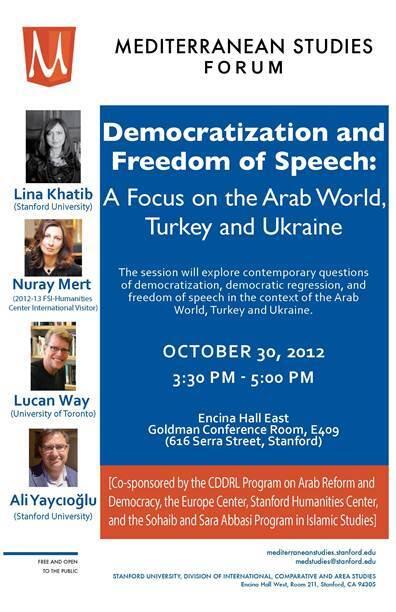
Co-sponsored by CDDRL Program on Arab Reform and Democracy, the Europe Center, Stanford Humanities Center, and the Abbasi Program in Islamic Studies

More info: http://www.stanford.edu/group/mediterranean/cgi-bin/web/2012/08/democratization-and-freedom-of-speech-a-focus-on-turkey-arab-world-and-ukraine/

Image

Richard and Rhoda Goldman Conference Room

Nuray Mert FSI-Humanities Center International Visitor Panelist
Lina Khatib Program Manager for the Program on Arab Reform and Democracy Panelist CDDRL
Lucan Way Associate Professor of Political Science Panelist University of Toronto
Ali Yaycioğlu Assistant Professor of Middle East History Moderator Stanford
Panel Discussions
-

Co-sponsored by the Abbasi Program on Islamic Studies, CDDRL Program on Arab Reform and Democracy, the Europe Center, Stanford Humanities Center, the Mediterranean Studies Forum, and the Center for Russian, East European and Eurasian Studies.

Reuben W. Hills Conference Room

Nuray Mert 2012-13 FSI-Humanities International Visitor Speaker
Lina Khatib Speaker
Lucan Way Speaker
Ali Yaycioğlu Speaker
Panel Discussions
-

Abstract:

Nearly two years after the Tunisian uprisings launched a massive wave of regional protest across the Arab world, many important and highly contested questions remain. How has the protest wave affected the dynamics of regional politics? Has the protest wave ended, or is it likely to recur? What explains the timing, the accomplishments and the limitations of that protest wave? What does the survival of many Arab regimes, the frustration of revolutionaries, the rise of Islamist movements in electoral politics, and the spiraling conflict in Syria mean for hopes of democratization and peaceful political change?

About the speaker:

Marc Lynch is associate professor of political science and international affairs at The George Washington University, where he directs the Institute for Middle East Studies. He also directs the Project on Middle East Political Science, edits the Middle East Channel for ForeignPolicy.com and the Columbia University Press book series Columbia Studies on Middle East Politics, and is a non-resident senior fellow at the Center for a New American Security. His most recent publications include The Arab Uprising (PublicAffairs 2012), Islamists in a Changing Middle East (ForeignPolicy 2012), and Blogs and Bullets II: New Media and the Arab Spring (US Institute for Peace).

CISAC Conference Room

Marc Lynch Director, Institute for Middle East Studies Speaker George Washington University
Seminars
-

Stephen Stedman is Freeman Spogli senior fellow at the Center on Democracy, Development, and the Rule of Law and FSI, an affiliated faculty member at CISAC, and professor of political science (by courtesy) at Stanford University. He currently serves as the Director for the Global Commission on Elections, Democracy, and Security, a body of eminent persons tasked with developing recommendations on promoting and protecting the integrity of elections and international electoral assistance. The Commission is a joint project of the Kofi Annan Foundation and International IDEA, an intergovernmental organization that works on international democracy and electoral assistance.

In 2003-04 Professor Stedman was Research Director of the United Nations High-level Panel on Threats, Challenges and Change and was a principal drafter of the Panel’s report, A More Secure World: Our Shared Responsibility. In 2005 he served as Assistant Secretary-General and Special Advisor to the Secretary- General of the United Nations, with responsibility for working with governments to adopt the Panel’s recommendations for strengthening collective security and for implementing changes within the United Nations Secretariat, including the creation of a Peacebuilding Support Office, a Counter Terrorism Task Force, and a Policy Committee to act as a cabinet to the Secretary-General. His most recent book, with Bruce Jones and Carlos Pascual, is Power and Responsibility: Creating International Order in an Era of Transnational Threats (Washington DC: Brookings Institution, 2009).

Encina Ground Floor Conference Room

CDDRL
Encina Hall, C152
616 Jane Stanford Way
Stanford, CA 94305-6055

(650) 725-2705 (650) 724-2996
0
Senior Fellow at the Freeman Spogli Institute for International Studies
Professor, by courtesy, of Political Science
Stedman_Steve.jpg PhD

Stephen Stedman is a Senior Fellow at the Freeman Spogli Institute for International Studies (FSI) and the Center on Democracy, Development and the Rule of Law (CDDRL), an affiliated faculty member at CISAC, and professor of political science (by courtesy) at Stanford University. He is director of CDDRL's Fisher Family Honors Program in Democracy, Development and Rule of Law, and will be faculty director of the Program on International Relations in the School of Humanities and Sciences effective Fall 2025.

In 2011-12 Professor Stedman served as the Director for the Global Commission on Elections, Democracy, and Security, a body of eminent persons tasked with developing recommendations on promoting and protecting the integrity of elections and international electoral assistance. The Commission is a joint project of the Kofi Annan Foundation and International IDEA, an intergovernmental organization that works on international democracy and electoral assistance.

In 2003-04 Professor Stedman was Research Director of the United Nations High-level Panel on Threats, Challenges and Change and was a principal drafter of the Panel’s report, A More Secure World: Our Shared Responsibility.

In 2005 he served as Assistant Secretary-General and Special Advisor to the Secretary- General of the United Nations, with responsibility for working with governments to adopt the Panel’s recommendations for strengthening collective security and for implementing changes within the United Nations Secretariat, including the creation of a Peacebuilding Support Office, a Counter Terrorism Task Force, and a Policy Committee to act as a cabinet to the Secretary-General.

His most recent book, with Bruce Jones and Carlos Pascual, is Power and Responsibility: Creating International Order in an Era of Transnational Threats (Washington DC: Brookings Institution, 2009).

Director, Fisher Family Honors Program in Democracy, Development and Rule of Law
Director, Program in International Relations
Affiliated faculty at the Center for International Security and Cooperation
Date Label
Stephen J. Stedman Freeman Spogli Senior Fellow at the Center on Democracy, Development, and the Rule of Law and FSI; CISAC Affiliated Faculty Member; Professor (by courtesy) of Political Science Speaker
Seminars
Subscribe to Democracy