FSI scholars approach their research on the environment from regulatory, economic and societal angles. The Center on Food Security and the Environment weighs the connection between climate change and agriculture; the impact of biofuel expansion on land and food supply; how to increase crop yields without expanding agricultural lands; and the trends in aquaculture. FSE’s research spans the globe – from the potential of smallholder irrigation to reduce hunger and improve development in sub-Saharan Africa to the devastation of drought on Iowa farms. David Lobell, a senior fellow at FSI and a recipient of a MacArthur “genius” grant, has looked at the impacts of increasing wheat and corn crops in Africa, South Asia, Mexico and the United States; and has studied the effects of extreme heat on the world’s staple crops.
Gita Wirjawan joined the Walter H. Shorenstein Asia-Pacific Research Center (Shorenstein APARC) as a visiting scholar for the 2022-23 and 2023-2024 academic years. In the 2024-25 year, he is a visiting scholar with Stanford's Precourt Institute for Energy. Wirjawan is the chairman and founder of Ancora Group and Ancora Foundation, as well as the host of the podcast "Endgame." While at APARC, he researched the directionality of nation-building in Southeast Asia and sustainability and sustainable development in the U.S. and Southeast Asia.
Rainforest in Sumatra, Indonesia burned to make space for palm oil plantations. | Peter Prokosch / GRID-Arendal
All News button
1
Subtitle
New work by team including FSE researchers provides a broad, cautionary understanding of why financial incentives alone are unlikely to prevent forest-clearing fires in Indonesia’s oil palm regions.
A vast array of critical new technologies rely on rare earth metals, a group of elements that are difficult to mine because they are so well dispersed in the earth and often contain radioactive elements such as thorium and uranium.
Over the last 20 years, demand for these elements in the U.S. has increased while domestic supply and production have fallen off. And globally, the supply chain is tightly controlled by just a few countries.
To explore the significant challenges created by this imbalanced supply chain, Gorakh Pawar, a visiting scholar at CISAC, and CISAC Co-Director Rod Ewing edited “Rare Earth Elements in Material Science,” a special theme issue of the MRS Bulletin, a journal of the Materials Research Society.
“With China's rapid rise and the reemergence of Russia as a major power, the global stage is set for multipolar competition to secure the critical materials supply chains and control the rare earth elements (REE) derived high-end products and relevant technologies,” Ewing and Pawar write in the introduction to the issue.
The issue includes six articles that delve into the material science aspects of the rare earth elements supply chain. Researchers from Australia, Germany, Korea and the US contributed articles on mineralogy, separation and extraction, mining economics and the environmental impact of rare earth element mining.
“REE recycling is no longer just a choice, but it has become necessary in a world where resources are constrained,” Pawar and Ewing write.
The MRS Bulletin includes recommendations that the US and other countries can follow to reduce dependence on China for rare earth elements.
The March issue of the MRS Bulletin can be found here.
Hero Image
All News button
1
Subtitle
A vast array of critical new technologies rely on rare earth metals, a group of elements that are difficult to mine because they are so well dispersed in the earth and often contain radioactive elements such as thorium and uranium.
As graduation approaches, many of our students are looking toward the future and new opportunities beyond the Farm. For the members of the Class of 2022 in the Ford Dorsey Master’s in International Policy (MIP), their time at Stanford was particularly unique. While they've finished their program together and in-person, the 24 members of the graduating class began their journey at the Freeman Spogli Institute for Internationsl Studies with a mix of online learning, outdoor classes, and health check requirements put in place to help mitigate the evolving COVID-19 pandemic.
Now at the end of their two years in the program we’ve asked four of our graduating students to share their thoughts on their time in MIP, what they’ve learned while at FSI, and where they will be heading next.
Sylvie Ashford | Starting with Questions, Not Answers
I am a co-term student, and I’m finishing up my B.A. in International Relations and Arabic at Stanford, with Honors in Democracy, Development, and the Rule of Law. I’m originally from Washington, D.C, and before coming to MIP I worked as a Middle East policy research assistant and campaign field organizer.
MIP was exactly what I hoped it would be. The program brings together fascinating people from different countries and life paths. I learned so much from them in and out of the classroom, which ended up being one of the most meaningful aspects of the program. Particularly after spending the first half of the program on Zoom, I loved every time we were able to come together as a cohort for classes and social events this year.
Being a part of this community has definitely changed how I think about the process of policymaking. What I've really come to understand is that policymaking should start with a question, not an answer, and with a rigorous effort to understand a specific social problem in its own context. After graduation, I'm moving to San Francisco to work at the Natural Resources Defense Council, and I know that keeping that perspective in mind will be a huge help to me as I’m doing policy analysis and advocacy work to support the NRDC's Climate and Clean Energy Program.
Sylvie Ashford
Master's in International Policy '22, Energy, Natural Resources, and the Environment (ENRE)
When I first started as an MIP student, I didn’t realize how flexible the program would be or how many options there are to study in different fields. The program really emphasizes how to approach policy making through practical considerations, not just wishful thinking, whether that’s in computer programming and coding, international affairs, climate science, business, design thinking, or any of the other topics policy covers. There’s a lot of crossover with other programs on campus like the design school and the Graduate School of Business, I think this dynamic gives students a policy framework that's grounded in sound political strategies.
It’s definitely been a busy two years. Beyond being a MIP student, I’m also an active duty officer in the U.S. army, and I have a family. I’ve been very appreciative of how I was able to work within the program to try and keep all of those different responsibilities in balance. This is the best location, hands down, to pursue a policy degree, and there are so many opportunities to get experience with things you truly value, whether that’s family, friends, researching a topic you have strong opinions about, coding, or surfing.
After graduation, I will be returning to the Army to be an operations officer, or a prime integrator, in organizations ranging from 700 to 10,000 soldiers. I know that what I’ve learned here at FSI in the master’s program — both about policy making and myself — is going to help me serve our men and women in uniform better.
David Sprague
Master's in International Policy '22, Cyber Policy and Security (CYBER)
I am graduating this June, but I’m not going far! The program helped me realize my dreams to continue my career in academia, and so I will be pursuing a PhD in political science here at Stanford.
Part of the MIP experience is the one-on-one advisor matching that the program organizes for students. I was paired with Dr. Jeremy Weinstein, and he was so genuinely helpful and keen on setting me up for success. He met with me every two weeks to help me plan and prepare to be a competitive, successful PhD candidate after MIP.
For any students coming into the program, I would strongly advise you take advantage of how flexible the program is. The four specializations — Cyber, Environment, Governance and Development, and International Security — are there to guide you, not to put you in a box. Take courses from departments in your interests and customize your electives to whatever you think will help you. Don’t be afraid to go beyond what’s expected of you in the program to explore and make the best out of your two years on the Stanford campus!
Shirin Kashani
Master's in International Policy '22, Governance and Development (GOVDEV)
Prior to starting this master’s program, I spent eight years studying and working in Beijing and Hong Kong, where I most recently worked for a global risk consultancy, assisting multinational companies with assessing cyber risk, threats, and regulations, as well as crisis management. One of my goals here at Stanford was to pivot away from Asia and refocus my studies in cyber security and cyber policy in the U.S.
Because it’s right in Silicon Valley and so close to the leading industries, the MIP program here at Stanford was my top choice of school, and it has not disappointed. Aside from being able to closely interact with top faculty members and professors such as Frank Fukuyama, I got to see guest speakers such as President Bill Clinton, President Barack Obama, and other high-level U.S. military officials that Stanford has brought to campus to speak to students. I’ve learned so much from classes like “INTLPOL 340: Technology, Innovation and Modern War,” taught by Steve Black and Joe Felter, and groups like the Hack Lab.
As my time at Stanford comes to an end, my academic experience and industry experience are making a full circle, and I will be going to work with the global financial technology firm where I interned over the summer. I will be working on technology and information security issues while I am in the U.S. by using the one year of optional practical training (OPT). Given the current events in Ukraine and their proximity to my native Estonia, at some point I would also like to be able to contribute my skills and experience back home.
Mikk Raud
Master's in International Policy '22, Cyber Policy and Security (CYBER)
Capstones from the 2022 Class of the Ford Dorsey Master's in International Policy
Meghan Moura
Meghan Moura
Meghan Moura
Meghan Moura
Meghan Moura
[LEFT] Janani Mohan, Leonel Diaz, and Eli MacKinnon were paired with the United Nations Development Programme in South Africa, and presented on "Connected Cafes: Narrowing the Employment Gap for Johannesburg Township Youth; [RIGHT] Chaeri Park, and Mikk Raud, Me Me Khant, and Eyal Zilberman worked with the Cyber Threat Alliance in Washington D.C., and presented on "Increasing Healthcare SMEs' Collective Resilience Against Ransomware."
Photo by:
Meghan Moura
Sylvie Ashford, Calli Obern, Daniel Gajardo, and Sarah Baran were paired with a branch of the U.S. Department of Energy's National Renewable Energy Laboratory (NREL) in Indonesia, and presented on "Decarbonizing Industrial Heat in the Indonesian Textiles & Apparel Sector."
Photo by:
Meghan Moura
Amanda Leavell, Madeleine Morlino, and Shirin Kashani worked with SheThePeople.TV in India, and presented on "Women's Access to SRH Information in India."
Photo by:
Meghan Moura
Kyle Thompson, Soomin Jun, and Emily Bauer (pictured with Kyle's wife Eman and Dr. Francis Fukuyama) partnered with Wasabi in Tunisia, and presented on "Taxes and Trash: Creating a Sustainable Taxpaying Culture in Tunisia."
Photo by:
Meghan Moura
Arelena Shala, Bradley Jackson, Johannes Hui, and Dave Sprague (pictured with the Hon. Rose Gottemoeller) worked with the International Centre for Defense and Security (ICDS) in Estonia, and presented on "Imposing Costs on Hybrid Aggressors in the Baltics."
Photo by:
Meghan Moura
Each of the students in the 2022 class of the Ford Dorsey Master's in International Policy has had the opportunity to practice policymaking and problem solving hands-on in the Policy Change Studio, the two-quarter capstone course of the MIP program. Each year, second-year students partner with NGOs, think tanks, and other groups around the world to get out of the classroom and into the world to bring their know-how to some of the world's most pressing issues.
To learn more about what the 2022 cohort has been working on, explore some of the capstone presentations below.
The Ford Dorsey Master's in International Policy
Want to learn more? MIP holds admission events throughout the year, including graduate fairs and webinars, where you can meet our staff and ask questions about the program.
Off the Farm and Into the Field: Master's Students Practice Hands-on Policymaking
The 2022 cohort of the Ford Dorsey Master's in International Policy has been busy this quarter getting out of the classroom and into hands-on policymaking with partner organizations in Tunisia, Estonia, India and beyond.
Where Our Master's Students are Making Policy Impacts in 2022
From women's health and reproductive rights in India to cybersecurity issues in Washington D.C., students from the 2022 cohort of the Ford Dorsey Master's in International Policy are tackling big policy projects in the Policy Change Studio.
Meet the Ford Dorsey Master’s in International Policy Class of 2022
The new cohort of MIP students kicked off an unusual fall quarter last week. Four of the first-year students describe what attracted them to the program and their hopes for the future.
Students and faculty from the Ford Dorsey Master's in International Policy gather outside of Encina Hall at Stanford University to celebrate the end of the 2022 academic year. | Meghan Moura
All News button
1
Subtitle
As the 2022 cohort of Master’s in International Policy students prepares to graduate, four classmates — Sylvie Ashford, David Sprauge, Shirin Kashani, and Mikk Raud — reflect on their experiences being part of the FSI community.
Join us on Tuesday, June 7th from 12 PM - 1 PM PT for “Enhancing the FTC's Consumer Protection Authority to Regulate Social Media Companies” featuring Paul Barrett of the NYU Stern Center for Business and Human Rights, and Susan Ness of the Annenberg Public Policy Center in conversation with Julie Owono of the Content Policy & Society Lab. This weekly seminar series is jointly organized by the Cyber Policy Center’s Program on Democracy and the Internet and the Hewlett Foundation’s Cyber Initiative.
About the Seminar:
The social media industry’s self-regulation has proven inadequate. It is time for Congress and the Federal Trade Commission to step in. Enhancing the FTC's Consumer Protection Authority to Regulate Social Media Companies offers principles and policy goals to help lawmakers and regulators sort through the dozens of bills pending before Congress and shape an agenda for the FTC to use its consumer protection authority to incentivize better corporate conduct.
About the Speakers:
Paul Barrett is the deputy director and senior research scholar at the Center for Business and Human Rights at New York University’s Stern School of Business. He joined the Center in September 2017 after working for more than three decades as a journalist focusing on the intersection of business, law, and society. At Bloomberg Businessweek magazine, he wrote cover stories on topics such as energy and the environment, military procurement, and the civilian firearm industry. From 1986 to 2005, he wrote for The Wall Street Journal, serving for part of that time as the newspaper’s Supreme Court correspondent. Paul is the author of four nonfiction books, including GLOCK: The Rise of America’s Gun, a New York Times Bestseller.
At the Center for Business and Human Rights, Paul has written a series of reports on the role of the social media industry in a democracy. Topics have included the problems of foreign and domestic disinformation, the consequences of outsourced content moderation, the debate over Section 230, the role of social media in intensifying political polarization in the U.S., and how Congress could enhance the Federal Trade Commission’s consumer protection authority to regulate the major platforms. Since 2008, Paul has served as an adjunct professor at the NYU School of Law, where he co-teaches a seminar called “Law, Economics, and Journalism.” He holds undergraduate and law degrees from Harvard.
Susan Ness is a distinguished fellow at the Annenberg Public Policy Center, where she leads a project to encourage transatlantic governments and stakeholders to forge common ‘modular’ solutions that are accepted under different tech regulatory frameworks. Previously, she convened the Transatlantic High-Level Working Group on Content Moderation and Freedom of Expression, which published a report and 14 briefing papers. She also is a distinguished fellow at the German Marshall Fund, working on transatlantic digital policy. She is a former member of the Federal Communications Commission, where she focused on digital transformation of communications. She is a board member of both media company TEGNA Inc, and Vital Voices Global Partnership, an NGO that supports women leaders who are improving the world. She holds a J.D. from Boston College Law School and an M.B.A. from The Wharton Graduate School (University of Pennsylvania).
Julie Owono is the Executive Director of the Content Policy & Society Lab (CPSL) and a fellow of the Program on Democracy and the Internet (PDI) at Stanford University. She is also the Executive Director of digital rights organization Internet Sans Frontières, one of the inaugural members of the Facebook Oversight Board, and an affiliate at the Berkman Klein Center at Harvard University. She holds a Master’s degree in International Law from la Sorbonne University in Paris, and practiced as a lawyer at the Paris Bar.
With a fluency in five languages, a childhood spent in various countries, and an educational background at the Lyçée Français Alexandre Dumas in Moscow, Julie has a unique perspective to understand the challenges and opportunities of a global Internet. This background has shaped her belief that global and multi stakeholder collaborations can be instrumental in the emergence of rights-based content policies and regulations.
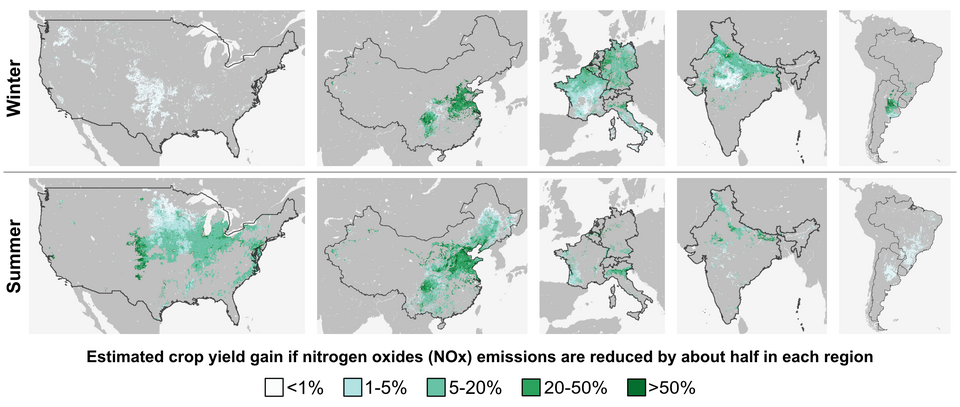
Usually, increasing agricultural productivity depends on adding something, such as fertilizer or water. A new Stanford University-led study reveals that removing one thing in particular – a common air pollutant – could lead to dramatic gains in crop yields. The analysis, published June 1 in Science Advances, uses satellite images to reveal for the first time how nitrogen oxides – gases found in car exhaust and industrial emissions – affect crop productivity. Its findings have important implications for increasing agricultural output and analyzing climate change mitigation costs and benefits around the world.
“Nitrogen oxides are invisible to humans, but new satellites have been able to map them with incredibly high precision. Since we can also measure crop production from space, this opened up the chance to rapidly improve our knowledge of how these gases affect agriculture in different regions,” said study lead author David Lobell, the Gloria and Richard Kushel Director of Stanford’s Center on Food Security and the Environment.
A NOx-ious problem
Nitrogen oxides, or NOx, are among the most widely emitted pollutants in the world. These gases can directly damage crop cells and indirectly affect them through their role as precursors to formation of ozone, an airborne toxin known to reduce crop yields, and particulate matter aerosols that can absorb and scatter sunlight away from crops.
While scientists have long had a general understanding of nitrogen oxides’ potential for damage, little is known about their actual impacts on agricultural productivity. Past research has been limited by a lack of overlap between air monitoring stations and agricultural areas, and confounding effects of different pollutants, among other challenges to ground-based analysis.
To avoid these limitations, Lobell and his colleagues combined satellite measures of crop greenness and nitrogen dioxide levels for 2018-2020. Nitrogen dioxide is the primary form of NOx and a good measure of total NOx. Although NOx is invisible to humans, nitrogen dioxide has a distinct interaction with ultraviolet light that has enabled satellite measurements of the gas at a much higher spatial and temporal resolution than for any other air pollutant.
“In addition to being more easily measured than other pollutants, nitrogen dioxide has the nice feature of being a primary pollutant, meaning it is directly emitted rather than formed in the atmosphere,” said study co-author Jennifer Burney, an associate professor of environmental science at the University of California, San Diego. “That means relating emissions to impacts is much more straightforward than for other pollutants.”
Image
Calculating crop impacts
Based on their observations, the researchers estimated that reducing NOx emissions by about half in each region would improve yields by about 25% for winter crops and 15% for summer crops in China, nearly 10% for both winter and summer crops in Western Europe, and roughly 8% for summer crops and 6% for winter crops in India. North and South America generally had the lowest NOx exposures. Overall, the effects seemed most negative in seasons and locations where NOx likely drives ozone formation.
“The actions you would take to reduce NOx, such as vehicle electrification, overlap closely with the types of energy transformations needed to slow climate change and improve local air quality for human health,” said Burney. “The main take-home from this study is that the agricultural benefits of these actions could be really substantial, enough to help ease the challenge of feeding a growing population.”
Previous research by Lobell and Burney estimated reductions in ozone, particulate matter, nitrogen dioxide, and sulfur dioxide between 1999 and 2019 contributed to about 20% of the increase in U.S. corn and soybean yield gains during that period – an amount worth about $5 billion per year.
Future analysis could incorporate other satellite observations, including photosynthetic activity measured through solar-induced fluorescence, to better understand nitrogen dioxide’s effects on crops’ varying degrees of sensitivity to the gas throughout the growing season, according to the researchers. Similarly, more detailed examination of other pollutants, such as sulfur dioxide and ammonia, as well as meteorological variables, such as drought and heat, could help to explain why nitrogen dioxide affects crops differently across different regions, years, and seasons.
“It’s really exciting how many different things can be measured from satellites now, much of it coming from new European satellites,” said study coauthor Stefania Di Tommaso, a research data analyst at Stanford’s Center on Food Security and the Environment. “As the data keep improving, it really drives us to be more ambitious and creative as scientists in the types of questions we ask.”
New analysis shows crop yields could increase by about 25% in China and up to 10% in other parts of the world if emissions of a common air pollutant decreased by about half.
Join us on Tuesday, May 31st from 12 PM - 1 PM PT for "A Former South African Politician’s Effort to Combat Misinformation in Elections" featuring Phumzile Van Damme, former Member of Parliament in South Africa, in conversation with Julie Owono of the Content Policy & Society Lab (CPSL). This weekly seminar series is jointly organized by the Cyber Policy Center’s Program on Democracy and the Internet and the Hewlett Foundation’s Cyber Initiative.
About the Seminar:
Misinformation during elections is a serious concern for democratic systems around the world. This is particularly true in various African countries, cases of electoral violence have been linked to disruptions in the informational realm. Yet, the underinvestment by technology companies in initiatives to limit the existence and impact of disinformation in Africa remains a reality.
Local initiatives have attempted to mitigate this inequality. This week’s webinar will focus on the work of Former South African MP Phumzile Van Damme, who launched a project to tackle the spread of misinformation on social media platforms before and during the local government elections in November 2021. She will share on the methodology used, and results observed. The webinar will also discuss the challenges faced in ensuring that South African users and citizens have access to reliable information.
About the Speakers:
Phumzile Van Damme is an independent consultant on disinformation and digital rights. She is a member of the Real Facebook Oversight Board, the International Grand Committee on Disinformation, and an advisory council member of #ShePersisted. Van Damme’s work on misinformation was the subject of a documentary that premiered at Sundance Film Festival in 2020, “Influence.”
A former Member of Parliament in South Africa, Van Damme served on the Communications and Digital Technologies committee as Shadow Minister. She played a pivotal role in holding social media platforms accountable for misinformation on their platforms and spearheaded the summoning of Facebook and other tech giants to Parliament.
In September 2021, she helped found and coordinate South Africa’s first electoral disinformation monitoring project, the ‘Local Government Anti-Disinformation Project’. She has spoken on various platforms on the subject of disinformation including at the UNDP and the UN Commission on the Status of Women.
Julie Owono is the Executive Director of the Content Policy & Society Lab (CPSL) and a fellow of the Program on Democracy and the Internet (PDI) at Stanford University. She is also the Executive Director of digital rights organization Internet Sans Frontières, one of the inaugural members of the Facebook Oversight Board, and an affiliate at the Berkman Klein Center at Harvard University. She holds a Master’s degree in International Law from la Sorbonne University in Paris, and practiced as a lawyer at the Paris Bar.
With a fluency in five languages, a childhood spent in various countries, and an educational background at the Lyçée Français Alexandre Dumas in Moscow, Julie has a unique perspective to understand the challenges and opportunities of a global Internet. This background has shaped her belief that global and multi stakeholder collaborations can be instrumental in the emergence of rights-based content policies and regulations.
Join us on Tuesday, May 17th from 12 PM - 1 PM PT for “Exposure to Untrustworthy Websites in the 2020 US Election” featuring Jeff Hancock, Ross Dahlke & Ryan Moore of the Social Media Lab. This weekly seminar series is jointly organized by the Cyber Policy Center’s Program on Democracy and the Internet and the Hewlett Foundation’s Cyber Initiative.
About The Seminar:
Prior research has documented exposure to fake news and online misinformation using large-scale data on individuals’ media use, which has provided important information about the scope and nature of people’s exposure to misinformation online. However, most of this work has made use of data collected during the 2016 US election, and far fewer studies have examined how exposure to misinformation online has changed since 2016. In this paper, we examine exposure to untrustworthy websites in the lead up to the 2020 US election using a dataset of over 7.5 million passively tracked website visits from a nationally representative sample of American adults (N = 1,151). We find that a significantly smaller percentage of Americans were exposed to untrustworthy websites in 2020 compared to in 2016 (as calculated by Guess et al. [2020]). While exposure was concentrated among similar groups of people as it was in 2016, levels of exposure appear to be lower across the board. There were also differences in the role online platforms played in directing people to untrustworthy websites in 2020 compared to 2016. Our findings have implications for future research and practice around online misinformation.
About The Speakers:
Jeff Hancock is the founding director of the Stanford Social Media Lab and is Harry and Norman Chandler Professor of Communication at Stanford University. Professor Hancock and his group work on understanding psychological and interpersonal processes in social media. The team specializes in using computational linguistics and experiments to understand how the words we use can reveal psychological and social dynamics, such as deception and trust, emotional dynamics, intimacy and relationships, and social support. Recently Professor Hancock has begun work on understanding the mental models people have about algorithms in social media, as well as working on the ethical issues associated with computational social science.
Ross Dahlke, from Westfield, Wisconsin, is pursuing a PhD in theory and research in the Stanford Social Media Lab at the Stanford School of Humanities and Sciences. He graduated from the University of Wisconsin-Madison with bachelor’s degrees in journalism and political science. Ross’s research focuses on applying AI and computational techniques to understand how people interact with complex systems. Before graduate school, he was a data scientist at a marketing technology firm where he developed machine learning platforms that helped Fortune 500 companies optimize their digital marketing spend in order to drive sales. He has also consulted on dozens of state-wide and local political campaigns. In high school, Ross started a cheese distribution business which has sold more than $3 million in cheese.
Ryan Moore studies how features of new media platforms and technologies affect the consumption, processing, and sharing of information, especially information about politics and news. In addition, he is interested in the role that age plays in internet and technology use, particularly as it relates to encountering deceptive or misleading content.
Day 1 of the workshop will focus on the strategic dimensions of industrial policy relating to digital goods and services. Key topics include national security reviews of inbound and outbound investments, export controls, and supply chain risks, with a view towards identifying areas that are ripe for multilateral alignment as well as points of friction and options for managing those points of friction. Elaborating the respective roles and responsibilities of government and private sector actors will be an important theme.
Day 2 of the workshop will focus on regulatory policy and workforce challenges and opportunities, especially AI and its ecosystem of supporting technologies.
Join us on Tuesday, May 10 from 12 PM - 1 PM PT for “Big Speech” featuring Kate Klonick of St. John’s University Law School, in conversation with Nate Persily of the Cyber Policy Center. This weekly seminar series is jointly organized by the Cyber Policy Center’s Program on Democracy and the Internet and the Hewlett Foundation’s Cyber Initiative.
About the Seminar:
Technology companies seem omnipotent, omnipresent, and without accountability for their harms to society. Nowhere is this truer than in the realm of Big Speech—the firms who control and profit from large scale user-generated content platforms. With reform through direct regulation likely foreclosed by the First Amendment, recent intervention has focused instead on breaking up these platforms under antitrust law. These proposals tap into both the pragmatic and emotional frustration around the power of private firms over freedom of expression and the public sphere. But while break up might be valuable in other areas of big tech, its effect on Big Speech is less certain.
Will breaking up Big Speech make individual user experience and the digital public sphere better or worse? Join us for insight on the nature of Big Speech and the challenges of reform.
About the Speakers:
Kate Klonick is an Associate Professor at St. John's University Law School, a fellow at the Brookings Institution and Yale Law School’s Information Society Project. Her writing on online speech, freedom of expression, and private governance has appeared in the Harvard Law Review, Yale Law Journal, The New Yorker, the New York Times, The Atlantic, theWashington Post and numerous other publications.
Nathaniel Persily is the James B. McClatchy Professor of Law at Stanford Law School, with appointments in the departments of Political Science, Communication, and FSI. Prior to joining Stanford, Professor Persily taught at Columbia and the University of Pennsylvania Law School, and as a visiting professor at Harvard, NYU, Princeton, the University of Amsterdam, and the University of Melbourne. Professor Persily’s scholarship and legal practice focus on American election law or what is sometimes called the “law of democracy,” which addresses issues such as voting rights, political parties, campaign finance, redistricting, and election administration. He has served as a special master or court-appointed expert to craft congressional or legislative districting plans for Georgia, Maryland, Connecticut, New York, North Carolina, and Pennsylvania. He also served as the Senior Research Director for the Presidential Commission on Election Administration. His current work, for which he has been honored as a Guggenheim Fellow, Andrew Carnegie Fellow, and a Fellow at the Center for Advanced Study in the Behavioral Sciences, examines the impact of changing technology on political communication, campaigns, and election administration. He is codirector of the Stanford Cyber Policy Center, Stanford Program on Democracy and the Internet, and the Stanford-MIT Healthy Elections Project, which supported local election officials in taking the necessary steps during the COVID-19 pandemic to provide safe voting options for the 2020 election. He is also a member of the American Academy of Arts and Sciences, and a commissioner on the Kofi Annan Commission on Elections and Democracy in the Digital Age.

 FSI scholars approach their research on the environment from regulatory, economic and societal angles. The Center on Food Security and the Environment weighs the connection between climate change and agriculture; the impact of biofuel expansion on land and food supply; how to increase crop yields without expanding agricultural lands; and the trends in aquaculture. FSE’s research spans the globe – from the potential of smallholder irrigation to reduce hunger and improve development in sub-Saharan Africa to the devastation of drought on Iowa farms.