
Food Security
News Type
Blogs
Date
Paragraphs

The world’s health systems face a complex and interconnected set of challenges that threaten to outpace our capacity to respond. Geopolitical fragmentation, climatic breakdown, technological disruption, pandemic threats, and misinformation have converged to strain the foundations of global health.  Building resilient global health systems requires five urgent reforms: sharpening the mandate of the World Health Organization (WHO), operationalizing the One Health concept, modernizing procurement, addressing the climate–health nexus, and mobilizing innovative financing. Together, these shifts can move the world from fragmented, reactive crisis management to proactive, equitable, and sustainable health security.

Emerging and Escalating Threats

While the global community demonstrated remarkable resilience in weathering the COVID-19 pandemic, the crisis also exposed profound structural weaknesses in global health governance and architecture. Chronic underinvestment in health systems led to coverage gaps, workforce shortages, and inadequate surveillance systems. The pandemic also revealed a fragmented global health architecture, plagued by institutional silos among key agencies (Elnaiem et al. 2023).

Years later, the aftershocks of the pandemic still resonate worldwide, with the ongoing triple burden of disease—the unfinished agenda of maternal and child health, the rising silent pandemic of noncommunicable diseases, and the reemergence of communicable diseases. These challenges, combined with the persistent challenge of malnutrition, unmet needs in early childhood development, growing concerns around mental health, and the threat of other emerging diseases, as well as the rising toll of trauma, injury, and aging populations, have placed countries across the world under immense strain. Health systems face acute infrastructure gaps, critical workforce shortages, and persistent inequities in service delivery, making it increasingly difficult to address the complex and evolving health needs of their populations. Post-pandemic fiscal tightening has constrained health budgets with debt-to-GDP ratios exceeding 70–80% in parts of the region (UN ESCAP 2023).

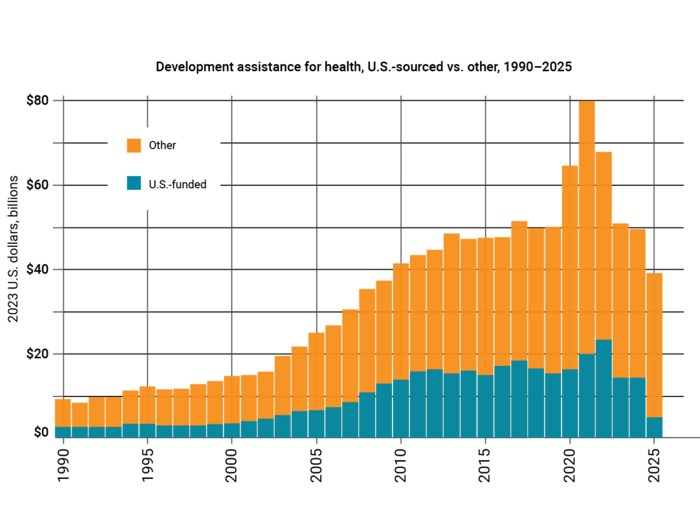
Global development assistance for health has significantly declined by more than $10 billion, with sharp cuts driven by the United States. This decline is likely to continue over the next five years.

 Furthermore, climate change is fundamentally redefining the risk landscape. Rising temperatures, more frequent floods, intensifying storms, and shifting vector ranges for organisms like mosquitoes and ticks are disrupting food systems, displacing populations, and driving new patterns of disease transmission. Over the next 25 years in low- and middle-income countries, climate change could cause over 15 million excess deaths, and economic losses related to health risks from climate change could surpass $20.8 trillion (World Bank 2024). The cost of inaction has never been higher.

Meanwhile, deepening political polarization is amplifying conflict and weakening the global cooperation essential for scientific progress. The number of geopolitical disturbances worldwide is at an all-time high, displacing over 122 million people and eroding access to essential health services (UNHCR 2024). In 2023, false and conspiratorial health claims amassed over 4 billion views across digital platforms, compromising vaccine uptake and fueling health-related conspiracy theories. (Kisa and Kisa 2025). Furthermore, exponential technological advances in artificial intelligence are outpacing public health governance systems, creating new ethical and equity dilemmas. Global development assistance for health has significantly declined by more than $10 billion, with sharp cuts driven by the United States. This decline is likely to continue over the next five years (Institute for Health Metrics and Evaluation 2025).
Image
Graph showing total development assistance for health, 1990-2025
Note: Development assistance for health is measured in 2023 real US dollars; 2025 data are preliminary estimates.
Source: Institute for Health Metrics and Evaluation 2025.
 

Sign up for APARC newsletters to receive our experts' updates >


Five Critical Reform Directions for Future-Proofing Global Health Systems


1.    WHO matters more than ever — but only if it sharpens its focus.

The World Health Organization remains the technical backbone of global health, with a mandate to set norms and standards, shape research agendas, monitor health trends, coordinate emergency responses and regulation, and provide technical assistance. COVID-19 underscored both its indispensability and its limitations. During the pandemic, WHO convened states, disseminated guidance, and spearheaded initiatives like the Solidarity Trial and COVAX to promote vaccine equity, illustrating why it remains vital as the only neutral platform where 194 member states can cooperate on pandemics, antimicrobial resistance, or climate-related health risks. Its work on universal health coverage, the “triple burden” of disease, and global health data continues to anchor policy across countries.

At the same time, the crisis exposed structural weaknesses: WHO lacks enforcement authority, relies heavily on voluntary donor-driven funding, and sometimes stretches beyond its comparative strengths. When it shifts from convening and technical guidance into direct fund management, logistics, or large-scale program delivery, it risks diluting its mandate and eroding trust. Critics argue this reflects a broader challenge of an expansive mandate and donor-driven mission creep, pushing WHO beyond what 7,000 staff and a modest budget can realistically deliver. The way forward lies in sharpening focus: leveraging its convening power and legitimacy, providing technical expertise and evidence-based guidance, coordinating emergencies under the International Health Regulations, and advocating for equity in access to medicines and care. Anchored in these core strengths, a more agile WHO can better lead during crises, sustain credibility, and ensure that global health standards are consistently applied across diverse national contexts.

2.    Animal Health as the Next Frontier

More than 70 percent of emerging infectious diseases are zoonotic in origin, with roughly three-quarters of newly detected pathogens in recent decades spilling over from animals into humans (WHO 2022; Jones, Patel, Levy, et al. 2008). The economic costs are staggering: the World Bank estimates that zoonotic outbreaks have cost the global economy over $120 billion between 1997 and 2009 through crises such as Nipah, SARS, H5N1, and H1N1 (World Bank 2012). The drivers of spillover are intensifying due to deforestation and land-use change, industrial livestock farming, wildlife trade, and climate change. These are further accelerating the emergence of novel pathogens. 

However, the governance of animal health remains fragmented. While WHO, the Food and Agriculture Organization (FAO), and the World Organization for Animal Health (WOAH) each hold mandates, they often operate in silos. The Quadripartite, expanded in 2021 to include the United Nations Environment Programme, launched a One Health Joint Plan of Action (2022–26), but it remains underfunded and lacks strong political commitment. 

There is an urgent need to move One Health from principle to practice. To fill this governance gap, the world should consider establishing an independent intergovernmental alliance for animal health with a clear mandate. This could strengthen global One Health response by augmenting joint surveillance, building veterinary workforce capacity, and integrating environmental data into early warning systems. Such an alliance should avoid creating new bureaucratic layers and instead leverage the Quadripartite as its operational backbone. Embedding One Health into national health strategies and cross-sectoral policies would enable animal, human, and environmental health systems to work in tandem and address risks at their source. Preventive investments are also very cost-effective; the World Bank estimates that annual One Health prevention investments of $10–11 billion could save multiple times that amount in avoided pandemic losses (World Bank 2012). Strengthening One Health is both a health and economic necessity. 

COVID-19 revealed how vital procurement and financial management are to global health security [...] Reform must begin by making procurement agile, transparent, and equitable.

3.    Agile Procurement: The Missing Link in Global Health Security

COVID-19 revealed how vital procurement and financial management are to global health security. A system built for routine procurement was suddenly called upon to handle crisis response on a worldwide scale, and it struggled to keep up. When vaccines became available, strict procedures, fragmented supply chains, and export restrictions meant access was uneven and often delayed. Developed countries’ advance purchase agreements stockpiled most of the supply, leaving many low- and middle-income countries waiting for doses. Within the UN system and its partners, overly complex procurement rules slowed the speed to market, and the lack of harmonized regulatory recognition caused further delays. As a result, those least able to handle shocks faced the longest waits and highest costs.

Reform must begin by making procurement agile, transparent, and equitable. Emergency playbooks should be pre-cleared to ensure that indemnity clauses and quality assurance requirements can be activated immediately when the next crisis arises. Regional pooled procurement mechanisms, like the Pan American Health Organization’s Revolving Fund or the African Union’s pooled initiatives, should be expanded to diversify supply sources and anchor distributed manufacturing. End-to-end e-procurement platforms would provide real-time shipment tracking, facility-level stock visibility, and open dashboards to strengthen accountability. Financial management must be integrated with procurement so that contingency funds, countercyclical reserves, and fast-disbursing credit lines can release resources in tandem with purchase orders. Together, these reforms would ensure that in future health emergencies, these procurement systems act as lifelines rather than bottlenecks.

4.    Addressing the Health–Climate Nexus

Climate change poses severe health risks, disproportionately affecting women and vulnerable populations in developing countries through heatwaves, poor air quality, food and water insecurity, and the spread of infectious diseases. Climate-related disasters are increasing in frequency and severity worldwide, reshaping both economies and health systems. In 2022, there were 308 climate-related disasters worldwide, ranging from floods and storms to droughts and wildfires (ADRC 2022). These events generated an estimated $270 billion in overall economic losses, with only about $120 billion insured—underscoring the disproportionate burden on low- and middle-income countries where resilience and coverage remain limited (Munich Re 2023). Over the past two decades, Asia and the Pacific have consistently been the most disaster-prone regions, accounting for nearly 40% of all global events, but every continent is now affected, from prolonged droughts in Africa and mega storms in North America to record-breaking heatwaves in Europe (UNEP n.d.).

Meeting this challenge requires a dual agenda of adaptation and mitigation. Health systems must be made climate-resilient by hardening infrastructure against floods and storms, ensuring reliable, clean energy in clinics and hospitals, and building climate-informed surveillance and early-warning systems that can anticipate disease outbreaks linked to environmental change. Supply chains need redundancy and flexibility to withstand shocks, and frontline workers require training to manage climate-driven health crises. At the same time, health systems must rapidly decarbonize. This means greening procurement and supply chains, phasing out high-emission medical products like certain inhalers and anesthetic gases, upgrading buildings and transport fleets, and embedding sustainability into financing and governance. Momentum is growing. The 2023 G20 Summit in Delhi, supported by the Asian Development Bank (ADB), recognized the health–climate nexus as a global priority, and institutions such as WHO, the World Bank, and ADB have begun to advance this agenda. The next step is to translate commitments into operational change by embedding climate-health strategies into national health plans, financing frameworks, and cross-sectoral policies. Climate action, sustainability, and resilience need to be integrated into the foundation of health systems.

5.    Mobilizing Innovative Financing

Strengthening health systems and preventing future pandemics will require massive financing, but global health funding is in decline. Innovative mechanisms to mobilize new resources are essential. This requires stronger engagement with finance ministries, development financing institutions, and the private sector to design models that attract and de-risk investment while enabling rapid disbursement during emergencies. International financing institutions (IFIs) need to unlock innovative financial pathways to amplify health investments. They need to deploy blended finance initiatives, public-private partnerships, guarantees, debt swaps, and outcome-based financing tools to mobilize private capital for health. Over the past few years, IFIs have committed billions in health-related financing worldwide. This has included landmark support for vaccine access facilities, delivery of hundreds of millions of COVID-19 vaccine doses, and mobilization of large-scale response packages that combine grants, loans, and technical assistance. 

Embedding health into climate policies and climate resilience into health strategies will ensure that future systems are both sustainable and resilient to shocks.

There is a need to broaden the financing mandate beyond investing in universal health coverage and mobilize capital for emerging areas, including the climate-health nexus, mental health, nutrition, rapid urbanization, demographic shifts, digitization, and non-communicable diseases. By leveraging their balance sheets, IFIs can generate a multiplier effect in fund mobilization and attract new financing actors. Innovative instruments are already demonstrating potential. For example, the International Finance Facility for Immunisation (IFFIm), which issues “vaccine bonds” backed by donor pledges, has raised over $8 billion for Gavi immunization programs (IFFIm 2022; Moody’s 2024).  Debt-for-health and debt-for-nature swaps have redirected debt service into social outcomes. For example, El Salvador’s 2019 Debt2Health agreement with Germany channeled approximately $11 million into strengthening its health system, while Seychelles’ debt-for-nature swap created SeyCCAT to finance marine conservation, yielding social and resilience co-benefits for coastal communities (Hu, Wang, Zhou, et al. 2024). Similarly, contingent financing facilities—such as the Innovative Finance Facility for Climate in Asia and the Pacific (IF-CAP) and the International Financing Facility for Education (IFFEd)—also hold significant potential for health (IFFEd n.d.; ADB n.d.).  These examples demonstrate how contingent financing and swaps can expand fiscal space without exacerbating debt distress.

This can create a virtuous cycle of facilitating investments that create regional cooperation for sustainable and scalable impact. In this vein, the G20 Pandemic Fund is a beacon of catalytic multilateralism funding in a fragmented world. Launched in 2022 with over $2 billion pooled from governments, philanthropies, and multilaterals, it strengthens pandemic preparedness in low- and middle-income countries. Every $1 awarded from the Pandemic Fund has mobilized an estimated $7 in additional financing. The fund demonstrates that nations can still unite around shared threats, offering hope and a template for collective action on global challenges.

Equally important is the ability to deploy funds rapidly in emergencies. During the COVID-19 pandemic, reserve and countercyclical funds, used by countries such as Germany, the Netherlands, and Lithuania, along with the Multilateral Development Bank’s fast-track financing facilities with streamlined approval and disbursement processes, provided urgent and timely financing support (Sagan, Webb, Azzopardi-Muscat, et al. 2021; Lee and Aboneaaj 2021). These mechanisms should be institutionalized in national financial management systems as well as IFIs to ensure rapid funding disbursement in future health emergencies

Moving Forward

Delivering on this reform agenda requires more than technical fixes—it demands political will, sustained financing, and cross-sectoral collaboration. Member states must empower WHO to lead within its comparative strengths, while reinforcing One Health through stronger mandates and funding. Governments, IFIs, and the private sector should jointly design agile procurement and financing mechanisms that can be activated at speed during crises. Embedding health into climate policies and climate resilience into health strategies will ensure that future systems are both sustainable and resilient to shocks. Above all, reform efforts must be anchored in equity, so that the most vulnerable are protected first.

The opportunity before the global community is to reimagine health as the backbone of resilience and prosperity in the 21st century. A whole-of-systems approach is necessary to clarify mandates, integrate animal and environmental health, develop agile and fair procurement systems, embed climate action into health systems, and mobilize innovative financing. The steps taken in the next few years can lead to a more connected, cooperative, and future-ready global health architecture. 


Works Cited

ADB (Asia Development Bank). n.d. “IF-CAP: innovative Finance Facility for Climate in Asia and the Pacific.”

ADRC (Asian Disaster Reduction Center). Natural Disasters Data Book 2022

Elnaiem, Azza, Olaa Mohamed-Ahmed, Alimuddin Zumla, et al. 2023. “Global and Regional Governance of One Health and Implications for Global Health Security.” The Lancet 401 (10377): 688–704. 

Hu, Yunxuan, Zhebin Wang, Shuduo Zhou, et al. 2024. “Redefining Debt-to-Health, a Triple-Win Health Financing Instrument in Global Health.” Globalization and Health 20 (1): 39. 

Institute for Health Metrics and Evaluation. 2025. “Financing Global Health.” 

IFFEd (International Financing Facility for Education). n.d. “A Generation of Possibilities.” 

IFFIm (International Finance Facility for Immunisation). 2022. “How the World Bank Built Trust in Vaccine Bonds.” October 21. 

Jones, Kate E., Nikkita G. Patel, Marc A. Levy, et al. 2008. “Global Trends in Emerging Infectious Diseases.” Nature 451: 990–93. 

Kisa, Adnan, and Sezer Kisa. 2025. “Health Conspiracy Theories: A Scoping Review of Drivers, Impacts, and Countermeasures.” International Journal for Equity in Health 24 (1): 93.  

Lee, Nancy, and Rakan Aboneaaj. 2021. “MDB COVID-19 Crisis Response: Where Did the Money Go?” CGD Note, Center for Global Development, November. 

Moody’s. 2024. "International Finance Facility for Immunisation—Aa1 Stable” Credit opinion. October 29. 

Munich Re. 2023. “Climate Change and La Niña Driving Losses: The Natural Disaster Figures for 2022.” January 10. 

Sagan, Anna, Erin Webb, Natasha Azzopardi-Muscat, et al. 2021. Health Systems Resilience During COVID-19: Lessons for Building Back Better. World Health Organization and the European Observatory on Health Systems and Policies. 

UN ESCAP (United Nations Economic and Social Commission for Asia and the Pacific). 2023. “Public Debt Dashboard.” 

UNEP (United Nations Environment Programme). n.d. “Building Resilience to Disasters and Conflicts.” Accessed September 1, 2025. 

UNHCR (United Nations High Commissioner for Refugees). 2024. Global Trends Report. Copenhagen, Denmark. 

WHO (World Health Organization). 2022. Zoonoses and the Environment

World Bank. 2012. People, Pathogens and Our Planet: The Economics of One Health.  

World Bank. 2024. The Cost of Inaction: Quantifying the Impact of Climate Change on Health in Low- and Middle-Income Countries. Washington D.C. 

Read More

A man walks past a bear-like sculpture at Evergrande City Plaza shopping center on September 22, 2021 in Beijing, China.
News

When the Storm Hit: How COVID Exposed China’s Flawed Fiscal System

A co-authored study by a team including Stanford political scientist Jean Oi traces how the Chinese central government’s shifting policies during the COVID pandemic exposed its fiscal fault lines and created a local government liquidity crisis.
When the Storm Hit: How COVID Exposed China’s Flawed Fiscal System
Close-up on coloured medication capsules and a stethoscope on the background of Korean won bills.
News

Spending More, Gaining Less: Lowest-Income Koreans Derive the Least Value from Health Care Investment, New Research Reveals

Despite rising health care spending, adults in South Korea’s lowest-income quintile experience the smallest relative improvement in life expectancy and well-being, according to a new study. The co-authors, including Stanford health economist Karen Eggleston, call for the country’s health policy to prioritize both equity and value, and highlight lessons for other health systems.
Spending More, Gaining Less: Lowest-Income Koreans Derive the Least Value from Health Care Investment, New Research Reveals
Hero Image
In Keny, a doctor administers to an AIDs patient holding her child.
Lab technician Martin Agunda tests a viral load sample from Ruth Gweyi, a mother living with HIV, in Kisumu, Kenya, where U.S. funding cuts to HIV programs strain local health services.
Michel Lunanga/Getty Images
All News button
1
Subtitle

Why Now Is the Time for Fundamental Reform

Date Label
Paragraphs

Supply chains can be surprisingly complex. In many low- and middle-income settings, large companies often rely on networks of small, independent distributors who travel by foot to sell consumer goods to otherwise hard-to-reach customers (Kruijff et al. 2024). These ‘micro-distributors’ operate at the far edge of the supply chain, with no formal employment contracts, thin profit margins, and high levels of economic risk.

In a field experiment in Kenya, we partnered with one of the world’s largest food manufacturers (pseudonymously “FoodCo”) to evaluate whether investment-appropriate financing contracts could help their independent distributors improve their business performance. We found that tailoring repayment terms to better share risk and rewards—compared to a standard, rigid debt contract—significantly boosted distributors’ profits. Crucially, these more flexible contracts took advantage of detailed administrative data on monthly performance. These findings underscore the promise of improved observability enabled by digitisation: with richer data, financial contracts can be designed to incorporate greater risk-sharing (Fischer 2013, Meki 2024), potentially opening new opportunities for mutually beneficial investments.

All Publications button
1
Publication Type
Journal Articles
Publication Date
Subtitle

Flexible financing for ‘last-mile’ distributors boosted profits across a food supply chain in Kenya.

Journal Publisher
VoxDev
Authors
Marcel Fafchamps
Authors
News Type
Blogs
Date
Paragraphs

For many, spring break is synonymous with time away on laid back beaches. But for the hardworking students in the Ford Dorsey Master's in International Policy Class of 2024, the break from their normal classes was the perfect opportunity to meet with partners all over the world and conduct field research for their capstone projects.

Each year, second year master's students participate in a two quarter course called the Policy Change Studio. Built on the idea that hands-on experience navigating the realities of bureaucracy, resource constraints, and politics is just as important for students as book learning and theory, this capstone course pairs groups of students with governments, NGOs, and research institutes around the world to practice crafting policy solutions that help local communities.

From agricultural policy in Mongolia to public transportation in Ghana, cyber resilience in Taiwan and AI governance in Brazil, keep reading to see how our students have been making an impact!


Brazil

Poramin Insom, Justin Yates, Thay Graciano, and Rosie Lebel traveled to Rio de Janeiro to work with the Institute for Technology and Society to investigate ways to design a governance strategy for digital and AI tools in public defenders' offices.

Artificial Intelligence promises to transform Public Defenders in Brazil, as seen throughout our fieldwork trip in Rio de Janeiro. Our team spent the week discussing the integration of AI in legal practices with defenders from 13 states and experts from Instituto de Tecnologia e Sociedade (ITS Rio) and COPPE / UFRJ. We focused on developing AI tools tailored to reduce administrative burdens, enabling defenders to concentrate on advocacy. With nearly 80% of Brazilians entitled to free legal aid, AI can automate routine tasks like document categorization and grammatical corrections.

Significant challenges relate to privacy and potential biases in algorithms, underscoring the need for collaborative governance to ethically implement these solutions. Thus, a unified technological strategy is crucial. We hope that through our work, we can create a collaborative governance framework that will facilitate the development of digital and AI tools, ultimately helping citizens at large. We appreciated the opportunity to learn from incredibly dedicated professionals who are excited to find new ways to jointly develop tools.


China-Taiwan

Sara Shah, Elliot Stewart, Nickson Quak, and Gaute Friis traveled to Taiwan to gain a firsthand perspective on China’s foreign information manipulation and influence (FIMI), with a specific focus on the role that commercial firms are playing in supporting these campaigns.

We met with government agencies, legislators, military and national security officials, private sector actors, and civil society figures within Taiwan's vibrant ecosystem for countering Foreign Information Manipulation and Interference (FIMI). On the ground, the team found that China’s FIMI operations are evolving and increasingly subtle and complex. As generative AI empowers malign actors, our team assessed that the battle against sophisticated, state-sponsored influence campaigns requires a more integrated and strategic approach that spans legal, technological, and societal responses.


Ghana

Skylar Coleman and Maya Rosales traveled to Accra and Cape Coast in Ghana while Rosie Ith traveled to Washington DC and Toronto to better understand the transit ecosystem in Ghana and the financial and governing barriers to executing accessible and reliable transportation.

During their time in Ghana, Skylar and Maya met with various stakeholders in the Ghanaian transportation field, including government agencies, ride-share apps, freight businesses, academics, and paratransit operators. Presently, paratransit operators, known locally as "tro tros," dominate the public transportation space and with a variety of meetings with their union officials and drivers in terminals around Accra they were able to learn about the nature of the tro tro business and their relationships — and lack thereof — with the government.

In D.C., Rosie met with development organizations and transport officials and attended the World Bank’s Transforming Transportation Conference and their paratransit and finance roundtable. Collectively, they learned about the issues facing the transport industry primarily related to problems surrounding bankability, infrastructure and vehicle financing, and lack of government collaboration with stakeholders. Insights from the trip spurred their team away from conventional physical interventions and toward solutions that will bridge stakeholder gaps and improve transport governance and policy implementation.


Mongolia

Ashwini Thakare, Kelsey Freeman, Olivia Hampsher-Monk, and Sarah Brakebill-Hacke traveled to Mongolia and Washington D.C. to better understand grassland degradation, the role that livestock overgrazing plays in exacerbating the problem, and what is currently being done to address it.

Our team had the opportunity to go to Mongolia and Washington DC where we conducted over twenty structured interviews with a variety of stakeholders. We spoke with people including local and central government officials, officials of international organizations, representatives from mining and cashmere industries, community organizations, academic researchers, herder households, NGOs and Mongolian politicians. Though we knew the practice of nomadic herding is core to Mongolia’s national identity, we didn’t fully realize just how integrated this practice, and the problem of grassland degradation, are in the economy, society and politics of Mongolia.

In the run-up to Mongolia’s election in June, this issue was especially top of mind to those we interviewed. Everyone we spoke with had some form of direct connection with herding, mostly through their own families. Our interviews, as well as being in Ulaanbaatar and the surrounding provinces, helped us to deepen our understanding of the context in which possible interventions operate. Most especially we observed all the extensive work that is being done to tackle grassland degradation and that institutionalizing and supporting these existing approaches could help tackle this issue.


New Zealand

Andrea Purwandaya, Raul Ruiz, and Sebastian Ogando traveled to Auckland and Wellington in New Zealand to support Netsafe’s efforts in combating online harms among 18- to 30-year-olds of Chinese descent. This partnership aims to enhance online safety messages to build safer online environments for everyone.

While on the ground, our team met with members from Chinese student organizations and professional associations to gather primary evidence on the online harms they face. We also met with Tom Udall, the U.S. Ambassador to New Zealand, his team, and university faculty to brainstorm solutions to tackle this problem. We learned about the prevalent use of “super-apps” beyond WeChat in crowdsourcing solutions and support, and were able to better grasp the complexities of the relationships between public safety organizations and the focus demographic. In retrospect, it was insightful to hear from actors across the public, private, and civic sectors about the prevalence of online harms and how invested major stakeholders are in finding common solutions through a joint, holistic approach.


Sierra Leone

Felipe Galvis-Delgado, Ibilola Owoyele, Javier Cantu, and Pamella Ahairwe traveled to Freetown, Sierra Leone to analyze headwinds affecting the country's solar mini grid industry as well as potential avenues to bolster the industry's current business models.

Our team met with private sector mini grid developers, government officials from the public utilities commission and energy ministry, and rural communities benefiting from mini grid electrification. While we saw first-hand the significant impact that solar mini grids can have on communities living in energy poverty, we also developed a deeper understanding of the macroeconomic, market, and policy conditions preventing the industry from reaching its full potential of providing energy access to millions of Sierra Leoneans. Moving forward, we will explore innovative climate finance solutions and leverage our policy experience to develop feasible recommendations specific to the local environment.


Taiwan

Dwight Knightly, Hamzah Daud, Francesca Verville, and Tabatha Anderson traveled to Taipei, Keelung, and Hsinchu, Taiwan to explore the island democracy’s current posture and future preparedness regarding the security of its critical communications infrastructure—with a special focus on its undersea fiber-optic cables.

During our travels around Taiwan and our many meetings, we were surprised with the lack of consensus among local decision-makers regarding which potential solution pathways were likely to yield the most timely and effective results. These discrepancies often reflected the presence of information asymmetries and divergent institutional interests across stakeholders—both of which run counter to Taiwan’s most urgent strategic priorities. Revising existing bureaucratic authorities and facilitating the spread of technical expertise would enable—and enrich—investment in future resilience.

While we anticipated that structural inefficiencies would impede change to some degree, our onsite interviews gave us a clearer picture of where policy interventions will likely have the most positive effect for Taiwan's defense. With the insights from our fieldwork, we intend to spend the remainder of the quarter exploring new leads, delving into theory of change, and designing a set of meaningful policy recommendations.


The Ford Dorsey Master's in International Policy

Want to learn more? MIP holds admission events throughout the year, including graduate fairs and webinars, where you can meet our staff and ask questions about the program.

Read More

The Ford Dorsey Master's in International Policy Class of 2024 at the Freeman Spogli Institute for International Studies.
Blogs

Meet the Ford Dorsey Master's in International Policy Class of 2024

The 2024 class of the Ford Dorsey Master’s in International Policy has arrived at Stanford eager to learn from our scholars and tackle policy challenges ranging from food security to cryptocurrency privacy.
Meet the Ford Dorsey Master's in International Policy Class of 2024
A photo collage of the 2023 cohort of the Ford Dorsey Master's in International Policy on their Policy Change Studio internships.
Blogs

Master's Students Tackle Policy Projects Around the Globe

From Egypt to England, the Maldives to Switzerland, Vietnam, Ghana, Kenya, and Fiji, the 2023 cohort of the Ford Dorsey Master's in International Policy has criss-crossed the world practicing their policymaking skills.
Master's Students Tackle Policy Projects Around the Globe
Hero Image
A seven picture collage of travel photos taken by the Ford Dorsey Master's in International Policy Class of 2024 during their spring internships through the Policy Change Studio.
Students from the Class of 2024 of the Ford Dorsey Master's in International Policy traveled the globe over their spring break to meet with partners of the Policy Change Studio and research their projects in the field.
Ford Dorsey Master's in International Policy
All News button
1
Subtitle

Each spring, second year students in the Ford Dorsey Master's in International Policy spread out across the globe to work on projects affecting communities from Sierra Leone to Mongolia, New Zealand, and beyond.

Date Label

616 Jane Stanford Way, #E401, Encina Hall, Staford, CA- 94305

0
Administrative Associate
sonal_image.jpg

Sonal has been working at FSE since 2018 and prior to that she was working for non-profit organizations for under privileged kids. She has Masters in Economics and Finance from Eastern Michigan University.

Paragraphs

High resolution satellite imagery and modern machine learning methods hold the potential to fill existing data gaps in where crops are grown around the world at a sub-field level. However, high resolution crop type maps have remained challenging to create in developing regions due to a lack of ground truth labels for model development. In this work, we explore the use of crowdsourced data, Sentinel-2 and DigitalGlobe imagery, and convolutional neural networks (CNNs) for crop type mapping in India. Plantix, a free app that uses image recognition to help farmers diagnose crop diseases, logged 9 million geolocated photos from 2017–2019 in India, 2 million of which are in the states of Andhra Pradesh and Telangana in India. Crop type labels based on farmer-submitted images were added by domain experts and deep CNNs. The resulting dataset of crop type at coordinates is high in volume, but also high in noise due to location inaccuracies, submissions from out-of-field, and labeling errors. We employed a number of steps to clean the dataset, which included training a CNN on very high resolution DigitalGlobe imagery to filter for points that are within a crop field. With this cleaned dataset, we extracted Sentinel time series at each point and trained another CNN to predict the crop type at each pixel. When evaluated on the highest quality subset of crowdsourced data, the CNN distinguishes rice, cotton, and “other” crops with 74% accuracy in a 3-way classification and outperforms a random forest trained on harmonic regression features. Furthermore, model performance remains stable when low quality points are introduced into the training set. Our results illustrate the potential of non-traditional, high-volume/high-noise datasets for crop type mapping, some improvements that neural networks can achieve over random forests, and the robustness of such methods against moderate levels of training set noise. Lastly, we caution that obstacles like the lack of good Sentinel-2 cloud mask, imperfect mobile device location accuracy, and preservation of privacy while improving data access will need to be addressed before crowdsourcing can widely and reliably be used to map crops in smallholder systems.

All Publications button
1
Publication Type
Journal Articles
Publication Date
Journal Publisher
Remote Sensing
Authors
David Lobell
Stefania Di Tommaso
Authors
News Type
News
Date
Paragraphs

The ocean could produce up to 75 percent more seafood than it does today and drive sustainable economic growth, holding a key role in solving global hunger. Center on Ocean Solutions Co-Director Jim Leape joined Stanford Earth Professor Roz Naylor for a conversation about food security, the current COVID-19 pandemic and how global food policies can better integrate “blue foods” from marine and freshwater systems. 

"COVID-19 is disrupting processed and widely traded seafood products, such as salmon, shrimp and tuna," states Naylor. "However, locally produced and consumed food systems are actually faring much better. This is especially true for some small-scale fisheries, where local fishing groups have taken the initiative to sell seafood locally and new markets are emerging during the COVID-19 period. Production and consumption have become more tightly connected as a result."

Both Leape and Naylor are part of the global Blue Food Assessment, the first comprehensive review of aquatic foods and their roles in the global food system. Naylor will discuss the assessment with collaborators during the Virtual Ocean Dialogues on June 3rd. 

The pair also highlighted promising innovations for sustainable future food systems. "Illegal fishing defeats efforts to manage the resource sustainability and cheats the fishers who are playing by the rules," Leape explains. "And we can end it. Emerging technologies are bringing much greater transparency into the fishing industry."

"If we want healthy oceans in the future, we have to be thinking about a wide range of innovations, and the institutions, financial incentives, and public trust needed to turn these innovations into real market solutions," says Naylor. 


Read the full Stanford ReportQ&A >

Explore the new Blue Food Assessment website >

Learn more about our work curbing illegal fishing >

Hero Image
adobestock 116717930 fish in sea and sipadan island  half and half over under split image 960x640
All News button
1
Subscribe to Food Security