Health and Medicine

FSI’s researchers assess health and medicine through the lenses of economics, nutrition and politics. They’re studying and influencing public health policies of local and national governments and the roles that corporations and nongovernmental organizations play in providing health care around the world. Scholars look at how governance affects citizens’ health, how children’s health care access affects the aging process and how to improve children’s health in Guatemala and rural China. They want to know what it will take for people to cook more safely and breathe more easily in developing countries.

FSI professors investigate how lifestyles affect health. What good does gardening do for older Americans? What are the benefits of eating organic food or growing genetically modified rice in China? They study cost-effectiveness by examining programs like those aimed at preventing the spread of tuberculosis in Russian prisons. Policies that impact obesity and undernutrition are examined; as are the public health implications of limiting salt in processed foods and the role of smoking among men who work in Chinese factories. FSI health research looks at sweeping domestic policies like the Affordable Care Act and the role of foreign aid in affecting the price of HIV drugs in Africa.

0
Global Affiliate Visiting Scholar, 2018-19
Reliance Life Sciences
rama_siddappa.jpg MS

Ramachandra Siddappa is a global affiliate visiting scholar at the Walter H. Shorenstein Asia-Pacific Research Center (Shorenstein APARC) for 2018-19.  Siddappa has over 12 years of experience in handling production and operational technical management systems and has been with Reliance Life Sciences Pvt. Ltd., India since 2007.    In his current role as Senior Manager in the Production Management Group, some of his responsibilities include the production and technical operation of microbial and mammalian cell culture products; GMP (Good Manufacturing Practice) aspects of manufacturing and documentation; audit management & compliance; technology transfer documentation and scale up design of recombinant products; equipment FAT (Factory Acceptance Test) & SAT (Site Acceptance Test) activity; and conducting & organizing internal training programs.

Prior to joining Reliance Life Sciences Pvt., Ltd., he worked for Shantha Biotechnics Pvt., Ltd. Hyderabad (Sanofi Division) in R&D upstream.  Siddappa received his post graduate degree in biotechnology from Kuvempu University, Karnatak, India in 2005.

-

Dr. Kenneth Dekleva's talk is one of the first times that a leadership analysis/political psychology profile of North Korea's Kim Jong Un has been presented in an academic setting.  He will discuss how such a profile can be useful to academic scholars, policy makers, and the national security community.

Image
img 1171 kenneth dekleva
Dr. Dekleva is McKenzie Foundation Chair in Psychiatry I, Director of Psychiatry-Medicine Integration, and Associate Professor in the Dept. of Psychiatry, Peter J. O’Donnell Brain Institute, University of Texas Southwestern Medical School, Dallas, TX.  He is board-certified in adult psychiatry, with additional qualification in forensic psychiatry.  Dr. Dekleva received his BA in History at UC Berkeley, and later undertook post-baccalaureate pre-medical studies at Columbia University, NY; he subsequently received his MD at UT Southwestern Medical School, Dallas, TX, and also completed post-graduate/residency training in psychiatry therein.  After working in a variety of academic, clinical and forensic psychiatric settings in the DFW area, he served as a Regional Medical Officer/Psychiatrist and senior US diplomat during 2002-2016, largely overseas (Moscow; Vienna; London; New Delhi; Mexico City), except for a 2-year assignment as Director of Mental Health Services, US Dept. of State, Washington, DC during 2013-2015.  He retired from the US Dept. of State in 2016 with the rank of Minister-Counselor.  Dr. Dekleva has published and/or presented (at local, regional, national, and international conferences) political psychology/leadership profiles of various world leaders since the mid-90s, including Radovan Karadzic, Slobodan Milosevic, Kim Jong Il, Vladimir Putin, Xi Jinping, and Kim Jong Un.  His work has been published in the Journal of the American Academy of Psychiatry and the Law, 38 North, The Diplomat, and the Cipher Brief; he has also given various interviews to media outlets such as NPR, Background Briefing, Smerconish/Sirius XM, and CNN.

Philippines Conference RoomEncina Hall, 3rd Floor616 Serra Mall, Stanford, CA 94305
Kenneth Dekleva, MD Associate Professor, The University of Texas Southwestern Medical School
Seminars
0
Global Affiliate Visiting Scholar, 2018-19
Reliance Life Sciences
fullsizeoutput_bd99.jpeg

Umesh Desai is a global affiliate vising scholar at the Walter H. Shorenstein Asia-Pacific Research Center (Shorenstein APARC) for 2018-19.  Desai has over 22 years experience in manufacturing of biopharmaceutical products and has been with Reliance Life Sciences Pvt. Ltd., India since 2007.  Currently, he is designated as Sr. Manager in the production team.  His current responsibilities include manufacturing activities (planning, execution, and manufacturing of biological products); communicating with support groups for the requirements as per the business demand within the organization; document submissions to the quality assurance group; preparation and business of BMR (Batch Manufacturing Record), BPR (Batch Packing Record) of biological products for the domestic and exports market as per the demand; and fulfilling the requirements.  Desai received his degree in chemistry from the D.G. Ruparel College of Arts, Commerce and Science, Mumbai University in 1992.  

Authors
Beth Duff-Brown
News Type
News
Date
Paragraphs

A new calculation that combines health and economic well-being at the population level could help to better measure progress toward the U.N. Sustainable Development Goals and illuminate major disparities in health and living standards across countries, and between men and women, according to a new study by Stanford and Harvard researchers.

In a study released this month in The Lancet Global HealthJoshua Salomon, a professor of medicine and core faculty member at Stanford Health Policy, finds there are startling differences between countries in the number of years people can expect to survive free from poverty, much greater than the differences observed in life expectancy alone, and that women surrender more years of life to poverty than men in much of the world.

At the U.N. Sustainable Development Summit in 2015, world leaders adopted the Sustainable Development Goals (SDGs) as the embodiment of the global agenda for development through 2030. One of the 17 goals calls for universal health coverage, including financial risk protection, which highlights the explicit link between economic and health development policies.

“Despite this link, and despite the multitude of targets and indicators established through the SDGs and other global initiatives, most monitoring and benchmarking efforts rely on metrics that are highly specific to a single dimension of interest,” Salomon and his colleagues from the Harvard T.H. Chan School of Public Health wrote in the Lancet study.

Such an approach misses opportunities to understand the broader impact of development policies as they affect the well-being of populations in multiple ways.

So, the researchers developed a population-level measure of poverty-free life expectancy (PFLE) and computed the measurements for 90 countries with available data. They used Sullivan's method to incorporate the prevalence of poverty by age and sex from household economic surveys into demographic life tables based on mortality rates that are routinely estimated for all countries. Poverty-free life expectancy for each country is the average number of years people could expect to survive with adequate income to meet their basic needs, given current mortality rates and poverty prevalence in that country.

The authors found that PFLE varies widely between countries, ranging from less than 10 years in Malawi to more than 80 years in countries such as Iceland.  In 67 of 90 countries, the difference between life expectancy and PFLE was greater for females than for males, indicating that women generally surrender more years of life to poverty than men do. 

In some African countries, people can expect to live more than half of the total lifespan in poverty.

“This new indicator can aid in monitoring progress toward the linked global agendas of health improvement and poverty elimination and can strengthen accountability for development policies,” the authors wrote.

Despite general improvements in survival in most regions of the world in the past decades, the focus in the Sustainable Development Goals era on ending poverty “brings into sharp relief the importance of ensuring that years of added life are lived with at least a minimum standard of economic well-being.”

Salomon said the researchers hope the development of a new, simple measure that summarizes overall health and economic welfare in a single number can do two things.

“One is to help encourage leaders to be transparent and accountable to the populations they serve through regular tracking and reporting on overall progress toward longer and better lives,” he said. “The other is to bring measurement out of the silos of individual sectors, to highlight both the need for multisectoral action to improve health and welfare and the connections between health and economic consequences of public policy.”

Hero Image
getty poverty africa Getty Images
All News button
1
Authors
News Type
News
Date
Paragraphs

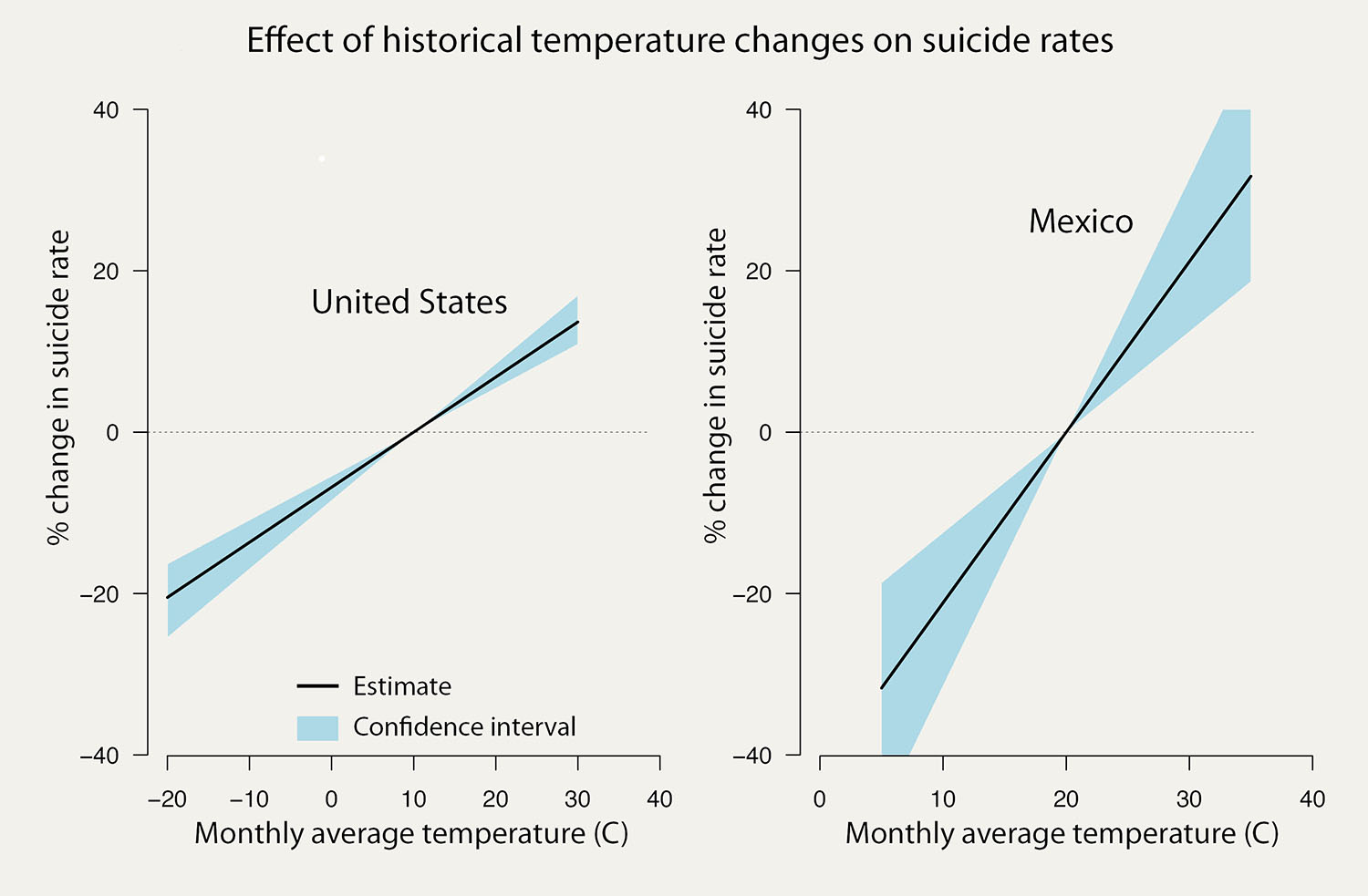
By comparing historical temperature and suicide data, researchers found a strong correlation between warm weather and increased suicides. They estimate climate change could lead to suicide rate increases across the U.S. and Mexico.

Suicide rates are likely to rise as the earth warms, according to new research published July 23 in Nature Climate Change. The study, led by Stanford economist Marshall Burke, finds that projected temperature increases through 2050 could lead to an additional 21,000 suicides in the United States and Mexico.

“When talking about climate change, it’s often easy to think in abstractions. But the thousands of additional suicides that are likely to occur as a result of unmitigated climate change are not just a number, they represent tragic losses for families across the country,” said Burke, assistant professor of Earth system science in the School of Earth, Energy & Environmental Sciences at Stanford.

Researchers have recognized for centuries that suicides tend to peak during warmer months. But, many factors beyond temperature also vary seasonally – such as unemployment rates or the amount of daylight – and up to this point it has been difficult to disentangle the role of temperature from other risk factors.

“Suicide is one of the leading causes of death globally, and suicide rates in the U.S. have risen dramatically over the last 15 years. So better understanding the causes of suicide is a public health priority,” Burke said.

Heat and suicide

To tease out the role of temperature from other factors, the researchers compared historical temperature and suicide data across thousands of U.S. counties and Mexican municipalities over several decades. The team also analyzed the language in over half a billion Twitter updates or tweets to further determine whether hotter temperatures affect mental well-being. They analyzed, for example, whether tweets contain language such as “lonely,” “trapped” or “suicidal” more often during hot spells.

The researchers found strong evidence that hotter weather increases both suicide rates and the use of depressive language on social media.

“Surprisingly, these effects differ very little based on how rich populations are or if they are used to warm weather,” Burke said.

For example, the effects in Texas are some of the highest in the country. Suicide rates have not declined over recent decades, even with the introduction and wide adaptation of air conditioning. If anything, the researchers say, the effect has grown stronger over time.

Effect of climate change

To understand how future climate change might affect suicide rates, the team used projections from global climate models. They calculate that temperature increases by 2050 could increase suicide rates by 1.4 percent in the U.S. and 2.3 percent in Mexico. These effects are roughly as large in size as the influence of economic recessions (which increase the rate) or suicide prevention programs and gun restriction laws (which decrease the rate).

Graph Showing Effects of historical temperature changes on suicide rates are shown for the U.S. and Mexico. Effects of historical temperature changes on suicide rates are shown for the U.S. and Mexico. (Image credit: Marshall Burke)
Effects of historical temperature changes on suicide rates are shown for the U.S. and Mexico. (Image credit: Marshall Burke)

“We’ve been studying the effects of warming on conflict and violence for years, finding that people fight more when it’s hot. Now we see that in addition to hurting others, some individuals hurt themselves. It appears that heat profoundly affects the human mind and how we decide to inflict harm,” said Solomon Hsiang, study co-author and associate professor at the University of California, Berkeley.

The authors stress that rising temperature and climate change should not be viewed as direct motivations for suicide. Instead, they point out that temperature and climate may increase the risk of suicide by affecting the likelihood that an individual situation leads to an attempt at self-harm.

“Hotter temperatures are clearly not the only, nor the most important, risk factor for suicide,” Burke emphasized. “But our findings suggest that warming can have a surprisingly large impact on suicide risk, and this matters for both our understanding of mental health as well as for what we should expect as temperatures continue to warm.”

Marshall Burke is also a fellow at the Center on Food Security and the EnvironmentStanford Woods Institute for the EnvironmentFreeman Spogli Institute for International Studies, and Stanford Institute for Economic Policy Research. Solomon Hsiang is also a faculty research fellow at the National Bureau of Economic Research. Other Stanford co-authors include Sanjay Basu, assistant professor of medicine, and Sam Heft-Neal, research scholar at the Stanford Center on Food Security and the Environment. Additional co-authors are from Pontificia Universidad Católica de ChileVancouver School of Economics, and the University of California, Berkeley. The research was partially supported by the Stanford Woods Institute for the Environment.

Hero Image
istock 682825852 copy iStockphoto/beer5020
All News button
1
Authors
Beth Duff-Brown
News Type
News
Date
Paragraphs

Malaria claims nearly half-a-million lives worldwide each year — and yet we still know so little about the immunology of the disease that has plagued humanity for centuries.

There were 216 million cases in 2016, according to the World Health Organization. Sub-Saharan Africa carries 80 percent of the global burden of the mosquito-borne infectious disease which devastates families, disrupts education, and promotes the vicious cycle of poverty.

It is particularly brutal to pregnant women, who are three times more likely to suffer from a severe form of the disease, leading to lower birthweight among their newborns and higher rates of miscarriage, premature and stillborn deliveries.

“Pregnant women and their unborn children are more susceptible to the adverse consequences of malaria, so we are working to investigate new strategies and even lay the foundation for a vaccine to prevent malaria in pregnancy,” said Prasanna Jagannathan, MD, an assistant professor of medicine who is this year’s recipient of the Rosenkranz Prize.

Jagannathan, an infectious disease physician who is also a member of Stanford’s Child Health Research Institute, said the $100,000 stipend that comes with the prize will allow his lab members to ramp up their research in Uganda. A member of the nonprofit Infectious Disease Research Collaboration in Kampala, his team is particularly interested in how strategies that prevent malaria might actually alter the development of natural immunity to malaria.

“With support from the Rosenkranz Prize, we hope to identify maternal immune characteristics and immunologic targets that are associated with protection of malaria in pregnancy and infancy,” Jagannathan said.

The Dr. George Rosenkranz Prize for Health Care Research in Developing Countries is awarded each year by the Freeman Spogli Institute for International Studies and Stanford Health Policy to a young Stanford researcher who is trying to improve health care in underserved countries. It was established in 2009 by the family or Dr. George Rosenkranz, a chemist who first synthesized cortisone in 1951, and later progesterone, the active ingredient in oral birth control pills.

“My father has held a lifelong commitment to scientific research as a way to improve the lives and well-being of communities around the world,” said Ricardo T. Rosenkranz, MD. “In particular, he has always sought to improve the health of at-risk populations. Dr. Jagannathan’s work offers the very sort of innovative ingenuity that characterized my father’s early research, as well as his vision towards the future.”

Jagannathan and his collaborators at UCSF and in Uganda are currently conducting a randomized control trial of 782 Ugandan women who are receiving intermittent preventive treatment with a fixed dose of dihydroartemisinin-piperaquine(or IPTp-DP), a medication that has dramatically reduced the risk of maternal parasitemia, anemia, and placental malaria. Their preliminary data suggests that among 684 infants born to these women, maternal receipt of IPTp-DP may lead to a reduced incidence of malaria in the first year of life.

Image

“Having the discretionary support of the Rosenkranz Prize will allow us to generate some preliminary ideas from this trial that could lead to larger studies, to push this agenda further along,” Jagannathan said.

That agenda is to create a vaccine that targets pregnant women to prevent malaria both during pregnancy — but also potentially preventing malaria in infants, giving them a better start in life.

“We’re not the first ones to think of this, but we have the opportunity to test these hypotheses in incredibly unique settings, with really well-studied cohorts that have real-world implications in terms of what we find,” Jagannathan said. “I’m hopeful that the data that’s generated over the new few years will allow us to keep moving forward.”

Jagannathan has been traveling to Uganda for a decade to study malaria. He’s seen firsthand the relentless, gnawing impact the disease has on daily life.

“Before I went to Uganda I really didn’t understand the burden that malaria causes in communities — and it’s just incredible,” he said. His first study was on children aged 5 and under who had on average six episodes of malaria a year.

“They just get it over and over again, and the toll on society is enormous,” he said. The clinics are overwhelmed and a parent or sibling must miss work or school to stay home with that child.

Yet, in highly endemic settings, children eventually develop an immunity that protects against the adverse outcomes from malaria. If he and his colleagues can understand how pregnant women and children develop this clinical immunity to malaria, it could lead to better treatments and preventative strategies.

“If we understand the mechanisms that underlie naturally acquired immunity, that would offer some clues as to how we can develop a vaccine that actually allows either that immunity to occur more quickly or prevents us from developing immunity that allows for the parasite to persist without symptoms,” he said.

There is currently a malaria vaccine undergoing testing in Africa. The vaccine, known as RTS,S, was developed by GlaxoSmithKline and the PATH Malaria Vaccine Initiative, with support from the Bill and Melinda Gates Foundation. Decades in the making, four doses of the vaccine are required to reduce malaria infection in humans.

“It’s a remarkable vaccine in that it’s effective in the beginning, but the problem is that the efficacy wanes very rapidly,” Jagannathan said, noting that some studies show that beyond three years, the effectiveness drops to 15-20 percent.

“That’s the big issue and why people are really interested in trying to find new strategies and new approaches for a next-generation malarial vaccine,” he said. “That’s the overarching aspect of what motivates my work.”


Hero Image
Prasanna Jagannathan Rosenkranz Beth Duff-Brown
All News button
1
Subtitle

Prasanna Jagannathan and his lab members intend to ramp up their research in Uganda. A member of the nonprofit Infectious Disease Research Collaboration in Kampala, his team is particularly interested in how strategies that prevent malaria might actually alter the development of natural immunity to malaria.

News Type
News
Date
Paragraphs

Conversational software programs might provide patients a less risky environment for discussing mental health, but they come with some risks to privacy or accuracy. Stanford scholars discuss the pros and cons of this trend.


Interacting with a machine may seem like a strange and impersonal way to seek mental health care, but advances in technology and artificial intelligence are making that type of engagement more and more a reality. Online sites such as 7 Cups of Tea and Crisis Text Line are providing counseling services via web and text, but this style of treatment has not been widely utilized by hospitals and mental health facilities.

Stanford scholars Adam MinerArnold Milstein and Jeff Hancockexamined the benefits and risks associated with this trend in a Sept. 21 article in the Journal of the American Medical Association. They discuss how technological advances now offer the capability for patients to have personal health discussions with devices like smartphones and digital assistants.

Stanford News Service interviewed Miner, Milstein and Hancock about this trend.

Read more: https://news.stanford.edu/2017/09/25/scholars-discuss-mental-health-technology/

Hero Image
mental health
Conversational software programs are making it possible for people to seek mental health care online and via text, but the risks and benefits need further study, Stanford experts say. (Image credit: roshinio / Getty Images)
All News button
1
News Type
News
Date
Paragraphs

The rising level of carbon dioxide in the atmosphere means that crops are becoming less nutritious, and that change could lead to higher rates of malnutrition that predispose people to various diseases.

That conclusion comes from an analysis published Tuesday in the journal PLOS Medicine, which also examined how the risk could be alleviated. In the end, cutting emissions, and not public health initiatives, may be the best response, according to the paper's authors, which includes Stanford Health Policy's Eran Bendavid and Sanjay Basu.

Research has already shown that crops like wheat and rice produce lower levels of essential nutrients when exposed to higher levels of carbon dioxide, thanks to experiments that artificially increased CO2 concentrations in agricultural fields. While plants grew bigger, they also had lower concentrations of minerals like iron and zinc.


Read the story at NPR


Hero Image
gettyimages rice Getty Images
All News button
1
-

Organizers: Stanford Prevention Research Center and Peking University Institute of Child and Adolescent Health

China’s extraordinary economic growth has fostered numerous social changes that threaten to offset the benefits of economic prosperity. Most prominent is rapid urbanization with substantial rural to urban migration. Resulting changes in health behaviors include increases in smoking, alcohol intake, overweight/obesity, pollutant exposure, and sedentary lifestyles. These changes exert distinct pressures on different population segments. Particularly impacted are adolescents and young adults. Unfavorable changes in their health behaviors presage magnified downstream increases in chronic diseases. Numerous problems are increasing in this age group, including substance abuse, depression, risky behavior, weight gain, visual impairment, infertility, and self-harm. China is modifying some economic strategies and shifting towards primary health care as well as adopting policies to directly improve the health of adolescents and young adults.

This all-day symposium focuses on the current health issues in adolescents and young adults and explores an integrated approach to tackle these problems.

AGENDA

9:10am      Introduction by Randall Stafford, Stanford Prevention Research Center

9:30am      Presentation on "A Chinese perspective on global health – examples from the United Nations" by Gang SUN, United Nations Programme on HIV and AIDS Headquarters

10:15am    Break

10:30         Presentation on "Media-based Interventions to Increase Physical Activity in Chinese Youth" by Patrick LAU, Department of Physical Education, Hong Kong Baptist University

11:15am     Student Group 1: Improving How Students Eat

11:35am     Student Group 2: University Student’s Mental Health

11:55am     Student Group 3: Breakfast and Adolescent Health

12:20pm     Lunch

1:30pm       Presentation on "Healthcare Entrepreneurship for the Youth Population" by Xing-Chuan LAN, Dekai Phamacy

2:15pm       Presentation on "Big Data in Health and Medicine: Implications for Adolescents" by Yi NING, Meinian Health Company, Peking University

3:00pm       Break

3:10pm       Panel Discussion

4:00pm       Close


TO REGISTER, PLEASE FILL IN THE FORM: http://web.stanford.edu/~lapli/adolescenthealth.fb


Stanford Center at Peking University
The Lee Jung Sen Building
Langrun Yuan
Peking University
No.5 Yiheyuan Road
Haidian District
Beijing, P.R.China 100871

Symposiums
Authors
News Type
News
Date
Paragraphs

The health insurance marketplaces created by the Affordable Care Act (ACA) could unravel because its enrollees strategically drop in and out of coverage, Stanford scholars write in a new working paper released June 4 by the National Bureau of Economic Research.

The end result could be a complete unraveling of the market, said Petra Persson, an assistant professor of economics in the Stanford School of Humanities and Sciences.

“If you have too many people who drop out after a few months of coverage, you might end up in a situation where insurers don’t want to offer any insurance at all in the market,” said Persson, who co-authored the paper with Stanford Graduate School of Business assistant professors Rebecca Diamond and Timothy McQuade and NYU Stern’s Michael J. Dickstein. Persson and Diamond are also fellows at the Stanford Institute for Economic Policy Research.

The ACA, also known as Obamacare, passed in March 2010 with the goal of making health insurance more accessible. It established a competitive marketplace where individuals could shop for federal and state-level health care plans. Over 2014 and 2015 – the first two years of the program – the share of Americans covered by individually purchased health insurance rose by 50 and 75 percent, respectively.

Health care consumption surged, especially in low-income households and families with young children. But, as the researchers discovered, so did attrition: Dropout was sharpest after just one month of coverage. And only half of all new enrollees committed a full year to an insurance program.

Health care consumption and attrition

To analyze enrollment and attrition, the researchers studied 104,233 households that purchased health insurance in California either before or after the ACA came into effect.

The researchers examined spending habits and income sources for possible explanations of why people might have discontinued health care coverage. For example, did they drop out because they could no longer afford it, because of a job loss or other large expense?

The researchers found that this was the case before the ACA came into effect. Pre-ACA, people often dropped out early because they experienced a loss of income, like unemployment. But post-ACA, the loss of income was much less important in explaining early dropout.

“These findings indicate that the ACA limited the risk of being forced to drop insurance coverage due to unexpected liquidity shocks,” said Persson.

If income shocks can’t account for dropout, then what can?

The researchers found that some people strategically drop coverage after they have used the health care services they need.

“Our analysis shows that many consumers are strategically signing up for insurance to help defray the costs of non-chronic, potentially discretionary, health care needs and then dropping coverage once they have satisfied these needs,” said Diamond.

“The regulatory structure of the ACA law potentially incentivizes exactly this behavior,” the researchers wrote, noting that because the ACA prevents insurers from discriminating against applicants, they cannot legally reject applicants who strategically dropped coverage the previous year.

The fallout of dropouts

This behavior makes it difficult for insurers to set prices, said Persson.

When people consume a year’s worth of health care in only a three-month period – and only pay a portion of the annual premium – it can be incredibly expensive for insurers. They can only guess what fraction of policyholders will end up dropping out mid-year.

The researchers discovered a counterintuitive response from insurers: Health care plans that experienced more dropouts reduced their premium prices the following year.

“Insurers are trying to increase the demand from the pool of consumers who don’t drop out,” said Diamond, observing that these are the people who are more price sensitive to the cost of an annual plan. “People who drop out are going to be less sensitive to the price set by the plan. They are always going to be willing to pay a higher monthly premium because they know they are not going to pay the full annual amount.”

While lowered annual premiums may seem like a beneficial result for committed health care consumers, the presence of dropouts undermines the stability of the market, the researchers said. As a result, insurers may be unwilling to offer plans in the individual market, they said.

Next steps

The ACA has been especially effective in providing lower-income households with health care coverage through a market that previously had largely served more affluent households, said Persson.

But for ACA to continue being effective, enrollees must stay enrolled, Persson added.

While the ACA originally came with penalties for ceasing coverage early, the researchers said it was not enough. It was still cheaper for new enrollees to pay the fine for dropping out mid-year than paying a full year of annual premiums, the researchers found in their cost analysis.

The recent removal of the individual mandate will likely increase the midyear dropout rate, said Diamond. “More dropout will raise financial pressure on insurers, increasing the possibility that the market unravels completely.”

 
Hero Image
aca Getty Images
All News button
1
Subscribe to Health and Medicine