Health and Medicine

FSI’s researchers assess health and medicine through the lenses of economics, nutrition and politics. They’re studying and influencing public health policies of local and national governments and the roles that corporations and nongovernmental organizations play in providing health care around the world. Scholars look at how governance affects citizens’ health, how children’s health care access affects the aging process and how to improve children’s health in Guatemala and rural China. They want to know what it will take for people to cook more safely and breathe more easily in developing countries.

FSI professors investigate how lifestyles affect health. What good does gardening do for older Americans? What are the benefits of eating organic food or growing genetically modified rice in China? They study cost-effectiveness by examining programs like those aimed at preventing the spread of tuberculosis in Russian prisons. Policies that impact obesity and undernutrition are examined; as are the public health implications of limiting salt in processed foods and the role of smoking among men who work in Chinese factories. FSI health research looks at sweeping domestic policies like the Affordable Care Act and the role of foreign aid in affecting the price of HIV drugs in Africa.

Authors
Beth Duff-Brown
News Type
Blogs
Date
Paragraphs

Measles came back with a vengeance in 2019, with cases quadrupling globally and 1,276 cases reported in the United States since the beginning of the year — the largest increase in 27 years.

Most of those cases worldwide were among people who weren't vaccinated against the preventable infection. Anti-vaccinations movements have gained ground in the industrialized nations while gaps of immunization coverage or lack of access to health care facilities plague Africa and developing nations around the globe.

But there's some good news in California. 

new study by researchers at Stanford and the University of California, San Francisco shows the vaccination rate for measles is approaching 95% in nearly all counties of the Golden State. That auspicious number promotes herd immunity, protecting vulnerable unvaccinated people, such as newborns.

The co-authors of the study, which appears in PLOS Medicine, believe this hike in the state's vaccination rate is due to a contentious 2016 law that did away with the personal belief and religious exemptions following the 2014-2015 measles outbreak that began in Disneyland.

The new vaccine policy is associated with a 3% increase in statewide MMR (measles, mumps and rubella) vaccine coverage since the law was adopted, the researchers found, and a 2% decrease in non-medical religious and philosophical exemptions.

That jump may put the state above the critical 95% vaccinated point, which is needed for effective herd immunity against measles. "That would be very meaningful," said Stanford Health Policy's Eran Bendavid, MD, an associate professor of medicine and a co-author of the study.

The policy debates surrounding vaccine hesitancy in the United States have focused on vaccine exemptions, which provide an option for parents to waive current vaccination requirements for entry into school or daycare centers. Currently, 18 states allow nonmedical exemptions based on philosophical, personal or other beliefs.

"The factors driving vaccine hesitancy are complex and include misconceptions and misinformation about vaccine safety, low perceived risk of infectious disease, and lack of trust in health care providers," the authors write. 

The California experiment, however, could serve as an example to state legislatures and public health departments, as well as the federal government, the researchers say. 

"While we did see a small increase in medical exemptions, the much larger increase in MMR coverage suggests that the policy worked as expected," said Sindiso Nyathi, a graduate student in epidemiology, and one of the paper's first authors. "This is good news for states considering similar policies."

Sindiso said evaluating the efficacy of vaccine policies can be difficult due to lack of controls to use as comparisons, which limits the conclusions that can be drawn. To address that gap, their work used a hypothetical control group and estimated how many Californian children would have received the MMR vaccine if the law had not gone into effect. They then compared that to how many kids were vaccinated following the law's enactment in 2016.

The researchers also broke the data down by county. 

"Our county-level analysis found that greater increases in coverage were observed in counties with low coverage levels before the policy," Nyathi said. "This is good news, as it suggests that the policy was more effective in areas that had lower coverage. Similar policies may be an effective tool to bring vaccine coverage levels above herd immunity thresholds." 

While the researchers found the law work as intended, there was a small, 0.4% increase in the number of medical exemptions. 

Under the current California law, parents can request vaccination waivers for children whose medical condition might be impacted by the vaccine.

In September, Gov. Gavin Newsom signed into law another vaccination bill that will go into effect on Jan. 1. It will give the California Department of Public Health the power to revoke medical exemptions if it determines they are not medically sound. The department will also have the power to review exemptions from doctors who write more than five in one year.


Hero Image
severine 43 Heather Hazzan, SELF Magazine
All News button
1
Authors
Noa Ronkin
News Type
News
Date
Paragraphs

Southeast Asia, home to over 640 million people across 10 countries, is one of the world’s most dynamic and fastest growing regions. APARC just concluded the year 2019 with a Center delegation visit to two Southeast Asian capital cities, Hanoi and Bangkok, where we spent an engaging week with stakeholders in the academic, policy, business, and Stanford alumni communities.

Led by APARC Director Gi-Wook Shin, the delegation included APARC Deputy Director and Asia Health Policy Program Director Karen Eggleston, Southeast Asia Program Director Donald Emmerson, and APARC Associate Director for Communications and External Relations Noa Ronkin. Visiting Scholar Andrew Kim joined the delegation in Bangkok.

With a focus on health policy, our first day in Hanoi included a visit to Thai Nguyen University, a meeting with government representatives at the Vietnam Ministry of Health, and a seminar on healthy aging and innovation jointly with Hanoi Medical University.

Image
Collage of four images showing participants at a roundtable held at Hanoi Medical University with APARC delegation members

Karen Eggleston and participants at the roundtable held at Hanoi Medical University, December 9, 2019.

Throughout the day, Eggleston presented some of her collaborative research that is part of two projects involving international research teams: one that assesses public-private roles and institutional innovation for healthy aging and another that examines the economics of caring for patients with chronic diseases across diverse health systems in Asia and other parts of the world. We appreciated learning from our counterparts about the health care system and health care delivery in Vietnam.

Shifting focus to international relations and regional security, day 2 in Hanoi opened with a roundtable, “The Rise of the Indo-Pacific and Vietnam-U.S. Relations,” held jointly with the East Sea Institute (ESI) of the Diplomatic Academy of Vietnam (DAV). Following a welcome by ESI Director General Nguyen Hung Son, the program continued with remarks by Shin, Emmerson, ESI Deputy Director General To Anh Tuan, and Assistant Director General Do Thanh Hai.

Image
Participants at a roundtable held at the Diplomatic Academy of Vietnam with APARC delegation members

Roundtable at the Diplomatic Academy of Vietnam, December 10, 2019.

The long-ranging conversation with DAV members included issues such as the future of the international order in Asia; the U.S. withdrawal from multilateralism; the concern about a lack of U.S. engagement in Southeast Asia, sparked by President Trump’s absence from the November 2019 summit of the Association of Southeast Asian Nations (ASEAN) at a time when China is bolstering its influence in the region and when ASEAN hopes to set a code of conduct with China regarding disputed waters in the South China Sea; the priorities for Vietnam as it assumes the role of ASEAN chair in 2020; and the challenges for the Vietnam-U.S. bilateral relationship amid the changing strategic environment in Southeast Asia.

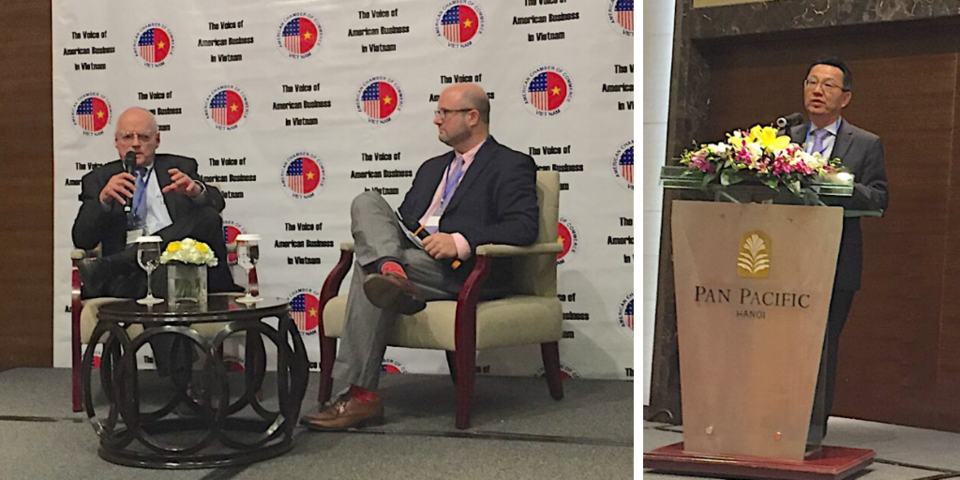
In the afternoon we were joined by members of the American Chamber of Commerce in Hanoi at an AmCham-hosted Lunch ‘n’ Learn session on Vietnam's challenges and opportunities amid the U.S.-China rivalry. The event featured Emmerson in conversation with AmCham Hanoi Executive Director Adam Sitkoff.

Image
Two men in conversation seated on stage and a man speaking at a podium

(Left) Donald Emmerson in conversation with Adam Sitkoff; (right) Gi-Wook Shin welcomes AmCham Hanoi members; December 10, 2019. 

Moving to Bangkok, delegation members Shin, Eggleston, Emmerson, and Kim spoke on a panel for executives of the Charoen Pokphand Group (C.P. Group), one of Thailand’s largest private conglomerates, addressing some of the core issues that lie ahead for Southeast Asia in 2020 and beyond in the areas of geopolitics, innovation, and health.

Image
Participants at a panel discussion with APARC delegation hosted by the C.P. Group, Thailand

Top, from left to right: Gi-Wook Shin, Karen Eggleston, Andrew Kim; bottom: C.P. Group executive listening to the panel, December 12, 2019.

We also enjoyed a tour at True Digital Park, Thailand’s first startup and tech entrepreneur’s campus. Developed by the C.P. Group, True Digital Park aspires to be an open startup ecosystem that powers Thailand to become a global hub for digital innovation.

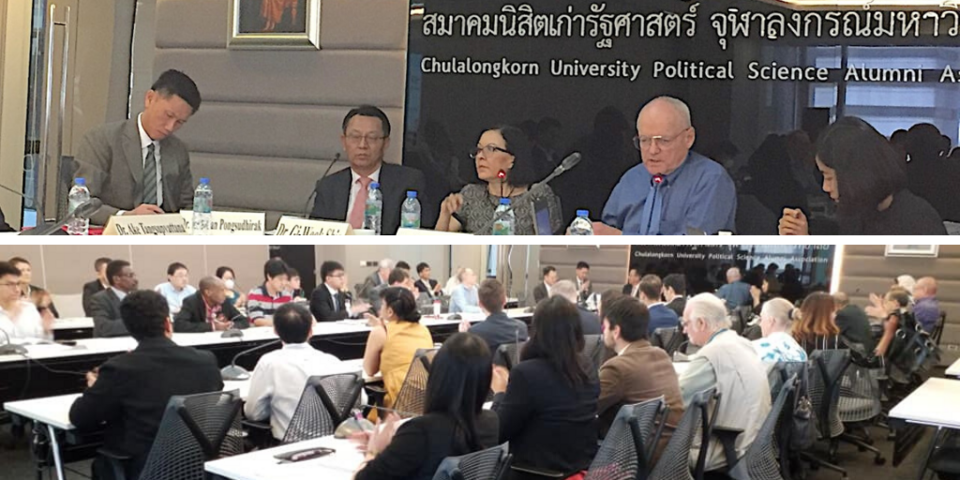
The following day, Shin and Emmerson participated in a public forum hosted by Chulalongkorn University’s Institute of Security and International Studies (ISIS Thailand), "Where Northeast Asia Meets Southeast Asia: The Great Powers, Global Disorder and Asia’s Future.” They were joined by ISIS Thailand Director Thitinan Pongsudhirak and Chulalongkorn University Faculty of Political Science Associate Dean for International Affairs and Graduate Studies Kasira Cheeppensook. The panel was moderated by Ms. Gwen Robinson, ISIS Thailand senior fellow and editor-at-large of the Nikkei Asian Review.

Image
Panelists and participants at a public forum held at Chulalongkorn University

ISIS Thailand forum participants and panelists, from left: Pngsukdhirak, Shin, Robinson, Emmerson, Cheeppensook; December 13, 2019.

As part of that discussion, Emmerson speculated that – driven by deepening Chinese economic and migrational involvement in Southeast Asia’s northern tier – Cambodia and Laos, less conceivably Myanmar, and still less conceivably Thailand could become incorporated de facto into an economically integrated “greater China” that could eventually reduce ASEAN to a more-or-less maritime membership in the region’s southern tier. Emmerson’s speculation was made in the context of his critique of ASEAN’s emphasis on its own “centrality” to the neglect of its lack of the proactivity that would serve as evidence of centrality and of a desire not to be rendered peripheral by the growing centrality-cum-proactivity of China. The event was covered by the Bangkok Post (although that report’s headline and quote of Emmerson are inaccurate, as neither the panel nor Emmerson predicted the “break-up of ASEAN.”)

Our delegation visit in Bangkok concluded with a buffet dinner reception and panel discussion jointly with the Stanford Club of Thailand.

Image
alumni event

Stanford and IvyPlus alumni listening to the panel, December 13, 2019.

Moderated by Mr. Suthichai Yoon, a veteran journalist and founder of digital media outlet Kafedam Group, the conversation focused on the changing geopolitics of Southeast Asia, innovation and health in the region, and the opportunities and challenges facing Thailand-U.S. relations. It was a pleasure to meet many new and old friends from the Stanford and IvyPlus alumni communities.

APARC would like to thank our partners and hosts in Hanoi and Bangkok for their hospitality, collaboration, and the stimulating discussions throughout our visit. We look forward to keeping in touch!

Hero Image
APARC delegation speaking to Stanford and IvyPlus alumni, Bangkok
All News button
1
Authors
David Relman
News Type
News
Date
Paragraphs

On 9 December, 1979, health officials declared smallpox as the first and only human disease to be eradicated in what is considered the greatest achievement of modern medicine. Four decades on, the U.S. and Russia still maintain samples of the potentially deadly virus, and the debate on whether they should be kept or destroyed rages on....To this day, only two remaining stocks of the variola virus are known to exist. They are kept under high-security conditions at a U.S. Centers for Disease Control and Prevention laboratory in Atlanta, and at Russia's State Research Centre of Virology and Biotechnology (Vector) in the Siberian city of Novosibirsk. Everything known about their location is in the public domain— except for the exact rooms and freezers where the samples are kept, David Relman, professor of microbiology and immunology at Stanford University, told Newsweek.


Read the Rest at Newsweek

Hero Image
screen shot 2019 12 18 at 8 23 05 am
All News button
1
-

Eran Bendavid, MD, MS

Associate Professor of Medicine


Eran Bendavid is an infectious diseases physician, an Associate Professor of Medicine in the Division of General Internal Medicine, and a Stanford Health Policy affiliate.  His research interests involve understanding the relationship between policies and health outcomes in developing countries. He explores how decisions about foreign assistance for health are made, and how those decisions affect the health of those whom assistance aims to serve.  Dr. Bendavid is also a disease modeler and uses this skill to explore issues of resource allocation in low and middle-income countries with cost-effectiveness analyses.

His recent research projects include an impact evaluation of the US assistance program for HIV in Africa, and an exploration of the association between drug prices, aid, and health outcomes in countries heavily affected by HIV.

He received a B.A. in chemistry and philosophy from Dartmouth College, and an M.D. from Harvard Medical School. His residency in internal medicine and fellowship in infectious diseases were completed at Stanford.

CHP/PCOR Conference Room
Encina Commons, Room 119
615 Crothers Way, Stanford, CA 94305

Eran Bendavid
Seminars
Authors
News Type
News
Date
Paragraphs

The toll from gun violence at schools has only escalated in the 20 years since the jolting, horrific massacre at Columbine High.

By December 2019, at least 245 primary and secondary schools in the United States had experienced a shooting, killing 146 people and injuring 310, according to The Washington Post.

At least 245 primary and secondary schools in the United States have experienced a shooting — killing 146 people and injuring 310 — since the country's first mass school shooting at Columbine High School in April 1999.

Now, new Stanford-led research sounds an alarm to what was once a silent reckoning: the mental health impact to tens of thousands of surviving students who were attending schools where gunshots rang out.

A study has found that local exposure to fatal school shootings increased antidepressant use among youths.

Specifically, the average rate of antidepressant use among youths under age 20 rose by 21 percent in the local communities where fatal school shootings occurred, according to the study. And the rate increase – based on comparisons two years before the incident and two years after – persisted even in the third year out.

“There are articles that suggest school shootings are the new norm – they’re happening so frequently that we’re getting desensitized to them – and that maybe for the people who survive, they just go back to normal life because this is just life in America. But what our study shows is that does not appear to be the case,” said Maya Rossin-Slater, a core faculty member at Stanford Health Policy and faculty fellow at the Stanford Institute for Economic Policy Research (SIEPR). “There are real consequences on an important marker of mental health.”

The study is detailed in a working paper published Monday by the National Bureau of Economic Research. It was co-authored by Rossin-Slater, an assistant professor of health policy in the Stanford School of Medicine; Molly Schnell, a former postdoctoral fellow at SIEPR now an assistant professor at Northwestern University; Hannes Schwandt, an assistant professor at Northwestern and former visiting fellow at SIEPR; Sam Trejo, a Stanford doctoral candidate in economics and education; and Lindsey Uniat, a former predoctoral research fellow at SIEPR now a PhD student at Yale University.

Their collaborative research – accelerated by their simultaneous stints at SIEPR – is the largest study to date on the effects of school shootings on youth mental health.

The study comes as the issue of gun safety continues to stoke political wrangling and public debate. And the researchers say their findings suggest policymakers should take a wide lens to their decision-making process.

“When we think about the cost of school shootings, they’re often quantified in terms of the cost to the individuals who die or are injured, and their families,” Rossin-Slater noted. “Those costs are unfathomable and undeniable. But the reality is that there are many more students exposed to school shootings who survive. And the broad implication is to think about the cost not just to the direct victims but to those who are indirectly affected.”

A Driver for Antidepressant Use

More than 240,000 students have been exposed to school shootings in America since the mass shooting in Columbine in April 1999, according to The Washington Post  data used in the study. And the number of school shootings per year has been trending up since 2015.

Yet despite this “uniquely American phenomenon” – since 2009, over 50 times more school shootings have occurred in the U.S. than in Canada, Japan, Germany, Italy, France and the United Kingdom combined – little is known about the effects of such gun violence on the mental health of the nation’s youth, the study stated.

“We know that poor mental health in childhood can have negative consequences throughout life,” Schwandt said. “At the same time, children are known to show significant levels of resilience, so it really wasn’t clear what we would find as we started this project.”

The researchers examined 44 shootings at schools across the country between January 2008 and April 2013. They used a database that covered the near universe of prescriptions filled at U.S. retail pharmacies along with information on the address of the medical provider who prescribed each drug. They compared the antidepressant prescription rates of providers practicing in areas within a 5-mile radius of a school shooting to those practicing in areas 10-to-15 miles away, looking at two years prior and two to three years after the incident.

Of those 44 school shootings, 15 of them involved at least one death. The 44 shootings occurred in 10 states: Alabama, California, Connecticut, Florida, Nebraska, North Carolina, Ohio, South Carolina, Tennessee and Texas.

Researchers found a marked increase in the rate of antidepressant prescriptions for youths nearby, but only for the shootings that were fatal. They did not see a significant effect on prescriptions for youths exposed to non-fatal school shootings.

“The immediate impact on antidepressant use that we find, and its remarkable persistence over two, and even three years, certainly constitutes a stronger effect pattern than what we would have expected,” Schwandt said.

Meanwhile, adult antidepressant use did not appear to be significantly impacted by local exposure to school shootings.

Layers of Costs, More Unknowns

The researchers also analyzed whether the concentration of child mental health providers in areas affected by fatal school shootings made a difference in the antidepressant rates, and they drilled a further comparison between the prevalence of those who can prescribe drugs, such as psychiatrists and other medical doctors, and those who cannot prescribe drugs, such as psychologists and licensed social workers.

Increases in antidepressant rates were the same across areas with both high and low concentrations of prescribing doctors, the researchers found. But in areas with higher concentrations of non-prescribing mental health providers, the increases in antidepressant use were significantly smaller – indicating perhaps a greater reliance on non-pharmacological treatments or therapy for shooting-related trauma.

The researchers also found no evidence that the rise in antidepressant usage stemmed from mental health conditions that were previously undiagnosed prior to the shootings.

In totality, the researchers say the results in the study clearly pointed to an adverse impact from a fatal shooting on the mental health of youths in the local community. Furthermore, the results capture only a portion of the mental health consequences: Non-drug related treatments could have been undertaken as well.

“Increased incidence of poor mental health is at least part of the story,” Schnell said.

Though their analysis included only 44 schools and 15 fatal school shootings, Rossin-Slater noted how the trend of school shootings is growing. She believes the mental health impact found on the local communities they studied “can be generalizable to other communities’ experiences.”

That’s all the more reason why policymakers should consider the overall negative effects of school shootings, and how further research will be needed to gauge other societal consequences, the researchers said.

“Think of it as layers of costs,” Rossin-Slater said. And when it comes to evaluating gun violence at schools, “we think our numbers say, ‘Hey, these are costly things, and it’s costlier than we previously thought.’”

Hero Image
schoolshooting shutterstock Shutterstock
All News button
1
Authors
News Type
News
Date
Paragraphs

Immigrants, once settled in a particular state, will not move to another state in search of public health benefits, Stanford researchers find.

Hero Image
Jens Hainmueller publication image Research shows no magnet effect when states lower the costs of health care for low-income immigrants. | iStock/FatCamera
All News button
1
Authors
News Type
News
Date
Paragraphs

Whether it’s designing equipment or developing drugs, scientists often fail to consider how gendered preferences, biases and assumptions can lead to unintended consequences.


According to Stanford historian Londa Schiebinger, it’s time for science to catch up.

Hero Image
Londa Schiebinger
All News button
1
-
Title: Why Do Data-Use Agreements Take So Long? A Study of Top-50 Research Universities
 
Dr. Michelle M. Mello, M.Phil., Ph.D., J.D.
 
Professor of Law
Professor of Medicine (Health Services Research)
 
Michelle Mello is a leading empirical health law scholar. Her research is focused on understanding the effects of law and regulation on health care delivery and population health outcomes. She has authored over 190 articles and book chapters on the medical malpractice system, medical errors and patient safety, public health law, regulation of pharmaceuticals, biomedical research ethics and governance, obesity policy, in addition to other topics. She was elected to the National Academy of Medicine at the age of 40 and is the recipient of a number of awards for her research.
 
Dr. Mello teaches courses in torts and public health law. She received a J.D. from the Yale Law School, a Ph.D. in Health Policy and Administration from the University of North Carolina at Chapel Hill, an M.Phil. from Oxford University, where she was a Marshall Scholar. She also holds a B.A. from Stanford University.
 
 
David M Studdert, LLB, ScD, MPH
 
Professor of Law
Professor of Medicine (PCOR)
 
 
David M. Studdert is a distinguished expert in the fields of health law and empirical legal research. His scholarship explores how the legal system influences the health and well-being of populations. A prolific scholar, he has authored more than 150 articles and book chapters, and his work appears frequently in leading international medical, law, and health policy publications.
 
Professor Studdert joined Stanford Law School faculty on November 1, 2013, in a joint appointment as Professor of Medicine (PCOR/CHP) and Professor of Law. Before joining the Stanford faculty, Professor Studdert was on the faculty at the University of Melbourne (2007-13) and the Harvard School of Public Health (2000-06). He has also worked as a policy analyst at the RAND Corporation, a policy advisor to the Minister for Health in Australia, and a practicing attorney.
 
Professor Studdert has received the Alice S. Hersh New Investigator Award from AcademyHealth, the leading organization for health services and health policy research in the United States. He was awarded a Federation Fellowship (2006) and a Laureate Fellowship (2011) by the Australian Research Council. He holds a law degree from University of Melbourne and a doctoral degree in health policy and public health from the Harvard School of Public Health.
 

CHP/PCOR Conference Room
Encina Commons, Room 119
615 Crothers Way, Stanford, CA 94305

Seminars

Maria Polyakova, PhD

Assistant Professor of Health Research and Policy

Maria Polyakova, PhD, is an Assistant Professor of Health Research and Policy at the Stanford University School of Medicine. Her research investigates questions surrounding the role of government in the design and financing of health insurance systems. She is especially interested in the relationships between public policies and individuals’ decision-making in health care and health insurance, as well as in the risk protection and re-distributive aspects of health insurance systems. She received a BA degree in Economics and Mathematics from Yale University, and a PhD in Economics from MIT.

CHP/PCOR Conference Room
Encina Commons, Room 119
615 Crothers Way, Stanford, CA 94305

Seminars

Encina Commons, Room 113,

615 Crothers Way,
Stanford, CA 94305-6006

650-736-8139
0
Senior Research Engineer, Health Policy
unknown.jpeg PhD

Lin Zhu is a research engineer in the Center for Health Policy and the Department of Health Policy. Her research focuses on developing simulation models to inform policy-making on infectious disease control and prevention. Lin received a Bachelor of Medicine and a Master of Science from Peking University in Beijing, China, where she has led and participated in several research projects including improvement of vaccination and infectious disease control in pre-school children in disadvantaged areas, control of HIV/AIDS in Beijing and Qingdao, systematic review on severe acute respiratory syndrome (SARS), and epidemiology of fever and diarrhea in Beijing. Lin completed her PhD in Epidemiology at University of Miami. During her PhD studies, she developed a spatial agent-based model to evaluate the impact of neglected vector behaviors and environmental resources on malaria transmission, to evaluate a novel tool for malaria control, and to compare various strategies for the elimination of residual malaria transmission. Prior to joining Stanford, Lin was a postdoctoral research fellow at Harvard T.H. Chan School of Public Health, where she developed methods to reduce sampling bias in network statistics, and developed an agent-based network model of hepatitis C virus (HCV) transmission among people who inject drugs (PWID).

Date Label
Subscribe to Health and Medicine