Governance

FSI's research on the origins, character and consequences of government institutions spans continents and academic disciplines. The institute’s senior fellows and their colleagues across Stanford examine the principles of public administration and implementation. Their work focuses on how maternal health care is delivered in rural China, how public action can create wealth and eliminate poverty, and why U.S. immigration reform keeps stalling. 

FSI’s work includes comparative studies of how institutions help resolve policy and societal issues. Scholars aim to clearly define and make sense of the rule of law, examining how it is invoked and applied around the world. 

FSI researchers also investigate government services – trying to understand and measure how they work, whom they serve and how good they are. They assess energy services aimed at helping the poorest people around the world and explore public opinion on torture policies. The Children in Crisis project addresses how child health interventions interact with political reform. Specific research on governance, organizations and security capitalizes on FSI's longstanding interests and looks at how governance and organizational issues affect a nation’s ability to address security and international cooperation.

Authors
Melissa Morgan
News Type
Commentary
Date
Paragraphs

The fusion of political polarization and populism is characteristic of the trend of democratic recession sweeping the globe. Be it Boris Johnson, Donald Trump, Jair Bolsonaro, Rodrigo Duterte, or Narendra Modi, contemporary populist leaders are winning through populist appeals that promote chauvinistic nationalism. While populist sentiments often emerge from hyper-conservative factions of right-wing parties, liberal, leftist governments are in no way immune to power grabs fueled by nationalistic fervor. This is precisely the situation that is unfolding in South Korea and driven by the Moon Jae In’s government, fears APARC and the Korea Program Director Gi-Wook Shin.

In “South Korea's Democratic Decay,” published in the Journal of Democracy, Shin warns that the current administration in South Korea is “more than a little drunk on its own sense of moral superiority.” Moon and his administration came to power in 2017 following the impeachment of then-president Park Geun Hye on corruption charges. Their campaign rallied around the cry to “eradicate deep-rooted evils” from Korean society and politics. The rhetoric was massively popular and easily won Moon the election.

According to Shin, Korea is following the same precarious path many democracies have stumbled on to in recent years. He explains the insidious danger of leaders like Moon: they come to power through legitimate, established democratic processes, but once in power, the chauvinistic populism and seemingly righteous dogma that fueled their campaign becomes a tool for eroding democracy from within. Though not as outwardly dramatic as a regime change or military coup, the result is just as damaging to democratic ideals.

As in the Korean expression about the light drizzle that soaks you before you even notice it, the subtle subversion of democratic norms across multiple spheres could one day hit Korea’s young democracy with unbearable costs.
Gi-Wook Shin
Director of APARC and the Korea Program

In South Korea’s case, the politicization of the court system serves as a prime example of this subtle subversion. To date, Moon has named 10 of the fourteen-member Supreme Court and will have an opportunity to appoint three more before the end of his term. He has also named eight of the nine judges to the Constitutional Court. Many of these appointees have left-wing connections, and some even openly echo the administration’s rhetoric to “expel deep-rooted evils.” Many of the judges and prosecutors were appointed from partisan positions, and many have entered politics immediately following their tenures in law using a loophole in the 2017 amendment of the Korean Prosecutor’s Act.

The appointments follow the letter of the law and fall within the purview of the executive office, but the clear partisanship at work is at odds with the spirit of democratic tradition. While it technically breaks no laws, it calls into question the impartiality of the courts, the legitimacy of the law, and the separation of powers within the government.

Similarly, the administration plays favoritism with the standards of free speech, another essential element of democracy. Free speech and a politically active society served Moon Jae In well in 2017 when protestors and an ultra-loyal cohort of civically-engaged citizens propelled him to victory. But in 2018, Moon’s government declared a “war on fake news.” Rather than expunge falsehoods, it used this effort to stifle voices critical of the administration both in and outside of Korea. In February 2020, the Democratic Party sued a professor for her newspaper op-ed urging people to vote against Moon. In 2018, the U.S.-Korea Institute, a Johns-Hopkins-affiliated think tank, closed after the Moon administration ended financial support to the institution, citing concerns its directors were “too conservative.”

These actions are indications that Korea is slipping towards a “democratic depression,” says Shin. “Both the spirit of democracy and actual liberal-democratic standards are under attack,” he writes. “Opponents are demonized, democratic norms are eroded, and political life only grows more polarized.”

Left shaken by COVID-19, the trajectory of the country is uncertain. Still in control of the executive, with supportive judges stacked in the judiciary and control of a majority of seats in the legislature, there are few checks left to balance Moon’s ambitions and aggressive reforms. Though he was elected as a champion against corruption and authoritarianism, Moon’s dismantling of democratic norms now leaves him teetering on the edge of becoming the thing he promised to eradicate.

On whether or not Korea can arrest its slide towards a democratically-sanctioned regime, Shin says, “For Korea to have a chance at overcoming the polarizing forces that are pulling it apart, the president must hold himself to a higher standard. Nothing but democratic ideals hold the power to revive a politics of concord big and strong enough to contain the politics of anger and revenge.”

Read the full article at the Journal of Democracy.

Read More

A Zoom panel of Jonathan Corrado, Gi-Wook Shin, and Stephen Noerper
Commentary

Gi-Wook Shin Offers Analysis of 2020 Korean National Election

The Korea Society hosts APARC's director for a timely discussion of the recent South Korean national election.
Gi-Wook Shin Offers Analysis of 2020 Korean National Election
Opposing political rallies converge in South Korea
Commentary

Korean Democracy Is Sinking Under the Guise of the Rule of Law

Korean Democracy Is Sinking Under the Guise of the Rule of Law
Hero Image
President Moon Jae In of South Korea during his inauguration proceedings.
Getty Images
All News button
1
Subtitle

South Korea is following global trends as it slides toward a “democratic depression,” warns APARC’s Gi-Wook Shin. But the dismantling of South Korean democracy by chauvinistic populism and political polarization is the work of a leftist government, Shin argues in a ‘Journal of Democracy’ article.

-
Image
The rise of digital authoritarianism banner advertisement

There will be four events, with the first on September 29th; all dates listed below

REGISTER

  • September 29th, 9-11am PST
  • October 1st, 9-11am PST
  • October 6th, 9-11am PST
  • October 9th, 9-11am PST


The Rise of Digital Authoritarianism: China, AI and Human Rights

Day 1- September 29, 2020

Welcome Remarks

Larry Diamond | Senior Fellow, Hoover Institution and FSI, Principal Investigator, Global Digital Policy Incubator

Glenn Tiffert | Research Fellow, Hoover Institution

Jenny Wang | Strategic Advisor, Human Rights Foundation

Opening Remarks

Condoleezza Rice | Director, Hoover Institution, Former U.S. Secretary of State, Denning Professor in Global Business at the Graduate School of Business


Panel 1: How AI is powering China's Domestic Surveillance State - How is AI exacerbating surveillance risks and enabling digital authoritarianism? This session will examine both state-sponsored applications and Chinese commercial services.

Panelists

Bethany Allen-Ebrahimian | China Reporter, Axios

Paul Mozur | Asia Technology Correspondent, New York Times

Glenn Tiffert | Research Fellow, Hoover Institution

Xiao Qiang | UC Berkeley & Editor-in-Chief, China Digital Times

Moderator

Melissa Chan | Foreign Affairs Reporter, Deutsche Welle Asia


Day 2- October 1, 2020

Panel 2: The Ethics of Doing Business with China and Chinese Companies

Eric Schmidt | Former Executive Chairman and CEO, Google//Co-Founder, Schmidt Futures
Conversant: Eileen Donahoe, Executive Director of GDPI


Panel 2: The Ethics of Doing Business with China and Chinese Companies - What dynamics are at play in China's effort to establish market dominance for Chinese companies, both domestically and globally? What demands are placed on non-Chinese technology companies to participateWhat dynamics are at play in China's effort to establish market dominance for Chinese companies, both domestically and globally? What demands are placed on non-Chinese technology companies to participate in the Chinese marketplace? What framework should U.S.-based companies use to evaluate the risks and opportunities for collaboration and market entry in China? To what extent are Chinese companies (e.g..,TikTok) competing in Western markets required to comply with Chinese government instructions or demands for access to data?

Panelists

Mary Hui | Hong Kong-based Technology and Business Reporter, Quartz
 
Megha Rajagopalan | International Correspondent and Former China Bureau Chief, Buzzfeed News
 

Alex Stamos | Director, Stanford Internet Observatory & Former Chief Security Officer, Facebook

Moderator

Casey Newton | Silicon Valley Editor, The Verge


Day 3- October 6, 2020

Panel 3: China as an Emerging Global AI Superpower

Keynote & Conversation

Competing in the Superpower Marathon with China

Mike Brown | Director, Defense Innovation Unit

Conversant: Larry Diamond, Senior Fellow, Hoover Institution and FSI, Principal Investigator, Global Digital Policy Incubator

Panel 3: China as an Emerging Global AI Superpower- How should we think about China's growing influence in the realm of AI and the attendant geopolitical risks and implications? This session will explore China’s bid through Huawei to build and control the world's 5G networks, and what that implies for human rights and national sovereignty and security; China's export of surveillance technology to authoritarian regimes around the world; China's global partnerships to research and develop AI; and the problem of illicit technology transfer/theft.

Panelists

Steven Feldstein | Senior Fellow, Carnegie Endowment for International Peace 

Lindsay Gorman | Fellow for Emerging Technologies, Alliance for Securing Democracy, German Marshall Fund 

Maya Wang | China Senior Researcher, Human Rights Watch

Moderator

Dominic Ziegler | Senior Asia Correspondent and Banyan Columnist, The Economist


Day 4- October 9, 2020

Panel 4: How Democracies Should Respond to China’s Emergence as an AI Superpower

Keynote

Digital Social Innovation: Taiwan Can Help

Audrey Tang | Digital Minister, Taiwan

Panel 4: How Democracies Should Respond to China's Emergence as an AI Superpower- How should the rest of the world, and especially the world's democracies, react to China's bid to harness AI for ill as well as good? How do we strike the right balance between vigilance in defense of human rights and national security and xenophobic overreaction?

Panelists

Christopher Balding | Associate Professor, Fulbright University Vietnam

Anja Manuel | Co-Founder, Rice, Hadley, Gates & Manuel

Chris Meserole | Deputy Director of the Artificial Intelligence and Emerging Technology Initiative, Brookings Institution

Moderator

Larry Diamond | Senior Fellow, Hoover Institution and FSI, Principal Investigator, Global Digital Policy Incubator


Closing Keynote & Conversation

Strengthening Human-Centered Artificial Intelligence

Fei-Fei Li | Co-Director, Stanford Institute for Human-Centered Artificial Intelligence (HAI) Conversant: Eileen Donahoe, Executive Director of GDPi

Closing Remarks: Alex Gladstein & Eileen Donahoe

Seminars
Date Label
Authors
Callista Wells
News Type
News
Date
Paragraphs

To celebrate its May Release, the Stanford China Program hosted a virtual book launch event for Fateful Decisions: Choices That Will Shape China’s Future (Stanford University Press) on June 2nd. Joining co-authors Thomas Fingar (Shorenstein APARC Fellow, Stanford University) and Jean C. Oi (Director, Stanford China Program; William Haas Professor of Chinese Politics, Stanford University) were contributors Karen Eggleston (Senior Fellow at FSI; Director of the Asia Health Policy Program, Shorenstein APARC, Stanford University), Barry Naughton (Sokwanlok Chair of Chinese International Affairs, School of Global Policy and Strategy, UC San Diego), and Andrew Walder (Senior Fellow at FSI; Denise O'Leary and Kent Thiry Professor, Stanford University). As Fingar and Oi point out in their volume, despite China’s extraordinary growth over the past 40 years, the country’s future is uncertain. China has enjoyed optimal conditions for development since the 1980s, but new hurdles including an aging populace, the loss of comparative economic advantage, a politically entrenched elite, and a population with rising expectations will test the country’s leaders. With each focusing on a different facet of China’s challenges, the panelists gathered to share their expertise and provide the audience with a glimpse into what the future might hold for this important country.

Following an introduction from Professor Jean Oi, the program kicked off with Professor Barry Naughton of University of California, San Diego, who discussed his chapter entitled “Grand Steerage.” Professor Naughton argued that, as it plans for the future, China’s policymaking is becoming increasingly technology-focused, particularly in the realm of economic policy. Naughton further notes that China’s economy is becoming simultaneously more state-guided and more centered around technology. This decision is a gamble, though: China is investing heavily in high-tech industries, advancing massive, centrally steered projects like the Greater Bay Area initiative and the Xiong’an New District. If they are successful, says Naughton, this will indeed be an incredible success. But, if they are not, China’s losses will be major: “There’s not really a middle ground.”

After Professor Naughton was Professor Karen Eggleston, an expert on health policy in Asia. Professor Eggleston’s chapter, “Demographic and Healthcare Challenges,” deals with emerging obstacles for China’s healthcare system, including population aging and the problems that come with it, like chronic diseases and elder care. Although China’s healthcare system has improved dramatically in recent decades, it has done so unevenly, notes Eggleston: life expectancy has greatly increased, but with disparities according to income, region, and urban vs. rural status; universal healthcare is available, but the benefit level is low, effectively limiting the standard of care many can receive. The ratio of health spending to GDP is also increasing, yet it is still modest compared to high-income countries. The COVID-19 crisis has, of course, introduced even more challenges: Will China be able to distribute future vaccines equitably? Will this crisis negatively affect young people’s decisions to choose healthcare as a career? Will telemedicine, which has seen a surge under the pandemic, improve or exacerbate existing disparities? China faces a multitude of constraints and choices going forward if it hopes to meet its population’s healthcare needs.

The audience then had a chance to hear from co-editor Thomas Fingar, speaking on his chapter, “Sources and Shapers of China’s Foreign Policy.” Fingar noted three key takeaways from both his chapter and his talk: Firstly, China’s foreign policy is a fundamental part of its national policy. Secondly, the global political environment plays an important role in shaping both foreign and domestic policy which, thirdly, plays an important role in shaping foreign policy. The conditions that allowed China to flourish over the past 40 years, emphasized Fingar, are very different from those of the present. In the 1970s and 80s, China was able to take advantage of Cold War bipolarity, globalization was in its infancy, and “China was the only significant developing country willing to embark, at that time, on the export-led path of development.” In recent years, though, China’s behavior internationally has alienated other countries; there are many competitors pursuing its style of development; and its needs and aspirations have changed, requiring more raw materials and depending upon multi-national economic agreements. Fingar suggests two potential foreign policy options: China could continue with its wolf warrior diplomacy, which has “alienated essentially all China’s neighbors to some degree,” or it could return to a style more similar to that of the 1980s and 90s Reform and Opening era. It remains to be seen which style will win out.

Finally, Professor Andrew Walder concluded the program with his discussion of China’s political future at large. His chapter, “China’s National Trajectory,” follows China’s remarkable advancement in recent years and “tr[ies] to divine what a lower growth era will mean for China’s political future.” The last 40 years of rapid growth have generated support for China’s political system, more patriotism, the near eradication of democracy movements, and an elite unity not seen in the 1970s and 80s. However, low growth rates could mean a reversal for many of these trends, says Walder. While the aforementioned support for and stability of the Chinese government was maintained by ever-improving living standards and upward mobility, a low growth period (coupled with an aging population) means the government will no longer be able to rely on these trends for popular support. Rather, it will need to improve its provision of public services to address present-day challenges. Regardless, argues Walder, the low growth era will undoubtedly lead to “dynamic changes underneath the façade of stability of Chinese politics….”

For more insights on the modern obstacles China faces and what they mean for the country’s future, check out Fateful Decisions: Choices That Will Shape China's Future, available for purchase now.

Read More

Elderly Chinese citizens sit together on a park bench.
Q&As

Karen Eggleston Examines China’s Looming Demographic Crisis, in Fateful Decisions

Karen Eggleston Examines China’s Looming Demographic Crisis, in Fateful Decisions
Quote from Thomas Fingar and Jean Oi from, "China's Challeges: Now It Gets Much Harder"
Commentary

Now It Gets Much Harder: Thomas Fingar and Jean Oi Discuss China’s Challenges in The Washington Quarterly

Now It Gets Much Harder: Thomas Fingar and Jean Oi Discuss China’s Challenges in The Washington Quarterly
Hero Image
Fateful Decisions book cover
All News button
1
-

Image
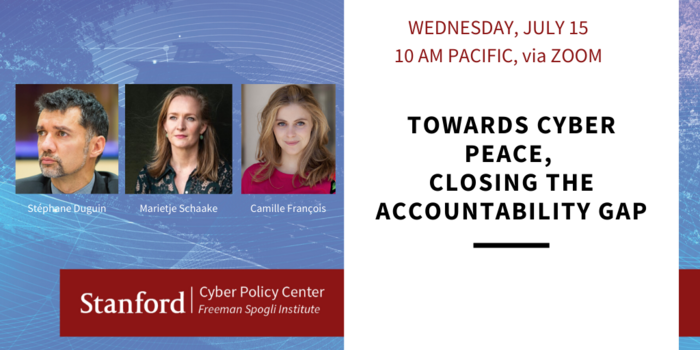
towards cyber peace

Please join the Cyber Policy Center for Towards Cyber Peace, Closing the Accountability Gap, hosted by Cyber Policy Center's Marietje Schaake, along with guests Stéphane Duguin, CEO of the Cyber Peace Institute and Camille François, CIO of Graphika and Mozilla Fellow. The discussion will focus on the challenges to cyber peace, and the work being done to chart a path forward. The session is open to the public, but registration is required. 

Marietje Schaake is the international policy director at Stanford University’s Cyber Policy Center and international policy fellow at Stanford’s Institute for Human-Centered Artificial Intelligence. She was named President of the Cyber Peace Institute. Between 2009 and 2019, Marietje served as a Member of European Parliament for the Dutch liberal democratic party where she focused on trade, foreign affairs and technology policies. Marietje is affiliated with a number of non-profits including the European Council on Foreign Relations and the Observer Research Foundation in India and writes a monthly column for the Financial Times and a bi-monthly column for the Dutch NRC newspaper. 

Camille François works on cyber conflict and digital rights online. She is the Chief Innovation Officer at Graphika, where she leads the company’s work to detect and mitigate disinformation, media manipulation and harassment. Camille was previously the Principal Researcher at Jigsaw, an innovation unit at Google that builds technology to address global security challenges and protect vulnerable users. Camille has advised governments and parliamentary committees on both sides of the Atlantic on policy issues related to cybersecurity and digital rights. She served as a special advisor to the Chief Technology Officer of France in the Prime Minister’s office, working on France’s first Open Government roadmap. Camille is a Mozilla Fellow, a Berkman-Klein Center affiliate, and a Fulbright scholar. She holds a masters degree in human rights from the French Institute of Political Sciences (Sciences-Po) and a masters degree in international security from the School of International and Public Affairs (SIPA) at Columbia University. François’ work has been featured in various publications, including the New York Times, WIRED, Washington Post, Bloomberg Businessweek, Globo and Le Monde.

Stéphane Duguin is the Chief Executive Officer of the CyberPeace Institute. His mission is to coordinate a collective response to decrease the frequency, impact, and scale of cyberattacks by sophisticated actors. Building on his hands-on experience in countering and analyzing cyber operations and information operations which impact civilians and civilian infrastructure, he leads the Institute with the aim of holding malicious actors to account for the harms they cause. Prior to this position, Stéphane Duguin was a senior manager and innovation coordinator at Europol. He led key operational projects to counter both cybercrime and online terrorism, such as the setup of the European Cybercrime Centre (EC3), the Europol Innovation Lab, and the European Internet Referral Unit (EU IRU). A leader in digital transformation, his work focused on the implementation of innovative responses to a large-scale abuse of the cyberspace, notably on the convergence of disruptive technologies and public-private partnerships.


Shorenstein APARC
Encina Hall
616 Jane Stanford way
Stanford, CA 94305-6055

(650) 723-2408
0
Senior Fellow at the Freeman Spogli Institute for International Studies
Professor of Sociology
Henri H. and Tomoye Takahashi Professor and Senior Fellow in Japanese Studies at the Shorenstein Asia-Pacific Research Center
Kiyo Tsutsui1_0.jpg PhD

Kiyoteru Tsutsui is the Henri H. and Tomoye Takahashi Professor and Senior Fellow in Japanese Studies at the Walter H. Shorenstein Asia-Pacific Research Center (APARC), the director of APARC and of the Japan Program at APARC, co-director of the Southeast Asia Program at APARC, executive director of the Inter-University Center for Japanese Language Studies, co-director of the Center for Human Rights and International Justice, senior fellow at the Freeman Spogli Institute for International Studies, and professor of sociology, all at Stanford University.

Prior to his appointment at Stanford in July 2020, Tsutsui was professor of sociology, director of the Center for Japanese Studies, and director of the Donia Human Rights Center at the University of Michigan, Ann Arbor.

Tsutsui’s research interests lie in political/comparative sociology, social movements, globalization, human rights, and Japanese society. More specifically, he has conducted (1) cross-national quantitative analyses on how human rights ideas and instruments have expanded globally and impacted local politics and (2) qualitative case studies of the impact of global human rights on Japanese politics. His current projects examine (a) changing conceptions of nationhood and minority rights in national constitutions and in practice, (b) populism and the future of democracy, (c) experimental surveys on public understanding about human rights, (d) campus policies and practices around human rights, (e) global expansion of corporate social responsibility and its impact on corporate behavior, and (f) Japan’s public diplomacy and perceptions about Japan in the world.

His research on the globalization of human rights and its impact on local politics has appeared in American Sociological Review, American Journal of Sociology, Social Forces, Social Problems, Journal of Peace Research, Journal of Conflict Resolution, and other social science journals. His book publications include Rights Make Might: Global Human Rights and Minority Social Movements in Japan (Oxford University Press 2018), and two co-edited volumes Corporate Social Responsibility in a Globalizing World (with Alwyn Lim, Cambridge University Press 2015) and The Courteous Power: Japan and Southeast Asia in the Indo-Pacific Era (with John Ciorciari, University of Michigan Press forthcoming). He has been a recipient of National Endowment for the Humanities Fellowship, National Science Foundation grants, the SSRC/CGP Abe Fellowship, Stanford Japan Studies Postdoctoral Fellowship, and other grants as well as awards from American Sociological Association sections on Global and Transnational Sociology (2010, 2013, 2019), Human Rights (2017, 2019), Asia and Asian America (2018, 2019), Collective Behavior and Social Movements (2018), and Political Sociology (2019). 

Tsutsui received his bachelor’s and master’s degrees from Kyoto University and earned an additional master’s degree and Ph.D. from Stanford’s sociology department in 2002.

Director, Shorenstein Asia-Pacific Research Center (APARC)
Director, Japan Program at Shorenstein APARC
Co-Director, Southeast Asia Program at Shorenstein APARC
Executive Director, Inter-University Center for Japanese Language Studies
Co-Director, Center for Human Rights and International Justice
CV
Date Label
Authors
Gary Mukai
News Type
Commentary
Date
Paragraphs

The Stanford Program on International and Cross-Cultural Education (SPICE) unequivocally condemns the systemic racism that permeates U.S. society and fully supports the recent calls for social justice and equity. I have been so moved and inspired by the protests across the United States that have brought world-wide attention to the systemic racism in the United States. Because of my age and the stay-at-home orders, I regret that I have not been able to participate in the protests. It is not due to my indifference. My family—in particular in late 1941 and 1942—also suffered from what would be called “racial profiling” today.

After the Japanese attack on Pearl Harbor on December 7, 1941, my grandparents, who were immigrants from Japan, and my U.S.-born parents were forcibly removed by Executive Order 9066 from their homes in Salinas, California, in 1942 and detained initially in the Salinas Assembly Center, one of 15 temporary detention facilities along the West Coast for Japanese immigrants and Japanese Americans. They were later transported to Poston War Relocation Center, which was built on the Colorado River Indian Reservation in the Arizona desert, and was one of ten more permanent detention camps that the U.S. government had initially referred to as concentration camps. They remained there until the end of World War II.

My father, as a high school student in Poston, became fully aware of not only the painful sting of scorpions but more importantly of the sting of indifference from Americans concerning their plight; and my mother, as an elementary school student, simply assumed that they had done something wrong because her family was surrounded by barbed wire and guard towers manned by U.S. soldiers with guns. During World War II, very few people spoke out as the constitutional rights of 120,000 people of Japanese ancestry—more than two-thirds of whom were U.S. citizens—were violated.

As I listened to President Donald Trump’s June 13th remarks at the 2020 United States Military Academy at West Point graduation ceremony, I was hoping that he would—especially given the times—specifically mention Henry Ossian Flipper, a former slave, who in 1877 became the first African American to graduate from the United States Military Academy at West Point; as well as others like the African American Tuskegee Airmen who served valiantly in World War II. One of my uncles, who was drafted into the U.S. Army from Poston, trained with other Japanese American soldiers in the 442nd Regimental Combat Team in Camp Shelby, Mississippi. Around town, he saw the segregated entrances—“Whites Only” and “Colored Only”—and didn’t know which one to enter. He went to Europe to fight bigotry.

As a young student in the late 1950s and 1960s, I had never learned about these stories in my elementary and secondary school classes. I learned about them informally through my family and formally for the first time as a freshman in fall 1972 at U.C. Berkeley. Here I was taught that what I had learned in elementary and secondary school was the U.S. master narrative of history, in which the 442nd Regimental Combat Team, Henry Ossian Flipper, and Tuskegee Airmen were not included, at least at the time.

SPICE fully supports FSI Director Michael McFaul’s call “to reassess our work and how we can move our local community, nation, and the world to achieve racial justice” in light of the horrific killing of George Floyd and the long, tragic history of racial injustice and police violence targeted at the Black community. SPICE—with roots that date back to 1973—is an educational outreach program of FSI. The goal of making Stanford scholarship accessible to K–12 students (and more recently community college students) has remained as SPICE’s mission since its establishment. Now—perhaps more than ever—I feel the need to do more to help open up the still strictly confined master narrative of U.S. history to include the Black Lives Matter movement and more broadly the contributions of minorities to U.S. society.

Long before terms like culturally relevant (or sensitive) curriculum were being used, SPICE has underscored the importance of helping to raise international and cultural awareness—through curriculum development—geared to students at a young age, when critical attitudes are being formed. SPICE is about to launch a website that is called “What does it mean to be an American?” The website’s lessons focus on topics like immigration, civil liberties & equity, civic engagement, justice & reconciliation, and leadership. It is meant as a starting point for critical discussions, including courageous conversations about race and discrimination. We hope that this is a modest starting point for teachers to encourage youth around the country to discuss topics like the Black Lives Matter movement, being Muslim in America, and LGBTQ issues.

Among SPICE’s offerings are a series of short lectures (Scholars Corner and Multimedia Library) by Stanford scholars with accompanying teacher guides. One focuses on “The Use of Lethal Force by the Police in Rio de Janeiro and the Pacification Process” by Professor Beatriz Magaloni in which she explores the connections between poverty, crime, and police violence—topics just as relevant in the contemporary United States as they are in Brazil. For many years, I have hoped to expand these further with scholars affiliated with the Martin Luther King, Jr. Research and Education Institute, which is directed by Professor Clayborne Carson. Several years ago, SPICE recorded a lecture by Professor Carson titled “Civil and Human Rights: The Martin Luther King, Jr. Legacy,” and I recommend its use in schools as his message is very timely. In addition, SPICE has worked with educators of the Navajo Nation for many years; someday we hope to collaborate on a long-term project. One of the Navajo educators was a Stanford student in the 1960s and he shared his efforts to persuade Stanford to drop the Indian symbol as a mascot in 1972 despite resistance or indifference on the part of many in the Stanford community.

I agree with Professor Michael McFaul that “We must do better.” I definitely need to do better. SPICE needs to do more to highlight BIPOC’s invaluable contributions to U.S. history and society and help to empower youth with a greater voice and platform today to address the systemic racism in the United States that is directly affecting their lives.

My mother, now 87, still vividly recalls the barbed wire that surrounded her as a 9-year-old American girl at the “assembly center” in Salinas in 1942. Reflecting upon the recent protests, she recently shared with me, “I imagine that Blacks feel like they have a fence around them all the time.” She also still nervously remembers the paranoia that her mother felt during World War II, and even after the war when her mother used to sometimes go outside in the middle of the night with a packed suitcase. After being escorted home by neighbors, she would tell her children that “She was going to Poston.” I know how much these stories still hurt me despite the passage of time. I believe that they help me to empathize as best I can with the plight of Black families in the United States today. But empathizing is not enough. We must ask ourselves, what more can we do to help take down the racial fences that still exist?

In SPICE’s curriculum work, we always preface each lesson with organizing questions (essential or overarching questions) that we would like students to consider. I would like to pose three for us to consider during this time: What can we at Stanford University do to move our local community, the United States, and the world to achieve greater racial justice? What can SPICE do to further make FSI/Stanford scholarship accessible to K–12 schools and community colleges ? What are the risks of remaining indifferent especially during times of crisis? These questions will be the driving force of our work in the weeks, months, and years ahead.

Hero Image
sting of indifference
Educators from the Navajo Nation, Encina Hall, Stanford University, June 12, 2013
All News button
1
Subtitle

Director Gary Mukai reaffirms SPICE’s commitment to racial and social justice.

Paragraphs

American democracy is in trouble. Since the 2016 election, a sizable literature has developed that focuses on diagnosing and assessing the state of American democracy, most of which concludes that our system of government is in decline.[2] These authors point to the rise in party polarization, the increasingly bipartisan abandonment of the norms of the democratic process, the rise of populism, the degradation of the public sphere, and the proliferation of gerrymandered districts and voting restrictions to illustrate the breakdown. And while attributing varying levels of significance to these factors, a common theme is that American democracy, once stable, is now threatened. On closer observation, however, it is unclear that American democracy was ever really as healthy as it may have appeared. This Essay argues that the stability of the American system has always been built and dependent upon racial exclusion; over the course of our history, each major movement toward a more fully representative participatory democracy has prompted a backlash that was resolved only by the adoption of policies that worked to undermine the full citizenship of communities of color. The point of this reframing is not to suggest that the United States has made no progress over its history. Nor does it diminish the accomplishments of those who have advocated for equality over the course of our history or minimize the importance of working to repair our democratic institutions. Rather, this reframing is necessary to avoid romanticizing our democratic history and to inform the choices in this moment as we seek to stabilize our country.

All Publications button
1
Publication Type
Journal Articles
Publication Date
Journal Publisher
Michigan Law Review Online
Authors
Didi Kuo
Authors
News Type
News
Date
Paragraphs

In a webinar dated June 8, 2020, American University in Cairo Scholar Amr Adly presented findings from his new book Cleft Capitalism: The Social Origins of Failed Market Making in Egypt (Stanford University Press, 2020). Egypt has undergone significant economic liberalization under the auspices of the International Monetary Fund, the World Bank, USAID, and the European Commission. Yet after more than four decades of economic reform, the Egyptian economy still fails to meet popular expectations for inclusive growth, better standards of living, and high-quality employment. While many analysts point to cronyism and corruption, this study finds the root causes of this stagnation in the underlying social and political conditions of economic development. It offers a new explanation for why market-based development can fail to meet expectations: small businesses in Egypt are not growing into medium and larger businesses. The practical outcome of this missing middle syndrome is the continuous erosion of the economic and social privileges once enjoyed by the middle classes and unionized labor, without creating enough winners from market making. This in turn set the stage for alienation, discontent, and, finally, revolt. With this book, Adly uncovers both an institutional explanation for Egypt's failed market making, and sheds light on the key factors of arrested economic development across the Global South.


Hero Image
screen shot 2020 06 09 at 2 41 41 pm
All News button
1
News Type
Commentary
Date
All News button
1
Subtitle

On May 28th, President Trump signed an executive order threatening to revoke CDA 230 protections, which would expose social media companies to increased liability for content that is posted on their sites. The Cyber Policy Center team responded on June 1 in a public webinar. The event was recorded.

Subscribe to Governance