Governance

FSI's research on the origins, character and consequences of government institutions spans continents and academic disciplines. The institute’s senior fellows and their colleagues across Stanford examine the principles of public administration and implementation. Their work focuses on how maternal health care is delivered in rural China, how public action can create wealth and eliminate poverty, and why U.S. immigration reform keeps stalling. 

FSI’s work includes comparative studies of how institutions help resolve policy and societal issues. Scholars aim to clearly define and make sense of the rule of law, examining how it is invoked and applied around the world. 

FSI researchers also investigate government services – trying to understand and measure how they work, whom they serve and how good they are. They assess energy services aimed at helping the poorest people around the world and explore public opinion on torture policies. The Children in Crisis project addresses how child health interventions interact with political reform. Specific research on governance, organizations and security capitalizes on FSI's longstanding interests and looks at how governance and organizational issues affect a nation’s ability to address security and international cooperation.

This event is open to the public online via Zoom, and limited-capacity in-person attendance for Stanford affiliates may be available in accordance with Stanford’s health and safety guidelines.

Register for Zoom                                            Register for In-Person

(Open to all)                                            (Stanford Only)

Recent elections in the advanced western democracies have undermined the basic foundations of political systems that had previously beaten back all challenges -- from both the left and the right. The election of Donald Trump to the U.S. presidency, only months after the United Kingdom voted to leave the European Union, signaled a dramatic shift in the politics of the rich democracies. In Anti-System Politics, Jonathan Hopkin traces the evolution of this shift and argues that it is a long-term result of abandoning the post-war model of egalitarian capitalism in the 1970s. That shift entailed weakening the democratic process in favor of an opaque, technocratic form of governance that allows voters little opportunity to influence policy. With the financial crisis of the late 2000s these arrangements became unsustainable, as incumbent politicians were unable to provide solutions to economic hardship. Electorates demanded change, and it had to come from outside the system.

Using a comparative approach, Hopkin explains why different kinds of anti-system politics emerge in different countries and how political and economic factors impact the degree of electoral instability that emerges. Finally, he discusses the implications of these changes, arguing that the only way for mainstream political forces to survive is for them to embrace a more activist role for government in protecting societies from economic turbulence. A historically-grounded analysis of arguably the most important global political phenomenon at present, Anti-System Politics illuminates how and why the world seems upside down.


Image
Jonathan Hopkin

Jonathan Hopkin is Professor in the European Institute and the Department of Government of the London School of Economics and Political Science. He obtained his PhD at the European University Institute in Florence. He is the author of Party Formation and Democratic Transition in Spain (1999, Macmillan) and Anti-System Politics: The Crisis of Market Liberalism in Rich Democracies (2020, Oxford University Press). Previously he taught at the Universities of Bradford, Durham and Birmingham, and held visiting positions at Johns Hopkins University Baltimore, the University of Bologna, and the Autonomous University of Barcelona. He has published widely on the party politics and political economy of Europe in peer-reviewed journals as well as for a wider audience.

*If you need any disability-related accommodation, please contact Shannon Johnson (sj1874@stanford.edu) by February 24, 2022.

Hybrid: Online via Zoom and in-person for Stanford affiliates.

Jonathan Hopkin Professor of Comparative Politics speaker London School of Economics

The focus of religion & politics research has been predominantly on the impact of religious actors on democratic and non-democratic political systems and religion-inspired political behavior. But to better understand the political significance of religion, it is necessary to look below this institutional level and adopt a micropolitical perspective which incorporates insights from fields such as behavioral ecology, social psychology or cognitive science to study the internal politics of religious communities.

Why is religion, despite its costly requirements and uncertain rewards, such a potent factor of mobilization? How does it legitimize claims for power and status? Why do religious groups significantly outlast secular ones? To address some of these questions, I examine political systems of communitarian religious groups – including the American Shakers and Russian Skoptsy – through the lenses of costly signaling theory of religion. This evolutionarily-informed theoretical framework contributes to the explanation of seemingly irrational and costly ascetic and ecstatic religious behavior not only as signals of commitment, but also as bids for power and status. The added value of such micropolitical study of religious communities is that it may shed light on the complex relationship between religion and political power in the early stages of human social development. But it also contributes to our understanding of some modern religio-political phenomena, such as various form of political sacrifice, including suicidal terrorism.
 

Image
Maciej Potz

Maciej Potz is a professor of Political Science at the Department of Political Systems, Faculty of International and Political Studies, University of Łódź, Poland. He earned his Ph.D. in 2006 from the Silesian University in Katowice and his post-doctoral degree from the University of Łódź in 2017, both in Political Science. His primary area of interest is religion and politics, with special focus on theocracies (as a Foundation for Polish Science scholar, he studied Shaker and Mormon theocracies in the USA in 2009 and 2012) and political strategies of religious actors in contemporary democracies, especially in Poland and the USA. His other research interests include political theory (especially theory of power and democratic theory), comparative politics and, most recently, evolutionary political science.

Maciej Potz published three monographs: (i) Granice wolności religijnej [The Limits of Religous Liberty] 2008 (2nd ed. 2015), Wrocław: FNP, on religious freedom, church-state relations and confessional politics in the USA; (ii) Amerykańskie teokracje. Źródła i mechanizmy władzy usankcjonowanej religijnie [American Theocracies. The Sources and Mechanisms of Religion-Sanctioned Power] 2016, Łódź: UŁ, theorizing theocracy as a type of a political system and emprically exploring North American theocracies; (iii) Political Science of Religion: Theorizing the Political Role of Religion, 2020, London: Palgrave MacMillan – a theoretical framework for the analysis of religion’s impact on politics. He also authored several journal articles, including in Religion, State and Society, Journal of Political Power, Politics and Religion and Studia Religiologica.

Maciej Potz has taught political science-related courses in the University of Lodz and, as guest lecturer, at other European universities, including University of the West of Scotland in Glasgow, Buskerund College and NTNU (Norway), University of Joensuu (Finland), University of La Laguna (Spain). He participated in a number of international conferences, including “XXI World IAHR Congress in Erfurt (2015), IPSA World Congresses of Political Science in Santiago (2019), Madrid (2012) and Poznań (2016), APSA Annual Meeting (forthcoming in 2021).  

The research project he will be pursuing at Stanford, entitled Costly signaling Under His Eye: explaining the commune longevity puzzle, uses costly signaling theory of religion to explore the determinants of cohesion and longevity of (communitarian) religious groups. It also proposes a novel political interpretation of signaling behavior. Over the next three years, he will head a research team undertaking an empirical study (funded by National Science Centre of Poland) of power and status in Catholic religious orders.


*If you need any disability-related accommodation, please contact: Shannon Johnson (sj1874@stanford.edu) by February 3, 2022.

Maciej Potz Professor of Political Science speaker University of Łódź, Poland
-

This is a virtual event. Please click here to register and generate a link to the talk. 
The link will be unique to you; please save it and do not share with others.


China’s rapidly growing local government debt problem has long been recognized by foreign observers as a risk, but inside China, only recently was this problem called out as alarming.  Why has local government debt been allowed to grow with little direct intervention from central authorities?  Based on a forthcoming paper, Oi will show how a “grand bargain” the central authorities entered into with the localities allowed Beijing to take the lion’s share of tax revenues after 1994, but also allowed localities to gain new resources and power as a quid pro quo.  While the bargain provided an expedient and seemingly successful strategy that worked for more than a decade to fuel rapid local state-led growth, it had significant costs that are now becoming increasingly visible.  Because land finance was the core means by which localities raised revenue, Oi also will help explain why the problems with property developers like Evergrande are so important to China’s future economy.   


Image
Dr. Jean C. Oi
Jean C. Oi is the William Haas Professor of Chinese Politics in the Department of Political Science and a senior fellow in the Freeman Spogli Institute for International Studies at Stanford University. She directs the China Program at the Walter H. Shorenstein Asia-Pacific Research Center and is the Lee Shau Kee Director of the Stanford Center at Peking University. Professor Oi has published extensively on China’s reforms. Recent books include Fateful Decisions: Choices That Will Shape China’s Future, co-edited with Thomas Fingar (Stanford University Press, 2020); Zouping Revisited: Adaptive Governance in a Chinese County, co-edited with Steven Goldstein (Stanford University Press, 2018); and Challenges in the Process of China’s Urbanization, co-edited with Karen Eggleston and Yiming Wang (2017). Current research is on fiscal reform and local government debt, continuing SOE reforms, and the Belt and Road Initiative.


Image
Chinese 100 yuan bills

This event is part of the 2022 Winter webinar series, The Future of China's Economy, sponsored by the APARC China Program.


Via Zoom Webinar. Register at: https://bit.ly/34mnOcc

Jean C. Oi Director of Shorenstein APARC China Program; William Haas Professor of Chinese Politics, Stanford University
Seminars
Authors
Melissa Morgan
News Type
News
Date
Paragraphs

The Ukraine-Russia crisis continues to evolve at the geographic boundaries of Eastern Europe, but Oleksiy Honcharuk believes the conflict is as much about democracy and ideology as it is about borders.

Hancharuk, the former prime minister of Ukraine and 2021 Bernard and Susan Liautaud Visiting Fellow at the Center on Democracy, Development and the Rule of Law (CDDRL), joined FSI Director Michael McFaul on World Class Podcast to discuss the roots of the crisis and why Vladamir Putin sees the success of democracy in Ukraine – or anywhere – as an existential threat to his authority.

Listen to the full episode and browse highlights from their conversation below. For additional reading, see McFaul and Honcharuk's joint op-ed in the Washington Post on the need for closer U.S.-Ukraine relations.

Click the link for a transcript of “Ukraine, Russia and the Fight for Democracy.”

The Complicated History Between Russia and Ukraine
 

Ukraine played a key role in the collapse of the Soviet Union, and it came out as the biggest independent country of the former Soviet states. Ukraine decided to be a democracy, thankfully, and this has been our path for the last thirty years.

This is a great achievement for our nation, because if you look around our country, even among hundreds of other successful European countries, there are not many other good examples of democracy. They have problems: Turkey has problems; Belarus has problems; Kazakhstan as well. We have some problems with corruption, but we are still an electoral democracy with fair elections.

Now, unfortunately, Russia understands itself as the successor, or empire, coming after the Soviet Union, and Putin has said many times that this collapse was the biggest catastrophe in the last twenty years of the last century. For him, Ukraine’s success is a tragedy.

For Putin, it's very dangerous to have examples of successful democratic countries, especially Slavic Orthodox Christian countries with close ties to Russia. Putin needs the Russian people to believe that democracy is a weak, failing idea that doesn’t work.
Oleksiy Honcharuk
Former Prime Minister of Ukraine

Putin has invaded Ukraine before during the annexation of Crimea. He tried to divide Ukraine into a Russian, authoritarian Ukraine and a European, democratic Ukraine. But he failed. Our civil society worked hard to create voluntary military and paramilitary organizations and units, and Ukrainians pushed back as a nation.

And that was a moment when Putin understood, finally, that he lost Ukraine not only as an economic partner, but ideologically. Ukrainians chose freedom. We chose democracy. And for Putin, it's very dangerous to have examples of successful democratic countries – especially Slavic Orthodox Christian countries with close ties to Russia – like Ukraine. Putin needs the Russian people to believe that democracy is a weak, failing idea that doesn’t work.

A Struggle Broader Than One Country
 

This buildup of Russian troops along the Ukrainian border is not juist a regional conflict, and it's not just about NATO. It’s a battle between two conceptually different systems: the authoritarian system and the democratic system. It’s an attack towards democracy and the Western world. Our values in the Western world are a threat for Mr. Putin himself.

Putin is trying to shape the situation and to undermine the trust among countries and among people. He's trying to create destabilizing situations like an immigration crises, organize sabotages among the military, have political murders, and so on and so forth.

This buildup is only one element of this game to create one more additional crisis to attract attention, and to create a situation where Western leaders have to decide and make very hard decisions. Putin is trying to show that, “If I do attack, nobody will protect you. All of these values you have are just fairy tales. The West is weak, the West is insincere. When they tell you that values matter, it’s a lie because the only real value is money. There is no democracy.”

The Role of the West in Supporting Democracies
 

For Putin, the weak reaction from the West to the aggression towards Ukraine was a signal that it was acceptable to act like this. That's why Putin is raising the stakes and why he will continue to raise the stakes every year. Right now, the sanctions policy and general Western policy is creating a situation where time is playing against the victim, not against the aggressor.

Putin’s strategy is to wait, to use all his resources to undermine his democratic opponents, and to make sure that the next politicians in the western world will be more flexible. And maybe in 10 years or 15 years when the annexation of Crimea has become deep history, he will find some new trade-off with the next generation of democratic leaders.

This buildup of Russian troops is not just a regional conflict, and it's not just about NATO. It’s a battle between two conceptually different systems: the authoritarian system and the democratic system. It’s an attack on democracy itself.
Oleksiy Honcharuk
Former Prime Minister of Ukraine

This is why there needs to be a new model of smart or cascading sanctions where the EU adopts a package of sanctions for some period of time, maybe five, seven or ten years, and every next wave, every next package of sanctions will automatically come into power if the problem is not solved. So every single day, it automatically raises the price for the aggressor.

Supporting fragile democracies is not just about making a morally right choice; these countries on the frontlines that have paid an additional price – an additional tax, if you will, for democracy, and have taken on additional burdens, because they choose the democratic path. Whether it’s Ukraine or other countries, we need Western support now in a much bigger way than we have it now.

For more from Oleksiy Honcharuk, listen to his his remarks on "Ukraine vs Russia: The War for Democracy," given as a Liautaud Lecture at the Center on Democracy, Development and the Rule of Law (CDDRL).

Read More

Vladimir Putin
Commentary

Does the Kremlin Understand Ukraine? Apparently Not

The abject failure of Russian policy toward Ukraine over the past seven years suggests Vladimir Putin has a flawed understanding of the country.
Does the Kremlin Understand Ukraine? Apparently Not
Valdimir Putin making a speech
Commentary

Will Russia launch a full military invasion of Ukraine?

As Russian troops gather on Ukraine’s borders, the outstanding question is whether Russian President Putin is prepared to bear the domestic and international costs of a full-scale invasion or if he’ll stop at pressuring NATO and the West for political concessions.
Will Russia launch a full military invasion of Ukraine?
Oleksiy Honcharuk
News

Oleksiy Honcharuk Appointed the Bernard and Susan Liautaud Visiting Fellow

Honcharuk, formerly the prime minister of Ukraine, will focus on examining what Western allies can do to support Ukraine in its struggle to thrive as a democracy in Eastern Europe while at Stanford.
Oleksiy Honcharuk Appointed the Bernard and Susan Liautaud Visiting Fellow
Hero Image
Members of the Ukrainian military carry the flag of Ukraine during the 30th anniversary of the country's independence.
Getty
All News button
1
Subtitle

Former prime minister of Ukraine Oleksiy Honcharuk joins Michael McFaul on the World Class Podcast to analyze Russia's aggression towards Ukraine and how it fits into Vladamir Putin's bigger strategy to undermine democracy globally.

For winter quarter 2022, CISAC will be hosting hybrid events. Many events will offer limited-capacity in-person attendance for Stanford faculty, staff, fellows, visiting scholars, and students in accordance with Stanford’s health and safety guidelines, and be open to the public online via Zoom. All CISAC events are scheduled using the Pacific Time Zone. 

REGISTRATION

(Stanford faculty, visiting scholars, staff, fellows, and students only)


About the Event: In Nigeria today, frequent conflicts, disappearances and mass violence, especially in the Northern region of the country, have amounted to large-scale destruction of human life and the displacement of large populations as unarmed civilians are caught in the crossfire. The effects of climate change on the Lake Chad basin are key triggers of conflict as herders migrate to other parts of the region to find fodder and water for their cattle. Existing responses to conflict and mass violence in Nigeria have been beset by challenges. The migration patterns of nomadic communities have begun to signal security concerns beyond the immediately impacted regions. In late 2017, state governments within the western and southern parts of the country began to set up community policing strategies to address growing security challenges around their states, including those relating to the (perceived) threats associated with the movement of cattle herders. Complicating this situation, the presence of large groups of cattle has incentivized “conflict entrepreneurship” as armed groups of young men across north-central, north-west and southern parts of the country engage in cattle rustling. Government efforts at various levels, ranging from the creation of legal and policy frameworks to programs on-the-ground, have been inadequate to protect civilians and have led to the development new mechanisms for human protection.  For example, interventions by the Nigerian Federal Government have, at times, accelerated conflict, as with the passage of an anti-grazing law that has fueled controversy over implementation at state and local levels of government. Local civil society initiatives have continued to emerge to address the gap and attempt to mitigate ever growing security concerns in the region. One such strategy has involved the development of Early Warning and Early Response Systems (EWER) using geospatial technologies and other forms of crowd sourcing imagery to enhance local resilience in the face of security threats and strengthen the ability of communities to protect themselves in a sustainable way. However, the potential of such technologies depends on the ability to “see” particular phenomena and render other phenomena illegible. This paper will argue that such geospatial technology’s interpretive power is concerned with assigning to future violence an interpretive code based on its baseline values.  As an act of decoding that is anticipatory, the power of EWER processes lies in its decoding potential. These interpretive code processes provide participants with the potential to engage in analyses that involve mapping patterns and potential risk that have the ability to produce indicators that have material effects. It is these material effects, drawn from visual codes, that are used to justify action that is life preserving as well as render other relations illegible and therefore invisible to intervention.  This paper explores the emergence of EWER strategies used to address widespread violence and the challenge of illegibility that is central to it.


About the Speaker: M. Kamari Clarke is the Distinguished Professor of Transnational Justice and Sociolegal Studies at the University of Toronto where she teaches in the Centre for Criminology and Sociolegal Studies and the Centre for Diaspora and Transnational Studies. Over her career she has worked at The University of California Los Angeles (2018-2021), Carleton University (2015-2018), The University of Pennsylvania (2013-2015) Yale University (1999-2013), and at Yale she was the former chair of the Council on African Studies from 2007- 2010 and the co-founder of the Yale Center for Transnational Cultural Analysis.  For more than twenty years, Professor Clarke has conducted research on issues related to legal institutions, human rights and international law, religious nationalism and the politics of globalization. For more than 20 years, Professor Clarke has conducted research on issues related to legal institutions, international legal domains, religious nationalism, and the politics of globalization and race. She  is the author of nine books and over fifty peer reviewed articles and book chapters, including her 2009 publication of Fictions of Justice: The International Criminal Court and the Challenge of Legal Pluralism in Sub-Saharan Africa (Cambridge University Press, 2009) and Affective Justice (with Duke University Press, 2019), which won the finalist prize for the American Anthropological Association’s 2020 Elliot P. Skinner Book Award for the Association for Africanist Anthropology.  Clarke has also been the recipient of other research and teaching awards, including Carleton University’s 2018 Research Excellence Award.  During her academic career she has held numerous prestigious fellowships, grants and awards, including multiple grant awards from the National Science Foundation and from The Social Sciences and the Humanities Research Council of Canada (SSHRCC), the Rockefeller Foundation, the Wenner-Gren Foundation for Anthropological Research and, very recently, the 2021 Guggenhiem Award for Career Excellence.

Virtual to Public. Only those with an active Stanford ID with access to William J Perry Conference Room in Encina Hall may attend in person. 

Kamari Clarke University of Toronto / UCLA
Seminars
-

Image
image of Jamal Greene, columbia law professor on blue background advertising january 18th seminar

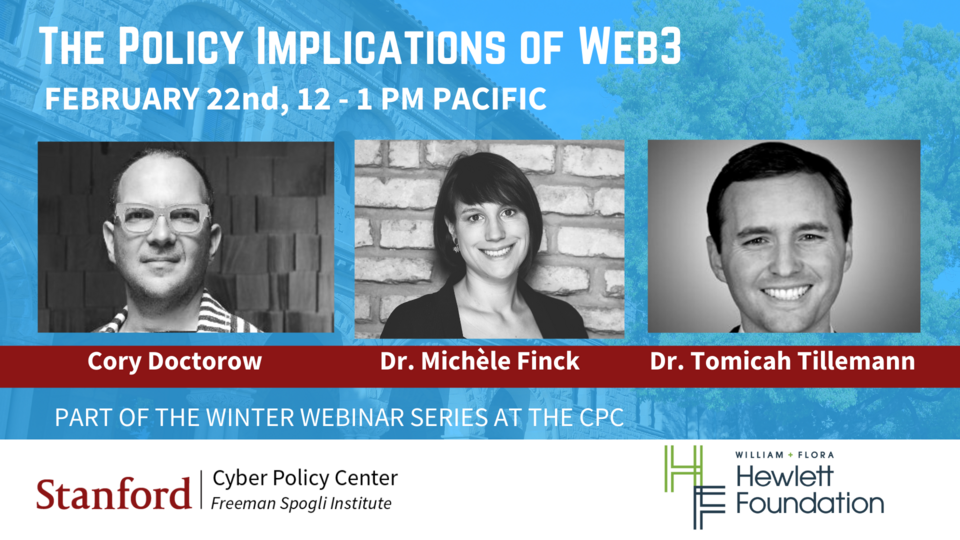
Join us on Tuesday, January 18 from 12 PM - 1 PM PST for Free Speech on Public Platforms featuring Professor Jamal Greene of Columbia Law School in conversation with Daphne Keller, Director of the Program on Platform Regulation at the CPC. This weekly seminar series is jointly organized by the Cyber Policy Center’s Program on Democracy and the Internet and the Hewlett Foundation’s Cyber Initiative. 

It is commonly assumed that social media companies owe their freedom to moderate solely to their status as private actors. This seminar explores the adequacy of that assumption by considering the hypothetical construct of a state-run social media platform. Jamal Greene argues that the categorical nature of First Amendment norms leave the doctrine ill-equipped to order regulation of such a platform, and that international human rights norms, while less categorical, remain immature in this space. Greene suggests that the most promising area of legal intervention would address the development of procedural rather than substantive norms.

Speaker:

Jamal Greene is the Dwight Professor of Law at Columbia Law School, where he teaches courses in constitutional law, comparative constitutional law, and the law of the political process. He is the author of How Rights Went Wrong: Why Our Obsession With Rights Is Tearing America Apart, as well as numerous articles and book chapters on constitutional law and theory. He is also a co-chair of the Oversight Board, an independent body that reviews content moderation decisions on Facebook and Instagram. He served as a law clerk to the Hon. Guido Calabresi on the U.S. Court of Appeals for the Second Circuit and for the Hon. John Paul Stevens on the U.S. Supreme Court. He earned his J.D. from Yale Law School and his A.B. from Harvard College.

-

Image
cloud governance event with speaker photos of kelly born, marietje schaake

Join us for our winter seminar series starting Tuesday, January 11 from 12 PM - 1 PM PST.  The first in the session is Cloud Governance Challenges and features leaders from the Carnegie Endowment’s Cloud Governance Project and Marietje Schaake of the Stanford Cyber Policy Center, in conversation with Kelly Born of the Hewlett Foundation. This weekly seminar series is jointly organized by the Cyber Policy Center’s Program on Democracy and the Internet and the Hewlett Foundation’s Cyber Initiative.

Central to the ongoing digital transformation is the growth of cloud computing, which is enabling remarkable gains in efficiency, innovation, and connectivity around the world. However, the cloud also accentuates many preexisting digital policy challenges and brings to the fore new ones. It increases the consequences of disruption resulting from cyberattacks and natural disasters, and raises the stakes associated with ensuring equitable access to the digital environment. It also creates some new challenges associated with the concentration of the cloud market in the hands of a few hyperscale providers. Left to their own devices, cloud providers lack the incentives to comprehensively address these issues, and governments’ ability to fill the gap is being challenged by the pace of the developments in the cloud technology landscape. To promote more coherent and effective governance of the cloud, concerned players must recognize the challenges, interconnections, and policy tradeoffs across issue areas. They will need to apply a combination of regulation, self-regulation, and industry standards, while balancing competing private, national, and international interests. 

Speakers:

Kelly Born, Director, Cyber Initiative, William and Flora Hewlett Foundation

Ariel Eli Levite, Nonresident Senior Fellow, Carnegie Endowment for International Peace

Vishnu Kannan, Special Assistant to the President, Carnegie Endowment for International Peace

Marietje Schaake, International Policy Director, Cyber Policy Center
 

-

For winter quarter 2021, CISAC will be hosting hybrid events. Many events will offer limited-capacity in-person attendance for Stanford faculty, staff, fellows, visiting scholars, and students in accordance with Stanford’s health and safety guidelines, and be open to the public online via Zoom. All CISAC events are scheduled using the Pacific Time Zone. 

SEMINAR RECORDING

Virtual Only.

Rolf Nikel
Seminars
-

Robert G. Wesson Lecture Series in International Relations Theory and Practice

As a Venezuelan, Leopoldo López lived through the gradual deterioration of what was once a regional reference for democracy into an authoritarian regime that has created the worst humanitarian and migration crisis in the Western Hemisphere. Venezuela is a clear example of how democracy could lose the battle against autocracy.

Unfortunately, the fight for freedom is no longer an issue to be solved only among Venezuelans. In fact, our conflict has become, like many others around the world, part of the global conflict between autocracy and democracy.

Autocracy in its different forms is spreading and constitutes a diverse but articulated movement around the world. To face this situation, new forms of organizations and democratic leadership must be promoted and empowered as an effective way to revert this new wave of autocracies. It is essential to create a synergy between effective local leadership, a comprehensive narrative and the use of new technologies that set up a range of possibilities to promote freedom.

The Wesson Lectureship was established at Stanford by the Freeman Spogli Institute for International Studies in 1989. It provides support for a public address at the university by a prominent scholar or practicing professional in the field of international relations. The series is made possible by a gift from the late Robert G. Wesson, a scholar of international affairs, prolific author, and senior research fellow at the Hoover Institution.

In establishing the series, Dr. Wesson stated his hope that the lectures would stimulate increased commitment to the study of international relations in a context that would enable students to understand the importance of developing practical policies within a theoretical and analytical framework. Previous Wesson Lecturers have included such distinguished speakers as McGeorge Bundy, Willi DeClerq, Condoleezza Rice, Mikhail Gorbachev, Fernando Henrique Cardoso, and Mary Robinson.
 

ABOUT THE SPEAKER

Image
Leopoldo Lopez
Leopoldo López is a Venezuelan political leader, pro-democracy activist and Sakharov prize laureate. He is the founder and national coordinator of the Voluntad Popular political party.

López received a Bachelor's degree cum laude in sociology and economics from Kenyon College, and a Master´s degree in public policy from the John F. Kennedy School of Government at Harvard University. He was awarded a honoris causa doctorate in Law from Kenyon College in 2007.

Leopoldo López was elected mayor of the municipality of Chacao in Caracas in 2000 and he finished his second term with a 92% approval rate. He also won third place at the World Mayor Awards and the 2007 and 2008 “Premio Transparencia”, awarded by Transparency International.

In 2014 he was unjustly detained by the Maduro regime and was sentenced to 14 years of imprisonment. He spent four years in a military prison, a year and a half in house arrest and another year and a half in the Spanish embassy in Caracas under political asylum. He was recognized by Amnesty International as a prisoner of conscience. Also, in 2015 his detention was declared arbitrary by the UN.

In October 2020, López escaped from Venezuela through Colombia to join his family in Spain. It was the first time in seven years that he was able to be with his family in freedom. In his exile, López continues his fight for Venezuela´s democracy and freedom.

López has received several international awards for his fight for democracy and freedom in Venezuela. Among them, he was honored with the 2014 Harvard alumni achievement award, the NED´S 2013 Democracy Award, the 2016 Geneva Summit Courage Award and the 2017 Sakharov Prize for Freedom and Thought.

Hybrid event: Online via Zoom, and in-person in Bechtel Conference Center

Leopoldo López Freedom Activist from Venezuela
Lectures
Date Label
0
Short-Term Research Fellow at the Stanford University Library, 2022
lauri-malksoo-1_-_lauri_malksoo.jpg

Lauri Mälksoo is Professor of International Law at the University of Tartu in Estonia, member of the Institut de Droit International and of the Estonian Academy of Sciences. He has published widely on Russian and Soviet approaches to international law and human rights, including the monograph "Russian Approaches to International Law" (OUP, 2015).

Subscribe to Governance