
FSI's research on the origins, character and consequences of government institutions spans continents and academic disciplines. The institute’s senior fellows and their colleagues across Stanford examine the principles of public administration and implementation. Their work focuses on how maternal health care is delivered in rural China, how public action can create wealth and eliminate poverty, and why U.S. immigration reform keeps stalling.
FSI’s work includes comparative studies of how institutions help resolve policy and societal issues. Scholars aim to clearly define and make sense of the rule of law, examining how it is invoked and applied around the world.
FSI researchers also investigate government services – trying to understand and measure how they work, whom they serve and how good they are. They assess energy services aimed at helping the poorest people around the world and explore public opinion on torture policies. The Children in Crisis project addresses how child health interventions interact with political reform. Specific research on governance, organizations and security capitalizes on FSI's longstanding interests and looks at how governance and organizational issues affect a nation’s ability to address security and international cooperation.
Political Inheritance and Hybrid Democracy: Family Politics and Democracy in Thailand
Related Multimedia


Reforming Japan's Energy Sector, Governance, and Economy
News Type
News
Date
Paragraphs
Significant scholarly work has begun on understanding the challenges and opportunities facing post-Fukushima Japan. A group of expert panelists from the United States, Japan, and Europe met for a conference at Stanford on Feb. 27 to delve into the key issues related to Japan’s energy industry, politics, society, and economy today.
Hero Image

All News button
1
One Year Later: International Responses to the Crisis in Syria
-
In commemoration of the Syrian revolution's one year anniversary, STAND and CDDRL are
proud to host a panel discussion about international responses to the crisis in Syria.
Join us in the Arrillaga Study Room from 6:00-7:30pm on Thursday, March 15th.
Co-sponsored by: MSAN
Study Room at Arrillaga Family Dining Commons
Larry Diamond
CDDRL
Stanford University
Encina Hall, C147
616 Jane Stanford Way
Stanford, CA 94305-6055
0
ldiamond@stanford.edu
Mosbacher Senior Fellow in Global Democracy at the Freeman Spogli Institute for International Studies
William L. Clayton Senior Fellow at the Hoover Institution
Professor, by courtesy, of Political Science and Sociology
Larry Diamond is the William L. Clayton Senior Fellow at the Hoover Institution, the Mosbacher Senior Fellow in Global Democracy at the Freeman Spogli Institute for International Studies (FSI), and a Bass University Fellow in Undergraduate Education at Stanford University. He is also professor by courtesy of Political Science and Sociology at Stanford, where he lectures and teaches courses on democracy (including an online course on EdX). At the Hoover Institution, he co-leads the Project on Taiwan in the Indo-Pacific Region and participates in the Project on the U.S., China, and the World. At FSI, he is among the core faculty of the Center on Democracy, Development and the Rule of Law, which he directed for six and a half years. He leads FSI’s Israel Studies Program and is a member of the Program on Arab Reform and Development. He also co-leads the Global Digital Policy Incubator, based at FSI’s Cyber Policy Center. He served for 32 years as founding co-editor of the Journal of Democracy.
Diamond’s research focuses on global trends affecting freedom and democracy and on U.S. and international policies to defend and advance democracy. His book, Ill Winds: Saving Democracy from Russian Rage, Chinese Ambition, and American Complacency, analyzes the challenges confronting liberal democracy in the United States and around the world at this potential “hinge in history,” and offers an agenda for strengthening and defending democracy at home and abroad. A paperback edition with a new preface was released by Penguin in April 2020. His other books include: In Search of Democracy (2016), The Spirit of Democracy (2008), Developing Democracy: Toward Consolidation (1999), Promoting Democracy in the 1990s (1995), and Class, Ethnicity, and Democracy in Nigeria (1989). He has edited or coedited more than fifty books, including China’s Influence and American Interests (2019, with Orville Schell), Silicon Triangle: The United States, China, Taiwan the Global Semiconductor Security (2023, with James O. Ellis Jr. and Orville Schell), and The Troubling State of India’s Democracy (2024, with Sumit Ganguly and Dinsha Mistree).
During 2002–03, Diamond served as a consultant to the US Agency for International Development (USAID) and was a contributing author of its report, Foreign Aid in the National Interest. He has advised and lectured to universities and think tanks around the world, and to the World Bank, the United Nations, the State Department, and other organizations dealing with governance and development. During the first three months of 2004, Diamond served as a senior adviser on governance to the Coalition Provisional Authority in Baghdad. His 2005 book, Squandered Victory: The American Occupation and the Bungled Effort to Bring Democracy to Iraq, was one of the first books to critically analyze America's postwar engagement in Iraq.
Among Diamond’s other edited books are Democracy in Decline?; Democratization and Authoritarianism in the Arab World; Will China Democratize?; and Liberation Technology: Social Media and the Struggle for Democracy, all edited with Marc F. Plattner; and Politics and Culture in Contemporary Iran, with Abbas Milani. With Juan J. Linz and Seymour Martin Lipset, he edited the series, Democracy in Developing Countries, which helped to shape a new generation of comparative study of democratic development.
Download full-resolution headshot; photo credit: Rod Searcey.
Former Director of the Center on Democracy, Development and the Rule of Law
Faculty Chair, Jan Koum Israel Studies Program
Hide publication sections
Off
Lina Khatib
Co-founder and Program Manager
Moderator
Program of Arab Reform, CDDRL
Nabeel Khoury
Director of the Office of Political Analysis for the Middle East
Speaker
US State Department
Anas Qtiesh
Syrian Human Rights activist and a blogger
Speaker
Conferences
Single Party Governance
In this lecture, Professor Okimoto explores distinctive aspects of Japan's political system, namely single-party rule. He examines the positive and negative aspects of Japan's political system and discusses topics such as the Yoshida Doctrine, nisei giin, and amakudari.
Daniel I. Okimoto
Speaker
Lectures


Brookings Doha Center-Stanford Project on Arab Transitions
The Brookings Doha Center-Stanford University "Project on Arab Transitions" - a joint initiative between the BDC and the Program on Arab Reform and Democracy at Stanford University's Center on Democracy, Development, and the Rule of Law (CDDRL) - aims to generate comprehensive analysis of the conditions impacting democratic transition in the Arab world. Because there have been so few democratic transitions in the Arab world, as well as a lack of cross-regional studies, there is a real need for better understanding among Western scholars and policymakers an
Sizing Up Taiwan's 2012 Election
-
Abstract:
One of Taiwan's leading political scientists and most widely quoted authorities on Taiwan politics and cross-Strait relations, Professor Chu will address five issues in his talk:
First, how should we interpret the outcome of the January election and the nature and extent of President Ma's renewed mandate?
Second, to what extent has the 2012 election enhanced the overall quality of Taiwan's democracy?
Third, what can we expect in terms of President Ma's domestic agenda for the next four years?
Fourth, how much further and faster can the warming of cross-Strait relations proceed during President Ma's second term?
Fifth, what are the challenges and opportunities for the US-Taiwan relationship in the coming year?
Speaker Bio:
Yun-han Chu is Distinguished Research Fellow of the Institute of Political Science at Academia Sinica and Professor of Political Science at National Taiwan University. He also serves concurrently as President of Chiang Ching-Kuo Foundation for International Scholarly Exchange. Professor Chu joined the faculty of National Taiwan University in 1987. He was a visiting associate professor at Columbia University in 1990-1991 and has held a visiting professorship at Peking University since 2007. Professor Chu specializes in politics of Greater China, East Asian political economy, international political economy, and democratization. He is the Coordinator of Asian Barometer Survey, a regional network of survey on democracy, governance and development covering more than seventeen Asian countries. He currently serves on the editorial board of Pacific Affairs, International Studies Perspective, China Review, Journal of Contemporary China, Journal of East Asian Studies and Journal of Democracy. He is the author, co-author, editor or co-editor of thirteen books. Among his recent English publications are Consolidating Third-Wave Democracies (Johns Hopkins University Press, 1997), China Under Jiang Zemin (Lynne Reinner, 2000), The New Chinese Leadership: Challenges and Opportunities after the 16th Party Congress (Cambridge University Press 2004) and How East Asians View Democracy (Columbia University Press, 2008).
Philippines Conference Room
Yun-han Chu
Distinguished Research Fellow at Academia Sinica; Professor of Political Science
Speaker
National Taiwan University
Seminars
Attorneys and New Philanthrophy
-
Will Fitzpatrick is the General Counsel of Omidyar Network. He will be sharing his perspectives on the role of philanthropy in social change, and the role that attorneys can play in philanthropy. Established by the founder of eBay, Pierre Omidyar and his wife Pam, Omidyar Network is a philanthropic investment firm dedicated to harnessing the power of markets to create opportunity for people to improve their lives around the world. They invest in and help scale innovative organizations to catalyze economic, social, and political change, focusing on the themes of access to capital and media, markets and transparency. This talk is intended to broaden student understanding of the attorney's role in international philanthropy, and in particular the way that attorneys working at internationally-focused philanthropic organizations have to navigate international and domestic law to achieve positive social change.
Please RSVP to the link below:
http://www.stanford.edu/dept/law/forms/fitzgerald.fb
Lunch will be provided
Image
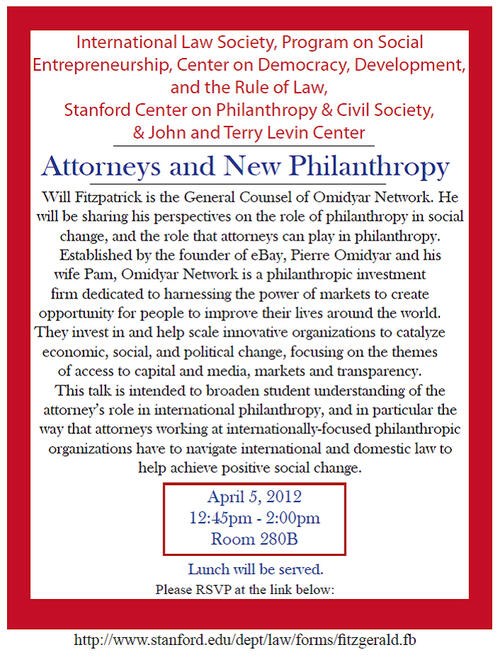
Room 280B
Will Fitzpatrick
General Counsel
Speaker
Omidyar Network
Conferences