
Governance

FSI's research on the origins, character and consequences of government institutions spans continents and academic disciplines. The institute’s senior fellows and their colleagues across Stanford examine the principles of public administration and implementation. Their work focuses on how maternal health care is delivered in rural China, how public action can create wealth and eliminate poverty, and why U.S. immigration reform keeps stalling. 

FSI’s work includes comparative studies of how institutions help resolve policy and societal issues. Scholars aim to clearly define and make sense of the rule of law, examining how it is invoked and applied around the world. 

FSI researchers also investigate government services – trying to understand and measure how they work, whom they serve and how good they are. They assess energy services aimed at helping the poorest people around the world and explore public opinion on torture policies. The Children in Crisis project addresses how child health interventions interact with political reform. Specific research on governance, organizations and security capitalizes on FSI's longstanding interests and looks at how governance and organizational issues affect a nation’s ability to address security and international cooperation.

News Type
News
Date
Paragraphs

The National Science Advisory Board for Biosecurity (NSABB), an independent advisory committee tasked with providing guidance on the biosecurity oversight of dual use research, announced on March 30 that it would recommend the publication of controversial research on the H5N1 avian flu. The issue ignited a debate in the scientific community on publishing research that could threaten public health. The committee sent its recommendations to the federal government for review. 

On March 12, Professor Paul Keim, chairman of the NSABB, and Dr. David Relman, a NSABB board member and CISAC affiliated faculty and professor of infectious diseases and microbiology and immunology at Stanford, discussed the debate over whether to make public scientific papers about the adaptation of the avian flu virus H5N1 to transmission in a mammal. The NSABB had not announced its decision to publish the research at the time of the presentation.

Audio from the March 12 seminar is available online. 

All News button
1
-

Abstract:

We present a new framework for conceptualizing and assessing the extent to which countries adhere to the rule of law in practice. This framework constitutes the backbone of the WJP Rule of Law Index® and is organized around nine basic concepts or factors: limited government powers; absence of corruption; order and security; fundamental rights; open government; effective regulatory enforcement; access to civil justice; effective criminal justice; and informal justice. These factors are further disaggregated into 52 sub-factors. We estimate numerical scores of these factors and sub-factors for a group of 66 countries and jurisdictions. These estimates are built from two novel data sources in each country: (1) a general population poll; and (2) qualified respondents’ questionnaires. All in all, the data contain more than 400 variables drawn from the assessments of over 66,000 people and 2,000 local experts. Our presentation will conclude with an overview of some highlights from Index data findings, as well as examples of ways in which the data have been applied in different contexts.

The World Justice Project (WJP) is an independent, non-profit organization that works to advance the rule of law for the development of communities of opportunity and equity worldwide. The WJP’s multinational and multidisciplinary efforts are aimed at: government reforms; development of practical programs on the ground in support of the rule of law; and increased awareness about the concept and impact of the rule of law. The Project has three complementary programs: Research and Scholarship, the World Justice Project Rule of Law Index, and mainstreaming practical on-the-ground programs to strengthen the rule of law.

Speaker Bio: 

Image
Dr. Alejandro Ponce joined The World Justice Project as Senior Economist in 2009. He is a co-author of the WJP Rule of Law Index. Dr. Ponce has extensive experience in the development of cross-country indicators. Before joining the World Justice Project, he served as an Economist at the World Bank collaborating in the design of surveys to measure financial inclusion around the world. Earlier in his career, he worked as a consultant in the design of the index of judicial efficiency and regulation of dispute resolution as part of the Doing Business Indicators of the World Bank and served as Deputy Director for the Mexican Banking and Securities Commission (CNBV). Dr. Ponce has also conducted research on behavioral economics, financial inclusion and on the linkage between economic development and the rule of law. He holds a B.A. in Economics from ITAM inMexico, and a M.A. and Ph.D. in Economics from Stanford University.

Speaker Bio: 

Image
Mr. Juan Carlos Botero is The World Justice Project's Interim Executive Director and Director of the Rule of Law Index, where he has led the development of an innovative quantitative tool to measure countries’ adherence to the rule of law worldwide. Mr. Botero’s previous experience includes service as Chief International Legal Counsel of the Colombian Ministry of Commerce; Deputy-Chief Negotiator of the US-Colombia Free Trade Agreement; Consultant for the World Bank; Associate Researcher atYaleUniversity; and Judicial Clerk at theColombian Constitutional Court. He has taught legal theory and comparative law at the Universidad de los Andes in Colombia and Universidad Privada Boliviana in Bolivia. His academic publications focus on the areas of rule of law, access to justice, labor regulation, and child labor. Mr. Botero is a member of the World Economic Forum's Global Agenda Council on the Rule of Law 2011. A national of Colombia, Mr. Botero holds a law degree from Universidad de los Andes and a Master of Laws from Harvard University. He is also a Doctor of Juridical Science (SJD) candidate at the Georgetown University Law Center.

CISAC Conference Room

Alejandro Ponce Senior Economist Speaker The World Justice Project
Juan Botero Rule of Law Index Director Speaker The World Justice Project
Seminars
-

Abstract:

The hegemony of the democratic ideal may be waning. Until recently, even the custodians of dictatorships claimed democratic status for their regimes. Many still do. But other rulers now drop the pretense of democracy and claim that their nondemocratic regimes provide the people with conditions that are superior to those found in democracies. They portray themselves as demophiles rather than democrats, and claim that their concern for their people provides a superior alternative to popular control over the state. What is more, some actually do pursue policies that differ meaningfully from the predation that characterizes the behavior of elites in many nondemocratic regimes. How may we understand contemporary demophily, and how does it challenge democracy?

Speaker Bio:

M. Steven Fish is a comparative political scientist who studies democracy and regime change in developing and postcommunist countries, religion and politics, and constitutional systems and national legislatures. He is the author of Are Muslims Distinctive? A Look at the Evidence (Oxford, 2011). He is also author of Democracy Derailed in Russia: The Failure of Open Politics (Cambridge, 2005), which was the recipient of the Best Book Award of 2006, presented by the Comparative Democratization Section of the American Political Science Association, and Democracy from Scratch: Opposition and Regime in the New Russian Revolution (Princeton, 1995). He is coauthor of The Handbook of National Legislatures: A Global Survey (Cambridge, 2009) and Postcommunism and the Theory of Democracy (Princeton, 2001). He served as a Senior Fulbright Fellow and Visiting Professor at the Airlangga University, Surabaya, Indonesia, in 2007 and at the European University at St. Petersburg, St. Petersburg, Russia, in 2000-2001. In 2005, he was the recipient of the Distinguished Social Sciences Teaching Award of the Colleges of Letters and Science, University of California-Berkeley.

CISAC Conference Room

M. Steven Fish Political Scientist Speaker UC Berkeley
Seminars
-

This event is co-sponsored with The Europe Center

Abstract:

Ruby Gropas is a lecturer in international relations at the law faculty of the Democritus University of Thrace (Komotini) and research fellow at the Hellenic Foundation for European and Foreign Policy (ELIAMEP). Gropas was in residence at CDDRL in 2011 as a visiting scholar. In this seminar she will discuss the ongoing Greek economic and political crisis, and what it means for the future of the European Union and monetary system. Is the crisis in Greece ‘internal’ or is it symptomatic of a wider European failure? Is the Greek crisis the result of failed modernity, or rather a precursor of things to come? Why has Greece become so important and why has it dominated global politics and world news for the past two years?  Are its malignancies purely domestic or are they representative of a wider malaise within Europe and possibly beyond? The collapse and orderly default of a eurozone country at the heart of the Western financial system arguably marks the end of an era. It has brought with it the deepest social and political crisis that modern Greecehas faced since the restoration of democracy and it has also led to Europe's deepest existential crisis. With the EU struggling to effectively managing the eurozone crisis and the burst of recent movements opposing neo-liberal orthodoxy and the “Occupy” movements – what does this mean for Europe? And what is next?

Speaker Bio: 

Ruby Gropas has worked on asylum and migration issues for UNHCR in Brussels and worked for McKinsey & Co. in Zurich and Athens (2000-2002). As part of the ELIAMEP team, her research concentrates on European integration and foreign policy, Transatlantic relations, human rights, migration and multiculturalism. She was Managing Editor of the Journal of Southeast European and Black Sea Studies (Taylor & Francis) between January 2006 and October 2009. Ruby has taught at the University of Athens and at College Year in Athens. She was Southeast Europe Policy Scholar at the Woodrow Wilson International Center for Scholars in Washington DC in 2007 and again in 2009. She is Vice-President of the Alexander S. Onassis Public Benefit Foundation Scholars' Association since June 2009, and was Member of the Academic Organisation Committee of the Global Forum for Migration and Development, Civil Society Days, Athens 2009.

Ruby studied Political Science at the Université Libre de Bruxelles (1994) and undertook graduate studies at the University of Leuven (MA in European Studies) and at Cambridge University (MPhil in International Relations). She holds a PhD in History from Cambridge University (New Hall, 2000).

Encina Ground Floor Conference Room

Encina Hall
Stanford, CA 94305-6055

0
R_Gropas.jpg PhD

Ruby Gropas is Lecturer in International Relations at the Law Faculty of the Democritus University of Thrace (Komotini) and Research Fellow at the Hellenic Foundation for European and Foreign Policy (ELIAMEP).

Ruby has worked on asylum and migration issues for UNHCR in Brussels and worked for McKinsey & Co. in Zurich and Athens (2000-2002). As part of the ELIAMEP team, her research concentrates on European integration and foreign policy, Transatlantic relations, human rights, migration and multiculturalism. She was Managing Editor of the Journal of Southeast European and Black Sea Studies (Taylor & Francis) between January 2006 and October 2009. Ruby has taught at the University of Athens and at College Year in Athens. She was Southeast Europe Policy Scholar at the Woodrow Wilson International Center for Scholars in Washington DC in 2007 and again in 2009. She is Vice-President of the Alexander S. Onassis Public Benefit Foundation Scholars' Association since June 2009, and was Member of the Academic Organisation Committee of the Global Forum for Migration and Development, Civil Society Days, Athens 2009.

Ruby studied Political Science at the Université Libre de Bruxelles (1994) and undertook graduate studies at the University of Leuven (MA in European Studies) and at Cambridge University (MPhil in International Relations). She holds a PhD in History from Cambridge University (New Hall, 2000).

CV
Ruby Gropas Lecturer in International Relations at the Law Faculty of the Speaker Democritus University of Thrance (Komotini)
Seminars
Authors
News Type
Q&As
Date
Paragraphs

A Wake-up Call for America: We Must Connect with the World

Former U.S. Sen. Russ Feingold, currently the Mimi and Peter E. Haas Distinguished Visitor at Stanford’s Haas Center for Public Service, uses an anecdote in his new book, While America Sleeps: A Wake-up Call for the Post-9/11 Era, to illustrate his concern that Americans have become too insular as a result of the 2001 terrorist attacks. While teaching at Marquette University Law School during the Arab Spring of last year, an undergraduate penned a column lamenting that so many students not only could not find Tunisia on the map – they could spell Kardashian before Kazakhstan.

Feingold writes that he admired this student for his confession about his lack of knowledge on global affairs, then quotes the final thought of the young columnist: “We are connected to the rest of the world in ways few of us can fully fathom, from the shoes we wear and coffee we drink to the cell phones we carry and the tweets we post.”

In a recent interview, CISAC Co-Director Mariano-Florentino Cuéllar and Feingold discuss steps to be taken to ensure that all Americans – young and old, inside the Washington beltway and out on the farm in Wisconsin – take a patriotic stand by engaging with the world to restore our national unity and regain global respect.    

Senator Feingold, what prompted you to write this book now?

Feingold: For me, as for many Americans, 9/11 was a life-changing event, the wake-up call in which we all understood that we no longer could be safe just assuming the world would take care of itself. We got misdirected with things like Iraq and we developed this sort of invade-one-country-at-a-time approach. There was also exploitation of the fears from 9/11 for domestic agendas, from the Patriot Act to the way that Muslims and Arabs are treated in this country. And then, finally, with the rise of the tea party, I feel like we went back to sleep. But there are signals all over the place, of the continued presence of al-Qaida and the continued potency of al-Qaida, not to mention so many other trends from the Chinese influence in Africa to the Iranian influence in Latin America. We aren’t connecting as a government or as a people in a way that I think is commensurate with our place in the 21st century. I’m trying to issue a warning that we’re going to get fooled or surprised again if we think we can just go back to being just sort of safely over here across the oceans. That’s just not the world anymore.

So how do you wake up Americans and make them realize we cannot, as you say, survive as a nation without being active and aware of global events and trends? 

Feingold: It’s at all levels. I happen to think we have a good president and I think he’s going to be a great president by the end of his second term. And I think he’s started the process of alerting Americans to the need to connect to all places in the world; he’s leading us toward a global vision of the kind that I think we have to have to be safe and to be competitively successful and to be well perceived by the rest of the world. The president and other leaders should call on each of us to try and become citizen diplomats. Three hundred million people should be urged as part of their patriotic duty not just to go to the moon as we once were, but go to the rest of the world. This isn’t Pollyanna; this is about being safe. I don’t think this country is geared up to make that connection and I think it’s a fatal flaw. The Russians, the Chinese and the Iranians, they’re all over the world and they have a plan for what they’re doing. We don’t.

What do you see as the most pressing global security issues today?

Cuéllar:  The United States is confronting a changing world, where countries like India, Brazil, and China are evolving and assuming greater importance. Engaging these countries to address problems like nuclear proliferation will be critical in the years ahead.  The world also faces a persistent problem involving failed or failing states. In places like Somalia, piracy is not only a regional problem in the Gulf of Aden.  The problem is an example of how threats can affect multiple countries and impact flows of commodities, disrupting the rule of law, highlighting the challenges of governing common resources such as international sea lanes. Another challenge is the enormous potential of technology to change people’s lives for the better, coupled with risks that arise which we are only in a very imperfect and incomplete way managing; risks of vulnerabilities in our infrastructure; risks of theft of intellectual property, risks of disruption of organizations.

Feingold: I like this answer because Prof. Cuéllar did not just say, “Well, it’s Russia and Iran and Colombia.” There’s this tendency to just speak of countries. We’re just trained to say, “OK what’s the hot spot and let’s just worry about that.” Like right now it’s Iran; a few months ago it was Yemen. In my book what I’m trying to point out is that you have to look at trends and overall tendencies around the world and somehow we have to have the capacity to deal with more than one thing at a time.

Senator Feingold, you called the Bush Administration’s terrorist surveillance program – the wiretapping and surveillance of emails and financial records without court approval – one of the worst assaults on the Constitution in American history. How does the government protect our constitutional rights to privacy and probable cause while monitoring criminal and terrorist networks in a digital age?

Feingold: The assault on the Constitutional by the administration was not about whether we could do those things, its whether or not the president would basically make up his own laws just because we’re in a crisis. That to me is completely unconstitutional. We understand that a president might have to take emergency action and he may have to come to Congress and say, you know I did this, it may be beyond the law, would you please pass a law to approve it, or I’ll stop doing it. That’s not what Bush did. Bush hid it. Bush hid what he was doing on torture; Bush hid what he was doing on wiretapping. That’s a very dangerous thing that completely saps our strength from within and is completely unnecessary to stop the terrorists.

Cuéllar: The challenge of living up to our constitutional values while we secure the country is always critical. It requires organizations that can learn from their mistakes to be honest with each other enough and recognize when they have overstepped their bounds, that make good use of entities like inspectors-general, that leverage the ability of Congress to do oversight. These are all elements of making our constitutional values relevant. So me the challenge has always been how to you leverage all the information technology and all our ability to make smart, thoughtful, careful decisions – including decisions that do permit appropriate degrees of surveillance and intelligence – in order to avoid superficial reactions against individuals who simply appear threatening.

What key steps should the U.S. government take to improve its counter-terrorism efforts both at home and abroad?

Feingold: The first thing is to recognize the nature of the threat. One of the chapters in the book is called A Game of Risk, where we seem to think the way to counter terrorism is to invade a country and stay there forever and say we have to stay there or the terrorist are going to come back. But this isn’t the nature of al-Qaida or similar organizations. President Bush used to say there were 60 countries where al-Qaida was operating and, of course, one thing that was embarrassing about it was that Iraq wasn’t one of them. But we’re still in this place today. Al-Shabab in Somalia; al-Qaida and the Islamic Maghreb in northern Africa; a group called Boko Haram in Nigeria, which looks very much like an al-Qaida group, has pulled off some 70 attacks in the last year. So this is an international organization that communicates with each other and they’re not done just because Osama bin Laden is gone. So let’s not get caught unawares again.

Senator Feingold, what was your most memorable, defining challenge in Congress and how did that change the way you see yourself and the world around you?

It had to do with recognizing when 9/11 occurred that there really was a group of people out there who would love to kill all of us and, despite the fact that I’m progressive and I voted against most military interventions, just saying to myself: look, there are times when threats are real. And it caused me to actually seek to be on the Intelligence Committee which is something I never wanted to do; I was not sure of the importance of intelligence in the post Cold War era and it was a real change for me. I remember having an emotional response, saying, “You know what? This is real; what these folks did was real and they have intimidated an entire country if not the world.” I wanted to know everything I could about how they came to be and what they were planning next, and to be a person who could try to think ahead for other kinds of threats so we as Americans can get ahead of threats instead of being the people who are reacting.


All News button
1
Authors
Scott Rozelle
Karen Eggleston
Jean C. Oi
Xueguang Zhou
Ang Sun
News Type
News
Date
Paragraphs

Full text available at YaleGlobal.

Children of China's Future – Part II

 
Aging population and poverty require stronger investment in China’s rural youth
Karen Eggleston, Jean Oi, Scott Rozelle, Ang Sun, Xueguang Zhou
YaleGlobal, 14 March 2012
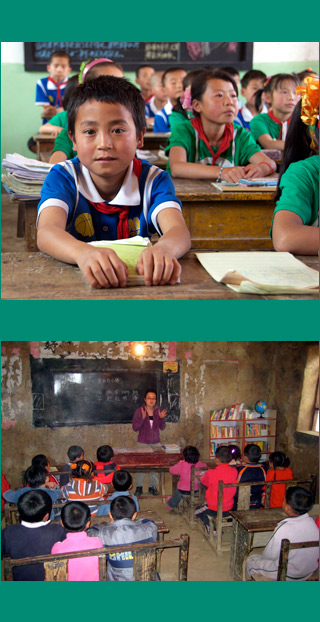
Poor education mortgaging the future? Students in a Gansu province school, where many are anemic (top); another class room in Loess Plateau. (Top Photo: Adam Gorlick)

DINGXI PREFECTURE: Wang Hongli, 8 years old, lives in a remote rural village on the Loess Plateau in one of China’s poorest and most agricultural provinces, Gansu. His prospects for living the good life are as bleak as the landscape. He is not on track to become part of China’s emerging middle class, the free-spending, computer-savvy, person-of-the-world often featured in the western media.

Hongli is a pseudonym. His parents work in a faraway industrial zone, coming home for only three weeks at Chinese New Year. His grandmother takes care of him and his siblings on the weekends, and during the week he lives in a dorm, three to a bed with 36 other students in an unheated room 4 by 4 meters.

Hongli suffers from iron-deficient anemia, but neither his family nor his teacher knows he is sick. Even if his anemia is discovered and treated by the researchers who have documented 30 percent anemia among children in poor rural areas, it likely will recur after he finishes the study, with furnished dietary supplements. Despite educational pamphlets, he’ll likely revert to a diet of staple grains and bits of pickled vegetables.

Unsurprisingly, Hongli’s grades are not good. In China’s competitive school system, he has only a slight chance of attending high school, much less college. In China’s future high-wage economy, all Hongli can hope for is a menial job in the provincial capital, Lanzhou, or as a temporary migrant elsewhere. Without urban permanent residency, hukou, he will have limited access to urban social services. He may suffer chronic unemployment, or resort to the gray economy or crime. He also may never marry – one of the millions of “forced bachelors” created by China’s large gender imbalance.

In China’s future high-wage economy, 
all the rural poor can hope for is menial jobs in a provincial capital.

Hongli is not alone. In fact, he’s one of 50 million school-age youth in China’s vast poor rural hinterlands. Recent studies by Stanford and Chinese collaborators show that 39 percent of fourth-grade students in Shaanxi Province are anemic, with similarly high rates elsewhere in the northwest; up to 40 percent of rural children in the poor southwest regions, e.g., Guizhou, are infected with intestinal worms. Millions of poor rural students throughout China are nearsighted, but do not wear glasses.

Because China’s urbanites have fewer children, poor rural kids like Hongli represent almost a third of China’s school-aged children, a large share of the future labor force. These young people must be healthy, educated and productive if China is to have any chance of increasing labor productivity to offset the shrinking size of its aging workforce.

Many observers presume that China’s growth will continue unabated, drawing upon a vast reservoir of rural labor to staff manufacturing plants for the world. In fact, to a considerable extent, China’s rural areas have already been emptied out, leaving many villages with only the old and the very young. The growth of wages for unskilled workers exceeds GDP growth.

Better pay should be good news for poverty alleviation. However, rising wages push up the opportunity cost of staying in school – especially since high school fees, even at rural public schools, are among the highest in the world.

It’s myopic to allow rural students to drop out of junior high and high school – mitigating the current labor shortage, but mortgaging their futures. Recent studies demonstrate that eliminating high school tuition – or reducing the financial burden on poor households – improves junior high achievement and significantly increases continuation on to high school. Yet unlike many other developing countries, China does not use incentives to keep children in school, such as conditional cash transfers. The public health and educational bureaucracies also do not proactively cooperate to remedy nutritional and medical problems – including mental health – that school-based interventions could address cost effectively.

Less than half of youth in China’s poor rural areas go to academic high school; less than 10 percent head to college.

The educational system, based on rote memory and drill, doesn’t teach children how to learn. The vocational education system is ineffective. Instead, China’s schools tend to focus resources on elite students. Tracking starts early, and test scores are often the sole criterion for success. A recent comparative study documents that China’s digital divide, with lower access to computers in poor rural areas, is among the widest in the world.

China’s government is increasing expenditures for school facilities and raising teacher salaries. However, these steps are far from adequate. During South Korea’s high growth, almost all Korean students finished high school. Today, less than half of youth in China’s poor rural areas go to academic high school, and the percent going to college remains in the single digits.

Greater investment in public health and education for the young people in China’s poor rural areas is urgent. If the government waits 10 years, it may be too late to avert risks for China’s stability and sustained economic growth.

Surely China could easily address this problem? A third of Chinese were illiterate in the early 1960s; now, fewer than 5 percent are. By 2010, about 120 million Chinese had completed a college degree. Chinese also enjoy a relatively long life expectancy compared to India and many other developing countries, and basic health insurance coverage is almost universal.

But the pace of change and citizens’ expectations are higher as well. Most Chinese assume that basic nutritional problems and intestinal worms were eradicated in the Mao era. China’s mortality halved in the 1950s; fertility halved in the 1970s. As a result, China will get old before it gets rich. Population aging, rapid urbanization and a large gender imbalance represent intertwined demographic challenges to social and economic governance. The policy options are complicated, the constraints significant, the risks of missteps real and ever-present.

China’s prosperity depends on youth mastering skills to thrive in a technology-driven world.

Timely policy response is complicated by competition for resources – pensions, long-term care, medical care for the elderly and more – as well as significant governance challenges arising from a countryside drained of young people. The well-intentioned programs for what government regards a “harmonious society” create large unfunded mandates for local authorities. Attempts to relocate rural residents to new, denser communities provoke anger at being uprooted and skepticism that local authorities simply want to expropriate land for development.

Millions of migrant workers – like Wang Hongli’s parents – return to their rural homes during economic downturns. Urbanization weakens this capacity to absorb future economic fluctuations. Government efforts at “social management” – strengthening regulatory control of informal social groups and strategies for diffusing social tensions – expand the bureaucratic state, a central target of popular discontent.

Premier Wen Jiabao’s announcement of a 7.5 percent growth target – the lowest in two decades – has been expected. Future economic growth will moderate partly because of demographics, but mostly because productivity gains slow as an economy runs out of surplus rural labor and converges on the technological frontier. Costly upgrading of industrial structure will squeeze the government’s ability to deliver on its promise of a better future for all, stoking social tensions.

China’s stability and prosperity, and that of the region and the globe, depends on how well today’s youth master the knowledge and skills that enable them to thrive in the technology-driven globalized world of the mid-21st century. Resilient public and private sector leaders of the future must be able to think creatively. Therefore, China’s government should respond to population aging by acting now to invest more in the health and education of youth, especially the rural poor.


Hero Image
5734696609 a3b10b4c8f z
All News button
1
-

You're invited!
 

Advance Screening of "A Whisper to a Roar"

A new feature documentary film on the global struggle for democracy
 

 Inspired by Larry Diamond's book

"The Spirit of Democracy"

 Presented by The Moulay Hicham Foundation

 Directed and produced by Ben Moses, creator of "Good Morning, Vietnam"


THURSDAY, APRIL 12, 2012

7:00pm
A discussion with the filmakers will follow screening

Cemex Auditorium
Knight Management Center
Stanford University

CDDRL
Stanford University
Encina Hall, C147
616 Jane Stanford Way
Stanford, CA 94305-6055

(650) 724-6448 (650) 723-1928
0
Mosbacher Senior Fellow in Global Democracy at the Freeman Spogli Institute for International Studies
William L. Clayton Senior Fellow at the Hoover Institution
Professor, by courtesy, of Political Science and Sociology
diamond_encina_hall.png MA, PhD

Larry Diamond is the William L. Clayton Senior Fellow at the Hoover Institution, the Mosbacher Senior Fellow in Global Democracy at the Freeman Spogli Institute for International Studies (FSI), and a Bass University Fellow in Undergraduate Education at Stanford University. He is also professor by courtesy of Political Science and Sociology at Stanford, where he lectures and teaches courses on democracy (including an online course on EdX). At the Hoover Institution, he co-leads the Project on Taiwan in the Indo-Pacific Region and participates in the Project on the U.S., China, and the World. At FSI, he is among the core faculty of the Center on Democracy, Development and the Rule of Law, which he directed for six and a half years. He leads FSI’s Israel Studies Program and is a member of the Program on Arab Reform and Development. He also co-leads the Global Digital Policy Incubator, based at FSI’s Cyber Policy Center. He served for 32 years as founding co-editor of the Journal of Democracy.

Diamond’s research focuses on global trends affecting freedom and democracy and on U.S. and international policies to defend and advance democracy. His book, Ill Winds: Saving Democracy from Russian Rage, Chinese Ambition, and American Complacency, analyzes the challenges confronting liberal democracy in the United States and around the world at this potential “hinge in history,” and offers an agenda for strengthening and defending democracy at home and abroad.  A paperback edition with a new preface was released by Penguin in April 2020. His other books include: In Search of Democracy (2016), The Spirit of Democracy (2008), Developing Democracy: Toward Consolidation (1999), Promoting Democracy in the 1990s (1995), and Class, Ethnicity, and Democracy in Nigeria (1989). He has edited or coedited more than fifty books, including China’s Influence and American Interests (2019, with Orville Schell), Silicon Triangle: The United States, China, Taiwan the Global Semiconductor Security (2023, with James O. Ellis Jr. and Orville Schell), and The Troubling State of India’s Democracy (2024, with Sumit Ganguly and Dinsha Mistree).

During 2002–03, Diamond served as a consultant to the US Agency for International Development (USAID) and was a contributing author of its report, Foreign Aid in the National Interest. He has advised and lectured to universities and think tanks around the world, and to the World Bank, the United Nations, the State Department, and other organizations dealing with governance and development. During the first three months of 2004, Diamond served as a senior adviser on governance to the Coalition Provisional Authority in Baghdad. His 2005 book, Squandered Victory: The American Occupation and the Bungled Effort to Bring Democracy to Iraq, was one of the first books to critically analyze America's postwar engagement in Iraq.

Among Diamond’s other edited books are Democracy in Decline?; Democratization and Authoritarianism in the Arab WorldWill China Democratize?; and Liberation Technology: Social Media and the Struggle for Democracy, all edited with Marc F. Plattner; and Politics and Culture in Contemporary Iran, with Abbas Milani. With Juan J. Linz and Seymour Martin Lipset, he edited the series, Democracy in Developing Countries, which helped to shape a new generation of comparative study of democratic development.

Download full-resolution headshot; photo credit: Rod Searcey.

Former Director of the Center on Democracy, Development and the Rule of Law
Faculty Chair, Jan Koum Israel Studies Program
Date Label
Larry Diamond Director Speaker CDDRL
Conferences
Authors
News Type
News
Date
Paragraphs

The Program on Arab Reform and Democracy at Stanford University's Center on Democracy, Development, and the Rule of Law is pleased to announce a joint venture with the Brookings Doha Center (BDC) to examine democratic transitions underway in the Arab world. The BDC-Stanford “Project on Arab Transitions” will engage both Arab and Western scholars and practitioners from diverse backgrounds to generate comprehensive analysis and offer recommendations to help inform policymaking and development assistance in both the Arab world and the broader international community. The collaboration was born out of the need to generate cross-regional scholarship and address the ongoing transitions in a more systematic manner.

“This partnership brings together the complementary strengths of two great institutions to generate original scholarship that unites the scholarly and policy worlds during a critical period of transition underway in the Arab world," said CDDRL Director Larry Diamond. "We are hopeful that it will provide guidance to the international community and Arab governments as they work to build democratic institutions in post-revolutionary societies."

The BDC-Stanford scholarly collaboration seeks to provide concrete and practical recommendations to Arab governments and the international policy community. The series of policy papers produced will analyze and illuminate the key issues facing the transition period, including electoral design, constitution-drafting, political party development, and national dialogue processes.

“We are excited to be working with a top university like Stanford University to produce cutting-edge research on the critical issues facing transitional countries like Egypt, Tunisia, and Libya,” said Salman Shaikh, the director of the Brookings Doha Center. “This will be a vital addition to the literature surrounding these transitions and policymakers’ understanding of them.”

The first paper in the BDC-Stanford Project on Arab Transitions series released today is authored Dr. Tamir Moustafa of Simon Fraser University in Canada and author of The Struggle for Constitutional Power: Law, Politics, and Economic Development in Egypt. Using Egypt as a case study, Moustafa highlights the deficiencies of the constitution-writing process to serve as an example to other Arab countries as they embark on their own national projects. In addition, Moustafa offers key recommendations to the international community, as well as to Egypt’s Constituent Assembly on the various statutes, provisions, and conditions that should be included in the document to ensure that human rights protections, judicial independence, and institutions of governance are enforced.

A forthcoming paper in the series will be authored by Ellen Lust from Yale University on the topic of electoral processes during democratic transition, drawing on recent experiences in Egypt and Tunisia.

For more information on The Project on Arab Transitions and the BDC-Stanford collaboration, please click here. 


Hero Image
ARDWRLD Logo
All News button
1
-

About the topic: This talk will present four important but largely unexplored topics in regarding conflict in cyberspace – two in some detail and two in a passing mention. These include escalation dynamics, uncertainties in threat assessment, offensive cyber operations for the private sector, and attribution in practice.

About the Speaker: Herbert Lin is chief scientist at the Computer Science and Telecommunications Board, National Research Council of the National Academies, where he has been study director of major projects on public policy and information technology. Of particular note are two recent studies: a 2009 study on offensive information warfare (Technology, Policy, Law, and Ethics Regarding U.S. Acquisition and Use of Cyberattack Capabilities), and a 2010 study on cyber deterrence (Proceedings of a Workshop on Deterring Cyberattacks: Informing Strategies and Developing Options for U.S. Policy). Prior to his NRC service, he was a professional staff member and staff scientist for the House Armed Services Committee (1986-1990), where his portfolio included defense policy and arms control issues. He received his doctorate in physics from MIT. 

CISAC Conference Room

Herbert Lin Chief Scientist, Computer Science and Telecommunications Board, National Research Council of the National Academies Speaker
Seminars
-

Please join the Stanford Baha'i Club, in collaboration with the Center on Democracy, Development, and the Rule of Law; the Center on Philanthrophy and Civil Society, Stanford Amnesty International, Stanford Six Degrees in defending Article 26 of the UN's Universal Declaration of Human Rights on

Friday, April 6 from 7:00-9:00pm

We will be screening Education Under Fire, a moving documentary about this issue. Following the screening, we will be having a panel discussion.

Imagine you are sitting in class at Stanford University when armed guards come into the classroom and arrest everyone in your class. Your professor is sentenced to five years in prison; you are expelled not only from Stanford, but from any institution of higher education in the country. Your crime? Gaining a higher education. Your professor’s crime? Providing higher education. Fortunately, this is not happening today at Stanford, but it is happening right now to many young people in Iran.

Since its inception, the Baha’i community of Iran has been suffering different forms of human rights violations, from intense persecution to being denied employment, the ability to bury their dead, access to higher education. Their crime? Being a Baha’i. The Bahá'í Institute for Higher Education (BIHE) was founded in 1987 in response to the Iranian government's continuing campaign to deny Iranian Bahá'ís access to higher education. The need to create a new university for those who were denied access to higher education captivated the talents and minds of exceptional faculty and staff from within Iran and abroad. For twenty years they have dedicated their efforts to building an exemplary institution and cultivating a student body prepared for fulfilling careers, future study, and social responsibility. But this has come with constant struggles and limited resources. In May 2011, the government launched a coordinated attack against the BIHE–raiding dozens of homes, confiscating computers and materials and detaining eighteen professors and administrators. Seven of those arrested received four or five-year prison terms. Their only crime: educating the youth in their community.

We also have a facebook event here - http://www.facebook.com/events/291432670928509/


CEMEX AUDITORIUM, Stanford

Conferences
Subscribe to Governance