
Governance

FSI's research on the origins, character and consequences of government institutions spans continents and academic disciplines. The institute’s senior fellows and their colleagues across Stanford examine the principles of public administration and implementation. Their work focuses on how maternal health care is delivered in rural China, how public action can create wealth and eliminate poverty, and why U.S. immigration reform keeps stalling. 

FSI’s work includes comparative studies of how institutions help resolve policy and societal issues. Scholars aim to clearly define and make sense of the rule of law, examining how it is invoked and applied around the world. 

FSI researchers also investigate government services – trying to understand and measure how they work, whom they serve and how good they are. They assess energy services aimed at helping the poorest people around the world and explore public opinion on torture policies. The Children in Crisis project addresses how child health interventions interact with political reform. Specific research on governance, organizations and security capitalizes on FSI's longstanding interests and looks at how governance and organizational issues affect a nation’s ability to address security and international cooperation.

-

Sponsored by

The Preventive Defense Project and the

CISAC Science Seminar Series

Roughly 85% of the critical infrastructure systems in the United States is owned or operated by the private sector. Managers of these systems must keep everything running and try to ensure nothing bad happens, despite increasing system complexity and demand for continuing improvements in efficiency. This challenge naturally leads to the questions “which parts of an infrastructure are critical,” “how critical are they,” and “how should we invest limited budget to defend our infrastructure?”

We introduce two- and three-stage optimization models that represent the strategic, game-theoretic interactions between preparations to defend critical infrastructure, an “attacker” who observes these preparations before acting, and a “defender” who operates the surviving infrastructure as best as possible after an optimal attack. We identify worst-case disruptions in the operation of a system by solving a system interdiction problem. Then, given an available budget and list of possible defensive investments (e.g., hardening, redundancy, capacity expansion), we solve for a combination of investments that makes the system maximally resilient to worst-case disruption. We show some unexpected results that have proven insightful.

These models apply equally well to government, military, and commercial systems. Between our NPS student-officers and faculty, we have conducted over 150 case studies on systems ranging from electric power, to transportation, to supply chains, to the Internet.


About the speaker: David L. Alderson, Ph.D, joined the Naval Postgraduate School faculty in 2006 after working for three years as a postdoctoral scholar in the Division of Engineering and Applied Sciences at the California Institute of Technology (Caltech). He received a B.S.E. in Civil Engineering and Operations Research from Princeton University and the M.S. and Ph.D. degrees from the Department of Management Science and Engineering at Stanford University. His research focuses on the function and operation of critical infrastructures, with particular emphasis on how to invest limited resources to ensure efficient and resilient performance in the face of accidents, failures, natural disasters, or deliberate attacks. He currently serves as the Director of the NPS Center for Infrastructure Defense (CID). As part of a Multiple University Research Initiative (MURI) team studying "Next-Generation Network Science," he studies tradeoffs between efficiency, complexity, and fragility in a wide variety of public and private network-centric systems. He has extensive experience working on the Internet and other complex communication networks, having been a researcher at the Xerox Palo Alto Research Center (PARC), the Santa Fe Institute (SFI), and the Institute for Pure and Applied Mathematics (IPAM) at UCLA. He is a member of INFORMS and MORS.

CISAC Conference Room
Dave Alderson Assistant Professor, Operations Research Department Director, Center for Infrastructure Defense, Naval Postgraduate School Speaker
Seminars
Authors
News Type
News
Date
Paragraphs
Retraction: In June 2012, Stanford researchers Rajaie Batniji and Eran Bendavid retracted the research findings explained in the following article. Their findings, presented in the essay, "Does development assistance for health really displace government health spending? Reassessing the evidence," contained errors in statistical model choice and reporting. The essay was published May 8, 2012, by the journal PLoS Medicine. The researchers erroneously concluded that there was no significant displacement of foreign aid. When they discovered their mistake, they informed editors at PLoS Medicine and moved to correct the record. The editors agreed with the need for the retraction and accepted the authors’ explanation of their error. The retraction can be read at www.plosmedicine.org/article/info%3Adoi%2F10.1371%2Fjournal.pmed.1001214.

When a 2010 study concluded that about half the money given to international governments for providing health care services isn’t used as intended, skeptics who argued that foreign aid is largely wasted were handed a powerful piece of data to bolster their claims.

But Stanford researchers Rajaie S. Batniji and Eran Bendavid say those findings are flawed. In an article featured in the May 8th edition of PLoS Medicine, Batniji and Bendavid say the two-year-old study by researchers at the University of Washington should not be used to guide decisions about how much money to give and who should get it.

“We can’t say that there’s absolutely no displacement of foreign aid, but these earlier findings are too tenuous for the basis of policy,” said Batniji, an affiliate of the Center on Democracy, Development, and the Rule of Law at the Freeman Spogli Institute for International Studies.

Batniji and Bendavid, an affiliate of FSI’s Stanford Health Policy and an assistant professor of medicine, are taking on the 2010 study – which appeared in the Lancet – at a critical time for foreign assistance programs.

The United States, which gives about half of all the world’s health aid, plans to chop its $10 billion budget by about 4 percent in the coming fiscal year. That’s the first cut in more than a decade. And officials have shown no signs of switching their preference of bypassing national governments as recipients of health aid, funneling more than half of U.S. support to non-governmental organizations instead.

Batniji and Bendavid decided to re-analyze the data used by the University of Washington researchers after meeting with policymakers who pointed to the study as a cautionary tale of foreign governments that waste and mismanage money earmarked for health programs.

“People were citing the Lancet piece, saying this was starting to shape how they thought about giving money,” said Batniji, who is also a resident physician at Stanford Medical Center. “But when we started asking questions about what the actual displacement looks like, the answers didn’t seem very compelling or reasonable.”

Taking a fresh look at the same numbers used for the 2010 study – public financing data culled from the World Health Organization and the International Monetary Fund – the researchers saw a different story emerge about the use of foreign aid in the health sector.

Once Batniji and Bendavid excluded conflicting and outlying data, such as huge discrepancies between WHO and IMF estimates and information about countries that were getting very small amounts of money from other countries, “there was no significant displacement of foreign aid,” Bendavid said.

The Stanford researchers’ findings are poised to influence a debate among policymakers and donors over whether it’s more efficient to give international assistance slated for health spending to government agencies or NGOs.

“We want to free donors of feeling that if they give money directly to governments, the money will be offset and used for an unintended purpose,” Batniji said. “The concern about displacement really amplifies the demands we make on governments for how they use the money. And that is at odds with a recent movement to let foreign governments set their own agendas for how to spend money.”

The research conducted by Batniji and Bendavid was supported by FSI’s Global Underdevelopment Action Fund and the Dr. George Rosenkranz Prize awarded to Bendavid in 2010.

All News button
1
-

Image

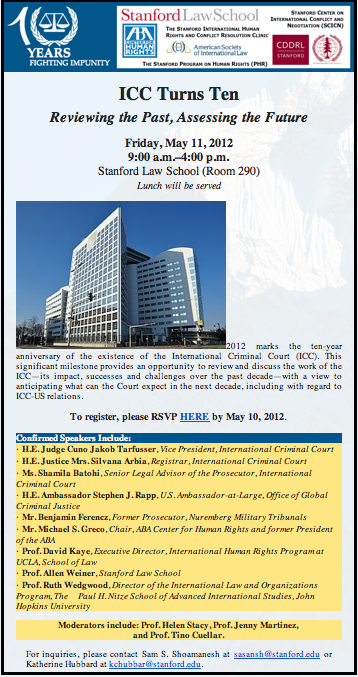
Stanford Law School (Room 290)

Helen Stacy Senior Fellow, CDDRL; Affiliated Faculty, Stanford School of Law; Europe Center Research Affiliate and Director, Program on Human Rights Moderator Stanford University
Conferences
-

On May 14, the Center for Northeast Asian Policy Studies (CNAPS) at Brookings and the Center on Democracy, Development, and the Rule of Law (CDDRL) at Stanford University hosted a seminar analyzing progress and challenges in the consolidation of Taiwan’s democratization and reforms. While the presidential and legislative elections held on January 14 were interpreted by many as proof that Taiwan’s democratic system—including its government and society—has matured since the first transition of political power in 2000, both big-picture and day-to-day challenges to effective democratic governance remain.

The seminar featured leading practitioners and political scientists from Taiwan and the United States. Panelists examined reforms that have been enacted in Taiwan over the past decade, and analyzed their impact on the functions of government agencies, political parties, and other non-governmental organizations. They also discussed how reform and consolidation are affecting policy and public perception of the system.


Participants

9:00 AM — Panel 1: Government

David Brown, Adjunct Professor, Paul H, Nitze School of Advanced International Studies, Johns Hopkins University

Nigel N.T. Li, Adjunct Professor, Graduate School of Law, Soochow University
Adjunct Professor, Graduate Institute of Political Science, National Taiwan University

Da-Chi Liao, Professor of Political Science, National Sun Yat-sen University

Jiunn-rong Yeh, Professor, College of Law, National Taiwan University

11:00 AM — Panel 2: Politics and Society

John Fuh-sheng Hsieh, Professor of Political Science, University of South Carolina

Shelley Rigger, Brown Professor of East Asian Politics Chair, Department of Political Science, Davidson College

Erich Che-wei Shih, News Anchor and Senior Producer, CTi Television

Eric Chen-hua Yu, Assistant Professor of Political Science, National Chengchi University

12:45 PM — Lunch

1:45 PM — Panel 3: Implications of Democratic Consolidation

Richard C. Bush III, Director, Center for Northeast Asian Policy Studies

Larry Diamond, Professor of Political Science; Director, Center on Democracy, Development, and the Rule of Law, Stanford University

Alan Romberg, Distinguished Fellow and Director, East Asia Program, The Stimson Center

Ho Szu-yin, Professor, Department of Political Science, National Chengchi University


Audio recordings of the event are available online at the Brookings website here:

http://www.brookings.edu/events/2012/05/14-taiwan-democracy

Falk Auditorium,
The Brookings Institution,
1775 Massachusetts Ave.,NW
Washington, DC

CDDRL
Stanford University
Encina Hall, C147
616 Jane Stanford Way
Stanford, CA 94305-6055

(650) 724-6448 (650) 723-1928
0
Mosbacher Senior Fellow in Global Democracy at the Freeman Spogli Institute for International Studies
William L. Clayton Senior Fellow at the Hoover Institution
Professor, by courtesy, of Political Science and Sociology
diamond_encina_hall.png MA, PhD

Larry Diamond is the William L. Clayton Senior Fellow at the Hoover Institution, the Mosbacher Senior Fellow in Global Democracy at the Freeman Spogli Institute for International Studies (FSI), and a Bass University Fellow in Undergraduate Education at Stanford University. He is also professor by courtesy of Political Science and Sociology at Stanford, where he lectures and teaches courses on democracy (including an online course on EdX). At the Hoover Institution, he co-leads the Project on Taiwan in the Indo-Pacific Region and participates in the Project on the U.S., China, and the World. At FSI, he is among the core faculty of the Center on Democracy, Development and the Rule of Law, which he directed for six and a half years. He leads FSI’s Israel Studies Program and is a member of the Program on Arab Reform and Development. He also co-leads the Global Digital Policy Incubator, based at FSI’s Cyber Policy Center. He served for 32 years as founding co-editor of the Journal of Democracy.

Diamond’s research focuses on global trends affecting freedom and democracy and on U.S. and international policies to defend and advance democracy. His book, Ill Winds: Saving Democracy from Russian Rage, Chinese Ambition, and American Complacency, analyzes the challenges confronting liberal democracy in the United States and around the world at this potential “hinge in history,” and offers an agenda for strengthening and defending democracy at home and abroad.  A paperback edition with a new preface was released by Penguin in April 2020. His other books include: In Search of Democracy (2016), The Spirit of Democracy (2008), Developing Democracy: Toward Consolidation (1999), Promoting Democracy in the 1990s (1995), and Class, Ethnicity, and Democracy in Nigeria (1989). He has edited or coedited more than fifty books, including China’s Influence and American Interests (2019, with Orville Schell), Silicon Triangle: The United States, China, Taiwan the Global Semiconductor Security (2023, with James O. Ellis Jr. and Orville Schell), and The Troubling State of India’s Democracy (2024, with Sumit Ganguly and Dinsha Mistree).

During 2002–03, Diamond served as a consultant to the US Agency for International Development (USAID) and was a contributing author of its report, Foreign Aid in the National Interest. He has advised and lectured to universities and think tanks around the world, and to the World Bank, the United Nations, the State Department, and other organizations dealing with governance and development. During the first three months of 2004, Diamond served as a senior adviser on governance to the Coalition Provisional Authority in Baghdad. His 2005 book, Squandered Victory: The American Occupation and the Bungled Effort to Bring Democracy to Iraq, was one of the first books to critically analyze America's postwar engagement in Iraq.

Among Diamond’s other edited books are Democracy in Decline?; Democratization and Authoritarianism in the Arab WorldWill China Democratize?; and Liberation Technology: Social Media and the Struggle for Democracy, all edited with Marc F. Plattner; and Politics and Culture in Contemporary Iran, with Abbas Milani. With Juan J. Linz and Seymour Martin Lipset, he edited the series, Democracy in Developing Countries, which helped to shape a new generation of comparative study of democratic development.

Download full-resolution headshot; photo credit: Rod Searcey.

Former Director of the Center on Democracy, Development and the Rule of Law
Faculty Chair, Jan Koum Israel Studies Program
Date Label
Larry Diamond Professor of Political Science; Director, Center on Democracy, Development, and the Rule of Law Speaker Stanford University
Conferences
-

In spring 2009, China’s leadership announced ambitious national health reforms. Have the five stated goals of the first three years of reform been met? What policies will China pursue in the next phase? As a prominent advisor to China's State Council Health Reform Office, Liu will discuss progress and prospects for reforms—especially the role of the private sector within the health system—within the context of China’s 2012 leadership transition.

Gordon Liu is a professor of economics at Peking University's (PKU) Guanghua School of Management, and director of PKU's China Center for Health Economic Research. Previously, he served as a tenured associate professor at the University of North Carolina at Chapel Hill (2000–2006), and as an assistant professor at the University of Southern California (1994–2000).

Liu's primary research interests include health and development economics, health policy and reform, and pharmaceutical economics. His current research is funded by the State Council Health Reform Office, the National Science Foundation, UNICEF, and the China Medical Board.

Liu currently serves on the State Council Health Reform Advisory Commission, and the Expert Panel for the State Ministry of Human Resource and Social Security. He serves as co-editor for the journal Value in Health, and as editor-in-chief for China Journal of Pharmaceutical Economics. He sits on the editorial boards for the European Health Economic Review, Global Handbook for Health Economics, and Chinese Journal of Health Economics.

He received his PhD in Economics from the City University of New York Graduate School while working as a graduate research fellow at the National Bureau of Economic Research under the supervision of Michael Grossman (1986–1991). He obtained post-doctoral training at Harvard University with William Hsiao (1992–1993). Liu has served as the president for the Chinese Economists Society, and chair for the Asian Consortium for the International Society for Pharmacoeconomics and Outcomes Research.

Philippines Conference Room

Gordon Liu Professor of Economics Speaker Peking University Guanghua School of Management
Seminars
Authors
News Type
News
Date
Paragraphs

The indigenous population in Latin America ranks among the highest in underdevelopment in the world, experiencing high levels of illiteracy, unemployment, poverty, disease, discrimination, violence and expropriation of their lands. In an effort to examine the common trends, actors, and challenges affecting this vulnerable community, the Program on Human Rights (PHR) at the Center on Democracy, Development and the Rule of Law (CDDRL) together with the Center for Latin American Studies is hosting a one-day conference on Tuesday, May 8 2012 at Stanford University to shed light on the important human rights issues indigenous populations face.

Alejandro Toledo, the former president of Peru and its first president of indigenous descent will deliver the opening address. Toledo was a visiting scholar at CDDRL from 2007-2009. The conference will bring together a diverse group of scholars to present research papers on a range of topics relating to indigenous communities in Latin America and the Caribbean, including: violence and security, education, the effect of climate change, health challenges, cultural survival, national and international property rights and political movements.

According to Helen Stacy, the director of the Program on Human Rights, “The goal of the conference is to create an integrated network of professionals that includes Stanford University students, faculty and researchers, who will advance and support continuous research on human rights issues affecting indigenous people in Latin America.”

The lunchtime keynote address will be delivered by the former first lady of Peru, Eliane Karp-Toledo, an anthropologist and economist who specializes in Andean indigenous cultures. Conference speakers include: Alexia Romero, a second year JD candidate at Stanford University, who will address the issue of indigenous property rights; Oliver Kaplan, a postdoctoral research associate at Princeton University, who will explore civil war violence in Columbia; Paul Kim, assistant dean and chief technology officer for Stanford’s School of Education, who will speak about the impact of mobile phone technology for indigenous people in Latin America; and Claire Mantini-Briggs, visiting lecturer at UC Berkeley’s Department of Anthropology, who will discuss inequalities in epidemiology and human rights.

The Center on Latin American Studies and the Program on Human Rights view this conference as the beginning of an ongoing research initiative to examine the state of indigenous rights. 

The sessions begin at 9:00 am and will be held in the Bechtel Conference Center. They are free and open to the public. To view the complete program and RSVP to the conference, please click here.

Hero Image
6822 small May8 logo
An image of the Amazon River.
All News button
1
Authors
News Type
Q&As
Date
Paragraphs

China’s demographic landscape is rapidly changing, and the government has responded by launching ambitious social and health service reforms to meet the changing needs of the country’s 1.3 billion people. This week, officials approved a five-year plan to develop a comprehensive nationwide social security network.

Karen Eggleston, the Asia Health Policy Program (AHPP) director and a Stanford Health Policy fellow, discusses the success of China’s health care reforms—including its recently established universal health care system—and the long road still ahead.

Why is the overall health and wellbeing of China’s population important globally?

There are many reasons why the health of China’s citizens matters within a larger global context. On the most basic level, China represents almost 20 percent of humanity. But it is also a major player in the world economy and it depends on having a healthy workforce, especially now that its population is aging more. The government’s ability to meet the needs of its underserved citizens contributes to a more productive and stable China, and works towards closing the huge gaps we see in human wellbeing across the world.

China also potentially offers a model for other developing countries, such as India, that may want to figure out how to make universal health coverage work at a tenth of the income of most of the countries that have put it into place before.

What are some of the biggest changes in China’s health care system since 1949?

One of the most significant changes is that China has achieved very basic universal health insurance coverage in a relatively short period of time.  

Throughout the Mao period (1949–1978) there was a health care system linked to the centrally planned economy, which provided a basic level of coverage via government providers with a lot of regional variation. When economic reform came in 1980, large parts of the system—particularly financing for insurance—collapsed. The majority of China’s citizens were uninsured during the past few decades of very rapid social and economic development.

China’s overall population is changing quite dramatically, which means it has different health care needs, such as treating chronic disease and caring for an increasingly elderly population. The central government is trying to establish a system of accessible primary care—a concept that China’s barefoot doctors helped to pioneer but that fell into disarray—and health services that fit these new needs. 

How does China’s basic health care system work? Are there segments of the population still not receiving adequate coverage and care?

China has had a system where people can select their own doctors. Patients usually want to go to clinics attached to the highest-reputation hospitals, but of course, when you are not insured you almost always by default go to where you can afford the care. “It is difficult to see the doctor, and it is expensive” has been the lament of patients in China, so an explicit goal of the health care reforms has been to address this.

The term “universal coverage” has different definitions. China initially put in place a form of insurance that only covers 20 or 30 percent of medical costs for the previously uninsured population, especially in rural areas. Benefits have expanded, but remain limited. As with the previous system, disparities in coverage still exist across the population. China not only has a huge population with huge economic differences, but within that there is a large migrant worker population. It is a challenge to figure out how to cover these citizens and how to provide them with access to better care. The government is quite aware there are segments of the population not receiving equal coverage, and it continues to strive to resolve the issue.  

What are the greatest innovations in China’s health care system in recent years?

One of the most remarkable things China has achieved is really its new health insurance system. Even if the current coverage is not particularly generous it is nearly universal, and mechanisms are put in place each year to provide more generous coverage. China is also working on strengthening its primary care and population health services, infusing a huge sum of government money into these efforts. It is the only developing country of its per-capita income that has achieved such results so far.

Interestingly, a lot of people assume China achieved its universal coverage by mandate, while in fact the central government did so by subsidizing the cost for local governments and individuals. This reduces the burden, for example, on poorer rural governments and residents, and is one innovative way China is trying to eliminate the disparity in access to care.

Eggleston has recently published a working paper on China’s health care reforms since the Mao era on the AHPP website, as well as an article in the Milken Institute Review.

Gordon Liu, a Chinese government advisor on health care and the executive director of Peking University’s Health Economics and Management Institute, spoke at Stanford on May 29 on the future of China’s health care system.

Hero Image
ShanghaiHealthImperative LOGO
A disabled woman from Henan writes a poetic plea for money explaining the circumstances of her disability, her family's difficulties in paying for treatment, and their subsequent debt, Shanghai, August 2009. | Flickr/Santo Chino; http://bit.ly/IGKsL1
All News button
1
Subscribe to Governance