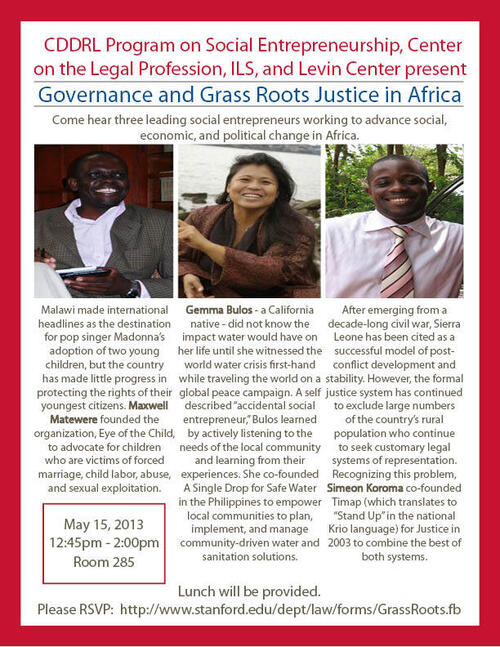
Governance and Grassroots Justice in Africa
Special Seminar at Stanford Law School in partnership with the Levin Center
Room 285 in the Classroom Building of the Stanford Law School
FSI's research on the origins, character and consequences of government institutions spans continents and academic disciplines. The institute’s senior fellows and their colleagues across Stanford examine the principles of public administration and implementation. Their work focuses on how maternal health care is delivered in rural China, how public action can create wealth and eliminate poverty, and why U.S. immigration reform keeps stalling.
FSI’s work includes comparative studies of how institutions help resolve policy and societal issues. Scholars aim to clearly define and make sense of the rule of law, examining how it is invoked and applied around the world.
FSI researchers also investigate government services – trying to understand and measure how they work, whom they serve and how good they are. They assess energy services aimed at helping the poorest people around the world and explore public opinion on torture policies. The Children in Crisis project addresses how child health interventions interact with political reform. Specific research on governance, organizations and security capitalizes on FSI's longstanding interests and looks at how governance and organizational issues affect a nation’s ability to address security and international cooperation.
Special Seminar at Stanford Law School in partnership with the Levin Center
Room 285 in the Classroom Building of the Stanford Law School
Abstract
Since the early years of her career working with children in some of the direst situations in Sri Lanka and Bangladesh, Susan Bissell, UNICEF’s Chief of Child Protection, has witnessed children being targeted for such exploitative practices as human trafficking, recruitment into armed forces, and child labor. Violations of the child’s right to protection take place in every country and are massive, under-recognized, and under-reported barriers to child survival and development, in addition to being human rights violations. Children subjected to violence, exploitation, abuse and neglect are at risk of death, poor physical and mental health, HIV/AIDS infection, educational problems, displacement, and vagrancy.
Protecting children from violence, exploitation and abuse is an integral component of protecting their rights to survival, growth, and development. UNICEF advocates and supports the creation of a protective environment for children in partnership with governments, national and international partners including the private sector, and civil society. Bissell guides UNICEF’s Child Protection program in 170 countries, working with government officials and other partners to shape child protection policies. During this discussion, she will provide an overview of her role at UNICEF and the work she does to help ensure that governments honor their commitments to strengthen child protection systems and protect children.
In 2009, Susan Bissell was appointed to her current position in New York, heading all of UNICEF’s Child Protection work. She oversees a team of professionals guiding efforts for children affected by armed conflict, child protection systems strengthening to prevent and respond to all forms of violence against children, and a range of other matters.
Richard and Rhoda Goldman Conference Room
Abstract
In 1989 more than 700 South African political prisoners went on indefinite hunger strike to protest their detention. The unprecedented scale forced the South Africian government to release hundreds of incapacitated prisoners into public hospitals and enabled the active intevention of progressive medical professionals, social workers and human rights lawyers.
The presentation explores the widespread impact of these events in galvanizing the anti-apartheid struggle, energizing international human rights organizations and propelling the new international medical protocols on the ethical care of political prisoners on hunger strike.
Nayan Shah is Professor and chair of the Department of American Studies and Ethnicity at the University of Southern california. He is the author of Contagious Divides,Epidemics and Race in San Francisco's Chinatown (Universty of California Press, 2001) and Stranger Intimacy Contesting Race Sexuality and Law in the North American West (University of California Press 2011) which was awarded the Norris and Carol Hundley Prize by the American Historical Association PAcific Branch for the most distinguished book on any historical subject. Since 2011 Shah is co-editor with Beth Freeman of GLO, The Journal of Lesbian and Gay Studies.
Co-sponsored by: American Studies, Comparative Literature. Modern Thought and Literature, History,Theater Arts and Performance Studies
Daniel and Nancy Okimoto Conference Room
Bio:
Emily Arnold-Fernández is the executive director of Asylum Access, an innovative international nonprofit that transforms the human rights landscape for refugees in Africa, Asia and Latin America. Using a unique combination of grassroots legal assistance and broader advocacy and strategic litigation efforts, Emily leads a team of refugee rights advocates to make human rights a reality for refugees, so they can live safely, work, send children to school and rebuild their lives.
Emily was a fall 2012 Social Entrepreneur in Residence at Stanford's Program on Social Entrepreneurship.
Abstract:
For the last half-century, the international response to refugees has been internment. Today, the average time in a refugee camp has reached 17 years.
When refugees reach “safety,” we imprison them behind barbed wire fences, often for years, sometimes for generations. We relegate them to starvation rations if aid runs low or politics intervenes. They almost never have adequate access to police, courts, or other mechanisms that could protect them from crime or ensure justice for victims. Adults are not allowed to go out and get a job, to feed their families and fill their days. Children grow up knowing no other life.
And refugees are protesting. Recently, a riot broke out in Zaatari refugee camp in Jordan after Syrian refugees attempted to leave the camp without permission. Hundreds of other refugee protests never make the news.
Answers to this problem have so far focused on supporting so-called “urban refugees” – refugees who have chosen to leave camps, usually illicitly, to move to the city. But what if we brought the city to the refugees?
Building cities, not camps, in refugee arrival zones has the potential to transform refugee response. Developing urban centers that can attract and support both locals and refugees creates the conditions for refugees to meet their own needs and make choices about their own lives, while also growing the regional and national economy and increasing opportunities for locals to thrive.
Building a city in place of a camp won't be easy. It requires convincing and coordinating multiple actors to make long-term investments in a refugee arrival area. National and local governments must work with development funders to implement roads, high-volume sanitation systems, and other infrastructure. Corporations must be invited, and at times incentivized, to locate factories, IT centers or other labor-intensive operations in the new location. Underemployed local populations in other urban centers must be made aware and take advantage of opportunities in the emerging city, so that refugees do not vastly outnumber the local population. This (correctly) sounds complex, but coordinating diverse actors for rapid development in the context of a mass influx lies exactly within the UN refugee agency's area of expertise.
To build a successful city also requires a policy framework and enforcement infrastructure that can ensure resources are equitably distributed. Refugees currently in urban areas often experience deep discrimination, exploitation, and poverty when their rights are not effectively protected. Refugees must be able to access resources and opportunities equitably with locals if the new city is to live up to its promise.
These and other challenges must be explored and overcome: Refugee camps may be built in a day (or at least a matter of weeks), but transforming our response from internment to urban center will take careful planning, piloting of iterations, and a willingness to learn from mistakes. The possibilities if we get it right are enormous: In place of segregated, aid-dependent camps, we'll have integrated, emerging urban economies offering opportunities for millions.
Encina Ground Floor Conference Room
CISAC Conference Room
Encina Hall
616 Serra Street
Stanford, CA 94305-6055
CISAC Conference Room
CISAC
Stanford University
Encina Hall, E214
Stanford, CA 94305-6165
David Holloway is the Raymond A. Spruance Professor of International History, a professor of political science, and an FSI senior fellow. He was co-director of CISAC from 1991 to 1997, and director of FSI from 1998 to 2003. His research focuses on the international history of nuclear weapons, on science and technology in the Soviet Union, and on the relationship between international history and international relations theory. His book Stalin and the Bomb: The Soviet Union and Atomic Energy, 1939-1956 (Yale University Press, 1994) was chosen by the New York Times Book Review as one of the 11 best books of 1994, and it won the Vucinich and Shulman prizes of the American Association for the Advancement of Slavic Studies. It has been translated into seven languages, most recently into Chinese. The Chinese translation is due to be published later in 2018. Holloway also wrote The Soviet Union and the Arms Race (1983) and co-authored The Reagan Strategic Defense Initiative: Technical, Political and Arms Control Assessment (1984). He has contributed to the Bulletin of the Atomic Scientists, Foreign Affairs, and other scholarly journals.
Since joining the Stanford faculty in 1986 -- first as a professor of political science and later (in 1996) as a professor of history as well -- Holloway has served as chair and co-chair of the International Relations Program (1989-1991), and as associate dean in the School of Humanities and Sciences (1997-1998). Before coming to Stanford, he taught at the University of Lancaster (1967-1970) and the University of Edinburgh (1970-1986). Born in Dublin, Ireland, he received his undergraduate degree in modern languages and literature, and his PhD in social and political sciences, both from Cambridge University.
Not in residence
Lynn Eden is a Senior Research Scholar Emeritus. She was a Senior Research Scholar at Stanford University's Center for International Security and Cooperation until January 2016, as well as was Associate Director for Research. Eden received her Ph.D. in sociology from the University of Michigan, held several pre- and post-doctoral fellowships, and taught in the history department at Carnegie Mellon before coming to Stanford.
In the area of international security, Eden has focused on U.S. foreign and military policy, arms control, the social construction of science and technology, and organizational issues regarding nuclear policy and homeland security. She co-edited, with Steven E. Miller, Nuclear Arguments: Understanding the Strategic Nuclear Arms and Arms Control Debates (Ithaca, N.Y.: Cornell University Press, 1989). She was an editor of The Oxford Companion to American Military History (New York: Oxford University Press, 2000), which takes a social and cultural perspective on war and peace in U.S. history. That volume was chosen as a Main Selection of the History Book Club.
Eden's book Whole World on Fire: Organizations, Knowledge, and Nuclear Weapons Devastation (Ithaca: Cornell University Press, 2004; New Delhi: Manas Publications, 2004) explores how and why the U.S. government--from World War II to the present--has greatly underestimated the damage caused by nuclear weapons by failing to predict damage from firestorms. It shows how well-funded and highly professional organizations, by focusing on what they do well and systematically excluding what they don't, may build a poor representation of the world--a self-reinforcing fallacy that can have serious consequences, from the sinking of the Titanic to not predicting the vulnerability of the World Trade Center to burning jet fuel. Whole World on Fire won the American Sociological Association's 2004 Robert K. Merton Award for best book in science, knowledge, and technology.
Eden has also written on life in small-town America. Her first book, Crisis in Watertown (Ann Arbor: University of Michigan Press, 1972), was her college senior thesis; it was a finalist for a National Book Award in 1973. Her second book, Witness in Philadelphia, with Florence Mars (Baton Rouge: Louisiana State University Press, 1977), about the murders of civil rights workers Schwerner, Chaney, and Goodman in the summer of 1964, was a Book of the Month Club Alternate Selection.
The Stanford University Libraries is pleased to invite you to a book party to celebrate a new publication by Mariano-Florentino Cuéllar: "Governing Security: The Hidden Origins of American Security Agencies."
ABOUT THE BOOK: The impact of public law depends on how politicians secure control of public organizations, and how these organizations in turn are used to define national security. Governing Security explores this dynamic by investigating the surprising history of two major federal agencies that touch the lives of Americans every day: the Roosevelt-era Federal Security Agency (which became today's Department of Health and Human Services) and the more recently created Department of Homeland Security.Through the stories of both organizations, Cuéllar offers a compelling account of crucial developments affecting the basic architecture of our nation. He shows how Americans end up choosing security goals not through an elaborate technical process, but in lively and overlapping settings involving conflict over agency autonomy, presidential power, and priorities for domestic and international risk regulation. Ultimately, as Cuéllar shows, the ongoing fights about the scope of national security reshape the very structure of government, particularly during—or in anticipation of—a national crisis.
Green Library, Bing Wing, 5th floor, Bender Room
Actors in government, civil society, and academia have been pioneering innovative approaches to advance transparency, accountability, and democracy around the world. Citizen engagement is at the forefront of democratic practices worldwide and a key pillar to support civil society is access to information.
Andrea Sanhueza, a 2012 Draper Hills Summer fellow, shares her success story of how a group of civil society organizations helped advocate for improved environmental governance cooperation across government and civil society in Latin America and the Caribbean region.
Sanhueza has been an active civil society stakeholder in the Summit of the Americas process, which works to build regional cooperation among governments of the Western Hemisphere. In 2009, Sanhueza drafted a strategy for the Organization of American States (OAS) to structure participation of civil society organizations in OAS activities. From 2001-2010, she served as the executive director of PARTICIPA, a Chilean NGO that works in the democracy field on issues of elections, transparency, access to information, and citizen participation.
What is The Access Initiative?
Founded in 2000, The Access Initiative (TAI) is a global coalition of civil society organizations that work towards the implementation of the right to access of information, participation and justice regarding environmental issues. These rights —known as access rights — are included in Principle 10 of the Río Declaration that was signed at the first Earth Summit in 1992.
Why are access rights important?
Access rights are key for democracy and governance because they are the foundation for exercising human rights. If a person can have access to information about a public issue (education, health, or pension) and can participate in a meaningful way, then he/she will be able to effectively exercise their rights. Without access to information — which is the major building block — it is almost impossible to exercise human rights.
Since its founding, TAI has been dedicated to improving citizens’ access to environmental decision-making, strengthening the enforcement of environmental law and policy, combating corruption, and realizing human rights.
What has been one of The Access Initiatives' key milestones?
In June 2012, the second conference on sustainable development took place in Brazil, known as the Río+20 Summit. TAI came together to advocate for the advancement of access rights for countries in the Latin American and Caribbean region.
I visited the government of Chile — specifically the Foreign Affairs Ministry and the Ministry of the Environment — to let them know about the TAI proposal for a regional convention. The proposal included evidence-based advocacy to encourage collaboration across government and civil society and promote innovation that advances transparency, accountability, and inclusiveness of civil society at all levels.
The government of Chile submitted the TAI proposal for a regional convention on the Principal 10 Declaration to the U.N. The governments of Jamaica and Brazil also submitted the TAI proposal and showed their support. This was a milestone in the longer process.
How were you and your partners successful in convincing other governments to support TAI?
TAI was successful in getting other governments on board to support the initiative through a strategic partnership with the government of Chile who was key to getting other governments to sign the declaration.
TAI and representatives of the government of Chile started advocating during the preparatory meetings of the summit to other governments. We encouraged them to join this proposal for the advancement of access rights for countries in the Latin American and Caribbean region. After two years of advocating for the relevance of a regional instrument in the declaration, we had 11 governments supporting our proposal for the development of a regional instrument to strengthen access to information, public participation, and access to justice in sustainable development decision‐making. These governments include: Brazil, Costa Rica, Chile, the Dominican Republic, Ecuador, Jamaica, Mexico, Panama, Paraguay, Peru, and Uruguay.
What was the outcome of this collation of governments in the Latin American and Caribbean region?
The signatory governments committed to drafting and implementing a Plan of Action 2012-14, to work towards an international instrument. The U.N. Economic Commission for Latin America and the Caribbean (ECLAC) is serving as the technical secretariat for the process.
In November 2012, ECLAC hosted the first meeting of representatives appointed by the signatory governments in Santiago, Chile. The representatives agreed on a roadmap that defines the next steps for the collation and appointed a steering committee composed of the governments of Chile, Dominican Republic, and Mexico to coordinate the process.
What role does civil society play in advancing environmental democracy?
The participation of civil society in the development of a Latin American and Caribbean Principle 10 instrument is essential to the process. There now exists a real opportunity to advance environmental democracy and access rights in the Latin American and Caribbean region. Civil society's participation would ensure that the instrument is capable of actually strengthening public institutions in the region, and ensure its legitimacy and viability as a tool to strengthen environmental governance for sustainable development. Governments have committed to a participatory process, but this commitment will not materialize if civil society lacks the actual capacity to participate in the relevant meetings of the process.
What does the future hold for TAI?
We are very excited about the possibility of creating a regional instrument for the efficient implementation of access rights in Latin American and Caribbean region. Today there is a real opportunity for both governments and civil society to promote good environmental governance through implementation of the LAC Principle 10 Declaration. The declaration is still open for signature by other Latin American and Caribbean countries, and it is expected that more countries will join the process and lend increased vigor to this innovative approach to regional cooperation on environmental governance.

More than 2,860 American and allied troops have been killed in the Afghanistan war, which was launched in the wake of the 9/11 terrorist attacks to avenge the deaths of nearly 3,000 civilians. As many as 17,500 Afghan civilians have lost their lives in America's second-longest war. The U.S. military intends to withdraw its combat troops from Afghanistan by the end of 2014, closing a chapter in American history that has largely been dropped from the headlines and the collective consciousness of the American people.
Stanford scholars and military experts, including Karl Eikenberry, Joseph Felter, J.B. Vowell, Viet Luong, Anja Manuel and Erik Jensen, talk about the lessons learned, the gains and losses and what to expect after the war formally comes to an end.