FSI's research on the origins, character and consequences of government institutions spans continents and academic disciplines. The institute’s senior fellows and their colleagues across Stanford examine the principles of public administration and implementation. Their work focuses on how maternal health care is delivered in rural China, how public action can create wealth and eliminate poverty, and why U.S. immigration reform keeps stalling.
FSI’s work includes comparative studies of how institutions help resolve policy and societal issues. Scholars aim to clearly define and make sense of the rule of law, examining how it is invoked and applied around the world.
FSI researchers also investigate government services – trying to understand and measure how they work, whom they serve and how good they are. They assess energy services aimed at helping the poorest people around the world and explore public opinion on torture policies. The Children in Crisis project addresses how child health interventions interact with political reform. Specific research on governance, organizations and security capitalizes on FSI's longstanding interests and looks at how governance and organizational issues affect a nation’s ability to address security and international cooperation.
Michael Callen is assistant professor of public policy at the Harvard Kennedy School of Government. His recent work uses experiments to identify ways to address accountability and service delivery failures in the public sector. He has published in the American Economic Review, the Journal of Conflict Resolution, and the British Journal of Political Science. He is an Affiliate of Evidence for Policy Design (EPoD), the Bureau for Research and Economic Analysis of Development (BREAD), the Jameel-Poverty Action Lab (J-PAL), the Center for Effective Global Action (CEGA), the Center for Economic Research Pakistan (CERP), Empirical Studies of Conflict (ESOC), and a Principal Investigator on the Building Capacity for the Use of Research Evidence (BCURE): Data and evidence for smart policy design project. His primary interests are political economy, development economics, and experimental economics.
Is communication technology conducive to collective violence? Recent studies have provided conflicting answers to the same question. While some see the introduction of cellular communication as a contributing factor to civil conflict in Africa (Pierskalla and Hollenbach APSR 2013), others ascribe an opposite effect to mobile communications in Iraq (Shapiro and Weidmann IO forthcoming). During the talk, I will further explore the logic behind "Why the revolution will not be tweeted", and argue that the answer lies in contagion processes of collective action at the periphery, not the hierarchical schemes of central coordination as was argued before. To provide evidence, I will draw on historical accounts of social revolutions, a GIS study of the Syrian Civil War, a convenience survey sample from the 2011 Egyptian Revolution, as well as network experiments of collective risk-taking in a controlled setting.
Speaker Bio
Navid Hassanpour
Navid Hassanpour (Ph.D.s in Political Science from Yale'14, and Electrical Engineering from Stanford'06) studies political contestation, in its contentious and electoral forms. Following an inquiry into collective and relational dimensions of contentious politics, currently he is working on a project that examines the history, emergence, and the dynamics of representative democracy outside the Western World. This year he is a Niehaus postdoctoral fellow at Princeton's Woodrow Wilson School of public and International Affairs. His work has appeared in Political Communication as well as IEEE Transactions on Information Theory. His book project, Leading from the Periphery, is under consideration at Cambridge University Press' Structural Analysis in the Social Sciences Series.
Crowdsourcing is an increasingly powerful method for combining amateurs' efforts to recreate an expert's abilities. However, across domains from design to engineering to art, few goals are truly the effort of just one person — even one expert. If we can now crowdsource simple tasks such as image labeling, how might we coordinate many peoples' abilities toward far more complex and interdependent goals? In this talk, I present computational systems for gathering and guiding crowds of experts --- including professional programmers, designers, singers and artists. The resulting collectives tackle problems modularly and at scale, dynamically grow and shrink depending on task demands, and combine into larger organizations. I'll demonstrate how these expert crowds, which we call Flash Teams, can pursue goals such as designing new user experiences overnight and producing animated shorts in two days.
As new forms of online work such as Flash Teams emerge, new forms of digital labor challenges also arise. I will introduce our work creating an online platform to facilitate collective action for workers on the Amazon Mechanical Turk marketplace. Our reflection from this effort: the nature of online communities make it easy to form new forms of publics to form, but equally easy for them to stall, face internal friction, and ultimately disintegrate.
Speaker Bio
Michael Bernstein
Michael Bernstein is an Assistant Professor of Computer Science at Stanford University, where he co-directs the Human-Computer Interaction group and is a Robert N. Noyce Family Faculty Scholar. His research in human-computer interaction focuses on the design of crowdsourcing and social computing systems. This work has received Best Paper awards and nominations at premier venues in human-computer interaction and social computing (ACM UIST, ACM CHI, ACM CSCW, AAAI ISWSM). Michael has been recognized with the NSF CAREER award, as well as the George M. Sprowls Award for best doctoral thesis in Computer Science at MIT. He holds Ph.D. and M.S. degrees in Computer Science from MIT, and a B.S. in Symbolic Systems from Stanford University.
Prime Minister Shinzo Abe dissolved Japan’s lower house of parliament in November, and held an early election on December 14. The vote kept the status quo – the ruling Liberal Democratic Party retained its majority in the Diet, winning two-thirds of the seats.
“For Abe, this election was all about power, and retaining power.
“With this victory, Abe should have staved off any serious challengers, barring external events that dramatically change the perception of his government.”
Sneider said the question remains what Abe will choose to do with his ‘somewhat rebuilt’ political clout.
The full article is available on the Dispatch Japan blog, and in Toyo Keizai, a Tokyo-based economics/politics publication, in Japanese and English.
This event is open to Stanford undergraduate students only.
The Center on Democracy, Development, and the Rule of Law (CDDRL) is currently accepting applications from eligible juniors due February 27, 2015 who are interested in writing their senior thesis on a subject touching upon democracy, economic development, and rule of law (DDRL) from any university department. CDDRL faculty and current honors students will be present to discuss the program and answer any questions.
For more information on the CDDRL Senior Honors Program, please click here.
Class of 2015 in front of the White House with Francis Fukuyama.
[[{"fid":"217337","view_mode":"crop_870xauto","fields":{"format":"crop_870xauto","field_file_image_description[und][0][value]":"SHP15 Info Session Flyer","field_file_image_alt_text[und][0][value]":"","field_file_image_title_text[und][0][value]":"","field_credit[und][0][value]":"","field_caption[und][0][value]":"SHP15 Info Session Flyer","field_related_image_aspect[und][0][value]":"","thumbnails":"crop_870xauto","pp_lightbox":false,"pp_description":false},"type":"media","attributes":{"height":1056,"width":870,"class":"media-element file-crop-870xauto"}}]]
Encina Hall, C148
616 Jane Stanford Way
Stanford, CA 94305
0
f.fukuyama@stanford.edu
Olivier Nomellini Senior Fellow at the Freeman Spogli Institute for International Studies
Director of the Ford Dorsey Master's in International Policy
Research Affiliate at The Europe Center
Professor by Courtesy, Department of Political Science
yff-2021-14290_6500x4500_square.jpg
Francis Fukuyama is the Olivier Nomellini Senior Fellow at Stanford University's Freeman Spogli Institute for International Studies (FSI), and a faculty member of FSI's Center on Democracy, Development and the Rule of Law (CDDRL). He is also Director of Stanford's Ford Dorsey Master's in International Policy, and a professor (by courtesy) of Political Science.
Dr. Fukuyama has written widely on issues in development and international politics. His 1992 book, The End of History and the Last Man, has appeared in over twenty foreign editions. His book In the Realm of the Last Man: A Memoir will be published in fall 2026.
Francis Fukuyama received his B.A. from Cornell University in classics, and his Ph.D. from Harvard in Political Science. He was a member of the Political Science Department of the RAND Corporation, and of the Policy Planning Staff of the US Department of State. From 1996-2000 he was Omer L. and Nancy Hirst Professor of Public Policy at the School of Public Policy at George Mason University, and from 2001-2010 he was Bernard L. Schwartz Professor of International Political Economy at the Paul H. Nitze School of Advanced International Studies, Johns Hopkins University. He served as a member of the President’s Council on Bioethics from 2001-2004. He is editor-in-chief of American Purpose, an online journal.
Dr. Fukuyama holds honorary doctorates from Connecticut College, Doane College, Doshisha University (Japan), Kansai University (Japan), Aarhus University (Denmark), the Pardee Rand Graduate School, and Adam Mickiewicz University (Poland). He is a non-resident fellow at the Carnegie Endowment for International Peace. He is a member of the Board of Trustees of the Rand Corporation, the Board of Trustees of Freedom House, and the Board of the Volcker Alliance. He is a fellow of the National Academy for Public Administration, a member of the American Political Science Association, and of the Council on Foreign Relations. He is married to Laura Holmgren and has three children.
(October 2025)
Global Populisms
A new project examining the global surge in populist movements and what it means for established democratic rules and institutions.
Encina Hall, C150
616 Jane Stanford Way
Stanford, CA 94305
0
jdkuo@stanford.edu
Center Fellow, Freeman Spogli Institute for International Studies
didi_kuo_2023.jpg
Didi Kuo is a Center Fellow at the Freeman Spogli Institute for International Studies (FSI) at Stanford University. She is a scholar of comparative politics with a focus on democratization, corruption and clientelism, political parties and institutions, and political reform. She is the author of The Great Retreat: How Political Parties Should Behave and Why They Don’t (Oxford University Press) and Clientelism, Capitalism, and Democracy: the rise of programmatic politics in the United States and Britain (Cambridge University Press, 2018).
She has been at Stanford since 2013 as the manager of the Program on American Democracy in Comparative Perspective and is co-director of the Fisher Family Honors Program at CDDRL. She was an Eric and Wendy Schmidt Fellow at New America and is a non-resident fellow with the Carnegie Endowment for International Peace. She received a PhD in political science from Harvard University, an MSc in Economic and Social History from Oxford University, where she studied as a Marshall Scholar, and a BA from Emory University.
Civil society is under siege in many parts of the world. Governments have arrested human rights activists, closed humanitarian NGOs, and banned peaceful protests. Simply stated, governments are criminalizing dissent and confining civic space. Join Doug Rutzen for a discussion of the global backlash against civil society and ongoing efforts to protect the freedoms of association and assembly around the world.
Speaker Bio
Douglas Rutzen
Doug Rutzen is President and CEO of the International Center for Not-for-Profit Law, which has worked on the legal framework for civil society in 100 countries. Doug also teaches “global revolutions, social change, and NGOs” at Georgetown law school. On the margins of the 2013 UN General Assembly, Doug joined President Obama on a panel discussing civil society. Under Doug’s leadership, ICNL received a MacArthur Award for Creative and Effective Institutions, the organizational analogue to MacArthur's "genius award" for individuals. Earlier this year, the Nonprofit Times named Doug as one of the most influential nonprofit leaders in the United States.
Arab workers participated prominently in the popular uprisings of 2011. They shared the outrage of many of their compatriots over daily abuse by internal security forces, widespread corruption, and foreign policies subservient to U.S. interests. Their participation in those uprisings was also informed by struggles against the neoliberal economic restructuring of the region since the 1970s, which resulted in an indecent chasm between rich and poor, deteriorating working conditions and public social services, and high youth unemployment.
Egypt experienced a strike wave of unprecedented magnitude in the 2000s. Tunisia, with one exception, experienced less intense contestation by workers and others. Egyptian workers’ have had very limited influence on national politics in the post-Mubarak era. Democratic development seems unlikely in the near future. The Tunisian national trade union federation and its affiliates were the central force in installing procedural democracy. The nature of workers’ social movements in the 2000s partially explains these divergent outcomes.
Speaker Bio:
Image
Joel Beinin is the Donald J. McLachlan Professor of History and Professor of Middle East History. He received his A.B. from Princeton University in 1970, his M.A. from Harvard University in 1974, and his A.M.L.S. and Ph.D. from the University of Michigan in 1978 and 1982. He also studied at the American University of Cairo and and the Hebrew University of Jerusalem. He lived in Egypt in 1969, 1980-81, 1985, 1986, 1994, 2004-05, and 2006-08 and in Israel in 1965-66, 1970-73, 1987, 1988, 1993, and 1993. He has taught Middle East history at Stanford University since 1983. From 2006 to 2008 he served as Director of Middle East Studies and Professor of History at the American University in Cairo. His research and writing focuses on workers, peasants, and minorities in the modern Middle East and on Israel, Palestine, and the Arab-Israeli conflict.
Beinin has written or edited nine books, most recently Social Movements, Mobilization, and Contestation in the Middle East and North Africa; co-edited with Frédéric Vairel (Stanford University Press, 2011) and The Struggle for Worker Rights in Egypt (Solidarity Center, 2010). His articles have been published in leading scholarly journals as well as The Nation, Middle East Report, The Los Angeles Times, The San Francisco Chronicle, Le Monde Diplomatique, and others. He has appeared on Al-Jazeera TV, BBC radio, National Public Radio, and many other TV and radio programs throughout North America, and in France, Egypt, Singapore, and Australia, and has given frequent interviews to the global media. In 2002 he served as President of the Middle East Studies Association of North America.
This event is co-sponsored by the Arab Studies Institute.
This event is offered as a joint sponsorship with the Hoover Institution Library & Archives.
About the Topic: Sarah Chayes's book, "Thieves of State: Why Corruption Threatens Global Security," presents an explosive argument: many of today's major world crises -- the ISIS takeover of much of Iraq and Syria, the robust Afghan and Nigerian insurgencies, the Arab Spring and Ukrainian revolutions and their aftermaths -- have their roots in systemic corruption. If this is the case, then the policy priority of addressing corruption must be raised. Rather than a marginal concern to be passed off to development agencies or specialized bureaus, anti-corruption must pervade the conduct of foreign policy. Thieves of State is a riveting book; Chayes will provide a few short readings and reflections on its implications before engaging a conversation with the public.
About the Speaker: A senior associate at the Carnegie Endowment for International Peace, Sarah Chayes served as special assistant to the chairman of the Joint Chiefs of Staff in 2010 and 2011. She is an expert on kleptocracy and anti-corruption, civil-military relations, and South Asia policy. Chayes joined the Pentagon after 8 years living and working in Kandahar, Afghanistan, and advising the command of the international forces in Afghanistan. Since leaving government, she has been conducting in-depth research on the security implications of acute corruption in such contexts as the insurgencies in Iraq, Syria, South and Central Asia, and Nigeria, and the revolutions of the Arab Spring and Ukraine. Her work has been dubbed "revolutionary" and "a paradigm shift" by senior professionals in foreign and security policy.
A new generation of leaders has taken the helm in China. They inherit a China that has experienced more than three decades of hyper growth. Yet the Chinese development model is being tested by growing imbalances even while the Chinese leadership faces growing public expectations at home and rising demand abroad. In this lecture, Professor Yang Dali will discuss the challenges to and prospects for China’s governance.
Dali Yang (Ph.D., Princeton, 1993) is the author of numerous books and scholarly articles on the politics and political economy of China. Among his books are Remaking the Chinese Leviathan: Market Transition and the Politics of Governance in China (Stanford University Press, 2004); Beyond Beijing: Liberalization and the Regions in China (Routledge, 1997); and Calamity and Reform in China: State, Rural Society, and Institutional Change since the Great Leap Famine (Stanford University Press, 1996). He is also editor of Discontented Miracle: Growth, Conflict, and Institutional Adaptations in China (World Scientific, 2007) and co-editor and a contributor to Holding China Together: Diversity and National Integration in Post-Deng China (Cambridge University Press, 2004). He is a member of various committees and organizations and serves on the editorial boards of Asian Perspective, American Political Science Review, Journal of Contemporary China, and World Politics.
China’s Conflicting Policy Directions
A climate of uncertainty marks the Xi administration’s second year in power. The unfurling of a nationwide anti-corruption campaign, including high-profile domestic and international targets, may have unintended effects on economic growth. But will these effects be short- or long-lived? Can this campaign build confidence, domestically and internationally, in the party’s governing capacity? Questions also swirl around the motivations for reviving Mao-era language in the political realm while maintaining a relentless urbanization drive in the social and economic realms. In foreign affairs, centrifugal regional forces and suspicion of US intentions in the Pacific must be reconciled with China’s deepening engagement with global institutions and commitment to “opening up” to the world. To address these issues, this series will bring together experts to share research and insights on the underlying logic for the seemingly contradictory policy paths recently chosen by China’s leaders.
A climate of uncertainty marks the Xi administration’s second year in power. The unfurling of a nationwide anti-corruption campaign, including high-profile domestic and international targets, may have unintended effects on economic growth. But will these effects be short- or long-lived? Can this campaign build confidence, domestically and internationally, in the party’s governing capacity? Questions also swirl around the motivations for reviving Mao-era language in the political realm while maintaining a relentless urbanization drive in the social and economic realms.

 Michael Callen
 Navid Hassanpour
 Michael Bernstein

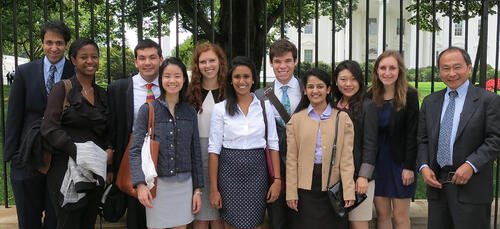 Class of 2015 in front of the White House with Francis Fukuyama.
 Douglas Rutzen
