Governance

FSI's research on the origins, character and consequences of government institutions spans continents and academic disciplines. The institute’s senior fellows and their colleagues across Stanford examine the principles of public administration and implementation. Their work focuses on how maternal health care is delivered in rural China, how public action can create wealth and eliminate poverty, and why U.S. immigration reform keeps stalling. 

FSI’s work includes comparative studies of how institutions help resolve policy and societal issues. Scholars aim to clearly define and make sense of the rule of law, examining how it is invoked and applied around the world. 

FSI researchers also investigate government services – trying to understand and measure how they work, whom they serve and how good they are. They assess energy services aimed at helping the poorest people around the world and explore public opinion on torture policies. The Children in Crisis project addresses how child health interventions interact with political reform. Specific research on governance, organizations and security capitalizes on FSI's longstanding interests and looks at how governance and organizational issues affect a nation’s ability to address security and international cooperation.

Paragraphs

On August 15, Prime Minister Shinzo Abe will publish a short statement to commemorate the seventieth anniversary of the end of World War II.  This follows similar practices of his predecessors.  Prime Minister Tomiichi Murayama started by delivering a short statement on the fiftieth anniversary in 1995.  Prime Minister Junichiro Koizumi followed in 2005 with the statement on the sixtieth anniversary.

Eight scholars at Shorenstein Asia-Pacific Research Center (APARC) and Freeman Spogli Institute for International Studies (FSI) wrote their own version of the statement -- what speech they would deliver if they were the Prime Miniser of Japan.  This book is a compilation of those statements.

Japanese version is also available here.

All Publications button
1
Publication Type
Books
Publication Date
Authors
Alberto Díaz-Cayeros
Thomas Fingar
David Holloway
Takeo Hoshi
Yong Suk Lee
Henry S. Rowen
Daniel C. Sneider
News Type
Commentary
Date
Paragraphs

In a recent interview with Korea Daily, Gi-Wook Shin, director of the Shorenstein Asia-Pacific Research Center, said that South Korea needs to be more strategic in its approach to its foreign policy agenda. The country’s leadership must aim to be more proactive in handling current diplomatic issues.

Shin suggested that South Korea should separate wartime history issues from other diplomatic priorities such as trade and security. This type of organization would allow each issue to receive the focused attention and expertise needed to understand and work toward resolution.

Recently, Japan provided a successful model for this, Shin said, referencing Japanese Prime Minister Shinzo Abe’s official state visit to the United States. Abe visited many major U.S. regions including Silicon Valley. He spoke mainly about the U.S.-Japan alliance and economic development as policy priorities for Japan. He did not address at length issues of the wartime past since the focus of his visit was U.S.-Japan relations and the economy.

Shin said he thinks it is important that South Korean President Park Geun-hye delivers a concrete foreign policy vision in her June visit to the United States. For the long-term, South Korea should find ways to boost its public diplomacy efforts to shore up support for that vision.

The full article is in Korean and available by clicking here.

Hero Image
obama park
U.S. President Barack Obama and President Park Geun-hye of the Republic of Korea walk on the Colonnade of the White House in May 2013.
White House
All News button
1
News Type
News
Date
Paragraphs

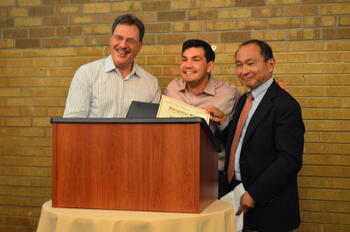
Francis Fukuyama, a senior fellow at the Freeman Spogli Institute for International Studies acclaimed for his scholarship on democracy, governance and political economy, is this year’s recipient of the Johan Skytte Prize in Political Science.

The prize, one of the most prestigious in political science, is being awarded to Fukuyama for his work in The Origins of Political Order (2011) and Political Order and Political Decay (2014).

The Johan Skytte Foundation at Uppsala University called the two volumes a “remarkable tour de force,” and selected Fukuyama for the prize “for having with breath-taking learnedness, clarity and courage thrown new light over the growth of modern political order.”

"I am extremely gratified to learn that I have been awarded the Johan Skytte Prize,” said Fukuyama, the Olivier Nomellini Senior Fellow at FSI who will take the helm of the institute’s Center on Democracy, Development, and the Rule of Law in September. “I feel very humbled to be in the company of the extremely distinguished earlier recipients of this great honor.”

The Skytte Prize is awarded to scholars who have made the most valuable contributions to political science. Research in all areas of the discipline is considered: political theory, comparative politics, public administration and international relations. 

The prize, which will be given to Fukuyama during a ceremony in Uppsala in October, consists of a medal and an award of about $55,000.

Click here to read the official press release by Uppsala University.


Hero Image
15395231560 337874636b o
In October 2014 Francis Fukuyama launched his latest book 'Political Order and Political Decay' at Stanford University.
Rod Searcey
All News button
1
Authors
News Type
News
Date
Paragraphs

It’s been 29 years since the Chernobyl nuclear disaster, but two nuclear security experts affiliated with the Center for International Security and Cooperation (CISAC) say there are still lessons to be learned from the worst nuclear accident of the 20th century.

In a new book by Sonja Schmid, the former CISAC science fellow argues that the consensus in the West about the cause of the disaster – that it was an inevitable result of a deeply flawed, backward Soviet system –  has precluded Western nuclear industries and policymakers from meaningfully incorporating the Soviet experience into their own practices.

The book, “Producing Power: The Pre-Chernobyl History of the Soviet Nuclear Industry”, is being praised by leading experts in the nuclear security field, including Freeman-Spogli Institute (FSI) Senior Fellow David Holloway who wrote: "[Schmid's] argument that the Soviet experience has to be incorporated into our broader understanding of the nuclear industry is both convincing and important."

Schmid was a social science research associate at Stanford University, a science fellow at CISAC, and a lecturer in the Program in Science, Technology and Society (STS) at Stanford from 2005-2007. She is now an assistant professor in Virginia Tech’s STS Department.

Schmid credits CISAC with providing resources crucial to the conception, research, and completion of “Producing Power,” including multiple travel grants to conduct research for the book, help with editing preliminary drafts, and a final book edit.

Schmid also tapped CISAC’s stable of nuclear experts. Along with Holloway, CISAC Associate Director for Research Lynn Eden mentored and supported her project. Siegfried Hecker, an FSI senior fellow, connected her with multiple Russian interviewees.

“Mentoring Sonja was a great pleasure. She came to CISAC with deep insight about the close connection between Soviet state bureaucracies and the reactor design choices that those bureaucrats made. It was an amazingly interesting and ambitious project,” Eden said.

“CISAC is a scholarly community that encourages and supports outstanding research and writing that is in some way policy-relevant,” she said. “For our pre- and post-doctoral fellows especially, we want to encourage them and help them to think deeply and/or broadly about a question that affects people’s lives, and to write clearly about it.”

Edward Geist, a MacArthur Nuclear Security Fellow at CISAC, said Schmid’s book is the first to grapple with the institutional history of Soviet nuclear power.

“The traditional accounts have tended to organize events around a ‘what went wrong’ narrative,” said Geist, whose article “Political Fallout: The Failure of the Emergency Management at Chernobyl”, appeared in the spring issue of Slavic Review. ”There’s a school of thought that emerged in the Soviet Union and was readily picked up abroad that says the Chernobyl disaster was the ultimate example of everything that was wrong with the Soviet Union,” Geist said.

This worries Geist, who specializes in nuclear power, Soviet history, and emergency management.

“As a result of having lived through the worst, Russian and Ukrainian nuclear energy industry leaders, to my mind, actually have a more realistic mindset regarding the hazards of nuclear energy than their Western counterparts,” Geist said.  “While a catastrophic nuclear accident in the United States is really unlikely, the nuclear industry claims to have made nuclear power safe through superior methods and procedures–and that attitude can forestall effective emergency planning.”

The Chernobyl disaster hurt popular trust in nuclear energy, including in the United States. The still-popular narrative that Chernobyl was a problem purely of Soviet making was spun by representatives of nuclear industries in other countries to protect their interests from popular backlash.

By detailing the decision processes and procedures behind the Soviet Union’s nuclear reactor choice, design and commercialization, Schmid aims to show that the Soviet process was rational and the product of expert input rather than an irrational byproduct of the Communist regime. Chernobyl, in short, was an accident of history rather than a byproduct of an illegitimate system and should therefore be studied by members of the Western nuclear industry and policymakers.

“The Western nuclear field has more to learn from the Soviet experience than they care to admit. The bureaucratic practices of the Soviets are not really that unique to them and can be repeated by our bureaucracies,” said Geist.

The 2011 Fukushima nuclear disaster in Japan was a case in point. Fukushima’s reactors were designed and built by Americans.

It’s Schmid’s hope that by putting Chernobyl in the context of what was a sophisticated nuclear energy bureaucracy that had many more successes than failures, much like its American counterpart, that lessons of caution can be drawn by the latter.

“What Chernobyl has demonstrated (and Fukushima has only confirmed),” writes Schmid, “is that organizing a civilian nuclear industry remains at best a high-stakes process of trial and error.”

Geist, with an eye on his field of emergency management, agrees.

“The lesson from Chernobyl and Fukushima is accidents happen no matter what procedures or levels of sophistication, but accidents need not be catastrophes if you’re willing to learn from others’ errors and incorporate them into planning.”

Hero Image
chornobyl dsc 0181 26
All News button
1
-


"The Controversy Over South Korean Wartime Operational Control: The Real Issues"

Speaker: Nam-soo Park2014-15 Visiting Scholar, Lieutenant General (Ret.)

South Korean Lt. Gen. (retired) Nam-soo Park will address the controversy in South Korea (ROK) over the indefinite, “conditions-based” postponement last year of Seoul’s planned reassumption of wartime operational control (opcon) over its own forces. Since the Korean War, the U.S. commander in South Korea has been assigned wartime operational control over most South Korean military units, but U.S. and Korean leaders agreed in 2007 that Seoul would resume wartime opcon over all its forces by 2012. That decision was based on progressives’ concerns that U.S. exercise of opcon over South Korean forces diminished Seoul’s sovereignty and disadvantaged it in negotiations with North Korea. Conservatives and some military leaders, however, pushed for postponement in the belief that ROK military forces were not adequately prepared for the change and that it might increase the likelihood of a further reduction in U.S. forces in South Korea. Lt. Gen. Park will share his views on this controversy over opcon change.


"The Use of Domestic and International Law: Against North Korean Subversion and Human Rights Violations"

Speaker: Dong Hyuk Chin, 2014-15 Visiting Scholar from Kim & Chang Law Firm

Visiting scholar Dong Hyuk Chin will discuss issues of criminal law related  to North Korea, including the application of the controversial National Security Law in South Korea in the case of individuals and organizations suspected of supporting Pyongyang, and the international community's consideration of the North Korean regime's human rights violations and crimes against humanity. Chin is a former South Korean prosecutor with experience handling cases involving the National Security Law; he also established comprehensive plans for national security-related administration while serving in the Public Security Affairs Division of the Ministry of Justice and District Prosecutor's Office. In his talk, he will review the South Korean Constitutional Court's recent dissolution of a political party accused of supporting North Korea; share his personal experience prosecuting a criminal case involving the National Security Law; and discuss the United Nation's Commission of Inquiry into North Korea's human rights situations and the UN General Assembly's referral of North Korean crimes against humanity to the International Criminal Court.

Philippines Conference Room

Encina Hall, 3rd floor

Shorenstein APARC616 Serra StreetEncina Hall E301Stanford, CA 94305-6055
(650) 723-6530
0
nam-soo_park.jpg

Lieutenant General (Ret) Park, Nam-soo joins the Walter H. Shorenstein Asia-Pacific Research Center (Shorenstein APARC) during the 2014-2015 academic year.  At Shorenstein APARC, General Park's research will focus on ROK-U.S. strategic responses to North Korean threats, the future of the ROK-U.S. alliance, and the establishment of peace on the Korean Peninsula.

As a career officer, General Park held varied military staff and field positions. His final assignment (2012-2013) was as superintendent of the Korea Military Academy (KMA), and he commanded the Capital Defense Command in 2011. Earlier, he was the director of Combat Readiness Inspection and the deputy chief of staff for Joint Operations with the Joint Chiefs of Staff (2010-2011). General Park also served as the director of Defense Reform Planning and Coordination, and later as the director of Management Reform at the Ministry of National Defense (2006-2008). After retirement, he served as a chair professor of Soegyung University in Seoul, and he is also a senior research fellow with the Korea Research Institute for Strategy (KRIS). He received a BA in literature from KMA and an MA in security assurance from Kyonggi University.


Visiting Scholar
Shorenstein APARC616 Serra StreetEncina Hall, E301Stanford, CA 94305-6055
(650) 723-6530
0
Visiting Scholar
dong-hyuk_chin.jpg

Dong Hyuk Chin joins the Walter H. Shorenstein Asia-Pacific Research Center during the 2014–15 academic year from the Kim & Chang Law Office in Korea. Chin is a senior attorney at Kim & Chang's Labor and Employment Group and White Collar Defense Practice Group. He served as a public prosecutor for 7 years, and has handled cases of the National Security Act and established comprehensive plans for a national security-related administration while in Public Security Affairs division of the Ministry of Justice and District Prosecutor’s Office.

Chin's research interests include the influence and meaning of criminal cases related to North Korean issues and the role of the jurists in preparation for the unification of Korea.

Chin graduated from the Judicial Research and Training Institute of the Supreme Court of Korea and holds a BA in law from the Seoul National University.

Seminars
-

"South Korea's 'Creative Economy' Initiative"

Speaker: Kyeongsik Cho, 2014-15 Visiting Scholar from Ministry of Science, ICT and Future Planning

In recent years South Korea, home of the economic "miracle on the Han River," has been suffering from low growth. A rapidly aging population means that the potential growth rate is falling, and the country has encountered difficulties adapting to new globally integrated markets. Concerned that low growth and jobless growth might become a permanent fixture, the Korean government has come up with a new vision to develop a "Creative Economy." Visiting scholar Kyeongsik Cho, a senior official in Korea's Ministry of Science, ICT and Future Planning, will explain the origin, content, and implementation of this critically important initiative.


"Is South Korea Ready for Internet of Things?"

Speaker: Seunghoon Lee, 2014-15 Visiting Scholar from Maeil Business Newspaper

Visiting scholar Seunghoon Lee will examine the current Internet of Things (IoT) trends and discuss how South Korea can benefit from emerging opportunities of the next technology wave of IoT.

Mr. Lee is a staff reporter at the Maeil Business Newspaper in Korea.


Philippines Conference Room

Encina Hall, 3rd floor

Shorenstein APARCStanford UniversityEncina Hall E301Stanford,  CA  94305-6055
(650) 723-6530
0
Visiting Scholar
kyeongsik_cho.jpg MS

Kyeongsik Cho joins the Shorenstein APARC during the 2014-2015 academic year from the Ministry of Science, ICT and Future Planning (MSIP) in Korea where he serves as a director general. His research interests encompass how the US is currently solving national issues that involve slow growth, unemployment and how scientific technologies and ICT are used in solving those problems. Kyeongsik Cho holds an MS in finance from the Michigan State University, and a BA in Business Administration from the Korea University.

Shorenstein APARC616 Serra StreetEncina Hall, E301Stanford, CA 94305-6055
(650) 723-6530
0
Visiting Scholar
seung-hoon_lee.jpg
Seung-Hoon Lee joins the Walter H. Shorenstein Asia-Pacific Research Center during the 2014-15 academic year from Maeil Business Newspaper (leading economic daily in South Korea) where he serves as an economics and industry reporter.  His research interests encompass IoT (Internet of Things) impact on the future of Korea. Since 2007, more 'things or objects' have been connected to the internet than people have. In 2015, world population would be 7.2 billion, and connected devices four times larger than that. In the era of IoT, he will analyze the collision of big data and machine-to-machine connected information.  He was awarded two major media related prizes in Korea: the Grand Prize by CITIGROUP for articles on Korea's economic reform and another Grand Prize by Korea Financial Investment Association for articles on capital market crisis.  He co-authored Great Decision (2012) and Mobile Economy (2010). Lee holds an MBA from KDI School of Public Policy and Management, and a BA in business from Korea University.  He also took a special course from Columbia University's Graduate School of Journalism.
Authors
Phillip Lipscy
News Type
News
Date
Paragraphs

When China first proposed creating the Asian Infrastructure Investment Bank (AIIB) in 2013, it generated considerable anxiety in Washington and many other capitals. Many pundits and policymakers view the AIIB as a bid to undermine or replace the international architecture designed by the United States and its allies since the end of World War II. Although several U.S. allies, including Australia, Germany, and the United Kingdom, have declared their intention to join the AIIB, others, including Japan, have expressed ambivalence. For its part, the United States has made it clear that it will seek to influence the institution from the outside. But it would be a mistake to shun or undermine the AIIB. Rather, it should be welcomed. Both the United States and Japan have far more to gain by joining the AIIB and shaping its future than remaining on the sidelines.

The details remain vague, but the AIIB is meant to be a multilateral development institution that will focus on infrastructure needs in Asia. There is no question that this is a deserving cause. Asia’s large population, rapid growth, and integration with the global economy all generate demand for better infrastructure. A report by the Asian Development Bank (ADB) estimates the region needs about $750 billion annually in infrastructure-related financing. Citing historical underinvestment, McKinsey & Company, a global management consulting firm based in New York City, proclaims a “$1 trillion infrastructure opportunity” in Asia. [...]

This article was originally published on Foreign Affairs on May 7, 2015, and an excerpt has been reproduced here with permission. The full article may be viewed on the Foreign Affairs website.

Hero Image
uschina strategicmtg flickr dos
U.S. Secretary of State John Kerry and U.S. Treasury Secretary Jack Lew meet with Chinese Premier Li Keqiang at an economic dialogue between the two nations in July 2014.
Flickr/U.S. Department of State
All News button
1
Authors
News Type
News
Date
Paragraphs

The damage that Mao Zedong wrought in China made it much easier for that country to move away from a Soviet-style economic model and toward a new market-oriented one, a Stanford scholar says.

In fact, China has been in full retreat for four decades from Mao's disastrous rule, according to a new book by Stanford sociology Professor Andrew Walder, a senior fellow at the Freeman Spogli Institute for International Studies and director emeritus of the Walter H. Shorenstein Asia Pacific Research Center.

"Mao ruined much of what he had built and created no viable alternative," he wrote. "At the time of his death, he left China backward and deeply divided."

Led by Mao, China's Communist Party seized power in 1949 after a long period of guerrilla insurgency followed by full-scale war. Mao launched a bloody Chinese revolution that resulted in the deaths of millions of Chinese over the next few decades. 

In an interview, Walder said that Mao pushed campaign after campaign against the Chinese Communist party and bureaucracy after 1966 – "The bureaucracy was basically flat on its back at the time of his death."

By contrast, Walder noted, the Soviet bureaucracy was powerful and well-entrenched, and had enormous vested interests that thwarted genuine reforms.

"In post-Mao China, the economy was so backward and the bureaucratic interests so weak that market reform was bundled together with a program of national revival – restructuring the economy along market lines while rebuilding the party and bureaucracy," he said.

Therefore, the politics of reform were much easier for a Chinese leader like Deng Xiaoping than for a Soviet leader like Mikhail Gorbachev, who had to contend with an entrenched bureaucracy still proud of the fact that the USSR was (until the late 1980s) the second largest economy in the world and an undeniable superpower, according to Walder.

He noted that Mao's initiatives repeatedly led to unintended and unanticipated outcomes.

"What is so remarkable is that after 1956 this was a recurring pattern. His initiatives repeatedly ran into trouble, forcing him to backtrack and change direction constantly – although he always insisted that things had unfolded in ways that were according to his plans," Walder said.

Class struggle, imaginary enemies

Mao's China, he added, was defined by a harsh Communist Party rule and a socialist economy modeled after the Soviet Union. Mao himself intervened at almost every level, despite a large national bureaucracy that oversaw this authoritarian system.

"The doctrines and political organization that produced Mao's greatest achievements – victory in the civil war, the creation of China's first unified modern state, a historic transformation of urban and rural life – also generated his worst failures: the industrial depression and rural famine of the Great Leap Forward and the violent destruction and stagnation of the Cultural Revolution," Walder wrote.

He said that Mao misunderstood China's real problems in advocating a top-down "class struggle" against capitalism and imaginary enemies.

"At the time of his death (in 1976), he left China backward and deeply divided," Walder wrote.

The result was a gradual transition to the market-oriented system of today, he added. Almost immediately following Mao's death, his most fervent followers and supporters in the party were arrested and detained – all of which opened the door to reform and opportunity.

China has overcome widespread poverty to become the second largest economy in the world within the span of just a couple of decades. Still, according to Walder, China's rulers seek to cling to a sanitized version of Mao as a way to buttress their legitimacy.

"The damage of his misrule, and the incompetence on his part that it reflects, are not part of the official story anymore, and certainly this is not what is taught to school children or in party manuals in the present day," he said.

World War II and Stalinism

On two other key issues, Walder said his book challenges the conventional wisdom about China and Mao.

First, he says that Mao's forces did very little of the fighting against the Japanese in WWII.

Walder said that the victory of the Chinese Communist Party in 1949 over the Chinese nationalist forces has usually been traced to the strategy of guerrilla warfare in rural regions championed early on by Mao.

"But that was simply a strategy of survival during the Japanese invasion – and Mao's forces did very little of the fighting against the Japanese, in stark contrast to the popular myth of rural resistance." (Only 10 percent of China's military casualties were Red Army, he said.)

What Mao's Chinese Communist Party (CCP) excelled at was mass mobilization for all-out warfare during the Chinese civil war of 1945-49, Walder said.

"And this – pushing your organization and the population for all-out mobilization for war – is the real source of the CCP's success over the Chinese nationalists. This was more like the Soviet Union's war against German armies during World War II than a 'people's war' led by a party that was close to the rural people and built support by catering to their needs," he said.

Second, Walder describes Mao's thinking as frozen in Stalinist doctrine, despite the conventional view of him as an original thinker.

"In fact, Mao's core ideas were absorbed from late-1930s Soviet pamphlets put out under Stalin, and his thinking was very much frozen in that earlier era," Walder said. "The core idea that he absorbed from these pamphlets in creating 'Mao Thought' was that socialism had to be built in an all-out mobilization, like warfare, by extracting huge sacrifices from the population."

The most pernicious idea that Mao absorbed from these old Soviet pamphlets, Walder said, was that class struggle actually intensifies after the means of production are put under public ownership and former exploiting classes are liquidated.

"The sad corollary to this idea is that the Great Leader is the fount of correct ideas, and those who doubt or oppose him represent class enemies who actually oppose socialism," said Walder.

Based on this logic, Walder pointed out, the class struggle had to be waged against "incorrect ideas" as judged by the Great Leader.

"Mao's personality cult was an imitation of Stalin's own," he said.

And so, the Chinese leader held on to old Stalinist ideas long after they were rejected by the Soviet Union as crude distortions of Marxism.

"Mao was actually insisting on keeping to the old and tattered Stalinist playbook," Walder said.

Clifton Parker is a writer for the Stanford News Service.

Hero Image
mao flickr tauno tohk
A statue of Mao Zedong in Lijiang, China.
Flickr/Tauno Tõhk
All News button
1
Paragraphs

This paper aims to understand Japan’s financial regulatory responses after the global financial crisis and recession. Japan’s post-crisis reactions show two seemingly opposing trends: collaboration with international organizations to strengthen the regulation to maintain financial stability, and regulatory forbearance for the banks with troubled small and medium enterprise [SME] borrowers. The paper evaluates the responses by the Japanese financial regulators in five areas (Basel III, stress tests, over-the-counter [OTC] derivatives regulation, recovery and resolution planning and banking policy for SME lending) and concludes that the effectiveness of the new regulations for financial stability critically depends on the willingness of the regulators to use the new tools.


"This article is (c) Emerald Group Publishing and permission has been granted for this version to appear here. Emerald does not grant permission for this article to be further copied/distributed or hosted elsewhere without the express permission from Emerald Group Publishing Limited."

All Publications button
1
Publication Type
Journal Articles
Publication Date
Journal Publisher
Journal of Financial Economic Policy
Authors
Takeo Hoshi
Satoshi Koibuchi
Subscribe to Governance