
Adverse Selection in an Opt-in Emissions Trading Program: The Case of Sectoral Crediting for Transportation
Paragraphs
Sectoral crediting mechanisms such as sectoral no-lose targets have been proposed as a way to provide incentives for emission reductions in developing countries as part of an international climate agreement, and scale up carbon trading from the project-level Clean Development Mechanism to the sectoral level.
Countries would generate tradable emission credits (offsets) for reducing emissions in a sector below an agreed crediting baseline. However, large uncertainties in the regulator's predictions of the counterfactual business-as-usual baseline are likely to render sectoral no-lose targets an extremely unattractive mechanism in practice, at least for the transportation case study presented here. Given these uncertainties, the regulator faces a tradeoff between efficiency (setting generous crediting baselines to encourage more countries to opt in) and limiting transfer payments for non-additional offsets (which are generated if the crediting baseline is set above business-as-usual).
The first-best outcome is attainable through setting a generous crediting baseline. However, this comes at the cost of either increased environmental damage (if developed country targets are not adjusted to account for non-additional offsets), or transfers from developed to developing countries that are likely to be too high to be politically feasible (if developed country targets are made more stringent in recognition that many offsets are nonadditional). A more stringent crediting baseline still generates a large proportion of non-additional offsets, but renders sectoral no-lose targets virtually irrelevant as few countries opt in.
All Publications button
1
Publication Type
Working Papers
Publication Date
Journal Publisher
Program on Energy and Sustainable Development
NNPC and Nigeria's Oil Patronage Ecosystem
Paragraphs
Nigeria depends heavily on oil and gas, with hydrocarbon activities providing around 65 percent of total government revenue and 95 percent of export revenues. While Nigeria supplies some LNG to world markets and is starting to export a small amount of gas to Ghana via pipeline, the great majority of the country's hydrocarbon earnings come from oil. In 2008, Nigeria was the 5th largest oil exporter and 10th largest holder of proved oil reserves in the world according to the U.S. Energy Information Administration. The country's national oil company NNPC (Nigerian National Petroleum Corporation) sits at the nexus between the many interests in Nigeria that seek a stake in the country's oil riches, the government, and the private companies that actually operate the vast majority of oil and gas projects.
Through its many divisions and subsidiaries, NNPC serves as an oil sector regulator, a buyer and seller of oil and petroleum products, a technical operator of hydrocarbon activities on a limited basis, and a service provider to the Nigerian oil sector. With isolated exceptions, NNPC is not very effective at performing its various oil sector jobs. It is neither a competent oil company nor an efficient regulator for the sector. Managers of NNPC's constituent units, lacking the ability to reliably fund themselves, are robbed of business autonomy and the chance to develop capability. There are few incentives for NNPC employees to be entrepreneurial for the company's benefit and many incentives for private action and corruption. It is no accident that NNPC operations are disproportionately concentrated on oil marketing and downstream functions, which offer the best opportunities for private benefit. The few parts of NNPC that actually add value, like engineering design subsidiary NETCO, tend to be removed from large financial flows and the patronage opportunities they bring.
Although NNPC performs poorly as an instrument for maximizing long-term oil revenue for the state, it actually functions well as an instrument of patronage, which helps to explain its durability. Each additional transaction generated by its profuse bureaucracy provides an opportunity for well-connected individuals to profit by being the gatekeepers whose approval must be secured, especially in contracting processes. NNPC's role as distributor of licenses for export of crude oil and import of refined products also helps make it a locus for patronage activities. Corruption, bureaucracy, and non-market pricing regimes for oil sales all reinforce each other in a dysfunctional equilibrium that has proved difficult to dislodge despite repeated efforts at oil sector reform.
All Publications button
1
Publication Type
Working Papers
Publication Date
Journal Publisher
Program on Energy and Sustainable Development
Economic Modernization in Late British India: Hindu-Muslim Differences
-
The Muslims of South Asia made the transition to modern economic life more slowly than the region’s Hindus. In the first half of the twentieth century, they were relatively less likely to use large-scale and long-living economic organizations, and less likely to serve on corporate boards. Providing evidence, this paper also explores the institutional roots of the difference in communal trajectories. Whereas Hindu inheritance practices favored capital accumulation within families and the preservation of family fortunes across generations, the Islamic inheritance system, which the British helped to enforce, tended to fragment family wealth. The family trusts (waqfs) that Muslims used to preserve assets across generations hindered capital pooling among families, and they were ill-suited to profit-seeking business. Whereas Hindus generally pooled capital within durable joint family enterprises, Muslims tended to use ephemeral Islamic partnerships. Hindu family businesses facilitated the transition to modern corporate life by imparting skills useful in large and durable organizations.
Timur Kuran is Professor of Economics and Political Science, and Gorter Family Professor of Islamic Studies at Duke University. His research focuses on social change, including the evolution of preferences and institutions. He has just completed a book, The Long Divergence (Princeton University Press, forthcoming 2010), on the role that Islam played in the economic rise of the Middle East and, subsequently, in the institutional stagnation that accompanied the region's slip into a state of underdevelopment. Some of the archival work on which this book was based will be published, also in 2010, as a ten-volume bi-lingual set entitled Kadı Sicilleri. Among Kuran's earlier publications are Private Truths,(Harvard University Press, Işığında 17. Yüzyıl İstanbul'unda Ekonomik Yaşam / Economic Life in Seventeenth-Century Istanbul, as Reflected in Court Registers Public Lies: The Social Consequences of Preference Falsification 1995) and Islam and Mammon: The Economic Predicaments of Islamism (Princeton University Press, 2004), each translated into several languages, including Turkish.
Link to paper: http://papers.ssrn.com/sol3/papers.cfm?abstract_id=1656038
Encina Ground Floor Conference Room
Timur Kuran
Professor of Economics and Political Science
Speaker
Duke University
Seminars
Earn-Key Joo of Samsung Electronics broadening his global perspective at Shorenstein APARC
News Type
News
Date
Paragraphs
Image
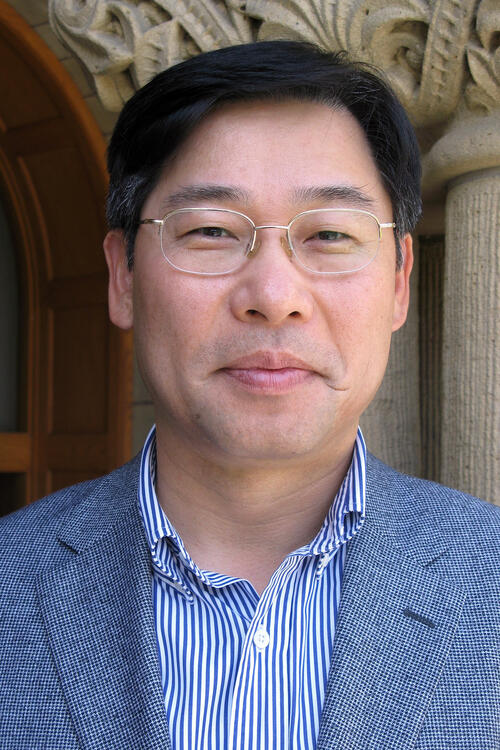
While Samsung's headquarters are based in Seoul, the larger research and development and operational offices are located in Suwon, a city in close proximity to Seoul. Samsung is the current leader of the global electronics market, manufacturing everything from televisions to refrigerators, and semiconductors to mobile phones. It is especially strong in the LED television, color monitor, memory chip, and LCD panel product sectors. Samsung is now trying to advance in the mobile phone market with the introduction of its Galaxy S smartphone, which is available in the United States.
Joo is currently researching ways for Samsung to maintain its market lead. Even as the current leader, he said, market changes could affect the company's success. Joo is studying the case of Sony, a previous electronics market leader, and the factors that led to the loss of its position. His advisor for the project is Gi-Wook Shin, director of Shorenstein APARC and the Korean Studies Program.
In addition to his research project, Joo is taking advantage of his time at Stanford University to improve his English-language skills. He is proficient at reading English, and is using the opportunity to strengthen his speaking ability. He also hopes in the coming months to attend more events, especially in order to learn about the systems of other companies. Joo has already participated in site visits to Cisco, the Federal Reserve Bank of San Francisco, and Palo Alto Utilities.
Joo, who has previously not had the experience of living abroad and has had few opportunities to engage with people from other countries, says, "This is a very good time for me to widen my global perspective." He wants to interact as much as possible with the other fellows-who come from diverse work sectors and different countries in Asia-to exchange information, including best practices, based on each fellow's unique professional experience.
After he returns to Korea, Joo plans to take some of the information he has gained from his research and his exchange of knowledge with other fellows and share it with different development and marketing teams at Samsung, in addition to applying it in his own job. Samsung, Joo believes, is in need of creativity now and he is exploring ways it can develop this in its employees.
In between research and company visits, Joo has been able to spend valuable time with his family, which has traveled with him from Korea. They are planning to visit as many places as possible in the United States and have already visited Yellowstone National Park and are planning a trip to Alaska.
Hero Image

All News button
1
Corporate Affiliates Program welcomes 2010-2011 fellows to Stanford
News Type
News
Date
Paragraphs
As the new academic year is about to get underway, the Corporate Affiliates Program of Shorenstein APARC welcomes its new class of fellows for the 2010-2011 academic year:
- Minoru Aosaki, Ministry of Finance, Japan;
- Wataru Ishii, Shizuoka Prefecture, Japan;
- Earn Key Joo, Samsung Electronics, Republic of Korea;
- Toshifumi Kadowaki, Sumitomo Corporation, Japan;
- Takeshi Kondo, Mitsubishi Electric, Japan;
- Yuichi Moronaga, Ministry of Economy, Trade and Industry, Japan;
- Makoto Murata, Kansai Electric Power Company, Japan;
- Pradnya Palande, Reliance Industries, India;
- Seung Gun Park, Samsung Electronics, Republic of Korea;
- Puangthong Pawakapan, the Asia Foundation / Chulalongkorn University, Thailand;
- Oshie Sato, Sumitomo Corporation, Japan;
- Naoki Takeuchi, Development Bank of Japan, Japan;
- Hirofumi Takinami, Ministry of Finance, Japan;
- Sonya Vasudeva, Reliance Industries, India; and
- Eiichi Yamamoto, Japan Patent Office, Japan.
During their stay at Stanford University, the fellows will audit classes, study English, and conduct individual research projects, which they will then present about at the end of the year. They will have the opportunity to consult with Shorenstein APARC's scholars and attend events featuring visiting experts from around the world. The fellows will also participate in special events and site visits to gain a first-hand understanding of business, society, and culture in the United States.
The Corporate Affiliates website will feature interviews with of each of the 2010-2011 fellows throughout the coming year.
Hero Image

All News button
1
China 2.0: The Rise of a Digital Superpower (October 2010)
中文版--Chinese version available here
China 2.0 Beijing Overview Videos Now Online!
| Image

|
Image

|
The Stanford Program on Regions of Innovation and Entrepreneurship (SPRIE) will host China 2.0 in Beijing on October 18-19, 2010 at the Grand Millennium Hotel in Beijing's central business district. (This event builds on the successful inaugural China 2.0 conference in Silicon Valley at Stanford University on May 24-25
China 2.0 will focus on the leaders driving China's continued ascendance as a "digital superpower" and analyze the strategies they are adopting for success.
China 2.0 is the preeminent new media forum about the dynamic PRC digital landscape that combines the right mix of strategic thinking, practical application and networking.
Fritz Demopoulos, CEO, Qunar.com
The agenda is available here. Please note this event will utilize simultaneous Chinese-English interpretation for the convenience of all participants.
China 2.0 Beijing will feature Internet & e-commerce CEOs and senior executives from China and the US, including members of Stanford's alumni network.
The conference will open with a special session reuniting the two scientists who established the first connection between China and the Internet in 1993: Xu Rongsheng, Institute of High Energy Physics in Beijing and Les Cottrell, Stanford Linear Accelerator Center (SLAC).
Keynote addresses will be given by:
- James Ding, Managing Director, GSR Ventures
- Bill Huang, General Manager, China Mobile Research Institute
- Victor Koo, CEO, YouKu
- John Liu, Vice President, Google
- Shen Haoyu, Senior Vice President--Operations, Baidu
- Brian Wong, Global Head of Sales, Alibaba
The China 2.0 event was bang up-to-date with content and stimulating debate from key players in the Chinese market. The organization was very professional bringing together China players and interested parties from the Bay Area.
--Graham Kill, CEO, Irdeto and CTO, Naspers
Format
China 2.0 is a highly engaging and interactive forum, featuring extensive video material, dynamic panel presentations and Q&A. We also have developed a China 2.0 application which is available now at the Apple Application store, for both iPad and iPhone/iTouch devices.
Final agenda (printable version here):
|
Monday, October 18, 2010 |
|
| 8:30 - 9:00 | Registration |
| 9:00 - 9:15 |
Welcome Remarks from China 2.0 Co-Chairs |
| 9:15 - 9:45 | Special Feature: How the Internet Came to China—and China to the Internet Short video and reunion (via Cisco TelePresence) of the two scientists who established the first connect between China & the Internet in 1993. Les Cottrell, Stanford Linear Accelerator Center (SLAC), Stanford University |
| 9:45 - 10:25 | Keynote Speech: Victor Koo, CEO, Youku (Stanford MBA '94) |
| 10:25 - 10:45 | Break |
|
10:45 - 12:00 |
Mobile 2.0: Apps & Ads |
| 12:00 - 12:40 | Keynote Speech: James Ding, Managing Director, GSR Ventures |
| 12:40 - 1:45 | Hosted Lunch: CBD International Restaurant (lobby level of Grand Millennium Hotel) |
| 1:45 - 2:25 | Keynote Speech: Bill Huang, General Manager, China Mobile Research Institute |
|
2:25 - 3:45 |
Shopping 2.0: Consumer e-Commerce in China |
| 3:45 - 4:05 | Break |
| 4:05 - 4:35 | Global Media Industry Outlook: Joel Budd, Media Editor, The Economist (London) |
|
4:35 - 5:55 |
Games Market Outlook |
| 5:55 - 6:00 | Wrap and Day 2 Outline by China 2.0 Co-chairs, Marguerite Gong Hancock and Duncan Clark |
| Tuesday, October 19, 2010 | |
| 8:30 - 9:00 | Registration |
| 9:00 - 9:05 | Welcome Remarks by China 2.0 Co-Chairs, Marguerite Gong Hancock and Duncan Clark |
| 9:05 - 9:45 | Keynote Speech: John Liu, Vice President, Google |
|
9:45 - 10:45 |
The Outlook for Trans-Pacific Entrepreneurship and Innovation—Indigenous & International? |
| 10:45 - 11:00 | Break |
|
11:00 - 12:00 |
Marketing 2.0 |
| 12:00 - 12:40 | Keynote Speech: Brian Wong, Head of Global Sales, Alibaba |
| 12:40 - 1:45 | Hosted Lunch: CBD International Restaurant (lobby level of Grand Millennium Hotel) |
|
1:45 - 3:00 |
Social Networking |
| 3:00 - 3:40 | Keynote Speech: Shen Haoyu, Senior Vice President-Operations, Baidu |
| 3:40 - 4:00 | Break |
|
4:00 - 5:00 |
TV 2.0: The Future of TV & Three Network Convergence in China |
|
5:00 -6:15 |
Fueling China 2.0 |
| 6:15 | Apple iPad Lucky Draw & Close by China 2.0 Co-Chairs Marguerite Gong Hancock and Duncan Clark |
The first China 2.0 provided a great selection of topics and speakers who knew their specialties and made focused presentations--with very little overlap and repetition among panels, always a challenge at such conferences. Well-organized, well-moderated, with a smart audience that asked good questions.
-Gady Epstein, Beijing Bureau Chief, Forbes Magazine
Sponsors
The China 2.0 Beijing conference is made possible by its generous sponsors:
Image

Media Participants
Image

Official PR Partner
Image

Image

Photos

Photos from the May event are available on SPRIE's Flickr page.
Videos


China 2.0 achieved the balance of giving a clear overview to the China newcomers but still bringing insights to market participants about other sectors. Great conference and surely the start of a successful series.
--Olivier Glauser, Managing Director, Steamboat Ventures
Overview videos for China 2.0 are available here. If you are trying to view the videos from within China, they are accessible on BDA's website.
 Hakan Eriksson speaks on infrastructure at China 2.0
Videos from China 2.0 (May 2010) are now avallable at iTunes University (do a power search for "China 2.0" in the title field).
Grand Millennium Hotel, Beijing, China
Conferences
Is Liberal Society a Parasite on Tradition?
-
SAMUEL BOWLES, (PhD, Economics, Harvard University) is Research Professor at the Santa Fe Institute where he heads the Behavioral Sciences Program. He is also Professor of Economics at the University of Siena. He taught economics at Harvard from 1965 to 1973 and at the University of Massachusetts, where he is now emeritus professor. His recent studies on cultural and genetic evolution have challenged the conventional economic assumption that people are motivated entirely by self-interest. These have included the mathematical modeling and agent-based computer simulations of the evolution of altruistic behaviors and behavioral experiments in 15 hunter-gather and other small-scale societies. Recent papers have also explored how organizations, communities and nations could be better governed in light of the fact that altruistic and ethical motives are common in most populations. Bowles' current research also includes theoretical and empirical studies of political hierarchy and wealth inequality and their evolution over the very long run.
His scholarly papers have appeared in Science, Nature, American Economic Review,Theoretical Population Biology, Journal of Theoretical Biology, Journal of PoliticalEconomy, Quarterly Journal of Economics, Behavioral and Brain Science, Philosophy and Public Affairs, Journal of Public Economics, Theoretical Primatology, Proceedings of the National Academy (USA), Harvard Business Review, Journal of Economic Literature, Journal of Economic Perspectives, and the Economic Journal.
His recent books include Microeconomics: Behavior, Institutions and Evolution(Princeton University Press, 2004), Moral Sentiments and Material Interests: the Foundations of Cooperation in Economic Life (MIT Press, 2005), Unequal Chances: Family Background and Economic Success (Princeton 2004), Poverty Traps (Princeton 2006), Inequality, Cooperation and Environmental Sustainability (Princeton 2005), Globalization and Egalitarian Redistribution (Princeton, 2006), Foundations of Human Sociality: Economic Experiments and Ethnographic Evidence in 15 Small-scale Societies. (Oxford University Press. 2004) and Understanding Capitalism: Competition, Command and Change (Oxford 2004).
He has also served as an economic advisor to the governments of Cuba, South Africaand Greece, to presidential candidates Robert F. Kennedy and Jesse Jackson, to the Congress of South African Trade Unions and to South African President Nelson Mandela.
His next major work, A Cooperative Species: Human reciprocity and its evolution,co-authored with Herbert Gintis, will be published in 2011. Drawing on their recentresearch on cultural and genetic evolution and his empirical studies of behavior in smallscale societies, this work will explain why humans, unlike other animals, engage incooperation among large numbers of people beyond the immediate family. His CastleLectures at Yale University, Machiavelli's Mistake: Why good laws are no substitute forgood citizens, will be published in 2011 by Yale University press.
Encina Ground Floor Conference Room
Samuel Bowles, PhD.
Research Professor
Speaker
Sante Fe Institute
Workshops
Executive Summary from the Fourth Korea-U.S. West Coast Strategic Forum Released
News Type
News
Date
Paragraphs
The fourth Korea-U.S. West Coast Strategic Forum was held on June 18th at Stanford to discuss current developments in North Korea and North Korea policy, the future of the U.S.-South Korean alliance, and a strategic vision for Northeast Asia. Former senior government officials and other leading experts from the United States and South Korea participated. The forum agenda and the executive summary available.
Participants from the United States included:
- Michael H. Armacost, Shorenstein Distinguished Fellow, Shorenstein Asia-Pacific Research Center (APARC), Stanford University
- Michael Chinoy, Senior Fellow, University of Southern California, U.S.-China Institute; former CNN foreign correspondent
- Siegfried S. Hecker, Co-Director of Center for International Security and Cooperation (CISAC), Stanford University; and Professor (Research), Department of Management Science and Engineering; FSI Senior Fellow
- David C. Kang, Professor of International Relations and Business, University of Southern California; Director, USC Korean Studies Institute
- Stephen D. Krasner, Professor of International Relations and Business, Deputy Director of Freeman Spogli Institute, Stanford University
- John W. Lewis, William Haas Professor of Chinese Politics, Emeritus, Stanford University; CISAC Faculty Member; FSI Senior Fellow, by courtesy
- Kyung-Ae Park, Associate Professor, Korea Foundation Chair, Institute of Asian Research, University of British Columbia
- William J. Perry, Michael and Barbara Berberian Professor (at FSI and Engineering) and Co-director of the Preventive Defense Project at CISAC; FSI Senior Fellow
- Gi-Wook Shin, Director, Shorenstein APARC; Director, Korean Studies Program and Tong Yang, Korea Foundation, and Korea Stanford Alumni Chair of Korean Studies; Professor of Sociology; FSI Senior Fellow
- David Straub, Associate Director, Korean Studies Program, Shorenstein APARC; former Director, Office of Korean Affairs, U.S. State Department
- Philip W. Yun, Vice President for Resource Development, The Asia Foundation
Participants from South Korea - Yun Young Cho, Associate Professor, Chung-Ang University
- Ro Myung Gong, Chairman, The Sejong Foundation; former Foreign Minister
- Young Sun Ha, Professor, Seoul National University
- Yong Ho Kim, Professor, Inha University; former President of Korea Political Science Association
- Sangho Lee, Research Fellow, The Sejong Institute (Program Coordinator)
- Yong Ok Park, Governor, South Pyongan Province; former Vice Minister of Defense
- Sang Woo Rhee, Head, Presidential Commission for National Security Review; former President, Hallym University
- Gi Woong Son, Senior Research Fellow, Korea Institute for National Unification
- Dae Sung Song, President, The Sejong Institute
Hero Image

All News button
1
Frank Fukuyama: Time for a Sensible Debate on Immigrants and Crime
News Type
Commentary
Date
Paragraphs
Opponents of immigration reform see illegal immigrants as criminals who will disregard U.S. laws once in the country, writes Frank Fukuyama in the Wall Street Journal, but they are better described as "informal" rather than "illegal." Reform that provides hardworking illegal immigrants with a path to citizenship should be seen as an effort to move people from a dangerous informal system to one based on a rule of law.
There is a widespread perception of a strong link between immigrants and crime. It is common to hear those who oppose immigration argue that the first act illegal immigrants commit on U.S. soil is to break the law-that is, our immigration laws-and that they are ipso facto criminals who will continue to disregard U.S. laws once in the country. Those making this argument are generally steadfastly opposed to any immigration reform that will provide the 10 million to 12 million illegals already in the country any path to citizenship, on the grounds that such an "amnesty" would reward law-breaking.
The association of immigrants with crime is strengthened by the weekly barrage of news about drug and gang violence in Mexico as the government of Mexican President Felipe Calderón seeks to crack down on that country's powerful drug mafias. And long before the Mexican drug war, Americans were threatened by Colombian cartels, Salvadoran street gangs, and other criminal groups from Latin America. Moreover, it is perfectly true that the simple fact of being an illegal immigrant induces one to break further laws: One is reluctant to buy mandated auto insurance, pay taxes, or register businesses for fear of deportation.
There is indeed a huge problem of crime originating in Latin America and spilling into the United States. This is almost wholly driven by the enormous demand for drugs from the U.S. There are many things we can and should do to mitigate this problem, but it will persist as long as that demand remains high.
But the problem of gangs and drug violence should not be confounded with the behavior of the vast majority of illegal immigrants to the U.S., who by and large are seeking the same thing that every immigrant to America has wanted since the time of the Mayflower: to better their condition and that of their families. They are not criminals in the sense of people who make a living by breaking the law. They would be happy to live legally, but they come from societies in which legal rules were never quite extended to them. They are therefore better described as "informal" rather than "illegal."
Understanding this distinction requires knowing something about the social order in Latin America or, for that matter, in many other developing countries. These societies are often characterized by sharp class distinctions between a relatively small, well-educated elite and a much broader and poorer population.
The rule of law exists in places like Mexico, Colombia and El Salvador; the problem is that access to the legal system tends to be a privilege of the well-to-do. The vast majority of illegal immigrants to the U.S. come from poor rural areas, or shantytowns in large cities, where the state-in the form of courts, government agencies and the like-is often absent. Registering a small business, or seeking help from the police, or negotiating a contract requires money, time and political influence that the poor do not possess. In many Latin American countries, as much as 70%-80% of the population lives and works in the informal sector.
The lack of legal access does not make everyone in these regions criminals. It simply means that they get by as best they can through informal institutions they themselves create. The Peruvian economist Hernando de Soto has written extensively about the lack of formal property rights, not just in his own country but throughout the developing world. The poor do not hold legal title to their homes, despite having lived in them for years, because of the insuperable barriers the system throws up to formal registration. So they squat in their homes, constantly insecure and unable to use their property as collateral.
The poor are entrepreneurial and form businesses like restaurants and bus companies, but they are unlicensed and don't conform to official safety rules. They and everyone else would be much better off if they could be brought into the formal legal system, but it is a dysfunctional political system that prevents that from happening.
What illegal immigrants to the U.S. have done is to recreate the informal system within our borders. The Americans who hire them are often complicit in this system by not providing benefits or helping them avoid taxes through cash payments. The gardeners and maids and busboys who participate in this game, along with their employers, are indeed breaking the law. But they are in a very different category from the tattooed Salvatrucha gang member who lives by extortion and drug-dealing.
A comprehensive immigration reform that provides hardworking illegal immigrants with an ultimate path to citizenship should not be regarded as rewarding criminal behavior. It should be seen as an effort to move people from a dangerous informal system to one characterized by a modern rule of law.
We need, of course, to control much better the total number of people coming into the country, which can ultimately be done only through stronger enforcement of employment rules. If we can better distinguish between illegal and informal in our political discourse, then we can begin to concentrate our resources on going after those in the immigrant population who are genuinely dangerous criminals.
Hero Image

All News button
1