
Introducing CDDRL's incoming pre- and postdoctoral fellows
Stanford University’s Center on Democracy, Development and the Rule of Law (CDDRL) is proud to announce our four incoming fellows who will be joining us in the 2016-2017 academic year to develop their research, engage with faculty and tap into our diverse scholarly community.
The pre- and postdoctoral program will provide fellows the time to focus on research and data analysis as they work to finalize and publish their dissertation research, while connecting with resident faculty and research staff at CDDRL.
Fellows will present their research during our weekly research seminar series and an array of scholarly events and conferences.
Topics of the incoming cohort include electoral fraud in Russia, how the elite class impacts state power in China, the role of emotions in support for democracy in Zimbabwe, and market institutions in Nigeria.
Learn more in the Q&A below.
Image
 Natalia Forrat
CDDRL Pre-Doctoral Fellow
Hometown: Tomsk, Russia
Academic Institution: Northwestern University
Discipline and expected date of graduation: Sociology, April 2017
Research Interests: authoritarianism, state capacity, social policy, civil society, trust, Russia and post-communist countries
Dissertation Title: The State that Betrays the Trust: Infrastructural State Power, Public Sector Organizations, and Authoritarian Resilience in Putin's Russia
What attracted you to the CDDRL Pre/post-doctoral program? I study the connection between state capacity and political regimes - the topic that is at the core of many research initiatives at CDDRL. Learning more about this work and receiving feedback for my dissertation will enrich and sharpen my analysis, while helping me to place it into a comparative context. I am looking forward to discussing my work with the faculty who study the post-Soviet region. I also will explore policy implications of my work with the help of policy experts at CDDRL.
What do you hope to accomplish during your nine-month residency at the CDDRL? Besides finishing writing my dissertation, I will workshop three working papers to prepare them for publication. The first one argues that Putin's regime used the school system to administer a large-scale electoral fraud in 2012 presidential elections; the second one shows how the networks of social organizations were used by subnational autocrats to strengthen the regime; and the third one will look at the factors that make the abuse of such organizations more difficult in some regions. In addition to these papers I will continue developing my post-graduation research project exploring the relationship between social trust and distrust, institutions, political competition, and democratization.
Fun fact: I have spent 25 years of my life in Siberia, and I can tell you: Chicago winters are worse!
Image
 Shelby Grossman
CDDRL Postdoctoral Fellow
Hometown: Reading, MA
Academic Institution: Harvard University
Discipline & Graduation Date: Government, Summer 2016
Research interests: political economy of development, private governance, market institutions, Sub-Saharan Africa, survey methods
Dissertation Title: The Politics of Order in Informal Markets: Evidence from Lagos
What attracted you to the CDDRL post-doctoral program? I was attracted to CDDRL largely for its community of scholars. Affiliated faculty work on the political economy of development and medieval and modern market institutions, topics that are tied to my own interests.
What do you hope to accomplish during your nine-month residency at the CDDRL? I plan to prepare a book manuscript based on my dissertation, a project that explains variation in the provision of pro-trade institutions in private market organizations through the study of physical marketplaces in Nigeria. In addition, I will continue to remotely manage an on-going project in Nigeria (with Meredith Startz) investigating whether reputation alleviates contracting frictions. I also plan to work on submitting to journals a few working papers, including one on the politics of non-compliance with polio vaccination in Nigeria (with Jonathan Phillips and Leah Rosenzweig).
Fun fact: Contrary to popular belief, not all cheese is vegetarian. I have a website to help people determine if a cheese is vegetarian or not: IsThisCheeseVegetarian.com.
Image
 Daniel Mattingly
CDDRL Postdoctoral Fellow
Hometown: Oakland, California
Academic Institution: University of California, Berkeley
Discipline & Graduation Date: Political Science, Summer 2016
Research Interests: Governance, rule of law, state building, authoritarian politics, Chinese politics
Dissertation Title: The Social Origins of State Power: Democratic Institutions and Local Elites in China
What attracted you to CDDRL? The Center has a fantastic community of scholars and practitioners who work on the areas that I'm interested in, including governance and the rule of law. I'm excited to learn from the CDDRL community and participate in the Center's events. The fellowship also provides me with valuable time to finish my book manuscript before I start teaching.
What do you hope to accomplish during your nine-month residency at the CDDRL? While at CDDRL, I plan to prepare my book manuscript and to work on some related projects on local elites and state power in China and elsewhere.
Fun fact: I grew up on an organic farm in Vermont.
Image
 Lauren E. Young
CDDRL Postdoctoral Fellow
Hometown: Saratoga, CA
Academic Institution: Columbia University
Discipline & Graduation Date: Political Science (Comparative Politics, Methods), May 2016 (defense), Oct 2016 (degree conferral)
Research Interests: political violence, political economy of development, autocratic persistence, democratization, protest, electoral violence
Dissertation Title: The Psychology of Repression and Dissent in Autocracy
What attracted you to the CDDRL post-doctoral program? As a graduate of the CISAC honors program when I was an undergraduate at Stanford, I have seen first-hand how intellectually stimulating, collaborative, and plugged into policy CDDRL is. While at the center I will be revising my dissertation work on the political psychology of participation in pro-democracy movements in Zimbabwe for submission as a book manuscript, and moving forward new projects that similarly seek to understand how different forms of violence by non-state actors affects citizens' preferences and decision-making. Because of its deep bench of experts on autocracy, narco-trafficking, and insurgency, CDDRL will add enormous value to these projects.
What do you hope to accomplish during your nine-month residency at the CDDRL? During my fellowship year, my primary goal is to revise my research on Zimbabwe into a book manuscript. I defended my dissertation as three stand-alone articles, including two experiments showing that emotions influence whether opposition supporters in Zimbabwe express their pro-democracy preferences and a descriptive paper showing that repression has a larger effect on the behavior of the poor. To prepare the book manuscript during my fellowship, I will bring in additional quantitative and qualitative descriptive evidence and tie the three papers together into a cohesive argument about how opposition supporters make decisions about participation in protest, why emotions have such a large effect on these decisions, and how this affects variation across individuals and the strategic choices of autocrats and activists.
Fun fact: During my fieldwork I took an overnight train from Victoria Falls to a southern city in Zimbabwe and hitch-hiked into a national park. It got a little nerve-wracking when night started to fall, but ended with an invitation to a barbecue!


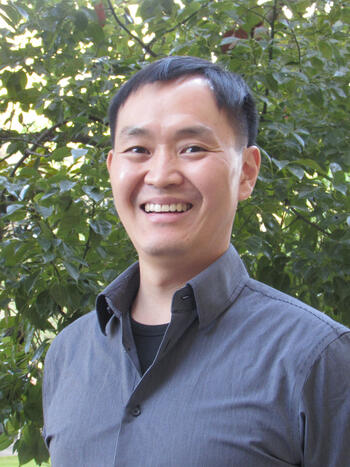
 Gaurav Kataria is a Big Data leader at Google who is responsible for driving Production Adoption initiatives across various Google for Work product lines - Gmail, Drive, G+, Hangouts, Google Docs, Drive, Android and Chrome. His group employs sophisticated machine learning and data mining techniques to understand the usage patterns across different products, and based on that creates programs to improve user engagement.

