
 FSI researchers consider international development from a variety of angles. They analyze ideas such as how public action and good governance are cornerstones of economic prosperity in Mexico and how investments in high school education will improve China’s economy.
They are looking at novel technological interventions to improve rural livelihoods, like the development implications of solar power-generated crop growing in Northern Benin.
FSI academics also assess which political processes yield better access to public services, particularly in developing countries. With a focus on health care, researchers have studied the political incentives to embrace UNICEF’s child survival efforts and how a well-run anti-alcohol policy in Russia affected mortality rates.
FSI’s work on international development also includes training the next generation of leaders through pre- and post-doctoral fellowships as well as the Draper Hills Summer Fellows Program.


LAD Course: Universidad ESAN Photo Album 2015
Related Multimedia

Presentation

Presentation

LAD Course: Universidad ESAN 2015
-
This is a four-and-a-half-day intensive program for a small number of mid- and high-level government officials and business leaders, exploring how government can encourage and enable the private sector to play a larger, more constructive role as a force for economic growth and development. The process includes small team interactions, with case studies drawn from Asia, Africa and Latin America. Major themes are 1) Industry promotion 2) Investment promotion 3) Public private partnerships in infrastructure, and 4) Access to finance.
Syllabus (English)
Download pdf
Universidad ESAN
Lima, Peru
Workshops
Honors students meet with top policy experts in DC
News Type
News
Date
Paragraphs
From September 13-19, 2015, CDDRL honors students attended the annual Honors College in Washington, D.C., gaining firsthand exposure to how the federal government, policy organizations and think tanks work to advance democracy and development around the world.
Throughout the week, students had the opportunity to learn about the government's vision for democracy at the State Department and the National Security Council. The Honors College agenda also included visits to regional organizations such as the Asia Institute, the Inter-American Dialogue and the Tahrir Institute for the Middle East Policy, where students were able to get a sense of how policy is implemented on the ground.
Scholars at the World Bank and Johns Hopkins School of Advanced International Studies provided an academic view of development, while speakers at Freedom House and the National Endowment for Democracy explain the challenges and advantages of empowering local democratic activists, particularly in countries hostile to democracy. This year, the students also had the privilege of meeting Gayle Smith, President Obama's nominee to lead the United States Agency for International Development.
CDDRL's Interdisciplinary Undergraduate Honors Program aims to provide an opportunity for eligible seniors focusing on democracy, economic development, and rule of law subjects in any university department to earn honors in democracy, development, and rule of law (DDRL). Beyond Honors College, students also meet weekly as a group and with advisors to develop their honors theses. This year's Honors College was led by Steve Stedman, director the honors program, alongside CDDRL scholars Francis Fukuyama and Larry Diamond. To view student testimonials and photos from this year's honors college, see below.
Photo Album
Student Testimonials
Image

"I had never spent a significant amount of time in D.C. before honors college. Throughout the entire week I was amazed as I realized that there is an entire city that is passionate about interests similar to mine. After meeting some influential and motivating people, I feel compelled to work in D.C. at some point in my future."
-Hannah Potter
Image

"Even though I had already spent a lot of time in D.C., spending a week there with CDDRL faculty and students showed me a side of the city I hadn't experienced before. Meeting with senior staff at think tanks, nonprofits, academic institutions and government agencies helped me understand how the academic concepts I've learned at Stanford are actually applied by people working to promote democracy and development around the world."
-Zachary Sorensen
Image

"One thing that was really amazing about Honors College was the ability to explore D.C., even beyond meeting with leaders in the fields of democracy and development. We were able to walk around and see what an interesting, historical, and hip city D.C. actually is. One morning, my roommate on the trip, Hannah Potter, and I took a run down to the Georgetown Waterfront and explored the beautiful walkway there.
-Hadley Reid
Image

"The CDDRL Honor's Program trip to Washington, D.C., was a unique opportunity to experience many different facets of policy-making and academia in the United States. From think tanks to government agencies, I was fascinated by the plethora of ways in which I can work in the realm of democracy and development."
-Hannah Meropol
To find out more about CDDRL's Interdisciplinary Undergraduate Honors Program, please click here. Applications for our 2016-2017 cohort of honors students will be due in February 2016.
Hero Image

All News button
1
Huffington Post: How Glasses Can Help Solve Rural China's Schooling Problem
News Type
News
Date
Paragraphs
Matt Sheehan
China Correspondent, The WorldPost
October 12th, 2015
Simply giving nearsighted children glasses can dramatically boost their school performance. Convincing teachers and parents is harder.
This article is the second in a What’s Working series that looks at innovative policy solutions pioneered by the Rural Education Action Program. REAP brings together researchers from Stanford University and China to devise new ways to improve rural education and alleviate poverty. You can read the first article in the series here.
QIN'AN COUNTY, China -- Wei Wentai can barely be heard over the crescendo of cackles coming from the hallway. Fourth graders everywhere cane be boisterousness, but today the presence of two foreigners, an exotic breed in the rugged hills of western China, has driven these kids into a frenzy.
You could try to reason with the children: tell them they need to quiet down because Dr. Wei is here to train their teachers in how to perform vision tests. Those tests will give some kids free glasses so they can see the blackboard, dramatically improving their grades and chances of graduating high school.
But yeah, that’d be about as effective here in rural Gansu, in China's northwest, as it would be in Alabama, and it takes the lunch bell to drag the mob away from the classroom window.
With relative peace restored, Wei continues to tutor the 12 village schoolteachers in the basics of eyesight and education. Having grown up nearby, he knows what superstitions to dispel (“No, glasses do not make your eyes worse”) and what points to drive home (“Yes, glasses dramatically improve grades for nearsighted students”). Despite receiving his medical training in Shanghai, Wei returned home after graduating and always speaks in the local dialect when training the teachers to perform this basic eye exam and write referrals.
Image

Teachers in Weng Yao village practice administering eye exams. Photo credit: Matt Sheehan
It’s a simple presentation tailored to this county, but one predicated on years of trust building and scientific trials by researchers on both sides of the Pacific Ocean.
Driving the project, called Seeing is Learning, are researchers from Stanford University’s Rural Education Action Plan (REAP) and Shaanxi Normal University’s Center for Experimental Economics in Education (CEEE). These groups operate in an emerging field of development economics that prizes rigorous experimentation over theory. Concrete interventions, randomized controlled trials and impact analysis are what drive their research and policy recommendations. Randomized controlled trials compare a randomly assigned group of participants receiving a particular treatment being studied with one not receiving the treatments. These trials are often called the gold standard of scientific research.
REAP and CEEE have spent almost five years accruing the political capital and research results that they hope will overcome one of the biggest obstacles standing between rural Chinese kids and a high school diploma: most of them can’t even see the writing on the blackboard.
Like many of their peers around East Asia, rural Chinese children suffer high rates of myopia. Around 57 percent are nearsighted by middle school, according to one REAP study. Unlike schoolchildren in Singapore or in China’s cities, most kids growing up in the Chinese countryside are ignorant of and isolated from vision care.
Image

Students line up for a vision screening organized by REAP and CEEE.
In hundreds of visits to rural Chinese classrooms, REAP program director Matt Boswell has rarely seen a bespectacled face. A patchy and inadequate rural medical system, the high cost of glasses and cultural preferences for eye exercises over glasses (what one researcher calls “voodoo health”) mean that most children growing up in townships and villages never take a vision test.
“There is no eye care at the township level in China,” said Boswell. “Period.”
That void has a huge impact on education. In a study published in the British Medical Journal, REAP and Chinese researchers showed that giving myopic kids free glasses improved their math test scores by about as much as reducing class sizes. Those improvements came despite the fact that only 41 percent of students who were prescribed glasses actually wore them regularly. According to Boswell, when results were limited to the students who actually wore the glasses they were given, the impact proved enormous: it roughly halved the achievement gap between these rural students and their urban peers in just nine months.
Image

A girl tries on her first pair of glasses at the Qi'nan County Hospital. Photo credit: Matt Sheehan
Improvements of that size represent some of the juiciest low-hanging fruit in Chinese education. Sixty percent of children in the countryside will drop out before high school, many due to failed grades and entrance exams. These tens of millions of dropouts threaten to throw a wrench in the Chinese government's plan to transition to a service- and innovation-based economy.
But when dealing with China’s bureaucracies, having a simple solution to a vexing problem isn’t enough to start harvesting that low-hanging fruit. The real art and science of the project came in aligning bureaucratic interests to get it off the ground.
“Every issue has its own little ecosystem,” Boswell said.
For Seeing is Learning, that ecosystem involved education officials committed to the eye exercise regime, schools that closely guard access to their students, families who are deeply suspicious of the effect of eyeglasses and hospitals that saw no reason to screen rural kids.
Image

Students hurry to lunch at a school in Weng Yao village. Photo credit: Matt Sheehan
To break the impasse, the researchers had to first get local education bureaucrats on board. Randomized controlled trials proved the effectiveness of glasses and debunked the myth of eye exercises. They caught the eye of a powerful official in the nearby city of Tianshui, whose backing opened the doors to local schools. With REAP’s pledge to subsidize glasses, the hospitals suddenly saw large new markets materialize.
As a kicker, one trial found that when teachers were offered an iPad if their students were wearing glasses during random inspections, usage rates jumped from 9 to 80 percent.
“Hospitals love it because they get in the schools. Principals love it because of the impact on scores,” said Boswell. “We love it because the kids are learning.”
Turning that newfound excitement into a working program required the creation of two “Model Vision Counties” in which nurses and doctors like Wei Wentai receive accelerated optometry training. In order to expand that reach from the county seat down to the village, REAP ran another trial to see if teachers could conduct accurate eye exams after just a half-day training (answer: yes). So the newly trained doctors now rotate through the village schools, training teachers who then refer students to the hospital vision centers for proper prescriptions.
Image

An elementary school teacher practices administering an eye exam during training. Photo credit: Matt Sheehan
Now the researchers are looking to scale up the program to six counties and at the same time turn the vision centers into sustainable social enterprises. Using their privileged access to schools, the vision centers can sell glasses to urban children with the resources to pay. Those profits then subsidize the first pair of glasses for rural kids, and repay REAP's initial loan, which REAP can then reinvest in creating further Model Vision Counties.
It’s a new model for REAP and one that prompts many new research questions. Can the vision centers earn enough revenue to both subsidize glasses and keep the hospitals happy? Will teachers enforce wearing eyeglasses if given a simple mandate rather than an iPad? Will the impact of the first pair of glasses convince rural parents to purchase the second pair?
Those questions will be investigated and answered when the project scales up. But as this van winds its way back down from the village to the county hospital, Wei Wentai reflects on the work they’ve done.
“I really feel like this is meaningful work,” he said. “When I hear the thank you’s from the parents, it’s really moving.”
Image

A child takes an eye exam administered by REAP and CEEE.
Hero Image

All News button
1
Catching Up, Forging Ahead, and Falling Behind in Southeast Asia: The Abramovitz Hypothesis Revisited
-
Co-sponsored by the Stanford Center for International Development
In 1986 then-Stanford professor Moses Abramovitz argued in a seminal article that all countries that are relatively backward in their levels of productivity had the potential for rapid advance, and indeed could quickly catch up with the leading economies if they could realize that potential. Their ability to catch up was to a large extent determined by their “social capability.” Although a number of European economies and Japan had narrowed the productivity gap with the USA in the post-1950 era, few low or middle income economies had managed to do this. Prof. Booth will examine the record inside Southeast Asia, where the gap in per capita GDP between Singapore and Malaysia compared with the region’s other economies has not narrowed much since 1960, and compared with some of them has actually widened. A particular puzzle concerns the Philippines, which was well ahead on most economic and social indicators in 1960 compared with Thailand and Indonesia, but fell behind over the ensuing 50+ years. Prof. Booth will explore the reasons for this.
Anne Booth has been an Asia-focused professor of economics in the School of Oriental and African Studies, University of London, since 1991. She studies the modern economic history of Southeast Asia with emphasis on the 20th century. Her many writings in this field include Colonial Legacies: Economic and Social Development in East and Southeast Asia. Her latest book, Economic Change in Modern Indonesia, is due from Cambridge University Press in April. Before coming to SOAS, she held research and teaching positions in Singapore and Australia. Her degrees are from Victoria University of Wellington (BA) and the Australian National University (PhD). Before 1991 she held research and teaching positions in Singapore and Australia. She grew up in New Zealand.Image

Anne Booth
2015-16 NUS-Stanford Lee Kong Chian Distinguished Fellow on Southeast Asia, Stanford University
Seminars
On Cruelty: Global Reflections from the Age of Revolutions to the War on Citizenship
-
This is the second meeting of the workshop series on Civility, Cruelty, Truth. A one-day event hosted by the Stanford Humanities Center, the workshop will explore the genealogies, promises, and limits of civic virtue—at the heart of which is the city, the classical polis, itself— as a universal ideal. European in its moral contours, constituted by a deep fascination with the rule of law, borders, and security, at once coercive and oblique in whom it excludes and includes, how it punishes and protects, the city held out the promise of a humane center for ethical and sovereign life, one upon which anticolonial struggles against European empires too were first conceived and mounted. This workshop will examine the ambiguous foundations and resolutions of that vision in Asia, Europe, and the fatal waters in between; a vision that has come to be marked today by extreme violence and tragic displacements, and which now presses new questions against the very limit of modern political imagination.
Faculty Organizer: Aishwary Kumar (Department of History)
Student Assistant: Ahoo Najafian (Department of Religious Studies)
Schedule (coming soon)
Co-sponsored by the Department of History, Department of Religious Studies, The Europe Center, The France- Stanford Center for interdisciplinary Studies, Program in Global Justice, McCoy Family Center for Ethics in Society, Stanford Global Studies, School of Humanities and Sciences, Stanford Humanities Center, Center for South Asia
Stanford Humanities Center
424 Santa Teresa St.
Conferences
The US is meeting a "rising India," ambassador says
News Type
News
Date
Paragraphs
The U.S.-India relationship has found new momentum in the midst of deepening strategic and economic cooperation, U.S. Ambassador to India Richard Verma told a Stanford audience on Friday.
“It’s not a hyberbole to say the relationship has soared over the past year,” Verma said to a crowded room in Encina Hall. The title of Verma’s talk was “Why India Matters.”
His visit to campus, organized by Stanford’s Walter H. Shorenstein Asia-Pacific Research Center in the Freeman Spogli Institute for International Studies, was part of a multi-day trip to the United States.
Arriving from Washington, D.C., he attended the first-ever U.S.-India Strategic and Economic Dialogue earlier that week. The meeting of Indian and American delegations was “hugely successful,” said Verma, who assumed his diplomatic post in January, following Kathleen Stephens, who is now is at Stanford as a distinguished fellow.
Verma was also in the Bay Area to accompany Prime Minister of India Narendra Modi during his visit to Silicon Valley, the first Indian head of state to visit the area since 1978. Prime Minister Modi used his visit to promote a vision of “Digital India,” tying Indian growth to the spread of information technology to all levels of Indian society, driven in part by investment from the technology industry in the United States. Leader of the Bharatiya Janata Party, Modi unseated one of the longest-serving governments in a landmark May 2014 election. He has won high public approval ratings and is one of the most followed public figures on Twitter.
Modi and President Obama have been a driving force behind the two countries’ growing alignment toward combatting global challenges, Verma told the audience. The two leaders share a “certain level of chemistry,” he said.
Obama and Modi held two summits within a four-month time period. And that, Verma said, “drives the governments to come together in a way that they might not ordinarily do.”
Verma noted the strategic overlap between the U.S. “rebalance to Asia” policy and India’s “Act East” policy, both of which commit the two countries to focus defense and economic commitments on the Asia-Pacific region. He praised rapid progress in security cooperation between the two powers, including growing sales of American defense technology to India.
On the strategic side, summit outcomes have included the creation of a joint-vision of cooperation and set up phone hotlines between the heads of state and their national security advisors.
The United States now looks upon India as a “net security provider in South Asia” and supports an increased role for India in international institutions, Verma said.
Image
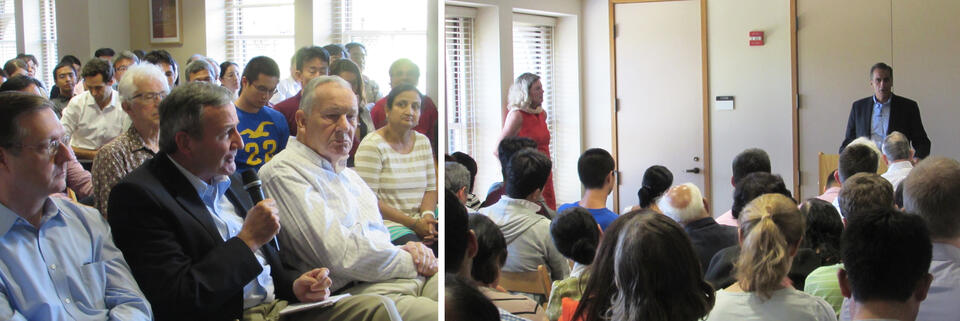
Asked about how Russia fits in, Verma acknowledged that historically there “has been a close relationship between New Delhi and Moscow. Not one or two or three years, but for decades.” But the U.S. envoy added “we don’t see that as somehow being inconsistent with a close relationship with the United States.”
On the economic side, the two leaders have committed two of the world’s largest economies to increase bilateral trade– from $100 to $500 billion – and meet for an annual economic dialogue.
Modi campaigned on a commitment to reform the economy and eradicate corruption.
However, the pace of economic reform in India has not gone as quickly as the United States would have hoped, and corruption remains an issue across India and South Asia, Verma said.
Answering a question from the audience, Verma pointed to anecdotal evidence of progress from American business in the removal of obstacles to growth from corruption. “There’s obviously a long way to go but my sense is it’s a big priority not only for the prime minister but for the people.”
Although India is modernizing, it still has a number of big-ticket development issues to tackle. Today, 300 million people don’t have access to electricity. And with over 1.2 billion people, India’s size makes it near impossible to implement sweeping change in a short period of time.
The scale of India, alone, motivates the United States to work with India, a nation that will play a “consequential role for decades to come,” Verma said. “When these two countries come together they can have a big impact on peace and prosperity across the world.”
Assessing the relationship potential for the longer-term, Verma said India and the United States’ are rooted in similar values and share diaspora communities. Support for a close U.S.-India relationship is widely expressed in the Congress, from both parties and the Ambassador anticipates the coming U.S. election will not bring any change in that commitment.
A growing number of Americans are choosing to study in India and a similar pattern is being seen in Indians coming to study in the United States. Last year, about 130,000 Indian students studied in the United States. In 2005, that number was only 30,000.
“Fundamentally, I’m optimistic because the people-to-people relationship is so strong,” Verma said.
Hero Image

All News button
1
Taiwan’s Evolving Position on the South China Sea—and Why It Matters
-
Taiwan’s claims in the South China Sea are often regarded as virtually indistinguishable from China’s. On paper, Taiwan and China appear to be making substantially the same claims and the controversial U-shaped dashed line may be found on ROC and PRC maps alike. Neither government has officially clarified the dashed line’s meaning or assigned its coordinates.
Dr Kuok, however, argues that Taiwan has in the past year taken small but significant steps toward clarifying its claims. It has also adopted a more conciliatory approach best illustrated by President Ma’s official launch of a South China Sea Peace Initiative in May 2015. These moves imply possible daylight between Taiwan and China regarding the South China Sea. Dr. Kuok will examine these developments, as well as the costs, benefits, and chances of widening or narrowing that daylight in the larger context of Taipei-Beijing relations, domestic considerations including the January 2016 election in Taiwan, and the responses of other actors in the region.
Lynn Kuok’s latest publication is Tides of Change: Taiwan’s Evolving Position in the South China Sea (2015). She was recently a senior visiting fellow at the Centre for International Law (Singapore), and has held fellowships at the Harvard Kennedy School and the Center for Strategic and International Studies. Her research interests include ethnic and religious relations and nationalism in Southeast Asia and the politics and security of the Asia-Pacific region. She has served as editor-in-chief of the Cambridge Review of International Affairs and the Singapore Law Review. She holds degrees from the University of Cambridge (PhD), the Fletcher School of Law and Diplomacy (MALD), and the National University of Singapore (LLB).Image

Lynn Kuok
Center for East Asia Policy Studies, Brookings Institution
Seminars
Masahiko Aoki Memorial Conference
-
The Shorenstein Asia-Pacific Research Center (APARC) Japan Program with the Freeman Spogli Institute of International Studies (FSI) as well as the Stanford Graduate School of Business, the Stanford Institute for Economic Policy Research (SIEPR), and the Stanford Department of Economics will be hosting a memorial conference and service on December 4th and 5th in honor of the late Masahiko Aoki. December 4th will be a full day conference featuring topics within Masa's extensive field of study and research including theoretical and applied economics, theory of institutions, corporate architecture and governance, and the Japanese and Chinese economies. The day will culminate with a cocktail reception. The Celebration of Life on December 5th will be a gathering for family and friends in remembrance of Masa with a light lunch reception to follow.
December 4, 2015
Memorial Conference
Bechtel Conference Center, 616 Serra Street
Stanford University
Agenda
8:30am - 8:50am Breakfast & Registration
8:50am - 9:00am Welcome Remarks: Takeo Hoshi (Stanford University)
9:00am - 9:30am Kenneth Arrow (Stanford University), “The Role of Organizational Structure in the Economy”
9:30am - 10:00am Paul Milgrom (Stanford University), "Designing the US Incentive Auction"
10:00am - 10:30am Break
10:30am - 11:00am Koichi Hamada, Yale University, “Masahiko Aoki: A Social Scientist"
11:00am - 11:30am Kotaro Suzumura (Hitotsubashi University), “Masahiko Aoki (1938-2015): Recollections of his Pilgrimage and Legacy in Japan”
11:30am - 12:00pm Yingyi Qian (Tsinghua University), "Masahiko Aoki and China"
12:00pm - 1:15pm Lunch
1:15pm - 1:45pm Jiahua Che (Chinese University of Hong Kong) presenting Masahiko Aoki's
"Three-person game of institutional resilience vc transition: A model and
China-Japan comparative history"
1:45pm - 2:15pm Miguel Angel Garcia Cestona (Universitat Autonoma de Barcelona), "Corporate Governance and Employee Participation: some lessons from Mondragon"
2:15pm - 2:45pm Herbert Gintis (Santa Fe Institute), "General Social Equilibrium and its Dynamics"
2:45pm - 3:15pm Break
3:15pm - 3:45pm Dale Jorgenson (Harvard University), "
3:45pm - 4:15pm Avner Greif (Stanford University), "Comparative Institutional Analysis: China and Europe Compared"
4:15pm - 4:45pm Francis Fukuyama (Stanford University), "Asian Kinship, Industrial Structure, and Trust in Government"
4:45pm - 5:00pm Closing, Takeo Hoshi (Stanford University)
5:00pm - 6:00pm Cocktail Reception
*Agenda is subject to change and will be updated as speakers are confirmed
December 5, 2015
Celebration of Life
Bechtel Conference Center, 616 Serra Street
Stanford University
Agenda
10:30am - 11:00am Registration
11:00am - 12:00pm Celebration of Life
12:00pm - 1:30pm Lunch Reception
Bechtel Conference Center616 Serra StreetStanford UniversityStanford, CA 94305
Conferences