FSI researchers consider international development from a variety of angles. They analyze ideas such as how public action and good governance are cornerstones of economic prosperity in Mexico and how investments in high school education will improve China’s economy.
They are looking at novel technological interventions to improve rural livelihoods, like the development implications of solar power-generated crop growing in Northern Benin.
FSI academics also assess which political processes yield better access to public services, particularly in developing countries. With a focus on health care, researchers have studied the political incentives to embrace UNICEF’s child survival efforts and how a well-run anti-alcohol policy in Russia affected mortality rates.
FSI’s work on international development also includes training the next generation of leaders through pre- and post-doctoral fellowships as well as the Draper Hills Summer Fellows Program.
The event is jointly sponsored by the Japan Program at the Shorenstein Asia-Pacific Research Center and the Japan Foundation Center for Global Partnership.
Japan is one of the world’s most prominent military space powers around. With the inescapable ambiguity of dual-use, Japan has acquired its impressive capabilities in full view of a pacifist public and under constitutional constraints. At this stage, as the country races to keep abreast of the latest space technology trends, its national security trajectories are openly and officially sanctioned in both law and policy. These realities are not well understood by Japan’s allies or rivals, which limits our appreciation about where Japan is headed in its own national interest in the region, the world, and beyond.
Image
Saadia M. Pekkanen works on outer space security, law, and policy. Her regional expertise is in the international relations of Japan/Asia. She earned Master’s degrees from Columbia University and Yale Law School, and a doctorate from Harvard University in political science. She holds the Job and Gertrud Tamaki Professorship at the University of Washington (UW). She has published a half-dozen books on space technology and geopolitics, and is working now on The Age of Newspace. She serves as Co-Chair of the U.S. Japan Space Forum, directs both the Space Security Initiative (SSI) and the project on Emerging Frontiers in Space at UW, and is the founding co-director of the Space Policy and Research Center (SPARC) at UW. She is passionate about contributing to the educational ecosystem for fostering the space sector through bridge-the-gap activities, and is a member of the Washington State Space Coalition (WSSC). She is also a contributor for Forbes on the space industry (https://www.forbes.com/sites/saadiampekkanen/#5897783f7d3f).
Saadia Pekkanen, Professor, University of Washington
The event is jointly sponsored by the Japan Program at the Shorenstein Asia-Pacific Research Center and the Japan Foundation Center for Global Partnership.
Since Frey and Osborne showed that 47% of US job would be substituted by AI, the penetration of AI into labor markets has been discussed in every country. In Japan, Benjamin David estimates 55% of jobs will vanish by the introduction of AI. However, these estimates are based only on the technological upper bound. We have to condifer of the economic mechanism behind it, especially the specificity of Japanese labor markets. In this seminar, I will summrize the characteristics of Japanese labor markets from the view point of task distribution, which reflects the technological aspect of them. Then, comparing with US data, I will discuss the role of economic institutions/circumstances and the future direction.
Image
Ryo Kambayashi is a Professor at Institute of Economic Research, Hitotsubashi University in Japan. His field of research include labor economics, Japanese economy, economic history, and law and economics. Based on the methodology of standard labor economics, Kambayashi's research interest is centered on the empirical investigations on the economic mechanism of current Japanese labor markets. Through several papers on wage and employment, he has found that the current transition of Japanese labor markets since 1990s has two aspects; that is, the changing part where so called non-standard workers have rapidly increased and the unchanged part where so called Japanese Employment System remains firmly. This disparity in labor markets does not come from the legal assignment surrounding the labor markets but from a spontaneous evolution, just because the Japanese Labor Law has strongly respected the mutual agreement between workers and employer which can officially create exemptions from legal regulations. Then, I am expanding my research agenda into the associations of labor markets with other parts of Japanese economy, such as trade, productivity, self-employment, to understand the whole of Japanese society. I am also gradually expanding the research into historical developments of institutions to find the evidence of spontaneous evolution of labor market institutions, e.g. the network of public employment agency was constructed by absorbing those of private agencies. Kambayashi holds a PhD, an MA, and a BA in economics, all from University of Tokyo.
Ryo Kambayashi, Professor, Institute of Economic Research, Hitotsubashi University
Please join us for a special screening of 'FOOD EVOLUTION' with a panel discussion where the film's director Scott Hamilton Kennedy and Stanford experts in the field of food security will discuss what "GMO" and "organic" mean for the health of your family and the environment. Pamela Ronald, coauthor of the book Tomorrow’s Table: Organic Farming, Genetics and the Future of Food which helped inspire the movie will also be hosting a book signing during the reception following the event.
Amidst a brutally polarized debate marked by passion, suspicion and confusion, FOOD EVOLUTION, by Academy Award®-nominated director Scott Hamilton Kennedy (The Garden, Fame High, OT: Our Town), explores the controversy surrounding GMOs and food. Traveling from Hawaiian papaya groves, to banana farms in Uganda to the cornfields of Iowa, the film, narrated by esteemed science communicator Neil deGrasse Tyson, wrestles with the emotions and the science driving one of the most heated arguments of our time.
In the GMO debate, both pro and anti camps claim science is on their side. Who’s right? FOOD EVOLUTION shows how easily misinformation, confusion and fear can overwhelm objective analysis. How do we ensure that our food supply is safe, and that everyone has enough to eat? How do we feed the world while also protecting the planet? Has genetic engineering increased or decreased pesticide use? Are GMO foods bad for your health? And, most importantly, what data, evidence and sources are we using to approach these important questions?
While the passionate advocates in the film are all concerned with the stewardship of safe, nutritious food for the planet, their differing views over what constitutes the truth have pit them against each other, rendering the very subject of food itself into an ideological battleground.
Enlisting experts such as Mark Lynas, Michael Pollan, Alison Van Eenennaam, Jeffrey Smith, Andrew Kimbrell, Vandana Shiva, Robert Fraley, Marion Nestle and Bill Nye, as well as farmers and scientists from around the world, this bold and necessary documentary separates the hype and emotion from the science and data to unravel the debate around food, and help audiences reach their own conclusions. In a debate in which all sides claim to be on the side of science, FOOD EVOLUTION brings a fresh perspective to one of the most critical issues facing global society today.
PANEL
Scott Hamilton Kennedy, FOOD EVOLUTION Director/Academy Award® nominee, writer, director, producer, cameraman, and editor
Ertharin Cousin, Payne Distinguished Lecturer, Freeman Spogli Institute for International Studies/Visiting Fellow, Center on Food Security and the Environment/Distinguished Fellow of Global Agriculture, Chicago Council on Global Affairs/Former Executive Director, World Food Programme
Pamela Ronald, Visiting Professor, Center on Food Security and the Environment/Distinguished Professor, Plant Pathology and the Genome Center, UC Davis/ Director, UC Davis Institute for Food and Agricultural Literacy/co-author “Tomorrow’s Table: Organic Farming, Genetics and the Future of Food"
MODERATOR
Rosamond Naylor, Gloria and Richard Kushel Director of the Center on Food Security and the Environment, William Wrigley Professor of Earth System Science, Senior Fellow, Stanford Woods Institute and Freeman Spogli Institute for International Studies
The event is jointly sponsored by the Japan Program at the Shorenstein Asia-Pacific Research Center and the Japan Foundation Center for Global Partnership.
Image
Through previously unexamined data from Japan, Professor Robert Dekle presents results from a preliminary study shoing the impact of robotics on Japanese labor between 1980 and 2012.
Robert Dekle is a Professor at the Department of Economics, University of Southern California. His field of research include international finance, open-economy and development, macroeconomics and the economies of Japan and East Asia. He obtained his Ph.D in economics at Yale University and B.A in economics at the University of California, Berkeley.
Robert Dekle, Professor of Economics, University of Southern California
The rise of Nokia as a global ICT leader in the 1990s and early 2000s was dramatic, as a company from the small Nordic country of Finland became a global titan. The lack of Japanese presence in global ICT industries in the 1990s and 2000s was unexpected, as it was a technological and platform leader in its domestic market but without followers in global markets. The advent of the iPhone and Android from Silicon Valley companies in the late 2000s thoroughly disrupted both Nokia and the Japanese companies. What happened? Why did it happen, and what were the lessons learned? Now, with the dominance and concentration of Silicon Valley companies and the rise of China in new areas such as AI and digital services, how do we understand the dynamics of competition unfolding? What general conclusions can we draw about the possibilities and risks of national strategies from the past experiences?
This panel brings expertise from China, Europe, Japan, and Silicon Valley to discuss these questions.
This event is brought to you by Shorenstein APARC Japan Program's Stanford Silicon Valley-New Japan Project in collaboration with the Berkeley Roundtable on the International Economy (BRIE)
AGENDA
Moderator and panelist: John Zysman, Co-founder, Berkeley Roundtable on the International Economy. Author of “The Third Globalization: Can Wealth Countries Stay Rich.”
3:00pm-3:05pm Introduction & Opening Remarks
3:05pm-3:35pm The rise and fall of Nokia as a global mobile leader, a management perspective
Presenter: Yves Doz, Solvay Chaired Professor of Technological Innovation, INSEAD. Author of “Ringtone: Exploring the Rise and Fall of Nokia in Mobile Phones” (2018)
3:35pm-4:05pm How Silicon Valley commoditized the global ICT industry. Japan: leading without followers, then disrupted, a political economy perspective
Presenter: Kenji Kushida, Research Scholar, Stanford University. Author of “The politics of commoditization in global ICT industries: a political economy explanation of the rise of Apple, Google, and industry disruptors” (2015)
4:05pm-4:35pm AI and Global Dynamic Capabilities: The Implications for China and the United States.
· The Chinese Case: Can China avoid the Finnish and Japanese fate? Will the scale of the Chinese market permit it to develop global standards? Will the geo-political rivalry change the dynamic of the market rivalries.
· The American case: Will the American platform strengths hold in in the face of Chinese challenges? Will Europe?
Presenters: Amy Shuen, Visiting Professor, Hong Kong University (formerly at UC Berkeley, Wharton, CEIBS). Co-author, Dynamic Capabilities and Strategic Management (SMJ, Best Paper Award, 2003) Author, “Web 2.0: A Strategy Guide” (OReilly, 2008) HKU Talk (2017) https://www.ecom-icom.hku.hk/Contents/Item/Display/1962
John Zysman, Co-founder, Berkeley Roundtable on the International Economy. Author of “The Third Globalization:Can Wealth Countries Stay Rich.”
In 1973, the roots of the Stanford Program on International and Cross-Cultural Education (SPICE) were established with the creation of the Bay Area China Education Program, which focused on the development of K–12 curriculum materials and teacher professional development. Only a year prior, President Richard Nixon had made his historic trip to China and many American students were able to view contemporary images of China on television for the first time in their lifetimes. Teachers who attended SPICE institutes on China in the 1970s often commented that they were at a loss about how to teach about China.
Forty-four years later, a new generation of educators expressed similar sentiments at a SPICE institute. However, the challenge wasn’t so much about the teaching of China but rather the teaching of North Korea. Thus, when Pulitzer Prize-winning author Adam Johnson spoke about his book, The Orphan Master’s Son, a New York Times bestselling novel about North Korea, teachers were riveted by his comments. Teachers were interested not only in ways that his novel could help them better understand contemporary North Korea but also in ways they could use the book to help their students gain a more balanced view of North Korea. The 22 teacher participants received copies of The Orphan Master’s Son to use in their teaching and were offered two SPICE curriculum units titled Inter-Korean Relations: Rivalry, Reconciliation, and Reunification and Uncovering North Korea.
Co-sponsored by the National Consortium for Teaching about Asia (NCTA), the SPICE summer institute, July 24–26, 2017, had the objectives of (1) deepening teachers’ understanding of Asia, U.S.–Asian relations, and the Asian-American experience; (2) providing teachers with teaching resources; and (3) creating a community of learners. The institute featured lectures by Stanford faculty (like Johnson), U.C. Berkeley faculty, and other experts on a range of Asia- and Asian-American-related topics closely aligned with the History-Social Science Framework for California Public Schools standards, which were recently revised. Interactive curriculum demonstrations by SPICE staff were also offered.
One such standard focuses on recent economic growth in China. Following a lecture by Thomas Fingar, Shorenstein Asia Pacific Research Center Fellow, on “Recurring Themes in U.S.–China Relations,” a curriculum demonstration on the SPICE curriculum unit, China in Transition: Economic Development, Migration, and Education, was offered by its author, Rylan Sekiguchi of SPICE. One teacher remarked, “I teach about China, and it was so helpful to hear someone with such deep expertise [Fingar] speak about U.S.–Chinese history in a way that enriches my knowledge and understanding to bring back some bigger themes to my teaching. I can’t wait to bring this content back to my students [through the SPICE curriculum].” Other scholarly lectures on Japan and Korea were also followed by curriculum demonstrations by SPICE staff. This coupling of lectures and curriculum demonstrations has been a hallmark of SPICE since its inception.
Updated History-Social Science Framework standards on the Asian-American experience were also addressed at the institute. Dr. Khatharya Um, Associate Professor of Ethnic Studies at the University of California at Berkeley, introduced the diverse cultural and historical backgrounds of the Asian-American student population which often comprises a significant percentage of students in schools in areas like the San Francisco Bay Area and Los Angeles. She emphasized the importance of acknowledging individual circumstances in minority student populations and breaking down commonly cited stereotypes of Asian Americans as being a critical element of effective teaching. One of the topics that she addressed was stereotypes of Japanese Americans that arose following the Japanese attack of Pearl Harbor. Her lecture was coupled with the sharing of first-hand experiences by Dr. Joseph Yasutake, who was interned at the age of nine. Dr. Yasutake’s talk stimulated discussions on civil liberties, race relations, discrimination, and American identity among the teachers. “Hearing history from one who has experienced it as well as studied and taught the history is really wonderful,” said one institute participant. “This combination brings a great amount of authority and well as authenticity to the narrative he [Yasutake] provides.” The SPICE curriculum unit, Civil Rights and Japanese-American Internment, was recommended as a resource for teachers.
The institute brought together both experienced mentor teachers and those new to the field. Naomi Funahashi, who organized and facilitated the institute, remains in communication with many of the teachers and has noticed that a community of learners, who are committed to a long-term exploration of Asian and Asian-American studies, has grown from the institute. She reflected, “One of the unexpected outcomes of the institute was the recommendations that many of the teachers have written in support of their students’ applications to my online class on Japan called the Reischauer Scholar Program. My hope is that some of my students will someday attend SPICE institutes as teachers and that SPICE institutes will continue to serve teachers as they have since 1973 for many decades to come.”
"Although peace was the prevailing theme of the opening night at the Pyeongchang Winter Olympics, the air in the VIP box was charged with awkwardness and intimidation," said researchers at the Shorenstein Asia-Pacific Research Center in a recently published article. "The real test for Moon's leadership begins now."
The full article in East Asia Forum is available here.
The Stanford Center for Innovation in Global Health invites you to a private screening of The New Barbarianism followed by a panel discussion with the film's executive producer and director Stephen Morrison, co-director and writer Justin Kenny and Stanford scholars Michele Barry, Paul Wise and Ertharin Cousin.
The New Barbarianism is a highly acclaimed CSIS Global Health Policy Center original feature documentary (58 minutes) that examines the crisis, its causes, the limited international response and possible ways forward through dozens of interviews and original footage obtained from inside Syria, Yemen and Afghanistan. It builds on several years of prior work on the intersection of health and security, the role of militaries, and the human tragedies seen in Syria and Yemen.
6:30pm Doors Open | 7pm Screening | 8pm Panel Discussion
Cubberley Auditorium 485 Lasuen Mall Stanford, CA 94305
Richard E. Behrman Professor of Child Health and Society
Senior Fellow, Freeman Spogli Institute for International Studies
rsd15_081_0253a.jpg
MD, MPH
Dr. Paul Wise is dedicated to bridging the fields of child health equity, public policy, and international security studies. He is the Richard E. Behrman Professor of Child Health and Society and Professor of Pediatrics, Division of Neonatology and Developmental Medicine, and Health Policy at Stanford University.He is also co-Director, Stanford Center for Prematurity Research and a Senior Fellow in the Center on Democracy, Development, and the Rule of Law, and the Center for International Security and Cooperation, Freeman Spogli Institute for International Studies, Stanford University. Wise is a fellow of the American Academy of Arts and Sciences and has been working as the Juvenile Care Monitor for the U.S. Federal Court overseeing the treatment of migrant children in U.S. border detention facilities.
Wise received his A.B. degree summa cum laude in Latin American Studies and his M.D. degree from Cornell University, a Master of Public Health degree from the Harvard School of Public Health and did his pediatric training at the Children’s Hospital in Boston.His former positions include Director of Emergency and Primary Care Services at Boston Children’s Hospital, Director of the Harvard Institute for Reproductive and Child Health, Vice-Chief of the Division of Social Medicine and Health Inequalities at the Brigham and Women’s Hospital and Harvard Medical School and was the founding Director or the Center for Policy, Outcomes and Prevention, Stanford University School of Medicine.He has served in a variety of professional and consultative roles, including Special Assistant to the U.S. Surgeon General, Chair of the Steering Committee of the NIH Global Network for Women’s and Children’s Health Research, Chair of the Strategic Planning Task Force of the Secretary’s Committee on Genetics, Health and Society, a member of the Advisory Council of the National Institute of Child Health and Human Development, NIH, and the Health and Human Secretary’s Advisory Committee on Infant and Maternal Mortality.
Wise’s most recent U.S.-focused work has addressed disparities in birth outcomes, regionalized specialty care for children, and Medicaid. His international work has focused on women’s and child health in violent and politically complex environments, including Ukraine, Gaza, Central America, Venezuela, and children in detention on the U.S.-Mexico border.
Core Faculty, Center on Democracy, Development and the Rule of Law
Affiliated faculty at the Center for International Security and Cooperation
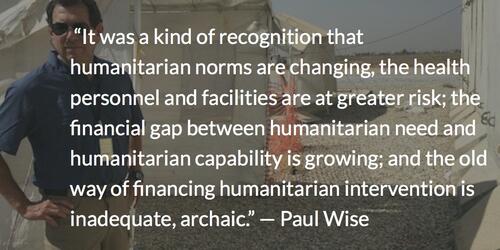
Stanford Health Policy's Paul Wise — the Richard E. Behrman Professor of Child Health and Society — traveled to Iraq last year with a small delegation of physician-academics to evaluate the World Health Organization's system to treat civilians injured in the battle for Mosul. The northern city controlled by the Islamic State in 2014 was retaken by government forces last year and the team visited field hospitals to review health care on the ground and determine whether there is a better way to distribute medical aid during armed conflict.
The Lancet also has published an editorial about their research to coincide with the release of the report.
"The Battle of Mosul provides an important case study for what might be to come," the editorial board wrote. "Above all, this should be a very rare occurrence, and The Lancet echoes the evaluation's recommendation that governments, and possibly their allies, must ensure their militaries can fulfill the obligations of protection and care for wounded citizens under the Geneva Conventions. However, in modern warfare, access to the injured may increasingly be one-sided when fighting against warring factions that see health workers and civilians as acceptable targets of war. Governments should be prepared to face this eventuality. To be able to continue providing the best standards of care and saving lives, a high-level meeting must urgently be organized to examine and answer this question: are the humanitarian principles as they are defined today still relevant for this changing warfare?"
Some of the key findings of the report include:
Between 1500-1800 lives, both military and civilian, may have been saved through this trauma response.
By attempting to apply Western military standards of trauma care and ‘moving forward’ towards the frontline to save civilians lives, WHO and its partners challenged existing humanitarian principles, particularly those of neutrality and independence.
The Iraqi government and its military did not have medical capacity to fulfill their obligations to protect and care for wounded civilians on the Mosul battlefield, and the U.S.-led coalition did not provide substantial medical care for wounded civilians.
WHO-supported field hospitals filled important gaps in trauma surgical care, while post-operative and rehabilitative care warranted greater support.
Successful coordination among local leaders, partners, and civilian and military officials occurred, but field coordination could have been better resourced.
Image
And some of the key recommendations:
Warring factions, and those supporting them, need to enhance the former’s medical capacities to ensure they can fulfill their obligations under the Geneva Conventions and Additional Protocols.
Deliberation is needed regarding the benefits to and the moral obligations of governments who support such warring factions, like the U.S.-led coalition in the Mosul battle.
Humanitarians must take care to avoid being instrumentalized by governments or military in future conflicts.
Medical teams operating directly with a combatant force should not be identified as humanitarian;
Frontline medical services could be provided by specialized groups explicitly trained to work directly with combatant forces, possibly contracted as military support services focusing on providing frontline medical services for both injured soldiers and civilians.
Using private medical organizations (i.e., contractors) to provide humanitarian services in conflict settings needs further study.
How humanitarian actors can apply standards of trauma care that compel them to move towards the frontline to save lives, and still adhere to longstanding humanitarian principles, needs debate at senior levels such as at the Inter Agency Standing Committee or at the intergovernmental level.
Co-sponsored by the Southeast Asia Program and the Abbasi Program in Islamic Studies
Transnational Islam lacks the centralized leadership and institutions associated with Catholicism. Yet hierarchical and authoritative bodies do make decisions regarding Islam in various contemporary settings, including within the institutional frameworks of states. What happens when Muslim faith and practice are adapted to the terms and procedures of bureaucracy and the modern nation-state?
Dr. Müller will present an original conceptual framework for studying the bureaucratization of Islam. He will apply it to five Southeast Asian cases—Brunei, Indonesia, Malaysia, the Philippines, and Singapore. State bureaucracies in these countries vary widely, but generally they aim to influence or control trends and meanings in local Islamic discourse. Drawing on current debates in the anthropology of the state, with particular reference to Brunei and Singapore, Müller will offer an original analytic framework to explain similarities and differences in bureaucratized Islam in Southeast Asia. Possible implications beyond the region will also be explored.
Dominik Müller
Image
heads the Max Planck Institute for Social Anthropology’s Research Group on the Bureaucratization of Islam and Its Socio-Legal Dimensions in Southeast Asia. He is also a non-resident fellow in the Centre for Asian Legal Studies at the National University of Singapore (NUS). Prior positions include visitorships at NUS (2016), the University of Oxford (2015), the University of Brunei Darussalam (2014), and Stanford University (APARC, 2013). His doctorate in anthropology is from Goethe University Frankfurt (2012).His latest publication is an article on “Hybrid Pathways to Orthodoxy” in Brunei in the April-May 2018 Journal of Current Southeast Asian Affairs, a special issue on bureaucratized Islam that he also guest-edited.
Shorenstein APARC
Stanford University
Encina Hall, Room C331
Stanford, CA 94305-6055
(650) 724-5656
(650) 723-6530
0
dominikm@stanford.edu
Visiting Scholar
MullerDominik.jpg
PhD
Dominik Müller joins the Walter H. Shorenstein Asia-Pacific Research Center (Shorenstein APARC) from February until May 2013 from the Department of Anthropology at Goethe-University Frankfurt where he serves as a postdoctoral research associate.
His research interests encompass Islam and popular culture in contemporary Southeast Asia, Malaysian domestic politics, and socio-legal change in the Malay world.
During his time at the Shorenstein APARC, Müller will conduct research on the religious bureaucracy of Malaysia. His research project at Stanford is funded by the German Academic Exchange Service (DAAD).
Müller obtained his PhD summa cum laude in 2012 in cultural anthropology from the Cluster of Excellence the “Formation of Normative Orders” at Frankfurt University. He previously studied anthropology, philosophy, and law in Frankfurt and at Leiden University. His dissertation on Islam, Politics, and Youth in Malaysia received the Frobenius Society’s Research Award 2012 and will be published in 2013.
Visiting Fellow, Islamic Legal Studies Program on Law and Social Change, Harvard University

 FSI researchers consider international development from a variety of angles. They analyze ideas such as how public action and good governance are cornerstones of economic prosperity in Mexico and how investments in high school education will improve China’s economy.