International Development

FSI researchers consider international development from a variety of angles. They analyze ideas such as how public action and good governance are cornerstones of economic prosperity in Mexico and how investments in high school education will improve China’s economy.

They are looking at novel technological interventions to improve rural livelihoods, like the development implications of solar power-generated crop growing in Northern Benin.

FSI academics also assess which political processes yield better access to public services, particularly in developing countries. With a focus on health care, researchers have studied the political incentives to embrace UNICEF’s child survival efforts and how a well-run anti-alcohol policy in Russia affected mortality rates.

FSI’s work on international development also includes training the next generation of leaders through pre- and post-doctoral fellowships as well as the Draper Hills Summer Fellows Program.

-

Image
Digital Trade Wars

Please join the Cyber Policy Center, Wednesday, October 21, from 10 a.m. –11 a.m. pacific time, with host Marietje Schaake, International Policy Director of the Cyber Policy Center, in conversation with Dmitry Grozoubinski, founder of ExplainTrade.com, and visiting professor at University of Strathclyde, along with Anu Bradford, Henry L. Moses Professor of Law and International Organizations at Columbia Law School and author of How the European Union Rules the World, for a discussion and exploration of the digital trade war. 

This event is free and open to the public, but registration is required.


0
marietje.schaake

Marietje Schaake is a non-resident Fellow at Stanford’s Cyber Policy Center and at the Institute for Human-Centered AI. She is a columnist for the Financial Times and serves on a number of not-for-profit Boards as well as the UN's High Level Advisory Body on AI. Between 2009-2019 she served as a Member of European Parliament where she worked on trade-, foreign- and tech policy. She is the author of The Tech Coup.


Non-Resident Fellow, Cyber Policy Center
Fellow, Institute for Human-Centered Artificial Intelligence
Date Label
Marietje Schaake
Anu Bradford
Dmitry Grozoubinski
Panel Discussions
-

* Please note all CISAC events are scheduled using the Pacific Time Zone.


Seminar Recording: https://youtu.be/VJgMJyNz3F4


About the Event: Join David Sanger, National Security Correspondent for the New York Times, Amy Zegart, Senior Fellow at the Freeman Spogli Institute of International Studies, Monica M. Ruiz, Program Fellow for the Cyber Initiative and Special Projects at the William and Flora Hewlett Foundation, Alex Stamos, Adjunct Professor at the Freeman Spogli Institute of International Studies, Michael McFaul, Director at the Freeman Spogli Institute for International Studies, and Herb Lin, Senior Research Scholar at the Center for International Security and Cooperation, for a panel discussion of The Perfect Weapon, an HBO documentary special based on the best-selling book by New York Times national security correspondent David E. Sanger, which is now available to stream on HBO Max. Directed by John Maggio, the film explores the rise of cyber conflict as a primary way in which nations now compete with and sabotage one another. Cheap, invisible and devastatingly effective, cyber weapons are the present and future of geopolitical conflict – a short-of-war pathway to exercising power. The Perfect Weapon draws on interviews with top military, intelligence and political officials for a comprehensive view of a world of new vulnerabilities, particularly as fear mounts over how cyberattacks and influence operations may affect the 2020 U.S. election, vulnerable power grids, America’s nuclear weapons arsenal, and the global networks that are the backbone of private enterprise. The film also explores how the U.S. government is struggling to defend itself from cyberattacks while simultaneously stockpiling and using the world's most powerful offensive cyber arsenal.

Watch the film trailer HERE.


About the Speakers: 

Dr. Herb Lin is senior research scholar for cyber policy and security at the Center for International Security and Cooperation and Hank J. Holland Fellow in Cyber Policy and Security at the Hoover Institution, both at Stanford University.  His research interests relate broadly to policy-related dimensions of cybersecurity and cyberspace, and he is particularly interested in the use of offensive operations in cyberspace as instruments of national policy and in the security dimensions of information warfare and influence operations on national security.  In addition to his positions at Stanford University, he is Chief Scientist, Emeritus for the Computer Science and Telecommunications Board, National Research Council (NRC) of the National Academies, where he served from 1990 through 2014 as study director of major projects on public policy and information technology, and Adjunct Senior Research Scholar and Senior Fellow in Cybersecurity (not in residence) at the Saltzman Institute for War and Peace Studies in the School for International and Public Affairs at Columbia University; and a member of the Science and Security Board of the Bulletin of Atomic Scientists. In 2016, he served on President Obama’s Commission on Enhancing National Cybersecurity.  Prior to his NRC service, he was a professional staff member and staff scientist for the House Armed Services Committee (1986-1990), where his portfolio included defense policy and arms control issues. He received his doctorate in physics from MIT.


Dr. Michael McFaul is Director at the Freeman Spogli Institute for International Studies, the Ken Olivier and Angela Nomellini Professor of International Studies in the Department of Political Science, and the Peter and Helen Bing Senior Fellow at the Hoover Institution. He joined the Stanford faculty in 1995.

Dr. McFaul also is as an International Affairs Analyst for NBC News and a columnist for The Washington Post. He served for five years in the Obama administration, first as Special Assistant to the President and Senior Director for Russian and Eurasian Affairs at the National Security Council at the White House (2009-2012), and then as U.S. Ambassador to the Russian Federation (2012-2014). Continue Reading >>>


Monica M. Ruiz is the Program Fellow for the Cyber Initiative and Special Projects at the William and Flora Hewlett Foundation. In her work on the Cyber Initiative, she supports efforts to build a more robust cybersecurity field and improve policy-making. She also manages the foundation’s portfolio of Special Projects grants, part of a pool of flexible funds that allow the foundation to respond to unanticipated opportunities, explore potential initiatives, collaborate with other funders and facilitate cross-pollinating work across the foundation’s programs.

Prior to joining the foundation, Monica was the first recipient of the Boren Fellowship to travel to Estonia, where her research focused on cybersecurity issues and she studied the Russian language. Earlier in her career, she worked at U.S. Southern Command in the J9 Partnering Directorate, where she served as the military education coordinator between the Command and partners in the region.

Born in Ecuador and raised in Miami, she holds a bachelor’s degree from Florida International University and a master’s degree from The Fletcher School of Law and Diplomacy at Tufts University.


David E. Sanger is a national security correspondent and  senior writer for the New York Times, a contributor to CNN and an adjunct lecturer at the Kennedy School of Government. In a 38-year reporting career for The Times, he has been on three teams that have won Pulitzer Prizes, most recently in 2017 for international reporting. His latest book, “The Perfect Weapon: War, Sabotage and Fear in the Cyber Age,’’ published in 2018, examined the emergence of cyberconflict as the primary way large and small states are competing and undercutting each other, changing the nature of global power. An HBO documentary based on the book will air in the Fall of 2020.

He is also the author of two Times best sellers on foreign policy and national security: “The Inheritance: The World Obama Confronts and the Challenges to American Power,” published in 2009, and “Confront and Conceal: Obama’s Secret Wars and Surprising Use of American Power,” published in 2012. For The Times, Mr. Sanger has served as Tokyo bureau chief, Washington economic correspondent, White House correspondent during the Clinton and Bush administrations, and chief Washington correspondent. He co-teaches “Central Challenges in American National Security, Strategy and the Press” at Harvard.


Alex Stamos is a cybersecurity expert, business leader and entrepreneur working to improve the security and safety of the Internet through his teaching and research at Stanford University. Stamos is an Adjunct Professor at Stanford’s Freeman-Spogli Institute and a visiting scholar at the Hoover Institution.

Prior to joining Stanford, Alex served as the Chief Security Officer of Facebook. In this role, Stamos led a team of engineers, researchers, investigators and analysts charged with understanding and mitigating information security risks to the company and safety risks to the 2.5 billion people on Facebook, Instagram and WhatsApp. During his time at Facebook, he led the company’s investigation into manipulation of the 2016 US election and helped pioneer several successful protections against these new classes of abuse. As a senior executive, Alex represented Facebook and Silicon Valley to regulators, lawmakers and civil society on six continents, and has served as a bridge between the interests of the Internet policy community and the complicated reality of platforms operating at billion-user scale. In April 2017, he co-authored “Information Operations and Facebook”, a highly cited examination of the influence campaign against the US election, which still stands as the most thorough description of the issue by a major technology company. Continue Reading >>>


Dr. Amy Zegart is a senior fellow at the Freeman Spogli Institute of International Studies (FSI), professor of political science (by courtesy) at Stanford University, and a contributing editor to The Atlantic. She is also the Davies Family Senior Fellow at the Hoover Institution, where she directs the Robert and Marion Oster National Security Affairs Fellows program. From 2013 to 2018, she served as co-director of the Freeman Spogli Institute’s Center for International Security and Cooperation (CISAC) and founder and co-director of the Stanford Cyber Policy Program. She previously served as the chief academic officer of the Hoover Institution.

Her areas of expertise include cybersecurity, US intelligence and foreign policy, drone warfare, and political risk. An award-winning author, she has written four books. These include Bytes, Bombs, and Spies: The Strategic Dimensions of Offensive Cyber Operations (2019) coeditor with Herb Lin; Political Risk: How Businesses and Organizations Can Anticipate Global Insecurity (2018) with Condoleezza Rice; Spying Blind: The CIA, the FBI, and Origins of 9/11 (2007), which won the National Academy of Public Administration’s Brownlow Book Award; Flawed by Design: The Evolution of the CIA, JCS, and NSC (1999); and Eyes on Spies: Congress and the US Intelligence Community (Hoover Institution Press, 2011). She has also published in leading academic journals, including International Security, the Journal of Strategic Studies, and Political Science Quarterly. Continue Reading >>>

Virtual Seminar

Herb Lin, Michael McFaul, Monica M. Ruiz, David Sanger, Alex Stamos, and Amy Zegart
Panel Discussions
-

This is a virtual event. Please click here to register and generate a link to the talk. 
The link will be unique to you; please save it and do not share with others.

Most people attribute the Belt and Road Initiative (BRI) to Beijing’s imperialist ambitions. In her talk, Professor Min Ye will go beyond top-level rhetoric, however, and investigate BRI’s origins, its implementation, and its on-the-ground effects inside China. She will unpack different local governments' approaches to the BRI by discussing how subnational entities have leveraged Beijing’s grand strategy and how the implementation of projects and programs related to the BRI facilitate local economic agendas. China’s local developmentalism, which has undergirded not only the BRI but also other national-level strategies (like the Western Development Program and China Goes Global policy), has propelled the Chinese economy from a middle power in 1998 to a superpower in 2018. The talk will conclude with a discussion of COVID-19’s impact on China’s BRI as well as preliminary findings from Professor Ye’s current research into other state-mobilized development initiatives in China.
 

Image
Portrait of Professor Min Ye
Min Ye is an Associate Professor at the Pardee School of Global Studies, Boston University. Her research lies in the nexus between domestic and global politics and economics and security, focusing on China, India, and regional relations. Her publications include The Belt, Road, and Beyond: State-Mobilized Globalization in China 1998 -- 2018 (Cambridge University Press, 2020), Diasporas and Foreign Direct Investment in China and India (Cambridge University Press, 2014), and The Making of Northeast Asia (with Kent Calder, Stanford University Press, 2010). She has received a Smith Richardson Foundation grant (2016-2018), the East Asia Peace, Prosperity, and Governance Fellowship (2013), Princeton-Harvard China and the World Program post-doctoral fellowship (2009-2010), and Millennium Education Scholarship in Japan (2006). In 2014-2016, Min Ye was an NCUSCR Public Intellectual Program fellow. Ye is currently the 2020 Rosenberg Scholar of East Asian Studies at Suffolk University.

Via Zoom Webinar. Register at: https://bit.ly/3kJlhM9

Min Ye Associate Professor, Pardee School of Global Studies, Boston University
Seminars
-

This event is part of Shorenstein APARC’s fall webinar series "Shifting Geopolitics and U.S.-Asia Relations"

Co-sponsored with the Center for South Asia (CSA)

Since May 2020, Chinese troops have crossed the disputed Line of Actual Control (LAC) and occupied positions in the Indian union territory of Ladakh. The Chinese troops crossed in multiple places and in large numbers, and have skirmished with Indian forces. Diplomatic channels are still open, but despite numerous pledges to disengage, this Chinese action appears to be an attempt to revise the LAC. This webinar will examine the crisis’ longer-term implications for China-India-U.S. relations. Can India and China reconcile their relationship or are they destined for a more antagonistic strategic rivalry? What tools and leverage does each side have in strategic competition? How does this affect U.S. policy in the Indo-Pacific region, and what action can Washington take to advance its interests?

Image
Joe Felter 100620
Joseph Felter is a William J. Perry Fellow at the Center for International Security and Cooperation and research fellow at the Hoover Institution.  From 2017 to 2019, Felter served as US deputy assistant secretary of defense for South Asia, Southeast Asia, and Oceania, where he was responsible for defense strategies and plans in the region. He previously taught at West Point and Columbia University. A former US Army Special Forces and Foreign Area officer, Joe served in a variety of special operations and diplomatic assignments, and holds a PhD in political science from Stanford University. 

Image
Madan Tanvi 100620
Tanvi Madan is a senior fellow in the Project on International Order and Strategy in the Foreign Policy program, and director of The India Project at the Brookings Institution in Washington, DC. Madan’s work explores India’s role in the world and its foreign policy, focusing in particular on India's relations with China and the United States. Madan is the author of the book "Fateful Triangle: How China Shaped US-India Relations during the Cold War," and researching her next book on the China-India-US triangle. She holds a PhD in public policy from the University of Texas at Austin.

Image
Yun Sun 100620
Yun Sun is a Senior Fellow and Co-Director of the East Asia Program and Director of the China Program at the Stimson Center. Her expertise is in Chinese foreign policy, U.S.-China relations and China’s relations with neighboring countries and authoritarian regimes. She has previously held positions at the Brookings Institution, where she focused on Chinese national security decision-making processes and China-Africa relations, and at the International Crisis Group, specializing in China’s foreign policy towards conflict countries and the developing world. She earned her master’s degree in international policy and practice from George Washington University.

Moderator:

Image
Arzan Terapore 100620
Arzan Tarapore is the South Asia research scholar at the Shorenstein Asia-Pacific Research Center at Stanford University, where he leads the newly-restarted South Asia research initiative. He is also a senior nonresident fellow at the National Bureau of Asian Research. Tarapore’s research focuses on Indian military strategy and contemporary Indo-Pacific security issues. He previously held research positions at the RAND Corporation, the Observer Research Foundation, and the East-West Center in Washington, and served in the Australian Defence Department. Tarapore holds a PhD in war studies from King’s College London.


Via Zoom Webinar

Register at https://bit.ly/2Hkx3ye

Joseph Felter William J. Perry Fellow, the Center for International Security and Cooperation and research fellow, the Hoover Institution
Tanvi Madan Senior Fellow in the Project on International Order and Strategy in the Foreign Policy program, and director of The India Project, the Brookings Institution, Washington, DC
Yun Sun Senior Fellow and Co-Director of the East Asia Program and Director of the China Program, the Stimson Center
Arzan Tarapore Moderator the South Asia research scholar, the Shorenstein Asia-Pacific Research Center, Stanford University
Seminars
Authors
Noa Ronkin
News Type
News
Date
Paragraphs

The Walter H. Shorenstein Asia-Pacific Research Center (APARC) invites applications for three types of postdoctoral fellowship in contemporary Asia studies for the 2021-22 academic year. Appointments for all three fellowship offerings are for one year beginning in fall quarter 2021.

APARC is committed to supporting junior scholars in the field of Asia studies to the greatest extent possible and that has become even more important during COVID-19, as graduate students are especially vulnerable to the adverse impacts of the pandemic, facing the loss of funding opportunities and access to field research.

The Center offers postdoctoral fellowships that promote multidisciplinary research on contemporary Japan, contemporary Korea, and contemporary Asia broadly defined. Learn more about each fellowship and its eligibility and specific application requirements:

Postdoctoral Fellowship on Contemporary Japan

The fellowship supports multidisciplinary research on contemporary Japan in a broad range of disciplines including political science, economics, sociology, law, policy studies, and international relations. The application deadline is January 4, 2021.

Korea Foundation-APARC Korea Program Postdoctoral Fellowship

The fellowship supports rising Korea scholars in the humanities and social sciences. The application deadline is January 20, 2021.

Shorenstein Postdoctoral Fellowship on Contemporary Asia

APARC offers two postdoctoral fellowship positions to junior scholars for research and writing on contemporary Asia. The primary research areas focus on political, economic, or social change in the Asia-Pacific region (including Northeast, Southeast, and South Asia), or international relations and international political economy in the region. The application deadline is January 4, 2021.

Read More

A young men sitting at a desk in front of computer monitors
News

Student Documentary Celebrates Transnational Brain Linkages

‘Brain Bridges,’ a documentary produced by senior Dexter Sterling Simpson, illustrates the positive gains of global talent flows.
Student Documentary Celebrates Transnational Brain Linkages
(Left) Yuen Yuen Ang; (Right) Congratulations Yuen Yuen Ang, Winner of the Theda Skocpol Prize from the American Political Science Association
News

Dr. Yuen Yuen Ang Awarded Theda Skocpol Prize for Emerging Scholars

Former China Program postdoc and Stanford Ph.D alumna Yuen Yuen Ang has received the Theda Skocpol Prize for Emerging Scholars from the American Political Science Association for her scholarship on China’s transformation into a global superpower.
Dr. Yuen Yuen Ang Awarded Theda Skocpol Prize for Emerging Scholars
Portrait of Oriana Skylar Mastro and a 3D cover of her book, 'The Costs of Conversation: Obstacles to Peace Talks in Wartime'
News

FSI Center Fellow Wins Best Book in Security Studies Award

The American Political Science Association recognizes Oriana Skylar Mastro for her work on military strategy and mediation.
FSI Center Fellow Wins Best Book in Security Studies Award
Hero Image
Encina Hall
All News button
1
Subtitle

The Center’s commitment to supporting young Asia scholars remains strong during the COVID-19 crisis.

-

ABSTRACT

This talk is based on the co-authors' recent paper "How Much Will the Pandemic Change Egyptian Governance and for How Long?" The Egyptian regime has reacted in an unexpected way to the global pandemic—with civilian, technocratic, and expert bodies leading the way and even some (admittedly officially patrolled) political debate being allowed to emerge. This talk examines these recent developments and evaluates whether they mark a real change in Egyptian governance, and if so, why, what kind, and will it last.

Co-Authors Bios

Image
Amr Hamzawy Headshot
Amr Hamzawy is currently a senior research scholar at the Center on Democracy, Development, and the Rule of Law at Stanford University. He studied political science and developmental studies in Cairo, The Hague, and Berlin. He was previously an associate professor of political science at Cairo University and a professor of public policy at the American University in Cairo. Between 2016 and 2017, he served as a senior fellow in the Middle East program and the Democracy and Rule of Law program at the Carnegie Endowment for International Peace, Washington, DC. His research and teaching interests as well as his academic publications focus on democratization processes in Egypt, tensions between freedom and repression in the Egyptian public space, political movements and civil society in Egypt, contemporary debates in Arab political thought, and human rights and governance in the Arab world. His new book On The Habits of Neoauthoritarianism – Politics in Egypt Between 2013 and 2019appeared in Arabic in September 2019. Hamzawy is a former member of the People’s Assembly after being elected in the first Parliamentary elections in Egypt after the January 25, 2011 revolution. He is also a former member of the Egyptian National Council for Human Rights. Hamzawy contributes a weekly op-ed to the All Arab daily al-Quds al-Arabi.

Image
Nathan Brown
Nathan Brown is Professor of Political Science and International Relations at The George Washington University. He is also a non-resident Senior Fellow at The Middle East Program at the Carnegie Endowment for International Peace and serves on the board of trustees at the American University in Cairo. His contributions span a wide range of topics, including Islamist movements, Egyptian politics, Palestinian politics, and Arab law and constitutionalism. Dr. Brown served as the president of the Middle East Studies Association between 2013 and 2015. He was previously named a Guggenheim Fellow and a Carnegie Scholar by the Carnegie Corporation of New York and is a former fellow at the Woodrow Wilson International Center for Scholars. His previous research was funded by the United States Institute of Peace and two Fulbright fellowships. He received the Oscar and Shoshana Trachtenberg Award for Scholarship from George Washington University in 2015 and the Harry Harding teaching award from the Elliott School of International Affairs in 2014. His dissertation received the Malcolm Kerr award from the Middle East Studies Association in 1987. Dr. Brown is the author of six books, including Arguing Islam after the Revival of Arab Politics (Oxford: Oxford University Press, 2016), and When Victory is Not an Option: Islamist Movements in Arab Politics (Ithaca: Cornell University Press, 2012). He received his B.A. in political science from the University of Chicago and his M.A. and Ph.D. in politics and Near Eastern Studies from Princeton University. 

Online, via Zoom: REGISTER

Amr Hamzawy Senior Research Scholar CDDRL, Stanford University
Nathan Brown Professor of Political Science and International Relations The George Washington University
Seminars
0
Soojong Kim

Soojong Kim is a postdoctoral fellow, jointly affiliated with the Program on Democracy and the Internet (PDI) and the Digital Civil Society Lab (DCSL). He received his PhD at the Annenberg School for Communication, University of Pennsylvania. His research centers around social media, misinformation, and computational social science. As a former computer scientist and engineer, he is also interested in applying and developing innovative research methods, including web-based experiments, computational modeling, network analysis, and natural language processing.

He is recently focusing on three research projects. (1) Real-time Misinformation Monitoring: Evaluating the impacts of real-world misinformation messages in real-time and reducing their adverse socio-psychological consequences. (2) Virtual Social Media: Discovering and examining factors that influence behavior and perception of social media users based on interactive multi-agent network experiments. (3) Map of Misinformation: Investigating the structure of disinformation messages and the landscape of the fake news ecosystem and designing effective misinformation suppression/prevention strategies.

Dr. Kim worked at Samsung Electronics as a computer scientist for several years after earning his B.S. and M.S. degrees in Electrical Engineering and Computer Science from Seoul National University, South Korea. He also holds his Master's degree in sociology. He is a recipient of the ICA Best Paper Award, Wharton Russell Ackoff Fellowship, Waterhouse Family Institute Research Grant Award, Annenberg Doctoral Research Fellowship, and MisinfoCon Research Grant.

Find more information on Dr. Kim’s research and news at his personal site http://www.soojong.kim/

Postdoctoral Fellow
Program on Democracy and the Internet (PDI) and the Digital Civil Society Lab (DCSL)
-

This event will take place on Zoom. Registration is required: http://bit.ly/Invisible_China

Image
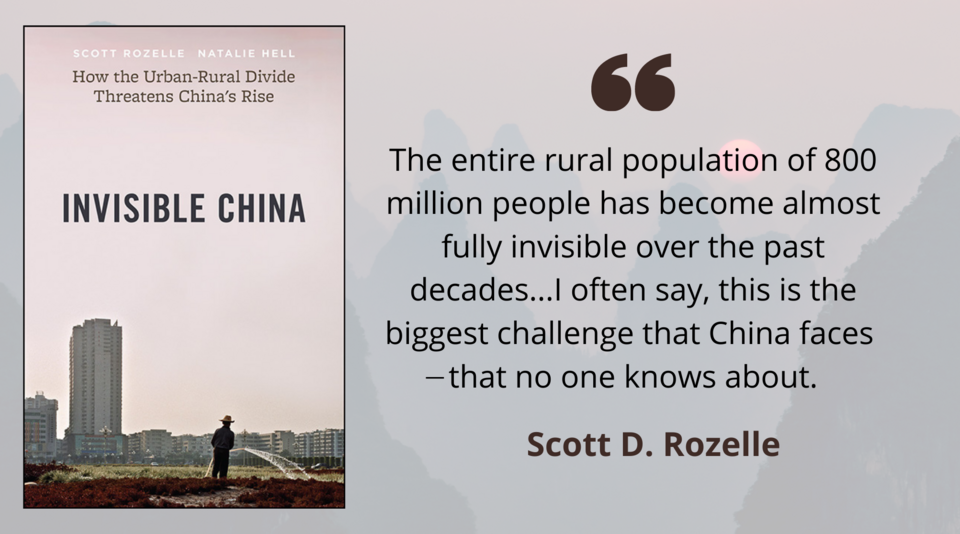
Book cover for "Invisible China: How the Urban-Rural Divide Threatens China's Rise" and a quote from Scott Rozelle, "The entire population of 800 million people has become almost fully invisible over the past decades..."

As the glittering skyline in Shanghai seemingly attests, China has quickly transformed itself from a place of stark poverty into a modern, urban, technologically savvy economic powerhouse. But as FSI Senior Fellow Scott Rozelle and Natalie Hell show in their new book Invisible China, the truth is much more complicated and might be a serious cause for concern.

Drawing on extensive surveys on the ground in China, Rozelle and Hell reveal that while China may be the second-largest economy in the world, its labor force has one of the lowest levels of education of any comparable country. The low levels of basic education of such a large share of workers may leave many unable to find work in the formal workplace as China’s economy changes and manufacturing jobs move elsewhere.

In this book talk event, Rozelle, who is also the director of FSI’s Rural Education Action Program, will be joined by Hongbin Li, a senior fellow at the Stanford Institute for Economic Policy Research and director of the China Program at the Stanford King Center on Global Development, who will moderate a discussion about the major themes of the book. A question and answer session with the audience will follow the discussion.


Image
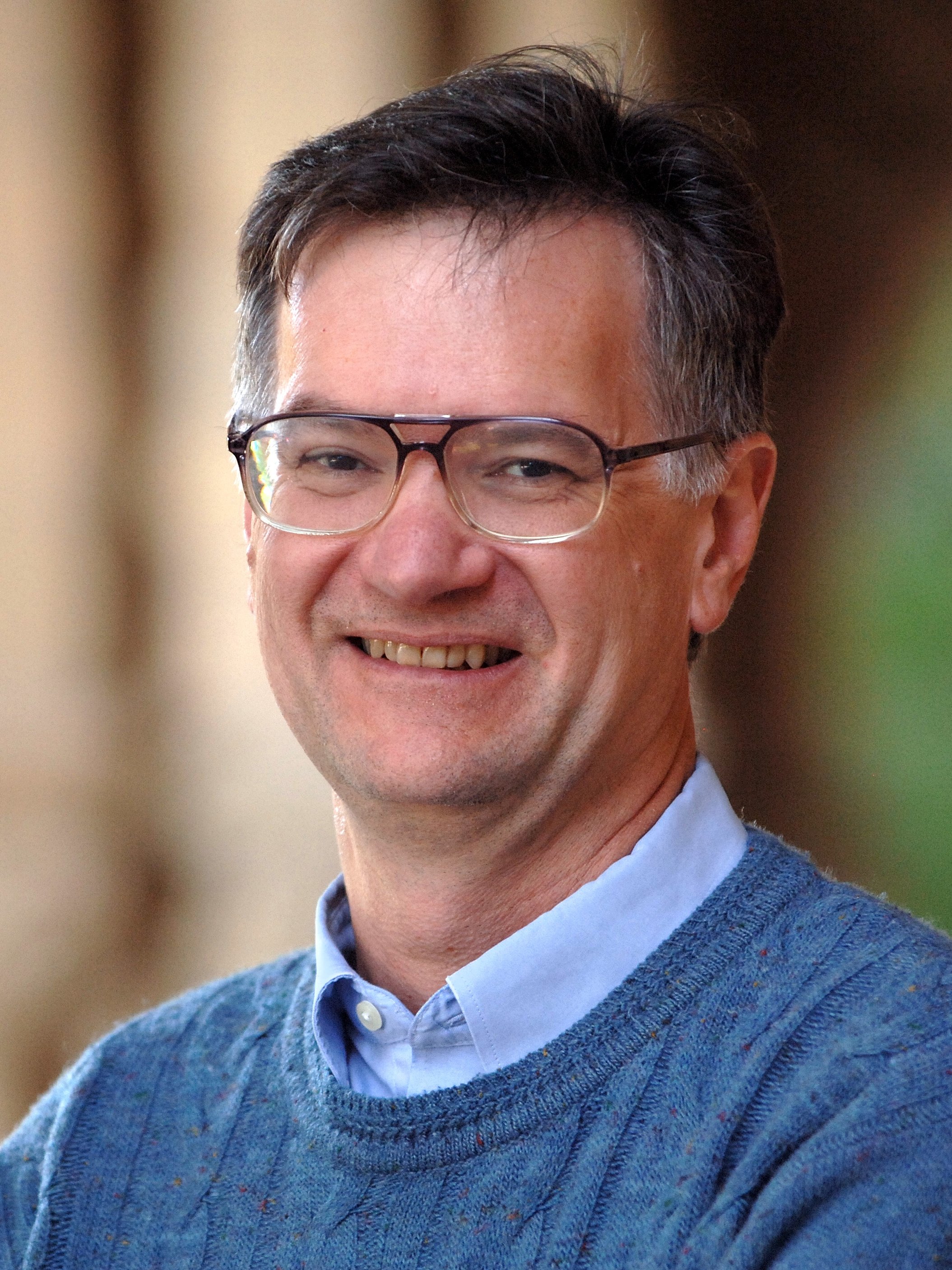
scott rozelle new headshot

Scott Rozelle holds the Helen Farnsworth Endowed Professorship at Stanford University and is Senior Fellow in the Food Security and Environment Program and the Shorenstein Asia-Pacific Research Center, Freeman Spogli Institute (FSI) for International Studies. For the past 30 years, he has worked on the economics of poverty reduction. Currently, his work on poverty has its full focus on human capital, including issues of rural health, nutrition and education. For the past 20 year, Rozelle has been the chair of the International Advisory Board of the Center for Chinese Agricultural Policy, Chinese Academy of Sciences (CAS). In recent years Rozelle spends most of his time co-directing the Rural Education Action Project (REAP). In recognition of this work, Dr. Rozelle has received numerous honors and awards. Among them, he became a Yangtse Scholar (Changjiang Xuezhe) in Renmin University of China in 2008. In 2008 he also was awarded the Friendship Award by Premiere Wen Jiabao, the highest honor that can be bestowed on a foreigner. 

Image
hongbin li headshot


Hongbin Li is the James Liang Director of the China Program at the Stanford King Center on Global Development, and a Senior Fellow of Stanford Institute for Economic Policy Research (SIEPR). Hongbin’s research has been focused on the transition and development of the Chinese economy, and the evidence-based research results have been both widely covered by media outlets and well read by policy makers around the world. He is currently the co-editor of the Journal of Comparative Economics.


Seminars
Paragraphs

Book Synopsis:

As the glittering skyline in Shanghai seemingly attests, China has quickly transformed itself from a place of stark poverty into a modern, urban, technologically savvy economic powerhouse. But as Scott Rozelle and Natalie Hell show in Invisible China, the truth is much more complicated and might be a serious cause for concern.

China’s growth has relied heavily on unskilled labor. Most of the workers who have fueled the country’s rise come from rural villages and have never been to high school. While this national growth strategy has been effective for three decades, the unskilled wage rate is finally rising, inducing companies inside China to automate at an unprecedented rate and triggering an exodus of companies seeking cheaper labor in other countries. Ten years ago, almost every product for sale in an American Walmart was made in China. Today, that is no longer the case. With the changing demand for labor, China seems to have no good back-up plan. For all of its investment in physical infrastructure, for decades China failed to invest enough in its people. Recent progress may come too late. Drawing on extensive surveys on the ground in China, Rozelle and Hell reveal that while China may be the second-largest economy in the world, its labor force has one of the lowest levels of education of any comparable country. Over half of China’s population—as well as a vast majority of its children—are from rural areas. Their low levels of basic education may leave many unable to find work in the formal workplace as China’s economy changes and manufacturing jobs move elsewhere.

In Invisible China, Rozelle and Hell speak not only to an urgent humanitarian concern but also a potential economic crisis that could upend economies and foreign relations around the globe. If too many are left structurally unemployable, the implications both inside and outside of China could be serious. Understanding the situation in China today is essential if we are to avoid a potential crisis of international proportions. This book is an urgent and timely call to action that should be read by economists, policymakers, the business community, and general readers alike.

Meet the Authors:

Image
scott rozelle new headshot
Scott Rozelle: Scott is the Helen F. Farnsworth Senior Fellow and the co-director of the Rural Education Action Program in the Freeman Spogli Institute for International Studies at Stanford University. His research focuses almost exclusively on China and is concerned with: agricultural policy, including the supply, demand, and trade in agricultural projects; the emergence and evolution of markets and other economic institutions in the transition process and their implications for equity and efficiency; and the economics of poverty and inequality, with an emphasis on rural education, health and nutrition. He has been published in top academic journals and has authored over 500 articles, chapters, and books. 


Image
Headshot of Natalie Hell.
Natalie Hell: Natalie is a writer based in the San Francisco Bay Area. As part of Stanford University’s Rural Education Action Program, she has worked on Chinese education and health issues for seven years. This work has included managing numerous large-scale field studies and conducting extensive qualitative interviews across rural China. She holds a bachelor’s degree in Chinese language and political science from Williams College, and is a fluent Mandarin speaker.


All Publications button
1
Publication Type
Books
Publication Date
Journal Publisher
University of Chicago Press
Authors
Scott Rozelle
Subscribe to International Development