
Foreign Policy
Authors
News Type
News
Date
Paragraphs

The cloud offers game-changing opportunities for start-ups to large enterprises, if entrepreneurs and enterprise leaders know how best to harness its power. A panel of cloud computing experts shared their wealth of experience to a full house at the special event on Innovation in the Cloud: How Cloud Computing is Changing the Landscape of Entrepreneurship and Innovation, organized by the Stanford Program on Regions of Innovation and Entrepreneurship (SPRIE) in partnership with China America Innovation Network (CHAIN).

In this featured panel discussion at the Stanford Graduate School of Business for Stanford's Entrepreneurship Week 2012, the panel shared insights on cloud computing technology changes, enterprise transformation, business model innovation, investor strategies, and market opportunities, with more than 200 Stanford students, faculty, entrepreneurs and Valley professionals.

The panel was composed of serial entrepreneur Jim Dai, CEO of CalmSea, IT expert Sam Ghods, vice president of technology at Box.com, marketing expert Ken Oestreich, senior director of cloud and virtualization marketing at EMC, and investor Cindy Padnos, founder and managing director of Illuminate Ventures. Robert Scoble, startup liaison officer at Rackspace and a technical evangelist, moderated the discussion.

The panelists acknowledged that users had grown to accept everything could be virtual, and cloud is radically changing the face of enterprise strategy, processes, and outcomes. Cloud computing can dramatically decrease timelines and investment costs which encourages flexible growth and experimentation by rapid iteration. This shift, together with cloud computing’s cost effectiveness, strongly favors the way start-ups work.

For entrepreneurs, one piece of good news is that cloud allows smaller firms to compete with big players in new ways. This trend has also prompted the rise of micro VCs, with typical investments of $100,000 to $500,000. While SMEs continue to embrace cloud-based services, how large enterprises adapt and evolve the cloud market will remain interesting.


Stanford Entrepreneurship Week 2012 takes place February 27 through March 7. This collection of over 30 events is hosted by the Stanford Entrepreneurship Network (SEN), a federation of programs, student groups and organizations supporting entrepreneurship in the Stanford community.
All News button
1
-

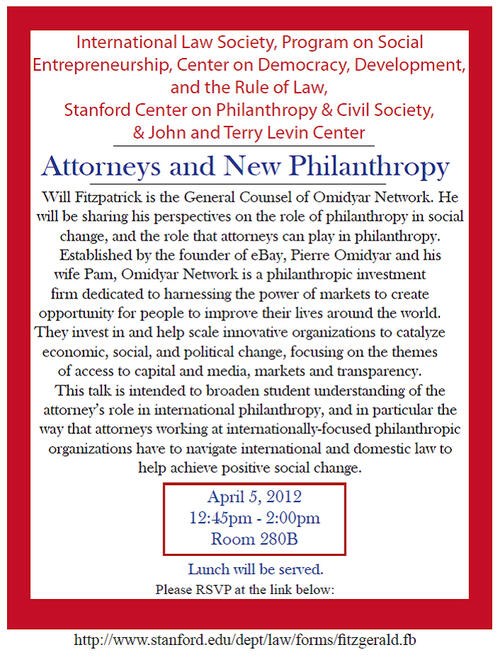
Will Fitzpatrick is the General Counsel of Omidyar Network.  He will be sharing his perspectives on the role of philanthropy in social change, and the role that attorneys can play in philanthropy.  Established by the founder of eBay, Pierre Omidyar and his wife Pam, Omidyar Network is a philanthropic investment firm dedicated to harnessing the power of markets to create opportunity for people to improve their lives around the world.  They invest in and help scale innovative organizations to catalyze economic, social, and political change, focusing on the themes of access to capital and media, markets and transparency.  This talk is intended to broaden student understanding of the attorney's role in international philanthropy, and in particular the way that attorneys working at internationally-focused philanthropic organizations have to navigate international and domestic law to achieve positive social change.

Please RSVP to the link below:

http://www.stanford.edu/dept/law/forms/fitzgerald.fb

Lunch will be provided

Image

Room 280B

Will Fitzpatrick General Counsel Speaker Omidyar Network
Conferences

Over the last hundred years, the cigarette has become a pillar of consumer life in China and many parts of the world. In 2010, the Chinese tobacco industry produced over two trillion cigarettes, generating over U.S. $90 billion in taxes and profits. Over 300 million Chinese citizens now use cigarettes every day, and tobacco kills 90 times more people each year than HIV/AIDS in China.

How has the cigarette become so integrated into the fabric of everyday life across the People’s Republic of China?

The importance of answering this question is unmistakable, but very little historical research and writing has examined China’s cigarette industry from the mid-20th century to the present. To get to the heart of this question, historians, health policy specialists, sociologists, anthropologists, business scholars, and other experts will meet Mar. 26 and 27 at the new Stanford Center at Peking University for a conference organized by the Asia Health Policy Program. They will examine connections intricately woven over the past 60 years between marketing and cigarette gifting, production and consumer demand, government policy and economic profit, and many other dimensions of China’s cigarette culture.

Stanford Center at Peking University

Conferences
-

More than two decades have passed since the first case of HIV infection was detected in Cambodia in 1991. Cambodia is among the countries with the highest HIV prevalence in Asia and has been experiencing the most serious HIV/AIDS epidemic in the region. The epidemic is spread primarily through heterosexual transmission and revolves largely around the sex trade.

Since the beginning of the epidemic, the Royal Government of Cambodia has made a strong political commitment to the need for prevention of HIV transmission and care for people living with HIV/AIDS. It has received some technical and financial support from national and international agencies. Several prevention and intervention programs have been successfully implemented, and the WHO/UNAIDS recognized that the Cambodia’s HIV/AIDS epidemic appeared to have stabilized in 2002.

The estimated HIV prevalence in the general adult population declined to 0.5% in 2009, down from 1.2% in 2001. Among women visiting antenatal care clinics, the prevalence also declined from 2.1% in 1999 to 1.1% in 2006. There was also a gradual increase in the percentage of HIV-infected pregnant women who received antiretroviral therapy to reduce the risk of mother-to-child transmission, from 1.2% in 2003 to 11.2% in 2007, and finally to 32.3% in 2009.

Despite the decline of HIV prevalence in the general population, the prevalence remains high among high-risk groups such as commercial sex workers, men who have sex with men, and injection drug users. Furthermore, the so-called prevention-successful-country is also seeing the growing need for HIV/AIDS treatment and care.

This seminar will highlight the past and current features of Cambodia’s HIV/AIDS epidemic, lessons learned from prevention and care policies, and future challenges that Cambodia may face in the battles against HIV/AIDS.  

Dr. Siyan Yi joins the Walter H. Shorenstein Asia-Pacific Research Center during the 2011–12 academic year from the National Center of Global Health and Medicine and the University of Tokyo, Japan, where he jointly served as a research fellow and lecturer. He has also served as an adjunct faculty member at Cambodia’s School of Public Health, the National Institute of Public Health, and the School of International Studies at the Royal University of Phnom Penh.

Daniel and Nancy Okimoto Conference Room

Siyan Yi 2011-12 Developing Asia Health Policy Fellow Speaker Stanford University
Seminars
Paragraphs

Abstract

The brief war between Georgia and Russia in August 2008 provoked vigorous international reactions among the European states as consequence of the sudden shift in the strategic balance. This article argues for a focus on the great powers France, Germany and Britain as crucial actors for understanding the policy reactions towards Russia. It argues furthermore that reactions must be explained from the perspective of experience based on past geopolitics which translate the external pressures into concrete foreign policy: France oriented towards the creation of a strong EU as global actor, Germany influenced by her self-imposed restraint in foreign affairs and Britain influenced by Atlanticist commitments in her balancing behaviour. Beyond the Russo-Georgian war, the article points to an interest-based foreign policy approach towards Russia in the longer term driven by a great power concert with the Franco-German axis as stable element but increasingly with backing from Britain, thus contributing to transatlantic foreign policy convergence on the issue.

All Publications button
1
Publication Type
Journal Articles
Publication Date
Journal Publisher
Routledge: European Security
Authors
Henrik Larsen
Subscribe to Foreign Policy