Foreign Policy
Authors
News Type
News
Date
Paragraphs

Stanford opened a research and education center at China’s Peking University, strengthening an already close academic bond and building a stronger tie to one of the world’s fastest-growing countries.

“Globalization is the defining characteristic of the 21st Century,” Stanford President John Hennessy said during an opening ceremony on March 21 that drew hundreds of academics, donors and government officials to the opening of the Stanford Center at Peking University.

“It is increasingly important for our students to understand what it means to be citizens of the world, to bring a more international perspective, to be able to communicate with others from different backgrounds or with different expertise,” he said. “Both Peking University and Stanford are stepping up to that challenge and moving to become more global institutions to address the challenges of this century. This new center exemplifies that.”

"It is increasingly important for our students to understand what it means to be citizens of the world, to bring a more international perspective, to be able to communicate with others from different backgrounds or with different expertise," Stanford President John Hennessy said at the opening of SCPKU.
Designed as a resource for the entire Stanford community and administered by the university’s Freeman Spogli Institute for International Studies, 10 programs and departments – including the School of Medicine’s Asian Liver Center, the Bing Overseas Studies Program and the Rural Education Action Project – will locate operations at SCPKU.

FSI faculty already doing research in China showcased their work during conferences held in conjunction with the opening of the center.

The new building is available to the several hundred Stanford scholars studying, researching and conducting university activities in China each year. It also offers the opportunity for Stanford faculty to work with academics from Peking University and other universities throughout China.

“Stanford is one of the most valued partners of Peking University,” PKU President Zhou Qifeng said. “The center will create more opportunities through collaborative research, student and faculty exchange programs, joint teaching and other activities.”

The center makes Stanford the first American university to construct a building for its use on a major Chinese university campus. SCPKU will allow current educational programs to expand, but will not grant Stanford degrees.

The center’s distinctiveness is reflected in the building that houses it – a 36,000-square-foot structure that combines Chinese and Western architecture. The courtyard building was constructed with interlocking mortise-and-tenon joinery – a classic Chinese technique that eliminates the need for nails or glue.

Hand-painted scenes depicting typical Chinese landscapes and views from Stanford’s campus are featured on the building beams. At the point where beams and columns meet, artists added Chinese symbols for teaching, learning and scholarship.

State-of-the-art classrooms, conference rooms and meeting spaces fill out the two floors below the courtyard. Skylights, interior gardens and a reflecting pool invoke a natural setting.

The melding of styles brings as much substance as symbolism.

The SCPKU opening drew hundreds of academics, donors and government officials.
SCPKU “marks a new era of collaboration between two outstanding universities,” Gary Locke, the U.S. ambassador to China, said during the opening ceremony. “It also represents a new bridge of understanding between our nations – and most importantly – our peoples.

“There are virtually no problems in the world today that cannot be solved if the people – the scientists and engineers, and the business people – of the United States and China join together,” Locke said. “And this center will help make that happen.”

Stanford’s relationship with China dates to the late 1970s, when the university began accepting Chinese graduate students. Students from China have accounted for the largest number of Stanford’s foreign graduate students for the past decade, with about 600 enrolled last year.

Those scholars are part of the 160,000 Chinese students studying in American colleges and universities every year, a number that eclipses the 16,000 American students taking classes in China, Locke said.

“We have to know much more about each other’s cultures, customs, traditions, values and languages so we can build a mutual trust and understanding that will allow us to face all of the challenges we face,” he said. “The way to build that trust starts with building people-to-people interactions. It starts with more student exchanges…and it most certainly starts with the Stanford center here at Peking University.”

Over the last 30 years, Stanford’s bond with Peking University has grown from an initial collaboration between the schools’ Asian language departments to a wide range of joint research and academic exchanges.

In 2004, Stanford’s undergraduate study abroad and internship programs began at Peking University. The study abroad program continues to be managed by the Bing Overseas Studies Program, which hosts roughly 60 undergraduates every year on the Peking University campus.  The internship programs are coordinated by the International, Comparative, and Area Studies Program.

The overseas studies program offers a broad curriculum taught by a Stanford faculty-in-residence who spends a 10-week quarter with the students in Beijing.  A range of topical and language courses are taught by Peking University faculty.

“The new center at PKU allows us to continue this dynamic program in a new environment designed to encourage interaction across disciplines and with graduate students and faculty from both universities,” said Irene Kennedy, the program’s executive director. “We also plan to continue supporting and developing interactions between Stanford and PKU students through language partnering and by including Chinese students in classes taught by Stanford faculty and associated field trips.”

Jean Oi and Andrew Walder – both senior fellows at the Freeman Spogli Institute – began building on that relationship in 2006 by envisioning a way to bolster Stanford research, teaching, training and outreach activities in China. Their ideas led to the creation of SCPKU and several new academic programs, including a law school exchange program.

The $7 million project is funded entirely from gifts made to the Stanford International Initiative. The lead donor was the charitable foundation of the family of Chien Lee, a Hong Kong-based private investor and Stanford emeritus trustee who received his bachelor's and master's degrees from the university in 1975 and his MBA from the Graduate School of Business four years later.

The SCPKU building is named for his father, the late Lee Jung Sen, who attended Peking University in the mid-1930s when it was Yenching University. Lee’s mother, Leatrice Lowe Lee, graduated from Stanford in 1945.

A bust of Lee Jung Sen sits in SCPKU’s courtyard, one level above the modern facility and surrounded by the more familiar, traditional Chinese architecture.

Hero Image
SCPKU SQUARE
All News button
1
Authors
News Type
News
Date
Paragraphs

Imagine you are on the staff of the National Security Council (NSC) and a naval dispute breaks out on the Korean Peninsula while you are at home celebrating Thanksgiving. You have just three hours to prepare a detailed memorandum summarizing the situation and offering recommendations for how the United States should respond.

This is a major responsibility with a large number of interrelated issues that must be taken into account—how would you proceed?

Stanford students in the winter quarter course U.S. Policy toward Northeast Asia (IPS 244) had the opportunity to step into the challenging role of the NSC senior director for Asia and consider such a security situation. They wrote and presented memoranda on this and an East Asia trade crisis scenario in class, as well as a final memorandum to the president proposing a China policy for his second term. The assignments required students to consider a wide range of global, regional, and domestic factors—many pulled directly from current global events.

Each member of the team of Shorenstein Asia-Pacific Research Center (Shorenstein APARC) Asia experts teaching the course drew on decades of related expertise to write the scenarios.

  • Michael H. Armacost, the Center’s Shorenstein Distinguished Fellow, previously served on the NSC, in the Defense Department, as U.S. ambassador to the Philippines and Japan, and as undersecretary of state for political affairs.
  • Shorenstein APARC associate director for research Daniel C. Sneider, an Asia history expert, spent over 30 years as a journalist reporting on international affairs and security issues, including working as a foreign correspondent in Japan, Korea, India, and Russia.
  • David Straub, associate director of Stanford’s Korean Studies Program, is a former State Department official with long-time expertise in U.S.-Korea relations and North Korea, including participation in the Six-Party Talks on North Korea’s nuclear program.
  • Thomas Fingar, FSI’s Oksenberg-Rohlen Distinguished Fellow, is a China expert and has previously held numerous key U.S. intelligence posts, most recently as the first deputy director of national intelligence for analysis and, concurrently, as chairman of the National Intelligence Council. He also served as assistant secretary of the State Department’s Bureau of Intelligence and Research.

In the first assignment, students read about a proposed China-Japan-South Korea free trade agreement (FTA). Navigating through a web of regional and domestic issues, they advised on how the United States should respond to an appeal from Japan for certain trade concessions in exchange for its backing out of the FTA. The assignment described complex economic and political conditions in May 2013 after elections in the United States, South Korea, and Japan, and a leadership transition in China. The U.S.-Japan alliance was one of many key factors students took into account.

“It was my great pleasure to participate in this class—it truly broadened my views of U.S. foreign policy toward Northeast Asia. The substantive knowledge presented by both instructors and students during the class will undoubtedly contribute to a much safer, more peaceful, and unified world.”
-Heeyoung Kwon, Visiting Scholar, Korea Foundation


The next memorandum assignment described an inter-Korean naval dispute falling in the crucial weeks between the 2012 U.S. and South Korean presidential elections. It narrated the economic and political situation of each country in precise detail, and set the stage for the dispute with real-life events like the 2010 sinking of the South Korean navy ship the Cheonan. Students were asked to consider the possible role China could play in mediating with North Korea, and how U.S. tensions with Iran could limit its involvement in negotiations.

“In IPS 244…no conversation is irrelevant to current events in Northeast Asia…The memo assignments…are so detailed, so current, and so realistic, that even a seasoned diplomat would be challenged by them—I know this because there are seasoned diplomats taking the class.”
-Jeffrey Stern, MA Student, International Studies Program


Shorenstein APARC offers U.S. Policy toward Northeast Asia each winter quarter. The diverse mix of students, combined with the “in-the-field” expertise of the instructors, creates a lively and challenging class environment. IPS 244 goes beyond a traditional academic course to create assignments based on real-life events and global conditions, and place students in the position of thinking like a government official. For the many of them that will go on to pursue government careers, the course serves as an important first-step in training for “scenarios” very similar to those they address in class.

Hero Image
Trilateral2009 NEWSFEED
South Korean President Lee Myung-bak (left), Chinese Premier Wen Jiabao, and Japanese former Prime Minister Yukio Hatoyama at the 2009 East Asia Trilateral Summit.
Flickr/Korea.net
All News button
1
-

This talk will address a primary foreign policy challenge for independent Ukraine which has been to strike a proper balance between its relations with the West and those with Russia.  Today, democratic backsliding is upsetting the balance, which will undermine President Yanukovych’s ability to achieve his professed foreign policy aims.


Steven Pifer
is a senior fellow at the Brookings Institution’s Center on the United States and Europe and director of the Brookings Arms Control Initiative.  He focuses on nuclear arms control, Russia and Ukraine.  He has offered commentary on these issues on CNN, Fox News, BBC, National Public Radio and VOA, and his articles have run in the International Herald Tribune, New York Times, Washington Post and Moscow Times, among others.

A retired Foreign Service officer, his more than 25 years with the State Department focused on U.S. relations with the former Soviet Union and Europe, as well as arms control and security issues.  He served as deputy assistant secretary of state in the Bureau of European and Eurasian Affairs with responsibilities for Russia and Ukraine (2001-2004), U.S. ambassador to Ukraine (1998-2000), and special assistant to the president and senior director for Russia, Ukraine and Eurasia on the National Security Council (1996-1997).

His publications include “Ukraine’s Perilous Balancing Act,” Current History (March 2012), “NATO, Nuclear Weapons and Arms Control,” Brookings Arms Control Series (July 2011); “The Next Round:  The United States and Nuclear Arms Reductions After New START,” Brookings Arms Control Series (November 2010); “Ukraine’s Geopolitical Choice, 2009,” Eurasian Geography and Economics (July 2009); and “Reversing the Decline:  An Agenda for U.S.-Russian Relations in 2009,” Brookings Foreign Policy Paper (January 2009).

Ambassador Pifer is a 1976 graduate of Stanford University with a B.A. in Economics.  He is a member of the Council on Foreign Relations. 


Co-sponsored by the Center for Russian, East European, and Eurasian Studies

Reuben W. Hills Conference Room

Steve Pifer Senior Fellow at the Brookings Institution’s Center on the United States and Europe and Director of the Brookings Arms Control Initiative Speaker
Seminars
Authors
News Type
News
Date
Paragraphs

The Program on Human Rights concluded its ninth and final installment of the Sanela Diana Jenkins International Speakers Series on March 13 with presentations with Dr. Mohammed Mattar, executive director of the Protection Project and professor at Johns Hopkins University and Professor Alison Brysk, chair of Global Governance, Global and International Studies at UC Santa Barbara.

Dr. Mattar noted that while effective anti-trafficking laws depend on law enforcement and survivor protection, the key intellectual and ethical rationale of such laws is the concept of the exploitation of vulnerable people in vulnerable circumstances. Dr. Mattar explained the legal distinction between “human trafficking” and “slavery,” emphasizing that the latter is based on twin ideas of human beings as commodities to be bought and sold, as well as the exercise of ownership of one person over another. “There is no doubt that human trafficking is a degrading and severe violation of basic human rights and fundamental freedoms, but it is unnecessary to label human trafficking as slavery because to do so we would need to identify the exercise of powers attached to the right of ownership,” Mattar said.

Among the challenges for a more effective anti-trafficking effort, Dr. Mattar listed the need to hold corporations responsible for their acts, to provide access to justice that allows for victim compensation, the engagement of civil society, and criminal enforcement and accountability under existing national and international law.

Professor Brysk explained that globalization has produced pernicious side effects.  The acceleration of migration, especially of women, increases the incidence of gender violence and the commodification of “disposable people.” All these factors enable the increase of human trafficking. Brysk observed that international recognition of trafficking as a form of contemporary slavery has been helpful in influencing policy change. “There is a slavery spectrum,” Brysk said. “We need to work to guarantee physical integrity of people, migration rights and children’s rights.”

She also noted that the focus on sex slavery has high costs because it is based on “protection and not empowerment,” and “rescue over rights.” The individualistic emphasis and sexual focus of anti-trafficking efforts fails to recognize many forms of exploitative globalized labor. Women and children are put in dangerous and debilitating non-sexual jobs. There are also many forms of sexual and gender violence in other forms of exploitative globalized labor, such as in sweatshops.

Together, the speakers in the final session of the Program on Human Rights speaker series made a strong plea for more sophisticated understanding of the dynamics of human trafficking in the 21st century. Sustained research that accounts for contemporary conditions, they told the Stanford audience, is needed to give policy makers and legislators the information and tools they need to combat the alarming global acceleration of human trafficking.

All News button
1
-

This event is co-sponsored with The Europe Center

Abstract:

Ruby Gropas is a lecturer in international relations at the law faculty of the Democritus University of Thrace (Komotini) and research fellow at the Hellenic Foundation for European and Foreign Policy (ELIAMEP). Gropas was in residence at CDDRL in 2011 as a visiting scholar. In this seminar she will discuss the ongoing Greek economic and political crisis, and what it means for the future of the European Union and monetary system. Is the crisis in Greece ‘internal’ or is it symptomatic of a wider European failure? Is the Greek crisis the result of failed modernity, or rather a precursor of things to come? Why has Greece become so important and why has it dominated global politics and world news for the past two years?  Are its malignancies purely domestic or are they representative of a wider malaise within Europe and possibly beyond? The collapse and orderly default of a eurozone country at the heart of the Western financial system arguably marks the end of an era. It has brought with it the deepest social and political crisis that modern Greecehas faced since the restoration of democracy and it has also led to Europe's deepest existential crisis. With the EU struggling to effectively managing the eurozone crisis and the burst of recent movements opposing neo-liberal orthodoxy and the “Occupy” movements – what does this mean for Europe? And what is next?

Speaker Bio: 

Ruby Gropas has worked on asylum and migration issues for UNHCR in Brussels and worked for McKinsey & Co. in Zurich and Athens (2000-2002). As part of the ELIAMEP team, her research concentrates on European integration and foreign policy, Transatlantic relations, human rights, migration and multiculturalism. She was Managing Editor of the Journal of Southeast European and Black Sea Studies (Taylor & Francis) between January 2006 and October 2009. Ruby has taught at the University of Athens and at College Year in Athens. She was Southeast Europe Policy Scholar at the Woodrow Wilson International Center for Scholars in Washington DC in 2007 and again in 2009. She is Vice-President of the Alexander S. Onassis Public Benefit Foundation Scholars' Association since June 2009, and was Member of the Academic Organisation Committee of the Global Forum for Migration and Development, Civil Society Days, Athens 2009.

Ruby studied Political Science at the Université Libre de Bruxelles (1994) and undertook graduate studies at the University of Leuven (MA in European Studies) and at Cambridge University (MPhil in International Relations). She holds a PhD in History from Cambridge University (New Hall, 2000).

Encina Ground Floor Conference Room

Encina Hall
Stanford, CA 94305-6055

0
R_Gropas.jpg PhD

Ruby Gropas is Lecturer in International Relations at the Law Faculty of the Democritus University of Thrace (Komotini) and Research Fellow at the Hellenic Foundation for European and Foreign Policy (ELIAMEP).

Ruby has worked on asylum and migration issues for UNHCR in Brussels and worked for McKinsey & Co. in Zurich and Athens (2000-2002). As part of the ELIAMEP team, her research concentrates on European integration and foreign policy, Transatlantic relations, human rights, migration and multiculturalism. She was Managing Editor of the Journal of Southeast European and Black Sea Studies (Taylor & Francis) between January 2006 and October 2009. Ruby has taught at the University of Athens and at College Year in Athens. She was Southeast Europe Policy Scholar at the Woodrow Wilson International Center for Scholars in Washington DC in 2007 and again in 2009. She is Vice-President of the Alexander S. Onassis Public Benefit Foundation Scholars' Association since June 2009, and was Member of the Academic Organisation Committee of the Global Forum for Migration and Development, Civil Society Days, Athens 2009.

Ruby studied Political Science at the Université Libre de Bruxelles (1994) and undertook graduate studies at the University of Leuven (MA in European Studies) and at Cambridge University (MPhil in International Relations). She holds a PhD in History from Cambridge University (New Hall, 2000).

CV
Ruby Gropas Lecturer in International Relations at the Law Faculty of the Speaker Democritus University of Thrance (Komotini)
Seminars
Authors
Scott Rozelle
Karen Eggleston
Jean C. Oi
Xueguang Zhou
Ang Sun
News Type
News
Date
Paragraphs

Full text available at YaleGlobal.

Children of China's Future – Part II

 
Aging population and poverty require stronger investment in China’s rural youth
Karen Eggleston, Jean Oi, Scott Rozelle, Ang Sun, Xueguang Zhou
YaleGlobal, 14 March 2012
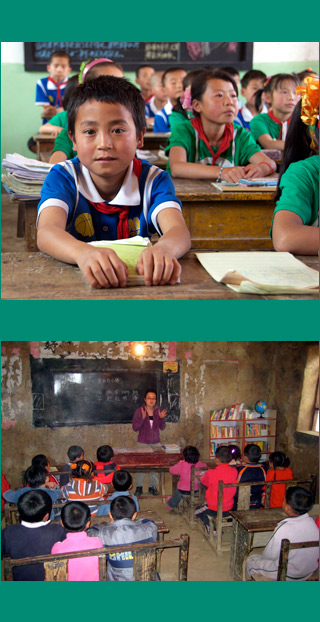
Poor education mortgaging the future? Students in a Gansu province school, where many are anemic (top); another class room in Loess Plateau. (Top Photo: Adam Gorlick)

DINGXI PREFECTURE: Wang Hongli, 8 years old, lives in a remote rural village on the Loess Plateau in one of China’s poorest and most agricultural provinces, Gansu. His prospects for living the good life are as bleak as the landscape. He is not on track to become part of China’s emerging middle class, the free-spending, computer-savvy, person-of-the-world often featured in the western media.

Hongli is a pseudonym. His parents work in a faraway industrial zone, coming home for only three weeks at Chinese New Year. His grandmother takes care of him and his siblings on the weekends, and during the week he lives in a dorm, three to a bed with 36 other students in an unheated room 4 by 4 meters.

Hongli suffers from iron-deficient anemia, but neither his family nor his teacher knows he is sick. Even if his anemia is discovered and treated by the researchers who have documented 30 percent anemia among children in poor rural areas, it likely will recur after he finishes the study, with furnished dietary supplements. Despite educational pamphlets, he’ll likely revert to a diet of staple grains and bits of pickled vegetables.

Unsurprisingly, Hongli’s grades are not good. In China’s competitive school system, he has only a slight chance of attending high school, much less college. In China’s future high-wage economy, all Hongli can hope for is a menial job in the provincial capital, Lanzhou, or as a temporary migrant elsewhere. Without urban permanent residency, hukou, he will have limited access to urban social services. He may suffer chronic unemployment, or resort to the gray economy or crime. He also may never marry – one of the millions of “forced bachelors” created by China’s large gender imbalance.

In China’s future high-wage economy, 
all the rural poor can hope for is menial jobs in a provincial capital.

Hongli is not alone. In fact, he’s one of 50 million school-age youth in China’s vast poor rural hinterlands. Recent studies by Stanford and Chinese collaborators show that 39 percent of fourth-grade students in Shaanxi Province are anemic, with similarly high rates elsewhere in the northwest; up to 40 percent of rural children in the poor southwest regions, e.g., Guizhou, are infected with intestinal worms. Millions of poor rural students throughout China are nearsighted, but do not wear glasses.

Because China’s urbanites have fewer children, poor rural kids like Hongli represent almost a third of China’s school-aged children, a large share of the future labor force. These young people must be healthy, educated and productive if China is to have any chance of increasing labor productivity to offset the shrinking size of its aging workforce.

Many observers presume that China’s growth will continue unabated, drawing upon a vast reservoir of rural labor to staff manufacturing plants for the world. In fact, to a considerable extent, China’s rural areas have already been emptied out, leaving many villages with only the old and the very young. The growth of wages for unskilled workers exceeds GDP growth.

Better pay should be good news for poverty alleviation. However, rising wages push up the opportunity cost of staying in school – especially since high school fees, even at rural public schools, are among the highest in the world.

It’s myopic to allow rural students to drop out of junior high and high school – mitigating the current labor shortage, but mortgaging their futures. Recent studies demonstrate that eliminating high school tuition – or reducing the financial burden on poor households – improves junior high achievement and significantly increases continuation on to high school. Yet unlike many other developing countries, China does not use incentives to keep children in school, such as conditional cash transfers. The public health and educational bureaucracies also do not proactively cooperate to remedy nutritional and medical problems – including mental health – that school-based interventions could address cost effectively.

Less than half of youth in China’s poor rural areas go to academic high school; less than 10 percent head to college.

The educational system, based on rote memory and drill, doesn’t teach children how to learn. The vocational education system is ineffective. Instead, China’s schools tend to focus resources on elite students. Tracking starts early, and test scores are often the sole criterion for success. A recent comparative study documents that China’s digital divide, with lower access to computers in poor rural areas, is among the widest in the world.

China’s government is increasing expenditures for school facilities and raising teacher salaries. However, these steps are far from adequate. During South Korea’s high growth, almost all Korean students finished high school. Today, less than half of youth in China’s poor rural areas go to academic high school, and the percent going to college remains in the single digits.

Greater investment in public health and education for the young people in China’s poor rural areas is urgent. If the government waits 10 years, it may be too late to avert risks for China’s stability and sustained economic growth.

Surely China could easily address this problem? A third of Chinese were illiterate in the early 1960s; now, fewer than 5 percent are. By 2010, about 120 million Chinese had completed a college degree. Chinese also enjoy a relatively long life expectancy compared to India and many other developing countries, and basic health insurance coverage is almost universal.

But the pace of change and citizens’ expectations are higher as well. Most Chinese assume that basic nutritional problems and intestinal worms were eradicated in the Mao era. China’s mortality halved in the 1950s; fertility halved in the 1970s. As a result, China will get old before it gets rich. Population aging, rapid urbanization and a large gender imbalance represent intertwined demographic challenges to social and economic governance. The policy options are complicated, the constraints significant, the risks of missteps real and ever-present.

China’s prosperity depends on youth mastering skills to thrive in a technology-driven world.

Timely policy response is complicated by competition for resources – pensions, long-term care, medical care for the elderly and more – as well as significant governance challenges arising from a countryside drained of young people. The well-intentioned programs for what government regards a “harmonious society” create large unfunded mandates for local authorities. Attempts to relocate rural residents to new, denser communities provoke anger at being uprooted and skepticism that local authorities simply want to expropriate land for development.

Millions of migrant workers – like Wang Hongli’s parents – return to their rural homes during economic downturns. Urbanization weakens this capacity to absorb future economic fluctuations. Government efforts at “social management” – strengthening regulatory control of informal social groups and strategies for diffusing social tensions – expand the bureaucratic state, a central target of popular discontent.

Premier Wen Jiabao’s announcement of a 7.5 percent growth target – the lowest in two decades – has been expected. Future economic growth will moderate partly because of demographics, but mostly because productivity gains slow as an economy runs out of surplus rural labor and converges on the technological frontier. Costly upgrading of industrial structure will squeeze the government’s ability to deliver on its promise of a better future for all, stoking social tensions.

China’s stability and prosperity, and that of the region and the globe, depends on how well today’s youth master the knowledge and skills that enable them to thrive in the technology-driven globalized world of the mid-21st century. Resilient public and private sector leaders of the future must be able to think creatively. Therefore, China’s government should respond to population aging by acting now to invest more in the health and education of youth, especially the rural poor.


Hero Image
5734696609 a3b10b4c8f z
All News button
1
-

Abstract: 

This talk draws on case study evidence from Princeton University’s Innovations for Successful Societies to reflect on some current theories about building accountable government.  The focus is on settings where geography, insecurity, and limited resources render conventional management strategies unworkable.

Speaker Bio:

Jennifer Widner is professor of politics and international affairs and director of the Mamdouha S.Bobst Center for Peace & Justice at Princeton University. She runs a research program on institution building and institutional reform called Innovations for Successful Societies, a joint initiative of the Bobst Center and  the Woodrow Wilson School. Before joining the Princeton faculty in 2004-5, she taught at Harvard and the University of Michigan.  Her current research focuses on the political economy of institutional reform, government accountability, and service delivery.  She also remains interested in constitution writing, constitutional design, and fair dealing—topics of earlier research. She is author of Building the Rule of Law (W. W. Norton), a study of courts and law in Africa, and she has published articles on a variety of topics in Democratization, Comparative Politics, Comparative Political Studies, Journal of Development Studies, The William & Mary Law Review, Daedalus, the American Journal of International Law, and other publications.  She is completing work on a book about making government work in challenging settings, drawing on experiences in Africa, Asia, and parts of Latin America. 

Reuben W. Hills Conference Room

Jennifer Widner Professor of Politics and International Affairs, Woodrow Wilson School Speaker Princeton University
Seminars
-

 Abstract:

Systemic corruption undermines state capacity, imperils socio-economic development, and diminishes democracy. In his Nairobi speech as a U.S. senator in August 2006, Barack Obama described the struggle to reduce corruption as "the fight of our time". An international conference in Lagos, Nigeria, in September 2011 was devoted to Richard Joseph's influential 1987 book, Democracy and Prebendal Politics in Nigeria: The Rise and Fall of the Second Republic.Transforming prebendalist systems must be at the center of strategies to strengthen democracy and achieve poverty-reducing economic growth in Africa and other regions.

 Speaker Bio: 

Richard Joseph is John Evans Professor of International History and Politics at Northwestern University and Non resident Senior Fellow in Global Economy and Development at the Brookings Institution. As a Fellow of The Carter Center, he participated in democracy and peace initiatives in Ghana, Zambia, Ethiopia, Liberiaand Sudan. He has written extensively on issues of democracy, governance and political economy. His books include Radical Nationalism in Cameroun (1977), Democracy and Prebendal Politics in Nigeria (1987) and edited books, Gaullist Africa: Cameroon under Ahmadu Ahidjo (1978), State, Conflict and Democracy in Africa (1999), and (with Alexandra Gillies), Smart Aid for African Development (2009). He served as Principal Investigator of the Research Alliance to Combat HIV/AIDS (REACH), a collaborative program in Nigeria, 2006–2011. His current writing and policy projects concern growth, democracy and security. To address these issues, he is designing a collaborative project, AfricaPlus (http://africaplus.wordpress.com/), whose first focus country is Nigeria.

Here is the link to Richard Joseph remarks and the PowerPoint for the talk.

http://africaplus.wordpress.com/author/africaplus/

CISAC Conference Room

Richard Joseph John Evans Professor of International History and Politics Speaker Northwestern University
Seminars
News Type
News
Date
Paragraphs

Karl Eikenberry, the 2012 Payne Distinguished Lecturer at the Freeman Spogli Institute, has received the George F. Kennan Award for Distinguished Public Service from the National Committee on American Foreign Policy (NCAFP).

The award honors Americans who served the country in an exemplary fashion and have made seminal contributions to defining, illuminating, and promoting the country’s national interest.

Eikenberry was the U.S. ambassador to Afghanistan from May 2009 until July 2011.  He served in the Army for 35 years, retiring in April 2009 as a lieutenant general. He was the commander of the American-led coalition forces in Afghanistan from 2005 to 2007 and has also served as deputy chairman of the NATO Military Committee in Brussels.

In a statement issued by the NCAFP, the organization praised Eikenberry for his accomplishments.

“We are particularly impressed by his widely respected and exemplary leadership in conceptualizing, designing, and articulating American military and foreign policy strategy and tactics involving and harmonizing both hard and soft power,” the statement said.

Other recipients of the Kennan Award include former Secretary of State Cyrus Vance, CIA Director David Petraeus, and New York City Police Commissioner Raymond Kelly.

Hero Image
Eikenberry highres logo
All News button
1
Subscribe to Foreign Policy