


Making Love for a Visa
-
The talk , based on a recent paper, will describe and examine the social understanding of selling sex for a visa among migrant Filipina hostesses in Tokyo. The paper examines the different constitutions of love in Japan and the Philippines to understand the making of love in the marriages of Filipina hostesses and their Japanese customers. The paper will attempt to argue why the act of selling sex for a visa does not necessarily reduce marriage to prostitution while at the same time questioning the assumption that marriage is ever free of rational motivation.
Rhacel Salazar Parreñas is Professor and Chair of the Sociology Department at the University of Southern California. Her research interests include the sociology of gender and labor, the family, and globalization. Her latest book Illicit Flirtations: Labor, Migration and Sex Trafficking in Tokyo received the 2012 Distinguished Book Award in the Labor and Labor Movements Section of the American Sociological Association.
Philippines Conference Room
Rhacel Salazar Parreñas
Professor and Chair of the Sociology Department
Speaker
University of Southern California
Seminars
Former British ambassador on North Korea's citizens, reform and engagement
News Type
Q&As
Date
Paragraphs
Hallmarks during the first year of young North Korean leader Kim Jong Un’s reign range from a much-publicized failed rocket launch to the appearance (and then disappearance) of an attractive, stylish wife by his side. Such events have prompted questions about the new leader’s intentions for the future, including the possibility of reform.
But there is another side to the Democratic Republic of Korea (DPRK) that often goes overlooked: its 20 million ordinary citizens. Only Beautiful, Please, a new book by former British diplomat John Everard, delves into the daily life of North Koreans and examines the challenges of developing successful diplomatic relations with the country.
Everard was Britain’s ambassador to North Korea between 2006 and 2008 and is a former Pantech Fellow of the Walter H. Shorenstein Asia-Pacific Research Center at Stanford’s Freeman Spogli Institute of International Studies. He presented highlights from his book, and offered his insight into current North Korea events during a seminar at Stanford on Oct. 26.
In a recent interview, Everard discussed his book, the prospect of reform in North Korea, and important considerations for engagement with the isolated country.
What is the significance of the book’s title?
A friend visiting me from the U.K. was pursued by a group of North Koreans who were convinced he had photographed things that did not show the DPRK in the best light. An army officer was eventually summoned, and after examining the pictures he concluded there was nothing offensive in them. As he returned my friend’s camera, he turned to me and said in his best English: “Only beautiful, please.” He meant that he wanted us to only photograph beautiful things in the DPRK.
I took this for the title because it says quite a lot about how the DPRK likes to hide the negative aspects of life there, and to portray itself as a country where only good things take place.
What do you most hope readers will take away from your book?
I hope readers will come away with the understanding that the DPRK is a real country, where real people live. North Korea is different from other countries in many important ways, but its citizens are much more preoccupied with everyday things like marriage, how their kids are getting on at school, and what they are having for supper, than they are about politics and denuclearization. It is a country with over 20 million people, and I hope their lives and happiness are not overlooked as the international community engages with the DPRK to seek long-term solutions to the difficult problems it poses.
..jpg)
What are the most important needs of North Korea’s citizens?
North Koreans are people like the rest of us, and they have the same physical and emotional needs. They need enough to eat, which is a need not always met. They also need to have normal social interactions. Friendships are very important in the DPRK, even if they are somewhat different than friendships in more open societies. North Koreans also have their self-respect and pride. They are a proud people, and as information about the outside world leaks into the DPRK and they learn how poor and backward their country is they feel quite disoriented. They will need to hold onto their self-respect through what is likely to be a very difficult period in the coming years.
There has been significant speculation in recent months about the possibility of reform in North Korea. Have we seen any tangible signs of plans for reform?
There have been indications that Kim Jong Un had been planning some limited economic reforms, including allowing farmers to retain a certain percentage of their produce after giving part of it to the state. But the most recent report suggests that this plan has stalled after the government realized there would be a poor harvest this year. They have decided it is more important to feed the military than it is to implement economic reforms at this point in time.
Another type of reform is the possibility of greater cultural opening. Mickey Mouse appeared in front of the DPRK leadership at a concert a few weeks ago, for example, and there is also the appearance of Ri Sol Ju, Kim Jong Un’s wife. She is a very presentable young woman, and dresses smartly, (and without wearing the traditional Kim badge). But there have been no further appearances of Mickey Mouse, and Ri Sol Ju has not appeared in public for several weeks. I suspect that these reforms, too, have been put on hold.
These are two quite different types of reform that do not depend on each other, and it is not clear if either of them is going to move forward.
In terms of easing diplomatic relations with North Korea, do you think that reform would pave the way or are there other issues to keep in mind?
If reform does indeed take place – I have my doubts – it might not be the kind of reform that would help improve relations with the DPRK. Economic reform does not necessarily translate into a greater readiness for meaningful dialogue with the international community.
A crucial point is that there are certain aspects of the DPRK regime that are extremely difficult to change. I argue in my book that the DPRK cannot conduct any kind of meaningful economic reform along the lines China did because to do so would erode the regime’s economic power over its citizens. The regime views this power as intrinsic to its survival. It also cannot allow greater openness because that would allow in new ideas to which the regime has no answer. It will be politically very difficult, and even dangerous, for the regime to encourage the greater openness we have seen in other reforming economies.
The DPRK regime is likely to continue broadly along the lines we have seen for many decades now. Although many people were hoping that Kim Jong Un would bring reforms, and perhaps even better relations with the West, as time passes it seems less likely that these hopes can be realized.
 What should the international community keep in mind in its relations with North Korea?
The DPRK has made it abundantly clear it has no intention whatsoever of surrendering its nuclear weapons. It has been hardened in its belief by its analysis of what has happened in the Arab world. Negotiations and talks towards persuading the DPRK to surrender its weapons are doomed to failure. They are not going to do so, and any engagement with the DPRK has to take that as a starting point.
There is a tendency in the United States to see North Korea's foreign relations simply in terms of the U.S.-DPRK relationship (or lack of it). The DPRK’s relations with the United States are indeed very important, but you also have to see the world through the DPRK’s eyes. If you are sitting in Pyongyang, your single most important relationship is with the People’s Republic of China.
Beijing has been deeply concerned about the DPRK’s behavior in a number of areas. Earlier this year, for example, we saw the launch of North Korea’s rocket against China’s express wishes, and the seizure of Chinese fishermen by the DPRK navy. The relationship between the DPRK and China has its difficulties, and one of the big determinants in what happens to the DPRK in the immediate future is going to be the position on the DPRK taken by the incoming Chinese government after the Party Congress in November.
About the Images
Even in central Pyongyang almost any cultivable patch of ground is ploughed for crops, like this one just outside the diplomatic quarter. (Credit: John Everard)
Stalls at Pyongyang spring trade fair -- the dominance of China at these events is clear. (Credit: John Everard)
Hero Image

North Korean newlyweds. They have probably presented flowers to a statue of Kim Il Sung earlier in the day, and are here seen outside the hotel that is hosting their wedding reception.
John Everard
All News button
1
Reception and Dinner: 2012 Presidential Debate on Foreign Policy
-
|
Please note: at 4:00 p.m. on October 22, the speakers will deliver CISAC's Annual Drell Lecture, entitled You are welcome to attend this public lecture in the Oak Lounge |
Image
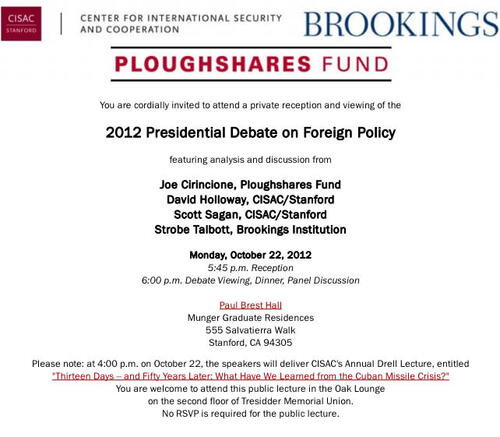
Paul Brest Hall
Munger Graduate Residences
555 Salvatierra Walk
Stanford, CA 94305
Conferences
FSE has a few more questions for the candidates
News Type
News
Date
Paragraphs
In advance of the third presidential debate, Freeman Spogli Institute center directors thought about key international policy issues that need addressing by presidential candidates Barak Obama and Mitt Romney. FSE center director Rosamond L. Naylor posed the question below among a list of other suggested FSI foreign policy questions to debate:
Should our government help American farmers cope with climate impacts on food production, and should this assistance be extended to other countries – particularly poor countries – whose food production is also threatened by climate variability and climate change?
What to listen for: Most representatives in Congress would like to eliminate government handouts, and many would also like to turn away from any discussion of climate change. Yet this year, U.S. taxpayers are set to pay up to $20 billion to farmers for crop insurance after extreme drought and heat conditions damaged yields in the Midwest.
With the 2012 farm bill stalled in Congress, the candidates need to be clear about whether they support government subsidized crop insurance for American farmers. They should also articulate their views on climate threats to food production in the U.S. and abroad.
Without a substantial crop insurance program, American farmers will face serious risks of income losses and loan defaults. And without foreign assistance for climate adaptation, the number of people going hungry could well exceed 15 percent of the world's population.
~Rosamond L. Naylor, director of the Center on Food Security and the Environment
Inspired by the spirit of debate, FSE fellows took the opportunity to pose a few additional questions for the candidates.
Questions from FSE deputy director Walter P. Falcon:
The US now uses more that 40% of its corn crop for biofuel. While some argue this contributes to long-term energy independence, others note that ethanol mandates, along with unfavorable weather, can contribute to higher and more volatile food prices like those seen in recent years. Do you regard the US policy emphasis on biofuels, especially corn-based ethanol, as being a successful program to date? Have the benefits from biofuels outweighed the negative impacts on higher food costs around the world, and do you believe that mandates continue to be the most appropriate policy going forward?
One of the largest agricultural programs in the US is in the form of food stamps to poor consumers. Would you prefer to cap, perhaps even eliminate, the food stamp (SNAP) program? Would you prefer to replace it with a direct cash transfer system? Whom do you think generally should qualify either for food stamps or cash transfers?
Questions from FSE associate director David Lobell:
A major initiative of the Obama Administration has been Feed the Future, which aims at improving food security in other countries. Is the U.S. focused sufficiently on hunger in other parts of the world? Have actions matched rhetoric? Is a $3 billion expenditure on this initiative the right sum in an era of large fiscal deficits in the U.S.?
Question from research scholar Bill Burke:
The United States is viewed by many as a world leader, but its role in foreign assistance is contentious. In dollar terms, the United States consistently gives more foreign assistance than any other donor nation. In 2012, for example, the U.S. provided nearly 34 billion dollars, or more than twice as much as any other country. On the other hand, many criticize the U.S. for contributing relatively little in comparison to other countries when donations are measured as a share of GDP. Some also point out that much of what is labeled foreign assistance is actually military or security assistance, and does not contribute directly towards economic development. Does the U.S. spend too little or too much on foreign assistance, and should a greater proportion of U.S. funding go directly towards poverty reduction and food security?
All News button
1
Five foreign policy questions for Obama and Romney
News Type
Q&As
Date
Paragraphs
President Obama and Mitt Romney meet for their third debate to discuss foreign policy on Monday, when moderator Bob Schieffer is sure to ask them about last month's terrorist attack in Libya and the nuclear capabilities of Iran.
In anticipation of the final match between the presidential candidates, researchers from five centers at Stanford’s Freeman Spogli Institute for International Studies ask the additional questions they want answered and explain what voters should keep in mind.
What can we learn from the Arab Spring about how to balance our values and our interests when people in authoritarian regimes rise up to demand freedom?
What to listen for: First, the candidates should address whether they believe the U.S. has a moral obligation to support other peoples’ aspirations for freedom and democracy. Second, they need to say how we should respond when longtime allies like Egypt’s Hosni Mubarak confront movements for democratic change.
And that leads to more specific questions pertaining to Arab states that the candidates need to answer: What price have we paid in terms of our moral standing in the region by tacitly accepting the savage repression by the monarchy in Bahrain of that country's movement for democracy and human rights? How much would they risk in terms of our strategic relationship with Bahrain and Saudi Arabia by denouncing and seeking to restrain this repression? What human rights and humanitarian obligations do we have in the Syrian crisis? And do we have a national interest in taking more concrete steps to assist the Syrian resistance? On the other hand, how can we assist the resistance in a way that does not empower Islamist extremists or draw us into another regional war?
Look for how the candidates will wrestle with difficult trade-offs, and whether either will rise above the partisan debate to recognize the enduring bipartisan commitment in the Congress to supporting democratic development abroad. And watch for some sign of where they stand on the spectrum between “idealism” and “realism” in American foreign policy. Will they see that pressing Arab states to move in the direction of democracy, and supporting other efforts around the world to build and sustain democracy, is positioning the United States on “the right side of history”?
~Larry Diamond, director of the Center on Democracy, Development, and the Rule of Law
What do you consider to be the greatest threats our country faces, and how would you address them in an environment of profound partisan divisions and tightly constrained budgets?
What to listen for: History teaches that some of the most effective presidential administrations understand America's external challenges but also recognize the interdependence between America's place in the world and its domestic situation.
Accordingly, Americans should expect their president to be deeply knowledgeable about the United States and its larger global context, but also possessed of the vision and determination to build the country's domestic strength.
The president should understand the threats posed by nuclear proliferation and terrorist organizations. The president should be ready to lead in managing the complex risks Americans face from potential pandemics, global warming, possible cyber attacks on a vulnerable infrastructure, and failing states.
Just as important, the president needs to be capable of leading an often-polarized legislative process and effectively addressing fiscal challenges such as the looming sequestration of budgets for the Department of Defense and other key agencies. The president needs to recognize that America's place in the world is at risk when the vast bulk of middle class students are performing at levels comparable to students in Estonia, Latvia and Bulgaria, and needs to be capable of engaging American citizens fully in addressing these shared domestic and international challenges.
~Mariano-Florentino Cuéllar, co-director of the Center for International Security and Cooperation
Should our government help American farmers cope with climate impacts on food production, and should this assistance be extended to other countries – particularly poor countries – whose food production is also threatened by climate variability and climate change?
What to listen for: Most representatives in Congress would like to eliminate government handouts, and many would also like to turn away from any discussion of climate change. Yet this year, U.S. taxpayers are set to pay up to $20 billion to farmers for crop insurance after extreme drought and heat conditions damaged yields in the Midwest.
With the 2012 farm bill stalled in Congress, the candidates need to be clear about whether they support government subsidized crop insurance for American farmers. They should also articulate their views on climate threats to food production in the U.S. and abroad.
Without a substantial crop insurance program, American farmers will face serious risks of income losses and loan defaults. And without foreign assistance for climate adaptation, the number of people going hungry could well exceed 15 percent of the world's population.
~Rosamond L. Naylor, director of the Center on Food Security and the Environment
What is your vision for the United States’ future relationship with Europe?
What to listen for: Between the end of World War II and the end of the Cold War, it was the United States and Europe that ensured world peace. But in recent years, it seems that “Europe” and “European” have become pejoratives in American political discourse. There’s been an uneasiness over whether we’re still friends and whether we still need each other. But of course we do.
Europe and the European Union share with the United States of America the most fundamental values, such as individual freedom, freedom of speech, freedom to live and work where you choose. There’s a shared respect of basic human rights. There are big differences with the Chinese, and big differences with the Russians. When you look around, it’s really the U.S. and Europe together with robust democracies such as Canada and Australia that have the strongest sense of shared values.
So the candidates should talk about what they would do as president to make sure those values are preserved and protected and how they would make the cooperation between the U.S. and Europe more effective and substantive as the world is confronting so many challenges like international terrorism, cyber security threats, human rights abuses, underdevelopment and bad governance.
~Amir Eshel, director of The Europe Center
Historical and territorial issues are bedeviling relations in East Asia, particularly among Japan, China, South Korea, and Southeast Asian countries. What should the United States do to try to reduce tensions and resolve these issues?
What to listen for: Far from easing as time passes, unresolved historical, territorial, and maritime issues in East Asia have worsened over the past few years. There have been naval clashes, major demonstrations, assaults on individuals, economic boycotts, and harsh diplomatic exchanges. If the present trend continues, military clashes – possibly involving American allies – are possible.
All of the issues are rooted in history. Many stem from Imperial Japan’s aggression a century ago, and some derive from China’s more assertive behavior toward its neighbors as it continues its dramatic economic and military growth. But almost all of problems are related in some way or another to decisions that the United States took—or did not take—in its leadership of the postwar settlement with Japan.
The United States’ response to the worsening situation so far has been to declare a strategic “rebalancing” toward East Asia, aimed largely at maintaining its military presence in the region during a time of increasing fiscal constraint at home. Meanwhile, the historic roots of the controversies go unaddressed.
The United States should no longer assume that the regional tensions will ease by themselves and rely on its military presence to manage the situation. It should conduct a major policy review, aimed at using its influence creatively and to the maximum to resolve the historical issues that threaten peace in the present day.
~David Straub, associate director of the Korea Studies Program at the Walter H. Shorentein Asia-Pacific Research Center
Compiled by Adam Gorlick.
Hero Image

President Obama and Mitt Romney speak during the second presidential debate on Oct. 16, 2012. Their third and final debate will focus on foreign policy.
Reuters
All News button
1
Alternative Approaches to Development: Modernization, Institutional Capacity and Elite Bargains
-
Understanding trajectories of political and economic change or development is one of the biggest challenges for social science. Within American academia there is an inchoate discussion involving three different approaches. Modernization theory has been very well researched and posits that socio-economic change leads to political change and ultimately to liberal democracy. Institutional capacity places emphasis first and foremost on establishing political order; without order development is impossible. Elite bargaining approaches focus on deals among elites that can be locked in through path-dependent processes.
The work of Professor Stephen Krasner deals primarily with sovereignty, American foreign policy and the political determinants of international economic relations. He served as Director of Policy Planning at the U.S. Department of State from 2005 to 2007, where he was a driving force behind foreign assistance reform designed to more effectively target American foreign aid. He is also involved in activities related to the promotion of good governance and democratic institutions around the world. He is a fellow of the American Academy of Arts and Sciences and a member of the Council on Foreign Relations. His major publications include Defending the National Interest: Raw Materials Investment and American Foreign Policy (1978), Structural Conflict:The Third World Against Global Liberalism (1985) and Sovereignty: Organized Hypocrisy (1999). He received his Ph.D. in government from Harvard University.
Stanford Center at Peking University
Stephen D. Krasner
CDDRL
Stanford University
Encina Hall
Stanford, CA 94305-6055
0
skrasner@stanford.edu
Senior Fellow at the Freeman Spogli Institute for International Studies, Emeritus
Graham H. Stuart Professor of International Relations
Senior Fellow at the Hoover Institution, Emeritus
Stephen Krasner is the Graham H. Stuart Professor of International Relations. A former director of CDDRL, Krasner is also an FSI senior fellow, and a fellow of the Hoover Institution.
From February 2005 to April 2007 he served as the Director of Policy Planning at the US State Department. While at the State Department, Krasner was a driving force behind foreign assistance reform designed to more effectively target American foreign aid. He was also involved in activities related to the promotion of good governance and democratic institutions around the world.
At CDDRL, Krasner was the coordinator of the Program on Sovereignty. His work has dealt primarily with sovereignty, American foreign policy, and the political determinants of international economic relations. Before coming to Stanford in 1981 he taught at Harvard University and UCLA. At Stanford, he was chair of the political science department from 1984 to 1991, and he served as the editor of International Organization from 1986 to 1992.
He has been a fellow at the Center for Advanced Studies in the Behavioral Sciences (1987-88) and at the Wissenschaftskolleg zu Berlin (2000-2001). In 2002 he served as director for governance and development at the National Security Council. He is a fellow of the American Academy of Arts and Sciences and a member of the Council on Foreign Relations.
His major publications include Defending the National Interest: Raw Materials Investment and American Foreign Policy (1978), Structural Conflict: The Third World Against Global Liberalism (1985), Sovereignty: Organized Hypocrisy (1999), and How to Make Love to a Despot (2020). Publications he has edited include International Regimes (1983), Exploration and Contestation in the Study of World Politics (co-editor, 1999), Problematic Sovereignty: Contested Rules and Political Possibilities (2001), and Power, the State, and Sovereignty: Essays on International Relations (2009). He received a BA in history from Cornell University, an MA in international affairs from Columbia University and a PhD in political science from Harvard.
CV
Document
krasner_bio_july_2021.doc
(96.5 KB)
Lectures
Failing History
Paragraphs
CISAC Faculty Member Amy Zegart outlines how the CIA's mindset has not changed since the Cuban Missile Crisis of October 1962. Fifty years since the crisis, the CIA and other intelligence agencies still operate in an organizational and psychological mindset that favors consensus and consistency. Zegart argues that these "invisible pressures" led to intelligence failures in Cuba in 1962 and Iraq in 2002, where dissenting opinions or internal disagreements were downplayed. The CIA and other intelligence agencies will continue making these mistakes until they recognize their flawed organizational mindset.
All Publications button
1
Publication Type
Commentary
Publication Date
Journal Publisher
Foreign Policy
Illicit Transnational Actors and Security: Myths, Misconceptions, and Historical Lessons
-
About the Topic: Conventional accounts of the proliferation of illicit transnational actors--ranging from migrant smugglers to drug traffickers to black market arms dealers--describe them as increasingly agile, sophisticated, and technologically savvy. Governments, in sharp contrast, are often depicted as increasingly besieged, outsmarted, poorly equipped, and clumsy in dealing with them. While there is much truth in these common claims, Andreas argues that they are overly alarmist and misleading and suffer from historical amnesia. Drawing especially from the U.S. historical and contemporary experience, he offers a corrective that challenges common myths and misconceptions about the illicit side of globalization.
About the Speaker: Peter Andreas is a professor of political science and international studies in the Department of Political Science and the Watson Institute for International Studies at Brown University. Andreas has published nine books, including Blue Helmets and Black Markets: The Business of Survival in the Siege of Sarajevo (Cornell University Press, 2008) and Border Games: Policing the U.S.-Mexico Divide (Cornell University Press, 2nd edition 2009). Other writings include articles for publications such as International Security, International Studies Quarterly, Political Science Quarterly, Foreign Affairs, Foreign Policy, The New Republic, and The Nation. His latest book is on the politics of smuggling in American history, titled, Smuggler Nation: How Illicit Trade Made America (Oxford University Press, 2013).
CISAC Conference Room
Peter Andreas
Professor of Political Science and International Studies, Brown University
Speaker
Seminars
Christian Collet
Walter H. Shorenstein
Asia-Pacific Research Center
Encina Hall, Room E301
616 Serra St.
Stanford, CA 94305-6055
0
ccollet@stanford.edu
Visiting Associate Professor
Christian Collet (PhD, University of California, Irvine) joins the Walter H. Shorenstein Asia-Pacific Research Center (Shorenstein APARC) during the 2012–13 academic year from International Christian University, Tokyo, where he serves as senior associate professor of American politics and international relations.
His research interests focus on public opinion in Asian Pacific/American contexts and the influence of race, ethnicity and nationalism on political mobilization.
During his time at Shorenstein APARC, he is working on a project that uses comparative survey data to examine the dynamics of Japanese opinion toward domestic politics, China and Southeast Asia. He is also finishing up a project concerning the role of Vietnam in the political incorporation of first generation Vietnamese Americans. In 2004–05, he held a visiting appointment at Viet Nam National University, Ho Chi Minh City, under the U.S. Fulbright Program.
Collet's work has appeared in Perspectives on Politics, The Journal of Politics, Public Opinion Quarterly, Japanese Journal of Political Science, PS, Amerasia Journal and Race/Ethnicity: Multidisciplinary Global Contexts. He is the co-editor, with Pei-te Lien, of The Transnational Politics of Asian Americans (Temple University Press, 2009).
Recent Publications
2012 “Is Globalization Undermining Civilizational Identities? A Test of Huntington’s Core State Assumptions among the Publics of Greater Asia and the Pacific,” Japanese Journal of Political Science 13(4), 553–587. With Takashi Inoguchi.
2010 “Enclave, Place or Nation? Defining Little Saigon in the Midst of Incorporation, Transnationalism and Long Distance Activism,” Amerasia Journal 36(3), 1–27. With Hiroko Furuya.
2009 The Transnational Politics of Asian Americans, Philadelphia: Temple University Press. With Pei-te Lien.
2009 “Contested Nation: Vietnam and the Emergence of Saigon Nationalism,” in Collet and Lien, The Transnational Politics of Asian Americans (Philadelphia: Temple University Press), 56–73. With Hiroko Furuya.
2008 “Minority Candidates, Alternative Media and Multiethnic America: Deracialization or Toggling?,” Perspectives on Politics 6 (December), 707–28.
CV
Document
Christian_Collet-CV.pdf
(103.99 KB)
File title
Christian_Collet-CV.pdf