
Stanford historical memory project seeks WWII reconciliation in Asia
News Type
News
Date
Paragraphs
From atomic bombs to harsh military occupations in the World War II period, the past is very much the present in the Asia Pacific region.
Stanford scholars are striving to help heal these wounds from yesteryear. Helping old enemies better understand each other today is the aim of the Divided Memories and Reconciliation project, a multi-year comparative study of the formation of historical memory regarding the wartime period in countries such as China, Japan, South Korea, Taiwan and the United States.
Left unattended, misguided wartime narratives may exacerbate current disputes to the point of armed conflict, said Daniel Sneider, associate director of research at Stanford's Shorenstein Asia-Pacific Research Center. He leads the Divided Memories project along with Gi-Wook Shin, a Stanford sociology professor and the Shorenstein center director.
Sneider points out the critical importance of textbooks and what is taught in schools – especially given the rise of nationalism among youth in China, Japan, Taiwan and South Korea.
"Dialogue among youth of the different nations is needed, along with an appreciation for the diversity of views and the complexity of history," he said.
Shin said, "Each nation in northeast Asia and even the U.S. has selective or divided memories of the past, and does not really understand the views of the other side."
Education and history
Launched in 2006, the Divided Memories project has published research findings, issued recommendations and convened conferences. In the early days, the researchers examined high school history textbooks in China, Japan, Korea, Taiwan and America.
Image
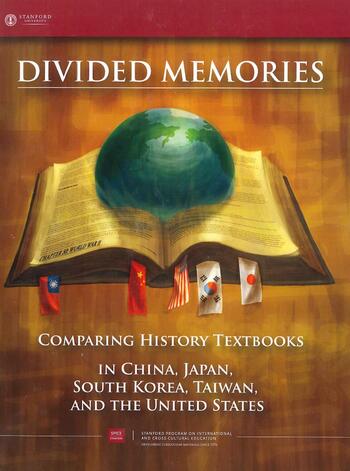
"Formal education is a powerful force in shaping our historical understandings," Sneider noted. "We wanted to look at the textbooks that have the most impact and usage."
A 2014 book, Confronting Memories of World War II: European and Asian Legacies, which was co-edited by Shin, Sneider and Daniel Chirot, a sociologist with the University of Washington, compared successful European WWII reconciliations with lagging Asian efforts. Another book, Divided Lenses, published earlier this year, examined the impact of dramatic film and other forms of popular culture on wartime memory. A new book is due out this summer, Divergent Memories: Opinion Leaders and the Asia-Pacific War, which focuses on leaders in politics, the media and academia in Japan, China, South Korea and the U.S.
The Divided Memories project aims to generate discussions and collaborations among those who create "historical memories" – educators, policymakers and government leaders. One report that grew out of such dialogues included suggestions for reconciliation:
- Create supplementary teaching materials on the issue.
- Launch dialogues among Asian, American and European historians.
- Offer educational forums for journalists, policymakers and students.
- Conduct museum exchanges and create new museums, such as one wholly dedicated to WWII reconciliation in Asia.
- Increase student exchanges among all the countries involved.
History is reflected in today's geopolitics, as noted in the revived disputes by these nations over rival claims to islands in the South China Sea and elsewhere. Without resolution, these disagreements can flare up into military conflicts, Sneider wrote.
"The question of history taps into sensitive and deeply rooted issues of national identity," he noted.
Whether recounting Japanese atrocities in China, China's exaggerated account of its Communist fighters' role in World War II, or the U.S. decision to drop atomic bombs on Japan, no nation is immune to re-creating the past to further its own interests today, Sneider wrote.
For example, Divided Memories research on Chinese textbooks shows how the Chinese government in recent decades embarked on a "patriotic education" campaign to indoctrinate young people by exaggerating its role in Japan's WWII defeat. This narrative suits the nationalistic desires of a Chinese government no longer exclusively motivated by communist ideology, Sneider said.
One project of APARC and its Japan Program that was also an outgrowth of Divided Memories involved Stanford scholars urging Japanese Prime Minister Shinzo Abe to show "clear, heartfelt remorse" in a 2015 speech on the 70th anniversary of the end of WWII. A 15-page report featured hypothetical statements suggesting what Abe might say to make amends for Japanese actions in China and Korea.
"While we cannot claim to have directly influenced the prime minister, his statement did go further in the direction of an expression of remorse over the war and the need to continue to look clearly and honestly at the past than many expected," said Sneider.
Image
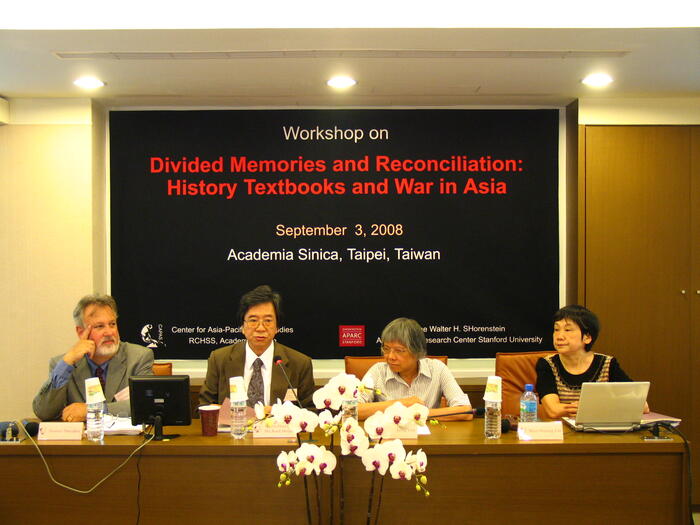
A workshop on history textbooks co-hosted by Shorenstein APARC and Academia Sinica's Center for Asia-Pacific Area Studies takes places in Taipei, Sept. 3, 2008.
Generations and grievances
Consciousness-raising on other fronts, however, is getting results, thanks to Stanford's Divided Memories project. A 2015 landmark agreement between Japan and South Korea over the WWII "comfort women" dispute was reached due to extensive U.S. involvement. Comfort women were women and girls who were forced into sexual slavery by the Imperial Japanese Army in occupied territories before and during World War II.
In an article, Sneider explained how the U.S. perceived that the dysfunctional relationship between South Korea and Japan over this issue, among others, threatened to undermine American strategic interests in Asia.
Shin highlights the importance of U.S. involvement. "The U.S. is not just an outsider to historical and territorial disputes in the region," he said. "From a geopolitical perspective, the U.S. has done a wonderful job in reviving the devastated region into a prosperous one after 1945, but from a historical reconciliation perspective, the U.S. has done a poor job."
He suggests that America should "play a constructive role in promoting historical reconciliation" among the countries involved. And so, the Divided Memories project has included the United States in its efforts.
According to Sneider, Divided Memories is unique among all reconciliation projects for its emphasis on the inclusion of the U.S.; comparative analyses across countries; and real-world policy impacts. As part of the Shorenstein research center, it is housed within Stanford's Freeman Spogli Institute for International Studies.
"This project reflects what Stanford, our center and the Freeman Spogli Institute are all about – true interdisciplinary research and engagement," Sneider said.
Clifton Parker is a writer for the Stanford News Service.
Hero Image

Japanese soldiers in Shanghai, March 23, 1927 | A Stanford project encourages World War II reconciliation and historical accuracy about the conflict and its consequences in Japan, China, Korea, Taiwan and the United States. Progress has been made on classroom textbooks and scholarly discussions and exchanges.
Getty Images
All News button
1
Advancing U.S.-Japan-ROK Trilateral Cooperation: A U.S. Perspective
Paragraphs
An analysis of the foundations and future of the trilateral relationship from a U.S. perspective, highlighting the critical role the United States has played in mediating tensions between the Republic of Korea and Japan.
The essay is also part of an expanded NBR Special Report with co-authors Yul Sohn and Yoshihide Soeya that offers insights into both the past and future of trilateral cooperation and provides recommendations for leaders in all three nations to move relations foward.
All Publications button
1
Publication Type
Policy Briefs
Publication Date
Journal Publisher
National Bureau of Asian Research (NBR)
SJIL 2016 Symposium (Day 2)-- Adjudicating Across Borders: Contemporary Challenges in International Arbitration
-
Stanford Journal of International Law
Annual Symposium
Saturday, April 30th 9am - 5pm
Breakfast
Procedure and Due Process in International Arbitration
Investor-State Arbitration: Here to Stay?
Lunch
Arbitration in Emerging Markets
Reception
Please RSVP here or contact Lbaker15@stanford.edu
This event is co-sponsored by The Europe Center.
Stanford Law School Room 290
Crown Quadrangle, 559 Nathan Abbott Way
Conferences
Making sense of the new North Korea crisis
News Type
News
Date
Paragraphs
North Korea’s fourth test of a nuclear device on February 6 and its rocket launch four weeks later in defiance of UN Security Council resolutions have caused a new sense of crisis on the Korean Peninsula. As if the tests themselves weren’t sufficiently provocative, Pyongyang is now claiming to have a hydrogen bomb and is threatening, if challenged, to launch a nuclear attack on both the United States and its ally South Korea. Whatever the exact state of North Korea’s capabilities, the tests underlined two basic facts: Pyongyang’s apparent determination to continue its efforts until it can indeed one day credibly threaten the United States with nuclear attack, and the international community’s resolve never to accept North Korea as a nuclear weapons state.
The international community responded with unprecedentedly tough sanctions against Pyongyang. On March 2, the UN Security Council passed Resolution 2270. It targets the hard currency that Pyongyang desperately needs to realize its byeongjin strategy of simultaneously trying to grow its economy and continuing nuclear weapons development. In addition, a number of countries, including the United States and Japan, introduced their own new bilateral sanctions. Perhaps most dramatically, South Korea on February 10 effectively permanently closed its decade-long joint North-South industrial park in the city of Kaesong in North Korea. It was the last project putting significant amounts of South Korean cash into the hands of the North Korean leadership.
North Korea’s response to the international community has included issuing even more threats, testing a series of new missiles, and sentencing an American college student to fifteen years’ imprisonment, allegedly for trying to filch a propaganda poster.
To help make sense of the new North Korea crisis, please stay tuned to this page for Korea Program Associate Director David Straub’s analysis and commentary. Straub is a former senior American diplomat whose thirty-year career focused on Korean affairs. His experiences include participation in the Six Party Talks and accompanying former President Clinton to Pyongyang in 2009 for a meeting with then-leader Kim Jong Il.
Latest Commentaries
In an interview with Radio Free Asia, Straub discusses the background and implications of the recent defections to South Korea of workers in North Korea's restaurants in China.
In a recent public lecture at Stanford, Straub explains why the critics of the Obama administration are wrong, and forecasts how the next U.S. administration is likely to approach the North Korea problem.
Straub tells NK News, a subscription-based website for the North Korea expert community, that the United States government may eventually have to further discourage or even ban American tourism to North Korea to protect citizens from arbitrary incarceration and prevent Pyongyang from blackmailing Washington for their release.
In an interview with the University of Virgina's student newspaper, Straub discusses North Korea's imprisonment of UV student Otto Warmbier for allegedly attempting to steal a poster inscribed with the slogan "Let's firmly arm ourselves with Kim Jong-il patriotism!” Straub explains how the alleged offense fits in with the cult of personality surrounding the Kim Il Sung family dynasty.
Overall Situation
In the aftermath of North Korea’s latest nuclear test, Straub joined Stanford colleagues in analyzing its import and discussing possible policy responses, in an interview published by the Stanford Report.
In an interview with South Korean newspaper Segye Ilbo (in Korean) immediately following North Korea’s latest nuclear test, Straub argued that South Korea had the stature and ability to lead the international community in imposing greater costs on North Korea. His recommendations included considering closing the Kaesong industrial park.
Straub told the Washington Post that calls by some South Koreans for their country to develop its own nuclear weapons to counter the North were mostly a media phenomenon. Responsible South Korean leaders know that pursuing nuclear weapons would be disastrous for their country.
Sanctions
Straub told Voice of America’s Korea Service (in Korean) that the new UN Security Council sanctions reflected years of preparation by the Obama administration and would significantly increase the psychological pressure on North Korea’s leaders to abandon their pursuit of nuclear weapons.
Kaesong Closure
In an interview featured on the front page of Chosun Ilbo (in Korean), South Korea’s biggest newspaper, Straub supported South Korean President Park’s controversial decision to close the Kaesong industrial park in North Korea.
Peace Treaty Proposals
Straub told Associated Press that North Korea’s proposal for a peace treaty with the United States was a non-starter in Washington as long as Pyongyang continued to pursue nuclear weapons.
North Korea’s Incarceration of American Citizens
In the wake of North Korea's sentencing of University of Virginia student Otto Frederick Warmbier to fifteen years' imprisonment of hard labor for allegedly trying to steal a propaganda poster, Straub talked with a reporter from the University of Virginia's student newspaper about the case. Straub draws on his experience of leading the office of Korean affairs at the U.S. Department of State to discuss the conditions faced by Americans incarcerated in North Korea as well as North Korean intentions.
Hero Image

A factory inside the Kaesong Industrial Zone. South Korea’s closure of the massive joint industrial park reflected its conclusion that much stronger international pressure is required to force Pyongyang to give up its nuclear weapons program.
John Everard
All News button
1
The January Taiwan Elections and the Implications for Cross-Strait Relations
Related Multimedia


Stanford experts discuss Sino-American relations in wake of North Korea provocations
- Read more about Stanford experts discuss Sino-American relations in wake of North Korea provocations
News Type
Commentary
Date
Paragraphs
Stanford experts from the Shorenstein Asia-Pacific Research Center (APARC) spoke with media in Asia and the United States about the dynamics on the Korean Peninsula following recent provocations by North Korea; a roundup of those citations is below.
The United Nations imposed a new set of sanctions against North Korea on March 2 in response to the country’s fourth nuclear test in January and subsequent rocket launch in February of this year. Shorenstein APARC Director Gi-Wook Shin offered his view in an interview with Dong-a Ilbo:
“The new sanctions are unprecedentedly strong and comprehensive, but the dominant view is pessimistic,” he said, emphasizing that the sanctions’ effectiveness stands largely on the shoulders of China, which is North Korea’s largest trading partner.
“Only if China doesn't fizzle out after a few months – but continuously enforces the sanctions – will we see any meaningful effect,” he said.
Shin also called upon South Korea to play a leadership role in dealing with North Korea because the United States has only limited interest in solving the nuclear problem, and China, will not change its approach and continue to move according to its own interests.
Shin relayed a similar message in an interview with Maeil Shinmun last December. South Korea must break from its own perception that it is the “balancer” between China and the United States. South Korea, often described as a “shrimp among whales,” should instead strive to play a larger role as a “dolphin,” he said.
Furthermore, Shin told Maeil that the U.S.-Korea relationship and the U.S.-China relationship are very different from each other, and should be viewed as they are. He pointed out that the U.S.-Korea relationship is an alliance where the two countries act accordingly as one body, whereas the China-Korea relationship is a strategic partnership insofar as the two countries cooperate on selective issues of mutual interest.
In a separate interview with the Associated Press, David Straub, associate director of the Korea Program, was asked about the possibility of peace talks with North Korea as an alternative to or parallel with the U.N. sanctions. Straub said “it would not make sense” and that “there is no support for such an approach in Washington” because of the strategic partnership between China and North Korea. He also told Voice of America that the new sanctions will significantly increase the political, diplomatic, and psychological pressures on North Korea's leaders to rethink their pursuit of nuclear weapons.
Hero Image

The U.N. Security Council unanimously adopts resolution 2270, imposing additional sanctions on North Korea in response to that country’s continued pursuit of a nuclear weapons and ballistic missile program, March 2, 2016.
United Nations
All News button
1
China and North Korea have ulterior motives, Straub says
News Type
Commentary
Date
Paragraphs
David Straub, associate director of the Korea Program, tells AP that China and North Korea have ulterior motives in demanding the replacement of the Korean peninsula armistice agreement with a peace treaty.
All News button
1
Take Action: Global Refugee Crisis
News Type
Commentary
Date
Paragraphs
At the March 1st Stanford OpenXChange event, “When the World is Aflame,” FSI Director and Senior Fellow, Michael McFaul challenged students and the campus community to get informed and get involved with global issues that they are passionate about. As a response to overwhelming interest, we present ways to get engaged on the Syrian Refugee Crisis, and refugees worldwide. The most important way to get involved is to know something. Educate yourself about the situation. Read the news, know the push and pull factors, and know the role that your government, international NGOs, intergovernmental organizations, and your community play in supporting refugees around the world.
How big is the current global refugee crisis?
The UN High Commissioner for Refugees estimates that as of 2015, there are 14.4 million refugees around the world, and an additional 32.3 million internally displaced people (IDP) living within the borders of their own countries. The total number of displaced people worldwide is the highest it has been since the end of World War II. At 4.8 million people, Syrian refugees make up one third of the total global refugees right now. However, large numbers of refugees are forced to move because of conflicts, ethnic persecution and climate change around the world, including large numbers from war in Afghanistan and the horn of Africa, criminal violence in Central America, ethnic conflicts in Southeast Asia, and rising sea levels on the Pacific Islands.
What has caused the surge in refugees from Syria?
Refugees don’t choose to leave. Syrians are fleeing a complex civil uprising and oppressive government actions. Taking the time to understand the root causes of this crisis is one of the most valuable things you can do. This is as simple as reading the news. For background on the Syrian civil war, check out summary pieces from international news organizations, such as “The story of the conflict” from the BBC, “The confused person’s guide to the Syrian Civil War” from the Atlantic, or “The war in Syria explained in five minutes” from the Guardian. Additionally, writer Jackie Roche and cartoonist/illustrator Audrey Quinn created a short graphic novel on “Syria’s Climate Conflict.” Explore the related articles!
Where do refugees go?
Many refugees do not have a passport or legal travel document and cannot obtain one from their government. Unable to board a plane, they flee their country of origin over land or water. As a result, almost half (1.8 million) of Syria’s refugees currently reside in neighboring Turkey, and over a million more in tiny Lebanon, where one fifth of the country’s population is now from Syria. The UNHCR maintains robust statistical datasets on these trends.
How easy is it to get refugee status in the U.S.?
In a word, complicated. So complicated, in fact, that the White House put together this rather pessimistic infographic on the complex and discouraging process of gaining refugee entry into the U.S. The American Immigration Council, a nonpartisan organization, has prepared this more simplified fact sheet on U.S. refugee law and policy.
What can you do right now?
On October 8, 2015, President Obama put out a call to #AidRefugees. There are many ways, both great and small, that you can take up that call to action right here on campus. Get involved with one of the on-campus organizations engaged in advocacy. Enroll in a course on refugees. Attend an event on the refugee crisis. Donate to an international organization working with refugees. Volunteer for a Bay Area non-profit serving refugee communities. Learn about technological innovations that are improving the lives of displaced people. Organize a discussion group in your dorm or community. Write a letter to your congressperson. Tell people about the issue. We have provided a list of links below to help you get involved.
On-Campus Organizations
-
American Middle East Network for Dialogue at Stanford (AMENDS)
-
Stanford in Government (which sponsors summer internships with UNHCR)
Spring Quarter Courses
International Organizations*
Innovators
-
Better Shelter, partnered with IKEA and UNHCR to provide better temporary shelter for refugees.
-
EduApp4Syria, a competition to develop a smartphone-based education app for Syrian children
-
Humanitarian Education Accelerator for cutting-edge education innovations that are ready to scale in emergencies
Bay area organizations*
-
Catholic Charities of Santa Clara County (San Jose)
-
International Rescue Committee in Northern California (San Francisco, Oakland, San Jose)
-
PARS Equality Center (Menlo Park)
-
Refugee Transitions (San Francisco, Oakland, San Jose)
-
San Francisco Coalition of Asylee, Immigrant, and Refugee Services
Still not satisfied? Sign up for FSI's Student Programs Newsletter or follow us on Facebook.
*FSI does not directly endorse any of these organizations.
All News button
1
16th Korea-U.S. West Coast Strategic Forum
-
The sixteenth session of the Strategic Forum brings together distinguished South Korean and U.S. West Coast-based American scholars, experts, and former officials to discuss the U.S.-South Korean alliance, North Korea, and regional dynamics in Northeast Asia. The session is hosted by the Korea Program in association with The Sejong Institute, a top South Korean think tank.
Conferences