Security

FSI scholars produce research aimed at creating a safer world and examing the consequences of security policies on institutions and society. They look at longstanding issues including nuclear nonproliferation and the conflicts between countries like North and South Korea. But their research also examines new and emerging areas that transcend traditional borders – the drug war in Mexico and expanding terrorism networks. FSI researchers look at the changing methods of warfare with a focus on biosecurity and nuclear risk. They tackle cybersecurity with an eye toward privacy concerns and explore the implications of new actors like hackers.

Along with the changing face of conflict, terrorism and crime, FSI researchers study food security. They tackle the global problems of hunger, poverty and environmental degradation by generating knowledge and policy-relevant solutions. 

-

Image
jacob ward photo with the loop book cover next to him on a blue background

Join us on Tuesday, April 19 from 12 PM - 1 PM PT for a book talk on “The Loop: How Technology is Creating a World without Choices and How to Fight Back” featuring Jacob Ward from NBC News, in conversation with Nate Persily of the Cyber Policy Center.  This weekly seminar series is jointly organized by the Cyber Policy Center’s Program on Democracy and the Internet and the Hewlett Foundation’s Cyber Initiative.

In The Loop: How Technology is Creating a World without Choices and How to Fight Back, Jake argues that AI is about to do to our ability to make decisions for ourselves what Google maps did to our ability to navigate. Drawing on interviews with over 100 scientists and 10-years of front-line reporting from the cutting edge of behavior-shaping technology, Jake’s book is a warning about our growing reliance on AI, and an encouragement to protect the best parts of being human.

Jacob Ward is a correspondent for NBC News, reporting for the TODAY show, Nightly News, MSNBC, and NBC News Now on the unanticipated consequences of science and technology in our lives. From 2018 to 2019, Jacob was a fellow at Stanford University’s Center for Advanced Study in the Behavioral Sciences, along with its partner the Berggruen Institute, which gave him space and companionship on the Stanford campus to write The Loop, his book about the effects of artificial intelligence on human decision making, with Hachette Book Group. Between 2016 and 2020, Jacob hosted a landmark four-hour television series on the science and implications of bias. Prior to that, he was a television correspondent for Al Jazeera, covering science and technology in the US and around the world. He was also editor-in-chief of Popular Science, the world’s largest science and technology publication.

Nathaniel Persily is the James B. McClatchy Professor of Law at Stanford Law School, with appointments in the departments of Political Science, Communication, and FSI.  Prior to joining Stanford, Professor Persily taught at Columbia and the University of Pennsylvania Law School, and as a visiting professor at Harvard, NYU, Princeton, the University of Amsterdam, and the University of Melbourne. Professor Persily’s scholarship and legal practice focus on American election law or what is sometimes called the “law of democracy,” which addresses issues such as voting rights, political parties, campaign finance, redistricting, and election administration. He has served as a special master or court-appointed expert to craft congressional or legislative districting plans for Georgia, Maryland, Connecticut, New York, North Carolina, and Pennsylvania.  He also served as the Senior Research Director for the Presidential Commission on Election Administration. His current work, for which he has been honored as a Guggenheim Fellow, Andrew Carnegie Fellow, and a Fellow at the Center for Advanced Study in the Behavioral Sciences, examines the impact of changing technology on political communication, campaigns, and election administration.  He is codirector of the Stanford Cyber Policy Center, Stanford Program on Democracy and the Internet, and the Stanford-MIT Healthy Elections Project, which supported local election officials in taking the necessary steps during the COVID-19 pandemic to provide safe voting options for the 2020 election. He is also a member of the American Academy of Arts and Sciences, and a commissioner on the Kofi Annan Commission on Elections and Democracy in the Digital Age.

Nathaniel Persily
Jacob Ward
Seminars
Authors
Larry Diamond
News Type
Commentary
Date
Paragraphs

In these next few minutes, I’d like to reflect on the moment we are at in world history, and what it means for the future of democracy. I know you have already heard a lot today, and will hear more tomorrow, about the war in Ukraine and its global implications. Here is my perspective.

Russia’s brutal and unprovoked aggression against Ukraine, which is now about to enter its seventh week, is the most important event in the world since the end of the Cold War.  9/11 changed our lives in profound ways, and even changed the structure of the U.S. Government. It challenged our values, our institutions, and our way of life. But that challenge came from a network of non-state actors and a dead-end violent jihadist ideology that were swiftly degraded. The Russian invasion of Ukraine, and the larger rising tide of authoritarian power projection, represent the return of great power competition. And more, they denote a new phase of what John F. Kennedy called in his 1961 inaugural address a “long twilight struggle” between two types of political systems and governing philosophies. Two years after JFK’s address, Hannah Arendt put it this way in her book, "On Revolution":

No cause is left but the most ancient of all, the one, in fact, that from the beginning of our history has determined the very existence of politics, the cause of freedom vs. tyranny.

That is what the war in Ukraine, the war FOR Ukraine, is about: not about Ukraine someday joining NATO, but about Ukraine — a country so important to Russia’s cultural heritage and historical self-conception — becoming a free country, a functioning liberal democracy, and thus a negation of and an insult to everything that Vladimir Putin and his kleptocratic Kremlin oligarchy cynically represent.

But it is not simply a “Resurrected Russia” (as Kathryn Stoner has termed it) that is counterposed to the global cause of freedom. The greater long-term threat comes from China’s authoritarian Communist party-state. China has the world’s fastest growing military and the most pervasive and sophisticated system of digital surveillance and control. Its pursuit of global dominance is further aided by the world’s most far-reaching global propaganda machine and a variety of other mechanisms to project sharp power — power that seeks to penetrate the soft tissues of democracy and obtain their acquiescence through means that are covert, coercive, and corrupting. It is this combination of China’s internal repression and its external ambition that makes China’s growing global power so concerning. China is the world’s largest exporter, its second largest importer, and its biggest provider of infrastructure development. It is also the first major nation to deploy a central bank digital currency; and it is challenging for the global lead in such critical technologies as AI, quantum computing, robotics, hypersonics, autonomous and electric vehicles, and advanced telecommunications.


A narrative has been gathering that democracies are corrupt and worn out, lacking in energy, purpose, capacity, and self-confidence. This has been fed by real-world developments which have facilitated the rise of populist challengers to liberal democracy.
Larry Diamond
Mosbacher Senior Fellow in Global Democracy at FSI

While China now innovates in many of these technologies, it also continues to acquire Western intellectual property through a coordinated assault that represents what former NSA Director General Keith Alexander calls “the greatest transfer of wealth in human history.” And every technological innovation that China can possibly militarize it does, through a strategy of “civil-military fusion.” With this accumulated power, Beijing plans to force Asia’s most vibrant liberal democracy, Taiwan, to “reunify with the motherland.” It also seeks to establish unilateral Chinese control over the resources and sea lanes of the South China Sea, and then gradually to push the United States out of Asia.

Russia’s aggression must be understood in this broader context of authoritarian coordination and ambition, challenging the values and norms of the liberal international order, compromising the societal (and where possible, governmental) institutions of rival political systems, and portraying Western democracies — and therefore, really, democracy itself — as weak, decadent, ineffectual, and irresolute. In this telling, the democracies of Europe, Asia, and North America — especially the United States — are too commercially driven, too culturally fractured, too riven by internal and alliance divisions, too weak and effeminate, to put up much of a fight.

At the same time, China, Russia, and other autocracies have been denouncing the geopolitical arrogance of the world’s democracies and confidently declaring an end to the era in which democracies could “intervene in the internal affairs of other countries” by raising uncomfortable questions about human rights. 

On the eve of the Beijing Winter Olympics on February 4, Vladimir Putin and Xi Jinping issued a joint statement denouncing Western alliances and declaring that there were no limits to the strategic partnership between their two countries. Many analysts believe Putin told Xi then that he was about to invade Ukraine and that Xi probably said, okay, just wait till the Olympics are over and make it quick. 

Four days after Xi’s closing Olympics fireworks display, Putin launched his own fireworks by invading Ukraine. It has been anything but successful or quick. Xi cannot possibly be pleased by the bloody mess that Putin has made of this, which helps to explain why China twice abstained in crucial UN votes condemning the Russian invasion, rather than join the short list of countries that stood squarely with Russia in voting no: Belarus, Eritrea, Syria, and North Korea. Xi must think that Putin’s shockingly inept and wantonly cruel invasion is giving authoritarianism a bad name.


Russia’s aggression must be understood in this broader context of authoritarian coordination and ambition, challenging the values and norms of the liberal international order and portraying Western democracies as weak.
Larry Diamond
Mosbacher Senior Fellow in Global Democracy at FSI

It is also costing China a lot of money in global trade at a time when China’s economic growth rate has slowed dramatically. And it’s undermining the narrative China was trying to push that the autocracies know what they are doing and represent the wave of the future. Moreover, this is coming at a moment when one of China’s two most important cities, Shanghai, is gripped by panic and a substantial lockdown over the Covid-19 virus, which Xi’s regime has no other means to control except lockdown, because it has refused to admit that the vaccines it developed are largely ineffective against the current strains of Covid, and instead import the vaccines that work.

All of this explains why this moment could represent a possible hinge in history as significant as the 1989-91 period that ended the Cold War. 2021 marked the fifteenth consecutive year of a deepening democratic recession. In both the older democracies of the West and the newer ones of the global South and East, the reputation of democracy has taken a beating. A narrative has been gathering that democracies are corrupt and worn out, lacking in energy, purpose, capacity, and self-confidence. And this has been fed by real-world developments, including the reckless and incompetent US invasion of Iraq, the 2008 financial crisis, steadily rising levels of economic inequality, widespread job losses, economic insecurity and status anxiety due to globalization and technological change, and the challenges of managing cultural diversity amid expanding immigration. These factors have fed or at least facilitated the rise of populist challengers to liberal democracy and the decay of democratic norms and institutions across many democracies — rich, poor, and middle-income. 

The Germans have a word for these trends in the global narrative:  “zeitgeist” — the spirit of the times, or the dominant mood and beliefs of a historical era. In the roughly 75 years since WWII, we have seen five historical periods, each with their own dominant mood. From the mid-1940s to the early 60s, the mood had a strong pro-democracy flavor that went with decolonization. It gave way in the mid-1960s to post-colonial military and executive coups, the polarization and waste of the Vietnam War, and a swing back to realism, with its readiness to embrace dictatorships that took “our side” in the Cold War. Then, third, came a swing back to democracy in southern Europe, Latin America, and East Asia, and a new wave of democracy, from the mid-1970s to around 1990. That period of expanding democracy was then supercharged by a decisively pro-democratic zeitgeist from 1990 to 2005, the so-called unipolar moment in which one liberal democracy, the U.S., predominated. That period ended in the Iraq debacle, and for the last 15 years, we have been in the tightening grip of a democratic recession and a nascent authoritarian zeitgeist. 

Could Russia’s criminal, blundering invasion of Ukraine launch a new wave of democratic progress and a liberal and anti-authoritarian zeitgeist? It could, but it will require the following things.


Freedom is worth fighting for, and democracy, with all its faults, remains the best form of government.
Larry Diamond
Mosbacher Senior Fellow in Global Democracy at FSI

First, Russia must fail in its bid to conquer and extinguish Ukraine. The United States and NATO must do everything possible, and much more than we are doing now, to arm and assist Ukraine militarily, and to punish Russia financially and economically.

Second, we must wage a more effective and comprehensive battle of information and ideas to expose Russia’s mendacity and criminality and to document its war crimes, not only before the court of public opinion, but in ways that reach individual Russians directly and creatively. We need an intense campaign of technological innovation to circumvent authoritarian censorship and empower Russian, Chinese, and other sources that are trying to report the truth about what is happening and to promote critical thinking and the values of the open society. In general, we need to promote democratic narratives and values much more imaginatively and resourcefully. The message of the Russian debacle in Ukraine is an old one and should not be difficult to tell: autocracies are corrupt and prone to massive policy failures precisely because they suppress scrutiny, independent information, and policy debate. Democracies may not be the swiftest decision makers, but they are over time the most reliable and resilient performers.

Third, we must ensure that we perform more effectively as democracies, and with greater coordination among democracies, to meet the challenges of developing and harnessing new technologies, creating new jobs, and reducing social and economic inequalities.

Fourth, to win the technological race, for example in semiconductors, artificial intelligence, biomedicine, and many other fields of science, engineering, and production, we must open our doors more widely to the best talent from all over, including China. We URGENTLY need immigration reform to facilitate this. As our late colleague George Shultz said:  Admit the best talent from all over the world to our graduate programs in science and engineering, and then staple green cards to their diplomas.

Finally, we have to reform and defend our democracy in the United States so that it can function effectively to address our major domestic and international challenges, and so that American democracy can once again be seen as a model worth emulating. We cannot do this without reforming the current electoral system of "first-past-the-post" voting and low-turnout party primaries, which has become a kind of death spiral of political polarization, distrust, and defection from democratic norms.

I believe we entered a new historical era on Feb 24. What the Ukrainian people have suffered already in these seven weeks has been horrific, and it will get worse. But the courage and tenacity of their struggle should renew our commitment not only to them but also to ourselves—that freedom is worth fighting for, and that democracy, with all its faults, remains the best form of government.

Larry Diamond

Larry Diamond

Mosbacher Senior Fellow in Global Democracy at FSI
Full Profile

Read More

Some of the original Ukrainian alumni from the Draper Hills Summer Fellowship gather in Kyiv in 2013.
News

A History of Unity: A Look at FSI’s Special Relationship with Ukraine

Since 2005, the Freeman Spogli Institute for International Studies has cultivated rich academic ties and friendships with Ukrainian scholars and civic leaders as part of our mission to support democracy and development domestically and abroad.
A History of Unity: A Look at FSI’s Special Relationship with Ukraine
Vladamir Putin and Xi Jinping shake hands.
News

Understanding the Global Rise of Authoritarianism

National security analyst and veteran podcaster Ben Rhodes joins Michael McFaul on World Class to discuss his new book, After the Fall: Being American in the World We've Made, and the reasons nationalism and authoritarianism are on the rise across the globe.
Understanding the Global Rise of Authoritarianism
Larry Diamond, center, with the Mosbacher family - Nancy, Bruce, Emily and Jack.
News

Larry Diamond Named Mosbacher Senior Fellow in Global Democracy at the Freeman Spogli Institute for International Studies

CDDRL’s Larry Diamond, a world-renowned expert on comparative democracy, is recognized for a career of impact on students, policymakers and democratic activists around the world.
Larry Diamond Named Mosbacher Senior Fellow in Global Democracy at the Freeman Spogli Institute for International Studies
Hero Image
Larry Diamond speaking in the Bechtel Conference Center in Encina Hall
Larry Diamond, the Mosbacher Senior Fellow in Global Democracy at FSI, speaks in the Bechtel Conference Center at the Freeman Spogli Institute for International Studies at Stanford University.
CDDRL
All News button
1
Subtitle

Speaking at the April 2022 meeting of the FSI Council, Larry Diamond offered his assessment of the present dangers to global democracy and the need to take decisive action in support of liberal values.

-

Image
larry diamond, charles mok, jason hsu photos for event on april 12 on blue background
Join us on Tuesday, April 12 from 12 PM - 1 PM PT for “Internet Freedom Under Threat: The Divergent Paths of Taiwan and Hong Kong” featuring Charles Mok, Visiting Scholar at the Global Digital Policy Incubator and Jason Hsu, Chief Initiative Officer at Taiwan AI Labs, in conversation with Larry Diamond, co-lead for the Global Digital Policy Incubator and Senior Fellow at the Freeman Spogli Institute for International Studies. This weekly seminar series is jointly organized by the Cyber Policy Center’s Program on Democracy and the Internet and the Hewlett Foundation’s Cyber Initiative.

About The Seminar: 

Both Taiwan and Hong Kong face increasing threats of online misinformation and cybersecurity risks, but the freedoms of the Internet for their citizens appear to be heading in opposite directions. From censorship and surveillance to influencing public opinions and elections, what are the lessons from the experiences of Hong Kong and Taiwan for the world?

Our speakers will provide an overview of the state of internet freedom in Hong Kong from before to after the enactment of the National Security Law in 2020. Censorship and surveillance are on the rise, and a misinformation law is looming on the horizon, to give the government and the police even more unfettered power. We will also cover the techniques used by cyber intrusion groups aimed at toppling election campaigns. Drawing research work from Taiwan AI Labs, we elaborate on how AI is used to track misinformation on social media particularly on Chinese-language speaking portals.

Jason Hsu is Senior Research Fellow at The Ash Center for Democratic Governance and Innovation Harvard Kennedy School. From 2016 to 2020 Hsu served as Legislator At-Large in Taiwan’s Legislative Yuan (national parliament) overseeing technology policy, development, entrepreneurship and innovation. Known as Crypto Congressman, Jason is credited for setting up Asia Blockchain Alliance (ABA),Taiwan Parliamentary Coalition for Blockchain (TPCB) and Self- Regulatory Organization(SRO).

Charles Mok is a Visiting Scholar at the Global Digital Policy Incubator. Prior to his time at Stanford, Charles served as an elected member of the Legislative Council in the Hong Kong Special Administrative Region, representing the Information Technology functional constituency, for two terms from 2012 to 2020. He served alternatively as chair and vice chair of the Information Technology and Broadcasting Panel from 2016 to 2020. As a lawmaker, Charles was a champion for policies and legislations on privacy, open data, freedom of expression and information, cybersecurity, innovation, fintech, electronic health records, as well as human rights and democracy.

Larry Diamond is a senior fellow at the Hoover Institution, the Mosbacher Senior Fellow in Global Democracy at the Freeman Spogli Institute for International Studies (FSI), and a Bass University Fellow in Undergraduate Education at Stanford University. He is also professor by courtesy of Political Science and Sociology at Stanford. He leads the Hoover Institution’s programs on China’s Global Sharp Power and on Taiwan in the Indo-Pacific Region.  At FSI, he leads the Program on Arab Reform and Democracy, based at the Center on Democracy, Development and the Rule of Law, which he directed for more than six years.  He also co-leads with (Eileen Donahoe) the Global Digital Policy Incubator, based at FSI’s Cyber Policy Center. He is the founding coeditor of the Journal of Democracy and also serves as senior consultant at the International Forum for Democratic Studies of the National Endowment for Democracy. His research focuses on democratic trends and conditions around the world and on policies and reforms to defend and advance democracy.

Larry Diamond
0
Research Scholar, Global Digital Policy Incubator
charles_mok.jpg

Charles is a Research Scholar at the Global Digital Policy Incubator of the Center on Democracy, Development and the Rule of Law at Stanford University, a member of the Board of Trustees of the Internet Society, and a board member of the International Centre for Trade Transparency and Monitoring. Charles served as an elected member of the Legislative Council in the Hong Kong Special Administrative Region, representing the Information Technology functional constituency, for two terms from 2012 to 2020. In 2021, he founded Tech for Good Asia, an initiative to advocate positive use of technology for businesses and civil communities. As an entrepreneur, Charles co-founded HKNet in 1994, one of the earliest Internet service providers in Hong Kong, which was acquired by NTT Communications in 2000. He was the founding chair of the Internet Society Hong Kong, honorary president and former president of the Hong Kong Information Technology Federation, former chair of the Hong Kong Internet Service Providers Association, and former chair of the Asian, Australiasian and Pacific Islands Regional At-Large Organization (APRALO) of ICANN. Charles holds a BS in Computer and Electrical Engineering and an MS in Electrical Engineering from Purdue University.

Date Label
Jason Hsu
Seminars
-
Banner card for the 2022 Oksenberg Conference

This year’s Oksenberg Conference, "Prospects for the New Sino-Russian Partnership,” explores the “why” and “so what” of this newly bolstered alliance that has been declared as a partnership “with no limits.” What does it mean for the U.S. and other non-autocratic states? Given Russia’s invasion of Ukraine and the unprecedented economic sanctions that the US and its allies have slapped on Russia in the wake of that attack, the more immediately important question is: What does this alliance mean for China? How strong is this new bond with Russia? China now finds itself in an extremely difficult position as it tries to protect its own economic relationships with the US and its allies in Europe and Asia. What can or will China do about Russia? How was this alliance sold to the domestic audience of each country?

A roundtable of experts on China and Russia, including those with extensive government experience, joins us to examine this critically important relationship and address the many questions that it raises. Each panelist will present 10-12 minutes of opening remarks before turning to a moderated discussion. During the last 20 minutes, the moderator will pose curated questions to the roundtable from the audience.

The Oksenberg Conference is held annually and honors the legacy of the late Stanford professor Michel Oksenberg (1938-2001), who was a Senior Fellow at Shorenstein APARC and the Freeman Spogli Institute for International Studies. Professor Oksenberg also served as a key member of the National Security Council when the U.S. normalized relations with China, and consistently urged that the U.S. engage with Asia in a more considered manner. In tribute, the Oksenberg Lecture recognizes distinguished individuals who have helped to advance understanding between the U.S. and the nations of the Asia-Pacific.

Panelists in alphabetical order:

Una Aleksandra Bērziņa-Čerenkova is a political scientist, China scholar, Head of Political Science Doctoral Programme and China Studies Centre at Rīga Stradiņš University, Head of the Asia program at the Latvian Institute of International Affairs, a member of the China in Europe Research Network (CHERN) and European Think Tank Network on China (ETNC). She has held a Senior visiting research scholar position at Fudan University School of Philosophy, Shanghai, China, and a Fulbright visiting scholar position at the Center for East Asian Studies, Stanford University. Bērziņa-Čerenkova publishes on PRC political discourse, contemporary Chinese ideology, EU-China relations, Russia-China, and BRI and her most recent monograph is Perfect Imbalance: China and Russia.

Thomas Fingar is the former first Deputy Director of National Intelligence for Analysis and Chairman of the National Intelligence Council, currently at Stanford as a Shorenstein APARC Fellow in the Freeman Spogli Institute for International Studies. From 2005-2008, he served as the first Deputy Director of National Intelligence for Analysis and, concurrently, as Chairman of the National Intelligence Council. Fingar previously served as Assistant Secretary of the State Department's Bureau of Intelligence and Research (2000-2001 and 2004-2005), Principal Deputy Assistant (2001-2003), Deputy Assistant Secretary for Analysis (1994-2000), Director of the Office of Analysis for East Asia and the Pacific (1989-1994), and Chief of the China Division (1986-1989). Fingar's most recent books are Uneasy Partnerships: China and Japan, the Koreas, and Russia in the Era of Reform (Stanford, 2017), Fateful Decisions: Choices that will Shape China’s Future, co-edited with Jean Oi (Stanford, 2020), and From Mandate to Blueprint: Lessons from Intelligence Reform (Stanford, 2021)

Alex Gabuev is a Senior Fellow at the Carnegie Endowment for International Peace. His research is focused on Russia's policy toward East and Southeast Asia, political and ideological trends in China, and China's relations with its neighbors—especially those in Central Asia. Prior to joining Carnegie, Gabuev was a member of the editorial board of Kommersant publishing house and served as deputy editor in chief of Kommersant-Vlast, one of Russia's most influential newsweeklies. He has previously worked as a nonresident visiting research fellow at the European Council on Foreign Relations (ECFR) and taught courses on Chinese energy policy and political culture at Moscow State University. Gabuev is a Munich Young Leader of Munich International Security Conference and a member of Council on Foreign and Defense Policy (Russia).

Michael McFaul is Director at the Freeman Spogli Institute for International Studies, the Ken Olivier and Angela Nomellini Professor of International Studies in the Department of Political Science, and the Peter and Helen Bing Senior Fellow at the Hoover Institution. McFaul is also an International Affairs Analyst for NBC News and a columnist for The Washington Post. He served for five years in the Obama administration, first as Special Assistant to the President and Senior Director for Russian and Eurasian Affairs at the National Security Council at the White House (2009-2012), and then as U.S. Ambassador to the Russian Federation (2012-2014). He has authored several books, most recently the New York Times bestseller From Cold War to Hot Peace: An American Ambassador in Putin’s Russia. Earlier books include Advancing Democracy Abroad: Why We Should, How We Can; Transitions To Democracy: A Comparative Perspective (eds. with Kathryn Stoner); Power and Purpose: American Policy toward Russia after the Cold War (with James Goldgeier); and Russia’s Unfinished Revolution: Political Change from Gorbachev to Putin.

Evan Medeiros is a Professor and Penner Family Chair in Asia Studies in the School of Foreign Service at Georgetown University and former top advisor on the Asia-Pacific in the Obama Administration, responsible for coordinating U.S. policy toward the Asia-Pacific across the areas of diplomacy, defense policy, economic policy, and intelligence. Prior to joining the White House, Medeiros worked for seven years as a senior political scientist at the RAND Corporation and served at the Treasury Department as a Policy Advisor-China to Secretary Hank Paulson Jr., working on the U.S.-China Strategic Economic Dialogue. Medeiros is a member of the Board of Directors of the National Committee on U.S.-China Relations, a member of the International Advisory Board of Cambridge University's Centre for Geopolitics, and a Life Member of the Council on Foreign Relations.

Jean Oi (Moderator) is the William Haas Professor of Chinese Politics in the Department of Political Science and a Senior Fellow of the Freeman Spogli Institute for International Studies (FSI) at Stanford University. She also directs the China Program at the Walter H. Shorenstein Asia-Pacific Research Center at FSI and is the founding Lee Shau Kee Director of the Stanford Center at Peking University. Oi has published extensively on political economy and the process of reform in China. Her books include State and Peasant in Contemporary China: The Political Economy of Village Government and Rural China Takes Off: Institutional Foundations of Economic Reform. Recent edited volumes include Zouping Revisited: Adaptive Governance in a Chinese County, co-edited with Steven Goldstein, and Fateful Decisions: Choices That Will Shape China's Future, co-edited with Thomas Fingar. 

Jean C. Oi

Via Zoom.

Una Aleksandra Bērziņa-Čerenkova

Freeman Spogli Institute for International Studies
Stanford University
Encina Hall, C-327
Stanford, CA 94305-6055

(650) 723-9149 (650) 723-6530
0
Shorenstein APARC Fellow
Affiliated Scholar at the Stanford Center on China's Economy and Institutions
tom_fingar_vert.jpg PhD

Thomas Fingar is a Shorenstein APARC Fellow in the Freeman Spogli Institute for International Studies at Stanford University. He was the inaugural Oksenberg-Rohlen Distinguished Fellow from 2010 through 2015 and the Payne Distinguished Lecturer at Stanford in 2009.

From 2005 through 2008, he served as the first deputy director of national intelligence for analysis and, concurrently, as chairman of the National Intelligence Council. Fingar served previously as assistant secretary of the State Department’s Bureau of Intelligence and Research (2000-01 and 2004-05), principal deputy assistant secretary (2001-03), deputy assistant secretary for analysis (1994-2000), director of the Office of Analysis for East Asia and the Pacific (1989-94), and chief of the China Division (1986-89). Between 1975 and 1986 he held a number of positions at Stanford University, including senior research associate in the Center for International Security and Arms Control.

Fingar is a graduate of Cornell University (A.B. in Government and History, 1968), and Stanford University (M.A., 1969 and Ph.D., 1977 both in political science). His most recent books are From Mandate to Blueprint: Lessons from Intelligence Reform (Stanford University Press, 2021), Reducing Uncertainty: Intelligence Analysis and National Security (Stanford University Press, 2011), The New Great Game: China and South and Central Asia in the Era of Reform, editor (Stanford University Press, 2016), Uneasy Partnerships: China and Japan, the Koreas, and Russia in the Era of Reform (Stanford, 2017), and Fateful Decisions: Choices that will Shape China’s Future, co-edited with Jean Oi (Stanford, 2020). His most recent article is, "The Role of Intelligence in Countering Illicit Nuclear-Related Procurement,” in Matthew Bunn, Martin B. Malin, William C. Potter, and Leonard S Spector, eds., Preventing Black Market Trade in Nuclear Technology (Cambridge, 2018)."

Selected Multimedia

CV
Date Label
Alex Gabuev

Encina Hall
616 Jane Stanford Way
Stanford, CA 94305-6055

0
Senior Fellow, Freeman Spogli Institute for International Studies
Ken Olivier and Angela Nomellini Professor of International Studies, Department of Political Science
Peter and Helen Bing Senior Fellow, Hoover Institution
mcfaul_headshot_2025.jpg PhD

Michael McFaul is the Ken Olivier and Angela Nomellini Professor of International Studies in Political Science, Senior Fellow at the Freeman Spogli Institute for International Studies, and the Peter and Helen Bing Senior Fellow at the Hoover Institution, all at Stanford University. He joined the Stanford faculty in 1995 and served as FSI Director from 2015 to 2025. He is also an international affairs analyst for MSNOW.

McFaul served for five years in the Obama administration, first as Special Assistant to the President and Senior Director for Russian and Eurasian Affairs at the National Security Council at the White House (2009-2012), and then as U.S. Ambassador to the Russian Federation (2012-2014).

McFaul has authored ten books and edited several others, including, most recently, Autocrats vs. Democrats: China, Russia, America, and the New Global Disorder, as well as From Cold War to Hot Peace: An American Ambassador in Putin’s Russia, (a New York Times bestseller) Advancing Democracy Abroad: Why We Should, How We Can; and Russia’s Unfinished Revolution: Political Change from Gorbachev to Putin.

He is a recipient of numerous awards, including an honorary PhD from Montana State University; the Order for Merits to Lithuania from President Gitanas Nausea of Lithuania; Order of Merit of Third Degree from President Volodymyr Zelenskyy of Ukraine, and the Dean’s Award for Distinguished Teaching at Stanford University. In 2015, he was the Distinguished Mingde Faculty Fellow at the Stanford Center at Peking University.

McFaul was born and raised in Montana. He received his B.A. in International Relations and Slavic Languages and his M.A. in Soviet and East European Studies from Stanford University in 1986. As a Rhodes Scholar, he completed his D. Phil. in International Relations at Oxford University in 1991. 

CV
Date Label
Evan Medeiros
Conferences
-

LECTURE RECORDING

Bechtel Conference Center
Encina Hall
616 Jane Stanford Way
Stanford, CA 94305

Congressman Ted Lieu
Seminars
-

The Korea Program at Stanford will mark its 20-year anniversary with a conference focused on North Korean issues and South Korea’s pop culture wave (Hallyu), two aspects of Korea that continue to intrigue the public, exploring how to translate this public attention into an increased academic interest in Korea.

This event is made possible by generous support from the Korea Foundation and other friends of the Korea Program.

Bukchon Hanok village and text about Stanford's Korea Program 20th anniversary conference on May 19-20, 2022.

Featuring a keynote address by
Ban Ki-moon, former Secretary-General of the United Nations


DAY 1: Thursday, May 19, 9:00 a.m. - 5:15 p.m.

9:00-9:15 a.m.
Opening and Welcome Remarks

Gi-Wook Shin, Director of Asia-Pacific Research Center and Korea Program, Stanford
Michael McFaul, Director of the Freeman Spogli Institute for International Studies, Stanford
Gabriella Safran, Senior Associate Dean of Humanities and Arts, Stanford


9:15-10:45 a.m.
Panel on North Korea

Moderated by Yumi Moon, Associate Professor of History, Stanford

Siegfried Hecker, Professor Emeritus, Management Science and Engineering; Senior Fellow Emeritus, FSI, Stanford
Kim Sook, former ROK Ambassador to UN; Executive Director, Ban Ki-moon Foundation for a Better Future
Joohee Cho, Seoul Bureau Chief, ABC News


11:00-11:50 a.m. 
Korea Program at Stanford: Past, Present, and Future 

Moderated by Kelsi Caywood, Research Associate, Korea Program, APARC, Stanford

Paul Chang, Associate Professor of Sociology, Harvard University
Joon-woo Park, former ROK Ambassador to EU and Singapore; 2011-12 Koret Fellow
Jong Chun Woo, former president of Stanford APARC-Seoul Forum; Professor Emeritus, Seoul National University
Megan Faircloth, Senior in East Asian Languages and Cultures, Stanford


11:50 a.m.-12:30 p.m.        Lunch Break


12:30-1:30 p.m.
Keynote Address by Ban Ki-moon, former Secretary-General of the United Nations

Image
portrait of UN Secretary General Ban Ki-moon

Introduction by H.R. McMaster, former National Security Advisor; Fouad and Michelle Ajami Senior Fellow, Hoover Institution, Stanford

Moderated by Gi-Wook Shin, Director of APARC and Korea Program, Stanford


2:00-3:30 p.m.
Panel on the Korean Wave

Moderated by Dafna Zur, Associate Professor of East Asian Languages and Cultures; Director of Center for East Asian Studies, Stanford

SUHO, Leader of EXO
Angela Killoren, CEO of CJ ENM America, Inc.
Marci Kwon, Assistant Professor of Art and Art History, Stanford


3:45-5:15 p.m.
Documentaries on K-pop
 and North Korean Human Rights (teaser)*

Moderated by Haley Gordon, Research Associate, Korea Program, APARC, Stanford

Introduction of the films by Director Hark Joon Lee and Director of Photography Byeon Jaegil 

Vivian Zhu, Junior in International Relations and East Asian Studies, Stanford
Youlim Kim, Third-year PhD student in Microbiology & Immunology, Stanford
*The documentaries will not be shown on the livestream


Conference speakers
Conference speakers include (from left to right) Ban Ki-moon, Kathryn Moler, SUHO, Soo-Man Lee, Marci Kwon, Michael McFaul, Siegfried Hecker, Kim Hyong-O, Dafna Zur, H.R. McMaster, Michelle Cho, Gabriella Safran.

Day 2: Friday, May 20, 9:00 a.m. - 12:00 p.m.

9:00-10:30 a.m.
How to Translate Interest in North Korea and K-pop into Korean Studies

Moderated by Gi-Wook Shin, Director of Asia-Pacific Research Center and Korea Program

David Kang, Professor of International Relations and Business, USC
Yumi Moon, Associate Professor of History, Stanford
Michelle Cho, Assistant Professor of East Asian Studies, University of Toronto
Dafna Zur, Associate Professor of East Asian Languages and Cultures; Director of Center for East Asian Studies, Stanford


10:45 a.m.-12:00 p.m.
Future Visions of K-pop

Image
Soo-Man Lee
Keynote speech by Soo-Man Lee, Founder and Chief Producer of SM Entertainment

Introduction by Gi-Wook Shin, Director of Asia-Pacific Research Center and Korea Program

Conversation with:
Dafna Zur, Associate Professor of East Asian Languages and Cultures; Director of Center for East Asian Studies, Stanford
SUHO, Leader of EXO

Conferences
-

For spring quarter 2022, CISAC will be hosting hybrid events. Many events will offer limited-capacity in-person attendance for Stanford faculty, staff, fellows, visiting scholars, and students in accordance with Stanford’s health and safety guidelines, and be open to the public online via Zoom. All CISAC events are scheduled using the Pacific Time Zone. 

Recording


About the event: A panel of Stanford experts presents an update on the war in Ukraine. What are the costs of war and what are the prospects for peace?

Speakers: 

  • Scott Sagan​ - Co-director of the Stanford Center for International Security and Cooperation
  • Kathryn Stoner - Mosbacher Director of the Stanford Center on Democracy, Development and the Rule of Law
  • Roman Badanin - Journalist, Researcher, and Founder of Proekt
  • Yuliia Bezvershenko - Visiting Scholar, Stanford Ukrainian Emerging Leaders Program

Bechtel Conference Center
Encina Hall
616 Jane Stanford Way
Stanford, CA 94305
(Virtual to Public. Only those with an active Stanford ID may attend in person.)

Scott Sagan
Kathryn Stoner
Roman Badanin
Yuliia Bezvershenko
Seminars
Governance
-
Guarding Dictatorship: The organization, tactics, and scale of China's surveillance state

The Hoover Project on China's Global Sharp Power invites you to Guarding Dictatorship: The organization, tactics, and scale of China's surveillance state on Tuesday, April 12, 2022, from 2:00 pm - 3:00 pm PT, in partnership with CDDRL and the China Program at APARC.

China has built an extensive, sophisticated, and highly effective apparatus to monitor the activities of its population and target, in particular, perceived threats to regime security. China's "whole-of-nation" approach has produced a surveillance apparatus few dictatorships can match. The country's rapid economic growth also allows the Communist Party to upgrade the technological capabilities of this apparatus and strengthen its political monopoly. Featuring Minxin Pei (Senior Fellow, Claremont-McKenna College). Followed by a conversation with Larry Diamond (Senior Fellow, Hoover Institution, and Mosbacher Senior Fellow in Global Democracy at FSI), Jean Oi (Senior Fellow at FSI, Director of the China Program at APARC), and Glenn Tiffert (Research Fellow, Hoover Institution).

ABOUT THE SPEAKER

Minxin Pei is the Tom and Margot Pritzker '72 Professor of Government and chairman of the Government Department at Claremont McKenna College. He specializes in Chinese domestic politics, economic reform, and foreign policy. Dr. Pei is also a non-resident senior fellow at the German Marshall Fund of the United States and was the inaugural Library of Congress Chair in U.S.-China Relations (2019).

FOLLOWED BY A CONVERSATION WITH

Jean C. Oi is the William Haas Professor of Chinese Politics in the Department of Political Science and a senior fellow in the Freeman Spogli Institute for International Studies at Stanford University. She directs the China Program at the Walter H. Shorenstein Asia-Pacific Research Center (APARC) and is the Lee Shau Kee Director of the Stanford Center at Peking University.

Glenn Tiffert is a research fellow at the Hoover Institution and a historian of modern China. He co-chairs the Hoover project on China’s Global Sharp Power and works closely with government and civil society partners to document and build resilience against authoritarian interference with democratic institutions. Most recently, he co-authored and edited Global Engagement: Rethinking Risk in the Research Enterprise (2020).

MODERATED BY

Larry Diamond is a senior fellow at the Hoover Institution, ​Mosbacher Senior Fellow in Global Democracy at the Freeman Spogli Institute for International Studies (FSI), and a Bass University Fellow in Undergraduate Education at Stanford University. He co-chairs the Hoover Institution’s programs on China’s Global Sharp Power and on Taiwan in the Indo-Pacific Region.

Larry Diamond

Online via Zoom

Minxin Pei

Department of Political Science
Stanford University
616 Serra Street
Stanford, CA 94305-26044

(650) 723-2843 (650) 725-9401
0
Senior Fellow at the Freeman Spogli Institute for International Studies
William Haas Professor in Chinese Politics
jean_oi_headshot.jpg PhD

Jean C. Oi is the William Haas Professor of Chinese Politics in the department of political science and a Senior Fellow of the Freeman Spogli Institute for International Studies at Stanford University. She is the founding director of the Stanford China Program at the Walter H. Shorenstein Asia-Pacific Research Center. Professor Oi is also the founding Lee Shau Kee Director of the Stanford Center at Peking University.

A PhD in political science from the University of Michigan, Oi first taught at Lehigh University and later in the Department of Government at Harvard University before joining the Stanford faculty in 1997.

Her work focuses on comparative politics, with special expertise on political economy and the process of reform in transitional systems. Oi has written extensively on China's rural politics and political economy. Her State and Peasant in Contemporary China (University of California Press, 1989) examined the core of rural politics in the Mao period—the struggle over the distribution of the grain harvest—and the clientelistic politics that ensued. Her Rural China Takes Off (University of California Press, 1999 and Choice Outstanding Academic Title, 1999) examines the property rights necessary for growth and coined the term “local state corporatism" to describe local-state-led growth that has been the cornerstone of China’s development model. 

She has edited a number of conference volumes on key issues in China’s reforms. The first was Growing Pains: Tensions and Opportunity in China's Transformation (Brookings Institution Press, 2010), co-edited with Scott Rozelle and Xueguang Zhou, which examined the earlier phases of reform. Most recently, she co-edited with Thomas Fingar, Fateful Decisions: Choices That Will Shape China’s Future (Stanford University Press, 2020). The volume examines the difficult choices and tradeoffs that China leaders face after forty years of reform, when the economy has slowed and the population is aging, and with increasing demand for and costs of education, healthcare, elder care, and other social benefits.

Oi also works on the politics of corporate restructuring, with a focus on the incentives and institutional constraints of state actors. She has published three edited volumes related to this topic: one on China, Going Private in China: The Politics of Corporate Restructuring and System Reform (Shorenstein APARC, 2011); one on Korea, co-edited with Byung-Kook Kim and Eun Mee Kim, Adapt, Fragment, Transform: Corporate Restructuring and System Reform in Korea (Shorenstein APARC, 2012); and a third on Japan, Syncretism: The Politics of Economic Restructuring and System Reform in Japan, co-edited with Kenji E. Kushida and Kay Shimizu (Brookings Institution, 2013). Other more recent articles include “Creating Corporate Groups to Strengthen China’s State-Owned Enterprises,” with Zhang Xiaowen, in Kjeld Erik Brodsgard, ed., Globalization and Public Sector Reform in China (Routledge, 2014) and "Unpacking the Patterns of Corporate Restructuring during China's SOE Reform," co-authored with Xiaojun Li, Economic and Political Studies, Vol. 6, No. 2, 2018.

Oi continues her research on rural finance and local governance in China. She has done collaborative work with scholars in China, including conducting fieldwork on the organization of rural communities, the provision of public goods, and the fiscal pressures of rapid urbanization. This research is brought together in a co-edited volume, Challenges in the Process of China’s Urbanization (Brookings Institution Shorenstein APARC Series, 2017), with Karen Eggleston and Wang Yiming. Included in this volume is her “Institutional Challenges in Providing Affordable Housing in the People’s Republic of China,” with Niny Khor. 

As a member of the research team who began studying in the late 1980s one county in China, Oi with Steven Goldstein provides a window on China’s dramatic change over the decades in Zouping Revisited: Adaptive Governance in a Chinese County (Stanford University Press, 2018). This volume assesses the later phases of reform and asks how this rural county has been able to manage governance with seemingly unchanged political institutions when the economy and society have transformed beyond recognition. The findings reveal a process of adaptive governance and institutional agility in the way that institutions actually operate, even as their outward appearances remain seemingly unchanged.

Selected Multimedia

Director of the China Program
Lee Shau Kee Director of the Stanford Center at Peking University
Faculty Affiliate at the Stanford Center on China's Economy and Institutions
Date Label
Glenn Tiffert
Panel Discussions
-

Image
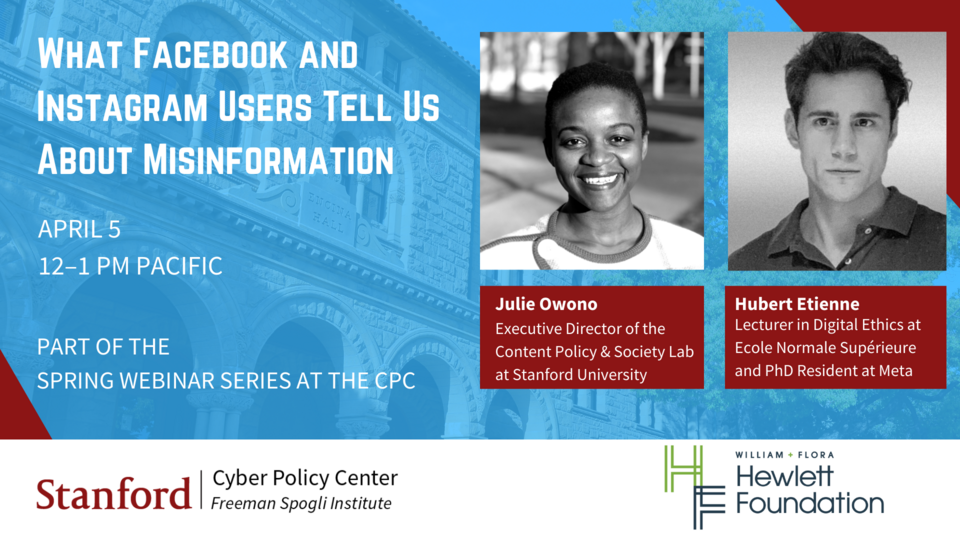
image of julie owono and hubert etienne on flyer
Join us on Tuesday, April 5th from 12 PM - 1 PM PT for “What Facebook and Instagram Users Tell Us About Misinformation” featuring Hubert Etienne, Philosopher and Researcher, Ecole Normale Supérieure and Meta AI in conversation with Julie Owono, Executive Director of the Content Policy & Society Lab. This weekly seminar series is jointly organized by the Cyber Policy Center’s Program on Democracy and the Internet and the Hewlett Foundation’s Cyber Initiative.

About The Seminar: 

Social media users who report content are key allies in the management of online misinformation. However, no research has been conducted yet to understand their role and the different trends underlying their reporting activity. Hubert Etienne presents an original approach to studying misinformation by examining it from the reporting users’ perspective at the content-level and comparatively across regions and platforms. This leads Etienne to propose the first classification of reported content pieces, resulting from a review of items reported on Facebook and Instagram in France, the UK, and the US in June 2020 to observe meaningful distinctions regarding misinformation reporting between countries and platforms as it significantly varies in volume, type, topic, and manipulation technique. Etienne identifies four reporting behaviors, from which he derives four types of noise capable of explaining the majority of the inaccuracy in misinformation reporting. He finally shows that breaking down the user reporting signal into a plurality of behaviors allows us to build a simple classifier trained on a small dataset with a combination of basic users-reports capable of identifying these different types of noise.

Speakers:

Hubert Etienne is a philosopher conducting research in AI ethics and computational philosophy at École Normale Supérieure and Meta AI. His research focuses on social interactions, especially the moderation of problematic interactions in cyberspace. He is a lecturer in AI ethics à Sciences Po, in data economics at HEC Paris and in digital regulation at the National School of Administration. He is currently a visiting fellow at Harvard University.


Julie Owono is the Executive Director of the Content Policy & Society Lab (CPSL) and a fellow of the Program on Democracy and the Internet (PDI) at Stanford University. She is also the Executive Director of digital rights organization Internet Sans Frontières, one of the inaugural members of the Facebook Oversight Board, and an affiliate at the Berkman Klein Center at Harvard University. She holds a Master’s degree in International Law from la Sorbonne University in Paris, and practiced as a lawyer at the Paris Bar.

Hubert Etienne
Seminars
-
Logo of APARC South Asia Initiative's May 6, 2022 conference, 'A New Agenda for Indian Competitiveness'

This Conference will be held in person on our Stanford University Campus.
Only register if you are attending the Conference in person.

About the Conference

The inaugural conference of the South Asia Initiative at Stanford University's Shorenstein Asia-Pacific Research Center (APARC) focuses on the role that critical and emerging technologies can play in India’s national security. These technologies promise to deliver enormous advantages as powers like India and China compete for security and influence. India’s ability to deploy critical and emerging technologies will shape not only its military power but also its resilience and self-sufficiency, which the Indian government sees as key national goals in a post-pandemic world. To develop these technologies, India’s national security establishment will need new policy settings – including new relationships with private industry – and new ways of cooperating with key partners, especially the United States.

Our conference will be a unique forum bringing together academic experts, senior policymakers, and leading industry representatives to develop this critical policy agenda. Keynote speeches and panel discussions will contemplate the changing character of national security, the imperatives for public-private cooperation on technology policy, and the implications for national and foreign policy. In keeping with our policy-focused mission, we look forward not only to fostering important dialogues but also to convening problem-solvers with different perspectives, to understand and act on new technologies’ role in strategic competition.

Image
A photo collage of headshot portraits of 18 guest speakers participating at the Shorenstein APARC South Asia Initiative Conference "A New Agenda for Indian Competitiveness"


Conference Agenda


8:30-8:45 a.m.
Opening and Welcome Remarks

Prof. Gi-Wook Shin, Director of Asia-Pacific Research Center and Korea Program, Stanford
Dr. Arzan Tarapore, Research Scholar, Asia-Pacific Research Center, Stanford


8:45-9:30 a.m.
Keynote address: “Technology’s Role in Managing India’s Security Challenges.”


Dr. Ajay Kumar, Defence Secretary, India
Introduction by Prof. Michael McFaul, Director of the Freeman Spogli Institute for International Studies, Stanford


9:30-10:45 a.m.
Panel 1: Redefining the Military’s Relationship with Technology


Moderated by Dr. Arzan Tarapore, Research Scholar, Asia-Pacific Research Center, Stanford

LtGen Stephen D. Sklenka, Deputy Commander, U.S. Indo-Pacific Command
LtGen (ret.) Raj Shukla, ARTRAC
Ms. Kari Bingen, Hawkeye 360
Ms. Heather Richman, BMNT


10:45-11:00 a.m.
Coffee Break


11:00 a.m. -12:15 p.m.
Panel 2: The Way Forward in Defense Innovation

Moderated by Mr. Steve Blank, Adjunct Professor, Management Science and Engineering, Stanford

Mr. Sanjay Jaju, Director iDEX (Virtual)
Mr. Mike Brown, Director DIU
Ms. Colleen Laughlin, Defense Innovation Board
Ms. Lauren Bedula, Silicon Valley Defense Group


12:15-2:00 p.m.
Lunch

Fireside chat: "Looking Forward: Critical and Emerging Technology in the U.S.-India Relationship"


Mr. Jose W. Fernandez, Under-Secretary of State for Economic Growth, Energy, and Environment (virtual)
Introduction by Amb. Scot Marciel, Visiting Practitioner Fellow on Southeast Asia, Stanford

Fireside chat: "A New Agenda for US-India Relations"

Amb. Atul Keshap, USIBC (Virtual)
Mr. Vikram Singh, USIP and USISPF

With Dr. Joe Felter, Gordian Knot Center for National Security Innovation, Stanford


2:00-2:15 p.m.
Coffee Break


2:15-3:45 p.m.
Panel 3: Start-Up Success Stories

Moderated by: Sridhar Narayanan, Professor of Marketing, Stanford Graduate School of Business
 

Mr. Vinayak Dalmia, 3rditech
Ms. Vrinda Kapoor, 114AI (Virtual)
Mr. John Martellaro, Skanda Defense
Ms. Jacqueline Tame, GameBreaker AI


3:45-4:00pm
Concluding Remarks

Breakfast, lunch, and afternoon refreshments will be served at the conference.

Parking information can be found on our Shorenstein APARC Contact Us page.

Conferences
Subscribe to Security