
FSI scholars produce research aimed at creating a safer world and examing the consequences of security policies on institutions and society. They look at longstanding issues including nuclear nonproliferation and the conflicts between countries like North and South Korea. But their research also examines new and emerging areas that transcend traditional borders – the drug war in Mexico and expanding terrorism networks. FSI researchers look at the changing methods of warfare with a focus on biosecurity and nuclear risk. They tackle cybersecurity with an eye toward privacy concerns and explore the implications of new actors like hackers.
Along with the changing face of conflict, terrorism and crime, FSI researchers study food security. They tackle the global problems of hunger, poverty and environmental degradation by generating knowledge and policy-relevant solutions.
What is synthetic biology and why does it matter?
-
About the topic: Products developed using recombinant DNA methods account for over $300 billion in annual U.S. domestic revenues, underlying a so-called “bioeconomy” that has grown 10-15% annually since the invention of genetic engineering ~40 years ago. Yet most of biotechnology has not been imagined let alone made true. I will review the last decade of work to make biology easier to engineer, from basic science to applied tools. Particular attention will be given to two underlying trends that are having policy impacts beyond research labs: (i) interconversion of physical genetic material and digital sequence information via advancing DNA sequence and synthesis tools, (ii) coordination of labor across time and place via technical standards supporting composition, measurement, and data exchange.
About the speaker: Drew works on “synthetic biology.” His group invented genome refactoring to both study and extend the utility of bacteriophage. His team also realized non-volatile chromosomal digital data storage, amplifying genetic logic gates, and cell-cell communication via engineered DNA messaging. He led the BIOFAB team that engineered a professional collection of reliably reusable standard biological parts and started the BioBricks Foundation (BBF) as a charity supporting development of a free-to-use language for programming life to benefit all people and the planet. In 2013 Drew was recognized by the White House for the BBF’s contributions to “open science” and received the Seymour Benzer lectureship from the US NAS.
CISAC Conference Room
Drew Endy
Assistant Professor of Bioengineering; CISAC Affiliated Faculty Member
Speaker
Seminars
Hecker receives AAAS Award for Science Diplomacy
News Type
News
Date
Paragraphs
CISAC and FSI Senior Fellow Siegfried Hecker has been awarded the prestigious Science Diplomacy Award from the American Association for the Advancement of Science for his dedication to building bridges through science.
Hecker, director emeritus of the Los Alamos National Laboratory and CISAC co-director from 2007-2012, was honored at the AAAS’s annual conference in Chicago for his “lifetime commitment to using the tools of science to address the challenges of nuclear proliferation and nuclear terrorism and his dedication to building bridges through science during the period following the end of the Cold War."
In nominating Hecker for the 2013 award, Glenn E. Schweitzer, director of the Office for Central Europe and Eurasia at the National Academies, noted that Hecker has been particularly effective in working with government officials and scientific colleagues in Russia, Kazakhstan and North Korea.
"For over two decades, Dr. Hecker has worked on international nuclear security activities and fostered cooperation with the Russian nuclear laboratories to secure and safeguard the vast stockpile of ex-Soviet fissile materials," said AAAS Chief International Officer Vaughan Turekian.
Schweitzer wrote in his nomination that Hecker's activities can be judged on two outcomes: responsible handling of nuclear materials and prevention of dangerous materials from falling into the wrong hands. "On both counts, he scores very high on anyone's ledger," Schweitzer wrote. "In addition, his openness and respect for the views of others have won important friends for the United States around the world."
More details about the award and Hecker's work can be read here.
Please join CISAC in congratulating Hecker for this honor.
Hero Image

Siegfried Hecker, (left) with his former research assistant Niko Milonopoulos (center) and CISAC consulting professor Chaim Brun at the Semipalatinsk nuclear test site in Kazakhstan, Sept. 19, 2012.
CISAC
All News button
1
The Global Economy, Innovation, and Interconnections
-
Due to venue capacity,
RSVP's for this event have been closed.
See the livestream here
Image

This event is co-sponsored with
The Stanford Institute
for Economic Policy Research
Doors open at 11:30a.m.
Complimentary valet parking available
For security reasons:
~No backpacks or oversized purses will be allowed
~All persons subject to search
~No food or beverages allowed inside the room
~RSVPs for this event are required and will be strictly enforced at check-in
Born in Paris in 1956, Christine Lagarde completed high school in Le Havre and attended Holton Arms School in Bethesda (Maryland, USA). She then graduated from law school at University Paris X, and obtained a Master’s degree from the Political Science Institute in Aix en Provence.
After being admitted as a lawyer to the Paris Bar, Christine Lagarde joined the international law firm of Baker & McKenzie as an associate, specializing in Labor, Anti-trust, and Mergers & Acquisitions. A member of the Executive Committee of the Firm in 1995, Christine Lagarde became the Chairman of the Global Executive Committee of Baker & McKenzie in 1999, and subsequently Chairman of the Global Strategic Committee in 2004.
Christine Lagarde joined the French government in June 2005 as Minister for Foreign Trade. After a brief stint as Minister for Agriculture and Fisheries, in June 2007 she became the first woman to hold the post of Finance and Economy Minister of a G-7 country. From July to December 2008, she also chaired the ECOFIN Council, which brings together Economics and Finance Ministers of the European Union.
As a member of the G-20, Christine Lagarde was involved in the Group's management of the financial crisis, helping to foster international policies related to financial supervision and regulation and to strengthen global economic governance. As Chairman of the G-20 when France took over its presidency for the year 2011, she launched a wide-ranging work agenda on the reform of the international monetary system.
In July 2011, Christine Lagarde became the eleventh Managing Director of the IMF, and the first woman to hold that position.
Christine Lagarde was named Officier in the Légion d'honneur in April 2012. A former member of the French national team for synchronized swimming, Christine Lagarde is the mother of two sons.
Bechtel Conference Center
Christine Lagarde
Managing Director
Speaker
International Monetary Fund
Seminars
Why Nuclear Weapons Became Unsustainable: Modernization Theory, International Norms, and the Environmental Roots of the Nuclear Taboo, 1958-1968
Related Multimedia


Philippines military recognizes Felter for counterterrorism work
News Type
News
Date
Paragraphs
CABANATUAN, Philippines – CISAC Senior Research Fellow Joe Felter co-teaches the popular class, “Face of Battle,” which dissects several of the great American battles such as Gettysburg and Little Bighorn.
Few of his students, however, likely know of his connection to the little-known, ongoing battles raging across the world in southern Philippines.
Felter was awarded the Assaulter Badge on Feb. 8 by the Philippines Army in recognition of his support in forming the country’s first counterterrorism unit. The Light Reaction Battalion has been battling terrorists and rebels in the Southeast Asian nation for a decade.
Felter, a retired U.S. Army Special Forces colonel, worked closely with Brig. Gen. Dionisio Santiago, the now-retired Philippine Armed Forces chief of staff, to form the elite unit during his stint as a U.S. military attaché in Manila.
 Brig. Gen. (Ret.) Dionisio Santiago, former chief of staff of the Armed Forces of the Philippines, looks on as Felter receives his award.
 Brig. Gen. (Ret.) Dionisio Santiago, former chief of staff of the Armed Forces of the Philippines, looks on as Felter receives his award. Brig. Gen. (Ret.) Dionisio Santiago, former chief of staff of the Armed Forces of the Philippines, looks on as Felter receives his award. Brig. Gen. (Ret.) Dionisio Santiago, former chief of staff of the Armed Forces of the Philippines, looks on as Felter receives his award. |
|
Brig. Gen. (Ret.) Dionisio Santiago, former chief of staff of the Armed Forces of the Philippines, looks on as Felter receives his award. |
The battalion, which fights communist and Islamic militants in the restive south – where more than 40 years of insurgency has taken thousands hostage and claimed more than 150,000 lives – will be expanded to a regiment of 1,500 soldiers.
Felter received the honor during a 10th anniversary celebration of the unit, which was initially trained, equipped and sustained by the U.S. Special Forces.
“It was a real privilege to help the Philippine military establish this counterterrorist unit,” Felter said. “I have so much respect for all they do here and the challenging missions they take on, so it feels great to receive this honor on this special day.”
The ceremony was held at Fort Magsaysay in Cabanatuan, the storied city where the Japanese imprisoned Filipino and American survivors of the brutal Bataan Death March. Filipino and U.S. forces liberated some 500 POWs at the end of World War II in what has become known as The Great Raid. The two militaries remain closely allied today.
The certificate that accompanied his badge of honor says Felter “exerted tremendous effort” in convincing the U.S. government of the need for a counterterrorism unit in the Philippines. Once he did so, he helped activate and train the unit – and kept on the U.S. Special Forces to remain involved.
“Col. Felter has exemplified the essence of soldiery in the fight against terrorism, earning him the admiration, gratitude and respect of the officers, men and women of the Light Reaction Battalion and making him worthy of the honor of being a member of the Counter Terrorist Brotherhood,” reads the certificate.
Felter has spent a decade building an unprecedented database with Filipino military colleagues and coders which tracks tens of thousands of terrorist attacks in the Philippines since 1975. His Empirical Studies of Conflict project is also building insurgency data in Afghanistan, Colombia, Iraq, Pakistan and Vietnam.
Hero Image

Flowers in honor of the nine Light Reaction Battalion soldiers killed by Islamic militants in the southern port of Zamboanga last September.
Flowers in honor of the nine Light Reaction Battalion soldiers killed by Islamic militants in the southern port of Zamboanga last September.
Flowers in honor of the nine Light Reaction Battalion soldiers killed by Islamic militants in the southern port of Zamboanga last September.
Flowers in honor of the nine Light Reaction Battalion soldiers killed by Islamic militants in the southern port of Zamboanga last September.
Flowers in honor of the nine Light Reaction Battalion soldiers killed by Islamic militants in the southern port of Zamboanga last September.
Flowers in honor of the nine Light Reaction Battalion soldiers killed by Islamic militants in the southern port of Zamboanga last September.
Ricky GayRicky GayRicky GayRicky GayRicky GayRicky Gay
Flowers in honor of the nine Light Reaction Battalion soldiers killed by Islamic militants in the southern port of Zamboanga last September.
Flowers in honor of the nine Light Reaction Battalion soldiers killed by Islamic militants in the southern port of Zamboanga last September.
Flowers in honor of the nine Light Reaction Battalion soldiers killed by Islamic militants in the southern port of Zamboanga last September.
Flowers in honor of the nine Light Reaction Battalion soldiers killed by Islamic militants in the southern port of Zamboanga last September.
Flowers in honor of the nine Light Reaction Battalion soldiers killed by Islamic militants in the southern port of Zamboanga last September.
All News button
1

A Relationship Transformed: Rethinking the Prospects for Conflict and Peace in the Taiwan Strait
Related Multimedia
Burma's Democracy: How Real?
-
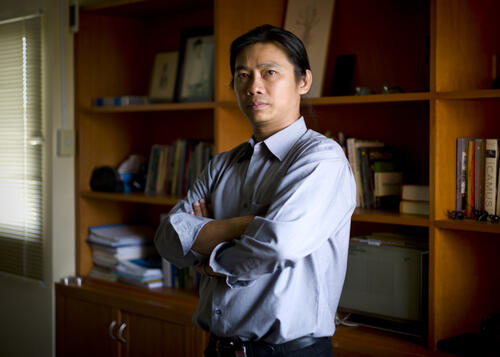
The opening up of Myanmar (Burma) and the steps undertaken taken toward political reform in that formerly isolated dictatorship have been among Asia's most dramatic and least expected events. But the establishment of full democracy is still on the agenda and faces many challenges. How willing is the current government in Burma to allow a full and free exercise of political rights, including media freedom? A panel of experts, including Aung Zaw, the editor and founder of The Irrawaddy and this year's recipient of the Shorenstein Award for Journalism in Asia, will address that question in discussing "Burma's Democracy: How Real?"
Stanford University’s Walter H. Shorenstein Asia-Pacific Research Center (Shorenstein APARC) is pleased to announce Aung Zaw as the 2013 recipient of the Shorenstein Journalism Award. Zaw has been selected for his leadership in establishing independent media in Myanmar (Burma) and his dedication to integrity in reporting on Southeast Asia.
| Image
|
| Aung Zaw |
Aung Zaw is the founding editor-in-chief and executive director of The Irrawaddy, an independent Burmese media organization operating in Myanmar and northern Thailand. Zaw has been an active campaigner for democratic reform in Burma/Myanmar over the last two decades. He was awarded the 2010 Prince Claus Fund Award for journalism along with two journalists from Iran and Cuba – and is recognized for his active dedication to achieving democratic governance in Burma and his work to uphold press freedom.
Zaw studied Botany at Rangoon University. As a student activist in Burma, he was part of the 1988 protests in Rangoon against the Burmese military regime of General Ne Win. He was arrested and detained for a week in Rangoon’s notorious Insein prison where he was severely tortured during interrogation about his pro-democracy activities. Upon release Aung Zaw continued to work with the resistance movement until the military staged a coup in September that year and he was forced to leave the country for neighboring Thailand.
Two years later, Aung Zaw founded the Burma Information Group (BIG) in Bangkok, to document human rights violations in Burma. He began to write political commentaries for national newspapers in Thailand and internationally, and in late 1993 launched The Irrawaddy News Magazine in Bangkok, covering Burma affairs. He worked in Bangkok for two years producing The Irrawaddy Magazine until relocating to the more secure position in Chiang Mai in the north of Thailand.
In February 2012, Aung Zaw was able to return to his homeland for the first time in more than 20 years for a temporary visit as an independent journalist. By the end of 2012, The Irrawaddy was able to establish a media and news office in central Yangon, returning to Burma/Myanmar to practice independent journalism, whilst retaining a regional office in Thailand.
In 2013, the government lifted ban on The Irrawaddy and other exiled websites, the Irrawaddy English magazine and the Irrawaddy Dateline Current Affairs TV program is available for audiences in Myanmar. Aung Zaw writes for New York Times, International Herald Tribune, Time, The Guardian, Bangkok Post, The Nation and several publications in the Europe. His interviews have also appeared on CN, BBC and Al Jazeera. He is the author of the Face of Resistance and is a recent Visiting Scholar at UC Berkeley, School of Journalism.
Bechtel Conference Center
Aung Zaw
2013 Journalism Prize Winner and Founder and Editor, The Irrawaddy News Magazine
Panelist
Nayan Chanda
Director of Publications and the Editor of YaleGlobal Online Magazine
Panelist
Yale Center for the Study of Globalization
Donald K. Emmerson
0
emmerson@stanford.edu
Senior Fellow Emeritus at the Freeman Spogli Institute for International Studies
Affiliated Faculty, CDDRL
Affiliated Scholar, Abbasi Program in Islamic Studies
At Stanford, in addition to his work for the Southeast Asia Program and his affiliations with CDDRL and the Abbasi Program in Islamic Studies, Donald Emmerson has taught courses on Southeast Asia in East Asian Studies, International Policy Studies, and Political Science. He is active as an analyst of current policy issues involving Asia. In 2010 the National Bureau of Asian Research and the Woodrow Wilson International Center for Scholars awarded him a two-year Research Associateship given to “top scholars from across the United States” who “have successfully bridged the gap between the academy and policy.”
Emmerson’s research interests include Southeast Asia-China-US relations, the South China Sea, and the future of ASEAN. His publications, authored or edited, span more than a dozen books and monographs and some 200 articles, chapters, and shorter pieces. Recent writings include The Deer and the Dragon: Southeast Asia and China in the 21st Century (ed., 2020); “‘No Sole Control’ in the South China Sea,” in Asia Policy (2019); ASEAN @ 50, Southeast Asia @ Risk: What Should Be Done? (ed., 2018); “Singapore and Goliath?,” in Journal of Democracy (2018); “Mapping ASEAN’s Futures,” in Contemporary Southeast Asia (2017); and “ASEAN Between China and America: Is It Time to Try Horsing the Cow?,” in Trans-Regional and –National Studies of Southeast Asia (2017).
Earlier work includes “Sunnylands or Rancho Mirage? ASEAN and the South China Sea,” in YaleGlobal (2016); “The Spectrum of Comparisons: A Discussion,” in Pacific Affairs (2014); “Facts, Minds, and Formats: Scholarship and Political Change in Indonesia” in Indonesian Studies: The State of the Field (2013); “Is Indonesia Rising? It Depends” in Indonesia Rising (2012); “Southeast Asia: Minding the Gap between Democracy and Governance,” in Journal of Democracy (April 2012); “The Problem and Promise of Focality in World Affairs,” in Strategic Review (August 2011); An American Place at an Asian Table? Regionalism and Its Reasons (2011); Asian Regionalism and US Policy: The Case for Creative Adaptation (2010); “The Useful Diversity of ‘Islamism’” and “Islamism: Pros, Cons, and Contexts” in Islamism: Conflicting Perspectives on Political Islam (2009); “Crisis and Consensus: America and ASEAN in a New Global Context” in Refreshing U.S.-Thai Relations (2009); and Hard Choices: Security, Democracy, and Regionalism in Southeast Asia (edited, 2008).
Prior to moving to Stanford in 1999, Emmerson was a professor of political science at the University of Wisconsin-Madison, where he won a campus-wide teaching award. That same year he helped monitor voting in Indonesia and East Timor for the National Democratic Institute and the Carter Center. In the course of his career, he has taken part in numerous policy-related working groups focused on topics related to Southeast Asia; has testified before House and Senate committees on Asian affairs; and been a regular at gatherings such as the Asia Pacific Roundtable (Kuala Lumpur), the Bali Democracy Forum (Nusa Dua), and the Shangri-La Dialogue (Singapore). Places where he has held various visiting fellowships, including the Institute for Advanced Study and the Woodrow Wilson International Center for Scholars.
Emmerson has a Ph.D. in political science from Yale and a BA in international affairs from Princeton. He is fluent in Indonesian, was fluent in French, and has lectured and written in both languages. He has lesser competence in Dutch, Javanese, and Russian. A former slam poet in English, he enjoys the spoken word and reads occasionally under a nom de plume with the Not Yet Dead Poets Society in Redwood City, CA. He and his wife Carolyn met in high school in Lebanon. They have two children. He was born in Tokyo, the son of U.S. Foreign Service Officer John K. Emmerson, who wrote the Japanese Thread among other books.
China and the World
Learn morePolicy Perspectives on the South China Sea
Learn moreHide publication sections
Off
Daniel C. Sneider
Stanford University
Encina Hall, Room E301
Stanford, CA 94305-6055
0
dsneider@stanford.edu
Lecturer in International Policy at the Ford Dorsey Master’s in International Policy
Daniel C. Sneider is a lecturer in international policy at Stanford's Ford Dorsey Master’s in International Policy and a lecturer in East Asian Studies at Stanford. His own research is focused on current U.S. foreign and national security policy in Asia and on the foreign policy of Japan and Korea. Since 2017, he has been based partly in Tokyo as a Visiting Researcher at the Canon Institute for Global Studies, where he is working on a diplomatic history of the creation and management of the U.S. security alliances with Japan and South Korea during the Cold War. Sneider contributes regularly to the leading Japanese publication Toyo Keizai as well as to the Nelson Report on Asia policy issues.
Sneider is the former Associate Director for Research at the Walter H. Shorenstein Asia-Pacific Research Center at Stanford. At Shorenstein APARC, Sneider directed the center’s Divided Memories and Reconciliation project, a comparative study of the formation of wartime historical memory in East Asia. He is the co-author of a book on wartime memory and elite opinion, Divergent Memories, from Stanford University Press. He is the co-editor, with Dr. Gi-Wook Shin, of Divided Memories: History Textbooks and the Wars in Asia, from Routledge and of Confronting Memories of World War II: European and Asian Legacies, from University of Washington Press.
Sneider was named a National Asia Research Fellow by the Woodrow Wilson International Center for Scholars and the National Bureau of Asian Research in 2010. He is the co-editor of Cross Currents: Regionalism and Nationalism in Northeast Asia, Shorenstein APARC, distributed by Brookings Institution Press, 2007; of First Drafts of Korea: The U.S. Media and Perceptions of the Last Cold War Frontier, 2009; as well as of Does South Asia Exist?: Prospects for Regional Integration, 2010. Sneider’s path-breaking study “The New Asianism: Japanese Foreign Policy under the Democratic Party of Japan” appeared in the July 2011 issue of Asia Policy. He has also contributed to other volumes, including “Strategic Abandonment: Alliance Relations in Northeast Asia in the Post-Iraq Era” in Towards Sustainable Economic and Security Relations in East Asia: U.S. and ROK Policy Options, Korea Economic Institute, 2008; “The History and Meaning of Denuclearization,” in William H. Overholt, editor, North Korea: Peace? Nuclear War?, Harvard Kennedy School of Government, 2019; and “Evolution or new Doctrine? Japanese security policy in the era of collective self-defense,” in James D.J. Brown and Jeff Kingston, eds, Japan’s Foreign Relations in Asia, Routledge, December 2017.
Sneider’s writings have appeared in many publications, including the Washington Post, the New York Times, Slate, Foreign Policy, the New Republic, National Review, the Far Eastern Economic Review, the Oriental Economist, Newsweek, Time, the International Herald Tribune, the Financial Times, and Yale Global. He is frequently cited in such publications.
Prior to coming to Stanford, Sneider was a long-time foreign correspondent. His twice-weekly column for the San Jose Mercury News looking at international issues and national security from a West Coast perspective was syndicated nationally on the Knight Ridder Tribune wire service. Previously, Sneider served as national/foreign editor of the Mercury News. From 1990 to 1994, he was the Moscow bureau chief of the Christian Science Monitor, covering the end of Soviet Communism and the collapse of the Soviet Union. From 1985 to 1990, he was Tokyo correspondent for the Monitor, covering Japan and Korea. Prior to that he was a correspondent in India, covering South and Southeast Asia. He also wrote widely on defense issues, including as a contributor and correspondent for Defense News, the national defense weekly.
Sneider has a BA in East Asian history from Columbia University and an MPA from the John F. Kennedy School of Government at Harvard University.
Panel Discussions
What to do about tensions in Asia
Karl Eikenberry, the William J. Perry Fellow for International Studies at CISAC, joins a panel discussion hosted by the Council on Foreign Relations about tensions in the Asia Pacific. The Jan. 28 event covered disputed islands in the East China and South China seas, their impact on U.S. interests, and recommendations for U.S. policy in terms of preventing military escalation in the region and how to respond if prevention fails.
Watch the event here.
Karl Eikenberry
William J. Perry Fellow in International Security at CISAC, CDDRL, TEC, and Shorenstein APARC Distinguished Fellow; and Former U.S. Ambassador to Afghanistan and Retired U.S. Army Lt. General
Speaker
Panel Discussions