Security

FSI scholars produce research aimed at creating a safer world and examing the consequences of security policies on institutions and society. They look at longstanding issues including nuclear nonproliferation and the conflicts between countries like North and South Korea. But their research also examines new and emerging areas that transcend traditional borders – the drug war in Mexico and expanding terrorism networks. FSI researchers look at the changing methods of warfare with a focus on biosecurity and nuclear risk. They tackle cybersecurity with an eye toward privacy concerns and explore the implications of new actors like hackers.

Along with the changing face of conflict, terrorism and crime, FSI researchers study food security. They tackle the global problems of hunger, poverty and environmental degradation by generating knowledge and policy-relevant solutions. 

-

REGISTRATION FULL.

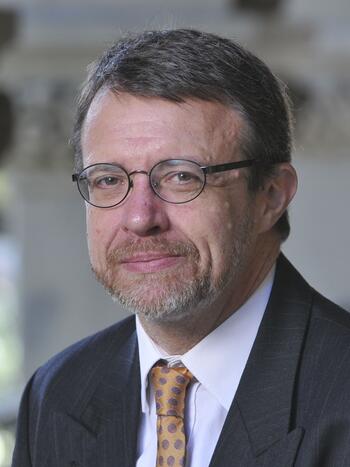
Ambassador Ušackas will dwell on security challenges faced by Europe. He will share his views on why and how interdependent economic partners: the EU and Russia got into a geopolitical confrontation and what is the way forward? What are the consequences of the war in Ukraine, effects of Syria crisis and what is the future role of NATO in Europe. 

Ambassador Ušackas has been serving as the European Union Ambassador to the Russian Federation as of 1 September 2013. Previously, he was the European Union Special Representative and Head of the European Union Delegation in Afghanistan from April 2010. After obtaining his Law Degree from Vilnius University and completing his post-graduate education in Political Sciences in Denmark and Norway in 1991, he joined the Lithuanian Ministry of Foreign Affairs. In his distinguished career in the Foreign Service, he served as Counselor to the Lithuanian Mission to both the EU and NATO from 1992 to 1996; Political Director of the Lithuanian Ministry of Foreign Affairs from 1996 to 1999; Deputy Minister of Foreign Affairs of Lithuania and Chief Negotiator for Lithuania’s Accession to the European Union from 1999 to 2001; Lithuanian Ambassador to the United States of America and United Mexican States from 2001 to 2006; Ambassador of Lithuania to the Court of St. James from 2006 – 2008; and was Lithuanian Foreign Minister from 2008 to 2010. During the course of his career, he has received numerous awards such as Order for Merits to Lithuania, Cross of Commander, State awards of Estonia, France, Georgia, Greece, Norway, Poland, Spain and Ukraine; award for merits to the city of Utena and Member of honour of Lithuanian Students’ Union. He was awarded the Honorary citizenship of his home town Skuodas in 2010 and Ukmerge in 2013. In 2014, Vygaudas Ušackas was bestowed a Honorary Doctor's Degree in Political Science of Vytautas Magnus University of Kaunas. He is also fluent in English and Russian and has a working knowledge of French. Mr Ušackas is married and has two children.


Vygaudas Ušackas European Union Ambassador to Russia
-

Incompetent and dishonest politicians are common in developing countries. Scholars who write about corruption and poor governance tend to take the existence of bad politicians as a given and focus on the damage that they do. Few study the ways in which politicians are recruited in order to improve that process. Some scholars acknowledge the need to encourage the creation of a political class that is competent and honest. But none have gone further by conducting real-world experiments to evaluate the efficacy of screening and incentivizing competent and virtuous citizens to stand for public office, that is, how to nudge good people to become politicians in the first place.

Dr. Ravanilla will describe a policy intervention designed to attract able and ethical candidates to public service. Can a leadership-training workshop and non-monetary status rewards be used to screen and motivate good people to serve the public good? His answer is yes. The results of a randomized field experiment among youth running for an elective post in the Philippines show that such an intervention is indeed feasible and can be effective in motivating able and moral individuals to seek public office while at the same time discouraging candidates who do not meet these criteria.

Image
rnico
Nico Ravanilla will begin an assistant professorship in the School of Global Policy and Strategy at the University of California, San Diego, in September 2016.  The Southeast Asia Research Group named him a Young Southeast Asia Fellow for 2015-16.  He earned his PhD in political science and public policy at the University of Michigan in 2015.

Nico Ravanilla 2015-16 Shorenstein APARC Postdoctoral Fellow, Stanford University
Seminars
Paragraphs

My Journey at the Nuclear Brink is a continuation of William J. Perry's efforts to keep the world safe from a nuclear catastrophe. It tells the story of his coming of age in the nuclear era, his role in trying to shape and contain it, and how his thinking has changed about the threat these weapons pose.
  
In a remarkable career, Perry has dealt firsthand with the changing nuclear threat. Decades of experience and special access to top-secret knowledge of strategic nuclear options have given Perry a unique, and chilling, vantage point from which to conclude that nuclear weapons endanger our security rather than securing it.

All Publications button
1
Publication Type
Books
Publication Date
Journal Publisher
Stanford University Press
Authors
News Type
Commentary
Date
Paragraphs

Why did Iran agree to send the bulk of its low-enriched uranium out of the country and remove the core of its Arak reactor? Those actions significantly lengthen the time it would take to build up a nuclear weapon program.

Siegfried Hecker, CISAC senior fellow and former Los Alamost National Laboratory director, shares his personal view in the Bulletin of Atomic Scientists: http://thebulletin.org/iran-nuclear-option-more-trouble-it-was-worth9064


Hero Image
23796778453 951e492b9d k
Iranian nuclear negotiators meet with international representatives at the International Atomic Energy Agency headquarters in Vienna, Austria on January 16, 2016.
IAEA
All News button
1
News Type
Commentary
Date
Paragraphs

Can the U.S. find the right balance between cooperation and containment, so it can realize the long-term benefits of the nuclear deal with Iran? CISAC visiting fellow Nicholas Burns, who helped to negotiate sanctions against Iran for the Bush administration a decade ago, offers his opinion in this piece for The New York Times.


Hero Image
iran us state dept flickr 24119931650 a05bb7e8a1 k
U.S. Secretary of State John Kerry takes his seat across from Iranian Foreign Minister Javad Zarif on January 16, 2016, at the Palais Coburg Hotel in Vienna, Austria, before a meeting about the implementation of the Joint Comprehensive Plan of Action outlining the shape of Iran's nuclear program.
U.S. State Department
All News button
1
-

In this fifteenth session of the Strategic Forum, former senior American and South Korean government officials and other leading experts will discuss current developments in the Korean Peninsula and North Korea policy, the future of the U.S.-South Korean alliance, and a strategic vision for Northeast Asia. The session is hosted by the Korea Program in association with The Sejong Institute, a top South Korean think tank.


Seoul, Republic of Korea

Workshops
-

Note: This event is open to Stanford community members only.

Stanford ID required for entry.

Remarks are off the record. Recording, reporting and citation of remarks is strictly prohibited.


P

Image
rior to his confirmation in July 2014, Mr. Shear served for 32 years in the Foreign Service, most recently as the United States Ambassador to Vietnam. He has also been posted to Sapporo, Beijing, Tokyo, and Kuala Lumpur. In Washington, he has served in the Offices of Japanese, Chinese, and Korean Affairs and as the Special Assistant to the Under Secretary for Political Affairs. He was Director of the Office of Chinese and Mongolian Affairs in 2008-2009 and Deputy Assistant Secretary in the Bureau of East Asian and Pacific Affairs in 2009-2011.


Mr. Shear was a Rusk Fellow at Georgetown University’s institute for the Study of Diplomacy 1998-99. He is the recipient of the State Department’s Superior Honor Award and the Defense Department’s Civilian Meritorious Service Award for his work in U.S.-Japan defense relations. 


Mr. Shear graduated from Earlham College and has a Master’s degree in International Affairs from the Johns Hopkins School of Advanced International Studies. He also attended Waseda University, Taiwan National University, and Nanjing University. 


David B. Shear U.S. Department of Defense, <i>Assistant Secretary of Defense for Asian and Pacific Security Affairs</i>
Seminars
-

This event is open to Stanford undergraduate students only. 

The Center on Democracy, Development, and the Rule of Law (CDDRL) is currently accepting applications from eligible juniors due February 12, 2016 who are interested in writing their senior thesis on a subject touching upon democracy, economic development, and rule of law (DDRL) from any university department. CDDRL faculty and current honors students will be present to discuss the program and answer any questions.

For more information on the CDDRL Senior Honors Program, please click here.


Image
cddrl senior honors program 2016 flyer 2


CDDRL
Encina Hall, C152
616 Jane Stanford Way
Stanford, CA 94305-6055

(650) 725-2705 (650) 724-2996
0
Senior Fellow at the Freeman Spogli Institute for International Studies
Professor, by courtesy, of Political Science
Stedman_Steve.jpg PhD

Stephen Stedman is a Senior Fellow at the Freeman Spogli Institute for International Studies (FSI) and the Center on Democracy, Development and the Rule of Law (CDDRL), an affiliated faculty member at CISAC, and professor of political science (by courtesy) at Stanford University. He is director of CDDRL's Fisher Family Honors Program in Democracy, Development and Rule of Law, and will be faculty director of the Program on International Relations in the School of Humanities and Sciences effective Fall 2025.

In 2011-12 Professor Stedman served as the Director for the Global Commission on Elections, Democracy, and Security, a body of eminent persons tasked with developing recommendations on promoting and protecting the integrity of elections and international electoral assistance. The Commission is a joint project of the Kofi Annan Foundation and International IDEA, an intergovernmental organization that works on international democracy and electoral assistance.

In 2003-04 Professor Stedman was Research Director of the United Nations High-level Panel on Threats, Challenges and Change and was a principal drafter of the Panel’s report, A More Secure World: Our Shared Responsibility.

In 2005 he served as Assistant Secretary-General and Special Advisor to the Secretary- General of the United Nations, with responsibility for working with governments to adopt the Panel’s recommendations for strengthening collective security and for implementing changes within the United Nations Secretariat, including the creation of a Peacebuilding Support Office, a Counter Terrorism Task Force, and a Policy Committee to act as a cabinet to the Secretary-General.

His most recent book, with Bruce Jones and Carlos Pascual, is Power and Responsibility: Creating International Order in an Era of Transnational Threats (Washington DC: Brookings Institution, 2009).

Director, Fisher Family Honors Program in Democracy, Development and Rule of Law
Director, Program in International Relations
Affiliated faculty at the Center for International Security and Cooperation
Date Label

Encina Hall, C148
616 Jane Stanford Way
Stanford, CA 94305

0
Olivier Nomellini Senior Fellow at the Freeman Spogli Institute for International Studies
Director of the Ford Dorsey Master's in International Policy
Research Affiliate at The Europe Center
Professor by Courtesy, Department of Political Science
yff-2021-14290_6500x4500_square.jpg

Francis Fukuyama is the Olivier Nomellini Senior Fellow at Stanford University's Freeman Spogli Institute for International Studies (FSI), and a faculty member of FSI's Center on Democracy, Development and the Rule of Law (CDDRL). He is also Director of Stanford's Ford Dorsey Master's in International Policy, and a professor (by courtesy) of Political Science.

Dr. Fukuyama has written widely on issues in development and international politics. His 1992 book, The End of History and the Last Man, has appeared in over twenty foreign editions. His book In the Realm of the Last Man: A Memoir will be published in fall 2026.

Francis Fukuyama received his B.A. from Cornell University in classics, and his Ph.D. from Harvard in Political Science. He was a member of the Political Science Department of the RAND Corporation, and of the Policy Planning Staff of the US Department of State. From 1996-2000 he was Omer L. and Nancy Hirst Professor of Public Policy at the School of Public Policy at George Mason University, and from 2001-2010 he was Bernard L. Schwartz Professor of International Political Economy at the Paul H. Nitze School of Advanced International Studies, Johns Hopkins University. He served as a member of the President’s Council on Bioethics from 2001-2004. He is editor-in-chief of American Purpose, an online journal.

Dr. Fukuyama holds honorary doctorates from Connecticut College, Doane College, Doshisha University (Japan), Kansai University (Japan), Aarhus University (Denmark), the Pardee Rand Graduate School, and Adam Mickiewicz University (Poland). He is a non-resident fellow at the Carnegie Endowment for International Peace. He is a member of the Board of Trustees of the Rand Corporation, the Board of Trustees of Freedom House, and the Board of the Volcker Alliance. He is a fellow of the National Academy for Public Administration, a member of the American Political Science Association, and of the Council on Foreign Relations. He is married to Laura Holmgren and has three children.

(October 2025)

CV
Date Label
0
brett_carter_2025.jpg

Brett Carter is an Associate Professor in the Department of Political Science and International Relations at the University of Southern California, a Hoover Fellow at Stanford University's Hoover Institution, and a Faculty Affiliate at Stanford's Center on Democracy, Development and the Rule of Law. He received a Ph.D. from Harvard University, where he was a fellow at the Harvard Academy for International and Area Studies.

Carter studies politics in the world's autocracies. His first book, Propaganda in Autocracies: Institutions, Information, and the Politics of Belief (Cambridge University Press), draws on the largest archive of state propaganda ever assembled — encompassing over eight million newspaper articles in six languages from nearly 60 countries around the world — to show how political institutions shape the propaganda strategies of repressive governments. It received the William Riker Prize for the Best Book in Political Economy, the International Journal of Press/Politics Hazel Gaudet-Erskine Best Book Award, Honorable Mention for the Gregory Luebbert Award for the Best Book in Comparative Politics, and Honorable Mention for the APSA Democracy & Autocracy Section's Best Book Award.

His second book, in progress, shows how politics in Africa’s autocracies changed after the fall of the Berlin Wall and how a new era of geopolitical competition — marked by the rise of China and the resurgence of Russia — is changing them again.

Carter’s other work has appeared in the Journal of Politics, British Journal of Political Science, Perspectives on Politics, Journal of Conflict Resolution, Security Studies, China Quarterly, Journal of Democracy, and Foreign Affairs, among others. His work has been featured by The New York Times, The Economist, The National Interest, and NPR’s Radiolab.

Hoover Fellow
CDDRL Affiliated Scholar
CDDRL Visiting Scholar, 2020-2021
Date Label

Encina Hall, C150
616 Jane Stanford Way
Stanford, CA 94305

0
Center Fellow, Freeman Spogli Institute for International Studies
didi_kuo_2023.jpg

Didi Kuo is a Center Fellow at the Freeman Spogli Institute for International Studies (FSI) at Stanford University. She is a scholar of comparative politics with a focus on democratization, corruption and clientelism, political parties and institutions, and political reform. She is the author of The Great Retreat: How Political Parties Should Behave and Why They Don’t (Oxford University Press) and Clientelism, Capitalism, and Democracy: the rise of programmatic politics in the United States and Britain (Cambridge University Press, 2018).

She has been at Stanford since 2013 as the manager of the Program on American Democracy in Comparative Perspective and is co-director of the Fisher Family Honors Program at CDDRL. She was an Eric and Wendy Schmidt Fellow at New America and is a non-resident fellow with the Carnegie Endowment for International Peace. She received a PhD in political science from Harvard University, an MSc in Economic and Social History from Oxford University, where she studied as a Marshall Scholar, and a BA from Emory University.

Date Label
Paragraphs

During the Republican primary debate held at the Ronald Reagan library in September, presidential candidates struggled to outdo each other in their admiration for and affinity with President Reagan. During the December 15 debate, however, everyone except Sen. Marco Rubio seemed to have rejected Ronald Reagan’s approach to foreign policy and national security. In particular, there was a serious debate about democracy promotion abroad and regime change. Most candidates came down against both. Read more...

All Publications button
1
Publication Type
Commentary
Publication Date
Journal Publisher
The Wall Street Journal Blog
Authors
Michael A. McFaul
Subscribe to Security