
 FSI researchers strive to understand how countries relate to one another, and what policies are needed to achieve global stability and prosperity. International relations experts focus on the challenging U.S.-Russian relationship, the alliance between the U.S. and Japan and the limitations of America’s counterinsurgency strategy in Afghanistan.
Foreign aid is also examined by scholars trying to understand whether money earmarked for health improvements reaches those who need it most. And FSI’s Walter H. Shorenstein Asia-Pacific Research Center has published on the need for strong South Korean leadership in dealing with its northern neighbor.
FSI researchers also look at the citizens who drive international relations, studying the effects of migration and how borders shape people’s lives. Meanwhile FSI students are very much involved in this area, working with the United Nations in Ethiopia to rethink refugee communities.
Trade is also a key component of international relations, with FSI approaching the topic from a slew of angles and states. The economy of trade is rife for study, with an APARC event on the implications of more open trade policies in Japan, and FSI researchers making sense of who would benefit from a free trade zone between the European Union and the United States.


The Crisis in Japanese and Chinese Public Opinion: Can Soft Power Soften an 'Enemy Image'?
-
Why are Japan and China perpetually at odds? In this talk, Christian Collet will discuss the growing role of public opinion in bilateral tensions and the conflicting images that are held by Chinese and Japanese of one another. While there has long been a mixture of affection, anger and rivalry at the diplomatic level, Collet will explain that the roots of contemporary discontent lie, in part, in contradistinctive citizen impressions: in China, perceptions of threat borne of history and new media; in Japan, discontent manifest in domestic political culture, including eroding trust and right-wing ideology. Collet will examine the potential of soft power for ameliorating the relationship, providing some evidence to suggest that pop cultural exchanges may have a desired impact on segments of both publics. But soft power can only go so far to soften a negative image; concerted efforts, Collet will argue, also need to be made by opinion leaders to reassure citizens and restore trust in governmental decision-making.
Christian Collet (PhD, University of California, Irvine) joins the Walter H. Shorenstein Asia-Pacific Research Center (Shorenstein APARC) during the 2012–13 academic year from International Christian University, Tokyo, where he serves as senior associate professor of American politics and international relations.
His research interests focus on public opinion in Asian Pacific/American contexts and the influence of race, ethnicity and nationalism on political mobilization. During his time at Shorenstein APARC, he is working on a project that uses comparative survey data to examine the dynamics of Japanese opinion toward domestic politics, China and Southeast Asia. He is also finishing up a project concerning the role of Vietnam in the political incorporation of first generation Vietnamese Americans. In 2004–05, he held a visiting appointment at Viet Nam National University, Ho Chi Minh City, under the U.S. Fulbright Program.
Collet's work has appeared in Perspectives on Politics, The Journal of Politics, Public Opinion Quarterly, Japanese Journal of Political Science, PS, Amerasia Journal and Race/Ethnicity: Multidisciplinary Global Contexts. He is the co-editor, with Pei-te Lien, of The Transnational Politics of Asian Americans (Temple University Press, 2009).
Philippines Conference Room
Christian Collet
Visiting Associate Professor
Speaker
Walter H. Shorenstein Asia-Pacific Research Center, Stanford University
Seminars
Making Love for a Visa
-
The talk , based on a recent paper, will describe and examine the social understanding of selling sex for a visa among migrant Filipina hostesses in Tokyo. The paper examines the different constitutions of love in Japan and the Philippines to understand the making of love in the marriages of Filipina hostesses and their Japanese customers. The paper will attempt to argue why the act of selling sex for a visa does not necessarily reduce marriage to prostitution while at the same time questioning the assumption that marriage is ever free of rational motivation.
Rhacel Salazar Parreñas is Professor and Chair of the Sociology Department at the University of Southern California. Her research interests include the sociology of gender and labor, the family, and globalization. Her latest book Illicit Flirtations: Labor, Migration and Sex Trafficking in Tokyo received the 2012 Distinguished Book Award in the Labor and Labor Movements Section of the American Sociological Association.
Philippines Conference Room
Rhacel Salazar Parreñas
Professor and Chair of the Sociology Department
Speaker
University of Southern California
Seminars
Former British ambassador on North Korea's citizens, reform and engagement
News Type
Q&As
Date
Paragraphs
Hallmarks during the first year of young North Korean leader Kim Jong Un’s reign range from a much-publicized failed rocket launch to the appearance (and then disappearance) of an attractive, stylish wife by his side. Such events have prompted questions about the new leader’s intentions for the future, including the possibility of reform.
But there is another side to the Democratic Republic of Korea (DPRK) that often goes overlooked: its 20 million ordinary citizens. Only Beautiful, Please, a new book by former British diplomat John Everard, delves into the daily life of North Koreans and examines the challenges of developing successful diplomatic relations with the country.
Everard was Britain’s ambassador to North Korea between 2006 and 2008 and is a former Pantech Fellow of the Walter H. Shorenstein Asia-Pacific Research Center at Stanford’s Freeman Spogli Institute of International Studies. He presented highlights from his book, and offered his insight into current North Korea events during a seminar at Stanford on Oct. 26.
In a recent interview, Everard discussed his book, the prospect of reform in North Korea, and important considerations for engagement with the isolated country.
What is the significance of the book’s title?
A friend visiting me from the U.K. was pursued by a group of North Koreans who were convinced he had photographed things that did not show the DPRK in the best light. An army officer was eventually summoned, and after examining the pictures he concluded there was nothing offensive in them. As he returned my friend’s camera, he turned to me and said in his best English: “Only beautiful, please.” He meant that he wanted us to only photograph beautiful things in the DPRK.
I took this for the title because it says quite a lot about how the DPRK likes to hide the negative aspects of life there, and to portray itself as a country where only good things take place.
What do you most hope readers will take away from your book?
I hope readers will come away with the understanding that the DPRK is a real country, where real people live. North Korea is different from other countries in many important ways, but its citizens are much more preoccupied with everyday things like marriage, how their kids are getting on at school, and what they are having for supper, than they are about politics and denuclearization. It is a country with over 20 million people, and I hope their lives and happiness are not overlooked as the international community engages with the DPRK to seek long-term solutions to the difficult problems it poses.
..jpg)
What are the most important needs of North Korea’s citizens?
North Koreans are people like the rest of us, and they have the same physical and emotional needs. They need enough to eat, which is a need not always met. They also need to have normal social interactions. Friendships are very important in the DPRK, even if they are somewhat different than friendships in more open societies. North Koreans also have their self-respect and pride. They are a proud people, and as information about the outside world leaks into the DPRK and they learn how poor and backward their country is they feel quite disoriented. They will need to hold onto their self-respect through what is likely to be a very difficult period in the coming years.
There has been significant speculation in recent months about the possibility of reform in North Korea. Have we seen any tangible signs of plans for reform?
There have been indications that Kim Jong Un had been planning some limited economic reforms, including allowing farmers to retain a certain percentage of their produce after giving part of it to the state. But the most recent report suggests that this plan has stalled after the government realized there would be a poor harvest this year. They have decided it is more important to feed the military than it is to implement economic reforms at this point in time.
Another type of reform is the possibility of greater cultural opening. Mickey Mouse appeared in front of the DPRK leadership at a concert a few weeks ago, for example, and there is also the appearance of Ri Sol Ju, Kim Jong Un’s wife. She is a very presentable young woman, and dresses smartly, (and without wearing the traditional Kim badge). But there have been no further appearances of Mickey Mouse, and Ri Sol Ju has not appeared in public for several weeks. I suspect that these reforms, too, have been put on hold.
These are two quite different types of reform that do not depend on each other, and it is not clear if either of them is going to move forward.
In terms of easing diplomatic relations with North Korea, do you think that reform would pave the way or are there other issues to keep in mind?
If reform does indeed take place – I have my doubts – it might not be the kind of reform that would help improve relations with the DPRK. Economic reform does not necessarily translate into a greater readiness for meaningful dialogue with the international community.
A crucial point is that there are certain aspects of the DPRK regime that are extremely difficult to change. I argue in my book that the DPRK cannot conduct any kind of meaningful economic reform along the lines China did because to do so would erode the regime’s economic power over its citizens. The regime views this power as intrinsic to its survival. It also cannot allow greater openness because that would allow in new ideas to which the regime has no answer. It will be politically very difficult, and even dangerous, for the regime to encourage the greater openness we have seen in other reforming economies.
The DPRK regime is likely to continue broadly along the lines we have seen for many decades now. Although many people were hoping that Kim Jong Un would bring reforms, and perhaps even better relations with the West, as time passes it seems less likely that these hopes can be realized.
 What should the international community keep in mind in its relations with North Korea?
The DPRK has made it abundantly clear it has no intention whatsoever of surrendering its nuclear weapons. It has been hardened in its belief by its analysis of what has happened in the Arab world. Negotiations and talks towards persuading the DPRK to surrender its weapons are doomed to failure. They are not going to do so, and any engagement with the DPRK has to take that as a starting point.
There is a tendency in the United States to see North Korea's foreign relations simply in terms of the U.S.-DPRK relationship (or lack of it). The DPRK’s relations with the United States are indeed very important, but you also have to see the world through the DPRK’s eyes. If you are sitting in Pyongyang, your single most important relationship is with the People’s Republic of China.
Beijing has been deeply concerned about the DPRK’s behavior in a number of areas. Earlier this year, for example, we saw the launch of North Korea’s rocket against China’s express wishes, and the seizure of Chinese fishermen by the DPRK navy. The relationship between the DPRK and China has its difficulties, and one of the big determinants in what happens to the DPRK in the immediate future is going to be the position on the DPRK taken by the incoming Chinese government after the Party Congress in November.
About the Images
Even in central Pyongyang almost any cultivable patch of ground is ploughed for crops, like this one just outside the diplomatic quarter. (Credit: John Everard)
Stalls at Pyongyang spring trade fair -- the dominance of China at these events is clear. (Credit: John Everard)
Hero Image

North Korean newlyweds. They have probably presented flowers to a statue of Kim Il Sung earlier in the day, and are here seen outside the hotel that is hosting their wedding reception.
John Everard
All News button
1
Silicon Valley Project Roundtable - Silicon Valley: Strengths and Challenges Looming Ahead
-
The Stanford Program on Regions of Innovation and Entrepreneurship (SPRIE) cordially invites you and your guests to an invitation-only roundtable with two research pioneers at Stanford University on drivers for innovation and entrepreneurship of Silicon Valley.
This roundtable is designed to bring together a small circle of the Valley's leading executives, entrepreneurs, investors, service providers, and Stanford faculty for an in-depth, off-the-record conversation. Your participation and insights will inform future research at Stanford on topics relevant for the future sustainability of the Valley.
|
CHARLES EESLEY
 Charles Eesley, Assistant Professor, Dept. of Management Sciences and Engineering, Stanford University
|
SHAI BERNSTEIN  Shai Bernstein, Assistant Professor of Finance, Stanford Graduate School of Business
|
8:30AM: Welcome and Introductions
8:40AM-9:30AM: "Stanford University’s Economic Impact via Innovation and Entrepreneurship"
Topic for discussion:
- How do various key institutions of the Valley's ecosystem, such as Stanford, contribute to real economic outcomes in innovation and entrepreneurship?
- How can they be measured? What has been Stanford's economic impact?
- How has it changed over time? What light does this new analysis shed on changes and vulnerabilities for the Valley going forward?
Charles Eesley will share the results of a newly-released study that puts into perspective the sheer scale of Stanford's economic impact. In this systematic survey of Stanford alumni and faculty conducted by Eesley and SPRIE co-director William F. Miller, it is estimated that companies formed by Stanford entrepreneurs generate world revenue of $2.7 trillion annually and have created 5.4 million jobs since the 1930s. In addition to quantifying Stanford’s economic impact, the report examines Stanford’s role in fostering entrepreneurship and describes how the university creates an ecosystem that encourages creativity and entrepreneurship across schools and disciplines.
Moderator: William F. Miller, SPRIE Co-director; Herbert Hoover Professor of Public and Private Management Emeritus, Stanford Graduate School of Business
Discussant: Dixon Doll, Co-Founder and General Partner, DCM
Roundtable Discussion: All
9:30AM - 10:20AM: "Does Going Public Affect Innovation?"
After going public, how do firms perform in innovative activities, such as internal innovative projects, inventors' turnover, and reliance on acquisition of external technologies? Is the overall"IPO effect" positive or negative for a firms' innovation? Why? What implications does this have for innovation strategies in Silicon Valley?
Shai Bernstein will share his new findings on the "IPO effect" by comparing the long-run innovation of …firms that completed their filing and went public with that of …firms that withdrew their filing and remained private due to exogenous reasons. Using standard patent-based metrics, the results illustrate that the quality of internal innovation of public firms declines by 40 percent relative to …firms that remained private. He will discuss the reasons why and public leads firms to change their strategies in pursuing innovation.
Moderator: Henry S. Rowen, SPRIE Co-director; Senior Fellow, Hoover Institution, Stanford University
Discussant: Bob Pavey, Partner, Morgenthaler Ventures
Roundtable Discussion: All
10:20AM-10:30AM: Wrap-up Discussion
All participants should RSVP by Wednesday, October 31.
Any further questions, please contact Yan Mei at yanmei@stanford.edu, or 650.725.1885.
Oberndorf Event Center, 3rd Floor, North Building, Knight Management Center, 641 Knight Way, Stanford Graduate School of Business, Stanford, CA 94305-7298
Panel Discussions
Reception and Dinner: 2012 Presidential Debate on Foreign Policy
-
|
Please note: at 4:00 p.m. on October 22, the speakers will deliver CISAC's Annual Drell Lecture, entitled You are welcome to attend this public lecture in the Oak Lounge |
Image
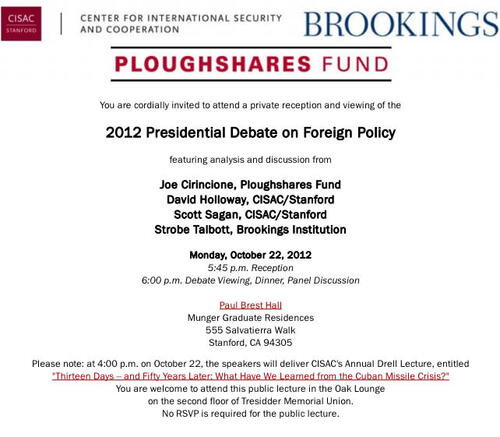
Paul Brest Hall
Munger Graduate Residences
555 Salvatierra Walk
Stanford, CA 94305
Conferences