As the United States redefines its role in the world, its closest ally, Japan, gains new prominence while facing new pressures, new challenges, and new opportunities. This symposium features leading experts on issues that concern the American, Japanese, and global public in this turbulent time. They will explore the evolving U.S.-Japan ties from various angles and engage in a wide-ranging conversation spanning the liberal international order, global trade, DEI, civil society — and baseball.
Free lunch and refreshments will be provided on a first-come, first-served basis
This symposium is co-sponsored by the Shorenstein Asia-Pacific Research Center Japan Program and the United States-Japan Foundation
Agenda
Session 1 – Global Democracy, Foreign Aid, and Regional Security: As the U.S. Pulls Back, Will Tokyo Step Up?
12:00 PM - 1:30 PM
Larry Diamond, Mosbacher Senior Fellow of Global Democracy at the Freeman Spogli Institute for International Studies
Shinichi Kitaoka, former Japanese Ambassador to the United Nations, former former President of the Japan International Cooperation Agency (JICA
Kiyoteru Tsutsui, Director, Japan Program at Shorenstein APARC; Stanford Professor of Sociology
Session 2 – How Tariffs and Trade Wars are Reshaping the Indo-Pacific
1:45 PM - 2:30 PM
Wendy Cutler, Vice President at the Asia Society Policy Institute (ASPI), former Acting Deputy United States Trade Representative
Peter Wonacott, Managing Editor, Stanford Doerr School of Sustainability; former Wall Street Journal Deputy Washington Bureau Chief
Session 3 — The Future of DEI, ESG, SDGs: Will Japan Follow the U.S. or Stay the Course?
2:30 PM - 3:15 PM
Keiko Tashiro, Deputy President, Head of Sustainability, Daiwa Securities Group Inc.
Gayle Peterson, Associate Fellow, Saïd School of Business, University of Oxford
Patricia Bromley, Co-Director, Stanford Center on Philanthropy and Civil Society
Session 4 — Redefining the Relationship Through Civil Society: Burden Sharing, Knowledge Sharing, Picking up the Slack
3:30 PM - 4:15 PM
Mike Berkowitz, Executive Director, Democracy Funders Network
Laura Deal Lacey, Executive Vice President, International Milken Institute
Jacob M. Schlesinger, President & CEO, United States-Japan Foundation
Session 5 — Diamond Diplomacy Redux: Baseball as a Bilateral Bridge
4:15 PM - 5:00 PM
Stan Kasten, President & CEO, Los Angeles Dodgers
Yuriko Gamo Romer, Director/Producer, Diamond Diplomacy documentary
Speakers
Larry Diamond is a senior fellow at the Hoover Institution and the Mosbacher Senior Fellow in Global Democracy at Stanford's Freeman Spogli Institute for International Studies (FSI). He chairs the Hoover Institution Project on Taiwan in the Indo-Pacific Region. He is the founding co-editor of the Journal of Democracy and serves as a senior consultant at the International Forum for Democratic Studies of the National Endowment for Democracy. His research focuses on democratic trends and conditions around the world and on policies and reforms to defend and advance democracy. During 2002–03, he served as a consultant to the US Agency for International Development (USAID) and was a contributing author of its report Foreign Aid in the National Interest.

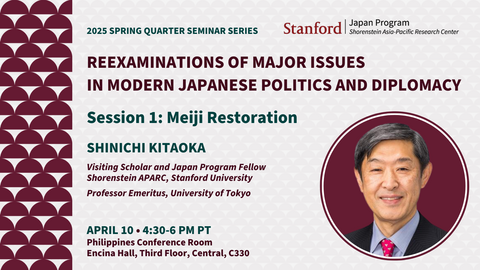
Shinichi Kitaoka is a Shorenstein APARC visiting scholar and Japan Program fellow. He was president of the Japan International Cooperation Agency (JICA: 2015-2022) and is an emeritus professor at the University of Tokyo. Previous posts include president of the International University of Japan (2012-2015), professor at University of Tokyo (1997-2012), professor of the National Graduate Institute for Policy Studies (GRIPS) (2012-), professor of Graduate Schools for Law and Politics, the University of Tokyo (1997-2004, 2006-2012), ambassador extraordinary and plenipotentiary, deputy permanent representative of Japan to the United Nations (2004-2006), and professor of the College of Law and Politics, Rikkyo University (1985-1997). His specialty is modern Japanese politics and diplomacy. He is a former member of the Board of Trustees of the United States-Japan Foundation.

Kiyoteru Tsutsui is the Henri H. and Tomoye Takahashi Professor and Senior Fellow in Japanese Studies at Shorenstein APARC, the director of the Japan Program, and deputy director at APARC, a senior fellow of the Freeman Spogli Institute for International Studies, and Professor of Sociology, all at Stanford University. His research interests lie in political/comparative sociology, social movements, globalization, human rights, and Japanese society. His current projects include studies of populism and the future of democracy, global expansion of corporate social responsibility and its impact on corporate behavior, Japan’s public diplomacy, and perceptions of Japan in the world. He is a fellow in the United States-Japan Foundation's U.S.-Japan Leadership Program network.

Wendy Cutler is vice president at the Asia Society Policy Institute (ASPI) and the managing director of the Washington, D.C. office. She focuses on leading initiatives that address challenges related to trade, investment, and innovation, as well as women’s empowerment in Asia. She joined ASPI after nearly three decades as a diplomat and negotiator in the Office of the U.S. Trade Representative (USTR), where she also served as acting deputy U.S. trade representative. During her USTR career, she worked on a range of bilateral, regional, and multilateral trade negotiations and initiatives, including the U.S.-Korea Free Trade Agreement, the Trans-Pacific Partnership, U.S.-China negotiations, and the WTO Financial Services negotiations. She is a member of the Board of Trustees of the United States-Japan Foundation.

Peter Wonacott is managing editor of a new global-facing sustainability publication being developed at the Stanford Doerr School of Sustainability. He previously worked for nearly three decades at The Wall Street Journal, where he was a correspondent in China, a senior correspondent in South Asia, chief of the Africa bureau, chief of the Middle East and North Africa bureau, and deputy chief of Washington coverage. He spent a year at the Johns Hopkins University-/Nanjing University Center for U.S.-China Studies, and is fluent in Mandarin.

Keiko Tashiro is a Member of the Board, Deputy President at Daiwa Securities Group, a position she has held since 2019. She currently serves as the Head of Asset Management, Sustainability and Financial Education. She has held various positions at Daiwa, including overseas assignments in Singapore, London, and New York. Outside of the firm, she serves as Vice Chairman at the Japan Association of Corporate Executive, a Trustee of the International Financial Reporting Standards (IFRS) foundation and Vice Chair of the Daiwa Anglo-Japanese Foundation. She is also a member of the Board of Trustees of the United States-Japan Foundation.

Gayle Peterson is associate fellow at Saïd Business School, University of Oxford and senior managing director of pfc social impact advisors. She directs Oxford's Impact Investing Programme and the Social Finance Programme. She has two decades of experience as a strategist, philanthropist, and advisor to social investors worldwide and has managed and assessed more than $15 billion in philanthropic and social investments to alleviate poverty, mitigate climate change, promote gender and financial inclusion, and build the capacity of new leaders in the field of social finance. She is currently leading a global case and film series, Ten Years in the Making: Japan’s Impact Economy, examining the role of philanthropy, public, and private sectors in addressing Japan’s most complex socio-economic challenges.

Patricia Bromley is associate professor in the Graduate School of Education, the Doerr School of Sustainability, and (by courtesy) Sociology at Stanford University. She also directs the Scandinavian Consortium for Organizational Research (SCANCOR) and is co-director of the Center on Philanthropy and Civil Society (PACS). She teaches courses related to sustainable development, nonprofit organizations, and global education policy. Her research examines the expansive societal effects of the rise and globalization of a liberal world culture as well as contemporary challenges to that order, such as growing restrictions on civil society organizations. Much of her current work takes place in the Global Civil Society and Sustainable Development Lab in PACS. Current research includes multiple projects related to sustainable development, education, organizations, and civil society.

Mike Berkowitz is co-founder & principal at Third Plateau, where he leads the firm’s Democracy practice and works across its Philanthropic Management and Jewish Community Impact portfolios. He serves as executive director of the Democracy Funders Network, a cross-ideological learning and action community for donors concerned about the health of American democracy. He is also co-founder of Patriots & Pragmatists, a network and convening space through which civic leaders and influencers debate, envision, and realize a brighter future for American democracy. He is a senior advisor to the Pritzker Innovation Fund, which supports the development and advancement of paradigm-shifting ideas to address the world’s most wicked problems, with a primary focus on climate and energy and on U.S. democracy.
Laura Deal Lacey is the Executive Vice President of International at the Milken Institute.
As the first employee of the Milken Institute in Asia, Deal Lacey was instrumental in establishing its center, programs, and activities in the Asia Pacific region. Over time, her responsibilities expanded to strategically grow the Institute’s presence across Europe, the Middle East, Latin America, and Africa.
Before joining the Institute, Deal Lacey served as the Executive Director of the American Chamber of Commerce in Singapore, where she represented the interests of U.S. companies, working to advance policy and business issues facing American businesses in Southeast Asia.
She serves on the board of FWD Insurance (Group) and is a member of the advisory board for The Sim Kee Boon Institute for Financial Economics at Singapore Management University.
Deal Lacey holds a Bachelor of Science from Arizona State University, a Master of Science from Columbia University, and an International Directors Certificate in Corporate Governance from INSEAD in France.
Jacob M. Schlesinger is president and CEO of the United States-Japan Foundation, an organization that gives grants and runs a fellowship program dedicated to bolstering relations between the two countries. Schlesinger previously worked at The Wall Street Journal for more than 30 years as a reporter and editor in Washington, D.C., Tokyo, and Detroit. He was a fellow at Stanford’s Asia-Pacific Research Center from 1994-1996 and returned to Stanford in 2021 as a fellow at the Distinguished Careers Institute, where he studied the threats and challenges to democracy, in the U.S. and around the world.

Stan Kasten is president & CEO of the Los Angeles Dodgers baseball team, a position he has held since 2012. He has been a member of numerous ownership committees in Major League Baseball, the National Basketball Association, and the National Hockey League, and is a former trustee of the Naismith Basketball Hall of Fame. In 1999, he became the first person to hold the title of president of three different teams in three different major sports simultaneously, doing so with MLB’s Atlanta Braves, the NBA’s Atlanta Hawks, and the NHL’s Atlanta Thrashers. He currently serves on the Advisory Board of the Professional Women’s Hockey League, founded in 2023. He is a member of the Board of Trustees of the United States-Japan Foundation.

Yuriko Gamo Romer is an award-winning documentary filmmaker. Her documentary, Diamond Diplomacy (funded in part by the U.S. Japan Foundation) is about U.S.-Japan relations through a shared love of baseball. Romer’s previous films include Baseball Behind Barbed Wire, about the WWII Japanese American incarceration and Mrs. Judo about Keiko Fukuda (1913-2013) the first woman to attain the tenth-degree black belt in judo (nationally on PBS, 20+ film festivals internationally and the Grand Jury Award for Best Documentary, 2013 International Festival of Sport Films Moscow. Her thesis Occidental Encounters won the Student Academy Award (Gold Medal), and Heartland Film Festival’s Jimmy Stewart Memorial Crystal Heart Award. MA documentary filmmaking, Stanford University. (Teaching fellowship, National Academy of Television Arts and Sciences Scholar)

 FSI researchers strive to understand how countries relate to one another, and what policies are needed to achieve global stability and prosperity. International relations experts focus on the challenging U.S.-Russian relationship, the alliance between the U.S. and Japan and the limitations of America’s counterinsurgency strategy in Afghanistan.