-

Speaker(s) Bio:

Image
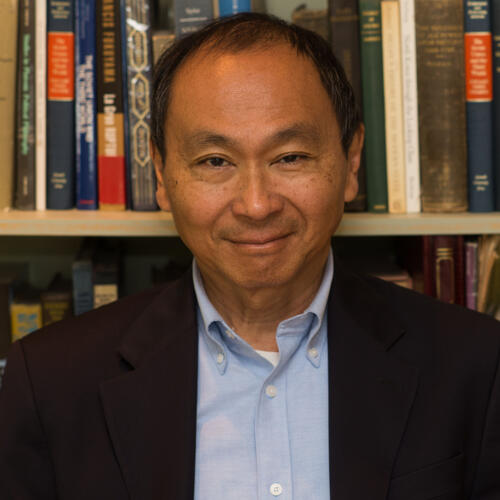
fukuyama francis self portrait logo
Francis Fukuyama is the Olivier Nomellini Senior Fellow at the Freeman Spogli Institute for International Studies (FSI) and the Mosbacher Director of FSI's Center on Democracy, Development, and the Rule of Law (CDDRL).  He is also a professor by courtesy in the Department of Political Science. He was previously at the Paul H. Nitze School of Advanced International Studies (SAIS) of Johns Hopkins University, where he was the Bernard L. Schwartz Professor of International Political Economy and director of SAIS' International Development program.


Image
bushra batainey
Bushra Bataineh is a PhD student in the Civil and Environmental Engineering department at Stanford University. Her research focuses on innovative project delivery mechanisms for water infrastructure worldwide. Her current research, conducted under the Global Projects Center at Stanford, is on private sector participation in water infrastructure projects in developing countries and the emergence of local private sector players. She is also analyzing cases of water sector public private partnerships in the United States in order to draw lessons learned with regards to innovative financial structuring.


Image
mbennon
Michael Bennon is a Managing Director at the Stanford Global Projects Center, developing new initiatives for the GPC and managing our student programs and industry affiliations. Michael’s research areas of interest for the center and work experience are in Public Sector finance, infrastructure and real estate investment, and project organization design. Michael served as a Captain in the US Army and US Army Corps of Engineers for five years, leading Engineer units, managing projects, and planning for infrastructure development in the United States, Iraq, Afghanistan, and Thailand. Michael received a bachelor’s degree in Civil Engineering from the United States Military Academy at West Point and received an MSCE and MBA from Stanford University.

Encina Hall, C148
616 Jane Stanford Way
Stanford, CA 94305

0
Olivier Nomellini Senior Fellow at the Freeman Spogli Institute for International Studies
Director of the Ford Dorsey Master's in International Policy
Research Affiliate at The Europe Center
Professor by Courtesy, Department of Political Science
yff-2021-14290_6500x4500_square.jpg

Francis Fukuyama is the Olivier Nomellini Senior Fellow at Stanford University's Freeman Spogli Institute for International Studies (FSI), and a faculty member of FSI's Center on Democracy, Development and the Rule of Law (CDDRL). He is also Director of Stanford's Ford Dorsey Master's in International Policy, and a professor (by courtesy) of Political Science.

Dr. Fukuyama has written widely on issues in development and international politics. His 1992 book, The End of History and the Last Man, has appeared in over twenty foreign editions. His book In the Realm of the Last Man: A Memoir will be published in fall 2026.

Francis Fukuyama received his B.A. from Cornell University in classics, and his Ph.D. from Harvard in Political Science. He was a member of the Political Science Department of the RAND Corporation, and of the Policy Planning Staff of the US Department of State. From 1996-2000 he was Omer L. and Nancy Hirst Professor of Public Policy at the School of Public Policy at George Mason University, and from 2001-2010 he was Bernard L. Schwartz Professor of International Political Economy at the Paul H. Nitze School of Advanced International Studies, Johns Hopkins University. He served as a member of the President’s Council on Bioethics from 2001-2004. He is editor-in-chief of American Purpose, an online journal.

Dr. Fukuyama holds honorary doctorates from Connecticut College, Doane College, Doshisha University (Japan), Kansai University (Japan), Aarhus University (Denmark), the Pardee Rand Graduate School, and Adam Mickiewicz University (Poland). He is a non-resident fellow at the Carnegie Endowment for International Peace. He is a member of the Board of Trustees of the Rand Corporation, the Board of Trustees of Freedom House, and the Board of the Volcker Alliance. He is a fellow of the National Academy for Public Administration, a member of the American Political Science Association, and of the Council on Foreign Relations. He is married to Laura Holmgren and has three children.

(October 2025)

CV
Date Label
CDDRL Mosbacher Director and Olivier Nomellini Fellow at FSI
Bushra Bataineh PhD student in the Civil and Environmental Engineering at Stanford
Michael Bennon Managing Director at the Stanford Global Projects Center
Seminars
-
Abstract: Individuals (such as Paul Rusesabagina during the Rwandan genocide and Oskar Schindler and Raoul Wallenberg during the Holocaust) and groups (including Muslims during the Rwandan genocide, Danes during the Holocaust, and the White Helmets in Syria today) have sought to rescue others during genocides and other atrocity crimes. Even if rare, such rescue can be significant, resulting in hundreds or thousands of lives saved. This talk—drawing on case studies from the Holocaust, the Rwandan genocide, and the ongoing conflict in Syria—will consider legal, political, and other approaches to promote rescue during such calamities.
 
Speaker bio: Zachary D. Kaufman, J.D., Ph.D., is a Lecturer in Law and Fellow at Stanford Law School, a Visiting Scholar at the Hoover Institution, and a Senior Fellow at Harvard University’s Kennedy School of Government. Previously, he taught at Yale and George Washington universities and held academic appointments at Yale Law School and Harvard Law School. Dr. Kaufman has served in all three branches of the U.S. government, including at the Supreme Court, the Departments of State and Justice, and the Senate Foreign Relations Committee. He has also served at three international war crimes tribunals (including the International Criminal Court), practiced law at O’Melveny & Myers LLP, and worked at Google. The author or editor of 3 books and over 40 articles and book chapters, Dr. Kaufman received his Ph.D. and M.Phil., both in International Relations, from Oxford University (where he was a Marshall Scholar), his J.D. from Yale Law School (where he was Editor-in-Chief of the Yale Law & Policy Review), and his B.A. in Political Science from Yale University (where he was the student body president).
Zachary D. Kaufman Stanford Law School, Hoover Institution, Harvard University
Seminars
-

Please join visiting scholar Sviatoslav Vakarchuk and Mosbacher Director of CDDRL Francis Fukuyama for a conversation on Ukraine's future success. 


Encina Hall, C148
616 Jane Stanford Way
Stanford, CA 94305

0
Olivier Nomellini Senior Fellow at the Freeman Spogli Institute for International Studies
Director of the Ford Dorsey Master's in International Policy
Research Affiliate at The Europe Center
Professor by Courtesy, Department of Political Science
yff-2021-14290_6500x4500_square.jpg

Francis Fukuyama is the Olivier Nomellini Senior Fellow at Stanford University's Freeman Spogli Institute for International Studies (FSI), and a faculty member of FSI's Center on Democracy, Development and the Rule of Law (CDDRL). He is also Director of Stanford's Ford Dorsey Master's in International Policy, and a professor (by courtesy) of Political Science.

Dr. Fukuyama has written widely on issues in development and international politics. His 1992 book, The End of History and the Last Man, has appeared in over twenty foreign editions. His book In the Realm of the Last Man: A Memoir will be published in fall 2026.

Francis Fukuyama received his B.A. from Cornell University in classics, and his Ph.D. from Harvard in Political Science. He was a member of the Political Science Department of the RAND Corporation, and of the Policy Planning Staff of the US Department of State. From 1996-2000 he was Omer L. and Nancy Hirst Professor of Public Policy at the School of Public Policy at George Mason University, and from 2001-2010 he was Bernard L. Schwartz Professor of International Political Economy at the Paul H. Nitze School of Advanced International Studies, Johns Hopkins University. He served as a member of the President’s Council on Bioethics from 2001-2004. He is editor-in-chief of American Purpose, an online journal.

Dr. Fukuyama holds honorary doctorates from Connecticut College, Doane College, Doshisha University (Japan), Kansai University (Japan), Aarhus University (Denmark), the Pardee Rand Graduate School, and Adam Mickiewicz University (Poland). He is a non-resident fellow at the Carnegie Endowment for International Peace. He is a member of the Board of Trustees of the Rand Corporation, the Board of Trustees of Freedom House, and the Board of the Volcker Alliance. He is a fellow of the National Academy for Public Administration, a member of the American Political Science Association, and of the Council on Foreign Relations. He is married to Laura Holmgren and has three children.

(October 2025)

CV
Date Label
CDDRL Mosbacher Director and Olivier Nomellini Fellow at FSI
0
Visiting Scholar, Ukrainian Emerging Leaders Program, 2017-18
slava_hs.jpg

Vakarchuk is a Ukrainian civic activist, musician and the lead vocalist and founder of the band “Okean Elzy.“ He will be in residence at CDDRL this fall to attend courses and study with some of the leading intellectuals and academics at CDDRL. He holds a doctorate degree in theoretical physics from the Ivan Franko National University of Lviv.

Vakarchuk is also the founder of a charity fund called “Lyudi Maybutnyogo” (People of the Future) and co-founder of the Center for Economic Strategy, an independent policy think tank dedicated to supporting reforms and sustainable economic growth in Ukraine. He served as a Yale World Fellow in 2015.

CDDRL Visiting Scholar and lead singer of "Okean Elzy" rock group
Seminars
-

Kevin Volpp is the founding Director of the Center for Health Incentives and Behavioral Economics, Division Chief of Health Policy for the Department of Medical Ethics and Policy, and the Founders President’s Distinguished Professor of Medicine at the Perelman School of Medicine and Health Care Management at the Wharton School of the University of Pennsylvania.

His work focuses on developing and testing innovative ways of applying insights from behavioral economics in improving patient health behavior and affecting provider performance. He has competitively been awarded more than $60 million to lead projects with a variety of employers, insurers, health systems, and consumer companies in testing the impact of different behavioral economic strategies on behavior.

You can listen to one of his more recent podcasts here: How Behavioral Economics Could Solve America's Health Care Woes

Update (3/12/18): We are now at capacity. Thank you to those who submitted RSVPs.

Kevin Volpp
Seminars
-

Abstract: The Berkeley Applied Nuclear Physics Program leads developments of new concepts and technologies to address challenges in fundamental physics, medicine, nuclear security, and safety. Recent progress in radiation detection and imaging combined with advances in computer vision and data processing enable unprecedented capabilities in the detection, mapping, and visualization of radiological and nuclear materials in complex environments. We have developed a new concept called 3-D Scene Data Fusion, which fuses contextual and radiation data to produce 3-D maps of radioactive sources in real-time. We have deployed this capability in unmanned and manned configurations in different locations including evacuated communities and at the Dai-ichi nuclear power plant in Fukushima Prefecture. While these technologies are necessary to better respond to accidents now and in the future, we need to ensure that the data provided can be understood by all stakeholders, including communities exposed to the risk of detrimental effects. We have established the Berkeley Institute for Resilient Communities to address this need by combining research, education, and communities in an international, multi-disciplinary, and multi-cultural context. Important components of these activities are the Radwatch and DoseNet programs which provide the basis for our communications. As an example, DoseNet aims at establishing a sustainable multi-sensor high-school network enabling students across the world to learn important concepts in science and engineering and what is normal in our world.


Speaker bio: Dr. Kai Vetter is Professor in the Department of Nuclear Engineering at the University of California, Berkeley and Faculty Senior Scientist and Head of the Applied Nuclear Physics program at the Lawrence Berkeley National Laboratory. His main research interests are in the development and demonstration of new concepts and technologies in radiation detection to address some of the outstanding challenges in fundamental sciences, nuclear security, and health.

Prof. Vetter is director of Institute for Resilient Communities that was established in 2015 to address the need to better integrate advancements in sciences and technologies with communities through education and outreach locally and globally. He initiated and still leads the Berkeley Radwatch and DoseNet activities with the goal to engage high and middle schools in performing environmental measurements employing fundamental science and engineering concepts and to expand across regions, nations, and cultures.

He has authored and co-authored about 200 publications in peer-reviewed journals and is fellow of the American Physical Society. He received Presidential Citations from the American Nuclear Society twice, for his engagement in Fukushima through measurements and enhancing community resilience.

Kai Vetter University of California, Berkeley; Lawrence Berkeley National Laboratory
Seminars
-

Abstract: What are the consequences of the emergence of robotics, big data, and artificial intelligence for international politics? Are these new technologies going to promote instability and conflict, as many warn, or are they going to reinforce U.S. military primacy? In particular, will China be able to gain and eventually exploit the unfolding technological revolution - the so-called Second Machine age - or are such concerns exaggerated? The literature in political science and international relations theory has either largely neglected technology and technological innovation, or simply assumed that technology is a substitute for labor that reduces countries' constraints to go to war. Drawing from the scholarship in economics and management, in this article we look at technology in terms of a set complements and nodes-in-the-network. Thus, while technological innovation reduces the prices of some goods or tasks, it simultaneously makes their complementary assets more difficult to procure (through an increase in the demand). The resulting distributional effects, we argue, explain why actors will benefit unevenly from technological change. We test our theoretical insights by looking at seapower in the first and in the emerging second machine age: respectively, the time of the steam engine, steel hulls, quick-firing long-range guns and the telegraph; as well as the unfolding era of neural networks, fast processors and real-time communications. Our preliminary empirical results corroborate our framework, namely that the effects of technological change are much more complex than the literature acknowledges and highlights the challenges countries will have to face in the military realm during the second machine age.

Speaker bios: Andrea Gilli is a Postdoctoral Fellow at the Belfer Center for Science and International Affairs, Harvard Kennedy School of Harvard University and a former Postdoctoral Fellow at the Center for International Security and Cooperation of Stanford University. Andrea has conducted research for several organizations, including the European Union Institute for Security Studies, RUSI in London and the Office of Net Assessment of the U.S. Department of Defense. He holds a Ph.D. in social and political science from the European University Institute, an MSc from the London School of Economics and Political Science and a B.A. from the University of Turin.


Mauro Gilli is a Senior Researcher at the Center for Security Studies of ETH-Zurich (Switzerland). During the academic year 2015-16, he was a Postdoctoral Fellow at the Dickey Center for International Understanding of Dartmouth College. He holds a Ph.D. in political science from Northwestern University, an MA from SAIS-Johns Hopkins and a B.A. from the University of Turin.

Belfer Center for Science and International Affairs, Harvard University
Mauro Gilli Center for Security Studies of ETH-Zurich
Seminars
-

Abstract: Over the past decade, fears about the decline of the United States relative to other countries (especially China) have become a prominent feature of American political discourse. While anxiety about losing power on the world stage has been a recurrent phenomenon in the United States since the 1950s, the present bout of pessimism – combining reactions to the disastrous Iraq War, the 2008 financial crisis, and most recently the rise of Donald Trump – makes this the deepest and most serious crisis of confidence in postwar American history. This project explores the domestic political and strategic consequences of anxiety about lost or eroding national status by combining insights from social theory and social psychology. I use evidence from historical cases of decline (including Spain after 1898, France after 1945 and the United Kingdom after 1945) as well as survey experiments to investigate hypotheses about the heterogenous ways in which different individuals and groups react to relative national decline, and how these responses combine to influence the declining state’s politics and foreign policy. 

Speaker bio: Steven Ward is a Junior Faculty Fellow at CISAC for the year 2017-2018 and an Assistant Professor in the Government Department at Cornell University. He holds an MA in Security Studies and a PhD in Government from Georgetown University. He is the author of Status and the Challenge of Rising Powers (Cambridge University Press, 2017). His work has appeared in Security Studies and International Studies Quarterly.

Seminars
-

Co-sponsored by the Southeast Asia Program and the Abbasi Program in Islamic Studies

Transnational Islam lacks the centralized leadership and institutions associated with Catholicism. Yet hierarchical and authoritative bodies do make decisions regarding Islam in various contemporary settings, including within the institutional frameworks of states. What happens when Muslim faith and practice are adapted to the terms and procedures of bureaucracy and the modern nation-state?

Dr. Müller will present an original conceptual framework for studying the bureaucratization of Islam. He will apply it to five Southeast Asian cases—Brunei, Indonesia, Malaysia, the Philippines, and Singapore. State bureaucracies in these countries vary widely,
but generally they aim to influence or control trends and meanings in local Islamic discourse. Drawing on current debates in the anthropology of the state, with particular reference to Brunei and Singapore, Müller will offer an original analytic framework to explain similarities and differences in bureaucratized Islam in Southeast Asia. Possible implications beyond the region will also be explored.

Dominik Müller

Image
dominik mueller4x4
heads the Max Planck Institute for Social Anthropology’s Research Group on the Bureaucratization of Islam and Its Socio-Legal Dimensions in Southeast Asia. He is also a non-resident fellow in the Centre for Asian Legal Studies at the National University of Singapore (NUS). Prior positions include visitorships at NUS (2016), the University of Oxford (2015), the University of Brunei Darussalam (2014), and Stanford University (APARC, 2013).  His doctorate in anthropology is from Goethe University Frankfurt (2012).His latest publication is an article on “Hybrid Pathways to Orthodoxy” in Brunei in the April-May 2018 Journal of Current Southeast Asian Affairs, a special issue on bureaucratized Islam that he also guest-edited.


Shorenstein APARC
Stanford University
Encina Hall, Room C331
Stanford, CA 94305-6055

(650) 724-5656 (650) 723-6530
0
Visiting Scholar
MullerDominik.jpg PhD

Dominik Müller joins the Walter H. Shorenstein Asia-Pacific Research Center (Shorenstein APARC) from February until May 2013 from the Department of Anthropology at Goethe-University Frankfurt where he serves as a postdoctoral research associate.

His research interests encompass Islam and popular culture in contemporary Southeast Asia, Malaysian domestic politics, and socio-legal change in the Malay world.

During his time at the Shorenstein APARC, Müller will conduct research on the religious bureaucracy of Malaysia. His research project at Stanford is funded by the German Academic Exchange Service (DAAD).

Müller obtained his PhD summa cum laude in 2012 in cultural anthropology from the Cluster of Excellence the “Formation of Normative Orders” at Frankfurt University. He previously studied anthropology, philosophy, and law in Frankfurt and at Leiden University. His dissertation on Islam, Politics, and Youth in Malaysia received the Frobenius Society’s Research Award 2012 and will be published in 2013.

Visiting Fellow, Islamic Legal Studies Program on Law and Social Change, Harvard University
Seminars
-

Abstract: The conventional international approach to post-conflict intervention has fallen short of expectations despite the enormous resources devoted to the endeavor. In this talk, Naazneen H. Barma will offer her original analysis of the underlying problem, arguing that while international peacebuilders aim to build effective and legitimate government, post-conflict elites co-opt process-focused interventions to serve their own very different political ends. She will present the core findings of her book, The Peacebuilding Puzzle, which develops a historical institutionalist approach to understanding peacebuilding. Through a comparative analysis of UN peace operations in Cambodia, East Timor, and Afghanistan, she will illustrate how competing international and domestic visions of post-conflict political order shape outcomes at three critical peacebuilding phases: the peace settlement; the transformative peace operation; and the aftermath of intervention. The central implication emerging from this study is that international peacebuilders must abandon the notion that post-conflict institutions can be designed and transplanted in whole cloth. Barma will conclude the talk with suggestions for a more incremental and adaptive approach to better achieve robust political order in post-conflict countries.

Speaker bio: Naazneen H. Barma is Associate Professor of National Security Affairs at the Naval Postgraduate School. Her research and teaching focus on peacebuilding and political order, the political economy of development, and natural resource governance, with a regional specialization in East Asia and the Pacific. Her most recent book, The Peacebuilding Puzzle (Cambridge University Press 2017), argues that international peace operations fall short of achieving the modern political order sought in post-conflict countries because the interventions empower domestic elites to attain their own political ends. Barma received her PhD and MA in Political Science from the University of California, Berkeley, and her MA in International Policy Studies and BA in International Relations and Economics from Stanford University. From 2007–2010, she was a Young Professional and Public Sector Specialist at the World Bank, where she conducted political economy analysis and worked on operational dimensions of governance and institutional reform in the East Asia Pacific Region. Barma is a founding member and co-director of Bridging the Gap, an initiative devoted to enhancing the policy impact of contemporary international affairs scholarship. 

Naazneen H. Barma Associate Professor, Department of National Security Affairs Naval Postgraduate School
Seminars
-

Abstract: This talk will explore the historical roots of the modern concept of identity, and how it plays out in contemporary nationalism, Islamism, populism, and liberal multiculturalism.  It will be based on my forthcoming book Identity: The Demand for Dignity and the Politics of Resentment, to be published by Farrar, Straus and Giroux in September 2018.

Speaker bio: Francis Fukuyama is Olivier Nomellini Senior Fellow at FSI and Mosbacher Director of the Center on Democracy, Development, and the Rule of Law. He has worked previously at the State Dept., the Rand Corporation, and taught at George Mason University and Johns Hopkins SAIS before coming to Stanford in 2010.
 
Frank Fukuyama CDDRL, Stanford University
Seminars
Subscribe to Seminars