Paragraphs

In Nigeria, cash transfers to women increase their desire for agency but only when husbands can't see it — revealing the complex interplay between economic empowerment and social norms.

Women's empowerment remains a central development goal, with policymakers frequently using cash transfer programmes to improve women's status within households (Almås et al. 2018, Duflo 2012, Greco et al. 2025). But do these economic interventions actually change power dynamics, or do they merely shift material outcomes? Our study of married couples in rural Nigeria reveals a surprising answer: cash transfers increase women's desire for decision-making power, but this desire remains hidden.

All Publications button
1
Publication Type
Journal Articles
Publication Date
Journal Publisher
VoxDev
Authors
Marcel Fafchamps
Authors
Khushmita Dhabhai
News Type
News
Date
Paragraphs

On September 25, 2025, FSI Senior Fellow Claire Adida presented her team’s research at a CDDRL Research Seminar Series talk under the title, “Overcoming Barriers to Women’s Political Participation: Evidence from Nigeria.” The seminar addressed a central paradox in global politics: although women’s legal formal right to vote is nearly universal, deep gender gaps remain in informal forms of political participation, such as contacting a local government official or attending a community meeting. This lack of engagement means women’s voices are underrepresented in governance and policies are less likely to reflect their priorities. This is particularly salient in hybrid democracies, where informal political participation may matter more than casting a vote.

Adida situated the study in the context of Nigeria, a large and diverse democracy that remains heavily patriarchal. Surveys highlight these disparities starkly: nearly half of Nigerian men believe men make better leaders than women; two in five women report never discussing politics with friends or family; and women are consistently less likely than men to attend meetings or contact community leaders. Against this backdrop, the project tested interventions designed to reduce barriers that discourage women’s participation.

The research team identified three categories of constraints: resource-based (a lack of time, skills, or information), norms-based (social expectations that women should remain outside the public sphere), and psychological (feelings of disempowerment and doubt about one’s capacity to create change). The study focused on the last two. To explore these, the team partnered with ActionAid Nigeria to conduct a randomized control trial (RCT) across 450 rural wards in three southwestern states. Local leaders identified groups of economically active women, aged 21 to 50, who were permitted by their spouses to join.

All communities began with an informational session on local governance. Beyond that, two types of training were introduced. The first, targeted at women, consisted of five sessions over five months designed to build leadership, organizing, and advocacy skills. These emphasized group-based learning and aimed to foster collective efficacy — the belief that a group can act together to achieve change. The second, targeted at men, encouraged husbands to act as allies in supporting women’s participation. After the initial informational session, communities were randomly assigned to no longer receive further training, to receive the 5 sessions of women’s training, or to receive the 5 sessions of women’s training and the 5 sessions of men’s training.

The findings were striking. Women’s trainings had clear positive effects: participants were more likely to engage in politics, attend meetings, and contact local leaders. The quality of their participation also improved, suggesting greater confidence and effectiveness. There was also evidence that these women’s trainings activated collective and self-efficacy, lending credence to the Social Identity Model of Collective Action (SIMCA), a framework explaining how a sense of shared identity, group-based injustice, and group efficacy build political engagement. By contrast, men’s trainings produced modest results. They did not increase women’s participation beyond the women’s trainings and, in some cases, had small negative effects, such as on grant applications. Still, men’s trainings reduced opposition to women’s involvement, improved beliefs about women in leadership, and increased perceptions of more permissive community norms, even if they did not translate into an increase in women’s political participation.

Adida noted that these limited effects may reflect “ceiling effects” — many men in the sample were already relatively supportive compared to national averages, or lower attendance rates. It is also possible that changes in men’s attitudes take longer to manifest in behavior. The seminar concluded that advocacy trainings for women show strong promise in boosting participation, while efforts to reshape patriarchal norms among men may require longer-term strategies.

Read More

Natalia Forrat presented her research in a CDDRL seminar on May 29, 2025.
News

Unity, Division, and the Grassroots Architecture of Authoritarian Rule

Dr. Natalia Forrat, a comparative political sociologist and lecturer at the University of Michigan’s Center for Russian, East European, and Eurasian Studies, explores how authoritarian regimes are maintained not only through top-down coercion but also through everyday social dynamics at the grassroots level.
Unity, Division, and the Grassroots Architecture of Authoritarian Rule
Paul Pierson presented his research in a CDDRL seminar on May 22, 2025.
News

The Risks of U.S. Democratic Backsliding

University of California, Berkeley Distinguished Professor Paul Pierson explores the risks of democratic backsliding in the United States in the face of rising polarization and inequality.
The Risks of U.S. Democratic Backsliding
Clémence Tricaud presented her research in a CDDRL seminar on May 15, 2025.
News

Margins That Matter: Understanding the Changing Nature of U.S. Elections

In a CDDRL research seminar, Clémence Tricaud, Assistant Professor of Economics at the UCLA Anderson School of Management, shared her research on the evolving nature of electoral competition in the United States. She explored a question of growing political and public interest: Are U.S. elections truly getting closer—and if so, why does that matter?
Margins That Matter: Understanding the Changing Nature of U.S. Elections
Hero Image
Claire Adida
All News button
1
Subtitle

In Nigeria, women are far less likely than men to attend meetings or contact leaders. Claire Adida’s research reveals interventions that make a difference.

Date Label
News Type
News
Date
Paragraphs

Introduction


Generative AI has become an incredibly attractive and widespread tool for people across the world. Alongside its rapid growth, AI tools present a host of ethical challenges relating to consent, security, and privacy, among others. As Generative AI has been spearheaded primarily by large technology companies, these ethical challenges — especially as viewed from the vantage point of ordinary people — risk being overlooked for the sake of market competition and profit. What is needed, therefore, is a deeper understanding of and attention to how ordinary people perceive AI, including its costs and benefits.

The Meta Community Forum Results Analysis, authored by Samuel Chang, James S. Fishkin, Ricky Hernandez Marquez, Ayushi Kadakia, Alice Siu, and Robert Taylor, aims to address some of these challenges. A partnership between CDDRL’s Deliberative Democracy Lab and Meta, the forum enables participants to learn about and collectively reflect on AI. The impulse behind deliberative democracy is straightforward: people affected by some policy or program should have the right to communicate about its contents and to understand the reasons for its adoption. As Generative AI and the companies that produce it become increasingly powerful, democratic input becomes even more essential to ensure their accountability. 

Motivation & Takeaways


In October 2024, the third Meta Community Forum took place. Its importance derives from the advancements in Generative AI since October 2023, when the last round of deliberations was held. One such advancement is the move beyond AI chatbots to AI agents, which can solve more complex tasks and adapt in real-time to improve responses. A second advancement is that AI has become multimodal, moving beyond the generation of text and into images, video, and audio. These advancements raise new questions and challenges. As such, the third forum provided participants with the opportunity to deliberate on a range of policy proposals, organized around two key themes: how AI agents should interact with users and how they should provide proactive and personalized experiences for them.

To summarize some of the forum’s core findings: the majority of participants value transparency and consent in their interactions with AI agents as well as the security and privacy of their data. In turn, they are less comfortable with agents autonomously completing tasks if this is not transparent to them. Participants have a positive outlook on AI agents but want to have control over their interactions. Regarding the deliberations themselves, participants rated the forum highly and felt that it exposed them to alternative perspectives. The deliberators wanted to learn more about AI for themselves, which was evidenced by their increased use of these tools after the deliberations. Future reports will explore the reasoning and arguments that they used while deliberating.


Image
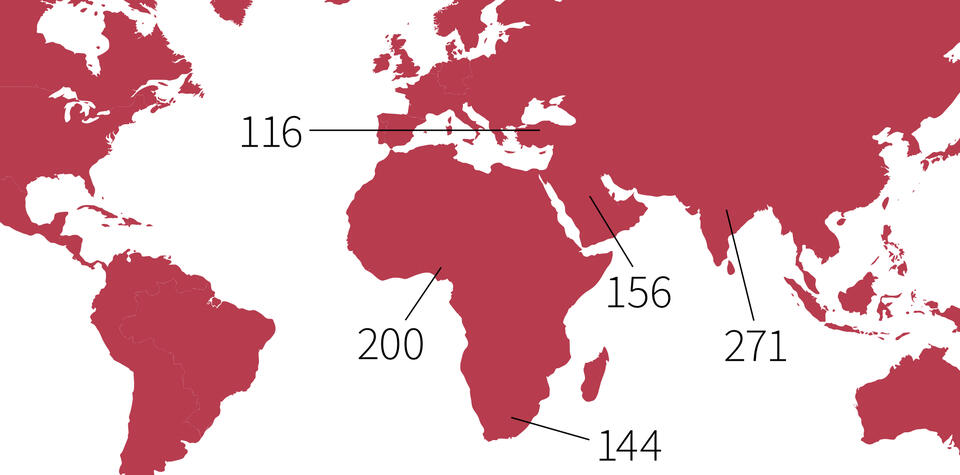
Map of where participants hailed from.


The participants of this Community Forum were representative samples of the general population from five countries - Turkey, Saudi Arabia, India, Nigeria, and South Africa. Participants from each country deliberated separately in English, Hindi, Turkish, or Arabic.


Methodology & Data


The deliberations involved around 900 participants from five countries: India, Nigeria, Saudi Arabia, South Africa, and Turkey. Participants varied in terms of age, gender, education, and urbanicity. Because the deliberative groups were recruited independently, the forum can be seen as five independent deliberations. Deliberations alternated between small group discussions and ‘plenary sessions,’ where experts answered questions drawn from the small groups. There were around 1000 participants in the control group, who did pre- and post-surveys, but without deliberating. The participant sample was representative with respect to gender, while the treatment and control groups were balanced on demography as well as on their attitudes toward AI. Before deliberating on the proposals, participants were presented with background materials as well as a list of costs and benefits to consider.

In terms of the survey data, large majorities of participants had previously used AI. There was a statistically significant increase in these proportions after the forum. For example, in Turkey, usage rates increased from nearly 70% to 84%. In several countries, there were large increases in participants’ sense of AI’s positive benefits after deliberating, as well as a statistically significant increase in their interest. The deliberations changed participants’ opinions about a host of claims; for example, “people will feel less lonely with AI” and “more proactive [agents] are intrusive” lost approval whereas “AI agents’ capability to increase efficiency…is saving many companies a lot of time and resources” and “AI agents are helping people become more creative” gained approval. After deliberating, participants demonstrated an improved understanding of some factual aspects of AI, although the more technical aspects of this remain challenging. One example here is AI hallucinations, or rather, the generation of false or nonsensical outputs, usually because of flawed training data.


Image
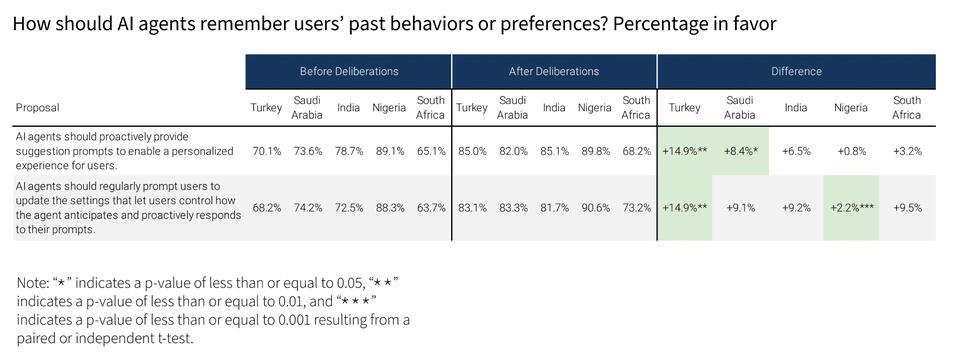
Chart: How should AI agents remember users' past behaviors or preferences? Percentage in favor


Proposals


Participants deliberated on nineteen policy proposals. To summarize these briefly: In terms of whether and how AI remembers users’ past behaviors and preferences, participants preferred proposals that allowed users to make active choices, as opposed to this being a default setting or only being asked once. They also preferred being reminded about the ability of AI agents to personalize their experience, as well as agents being transparent with users about the tasks they complete. Participants preferred that users be educated on AI before using it, as well as being informed when AI is picking up on certain emotional cues and responding in “human-like” ways. They also preferred proposals whereby AI would ask clarifying questions before generating output. Finally, when it comes to agents helping users with real-life relationships, this was seen as more permissible when the other person was informed. Across the proposals, gender was neither a significant nor consistent determinant of how they were rated. Ultimately, the Meta Community Forum offers a model for how informed, public communication can shape AI and the ethical challenges it raises.

*Research-in-Brief prepared by Adam Fefer.

 
Hero Image
Agentic AI Workflow Automation, Artificial intelligence AI driven decision-making concept illustration blue background iStock / Getty Images
All News button
0
Subtitle

CDDRL Research-in-Brief [4-minute read]

Date Label
Paragraphs

In October 2024, Meta, in collaboration with the Stanford Deliberative Democracy Lab, implemented the third Meta Community Forum. This Community Forum expanded on the October 2023 deliberations regarding Generative AI. For this Community Forum, the participants deliberated on ‘how should AI agents provide proactive, personalized experiences for users?’ and ‘how should AI agents and users interact?’ Since the last Community Forum, the development of Generative AI has moved beyond AI chatbots and users have begun to explore the use of AI agents — a type of AI that can respond to written or verbal prompts by performing actions for you, or on your behalf. And beyond text-generating AI, users have begun to explore multimodal AI, where tools are able to generate content images, videos, and audio as well. The growing landscape of Generative AI raises more questions about users’ preferences when it comes to interacting with AI agents. This Community Forum focused deliberations on how interactive and proactive AI agents should be when engaging with users. Participants considered a variety of tradeoffs regarding consent, transparency, and human-like behaviors of AI agents. These deliberations shed light on what users are thinking now amidst the changing technology landscape in Generative AI.

For this deliberation, nearly 900 participants from five countries: India, Nigeria, Saudi Arabia, South Africa, and Turkey, participated in this deliberative event. The samples of each of these countries were recruited independently, so this Community Forum should be seen as five independent deliberations. In addition, 1,033 persons participated in the control group, where the participants did not deliberate in any discussions; the control group only completed the two surveys, pre and post. The main purpose of the control group is to demonstrate that any changes that occur after deliberation are a result of the deliberative event.

All Publications button
1
Publication Type
Reports
Publication Date
Subtitle

April 2025

Authors
James S. Fishkin
Alice Siu
Paragraphs

Governments often have contentious relationships with residents of urban informal settlements. Motivated by the desire for rents and dreams of becoming the next luxury destination, city governments worldwide have forcefully evicted and demolished informal communities in this pursuit. In such instances it would seem that the state has broken the social contract with its most vulnerable citizens. How do citizens respond? We might expect them to reciprocate in kind, by withholding taxes owed to the government. Using a survey of citizens living in informal settlements across Lagos State in Nigeria, we explore what predicts citizens’ willingness to comply with government taxation. In this unlikely context for voluntary compliance, we observe that a third of respondents pay taxes and a majority are willing to pay absent enforcement. We find minimal support for standard theories of tax payment — trust in or reciprocity towards the government, or identification with the nation. Instead, we find that willingness to pay taxes is correlated with donating to the community, group membership, and believing that community members respect taxpayers. Our data suggest that local institutions and social relations may be important factors associated with citizens’ willingness to comply with tax policy.

All Publications button
1
Publication Type
Working Papers
Publication Date
Authors
Leah R. Rosenzweig
Paragraphs

Key messages:

  • The Congo Basin is rich in biodiversity and stores an estimated 25%-30% of the worlds tropical forest carbon stocks. As agricultural land becomes increasingly scarce in Southeast Asia, and regulatory pressures continue to intensify, the Congo Basin could become the next frontier for oil palm expansion. Most of the roughly 280 million hectares (Mha) of additional land suitable for oil palm in the Congo Basin are found in the Democratic Republic of Congo (60%), Cameroon (11%) and the Republic of Congo (10%).
  • Many heavily forested countries in the Congo Basin are setting national targets to increase production to meet national and regional demands. Land area allocated to oil palm increased by 40% in the Congo Basin and five additional top-producing countries in Africa between 1990 and 2017. Without intervention, future production increases in the region will likely come from expansion rather than intensification due to low crop and processing yields, possibly at the expense of forest.
  • Sustainability strategies initiated by companies and aimed at certifying palm oil mills are unlikely to be effective at curbing deforestation in the Congo Basin. Smallholder farmers are an engine of growth in the regions palm oil sector, and recent evidence suggests they are actively clearing forest to expand. Because of the proliferation of non-industrial processing facilities (artisanal mills), a substantial fraction of the palm oil produced by smallholders never passes through a company's jurisdiction. Smallholders are also disadvantaged by power imbalances and limited access to technical and financial resources. Including smallholders in sustainability strategies offers opportunities to achieve multisectoral goals.
  • Recommendations to improve the sustainability of the palm oil sector in the Congo Basin include (1) improving access to finance for smallholders and non-industrial mill managers; (2) implementing policies to safeguard natural resources and facilitate access to appropriate market opportunities that offer incentives to prevent future deforestation; (3) intensifying production by replanting aging plantations, rehabilitating abandoned plantations with disease-resistant and high-yielding varieties, and increasing fertilization, without further expansion into high conservation value or high carbon stock forest areas; and (4) improving processing capacity and extraction rates by upgrading mill technologies. Sustainable palm oil development in the Congo Basin will require careful consideration of the governance, institutional, environmental and socioeconomic factors that underpin the complex regional supply chains.
All Publications button
1
Publication Type
Journal Articles
Publication Date
Journal Publisher
Center for International Forestry Research Center for International Forestry Research
Authors
Rosamond L. Naylor
Number
Infobrief 255
News Type
Q&As
Date
Paragraphs

Stanford University’s Center on Democracy, Development and the Rule of Law (CDDRL) is proud to announce our four incoming fellows who will be joining us in the 2016-2017 academic year to develop their research, engage with faculty and tap into our diverse scholarly community. 

The pre- and postdoctoral program will provide fellows the time to focus on research and data analysis as they work to finalize and publish their dissertation research, while connecting with resident faculty and research staff at CDDRL. 

Fellows will present their research during our weekly research seminar series and an array of scholarly events and conferences.

Topics of the incoming cohort include electoral fraud in Russia, how the elite class impacts state power in China, the role of emotions in support for democracy in Zimbabwe, and market institutions in Nigeria. 

Learn more in the Q&A below.


Image
natalia embedded
Natalia Forrat

CDDRL Pre-Doctoral Fellow

Hometown: Tomsk, Russia

Academic Institution: Northwestern University

Discipline and expected date of graduation: Sociology, April 2017

Research Interests: authoritarianism, state capacity, social policy, civil society, trust, Russia and post-communist countries

Dissertation Title: The State that Betrays the Trust: Infrastructural State Power, Public Sector Organizations, and Authoritarian Resilience in Putin's Russia

What attracted you to the CDDRL Pre/post-doctoral program? I study the connection between state capacity and political regimes - the topic that is at the core of many research initiatives at CDDRL. Learning more about this work and receiving feedback for my dissertation will enrich and sharpen my analysis, while helping me to place it into a comparative context. I am looking forward to discussing my work with the faculty who study the post-Soviet region. I also will explore policy implications of my work with the help of policy experts at CDDRL.

What do you hope to accomplish during your nine-month residency at the CDDRL? Besides finishing writing my dissertation, I will workshop three working papers to prepare them for publication. The first one argues that Putin's regime used the school system to administer a large-scale electoral fraud in 2012 presidential elections; the second one shows how the networks of social organizations were used by subnational autocrats to strengthen the regime; and the third one will look at the factors that make the abuse of such organizations more difficult in some regions. In addition to these papers I will continue developing my post-graduation research project exploring the relationship between social trust and distrust, institutions, political competition, and democratization.

Fun fact: I have spent 25 years of my life in Siberia, and I can tell you: Chicago winters are worse!


Image
shelby embedded
Shelby Grossman

CDDRL Postdoctoral Fellow

Hometown: Reading, MA

Academic Institution: Harvard University

Discipline & Graduation Date:  Government, Summer 2016

Research interests: political economy of development, private governance, market institutions, Sub-Saharan Africa, survey methods

Dissertation Title: The Politics of Order in Informal Markets: Evidence from Lagos

What attracted you to the CDDRL post-doctoral program? I was attracted to CDDRL largely for its community of scholars. Affiliated faculty work on the political economy of development and medieval and modern market institutions, topics that are tied to my own interests.

What do you hope to accomplish during your nine-month residency at the CDDRL? I plan to prepare a book manuscript based on my dissertation, a project that explains variation in the provision of pro-trade institutions in private market organizations through the study of physical marketplaces in Nigeria. In addition, I will continue to remotely manage an on-going project in Nigeria (with Meredith Startz) investigating whether reputation alleviates contracting frictions. I also plan to work on submitting to journals a few working papers, including one on the politics of non-compliance with polio vaccination in Nigeria (with Jonathan Phillips and Leah Rosenzweig). 

Fun fact: Contrary to popular belief, not all cheese is vegetarian. I have a website to help people determine if a cheese is vegetarian or not: IsThisCheeseVegetarian.com. 


Image
daniel embedded
Daniel Mattingly

CDDRL Postdoctoral Fellow

Hometown: Oakland, California

Academic Institution: University of California, Berkeley

Discipline & Graduation Date: Political Science, Summer 2016

Research Interests: Governance, rule of law, state building, authoritarian politics, Chinese politics

Dissertation Title: The Social Origins of State Power: Democratic Institutions and Local Elites in China

What attracted you to CDDRL?  The Center has a fantastic community of scholars and practitioners who work on the areas that I'm interested in, including governance and the rule of law. I'm excited to learn from the CDDRL community and participate in the Center's events. The fellowship also provides me with valuable time to finish my book manuscript before I start teaching.

What do you hope to accomplish during your nine-month residency at the CDDRL? While at CDDRL, I plan to prepare my book manuscript and to work on some related projects on local elites and state power in China and elsewhere. 

Fun fact: I grew up on an organic farm in Vermont.


Image
lauren embedded
Lauren E. Young

CDDRL Postdoctoral Fellow

Hometown: Saratoga, CA

Academic Institution: Columbia University 

Discipline & Graduation Date: Political Science (Comparative Politics, Methods), May 2016 (defense), Oct 2016 (degree conferral)

Research Interests: political violence, political economy of development, autocratic persistence, democratization, protest, electoral violence

Dissertation Title: The Psychology of Repression and Dissent in Autocracy

What attracted you to the CDDRL post-doctoral program? As a graduate of the CISAC honors program when I was an undergraduate at Stanford, I have seen first-hand how intellectually stimulating, collaborative, and plugged into policy CDDRL is. While at the center I will be revising my dissertation work on the political psychology of participation in pro-democracy movements in Zimbabwe for submission as a book manuscript, and moving forward new projects that similarly seek to understand how different forms of violence by non-state actors affects citizens' preferences and decision-making. Because of its deep bench of experts on autocracy, narco-trafficking, and insurgency, CDDRL will add enormous value to these projects.

What do you hope to accomplish during your nine-month residency at the CDDRL?  During my fellowship year, my primary goal is to revise my research on Zimbabwe into a book manuscript. I defended my dissertation as three stand-alone articles, including two experiments showing that emotions influence whether opposition supporters in Zimbabwe express their pro-democracy preferences and a descriptive paper showing that repression has a larger effect on the behavior of the poor. To prepare the book manuscript during my fellowship, I will bring in additional quantitative and qualitative descriptive evidence and tie the three papers together into a cohesive argument about how opposition supporters make decisions about participation in protest, why emotions have such a large effect on these decisions, and how this affects variation across individuals and the strategic choices of autocrats and activists.

Fun fact: During my fieldwork I took an overnight train from Victoria Falls to a southern city in Zimbabwe and hitch-hiked into a national park. It got a little nerve-wracking when night started to fall, but ended with  an invitation to a barbecue! 



Hero Image
cddrl fellows 2016 logo
All News button
1
Encina Hall, C433 616 Jane Stanford Way Stanford, CA 94305-6055
0
shelby_grossman.jpg PhD

Shelby Grossman was a research scholar at the Cyber Policy Center. Her research focuses on online safety. Shelby's research has been published in Comparative Political Studies, PNAS Nexus, Political Communication, The Journal of Politics, World Development, and World Politics. Her book, "The Politics of Order in Informal Markets," was published by Cambridge University Press. She is co-editor of the Journal of Online Trust and Safety, and teaches classes at Stanford on open source investigation and online trust and safety issues. 

Shelby was an assistant professor of political science at the University of Memphis from 2017-2019, and a postdoctoral fellow at Stanford University’s Center on Democracy, Development, and the Rule of Law from 2016-17. She earned her Ph.D. in Government from Harvard University in 2016.

Research Scholar
CDDRL Postdoctoral Fellow, 2016-17
Date Label
News Type
News
Date
Paragraphs
In an interview with Nigeria's This Day Live, CDDRL Director Larry Diamond comments on the release of a new edition of his 1988 book, Class, Ethnicity and Democracy in Nigeria: The Failure of the First Republic. This newspaper interview marks the occasion and reflects on Nigeria's election aftermath.
 
Hero Image
general buhari holding a broom at a campign rally
General Muhammadu Buhari holding a broom at a campaign rally. Jan. 2015.
Heinrich-Boll-Stiftung
All News button
1
Authors
Larry Diamond
News Type
News
Date
Paragraphs

Is democracy heading toward a depression? CDDRL Director Larry Diamond answers in a recent Foreign Policy piece, assessing the challenges of overcoming a global, decade-long democratic recession. With much of the world losing faith in the model of liberal democracy, Diamond believes the key to setting democracy back on track involves heavy reform in America, serious crackdowns on corruption, and a reassessment of how the West approaches its support for democratic development abroad. 

Hero Image
protect your republic protest   1 2007 04 14 2
'Protect your Republic Protest' in Anıtkabir, Ankara, Turkey. 14 April 2007.
Selahattin Sönmez, Wikimedia Commons
All News button
1
Subscribe to Nigeria