
Authors
News Type
News
Date
Paragraphs

Motivation


Retaliation (or the threat thereof) is a central component of human behavior. It plays a key role in sustaining cooperation — such as in international organizations or free trade agreements — because those known to retaliate come to acquire a reputation of being hard to exploit. But how does the use and function of retaliation vary across cultures, and how does it interact with formal forms of punishment?

In “Cross-cultural differences in retaliation: Evidence from the soccer field,” Alain Schläpfer tackles these questions using data on retaliation from association football. Retaliation is simply defined in terms of fouling: player B retaliates against player A if and only if, after A fouls B, B then fouls A. Among other findings, Schläpfer shows that players from cultures emphasizing revenge are more likely to retaliate on the football field. This form of ‘informal punishment’ by players also interacts with ‘formal punishment’ by referees: retaliation by B is less likely when A is sanctioned with a yellow card. Schläpfer’s paper increases our knowledge of the causes and consequences of retaliation, while showing how informal cultural norms interact with the formal rules of football.  

Data


Schläpfer creates a data set of fouls committed over three football seasons (2016-2019) in nine of the world’s top professional men’s leagues. This includes the European leagues of Premier League (England), Serie A (Italy), Bundesliga (Germany), LaLiga (Spain), and Ligue 1 (France), as well as Série A (Brazil), Liga Profesional (Argentina), Liga MX (Mexico), and Major League Soccer (United States). The dataset comprises 9,531 games, 230,113 fouls committed by 10,928 unique perpetrators from 139 countries against 11,115 unique victims from 137 countries.

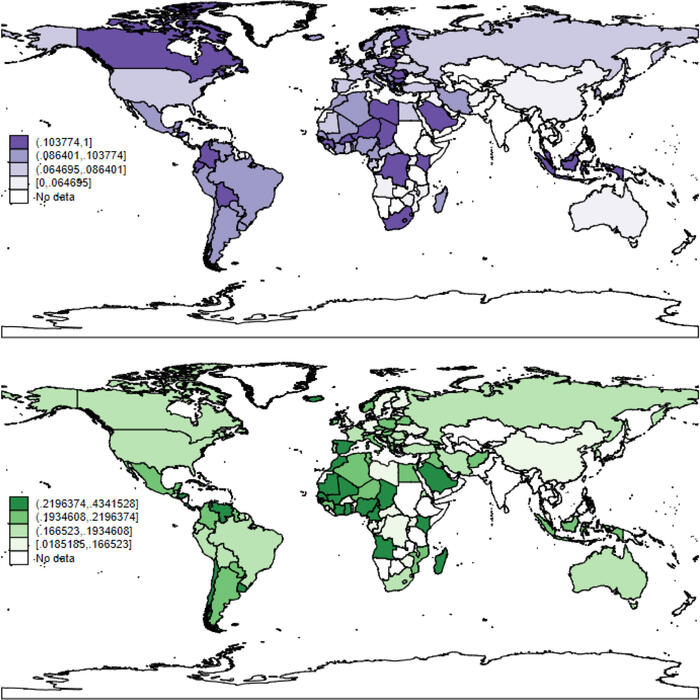
Because Schläpfer hypothesizes that being from more revenge-centric cultures explains on-field retaliation, the key independent variable is measured using a dataset from Stelios Michalopoulos and Melanie Meng Xue that identifies revenge motifs in a culture’s folklore. Examples of this include supernatural forces avenging human murders or animals avenging the death of their friends by humans. Schläpfer uses a host of other independent variables, such as country-level survey data about the desire to punish — as opposed to rehabilitate — criminals, which is also theoretically linked to revenge. As stated above, retaliation is measured in terms of fouls committed. Schläpfer shows that there is substantial variation in retaliation rates among players from different countries, from Gabon (8%) to Iceland (31%). Can the folklore in the country of origin explain the behavior of players on the field?


Image
Fig. 1. The share of fouls retaliated in soccer games (top) and the prevalence of revenge motifs in folklore (bottom). Both variables tend to have higher values for players and folklore from the Middle East, Central Africa, Eastern Europe, and parts of South America.


Fig. 1. The share of fouls retaliated in soccer games (top) and the prevalence of revenge motifs in folklore (bottom). Both variables tend to have higher values for players and folklore from the Middle East, Central Africa, Eastern Europe, and parts of South America.


Findings


Retaliation:

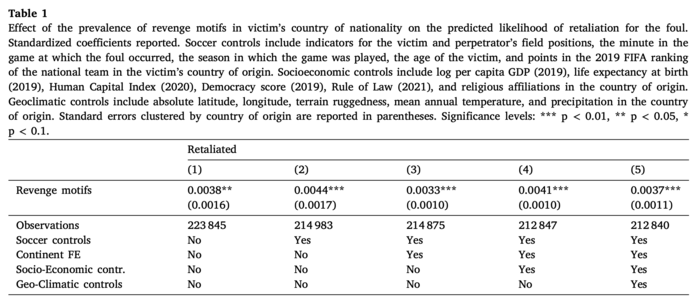
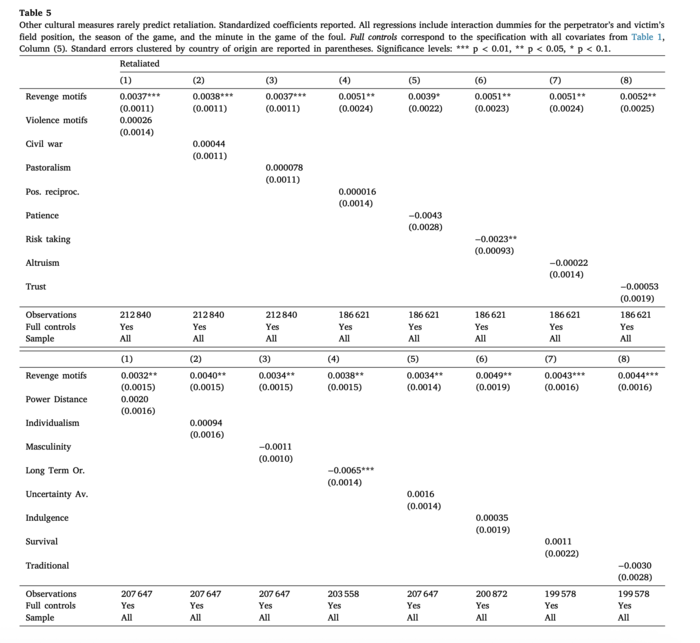
Schläpfer finds evidence that players from cultures that value revenge are indeed more likely to retaliate for fouls. However, they are not more likely to commit fouls overall, cautioning us against conflating the concepts of retaliation and violence. Indeed, Schläpfer demonstrates that motifs of violence in a culture's folklore do not predict retaliation. Players are also found to be more retaliatory early on in a game, which is consistent with its use as a signal or aspect of one’s reputation. In other words, retaliation serves to deter future fouls. Victims of fouls also retaliate quickly. Indeed, retaliation rates are stable or slightly increasing during the first 30 minutes of a game, but then fall consistently thereafter.


Image
Table 1. Effect of the prevalence of revenge motifs in victim’s country of nationality on the predicted likelihood of retaliation for the foul.


Evidence is also provided to show that retaliation deters future transgressions: perpetrators are less likely to foul again if victims retaliate for the initial foul. However, this deterrence finding is only observed when the perpetrator is from a revenge culture. In other words, for retaliation to support cooperation (the absence of fouls), players must share a similar cultural background.

Schläpfer’s findings hold even when soccer-related or socioeconomic factors are taken into account. Further, the paper considers, but finds little support for, alternative explanations of why retaliation varies. These include that some teams encourage players to retaliate more or employ more players from revenge cultures. Further, retaliation does not appear to be driven by emotions; otherwise, it would be less likely to occur after halftime when players have had a chance to cool down, but this is not the case.


Image
Table 5. Other cultural measures rarely predict retaliation. Standardized coefficients reported.


Informal and Formal Sanctioning:

Finally, Schläpfer analyzes the interaction between player retaliation and refereeing. Most importantly, retaliation is significantly less likely if a foul is sanctioned with a yellow card. This illustrates the theoretical principle of formal punishment “crowding out” informal punishment, such as religious excommunication, which carries greater weight than social shunning or police fines compared to peer pressure. Both retaliation and referee sanctioning are shown to reduce the frequency of repeated offenses by perpetrators, especially among players from revenge cultures. However, Schläpfer finds that formal sanctioning is roughly three times more effective than retaliation. This suggests that football referees are doing a better job managing conflict between players than players themselves. 

Schläpfer concludes by mentioning a few of the paper’s limitations. First of all, retaliation is measured only by what referees sanction. However, referees may miss crucial incidents for which retaliation is a response, such as Zinedine Zidane’s 2006 World Cup headbutt after a verbal insult (that was not sanctioned). This is important because individuals from revenge cultures are likely to be particularly offended by verbal insults. Second, the paper does not capture retaliation that occurs across games played by the same teams over time, particularly when rivalries and hostilities have intensified. Similarly, it does not account for preemptive retaliation that does not follow a foul. Ultimately, Schläpfer deepens our understanding of retaliation in a domain where many would expect it not to operate or to do so with minimal significance. The article impressively marshals large-scale data from both sports and cultural history to clarify the causes and consequences of retaliation.

*Research-in-Brief prepared by Adam Fefer.

Hero Image
A person in a red and blue football uniform on a field Jona Møller via Unsplash
All News button
1
Subtitle

CDDRL Research-in-Brief [4-minute read]
Date Label
Authors
News Type
News
Date
Paragraphs

Motivation & Contribution


Over the past 10-15 years, both longstanding and relatively new democracies have suffered from backsliding and erosion, including India, the United States, Brazil, Turkey, and many others. Many social scientists have explained this wave of backsliding in terms of either (a) elected autocrats who undermine democracy from within or (b) declining popular support for democrats who have failed to deliver economic growth and prosperity. However, recent scholarship by Thomas Carothers and Brendan Hartnett has questioned the wisdom of the latter. For example, India enjoyed strong economic growth prior to its backsliding under Narendra Modi.

In “Delivering for Democracy,” Francis Fukuyama, Chris Dann, and Beatriz Magaloni set out to more systematically evaluate the evidence connecting popular support for democracy with delivery, examining both backsliding and non-backsliding countries. After finding preliminary evidence for the democracy-delivery relationship, they offer an explanation of why delivery is simultaneously so important and so elusive under democratic governance.

Evidence


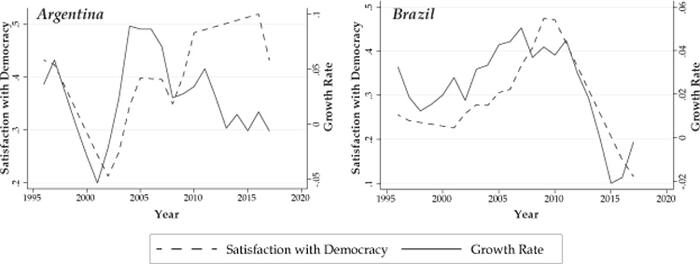
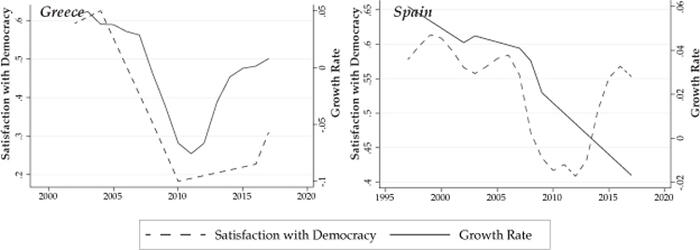
Using ten data sources covering 650,000 people in both old and new democracies, the authors find a strong, positive correlation between satisfaction with democracy and economic performance. This relationship holds not only for many countries at one point in time but for pairs of countries over time. In two developing democracies — Argentina and Brazil — as well as in two developed democracies — Greece and Spain — satisfaction and delivery have been closely connected since 2005, plummeting during economic crises and rising during periods of prosperity. These patterns call for an explanation for why voters care so much about delivery, such that they may be willing to sacrifice their democratic freedoms for it.


Image
Graphs showing satisfaction with democracy and growth rate in Argentina and Brazil


Image
Graphs showing satisfaction with democracy and growth rate in Greece and Spain


The Argument


Delivery is Important

The authors begin from the axiom that stable political life depends upon citizens perceiving their governments as legitimate. Legitimacy can be thought of in terms of both performance — the effective delivery of goods and services — and procedure, which encompasses policies that reflect the democratic will of the people. As the examples of China, Turkey, Saudi Arabia, and Singapore show, however, plenty of autocracies and backsliding democracies have not only delivered, but have also arguably outperformed their democratic peers. From China’s Belt and Road Initiative to Turkey’s Yavuz Sultan Selim Bridge, authoritarian leaders and ruling parties have achieved remarkable performance legitimacy. 

Although autocracies, by definition, cannot be procedurally legitimate, this may carry little weight for democratic citizens who experience prolonged unemployment or must deal with dilapidated infrastructure. Indeed, public engagement through procedural channels — such as voting or jury service — has steadily declined across the democratic world. Democratic voters are increasingly willing to support outsider candidates who build new infrastructure or promise to fight crime, but who nonetheless restrict their political freedoms. Many citizens of El Salvador — which now claims the world’s highest incarceration rate — continue to view Nayib Bukele’s administration as the surest way of delivering security, despite a years-long state of emergency that has seriously eroded democratic freedoms. 

Meanwhile, established democracies built much of their infrastructure decades ago, so investments primarily maintain these systems, rather than showcasing new projects that can garner public support. In some cases, democracies have struggled to even maintain their existing infrastructure, perhaps best exemplified by the collapse of Baltimore’s Francis Scott Key Bridge. All of this creates the conditions for voters to support far-right, anti-democratic parties, which often blame immigrants for economic problems and propose illiberal solutions.

Yet Democratic Delivery is Difficult

Elected democrats seeking to deliver may find themselves hamstrung in ways that autocrats are not. For one, democratic institutions are composed of ‘veto players’ who can stymie the introduction of badly needed policies: national and subnational governments, multiple legislative chambers, judges who review and overturn executive action, and so on. At the same time, democrats must worry about election cycles and term limits, decreasing their incentives to deliver for the long term when later politicians may take credit. Meanwhile, legal and regulatory systems, such as those intended to protect the environment, may prevent the building of critical infrastructure. Property rights prevent the forcible displacement of communities for development, while civil liberties prevent the repression of those who refuse to be displaced. Rules meant to prevent regulatory capture often become arenas where powerful interest groups block and delay government action. 

Independent news media present another potential impediment to delivery, as criticism from journalists can make incumbents wary of undertaking new projects. In addition, media bias can convince voters to remove politicians who do, in fact, deliver. By contrast, autocrats who censor media and arrest journalists can focus on delivery alone, even while their development schemes often rest on corrupt and nepotistic practices. Popular discontent with democratic government ultimately creates a damaging feedback loop: voters are unwilling to fund government projects, in turn leading government to function worse, generating further discontent.


Autocrats have figured out ways to deliver the goods and services their citizens want, but this does not make autocracy a just political system.


Prospects


Autocrats have figured out ways to deliver the goods and services their citizens want, but this does not make autocracy a just political system. By the same token, democracies may struggle to deliver, but their procedural legitimacy — especially voters’ ability to hold representatives to account — entails a powerful means of generating fair and inclusive delivery. As such, the authors call on democracies to examine their past and that of their peer countries — both developed and developing — for inspiration. For example, the U.S. New Deal was exemplary in building ambitious and popular infrastructure, as well as providing broad social and economic protections. (Of course, most of these projects would be hamstrung by modern-day regulatory frameworks.)

Meanwhile, Australia’s citizens have both benefited from a recent infrastructure boom and have demonstrated strong support for democracy. Finally, many Latin American countries have implemented popular and effective programs like conditional cash transfers. For the authors, addressing the issues most pressing to voters — such as job creation, which is especially salient to young people, who are most dissatisfied with democracy — will require democratic governments to strike the right balance between democracy and delivery.

*Research-in-Brief prepared by Adam Fefer.

Hero Image
Group of people protesting in Ibadan, Nigeria, holding a sign reading "#EndSARS #EndBadGov"
Group of people protesting in Ibadan, Nigeria.
Oladipo Adejumo via Unsplash
All News button
0
Subtitle

CDDRL Research-in-Brief [4-minute read]
Date Label
Authors
Khushmita Dhabhai
News Type
News
Date
Paragraphs

In a weekly research seminar, CDDRL's Einstein-Moos Postdoctoral Fellow Julieta Casas explored the varied paths of civil service reform in the Americas during the 19th and early 20th centuries. Her research emphasized the significant impact of patronage systems, particularly the practices surrounding employee dismissals, on the success or failure of these reform efforts.

Patronage systems were frameworks in which government jobs and resources were allocated based on loyalty to political leaders rather than solely merit or qualifications. Although many countries in the Americas operated under such systems during this historical period, the mode of bureaucratic management differed greatly across contexts. The United States and Argentina had similar patronage systems after independence but diverged after the rise of mass politics. That divergence helps us understand why the United States successfully moved to a merit-based civil service system while Argentina encountered significant difficulties in making similar changes.

Casas argued that the practices related to employee dismissals were pivotal in influencing the momentum of reform movements. In the United States, public servants were often dismissed following elections, leading to a significant number of fired employees and job seekers who self-selected out of applying to jobs in the public administration due to the uncertainty of tenure. This created widespread dissatisfaction among civil servants, which political entrepreneurs leveraged to push for civil service reform as a way to improve government efficiency.

In contrast, Argentina's patronage system provided considerable job security to public employees, even during political transitions. As a result, Argentine civil servants experienced fewer grievances and were less motivated to push for systemic change. Rather than advocating for a comprehensive overhaul of the bureaucracy, they primarily focused on labor rights, seeking improvements in wages and working conditions. The absence of a constituency autonomous to the state in favor of reform hindered civil service reform efforts in Argentina, making it challenging to garner the necessary political support.

In building this case, Casas employed diverse methods, utilizing original archival evidence from both the United States and Argentina. She analyzed a variety of archival sources, including civil service reform bills, bureaucratic censuses, government documents, reports from public employee associations, and contemporary accounts, to trace the evolution of bureaucratic and political dynamics, with particular attention to employee turnover before and after the rise of mass politics. Additionally, her quantitative analysis of firing rates and employment trends within the civil service offered a comprehensive understanding of how different patronage systems evolved.

Casas’ research underscored how firing practices within patronage systems significantly shaped divergent trajectories of bureaucratic development across the Americas. The frequent dismissals in the United States created an environment that propelled reform movements forward, while the stable employment conditions in Argentina dampened the drive for professionalization. Her findings provided valuable insights into the complexities of bureaucratic reform, highlighting the critical role of personnel management in determining the success or failure of efforts to professionalize government institutions.

Read More

Ivetta Sergeeva presents during the 2024 Global Development Postdoctoral Fellows Conference
News

Call for Applications: CDDRL 2025-26 Pre- & Postdoctoral Fellowships

The Center on Democracy, Development and the Rule of Law welcomes applications from pre-doctoral students at the write-up stage and from post-doctoral scholars working in any of the four program areas of democracy, development, evaluating the efficacy of democracy promotion, and rule of law.
Call for Applications: CDDRL 2025-26 Pre- & Postdoctoral Fellowships
A red pedestrian traffic light in front of the US Capitol Building in Washington, D.C.
News

Stanford Scholar Issues Call to Action to Protect and Reform the U.S. Civil Service

A new working group led by Francis Fukuyama seeks to protect and reform the U.S. civil service by promoting nonpartisan, effective, and adaptable workforce practices while opposing politicization efforts like "Schedule F."
Stanford Scholar Issues Call to Action to Protect and Reform the U.S. Civil Service
Miriam Golden presents during a CDDRL research seminar
News

Civil Service Reform and Reelection Rates in the United States

Miriam Golden argues that a decline in patronage appointments to state bureaucracies due to civil service legislation increased reelection rates in state legislatures.
Civil Service Reform and Reelection Rates in the United States
Hero Image
Julieta Casas presents her research during a CDDRL seminar on October 3, 2024.
Khushmita Dhabhai
All News button
1
Subtitle

Research by CDDRL’s Einstein-Moos Postdoctoral Fellow Julieta Casas underscores how firing practices within patronage systems significantly shaped divergent trajectories of bureaucratic development across the Americas.

Date Label
Paragraphs

Accurate prediction of crop yields in developing countries in advance of harvest time is central to preventing famine, improving food security, and sustainable development of agriculture. Existing techniques are expensive and difficult to scale as they require locally collected survey data. Approaches utilizing remotely sensed data, such as satellite imagery, potentially provide a cheap, equally effective alternative. Our work shows promising results in predicting soybean crop yields in Argentina using deep learning techniques. We also achieve satisfactory results with a transfer learning approach to predict Brazil soybean harvests with a smaller amount of data. The motivation for transfer learning is that the success of deep learning models is largely dependent on abundant ground truth training data. Successful crop yield prediction with deep learning in regions with little training data relies on the ability to fine-tune pre-trained models.

All Publications button
1
Publication Type
Working Papers
Publication Date
Journal Publisher
COMPASS '18 Proceedings of the 1st ACM SIGCAS Conference on Computing and Sustainable Societies
Authors
David Lobell
Stefano Ermon
-

Abstract: In the fifty years following World War II, Argentina and Brazil constructed advanced nuclear energy programs that far outpaced those of other countries in Latin America. However, their more memorable and lasting contribution to nuclear energy history may well be diplomatic, rather than technical. Beginning in 1974 with an Argentine delegation’s tour of carefully selected Brazilian nuclear facilities, and vice versa, the two countries – under military rule and in a centuries-long competition for regional influence and dominance – began a rapprochement around nuclear energy as gradual as it was unlikely. A watershed presidential summit in 1980 pledged the neighbors to cooperation in specific areas of nuclear energy. It took until 1991, however, for a growing system of informal inspections to coalesce into the world’s only bilateral nuclear safeguards organization, known as ABACC. This talk will focus primarily on the contributions of the scientific and technical communities, and their close work with the two foreign ministries, within this delicate seventeen-year process.

Speaker bio: Chris Dunlap is a Nuclear Security Postdoctoral Fellow at CISAC. His research is funded by the MacArthur Foundation. His book project, developed from his dissertation, focuses on the fundamental role of nuclear energy technology and diplomacy in shaping modern Brazil and Argentina and their bilateral relationship. The paths taken to develop nuclear energy in the South American neighbor countries also illustrate the impact that these nations and their key actors, often left out of global energy history, made upon the physical, legal, and diplomatic structures of the Atomic Age. By 1995, both nations had ceased early-stage efforts toward a nuclear explosion, accepted full safeguards and international verification of all fuel cycle activities, and transformed the "imported magic" of nuclear technology into their own. How this happened, and why, is the history at the heart of the parallel power play that defined Brazil and Argentina's engagement with Atomic Age diplomacy and technology.  

Chris received his Ph.D. in history from the University of Chicago in 2017, and also holds a B.A. in history with high distinction, B.S. in biochemistry, and M.A. in history from the University of Virginia.
Christopher Dunlap CISAC Nuclear Security Postdoctoral Fellow
Seminars

Montek Singh Ahluwalia is an economist who trained at Oxford as a Rhodes Scholar. He spent several years at the World Bank before returning to India to serve as the Economic Advisor to the Finance Minister. The Government of India then appointed him to several senior positions, including Secretary of Commerce and Secretary in the Department of Economic Affairs at the Ministry of Finance. In 1998, he was appointed as a Member of the Planning Commission and Advisory Council to the Prime Minister of India. In 2001, he became the Director of Independent Evaluation Office at the International Monetary Fund, resigning this position in 2004 to become the Deputy Chairman of the Planning Commission.

He has written widely about India and the world economy, co-authoring Redistribution with Growth: An Approach to Policy, and editing Macroeconomics and Monetary Policy: Issues for Reforming the Global Financial Architecture with Y.V. Reddy and S.S. Tarapore.

The Payne Distinguished Lectureship is named for Frank and Arthur Payne, brothers who gained an appreciation for global problems through their international business operations. This lectureship, hosted by the Freeman Spogli Institute for International Studies, brings speakers with an international reputation for leadership and visionary thinking to Stanford to deliver a major public lecture. 

This event is carried out in partnership with the Stanford Center for International Development (SCID).

A public reception will follow the lecture.

Montek Singh Ahluwalia Deputy Chairman, Planning Commission 2004-2014, Government of India Deputy Chairman, Planning Commission 2004-2014, Government of India
Lectures
-

Abstract

Political economy scholarship suggests that private sector investment, and thus economic growth, is more likely to occur when formal institutions allow states to provide investors with credible commitments to protect property rights. This book argues that this maxim does not hold for infrastructure privatization programs. Rather, differences in firm organizational structure better explain in the viability of privatization contracts in weak institutional environments. Domestic investors – or, if contracts are granted subnationally, domestic investors with diverse holdings in their contract jurisdiction – work most effectively in the volatile economic and political environments of the developing world. They are able to negotiate mutually beneficial adaptations to their contracts with host governments because cross-sector diversification provides them with informal contractual supports. The book finds strong empirical support for this argument through an analysis of fourteen water and sanitation privatization contracts in Argentina and a statistical analysis of sector trends in developing countries.

Book published by Cambridge University Press, 2014


Speaker Bio

[[{"fid":"216992","view_mode":"crop_870xauto","fields":{"format":"crop_870xauto","field_file_image_description[und][0][value]":"","field_file_image_alt_text[und][0][value]":"","field_file_image_title_text[und][0][value]":"","field_credit[und][0][value]":"","field_caption[und][0][value]":"","field_related_image_aspect[und][0][value]":"","thumbnails":"crop_870xauto","pp_lightbox":false,"pp_description":false},"type":"media","attributes":{"height":233,"width":870,"style":"line-height: 1.538em; width: 150px; height: 199px; margin: 15px; float: left;","class":"media-element file-crop-870xauto"}}]]Alison Post is an Assistant Professor of Political Science and Global Metropolitan Studies.  Her research lies at the intersection of comparative urban politics and comparative political economy, with a regional focus on Latin America.  It examines several related themes: the politics of regulating privatized infrastructure, the varying ability of subnational governments to provide infrastructure services effectively following the decentralization wave of the 1990s, and the politics of urban policy more broadly.  She is the author of Foreign and Domestic Investment in Argentina: The Politics of Privatized Infrastructure (Cambridge University Press, 2014) and articles in Politics & Society, Studies in Comparative International Development, World Development, and other outlets.  She has been named a Clarence Stone Scholar (an early career award) by the Urban Politics Section of the American Political Science Association. Her doctoral dissertation, “Liquid Assets and Fluid Contracts: Explaining the Uneven Effects of Water and Sanitation Privatization,” won the 2009 William Anderson award from the American Political Science Association for the best dissertation in the general field of federalism, intergovernmental relations, state or local politics. She has served as a a Marshall Scholar, a postdoctoral research scholar with the Committee on Global Thought at Columbia University, a Visiting Researcher at the Centro de Estudios de Estado y Sociedad in Buenos Aires and the U.N. Economic Commission for Latin America and the Caribbean (E.C.L.A.C.) in Santiago, and as a Researcher at L.S.E. Urban Research in London.


This event is co-sponsored by the Bill Lane Center for the American West and the Center on Democracy, Development, and the Rule of Law.

Y2E2, Room 300 (Engineering Quad)

473 Via Ortega, Stanford

Subscribe to Argentina