Authors
Héctor Fuentes
News Type
News
Date
Paragraphs

El Democracy Action Lab (DAL), una iniciativa del Centro sobre Democracia, Desarrollo y Estado de Derecho de la Universidad de Stanford para defensores de la democracia, se enorgullece en anunciar oficialmente la primera cohorte de The Democracy Garage, el primer programa acelerador de su tipo dedicado a fortalecer a los defensores de la democracia en primera línea en América Latina y el Caribe.

The Democracy Garage nació de una convicción simple pero urgente: la resiliencia democrática no se construye únicamente a través de ideas, sino a través del fortalecimiento de capacidades de la sociedad civil para actuar estratégicamente, usar la evidencia con eficacia, comunicar de manera persuasiva y adaptarse a entornos políticos en rápida evolución. DAL construyó este programa para cerrar una brecha persistente en el apoyo a la democracia, tendiendo un puente entre la investigación de alto nivel y las necesidades operativas en tiempo real de las organizaciones que hacen el trabajo más difícil sobre el terreno.

Durante los próximos meses, DAL trabajará codo a codo con ocho extraordinarias organizaciones en la región, aplicando una metodología estructurada de acelerador para co-desarrollar estrategias adaptadas a los desafíos democráticos específicos de cada país. Este no es un programa de crecimiento tradicional: es una asociación profunda y colaborativa basada en la evidencia, la estrategia y la solidaridad.

Un Modelo Acelerador de Tres Ejes


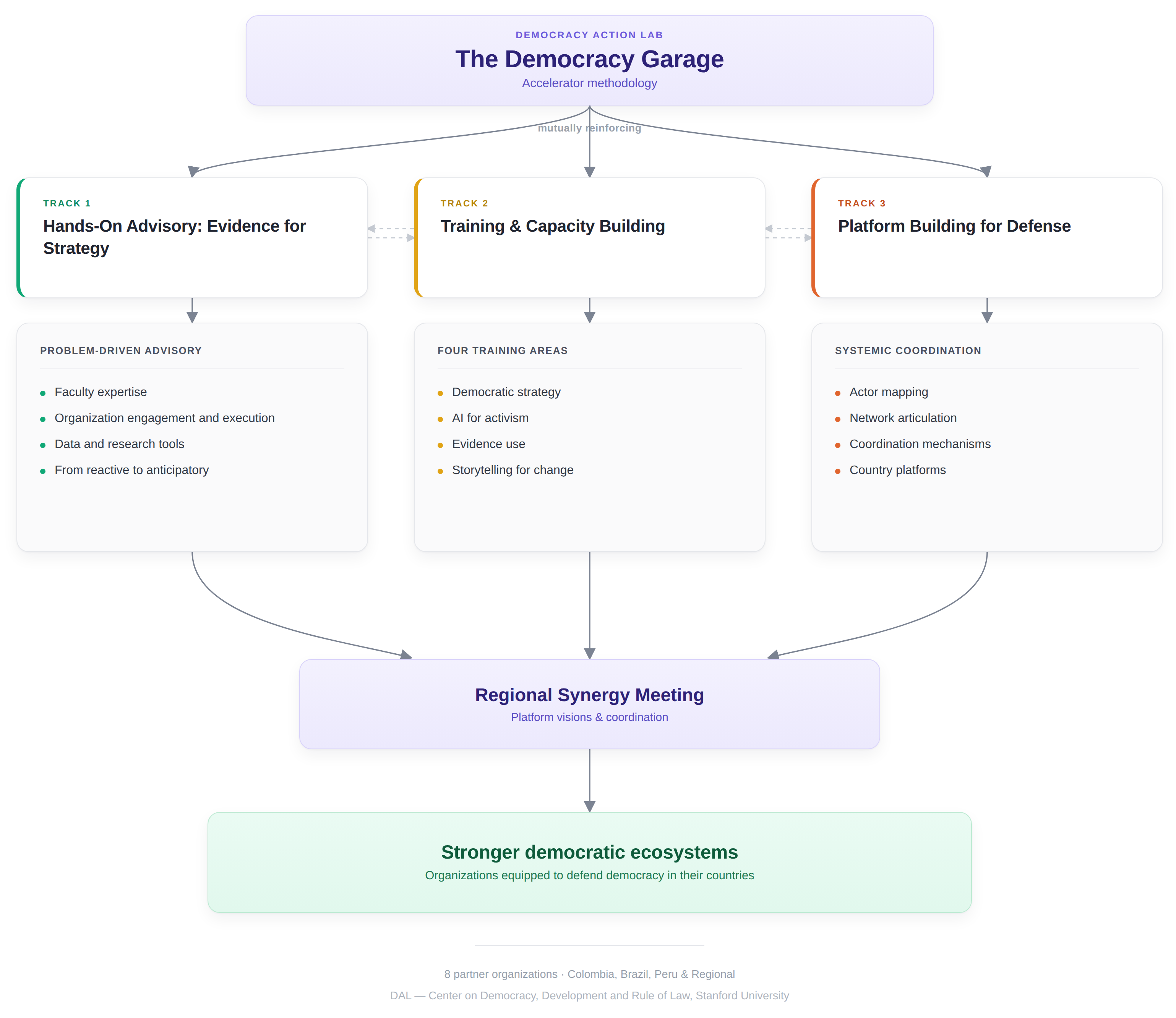
El modelo acelerador de The Democracy Garage se organiza en torno a tres ejes que se refuerzan mutuamente, diseñados para abordar una brecha clave en el ecosistema de apoyo democrático: muchos programas ofrecen formación de alto nivel desconectada de las necesidades inmediatas, o asistencia técnica a corto plazo que no genera capacidad duradera. The Garage tiende ese puente.

Eje 1  |  Análisis de Evidencia para la Estrategia Democrática  —  Asesoría Práctica

El primer eje proporciona apoyo de asesoría directa, orientada a los problemas. Cada organización  entra al Garage con un desafío concreto y actual. DAL moviliza su capacidad analítica — incluyendo la experiencia de su cuerpo docente, la participación de estudiantes y herramientas de datos — para abordarlo de forma colaborativa. No se trata de asistencia técnica unidireccional: es un proceso conjunto que desarrolla la propia capacidad de las organizaciones para usar la evidencia como herramienta estratégica, transitando de modos reactivos a anticipatorios.

Eje 2  |  Formación y Fortalecimiento de Capacidades  —  Cuatro Áreas Fundamentales

El segundo eje ofrece formación estructurada en cuatro áreas críticas para la acción democrática: (1) Estrategia para la defensa democrática — comprender el estado de la democracia en la región y sus principales desafíos; (2) IA para el activismo — aplicaciones prácticas de la inteligencia artificial para monitoreo, comunicación y toma de decisiones; (3) Evidencia para la defensa democrática — recolección, análisis e interpretación de datos vinculados directamente a las decisiones estratégicas; y (4) Narrativa para el cambio — traducir el análisis complejo en narrativas persuasivas que resuenen con tomadores de decisiones, medios de comunicación y ciudadanos.

Eje 3  |  Construcción de Plataformas para la Defensa Democrática  —  Escalar el Impacto Sistémico

El tercer eje apoya a las organizaciones  para que se conviertan en nodos fundacionales de plataformas nacionales de defensa democrática. El deterioro democrático rara vez se produce de forma aislada: requiere respuestas coordinadas entre la sociedad civil, los medios, la academia y las instituciones. A través del mapeo de actores, la articulación de redes y el desarrollo de mecanismos de coordinación, el Garage contribuye a construir ecosistemas estructurados capaces de acción colectiva. Este eje culmina en el Encuentro Regional de Sinergias en agosto de 2026, donde las organizaciones presentarán su visión de plataforma y sentarán las bases para la coordinación regional.

Image
Diagram of Democracy Action Lab's Democracy Garage accelerator methodology, showing three mutually reinforcing tracks — Advisory, Training, and Platform Building — leading to a Regional Synergy Meeting and stronger democratic ecosystems.


Metodología de aceleración de DAL (haga clic para ampliar)

Ocho Organizaciones. Tres Países. Una Región.


Tras un riguroso proceso de selección, The Democracy Garage se enorgullece en dar la bienvenida a las siguientes organizaciones participantes:

CESJUL — Centro de Estudios Socio Jurídicos Latinoamericanos (Colombia)  

Trabaja en la intersección del derecho penal, los derechos humanos y la gobernanza democrática, aportando análisis jurídico riguroso a los desafíos más urgentes de la democracia colombiana — incluyendo el uso del derecho tanto como herramienta de represión como vehículo de rendición de cuentas.

Dejusticia (Colombia)

Una de las organizaciones de derechos humanos más respetadas de América Latina — un auténtico think-and-do tank que combina investigación jurídica rigurosa con litigio estratégico, incidencia directa y formación de capacidades en antidiscriminación, justicia transicional y protección del espacio cívico.

Instituto Sou da Paz (Brazil)

Referente en política de seguridad pública en Brasil durante 25 años, influyendo en la legislación nacional sobre regulación de armas y reducción de homicidios mediante un enfoque basado en evidencia que centra a las comunidades más afectadas por la violencia, en particular la población negra brasileña.

Pacto pela Democracia (Brazil)

La principal coalición pro-democracia de Brasil, integrada por más de 200 organizaciones y reconocida internacionalmente como modelo de defensa democrática colectiva. Su protección coordinada de las elecciones de 2022 — más de 80 acciones entre 35 organizaciones — demostró el poder de construir coaliciones antes de que llegue la crisis.

Instituto de Estudios Peruanos (IEP) (Perú)

Una de las instituciones de ciencias sociales más antiguas y distinguidas de América Latina, el IEP ha construido durante seis décadas la base empírica del análisis democrático en el Perú — desde encuestas de opinión pública y estudios electorales hasta investigación interdisciplinaria sobre poder, desigualdad y el Estado.

Recambio (Perú)

En un país que ha tenido ocho presidentes en una década, Recambio reconstruye la cultura democrática desde dentro del sistema político — con una red de más de 500 egresados de 28 partidos políticos, diálogo interpartidario y la iniciativa 'Voces Contra la Polarización'.

Espacio Crítico (Regional, LAC)

Una organización regional que brinda apoyo estratégico personalizado, formación técnica y asesoría en seguridad a organizaciones de la sociedad civil, periodistas independientes y líderes políticos en la primera línea del retroceso democrático en América Latina y el Caribe.

D-Hub (Regional, Global)

Una comunidad global de defensores de la democracia que conecta a activistas de primera línea y organizaciones de la sociedad civil con expertos que han enfrentado desafíos similares — construyendo la infraestructura para la solidaridad democrática transfronteriza que ninguna organización puede sostener sola.

Un Hito Histórico


The Democracy Garage es el primer programa acelerador de este tipo diseñado específicamente para defensores de la democracia en América Latina y el Caribe. Al combinar el rigor de la investigación basada en evidencia, la agilidad de un modelo acelerador y la profundidad de una alianza a largo plazo, DAL está abriendo un camino inédito para fortalecer la resiliencia democrática — basado en la convicción de que las organizaciones más cercanas a la crisis están mejor posicionadas para afrontarla, cuando se les proporcionan las herramientas, el conocimiento y las conexiones adecuadas.

“Nos enorgullece inmensamente lanzar The Democracy Garage junto a estas ocho organizaciones extraordinarias," afirmó Beatriz Magaloni, codirectora del DAL y Graham H. Stuart Professor of International Relations en el Departamento de Ciencia Política. "Cada una de ellas representa lo que es la defensa de la democracia en la práctica, no en la teoría. Juntos, estamos comprometidos con algo sin precedentes: construir una comunidad de estrategia y solidaridad que fortalezca la democracia, país por país.”
 

Sobre el Democracy Action Lab

El Democracy Action Lab (DAL) es una iniciativa de investigación y estrategia con sede en el Center on Democracy, Development and Rule of Law de la Universidad de Stanford, dedicada a traducir las ciencias sociales en herramientas prácticas para quienes defienden la democracia. El DAL trabaja en la intersección entre la evidencia y la acción, colaborando con organizaciones de primera línea para fortalecer las instituciones democráticas, proteger el espacio cívico y contrarrestar las amenazas autoritarias en América Latina y más allá.

Read More

Wall plastered with posters and graffiti text reading "DEMOCRACY NOW"
News

Stanford Launches New Democracy Action Lab to Confront Global Democratic Backsliding

By combining rigorous research with practitioner collaborations, the Democracy Action Lab at the Center on Democracy, Development and the Rule of Law turns ideas into action.
Stanford Launches New Democracy Action Lab to Confront Global Democratic Backsliding
DAL launch panel
News

Political scientists emphasize need for pro-democracy coalitions at launch of Democracy Action Lab

Political science scholars discussed strengthening pro-democracy coalitions in a Wednesday event marking the launch of CDDRL’s new Democracy Action Lab.
Political scientists emphasize need for pro-democracy coalitions at launch of Democracy Action Lab
Prof. Adam Prezworski, Prof. Beatriz Magaloni, and Prof. Alberto Díaz Cayeros present during DAL’s Inaugural Conference at El Colegio de Mexico.
Blogs

Stanford’s Democracy Action Lab Launches in Mexico City

The new initiative from the Center on Democracy, Development and the Rule of Law connects research with frontline efforts to address democratic backsliding across Latin America.
Stanford’s Democracy Action Lab Launches in Mexico City
Hero Image
Illustration of diverse young activists emerging from a garage carrying books and a raised-fist flag, with a network of connected stars overhead, symbolizing the Democracy Garage.
Pariplab Chakraborty
All News button
1
Subtitle

El Primer Acelerador de Democracia de Este Tipo en América Latina y el Caribe.

Date Label
In Brief
  • El Laboratorio de Democracia en Acción (DAL, por sus siglas en inglés) del CDDRL lanzó el primer acelerador de democracia de América Latina, el Democracy Garage (Garaje de la Democracia).
  • El programa combina la capacidad de investigación y la experiencia docente del DAL con ocho organizaciones de Colombia, Brasil y Perú.
  • Beatriz Magaloni, codirectora del DAL, calificó la iniciativa como una comunidad de estrategia y solidaridad sin precedentes, impulsada por Stanford.
Display Hero Image Wide (1320px)
Yes
Authors
Héctor Fuentes
News Type
News
Date
Paragraphs

The Democracy Action Lab (DAL), a practitioner-centered initiative of the Center on Democracy, Development and the Rule of Law at Stanford University, is proud to officially announce the first cohort of its Democracy Garage, the first accelerator program of its kind dedicated to strengthening frontline democracy defenders across Latin America and the Caribbean.

The Democracy Garage was born from a simple but urgent conviction: democratic resilience is built not only through ideas, but through the capacity of organizations to act strategically, use evidence effectively, communicate persuasively, and adapt to rapidly evolving political environments. DAL built this program to close a persistent gap in democracy support, bridging high-level research with the real-time, operational needs of the organizations doing the hardest work on the ground.

Over the next few months, DAL will work side by side with eight extraordinary organizations across the region, applying a structured accelerator methodology to co-develop strategies tailored to the specific democratic challenges in each country. This is not a traditional growth program: it is a deep collaboration grounded in evidence, strategy, and solidarity.

A Three-Track Accelerator Model


The accelerator model of the Democracy Garage is organized around three mutually reinforcing tracks designed to address a key gap in the democracy support ecosystem: many programs either provide high-level training disconnected from immediate needs or short-term technical assistance that does not build lasting capacity. The Garage bridges this divide.

Track 1  |  Evidence Analysis for Democratic Strategizing  —  Hands-On Advisory

The first track provides direct, problem-driven advisory support. Each of the selected organizations enters the Garage with a defined, real-time challenge. DAL mobilizes its analytical capacity, including faculty expertise, student engagement, and data tools, to help address it collaboratively. This is not one-directional technical assistance: it is a joint process that builds organizations' own capacity to use evidence as a strategic tool, shifting from reactive to anticipatory modes of operation.

Track 2  |  Training and Capacity Building  —  Four Core Areas

The second track offers structured training in four areas critical to democratic action: (1) Strategizing for democratic defense — understanding the state of democracy in the region and its main challenges; (2) AI for activism — practical applications of artificial intelligence for monitoring, communication, and decision-making; (3) Evidence for democratic defense — data collection, analysis, and interpretation linked directly to strategic decisions; and (4) Storytelling for change — translating complex analysis into compelling narratives that resonate with policymakers, media, and citizens alike.

Track 3  |  Platform Building for Democratic Defense  —  Scaling for Systemic Impact

The third track supports participating organizations in becoming foundational nodes of country-level democratic defense platforms. Democratic erosion rarely unfolds in isolation: it requires coordinated responses across civil society, media, academia, and institutions. Through actor mapping, network articulation, and the development of coordination mechanisms, the Garage helps build structured ecosystems capable of collective action. This track culminates at the Regional Synergy Meeting in August 2026, where organizations will present their platform visions and lay the groundwork for regional coordination.

Image
Diagram of Democracy Action Lab's Democracy Garage accelerator methodology, showing three mutually reinforcing tracks — Advisory, Training, and Platform Building — leading to a Regional Synergy Meeting and stronger democratic ecosystems.


DAL's Accelerator Methodology (click to enlarge)

Eight Organizations. Three Countries. One Region.


After a rigorous selection process, The Democracy Garage is proud to welcome the following participating organizations:

CESJUL — Centro de Estudios Socio Jurídicos Latinoamericanos (Colombia)  

Works at the intersection of criminal law, human rights, and democratic governance, bringing rigorous legal analysis to the most pressing challenges in Colombian democracy — including the use of law as both a tool of repression and a vehicle for accountability.

Dejusticia (Colombia)

One of Latin America's most respected human rights organizations — a true think-and-do tank combining rigorous legal research with strategic litigation, direct advocacy, and capacity-building across anti-discrimination, transitional justice, and the protection of civic space.

Instituto Sou da Paz (Brazil)

A 25-year leader in public security policy in Brazil, shaping national legislation on firearms regulation and homicide reduction through an evidence-first approach that centers the communities most affected by violence — particularly Black Brazilians.

Pacto pela Democracia (Brazil)

Brazil's preeminent pro-democracy coalition of more than 200 organizations, and an internationally recognized model for coalition-based democratic defense. Its coordinated protection of the 2022 elections — over 80 actions across 35 organizations — demonstrated the power of building coalitions before the crisis arrives.

Instituto de Estudios Peruanos (IEP) (Perú)

One of Latin America's oldest and most distinguished social science institutions, IEP has spent six decades producing the empirical foundation for democratic analysis in Perú — from public opinion surveys and electoral studies to interdisciplinary research on power, inequality, and the state

Recambio (Perú)

In a country that has seen eight presidents in a decade, Recambio is rebuilding democratic culture from within the political system — with a network of over 500 alumni from 28 political parties, cross-partisan dialogue, and the 'Voices Against Polarization' initiative.

Espacio Crítico (Regional, LAC)

A regional organization providing tailored strategic support, technical training, and security advice to civil society organizations, independent journalists, and political leaders on the front lines of democratic backsliding across Latin America and the Caribbean.

D-Hub (Regional, Global)

A global community of democracy defenders connecting frontline activists and civil society organizations with experts who have faced similar challenges — building the infrastructure for cross-border democratic solidarity that no single organization can sustain alone.

A Historic First


The Democracy Garage is the first accelerator program of this type designed specifically for democracy defenders in Latin America and the Caribbean. By combining the rigor of evidence-based research, the agility of an accelerator model, and the depth of long-term collaboration, DAL is pioneering a new approach to democratic resilience — one grounded in the conviction that the organizations closest to the crisis are best positioned to address it, when equipped with the right tools, knowledge, and connections.

"We are immensely proud to launch the Democracy Garage alongside these eight remarkable organizations," said DAL co-director Beatriz Magaloni, the Graham H. Stuart Professor of International Relations. "Each of them represents what democratic defense looks like in practice, not in theory. Together, we are committed to something unprecedented: building a community of strategy and solidarity that makes democracy stronger, one country at a time."
 

About the Democracy Action Lab

The Democracy Action Lab (DAL) is a research and strategy initiative housed at Stanford University’s Center on Democracy, Development and Rule of Law, dedicated to translating social science into practical tools for democracy defenders. DAL works at the intersection of evidence and action, partnering with frontline organizations to strengthen democratic institutions, protect civic space, and counter authoritarian threats across Latin America and beyond.

Read More

Wall plastered with posters and graffiti text reading "DEMOCRACY NOW"
News

Stanford Launches New Democracy Action Lab to Confront Global Democratic Backsliding

By combining rigorous research with practitioner collaborations, the Democracy Action Lab at the Center on Democracy, Development and the Rule of Law turns ideas into action.
Stanford Launches New Democracy Action Lab to Confront Global Democratic Backsliding
DAL launch panel
News

Political scientists emphasize need for pro-democracy coalitions at launch of Democracy Action Lab

Political science scholars discussed strengthening pro-democracy coalitions in a Wednesday event marking the launch of CDDRL’s new Democracy Action Lab.
Political scientists emphasize need for pro-democracy coalitions at launch of Democracy Action Lab
Prof. Adam Prezworski, Prof. Beatriz Magaloni, and Prof. Alberto Díaz Cayeros present during DAL’s Inaugural Conference at El Colegio de Mexico.
Blogs

Stanford’s Democracy Action Lab Launches in Mexico City

The new initiative from the Center on Democracy, Development and the Rule of Law connects research with frontline efforts to address democratic backsliding across Latin America.
Stanford’s Democracy Action Lab Launches in Mexico City
Hero Image
Illustration of diverse young activists emerging from a garage carrying books and a raised-fist flag, with a network of connected stars overhead, symbolizing the Democracy Garage.
Pariplab Chakraborty
All News button
1
Subtitle

The first democracy accelerator of its kind in Latin America and the Caribbean.

Date Label
In Brief
  • CDDRL’s Democracy Action Lab (DAL) has launched Latin America's first democracy accelerator, the Democracy Garage.
  • The program pairs DAL’s research capacity and faculty expertise with eight organizations across Colombia, Brazil, and Perú.
  • DAL co-director Beatriz Magaloni called the initiative an unprecedented Stanford-led community of strategy and solidarity.
Display Hero Image Wide (1320px)
Yes
Paragraphs

Critics have warned that Chinese projects could chip away at democracy in Latin America. Our research suggests the opposite may be happening.

This article is based on Ibáñez and Schläpfer's working paper on how exposure to Chinese development projects shapes democratic attitudes in Latin America.

All Publications button
1
Publication Type
Journal Articles
Publication Date
Journal Publisher
Development + Cooperation
Authors
Alain Schläpfer
Number
pp. 54-56
0
rufaro.jpeg

Rufaro is a Research Assistant and contributor at the Democracy Action Lab, where she supports the lab's research on democracy, security, and state violence. She is a 2026 graduate from Stanford University, completing a Bachelor of Arts in Political Science. Her research interests center on the relationship between law, sovereignty, and state coercive capacity, with a focus on Latin America and sub-Saharan Africa. Prior to joining DAL, she held research and policy positions at the UN Office of the High Commissioner for Human Rights, Stanford Humanities Center, and Oxford University. In Fall 2026, she will read for an MSc in Refugee and Forced Migration Studies at the University of Oxford.

Research Assistant, Democracy Action Lab
Date Label
Paragraphs

As the global order becomes increasingly multipolar, Russia is not only reacting to Western sanctions but also advancing a distinct vision of global governance. This study investigates the ideological, political, and economic narratives Russia uses to shape an 'alternative world order' in the Global South and examines how these narratives contribute to its strategic ambitions amidst rising geopolitical tensions. Through systematic analysis of diplomatic statements, media content, and bilateral relationships across three regional case studies — Africa, India, and Latin America — this research reveals that Russia's Global South engagement, while ideologically coherent on the surface, suffers from significant structural contradictions that undermine its strategic effectiveness.

All Publications button
1
Publication Type
Conference Memos
Publication Date
Authors

Encina Hall, C151
616 Jane Stanford Way
Stanford, CA 94305-6055

0
Associate Professor, Josef Korbel School of International Studies at the University of Denver
CDDRL Visiting Scholar, 2025-26
20250506-kaplano-487_-_oliver_kaplan.jpg

Oliver Kaplan is an Associate Professor at the Josef Korbel School of International Studies at the University of Denver. He is the author of the book, Resisting War: How Communities Protect Themselves (Cambridge University Press, 2017), which examines how civilian communities organize to protect themselves from wartime violence. He is a co-editor and contributor to the book, Speaking Science to Power: Responsible Researchers and Policymaking (Oxford University Press, 2024). Kaplan has also published articles on the conflict-related effects of land reforms and ex-combatant reintegration and recidivism. As part of his research, Kaplan has conducted fieldwork in Colombia and the Philippines.

Kaplan was a Jennings Randolph Senior Fellow at the U.S. Institute of Peace and previously a postdoctoral Research Associate at Princeton University and at Stanford University. His research has been funded by the Carnegie Corporation of New York, the International Committee of the Red Cross, the Smith Richardson Foundation, and other grants. His work has been published in The Journal of Conflict Resolution, Journal of Peace Research, Conflict Management and Peace Science, Stability, The New York Times, Foreign Affairs, Foreign Policy, CNN, and National Interest.

At the University of Denver, Kaplan is Director of the Korbel Asylum Project (KAP). He has taught M.A.-level courses on Human Rights and Foreign Policy, Peacebuilding in Civil Wars, Civilian Protection, and Human Rights Research Methods, and PhD-level courses on Social Science Research Methods. Kaplan received his Ph.D. in political science from Stanford University and completed his B.A. at UC San Diego.

Date Label

Encina Hall, E109
616 Jane Stanford Way
Stanford, CA 94305-6055

0
Gerhard Casper Postdoctoral Fellow, 2025-26
xt4c0697.jpg

Ana Paula Pellegrino is the Gerhard Casper Fellow in Rule of Law at the Center on Democracy, Development and the Rule of Law (CDDRL) and a JSD Candidate at Stanford Law School. Pellegrino is an empirical political scientist using experimental, observational, and qualitative data to study questions of criminal and political violence, with a particular interest in Latin America. Her research agenda includes projects on state and non-state armed actors, including police and criminal groups, and how they form and engage with each other. Other projects explore public attitudes towards violence and war, as well as the micro-dynamics of violence and war outcomes.

Pellegrino's work has been supported by Georgetown University, Fundação Estudar’s Leaders program, and the Harry Frank Guggenheim Foundation’s Emerging Scholars program. She holds a Ph.D. in Government from Georgetown University and a BA and MA in International Relations from the Pontifical Catholic University of Rio de Janeiro. She is an incoming Assistant Professor at the School of Government at the Pontifical Catholic University of Chile, in Santiago, where she will begin in July 2026.

Date Label

Encina Hall, E111
616 Jane Stanford Way
Stanford, CA 94305-6055

0
CDDRL Predoctoral Fellow, 2025-26
hanna_folsz_-_hanna_folsz.jpg

Hanna Folsz is a PhD candidate in Political Science at Stanford University. Her research focuses on opposition parties in authoritarian dominant-party regimes, with a particular focus on the challenges and opportunities they face in countering autocratization. More broadly, her work examines the causes and consequences of democratic backsliding, populism, media capture, and political favoritism — primarily in East-Central Europe and, secondarily, in Latin America. She uses a multi-method approach, including modern causal inference and text analysis techniques.

Her research has been supported by the National Science Foundation and the American Political Science Association, among others. She is the co-founder and co-organizer of EEPGW, a monthly online graduate student workshop on East European politics, and a co-founder and regular contributor to The Hungarian Observer, the most widely read online newsletter on Hungarian politics and culture. At Stanford, she is an active member of  CDDRL's Poverty, Violence, and Governance Lab (PovGov).

Date Label
Authors
News Type
News
Date
Paragraphs

In an inspiring lecture, former Colombian President Juan Manuel Santos reflected on a historic peace deal in his country and highlighted how a relentless commitment to dialogue made that possible. 

“The key is planning and knowing who you are negotiating with,” Santos told a Stanford audience May 1 at an event co-sponsored by the Center on Democracy, Development and the Rule of Law, the Business, Government & Society Initiative at the Stanford Graduate School of Business, and the Center for Latin American Studies.

He added, “It is about establishing what Nelson Mandela used to call constructive dialogue. Constructive dialogue means you sit down and learn from the person you are trying to reach some kind of agreement with. Learn from them, why they think the way they think, and behave the way they do. And in Colombia, that is what we did.”

Santos, who received the Nobel Peace Prize in 2016 for his efforts to end a five-decades-long civil war with a guerrilla group that killed more than 200,000 people in the South American country, served as president of Colombia from 2010 to 2018.

Known as a tenacious negotiator, Santos said, “The big challenge in the 140 conflicts currently in the world is that leaders need to sit down and talk in very constructive ways.”

Titled “The Power of Long-View Leadership,” the event included opening remarks from Alberto Díaz-Cayeros, senior fellow at the Freeman Spogli Institute for International Studies (FSI), as well as a brief response followed by an audience Q&A moderated by Héctor Hoyos, director of the Center for Latin American Studies.

Díaz-Cayeros said, “This discussion is especially timely and vital today as we confront global challenges – not only here in the United States but throughout the hemisphere and around the world – that demand both moral courage and a strategic vision.”

Listening, talking


In November 2024, Santos was appointed Chair of The Elders, the organization founded by Nelson Mandela to advocate for peace, justice, human rights, and a sustainable planet.

In his address, Santos explained the process of bringing the guerrilla group – the Revolutionary Armed Forces of Colombia, or “FARC” — to the peace negotiating table. A meeting in the late 1990s with Mandela, the South African anti-apartheid activist, was particularly inspirational.

“He taught me why that program (in South Africa) to bring victims and perpetrators together to reconcile for the future was so important,” said Santos, who described it as the most interesting conversation he’s ever had about peacemaking.

So, he started studying peace processes all around the world — the ones that were successful, the ones that failed, and the ones that still held out hope. Gradually, he identified the conditions that were necessary to begin an authentic peace process with the FARC.

“What had my predecessors done wrong? What could I bring from other examples around the world?” He came to understand that three key conditions existed in the Colombian dynamic.

“As long as the guerrillas think that they will win through violence,” Santos said, “they will never sit down in good faith. They have to be convinced that they will never achieve power through violence. Second, the leaders of the guerrillas themselves personally have to be involved in the negotiations.”

Finally, he said, Colombia’s neighbors needed to support the peace process, or the guerrillas would always use those neighbors as safeguards and not commit to the peace process.

Juan Manuel Santos addressed a full audience in CEMEX Auditorium.
Juan Manuel Santos addressed a full audience in CEMEX Auditorium. | Rod Searcey

Santos brought on advisors who had successfully negotiated peace deals in other global hotspots. Some of the advice was especially sage.

“I was told to treat the FARC not as our enemies but as our adversaries. Enemies you eliminate. Adversaries you beat.” So, he instructed his military to make policy changes and to be conscious of all their actions, which they would live with forever.

“Treat them (FARC members) as human beings,” Santos said. “They have mothers, they have fathers, so while you fight with them, understand that they're human beings. So, I changed the whole military doctrine.”

A 2016 national referendum in Colombia rejected the peace deal by a narrow margin. Since then, the government and FARC have largely upheld the ceasefire and called for a broader national dialogue to continue the peace process.

Today, Santos is concerned that the gains from Colombia’s peace agreement with the FARC are unraveling. “The difficult path in every peace process is how to reconcile in order to have peace in the long run.”


The difficult path in every peace process is how to reconcile in order to have peace in the long run.
Juan Manuel Santos
Former President of Colombia


Humanity’s clock ticks


In January, Santos was invited to deliver an address at the annual unveiling of the Doomsday Clock’s time, which is set by the Bulletin of the Atomic Scientists. He noted that the only criteria that existed through the 1990s was the possibility of nuclear war. Now, existential threats to humanity’s fate have rapidly expanded, including climate change, AI, pandemics, and biological threats.

At 89 seconds to midnight, the Doomsday Clock stands closer to catastrophe than at any moment in its 77-year history, Santos said. The clock speaks to the threats that confound and confront us — and the need for cooperation, unity, and bold leadership to turn back its hands.

Unfortunately, what is happening around the world reflects the contrary, Santos said. The multilateral system, the respect for the rule of law, and the respect for protocols are all under attack.

Long-term leadership that makes decisions — not according to the next election, but according to the well-being of future generations — is what the world truly needs, Santos noted.

“How can we do what we did in Colombia on the world stage? That is the great challenge, and that’s when dialogue is imperative,” he said.


How can we do what we did in Colombia on the world stage? That is the great challenge, and that’s when dialogue is imperative.
Juan Manuel Santos
Former President of Colombia


Instead of competing amongst each other to see who wins this or who wins that, Santos urged that “world leaders need to sit down and talk about how to work together to avoid nuclear war, control climate change, regulate AI, and more.”

“Every second counts,” he concluded.

Student and community engagement


Following the lecture, Professor Héctor Hoyos praised Santos for his unwavering commitment to education, both as President and throughout his career. Reflecting on a personal experience, Hoyos shared a formative moment from his own childhood, when he received a letter from then-Secretary of Education Santos, recognizing him as one of Colombia's most promising young students. "I want to thank you publicly for that gesture, which went a long way," Hoyos said of the experience that inspired him to pursue the scholarly path he follows today.

The lecture also sparked lively engagement among students, many of whom lined up to ask thoughtful questions about applying Santos’ insights to current global challenges. Their inquiries reflected a desire to connect lessons from Colombia’s peace process to diverse contexts around the world. Santos, practicing the very principles of dialogue he had emphasized, listened attentively, responded thoughtfully, and demonstrated a genuine willingness to engage in a constructive exchange of ideas.

After the event, Santos joined more than twenty students from the Graduate School of Business and other programs for a lunch, where discussions continued on leadership, peacebuilding, and the importance of dialogue in addressing contemporary issues.

Read More

Leopoldo López
News

“Venezuela can be the spark for a fourth wave of democratization,” says Leopoldo López

López, a political leader and prominent advocate for democracy in Venezuela, shared his vision for uniting global efforts to champion freedom and push back against authoritarianism with a Stanford audience on December 2, 2024.
“Venezuela can be the spark for a fourth wave of democratization,” says Leopoldo López
Vladimir Kara-Murza onstage with Michael McFaul at Stanford University.
News

Gone Today, Here Tomorrow: Vladimir Kara-Murza on the Fight for Democracy in Russia

During the 2024 Wesson Lecture, former political prisoner and democracy activist Vladimir Kara-Murza called for transparency and accountability from within Russia and more support from the international community to establish and grow Russian democracy.
Gone Today, Here Tomorrow: Vladimir Kara-Murza on the Fight for Democracy in Russia
María Corina Machado spoke to a Stanford audience in a special video address on November 18, and engaged in a conversation with Larry Diamond.
News

Venezuela: Cultivating Democratic Resilience Against Authoritarianism

María Corina Machado, the leader of the Venezuelan pro-democracy movement, suggests that a strong international response to Venezuelan authoritarianism will help overcome electoral fraud against democracy in her country.
Venezuela: Cultivating Democratic Resilience Against Authoritarianism
Hero Image
Former Colombian President Juan Manuel Santos addressed a Stanford audience at a May 1 event.
Former Colombian President Juan Manuel Santos addressed a Stanford audience at a May 1 event. | Rod Searcey
All News button
1
Subtitle

Former Colombian President Juan Manuel Santos shared insights on peace processes, leadership, and conflict transformation with a Stanford audience.

Date Label
-
The Power of Long-View Leadership: A Conversation with Juan Manuel Santos, Former President of Colombia and Nobel Peace Prize Laureate

In an era of growing uncertainty, the need for visionary leadership has never been greater. On May 1, former President of Colombia and Nobel Peace Prize laureate Juan Manuel Santos will share insights from his remarkable journey, emphasizing the power of long-view leadership in addressing existential threats, fostering dialogue and reconciliation, and building lasting peace.

Drawing from his experience brokering Colombia’s historic peace agreement with the FARC, President Santos will highlight the importance of patience, pragmatism, and moral courage in resolving deep-rooted conflicts. He will explore how leaders must navigate complex global challenges — climate change, economic inequality, and geopolitical tensions — through diplomacy and strategic foresight. With a focus on actionable lessons, this talk provides a compelling roadmap for policymakers, business leaders, and changemakers striving to turn crisis into opportunity. President Santos demonstrates that sustainable peace is not just a political goal but a leadership imperative for the survival and progress of humanity.

The event will begin with opening remarks from Alberto Díaz-Cayeros, Senior Fellow at the Freeman Spogli Institute for International Studies (FSI). Following his keynote address, President Santos will join Héctor Hoyos, Director of the Center for Latin American Studies, in conversation. The event will conclude with an audience Q&A.

This event is co-sponsored by the Center on Democracy, Development and the Rule of Law, the Business, Government & Society Initiative at the Stanford Graduate School of Business, and the Center for Latin American Studies.

about the speakers

Juan Manuel Santos

Juan Manuel Santos

Former President of Colombia and Nobel Peace Prize Laureate

Juan Manuel Santos was the President of Colombia, from 2010 to 2018, and the sole recipient of the Nobel Peace Prize in 2016 for “his resolute efforts to bring the country’s more than 50-year-long civil war to an end”. Before becoming president, he was Minister of Foreign Trade, Minister of Finance, and Minister of Defense.

Santos graduated from the Colombian Naval Academy in Cartagena. He holds a Business and Economics degree from the University of Kansas and did postgraduate studies at the London School of Economics, the Fletcher School of Law and Diplomacy, and Harvard University, where he obtained a Master’s in Public Administration at the Kennedy School.

He is currently the Chairman of the Board of the Compaz Foundation, which he created to contribute to peacebuilding in Colombia. He is also a member of the boards of the International Crisis Group, the Rockefeller Foundation, the Wildlife Conservation Society, the Global Commission on Drug Policy, and the Planetary Guardians.

In November 2024, he was appointed Chair of The Elders, the organization founded by Nelson Mandela to advocate for peace, justice, human rights, and a sustainable planet.

Alberto Díaz-Cayeros

Alberto Díaz-Cayeros

Senior Fellow, Freeman Spogli Institute for International Studies
Professor, by courtesy, of Political Science
full bio
Hector Hoyos

Héctor Hoyos

Director, Center for Latin American Studies
Professor, Iberian and Latin American Cultures
full bio
Alberto Díaz-Cayeros
Héctor Hoyos

CEMEX Auditorium
Stanford Graduate School of Business (655 Knight Way, Stanford)

This is an in-person only event.

Members of the media interested in attending this event should contact cddrl_communications@stanford.edu.

Juan Manuel Santos
Lectures
Date Label
Subscribe to South America