Authors
Kiyoteru Tsutsui
News Type
Commentary
Date
Paragraphs

This op-ed by Kiyoteru Tsutsui originally appeared in Nikkei Asia.


As the summer of racial unrest forced America to confront its racist past and present yet again, a book by Heather McGhee, The Sum of Us: What Racism Costs Everyone and How We Can Prosper Together, which documents how racial division prevents Americans from uniting to lift everyone's lot, has attracted a good deal of attention.

From welfare to education to policing, Americans have generally supported policies that lifted the white middle class. But as the middle class has become more racially diverse, politics has become a divisive zero-sum game, with many whites seeing government spending as shifting money away from them toward minorities, even if whites also benefit.

This politics of racial division forecloses a social consensus that could boost the U.S. as a whole, leading to flagging social infrastructure, sputtering criminal justice system reform and challenges in offering broad economic support even to counter the pandemic.

This is not a problem unique to the United States. Social scientists have studied the relationship between racial division and low levels of public goods provision in multiple countries and established that ethno-racially heterogeneous societies tend to provide less in the way of public services.

Plagued by suspicions that some groups might benefit more than others, diverse societies tend to have greater difficulty in reaching consensus and working together on a strategy for economic and social development that would improve everyone's lives.

On this count, Japan is at the other end of the spectrum. More ethno-racially homogenous than most other advanced democracies, Japan has fared well when it comes to providing public goods such as efficient public transportation systems, low crime rates and universal health care.

Japan is often quick to reach a broad consensus about government spending on public services, since people generally feel that everyone benefits if they all support each other. Strong social cohesion, facilitated by the relative homogeneity of the population, enables this social consensus that supports spending on public goods.

The flip side of this coin is Japanese society's persistent resistance to diversity and disruption. Used to the comfort of living and working with similar people, Japan has been criticized for its reluctance to accept immigrants.

In response, the Japanese government has rather clumsily allowed immigrant workers in recent decades, first encouraging the migration of Japanese-Brazilians on the basis of shared ethnic roots that were supposed to make it easy for them to assimilate.

Learning that the reality of Japanese-Brazilians' life in Japan did not support this idea, Japan then adopted trainee programs to bring in foreign workers on a temporary basis. With the emphasis squarely on the temporary nature of their stay, those who came to Japan under this scheme could not contribute toward the country's long-term diversity.

Faced with a declining population, Japan needs immigrant labor, and its business leaders have consistently supported accepting more migrant workers. In addition to addressing the labor shortage, a more diverse workforce would likely stimulate innovation and facilitate adaptation to changing economic environments. Much social science research has demonstrated positive relationships between diversity and innovation.

Yet Japan's leaders are having a hard time pressing ahead. While it is easy for the public to come to a consensus for policies that boost all Japanese, it has proved difficult for them to support any policy that would undermine Japan's homogeneity.

Aside from ethnic diversity, Japan's consensus-oriented society is generally resistant to change. Valuing the protection of all members, companies have been slow to streamline and transform their operations to adapt to the changing economic environment, resulting in the prolonged economic decline since the 1990s.

While Brazil is home to the world's largest overseas Japanese population, many Japanese-Brazilians who moved to Japan discovered it was not easy for them to assimilate.

Urged on by American consultants, Japan imported America's neoliberal economic model to revitalize its economy through this period, and the lifetime employment and seniority-based salary system has given way to a rise in temp workers and various attempts to introduce a merit-based salary system. These efforts have not met with much success, leaving behind a questionable legacy, including the suppression of wages after the labor shortage of recent years.

In the U.S., racial division undermines the provision of public goods that would reduce economic inequality. But its acceptance of diversity contributes to innovation and economic revitalization that keeps the U.S. at the vanguard of a new economy.

In Japan, ethno-racial harmony facilitates public goods provision that prevents economic inequality from spiraling out of control. But aversion to diversity and dissent makes it difficult to accept much-needed immigrant labor and to adapt to changes in the economic environment.

In both countries, these characteristics are ingrained into their social fabric and resistant to change. However, the two largest economies with a democratic polity have much to learn from each other, and they should work together to find solutions for their problems.

Otherwise, China's nondemocratic model could become the dominant model for economic success, with its top-down forced consensus and suppression of diversity.

Democracies have long proven better at correcting their mistakes and adjusting to changes in their environment. As the two largest democratic economies in the world, the U.S. and Japan should be able to overcome the cost of racial division and the cost of homogeneity respectively even if it takes decades to achieve that.

Read More

Demonstrators in South Korea sitting on the ground and carrying signs in Korean
Q&As

Gi-Wook Shin on Racism in South Korea

Protections against gender and sexual discrimination are increasing in South Korea, but addressing longstanding racial discriminations based in nationalism and building a multicultural identity still has a long way to go, says Gi-Wook Shin in a new interview with Asia Experts Forum.
Gi-Wook Shin on Racism in South Korea
A man wearing a face mask prays for the new year at Meiji Shrine in Tokyo, Japan.
Commentary

Japan's Challenges in the Next Year are Greater than its Opportunities

Surging coronavirus cases and ongoing political scandals have docked Suga's approval ratings, but successfully handling the upcoming Olympics and taking further strides with the United States, ASEAN, and South Korea may help him rebound.
Japan's Challenges in the Next Year are Greater than its Opportunities
Hero Image
Protesters hold signs and chant slogans during a Black Lives Matters Peaceful March on June 14, 2020 in Tokyo, Japan.
Protesters hold signs and chant slogans during a Black Lives Matters Peaceful March on June 14, 2020 in Tokyo, Japan. | Takashi Aoyama, Getty Images
All News button
1
Subtitle

Japan Program Director Kiyoteru Tsutsui explores the cost of racial division versus the cost of homogeneity by comparing the experiences of Japan and the United States.

Authors
Gary Mukai
News Type
Blogs
Date
Paragraphs

In his March 15, 2021 lecture for SPICE’s Reischauer Scholars Program, actor George Takei—who played Hikaru Sulu, helmsman of the USS Enterprise in Star Trek—added “and Stand Back” to the iconic Star Trek words, “Live Long and Prosper,” as he was greeting students. His addition of “and Stand Back” was a message to the RSP students that it is important to continue to socially distance during the pandemic.

During his riveting lecture, Takei didn’t need to draw upon his acting skills to engage his audience of students as he recollected his family’s life after the Japanese attack on Pearl Harbor on December 7, 1941, and drew parallels between his family’s experience during World War II and anti-Asian sentiment and hate crimes (including killings and stabbings) against Asian Americans today. Takei was four years old at the time of the Pearl Harbor attack, and following the signing of Executive Order 9066 by President Franklin Roosevelt on February 19, 1942, Takei and his family along with approximately 120,000 people of Japanese descent—two thirds of whom were American citizens like Takei—were forced from their homes.

As he did with his legions of fans in Star Trek, Takei had the students glued to their screens as he recalled the day that he and his family were forced from their home in Los Angeles.

On that day that I can never forget, I had just turned five years old. It was a few weeks after my birthday, April 20. My father had gotten us dressed up hurriedly and told us to wait in the living room while my father and mother did some last-minute packing in the bedroom. Our baby sister was an infant and she was in the bedroom with them in a cradle. In the living room, my brother and I were just gazing out the front window at our neighborhood and suddenly we saw two soldiers marching up our driveway. They carried rifles with shiny bayonets on them. They stomped up the front porch and with their fists, began pounding the door. I still remember how it felt, like the walls were trembling… My father came out of the bedroom, answered the door, and literally, at gunpoint we were ordered out of our home… Shortly after and escorted by one of the soldiers, my mother came out holding our baby sister in one arm and a huge duffle bag in the other, and tears were streaming down her cheeks. The terror of that morning is still alive in me. I will never be able to forget that horrific day. It is seared into my memory.

Upon hearing this, RSP student Kogen Brown reflected, “I was deeply struck by the fact that these details remained in Mr. Takei’s mind after all these years. I remember only a few snippets of my life from that age, and the fact that he remembers so many specific aspects about the time that he was interned really goes to show the emotional and psychological impact that internment had on Japanese Americans—even those who were so young that they didn’t know what was happening or why it was happening to them.”

The War Relocation Authority (WRA) was the federal agency created in 1942 to oversee the Japanese Americans who were removed from the West Coast during World War II. The WRA built and operated a network of camps, where those removed were subjected to forced incarceration. Takei and his family were taken to the horse stables in Santa Anita Racetrack where they were assigned to a horse stall, which was still pungent with horse manure. The family stayed for four or five months in the so-called Santa Anita Assembly Center while the more permanent concentration camps were being built. From Santa Anita, Takei and his family were sent by train to the so-called Rohwer War Relocation Center in Arkansas. Takei recollected, “There, as a five-year-old child, I had an adventure. A discovery of a whole alien world. I am a southern Californian. I’m used to palm trees. In Rohwer beyond the barbed wire fence was the bayou. I have memories of camp as a fun experience, but that was a child’s experience. At the same time, parallel to my childhood experience, my parents had a grotesque experience—barbed wire fences, sentry towers, machine guns pointed at them. When we made the night run to the latrine from our barrack, searchlights followed us. My mother considered it an invasive, humiliating light but the five-year-old me thought it was nice that they lit the way for me to pee. Same experiences but two different memories.”

During his recollection of his life during World War II, Takei noted, “There are relevant lessons that apply to what’s happening today. We talk about Asian hate, hate of Asian people, and horrific things are being done to elderly Asians because of the pandemic we are going through. This kind of hate is what Japanese Americans were subjected to more than 80 years ago… back then, graffiti was painted on some of our homes, on our cars… like what’s happening today.”

Takei underscored the ironies of being detained behind barbed wire. He noted,

I went to school in a black tar barrack and every morning, we started the school day with the Pledge of Allegiance to the flag. I could see the barbed wire fence and the sentry towers right outside my school house window as I recited the words, ‘with liberty and justice for all.’

“I still can’t wrap my head around how horribly the U.S. government failed Japanese Americans,” reflected RSP student Kalia Lai, “Hearing from Mr. Takei that he and the other Japanese American students still had to say the Pledge of Allegiance at the start of school made me realize how empty those words, ‘with liberty and justice for all,’ turned out to be for Japanese Americans, and how inhumane the incarceration camps were.”

Takei also shared that in 1943, the War Department and WRA established a “loyalty questionnaire” as a means to assess the loyalty of all adults in the WRA camps. Takei spoke specifically about the final two questions, questions 27 and 28, which created confusion and resentment.

Question number 27 asked if Japanese Americans were willing to serve in the armed forces of the United States on combat duty wherever ordered. Question number 28 asked if individuals would swear unqualified allegiance to the United States and faithfully defend the United States from any or all attack by foreign or domestic forces, and forswear any form of allegiance or obedience to the Japanese Emperor, or any other foreign government, power, or organization. U.S. citizens resented being asked to renounce loyalty to the Emperor of Japan when they had never held a loyalty to the Emperor. At the time, Japanese immigrants were barred from becoming U.S. citizens, so they wondered if renouncing their only citizenship would leave them stateless.

Despite the confusion, thousands from Hawaii and the concentration camps served in the U.S. Army. The 442nd Regimental Combat Team was organized on March 23, 1943, after more than a year during which Americans of Japanese descent were declared enemy aliens by the U.S. War Department. Takei emphatically noted, “We weren’t the enemy, we were Americans.” The 442nd RCT became the most decorated unit for its size and length of service in U.S. military history. Following the end of the war, President Truman honored them and said, “You fought not only the enemy, but you fought prejudice—and you have won.”

Takei noted the importance for students to study about history as it teaches us important lessons and stated that he has made it his life’s mission to talk about the incarceration of Japanese Americans. “As a matter of fact, today we are living through a time that will be studied as a very important part of history by future generations,” expressed Takei. Recalling his years behind barbed wire, he emphasized that he and his family were viewed with suspicion and hate simply because of the way they looked. “There were no charges, no trial, no due process… Terror made toxic by racism started to affect the so-called leaders of our country, the politicians, but instead of leading, these politicians got swept up by the hysteria and became part of that hysteria… We have so much to learn from history because we are repeating the same kind of mentality that put us in these barbed wire prison camps.”

These words resonated in RSP student Noah Kurima, whose paternal grandparents were among the 120,000 who were incarcerated. Kurima commented, “What surprised me the most upon hearing Mr. Takei speak about his wartime experiences are the parallels that I see in our country eight decades later. As a 16-year-old, I would have hoped that more progress had been made in the area of cross-cultural understanding. The hysteria, racism, and failure of political leadership that Mr. Takei described from his childhood seem eerily similar to what I have seen in the media recently. I hope that the RSP students in the year 2100 will not be witnessing the same parallels that I am today.”

In a strongly emphasized message to the students, Takei said that the ideals of the United States “are noble but they become real and true only when the people infuse those ideals with truth with backing. At times of panic and hysteria, we start behaving irrationally.”

RSP Instructor Naomi Funahashi reflected, “I hope that my students especially take this message to heart. I honestly hesitated to close the session because of the clear impact that Mr. Takei was having on my students.” Funahashi gratefully acknowledged Takei and noted, “Sharing your recollections—particularly those of you as a five-year-old boy—we could feel your very palpable sense of terror and fear, and through your voice, you helped students to understand why it’s such an important issue to study today.”

George Takei is a social justice activist, social media superstar, Grammy-nominated recording artist, New York Times bestselling author, and pioneering actor whose career has spanned six decades. He has appeared in more than 40 feature films and hundreds of television roles, and he has used his success as a platform to fight for social justice, LGBTQ+ rights, and marriage equality. For the full story of George Takei’s childhood imprisoned within American concentration camps during World War II, see his graphic memoir, They Called Us Enemy. Naomi Funahashi and I are grateful to Brad Takei for his support of George’s lecture and this article, and also to Michael Kurima for his support as a liaison between SPICE and George Takei.

Read More

Koki Mashita at Webb School of California; photo courtesy Koki Mashita
Blogs

The Reischauer Scholars Program: The Inspiration to Start an Investment Firm

The following reflection is a guest post written by Koki Mashita, an alumnus of the Reischauer Scholars Program.
The Reischauer Scholars Program: The Inspiration to Start an Investment Firm
Illustration of a virtual classroom session
Blogs

Bridging “Social Distancing” Across the Pacific: 6 Tips for Facilitating Cross-Cultural Online Learning

Bridging “Social Distancing” Across the Pacific: 6 Tips for Facilitating Cross-Cultural Online Learning
Hero Image
George Takei, Hosato Enterprises, Inc., Los Angeles
George Takei; photo courtesy Hosato Enterprises, Inc., Los Angeles
All News button
1
Subtitle

In his March 15, 2021 lecture for SPICE’s Reischauer Scholars Program, actor George Takei—who played Hikaru Sulu, helmsman of the USS Enterprise in Star Trek—added “and Stand Back” to the iconic Star Trek words, “Live Long and Prosper,” as he was greeting students.

Paragraphs
3D cover of the book "Patterns of Impunity" by Robert R. King

Why North Korean Human Rights Matter: Book Talk with Robert R. King >

As the U.S. special envoy for North Korean human rights from 2009 to 2017, Ambassador Robert R. King led efforts to ensure that human rights were an integral part of U.S. policy with North Korea. In Patterns of Impunity, he traces U.S. involvement and interest in North Korean human rights, from the adoption of the North Korean Human Rights Act in 2004—legislation which King himself was involved in and which called for the creation of the special envoy position—to his own negotiations with North Korean diplomats over humanitarian assistance, discussions that would ultimately end because of the death of Kim Jong-il and Kim Jong-un’s ascension as Supreme Leader, as well as continued nuclear and missile testing.

Beyond an in-depth overview of his time as special envoy, Ambassador King provides insights into the United Nations’ role in addressing the North Korean human rights crisis, including the UN Human Rights Council’s creation of the UN Commission of Inquiry on Human Rights in the DPRK in 2013–14, and discussions in the Security Council on North Korea human rights.

King explores subjects such as the obstacles to getting outside information to citizens of one of the most isolated countries in the world; the welfare of DPRK defectors, and how China has both abetted North Korea by returning refugees and enabled the problem of human trafficking; the detaining of U.S. citizens in North Korea and efforts to free them, including King’s escorting U.S. citizen Eddie Jun back from Pyongyang in 2011; and the challenges of providing humanitarian assistance to a country with no formal relations with the United States and where separating human rights from politics is virtually impossible.

Desk, examination, or review copies can be requested through Stanford University Press.

"King is realistic about how painstakingly difficult it is to achieve progress on these issues ― but he illustrates that pressing for change can yield results. He points to the improvement of rights of the disabled in North Korea as one victory."

Haley Gordon, Stanford University

Read the complete book review via The Korea Times >> 

Purchase the Ebook

Download front matter and chapter 1.
Download pdf
All Publications button
1
Publication Type
Books
Publication Date
Subtitle

Human Rights in North Korea and the Role of the U.S. Special Envoy

Authors
Robert R. King
Book Publisher
Shorenstein APARC
All Publications button
1
Publication Type
Journal Articles
Publication Date
Subtitle
Now that a third COVID-19 vaccine has been given emergency-use authorization, Michelle Mello and colleagues ask whether individuals should be able to choose which vaccine they receive.
Journal Publisher
The New England Journal of Medicine
Authors
Michelle Mello
Authors
Callista Wells
News Type
News
Date
Paragraphs

The China Program at Shorenstein APARC had the privilege of hosting Jude Blanchette, the Freeman Chair in China Studies at the Center for Strategic and International Studies​ (CSIS). The program, entitled "What’s ‘Communist’ about the Communist Party of China?," explored the goals and ideology of the Chinese Communist Party (CCP), as well as what they might mean for the future of China in the global community. Professor Jean Oi, William Haas Professor of Chinese Politics and director of the APARC China Program, moderated the event.

After the death of Mao Zedong in 1976, the goals of the CCP became less clear. As the country began to adopt market reforms in the 1980s and 1990s, CCP theorists were forced into contortions providing ideological justifications for policies that appeared overtly capitalist. Deng Xiaoping’s concept of “Socialism with Chinese characteristics” came to be seen as a theoretical fig leaf rather than a description of an egalitarian economic system, and by the 2000s, a consensus emerged that the CCP had completely abandoned any pretense of pursuing the Marxist vision it purported to hold. With the rise of Xi Jinping, however, the Party talks with renewed vigor about Marxism-Leninism and the goal of achieving actual, existing socialism. Has the CCP re-discovered communism?  In his talk, Blanchette discussed the abandoned and existing legacies of Mao Zedong, Marxism-Leninism, and the CCP’s vision of socialism. Watch now: 

Read More

Min Ye speaking
News

Domestic or International? The Belt and Road Initiative Is More Internally Focused Than We Think, Says Expert Min Ye

Domestic or International? The Belt and Road Initiative Is More Internally Focused Than We Think, Says Expert Min Ye
Banner of Hau L. Lee
News

The Pandemic, U.S.-China Tensions and Redesigning the Global Supply Chain

The Pandemic, U.S.-China Tensions and Redesigning the Global Supply Chain
American and Chinese flags
News

U.S.-China Relations in the Biden Era

Dr. Thomas Wright examines the recent history of US-China relations and what that might mean for the new administration.
U.S.-China Relations in the Biden Era
Hero Image
National Emblem of the People's Republic of China on the Great Hall of the People
All News button
1
Subtitle

Is the Chinese Communist Party really communist at all? Expert Jude Blanchette, Freeman Chair in China Studies at the Center for Strategic and International Studies, weighs in.

Authors
Herbert Lin
News Type
Commentary
Date
Paragraphs

On March 3, the Biden administration released its Interim National Security Strategic Guidance. Regarding cybersecurity, the document stated that 

Read the rest at Lawfareblog

Hero Image
President Joe Biden walks with Vice President Kamala Harris and Secretary of Defense Lloyd Austin.
White House Photo by Adam Schultz
All News button
1
Subtitle

The Biden administration released its Interim National Security Strategic Guidance. One would expect a final guidance document to be roughly consistent with the it while also containing more substantial elaboration. To get a sense of relative priorities, I found it interesting to compare the interim guidance to the Trump National Cyber Strategy published in 2018.

Authors
Noa Ronkin
News Type
News
Date
Paragraphs

China and the United States are usually cast as fierce rivals, but there are broad areas of society where the two nations share profound similarities. As they confront growing demands to provide their citizens with goods and services such as healthcare, education, housing, and transportation, both the Chinese and U.S. governments engage the private sector in the pursuit of public value, although they do so in different ways.

This type of engagement, in which the government calls on the private sector to meet public goals, is known as collaborative governance and it is becoming an increasing share of the economy in both China and the United States. A new book, The Dragon, the Eagle, and the Private Sector (Cambridge University Press), analyzes the application of collaborative governance in a wide range of policy arenas in China and the United States.

The book itself is the result of collaborative research by three co-authors: APARC Deputy Director Karen Eggleston, Harvard Kennedy School Raymond Vernon Senior Lecturer in Public Policy John Donahue, and Harvard Kennedy School’s Frank P. Ramsey Professor of Political Economy Richard Zeckhauser. On March 5, 2021, the three co-authors gathered for a virtual book launch, an event co-sponsored by Shorenstein APARC and the Mossavar-Rahmani Center for Business and Government at the Harvard Kennedy School.

[Sign up for APARC newsletters to receive the latest updates from our experts.]

Introducing the new book, Lawrence H. Summers, president emeritus of Harvard University and the Charles W. Eliot University Professor at the Kennedy School, called the co-authors’ analysis of collaborative governance “micro microeconomics” that shows how particular tasks and particular commitments of resources, once decided on, are going to be best accomplished. This work, Summers noted, sheds light on situations involving both cooperation and competition — aspects that affect almost any complex problem yet are rarely considered by economists.

A key element of collaborative governance, noted Zeckhauser, is the sharing of discretion. Rather than contracting at one pole and complete laissez-faire at the opposite pole, in a collaborative governance process, the two parties involved play a role in determining what is produced and how it is produced. It is a process that calls on the best capabilities of both the private and public sectors and that grants each of them an element of control. Sometimes that process results in triumphs, sometimes in tragedies, and other times in outcomes that are “in-between.” The book analyses cases of this entire gamut. “We hope that this volume provides guidance on how the triumphs can become more common, the tragedies more scarce, and the in-between outcomes improved,” said Zeckhauser.

This book provides a key to understanding how to achieve [...] quality-public-private collaboration, done right. Delving deep into two very different societies, the US and China, the authors provide lessons that illuminate and should inform scholars and policymakers alike.
Fareed Zakaria
Journalist and Author

Collaborative Governance in the Time of COVID-19

The unfolding of the COVID-19 pandemic provides dramatic current illustrations of collaborative governance. The urgent need for an effective vaccine created the conditions for a successful partnership between the U.S. government and the pharmaceutical sector, with the former offering both regulatory processes and significant financing, the latter its innovation. Consider the Moderna vaccine, which, based on evidence from clinical trials, is over 90% effective at preventing laboratory-confirmed COVID-19 illness. The vaccine was created within less than a year using a new approach, based on Messenger RNA technology, by a company that had never before produced a commercial product. “This is a triumph of collaborative governance,” said Zeckhauser.

The vaccine distribution process in the United States, however, has proved to be challenging and chaotic. Zeckhauser contrasted this experience with China’s activation of technology giant Tencent, which is using its ubiquitous WeChat application to allow individuals to easily find where the vaccine is distributed and sign up for vaccination appointments. “There is probably a lesson here in the way these two outcomes came about. We hope that individuals in both China and the United States will examine the lessons in this volume to see how they can achieve outcomes for their citizens that produce public benefits more effectively.”

A Spectrum of Policy Domains

The book details how China and the United States grapple with the complexity of producing the goods and services they need to meet a broad array of public goals. Eggleston surveyed the five broad policy domains she and her co-authors examine in the book through detailed historical legacies and case studies of the application of collaborative governance in both countries.

These domains include the railroads that build the nation historically in both countries and China’s high-speed rail network; real estate's intricate tangle of public and private partnerships; hosting the Olympic Games and the experience of the public and private sectors in that endeavor in both countries; education provision; and state and market in population health and health care in both countries. The book spotlights the different ways in which both countries produce public goods and services in these broad policy domains.

It is crucial for China to embrace the transparency imperative because the evil twin of collaborative governance is cronyism or corruption.
John Donahue
Harvard University

East and West

Professor Yijia Jing of Fudan University, an expert on privatization, governance, and collaborative service delivery, participated in the discussion with the book co-authors and shared insights on public-private relationships in China. Collaborative governance in the country, he said, has undergone a gradual process of institutionalization. He observed that Chinese local governments apply different strategies in collaborating with private companies. For example, local governments like Guangdong and Shanghai partner in different ways with digital giants Tencent and Alibaba to build up their digital capacities — collaborations through which they have been learning how to balance their multiple roles as partners, policymakers, and market regulators.

Jing noted that China uses collaborative governance not only in domestic arenas but also in areas of international development, through entities such as the BRICS Development Bank and the Asian Infrastructure Investment Bank. China is also promoting collaborative governance as part of its Belt and Road initiative.

A Call for Transparency

The Dragon, the Eagle, and the Private Sector helps decision-makers apply the principles of collaborative governance to effectively serve the public. The book's overarching conclusion is that transparency is the key to the legitimate growth of collaborative governance. In the United States, said Donahue, the principle of governmental transparency is widely accepted as a broad-spectrum accountability device. He recognized that he and his co-authors do not expect China to adopt the U.S. approach to transparency, but expressed their hope to see more transparency “with Chinese characteristics.” “It is crucial for China to embrace the transparency imperative because the evil twin of collaborative governance is cronyism or corruption,” Donahue argued.

In many countries and policy arenas, collaborative governance could effectively increase innovation but is not available because the populace is convinced that any interaction between the public and private sectors amounts to corruption on the part of elites against the public interest. The potential in China to create public value through interaction between its public and private sectors is enormous, concluded Donahue. ”It would be a shame to squander that.”

Read More

Demographics and Innovation in the Asia-Pacific
News

New Book Explores the Intersection of Demographic Shifts and Innovation, Offering Lessons from Asian Nations

Contributing authors to the new volume 'Demographics and Innovation in the Asia-Pacific' convened for a virtual book launch and discussion of the challenges facing aging societies in East Asia and the roles technology and innovation may play in rebalancing them.
New Book Explores the Intersection of Demographic Shifts and Innovation, Offering Lessons from Asian Nations
A Japanese robot prototype lifts a dummy patient
News

Robot Adoption Brings Benefits to Japan’s Aging Society

In one of the first studies of service sector robotics, APARC scholars examine the impacts of robots on nursing homes in Japan. They find that robot adoption may not be detrimental to labor and may help address the challenges of rapidly aging societies.
Robot Adoption Brings Benefits to Japan’s Aging Society
Hero Image
3D mockup of the book 'The Dragon, the Eagle, and the Private Sector'
All News button
1
Subtitle

In their new book, APARC Deputy Director Karen Eggleston and co-authors John Donahue and Richard Zeckhauser of Harvard University seek to empower decision-makers to more wisely engage the private sector in the pursuit of public value by analyzing how China and the United States use collaborative governance strategies to meet growing demands for public services.

Authors
Callista Wells
News Type
News
Date
Paragraphs

On February 24, 2021, the China Program at Shorenstein APARC hosted Dr. Thomas Wright, director of the Center on the United States and Europe and a senior fellow in the Project on International Order and Strategy at the Brookings Institution. Professor Jean Oi, William Haas Professor of Chinese Politics and director of the APARC China Program, moderated the event.

The program, entitled "U.S.-China Relations in the Biden Era," explored the future of US-China relations based on experience from past administrations. Under former President Trump, U.S. relations with China evolved into outright rivalry. In his talk, Dr. Wright discussed whether this rivalry will continue and evolve during a Biden administration by analyzing the roots of strategic competition between the two countries and various strands of thinking within the Biden team. According to Wright, the most likely outcome is that the competition between the two countries will evolve into a clash of governance systems and the emergence of two interdependent blocs where ideological differences become a significant driver of geopolitics. Cooperation is possible but it will be significantly shaped by conditions of rivalry. Watch now:

Read More

Min Ye speaking
News

Domestic or International? The Belt and Road Initiative Is More Internally Focused Than We Think, Says Expert Min Ye

Domestic or International? The Belt and Road Initiative Is More Internally Focused Than We Think, Says Expert Min Ye
Banner of Hau L. Lee
News

The Pandemic, U.S.-China Tensions and Redesigning the Global Supply Chain

The Pandemic, U.S.-China Tensions and Redesigning the Global Supply Chain
Photograph of Xi Jinping and Vladmir Putin walking in front of two lines of armed Chinese soldiers
News

Military Competition with China: Harder to Win Than During the Cold War?

On February 10th, the APARC China Program hosted Professor Oriana Mastro to discuss military relations between the US and China, and why deterrence might be even more difficult than during the Cold War.
Military Competition with China: Harder to Win Than During the Cold War?
Hero Image
American and Chinese flags
All News button
1
Subtitle

Dr. Thomas Wright examines the recent history of US-China relations and what that might mean for the new administration.

Division of Infectious Disease and Geographic Med

300 Pasteur Drive, L134, MC 5107

Stanford, CA 94305

650-723-6661
0
Professor of Medicine
Senior Fellow (courtesy), Freeman Spogli Institute
dw_iba_highres.jpg MD

Dean Winslow, MD is Professor of Medicine with appointments in the Divisions of Hospital Medicine and Infectious Diseases and is a Senior Fellow (courtesy) at CISAC/Freeman Spogli Institute. He has served on the Stanford faculty since 1998 and served from 2003-2008 as Co-Director of Stanford's Infectious Diseases Fellowship Training Program. He was in private practice in Wilmington, Delaware where he started the state’s first multidisciplinary clinic for HIV patients in 1985. In 1988 he joined the DuPont Company where he worked both as a bench scientist on HIV drug resistance then later designed the clinical trials supporting FDA approval of efavirenz. In 1999 he became Vice President of Regulatory Affairs at Visible Genetics Inc. and led the FDA clearance of the TRUGENE HIV-1 drug resistance test. Dr. Winslow joined the staff at Santa Clara Valley Medical Center in 2003, where he served as Chief of the Division of AIDS Medicine and later as Chair of the Department of Medicine. In 2015 he was appointed Academic Physician-In-Chief at Stanford/ValleyCare and Vice Chair of the Department of Medicine. He was a Resident Fellow in Robinson House 2013-2017 and was visiting faculty at Oxford University in 2017. He was Lead Physician for the US Antarctic Program of the National Science Foundation 2019-2020 based at McMurdo Station, Antarctica. In 2021 he took leave from Stanford to lead the US COVID-19 Testing and Diagnostic Working Group. He served as CDC Senior Advisor to Operation ALLIES WELCOME and Chief Medical Officer for the Southwest Border Migrant Health Task Force before returning to Stanford in July 2022.

Dr. Winslow is a Master of the American College of Physicians, Fellow of the Royal College of Physicians, the Infectious Diseases Society of America, and the Pediatric Infectious Diseases Society. He is the author of 87 papers. He is,a member of the IDSA Sepsis Task Force, and previously served as Chair of the Standards and Practice Guidelines Committee.

Colonel Winslow entered the Air National Guard in 1980 and was a Distinguished Graduate of the USAF School of Aerospace Medicine. He served as Commander of the 159th Medical Group 1992-1995 and was State Air Surgeon, Delaware Air National Guard 1995-2011. He served as ANG Assistant to the Commander, 59th Medical Wing, Joint Base San Antonio 2011-2014. Colonel Winslow deployed to the Middle East six times from 2003-2011 as a flight surgeon supporting combat operations in Iraq and Afghanistan. From Jan-April 2003 Colonel Winslow was the flight surgeon responsible for combat rescue operations from Tikrit to northern Iraq. In 2005 he coordinated military public health in Louisiana in the aftermath of Hurricane Katrina. In 2006 Colonel Winslow served as an ER physician at the United States Air Force 447th EMEDS (combat hospital) in Baghdad and in 2008 he served as hospital commander during the Iraq surge. He is a 2007 graduate of Air War College. He served as an infectious disease consultant to the USAF Surgeon General. In 2017 Dr. Winslow was nominated by the President to serve as Assistant Secretary of Defense for Health Affairs. He has 1150 military flying hours including 431 combat hours and 263 combat sorties. He has extensive operational experience in fighter, tactical airlift, and combat rescue missions. He holds an FAA Airline Transport Pilot license.

Since 2006 Dr. Winslow has arranged medical care in the U.S. for 28 Iraqi children who have complicated medical conditions for which care is not available in Iraq. In 2015, Dr. Winslow and his wife, Dr. Julie Parsonnet, created The Eagle Fund of the Silicon Valley Community Foundation, which provides aid to middle eastern and central American refugees. In 2018 he co-founded Scrubs Addressing the Firearms Epidemic (SAFE), which unites health care professionals to address gun violence in the US as a public health issue and to advocate for education, research, and evidence-backed policy to reduce gun violenc

CV
Date Label
-

This is a virtual event. Please click here to register and generate a link to the talk. 
The link will be unique to you; please save it and do not share with others.

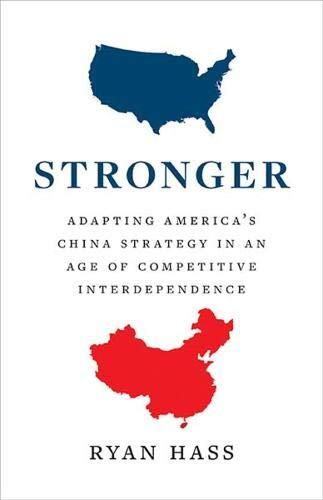
How can the U.S. best manage its relationship with China? The country is at once a major and increasingly hostile competitor to the U.S., a formidable challenger to U.S.’ regional and global leadership, and an important partner on a range of transnational challenges. Will it be possible for both sides to coexist amidst intensifying competition? How great is the risk of US-China conflict, including over Taiwan? Ryan Hass, author of Stronger: Adapting America’s China Strategy in an Age of Competitive Interdependence, will address these questions and more in opening comments before engaging in an open Q&A on the future of the world’s most consequential bilateral relationship.


Image
Portrait of Ryan Hass
Ryan Hass is a senior fellow and the Michael H. Armacost Chair in the Foreign Policy program at Brookings, where he holds a joint appointment to the John L. Thornton China Center and the Center for East Asia Policy Studies. He is also the Interim Chen-Fu and Cecilia Yen Koo Chair in Taiwan Studies. Hass focuses his research and analysis on enhancing policy development on the pressing political, economic, and security challenges facing the United States in East Asia. He is the author of Stronger: Adapting America’s China Strategy in an Age of Competitive Interdependence, published by Yale University Press.

Image
"Stronger" Book Cover
From 2013 to 2017, Hass served as the director for China, Taiwan and Mongolia at the National Security Council (NSC) staff. In that role, he advised President Obama and senior White House officials on all aspects of U.S. policy toward China, Taiwan, and Mongolia, and coordinated the implementation of U.S. policy toward this region among U.S. government departments and agencies. He joined President Obama’s state visit delegations in Beijing and Washington respectively in 2014 and 2015, and the president’s delegation to Hangzhou, China, for the G-20 in 2016, and to Lima, Peru, for the Asia-Pacific Economic Cooperation (APEC) Leaders Meetings in 2016. Prior to joining NSC, Hass served as a Foreign Service Officer in U.S. Embassy Beijing, where he earned the State Department Director General’s award for impact and originality in reporting. Hass also served in Embassy Seoul and Embassy Ulaanbaatar, and domestically in the State Department Offices of Taiwan Coordination and Korean Affairs. 


Image
American and Chinese flags
This event is part of the 2021 Winter/Spring Colloquia series, Biden’s America, Xi’s China: What’s Now & What’s Next?, sponsored by APARC's China Program.


Via Zoom Webinar. Register at: https://bit.ly/3c3v10W

Ryan Hass Senior Fellow, Michael H. Armacost Chair in Foreign Policy Studies, Brookings Institution
Seminars
Subscribe to United States