Authors
News Type
Commentary
Date
Paragraphs

During the last two months of 2021, Russia created a crisis by deploying large military forces near Ukraine and demanding security guarantees from the United States and NATO.  In mid-December, Moscow publicized draft U.S.-Russia and NATO-Russia agreements encapsulating its demands, many of which were clearly unacceptable.

Over the past four days, U.S. and Russian officials have held bilateral talks, the NATO-Russia Council met, and a meeting of the Organization for Security and Cooperation in Europe took place.  Russian officials now have an idea of what is and is not negotiable.

The question remains as it was in late December:  does the Kremlin seek a genuine give-and-take negotiation, or will the Kremlin use rejection of certain of its demands as a pretext for military action against Ukraine?  Unfortunately, it increasingly looks like the latter.

By the end of 2021, the Russian military had deployed some 100,000 troops on or near the Ukrainian border.  U.S. intelligence projected that the number could reach 175,000 soldiers early in 2022.

In December, Vladimir Putin called for security guarantees for Russia.  This seemed ironic.  The Kremlin controls the world’s largest nuclear arsenal and the most power conventional forces of any country in Europe, and Russian military forces are deployed—unwanted—on the territory of Ukraine, Georgia and Moldova.

In mid-December, Russian officials gave U.S. officials a draft U.S.-Russia treaty and a draft NATO-Russia agreement and promptly made them public.  The fact that the drafts contained provisions, such as NATO foreswearing further enlargement, that Russian officials had to know NATO would not accept, their immediate publication, the inflammatory rhetoric pouring out of Moscow, and the continuing troop build-up near Ukraine raised questions about whether the Kremlin truly sought a negotiation.

Presidents Biden and Putin held two video conferences in December.  The U.S. president outlined the costs that would ensue if Russia launched a new attack on Ukraine—new, more punitive sanctions, greater Western military assistance to Ukraine, and a bolstering of NATO’s military presence on its eastern flank near Russia (all in addition to the costs that Ukraine would impose in resisting the Russian assault)—but he also expressed a readiness for dialogue.  The two leaders agreed to discussions in January.

U.S. and Russian officials met for nearly eight hours in Geneva on January 10.  Deputy Secretary of State Sherman afterwards told the press that some Russian ideas, such as limits on missile placement in Europe and reciprocal constraints on military exercises, might provide a basis for discussion and negotiation.  However, the Americans were firm “in pushing back on security proposals that are simply non-starters for the United States.  We will not allow anyone to slam closed NATO’s “Open Door” policy [on enlargement].”   

Officials from NATO allies took similar positions when the NATO-Russia Council met in Brussels on January 12.  Following the four-hour session, NATO Secretary General Stoltenberg told the press that NATO allies “reaffirmed NATO’s Open Door policy and the right for each nation to choose its own security arrangements” and “made clear that they will not renounce their ability to protect and defend each other, including with presence of troops in the eastern part of the Alliance.”   However, NATO was prepared for a discussion of concrete proposals on military transparency, arms control and reciprocal limits on missiles.

Sherman separately said “Thirty sovereign nations spoke separately—NATO allies—and also spoke as one.”  They made clear “that all countries must be able to choose their own foreign policy orientation, that sovereignty and territorial integrity are sacrosanct and must be respected, and that all nations are and must be free to choose their own alliances.”

The Organization for Security Cooperation in Europe session in Vienna on January 13, in which Ukrainian officials took part, concluded with no movement reported on resolving the tensions between Russia and Ukraine.

The Kremlin spokesperson gave a downbeat assessment of the U.S.-Russia and NATO-Russia discussions.  He noted that, while there were “some positive nuances, positive elements,” the sides disagreed on what Russia considered the principal issues [Russia’s demands that NATO agree to no further enlargement and remove military forces deployed to countries that had joined the Alliance after 1997].  Other Russian officials likewise depicted the West has showing no movement on Moscow’s key demands.

While Russian officials suggested that there might yet be written responses to their proposals, U.S., European and Ukrainian officials consulted intensely in the run-up to this week’s meetings.  There is no reason to expect that any written response would differ from what Russian diplomats heard in Geneva, Brussels and Vienna.  Moscow now should have a good sense for what in their draft agreements would and would not provide a basis for negotiation.

The Kremlin has largely framed this as a crisis between NATO and Russia.  Putin is unhappy about how the post-Cold War situation in Europe has evolved, especially the enlargement of NATO.  He would like to wind back the clock, something NATO members will not agree to do.

For the Kremlin, however, this is first and foremost about Ukraine and Moscow’s desire for a sphere of influence in the post-Soviet space.  After meeting U.S. officials on January 10, Deputy Foreign Minister Ryabkov said “it’s absolutely mandatory to make sure that Ukraine, never, never ever becomes a member of NATO.”  (While there is little enthusiasm among NATO members now for putting Ukraine on a membership track, as the Russians almost certainly understand, NATO will not foreswear the future possibility.)

Moscow worries that it is losing Ukraine, which it is.  Over the past eight years, the Russian military seized Crimea, and Russia instigated and sustained a conflict in Donbas that has claimed more than 13,000 lives.  Such actions, not surprisingly, have driven Ukraine away from Russia and bolstered elite and public support there for joining NATO. 

The Kremlin’s policy toward Ukraine has produced a strategic failure.  Launching a new attack now would hardly improve Ukrainian attitudes toward Russia, but the Russian military is by all appearances preparing for a major operation.

It may be that Putin has not yet decided what to do.  However, he seems to be painting himself into a corner in which military action remains his only feasible choice.  While leaving the path for dialogue open, the West should redouble its effort to dissuade and deter him from taking that choice.  But it increasingly appears that the West will not succeed. 

Hero Image
Vladimir Putin
Adam Berry / Stringer accessed through GettyImages
All News button
1
Subtitle

During the last two months of 2021, Russia created a crisis by deploying large military forces near Ukraine and demanding security guarantees from the United States and NATO.

-

This event will offer simultaneous translation between Japanese and English. 
当イベントは日本語と英語の同時通訳がついています。

This is a virtual event. Please click here to register and generate a link to the talk. 
The link will be unique to you; please save it and do not share with others.
当イベントはZoomウェビナーで行われます。ウェビナーに参加するためには、
こちらのリンクをクリックし、事前登録をして下さい。


January 27, 4-5:30 p.m. California time/ January 28, 9-10:30 a.m. Japan time

This event is part of the 2022 Japan Program Winter webinar series, The Future of Social Tech: U.S.-Japan Partnership in Advancing Technology and Innovation with Social Impact


A tidying expert who started her consulting business as a 19-year-old college student, Marie Kondo leveraged her success in the Japanese market into global fame with her husband Takumi Kawahara as a key producer. What were the business strategies behind their success and how did they break the cultural barrier in the U.S. that shattered the dreams of many Japanese content makers to produce a New York Times bestseller, a hit Netflix show, and a recognition as Time magazine’s 100 Most Influential People in the World? This session explores their media strategy that used platforms like Netflix and YouTube effectively and lessons that other content makers can learn from their success in bringing content from Japan to the U.S.

Panelists

Image
Photo of Marie Kondo
Marie Kondo is a tidying expert, bestselling author, star of Netflix’s hit show, “Tidying Up With Marie Kondo,” and founder of KonMari Media, Inc. Enchanted with organizing since her childhood, Marie began her tidying consultant business as a 19-year-old university student in Tokyo. Today, Marie is a renowned tidyingexpert helping people around the world to transform their cluttered homes into spaces of serenity and inspiration.

In her #1 New York Times bestselling book, “The Life-Changing Magic of Tidying Up,” Marie took tidying to a whole new level, teaching that if you properly simplify and organize your home once, you’ll never have to do it again.

Marie has been featured in The New York Times, The Wall Street Journal, The London Times, Vogue, The Late Show With Stephen Colbert, The Ellen Show as well as on more than fifty major Japanese television and radio programs. She has also been named one of Time magazine’s 100 Most Influential People in the World.


Image
Photo of Takumi Kawahara
Born and raised in Hiroshima, Japan, Takumi Kawahara began his career as a corporate HR consultant and strategist for Achievement Co., Ltd. in Tokyo, serving more than 5,000 employees across multiple companies.

After befriending tidying expert, Marie Kondo, in his college years and becoming her trusted advisor, the two were married in 2013. Together, they established KonMari Media, Inc. in 2015, and Takumi assumed the role of CEO, leading the global expansion of the business – including books, media channels and the certified KonMari Consultant program, which is active in over 30 countries.

Takumi is an executive producer of Netflix’s hit show, “Tidying Up With Marie Kondo,” and overseeing product development for the KonMari brand. Takumi currently resides in Los Angeles with his partner, Marie, and their two young daughters.


Moderator

Image
Photo of Kiyo Tsutsui
Kiyoteru Tsutsui is the Henri H. and Tomoye Takahashi Professor, Professor of Sociology, Senior Fellow at the Freeman Spogli Institute for International Studies, and Deputy Director of the Walter H. Shorenstein Asia-Pacific Research Center, where he is also Director of the Japan Program. He is the author of Rights Make Might: Global Human Rights and Minority Social Movements in Japan (Oxford University Press, 2018), co-editor of Corporate Responsibility in a Globalizing World (Oxford University Press, 2016) and co-editor of The Courteous Power: Japan and Southeast Asia in the Indo-Pacific Era (University of Michigan Press, 2021). 


Via Zoom Webinar
Register:  https://bit.ly/3zQY9nE


Marie Kondo <br>Founder of KonMari Media, Inc.<br><br>
Takumi Kawahara <br>CEO of KonMari Media, Inc.<br><br>
Kiyoteru Tsutsui <br>Director of the Japan Program and Professor of Sociology, Stanford University
Panel Discussions
-

Image
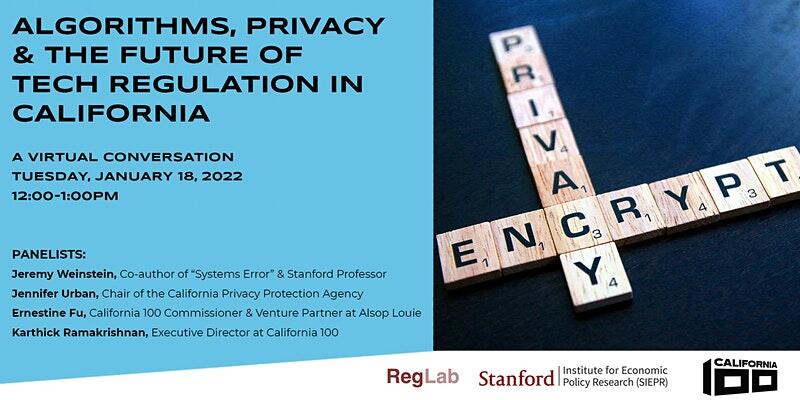
Algorithms, Privacy &amp; the Future of Tech Regulation in California

Register Now


California-grown technology has led the nation and world in multiple ways—from democratizing the ways we live, work and play, to posing enormous ethical and social challenges that have fueled demands for government regulation.

When, and how, should state governments regulate the harms caused by new technologies? And what are the conditions under which industry self-regulation more appropriate? How do we balance the need to encourage innovation while also protecting communities from harm?

Join experts in academia, industry, and government in a deeper conversation about algorithms, privacy, and the future of tech regulation in California.

Featuring Jeremy Weinstein (Stanford professor and co-author of the recent book System Error), Jennifer Urban (Board Chair of the California Privacy Protection Agency), Ernestine Fu (California 100 Commissioner and Venture Partner, Alsop Louie), and Karthick Ramakrishnan (Executive Director, California 100) as the moderator, this discussion will cover present-day challenges and remedies on data privacy and lack of consumer power, as well as larger questions about when and how to step into future regulation conversations involving new technologies.

Authors
News Type
Blogs
Date
Paragraphs

Moving from Tokyo to California in second grade, I knew very little about my home country. I may have looked and spoken Japanese, but the more time I spent in the United States, the more I felt like my identity strayed away from my Japanese cultural roots. For most of my life, I was hesitant to proudly call myself a Japanese American simply due to the lack of knowledge I had about my home country.

That was until I stumbled upon Stanford’s Reischauer Scholars Program (RSP), an online program that introduced Japanese history, society, culture, and the U.S.–Japan relationship. With its focus on deepening cross-cultural knowledge, this was the perfect opportunity to reconnect with my cultural roots.

On the first day of the RSP, I was astounded by the diversity of the students that were present. Students in the program were from all around the country, each showing unique individual interests and strengths that they added to the class. Alongside these friendly and committed students led by our brilliant instructor Ms. Naomi Funahashi, the RSP provided a motivated and collaborative environment to learn about my home country. The activities in our virtual classes included not only the review of insightful readings that we were assigned, but also the once-in-a-lifetime opportunities to meet top scholars and experts in U.S.–Japan relations and ambassadors. Having had the chance to converse with these speakers, we were introduced to significant ideas and insights about the U.S.–Japan relationship that developed my diverse perspective on the topic.

Throughout the course of the program, the inclusive environment of the virtual classrooms allowed us to comfortably share and challenge ideas we would bring up. With each of us from very different backgrounds, we were able to have insightful conversations about the cause of isolationism in Japan, the effect of industrialization on the Japanese economy, and many other concepts about Japanese history and culture.

With each new perspective that my peers would view the topic from, I was given a broader understanding of each concept we covered, expanding my knowledge about my home country.

To me, the most memorable days of the RSP were the joint virtual classrooms with the Stanford e-Japan program. Through these joint classrooms, we had the opportunity to converse with Japanese high school students, where we were able to deepen our mutual cross-cultural understanding. From the bunkasai, to the undokai, to juku, these joint classrooms gave us the opportunity to learn more about the exciting Japanese culture and contemporary society from a primary source. With nearly no opportunity to speak with Japanese students outside of my family during my time in the United States, I was able to take away many valuable insights I keep to this day thanks to the unique opportunity given by the RSP. With each meeting with these students, I was given a clearer image of what it truly meant to be “Japanese.”

Read More

high school girl standing amidst park greenery
Blogs

Finding My Place in the RSP & the U.S.–Japan Relationship

The following reflection is a guest post written by Kristine Pashin, an alumna of the Reischauer Scholars Program, which will begin accepting student applications on September 6, 2021.
Finding My Place in the RSP & the U.S.–Japan Relationship
Brandon Cho at Todaiji Temple, Nara
Blogs

A Journey Through Time: The RSP as a Gateway from the Past to My Future

The following reflection is a guest post written by Brandon Cho, an alumnus of the Reischauer Scholars Program.
A Journey Through Time: The RSP as a Gateway from the Past to My Future
Naomi Funahashi after receiving the 2017 Elgin Heinz Teacher Award
News

SPICE’s Naomi Funahashi receives 2017 Elgin Heinz Teacher Award

SPICE’s Naomi Funahashi receives 2017 Elgin Heinz Teacher Award
Hero Image
a student standing in front of a modern-looking building
Hikaru Sean Isayama at MIT; photo courtesy Isayama family
All News button
1
Subtitle

The following reflection is a guest post written by Hikaru Sean Isayama, a 2020 alumnus of the Reischauer Scholars Program.

Authors
Melissa Morgan
News Type
Commentary
Date
Paragraphs

A year ago, a crowd on the National Mall violently breached the halls of the U.S. Capitol with the intent of disrupting the formal ratification of the 2020 presidential election. Despite the chaos, Joe Biden was inaugurated as the president, the prosecution of individual perpetrators has begun, and the House of Representatives January 6 Commitee's investigation is ongoing. Yet there remains a sense that something fundamental to American democracy has changed. Where is America now, one year from the attack?

To mark the first anniversary of the January 6 Capitol riot, scholars from across the Freeman Spogli Institute for International Studies share their thoughts on what has happened in the year since, and what the ongoing effects of the violence signal about the future of democracy and the integrity of America’s image at home and abroad.


Intensifying Divisions

Larry Diamond, Mosbacher Senior Fellow in Global Democracy

The January 6 insurrection was the gravest assault on American democracy since the Civil War, and it came much closer to disrupting the peaceful transfer of power (and possibly our democracy itself) than we realized at the time.

Rather than providing a sobering lesson of the dangers of political polarization, the insurrection seems only to have intensified our divisions, and the willingness to contemplate or condone the use of violence. According to a recent Washington Post survey, a third of Americans feel violence against the government could be justified in some circumstances —a sharp increase from 16 percent in 2010 and 23 percent in 2015.

Sadly, many politicians have not been the least bit chastened by the close brush with a constitutional catastrophe. The “Big Lie” that Biden did not legitimately win the 2020 election retains the support of most Republicans and a substantial proportion of independents. Around the country, Republican legislatures have been introducing, and in many states adopting, bills that would give Republican legislatures the ability to reverse or sabotage legitimate electoral outcomes, and other bills that make it more difficult for people (especially Democratic-leaning groups) to vote. All of this is doing deep damage to the global reputation and hence “soft power” of American democracy.

Although they are generally relieved that Trump is no longer president, our allies remain deeply worried about the stability and effectiveness of American democracy.

What gives me some hope is the expanding network of civil society organizations documenting the multiple threats to electoral integrity in the U.S. But we are going to need much more widespread and resourceful mobilization to counter the downward spiral of our democracy.

Professor Larry Diamond

Larry Diamond

Mosbacher Senior Fellow in Global Democracy at FSI
Full Profile

Problems at Home, Issues Abroad

Francis Fukuyama, Olivier Nomellini Senior Fellow

The Capitol uprising on January 6 marked a grave crisis in American institutions, when a sitting President refused to transfer power peacefully and sought to actively overturn an election.  The Republican Party, rather than repudiating the uprising and marginalizing its organizers, instead rallied in subsequent weeks to normalize the event.  These developments, while bad in themselves from the standpoint of US politics, also sent an unmistakable geopolitical signal that the Biden presidency would not represent an American return to “normal” internationalism.  The Administration would lead a deeply polarized country uncertain of its own global role.

This is the point at which geopolitics and domestic unrest come together. The single greatest weakness of the United States today does not lie in its economy or military power, but in the deep polarization that has affected American politics.  This is not just speculation, but something underlined by Kremlin-linked commentators, as Françoise Thom has detailed: in the words of one, "the decrepit empire of the Stars and Stripes, weakened by LGBT, BLM, etc." makes "it is clear that it will not survive a two-front war."  They see that a significant number of Republicans believe that the Democratic Party represents a bigger threat to the American way of life than does Russia.  A country that cannot rally around sensible public health measures during a pandemic will not rally around defense of freedom abroad.  This is the significance of January 6:  it has hardened partisan divisions rather than being the occasion for national soul-searching.

Read Francis Fukuyama's full commentary in American Purpose.

Francis Fukuyama

Francis Fukuyama

Olivier Nomellini Senior Fellow at FSI
Full Profile

Democracy vs. Partisanship

Didi Kuo, Senior Research Scholar at CDDRL

It has been a year since rioters stormed the United States Capitol in an effort—an organized, violent effort—to declare Donald Trump the rightful winner of the 2020 presidential election. The riots signaled a dangerous turn in American politics, an attack on the basic, fundamental institutions of democracy. For democracy to work, all sides must agree on the rules of the game: the fairness of the balloting and counting process, the routine and peaceful transfer of power. We now see what happens when the institutions and procedures of elections are delegitimated.

Our political leaders can act now to restore confidence in elections. They can do so by protecting election administrators from threats of violence, by depoliticizing oversight of elections, and by passing democratic reforms. Although President Biden’s Freedom to Vote Act and John Lewis Voting Rights Advancement Act have been blocked by Republicans, narrower versions of these bills could create stricter federal election standards. And Americans can organize to protect democracy through civic groups that push for ballot access and election integrity, particularly at the state level. Politicians and activists alike must make clear that election administration is not a partisan issue. As the nation enters the third year of a global pandemic and an upcoming midterm election, our leaders must make strengthening democracy their utmost priority.

Watch Kuo's conversation with Hakeem Jefferson about the anniversary of the riots at the U.S. Capitol.

Didi Kuo

Didi Kuo

Senior Research Scholar at CDDRL
Full Profile

Epistemic Fractures and Exploitation

Herbert Lin, Senior Research Scholar at CISAC

The failure of the Jan. 6 insurrection provided an opportunity for the United States to collectively take a step back from the conspiracy theories and lies that pervaded American political discourse in the preceding couple of years. But alas, the nation failed to take advantage of that opportunity, with tens of millions of Americans maintaining their delusions as strongly as ever. Substantial numbers of Americans continue to believe that Donald Trump really won the 2020 election, and the number of QAnon adherents and believers was virtually unchanged.

Even more alarming has been the cynical exploitation of such trends by elected officials in their quest to gain or retain political power. Rather than standing up for the rule of law and defending the conclusions of an independent judiciary regarding various allegations of election fraud, they have pointed to such outcomes as yet more evidence of a system rigged against them. We now live in a environment in which no conceivable evidence can persuade true believers to change their minds, and the resulting epistemic fractures translate into a once-unified nation sharply divided against itself.  A worse national posture to meet the challenges of coming great-power competition could not be imagined.

Read more of Herbert Lin's analysis of contemporary security issues and power competition in his latest book, Cyber Threats and Nuclear Weapons (Stanford University Press, 2021).

Dr. Hebert Lin

Herbert Lin

Senior Research Scholar at CISAC
Full Profile

The Need to Protect and Invest In Elections

Matthew Masterson, Non-resident Fellow at the Stanford Internet Observatory

The insurrection on January 6th left a scar on American Democracy. For the first time in our history, America did not have a peaceful transition of power. The effects of that day continue to be felt every day in election offices across the United States. Election officials, the guardians of our Democracy, are targets of harassment and threats fueled by the ongoing lies regarding the integrity and accuracy of the election. Worse yet, there have been little no consequences for these threats against our democracy. While some who participated in January 6th are being investigated and prosecuted, those responsible for the threats against election officials have faced little to no accountability for their actions. Facing ongoing threats and little support from law enforcement election officials are leaving their jobs out of fear for their own safety and the safety of their families.

Healing the wound of January 6th won’t be easy; there must be accountability for the damage done to our democracy. American democracy is resilient and strong, but can not survive the unchecked attacks against it. Those who seek to profit from the lies about 2020 need to be held accountable for selling out democracy in pursuit of their own political and financial gain. They must be defeated at the ballot box or their businesses made to pay the price  by Americans unwilling to accept holding democracy for ransom. As we bring accountability, we need to invest in continuing to improve the security, accessibility and integrity of the process. We need to fund elections on an ongoing basis like the national security issue they are. The only response to this sustained attack on our democracy is a sustained investment in protecting it.  

Matt Masterson

Matthew Masterson

Non-resident Fellow at the Stanford Internet Observatory
Full Profile

Read More

storming of capital 2021
News

To Support Democracy Abroad, the U.S. Needs To Set Its Own House In Order, says FSI Director Michael McFaul

Former U.S. ambassador to Russia and Stanford political scientist Michael McFaul recommends that the incoming Biden administration “go big” in its efforts to reaffirm core democratic values – including passing comprehensive, structural reforms.
To Support Democracy Abroad, the U.S. Needs To Set Its Own House In Order, says FSI Director Michael McFaul
Capitol Building
News

Stanford Scholars React to Capitol Hill Takeover

FSI scholars reflect on the occupation of the U.S. Capitol on Wednesday and suggest what needs to happen next to preserve democracy.
Stanford Scholars React to Capitol Hill Takeover
Hero Image
Protesters attack the U.S. Capitol on January 6, 2021.
Protesters attacked the U.S. Capitol on January 6, 2021 in an attempt to disrupt the verification of the 2020 election results. | Getty
All News button
1
Subtitle

On the first anniversary of the riot at the U.S. Capitol, scholars from across FSI reflect on the ongoing ramifications the violence is having on America's domestic politics and international influence.

Date Label
0
Assistant Professor, Political Science
HakeemJefferson_Headshot2023.png

Hakeem Jefferson is an assistant professor of political science at Stanford University where he is also a faculty affiliate with the Center for Comparative Studies in Race and Ethnicity and the Stanford Center for American Democracy. During the 2021-22 academic year he was also the SAGE Sara Miller McCune Fellow at the Center for Advanced Study in the Behavioral Sciences.

Hakeem’s work focuses primarily on the role identity plays in structuring political attitudes and behaviors in the U.S. His in-progress book project builds on his award-winning dissertation to consider how Black Americans come to support punitive social policies that target members of their racial group.

In other projects, Hakeem examines the causes of the racial divide in Americans’ reactions to officer-involved shootings; works to evaluate the meaningfulness of key political concepts, like ideological identification among Black Americans; and considers how white Americans navigate an identity that many within the group perceive as increasingly stigmatized. In these and other projects, Hakeem sets out to showcase and clarify the important and complex ways that identity matters across all domains of American life.

A public-facing, justice-oriented scholar, Hakeem is an academic contributor at FiveThirtyEight and his writings and commentary have been featured in places like the New York Times, The Washington Post, NPR, and other major outlets. He is also active on Twitter, and you can follow him @hakeemjefferson.

CDDRL Affiliated Faculty
CV
Authors
Nora Sulots
News Type
News
Date
Paragraphs

We are delighted to announce that Hakeem Jefferson, Assistant Professor of Political Science, is a new faculty affiliate at the Center on Democracy, Development and the Rule of Law.

Professor Jefferson’s research focuses primarily on the role identity plays in structuring political attitudes and behaviors in the U.S. He is especially interested in understanding how stigma shapes the politics of Black Americans, particularly as it relates to group members’ support for racialized punitive social policies. In other research projects, he examines the psychological and social roots of the racial divide in Americans’ reactions to officer-involved shootings and works to evaluate the meaningfulness of key political concepts, like ideological identification, among Black Americans.

"I am delighted that Hakeem Jefferson is joining the CDDRL community” shared Kathryn Stoner, Mosbacher Director of CDDRL. “Hakeem's work on race and politics in America is a welcome addition to the Center's expanding work on the quality of American democracy. I look forward to supporting his important work on the role that identity plays in the United States and elsewhere in structuring political behavior and social policies."

Hakeem's work on race and politics in America is a welcome addition to the Center's expanding work on the quality of American democracy.
Kathryn Stoner
Mosbacher Director of CDDRL

Professor Jefferson is also a faculty affiliate with the Center for Comparative Studies in Race and Ethnicity and the Stanford Center for American Democracy. He received his PhD in political science from the University of Michigan and a Bachelor of Arts degree in political science and African American Studies from the University of South Carolina.

In 2020, his dissertation, "Policing Norms: Punishment and the Politics of Respectability Among Black Americans," was a co-winner of the Best Dissertation Award from the Political Psychology Section of the American Political Science Association.

Hakeem Jefferson

Hakeem Jefferson

Assistant Professor, Political Science and CDDRL Affiliated Faculty
Read more about Hakeem
Hero Image
Hakeem Jefferson
Photo by Andrew Brodhead
All News button
1
Subtitle

Jefferson, an assistant professor of political science at Stanford University, will join the center as a faculty affiliate.

Authors
News Type
News
Date
Paragraphs

SPICE and Stanford Global Studies are pleased to announce an upcoming Education Partnership for Internationalizing Curriculum (EPIC) workshop for community college instructors that will feature a talk by Dr. Herbert Lin on his latest book, Cyber Threats and Nuclear Weapons. This free virtual workshop will take place on Tuesday, January 25, 4:00pm–6:00pm (Pacific Time). All attendees will receive a copy of Dr. Lin’s book after the workshop. Please see the workshop description below for more information as well as the registration link.


The Stanford Program on International and Cross-Cultural Education (SPICE) and Stanford Global Studies (SGS) are continuing their partnership to offer engaging professional development opportunities for community college instructors who wish to internationalize their curriculum. This two-hour workshop is presented by SPICE and SGS as part of the Education Partnership for Internationalizing Curriculum (EPIC) and is supported by Department of Education Title VI funding.

This workshop will feature a talk by Dr. Herbert Lin on his latest book, Cyber Threats and Nuclear Weapons. Participants will have the opportunity to ask questions and discuss with Dr. Lin the cyber threat across the U.S. nuclear enterprise.

As noted by Stanford University Press, the publisher of Cyber Threats and Nuclear Weapons, “The technology controlling United States nuclear weapons predates the Internet. Updating the technology for the digital era is necessary, but it comes with the risk that anything digital can be hacked. Moreover, using new systems for both nuclear and non-nuclear operations will lead to levels of nuclear risk hardly imagined before. This book is the first to confront these risks comprehensively.” (https://www.sup.org/books/title/?id=34611)

Dr. Herbert Lin is Senior Research Scholar at the Center for International Security and Cooperation, FSI, and Hank J. Holland Fellow in Cyber Policy and Security, Hoover Institution.

Please register here at your earliest convenience and before January 21, 2022.

Read More

Professor Tomás Jiménez
News

Virtual Workshop for Community College Instructors Will Explore Immigration Policies, Attitudes, and Inclusion

SPICE and Stanford Global Studies will offer a free virtual workshop with Professor Tomás Jiménez on November 9, 4:00–6:00PM.
Virtual Workshop for Community College Instructors Will Explore Immigration Policies, Attitudes, and Inclusion
Maiya Evans at the Van Gogh Museum, Amsterdam, Netherlands
Blogs

Reimagining Public Health

Guest author Maiya Evans reflects on her EPIC project, which challenges students to reimagine public health.
Reimagining Public Health
image of six fellows
News

Collegiality and the 2020–21 EPIC Fellows

On August 13 and 14, 2020, Stanford Global Studies welcomed 12 new Education Partnership for Internationalizing Curriculum (EPIC) Fellowship Program community college instructors as members of its 2020–21 cohort.
Collegiality and the 2020–21 EPIC Fellows
Hero Image
Dr. Hebert Lin
Dr. Herbert Lin
All News button
1
Subtitle

SPICE and Stanford Global Studies will offer a free virtual workshop with Dr. Herbert Lin on January 25th, 4:00pm–6:00pm.

Authors
Gary Mukai
News Type
Blogs
Date
Paragraphs

The following is Part 6 of a multiple-part series. To read previous installments in this series, please visit the following articles: Part 1, Part 2, Part 3, Part 4, and Part 5.

On December 8, 2020, January 19, 2021, March 16, 2021, May 18, 2021, and July 20, 2021, SPICE posted five articles that highlight reflections from 41 students on the question, “What does it mean to be an American?” Part 6 features eight additional reflections.

The free educational website “What Does It Mean to Be an American?” offers six lessons on immigration, civic engagement, leadership, civil liberties & equity, justice & reconciliation, and U.S.–Japan relations. The lessons encourage critical thinking through class activities and discussions. On March 24, 2021, SPICE’s Rylan Sekiguchi was honored by the Association for Asian Studies for his authorship of the lessons that are featured on the website, which was developed by the Mineta Legacy Project in partnership with SPICE.

Since the website launched in September 2020, SPICE has invited students to review and share their reflections on the lessons. Below are the reflections of eight students. The reflections below do not necessarily reflect those of the SPICE staff.

Aime Chao, California
The American Dream is a set of ideals: democracy, liberty, opportunity, and equality. These ideals are not necessarily the reality; for example, my Japanese American grandmother was unconstitutionally incarcerated during WWII. Yet, the same ideals made it possible for my family from East Asia to build a life in the United States. The juxtaposition of the American Dream and the facts on the ground unveils the characteristic of America that distinguishes what it means to be American—that everyone has a voice. I am growing up in a time when my country is increasingly polarized, and it can be challenging to identify or be identified with being American. However, the perseverance involved in bettering our future by bridging our reality with our ideals makes me proud of my identity as an American.

Jiahao Guo, Ohio
America is divided. And the division breeds inequality. But there is an often-ignored divide, a geographical one: Rural America vs. Urban America. As an Ohioan, the stark differences between the two Americas are apparent, encompassing all aspects of life, regardless of race or culture. Compared with urban America, the average income is much lower. Infrastructure is ignored. Education opportunities are far less accessible. And rural America is often forgotten or even dismissed by the rest of the country. There’s even a term for this: Flyover States. States so unimportant you can just fly over them. I am constantly reminded of this divide. Some say that this is just a fact to be accepted. But in the land of opportunity, we must do our best to bring about a more equal landscape.

Noah Kurima, California
America is a unique experiment. Our founding fathers concocted a country not based on race but on the unfathomable-at-the-time ideals of freedom, equality, and opportunity. To me, to be an American means to aspire for these ideals during smooth sailing, but also when faced with adversity. There is so much noise right now—the pandemic, school shootings, the recent rise of racial hate and violence. But we must look around and observe the appalling abuses of authoritarian regimes around the world. We must acknowledge the immense power of our rights and freedoms, as well as their vulnerability. We must be willing to spend the long nights in the laboratory that is our democracy, avoiding corrosive missteps and working to perfect the seemingly volatile formula for liberty and justice for all.

Riya Narayan, Tennessee
The American Dream is the idea that our country fosters equality, peaceful opportunity, and the freedom to pursue life. It is through this simple notion that millions of people immigrate to the United States every single year, and it’s why my family immigrated here in 2011. What does this American Dream stand for? For me, it symbolizes the peaceful unity of people from different cultures, backgrounds, and identities. It represents the sharing of ideas and a drive for positive change. For my family, it represents a world of opportunity. My parents and I became American citizens in May 2019, and ever since, we have worked to uphold this purpose: to be a vessel for the innovation, creativity, and equality our country brings for the betterment of others. This, for me, is what it means to be an American.

Jack Pelster-Wiebe, Minnesota
I have a complicated relationship with America and American-ness. I am not legally a citizen, but I am a white person who’s lived in the United States for the majority of my life. I also speak English with an American-adjacent Canadian accent, and so I’ve rarely been treated as though I don’t belong here. But still, I am not an American. When I think about what divides my American friends from me, I find largely nebulous contradictions that can’t apply to everyone. Then maybe there is no one defining characteristic of an American, nothing that makes them any more or less citizen than the neighbors around them. It’s up to each person to define themselves what makes them American, decide whether they want to tie themselves to the land, border, culture, or whatever feels like “America” to them.

Kevin Phan, Hawaii
I believe it is the cultural practices of every nation that make them distinct. It is what makes the German people German. It is what makes the Chinese people Chinese. Our culture is what makes us American. One doesn’t need to enjoy every single tenant of American culture, but rather enough of it to where it has a strong influence in our lives. People around the world can enjoy things like the NBA, the Kardashians, and Taylor Swift, however, it is only Americans who are able to enjoy those things and more. Thus, it is not an appreciation of our history, nor our citizenship that make us American. It is the love and interests that we culminate through exposure and experience that makes us a part of this nation.

Kasha Tyranski, Florida
“The frog is almost five hundred million years old. Could you really say... that America… will last as long as... the frog?” I can respond to Catch-22’s question with one word: yes. Perhaps not a physical America—but the essence of what it means to be American will outlive the frog. To be American is to be a quilt—a patchwork of struggles, triumphs, and dreams that transcend time. America is my ancestors joining za chlebem with whispers of hope hidden in their coat folds. America is speaking in Tajiki to Dushanbean students, describing the skyscrapers of the place I call home. America is opportunity, dynamism, reflectiveness, and reconciling the past and present. It means being part of a story greater than myself—one that will continue being woven, with or without frogs.

Andy Wattanaskolpant, Tennessee
The concept of being American is rooted in complexity, curiosity, and change. It is based on the notion that our uniqueness and individuality help to unite us. Indeed, our country has been marred by a history of injustice that still impacts us today, however, the fundamental idea of being American is the eagerness to push for change. Over the years, I have noticed the dynamic change happening in America—within the police system, the political environment, the food industry. There is no doubt that the rudimentary attitude of change is continuing to perpetuate inside the minds of Americans. I find myself realizing that utilizing love as the drive for change makes the fight all the more worth it. To love is what makes me most American.

Read More

headshots of eight high school students
Blogs

What Does It Mean to Be an American?: Reflections from Students (Part 5)

Reflections of eight students on the website "What Does It Mean to Be an American?"
What Does It Mean to Be an American?: Reflections from Students (Part 5)
Hero Image
headshots of eight high school students
Clockwise from top left: Aime Chao, Jiahao Guo, Noah Kurima, Riya Narayan, Jack Pelster-Wiebe, Kevin Phan, Kasha Tyranski, Andy Wattanaskolpant
All News button
1
Subtitle

Reflections of eight students on the website “What Does It Mean to Be an American?”

News Type
News
Date
Paragraphs

During this multimedia course, Clayborne Carson, the editor of The Papers of Martin Luther King, Jr. and The Autobiography of Martin Luther King, Jr., and the director of the World House Project, will examine the lives of Martin and Coretta Scott King. We will follow Dr. King’s unexpected emergence as an internationally known nonviolence and human rights advocate. We will learn about the successes and challenges he experienced as the preeminent leader of the civil rights movement, and we will discuss the central role that Coretta Scott King played as a partner and activist during Martin’s life and afterward.

This course will highlight the crucial events that influenced Coretta’s and Martin’s lives, such as the 1955 Montgomery Bus Boycott, the 1960 sit-ins, the 1963 Birmingham Campaign and the March on Washington for Jobs and Freedom, as well as the 1965 Selma to Montgomery March. Further, we will look at the Kings’ involvement in the 1966 Chicago Freedom Movement Campaign and their effort to mobilize the 1968 Poor People's Campaign, which brought Martin to Memphis in the Spring of 1968. Finally, we will examine Coretta’s transformation from Martin’s partner into a leader of the movement to shape his legacy. In each session, Mira Foster, the director of education for the World House Project, will provide rich and rarely seen historical material, on-location filming, and other audiovisual documents, to help us understand what inspired and motivated these two remarkable people.

Hero Image
King at Press Conf
All News button
1
Subtitle

Available through Stanford Continuing Studies, "American Prophet: The Life and Legacy of Martin Luther King Jr." will run online for eight weeks on Thursdays from January 20 through March 10, 2022.

Subscribe to United States