Bringing Korea into the classroom
News Type
News
Date
Paragraphs
Hero Image

All News button
1

Japanese Prime Minister Shinzo Abe and his Liberal Democratic Party won by a landslide in the national election for the upper house of parliament on July 10. Writing for Toyo Keizai, Shorenstein APARC Associate Director for Research Daniel Sneider said American policymakers hope the Prime Minister will use the fresh mandate to kick-start stalled economic reforms and to move ahead on implementation of Japan’s new security legislation. Read the article here.

A new course jointly taught by Stanford and Peking University brought together students and scholars in China and the United States in dialogue using videoconferencing.
Each week during the past spring quarter, students at Stanford and Peking University (PKU) gathered in a classroom to learn, just as they would for any other course. The only difference was these students were neither in the same classroom nor on the same continent.
Despite being separated by nearly 6,000 miles, 18 students in Palo Alto and 28 students in Beijing held ‘face-to-face’ conversations via high definition videoconference in a course taught by American and Chinese scholars. On each side, they sat in a three-rowed amphitheater and looked directly ahead – not at a whiteboard – but at a screen that projects a video ‘wall’ of their colleagues at the other campus. The venue, known as a ‘Highly Immersive Classroom,’ enabled the distance learning experience between the two universities, using advanced software to create a cross-Pacific virtual classroom. The course titled The United States, China, & Global Security, led by former U.S. Ambassador to Afghanistan Karl Eikenberry and PKU professor Fan Shiming, was organized under the auspices of the U.S.-Asia Security Initiative whose research focuses on security challenges in Asia with teaching as one of its core activities.
“We set out to host a course that addressed topics critical to China and the United States in a new type of classroom format,” said Eikenberry, the Oksenberg-Rohlen Distinguished Fellow in the Shorenstein Asia-Pacific Research Center and director of the Initiative. “What resulted was a truly unique academic exchange that considered topics even beyond the bilateral relationship and carried a certain ‘Silicon Valley spirit’ being divided by an ocean yet connected through technology.”
“I loved the cybersecurity class because there was a lot of candor on both sides.” -Shan Jee Chua, PKU graduate student |
Over eight weeks, a select group of graduate students from the two universities explored a wide array of subjects related to international security, ranging from terrorism to trade and energy and the environment. The course aimed to provide students with a forum to discuss current issues in U.S.-China relations and to analyze areas that could be applied to other case studies.
“Because each week was a different topic, it didn’t feel like I was just thinking about the United States and China again every Wednesday night,” said Sam Ide, a Stanford graduate student who studies China’s relations with Central Asia. “Each session was very interesting to me in a different way.”
Guest-taught by prominent scholars and former senior government officials from the United States and China, the course sessions allocated thirty minutes for each lecturer to present, followed by a thirty minute question-and-answer period in which students were given the opportunity to interact with the lecturers and their peers on the other campus. Lecturers from Stanford included nuclear scientist Siegfried Hecker, former U.S. Secretary of Energy Steven Chu, and Thomas Fingar, a former deputy director at the U.S. Office of the Director of National Intelligence; and from PKU, Dean of the School of International Studies Jia Qingguo, and arms control and disarmament expert Han Hua. All discussions were off-the-record to encourage candid exchange of ideas.
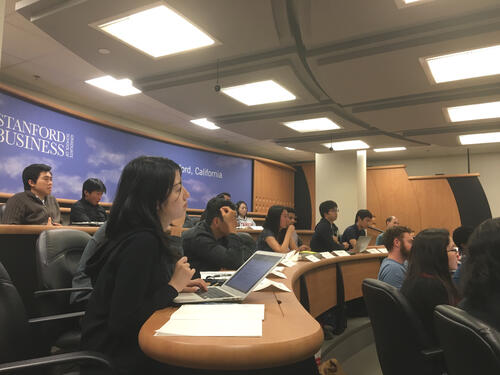
At Stanford's Highly Immersive Classroom in Palo Alto, students look ahead at their counterparts in Beijing.
One course session in particular resonated with students. The session, taught by Zha Daojiong, a professor of political economy at PKU and Herbert Lin, a senior research scholar at Stanford’s Freeman Spogli Institute for International Studies, focused on the changing nature and future of cybersecurity relations between China and the United States.
“I loved the cybersecurity class because there was a lot of candor on both sides,” PKU student Shan Jee Chua recalled.
Kimberly Chang, a second year Stanford graduate student in management science and engineering, noted that it was beneficial to hear the Chinese view on cyber “because most of the talk within the United States has been from an American perspective.”
“Hopefully, I'll be able to meet some of these people in real life who I've met on the 'wall.'” -Sam Ide, Stanford graduate student |
The course revealed a broader range of perspectives and provided a chance to interact first-hand with international colleagues while remaining at their home campus. Discussion amongst peers uncovered the “behind the scenes stories” and added context to media reports found online or in print, said Seung Kim, a student in Stanford’s East Asian studies program.
Besides the technology, a unique aspect of the course was its diversity. More than half of the course participants were international, representing 15 countries beyond China and the United States. That setting encouraged debate and reinforced the notion that “neither the United States nor China is the center of the universe,” said Zhu Jun Zhao, a PKU international relations student.
When students were asked what could bring about better understanding between China and the United States, continued dialogue was a common answer. The future of U.S.-China relations rests in the hands of people talking to one another: “I think we need more honest conversations,” Chang said.
And for some students, an opportunity to hold those conversations in-person may be close. Ide said he anticipates traveling to Beijing over the summer and plans to try and meet with a few of his counterparts whom he met through the course.
“Hopefully, I’ll be able to meet some of these people in real life who I’ve met on the ‘wall.’”
Related Links:
Video showcases SCPKU's Highly Immersive Classroom enabling co-teaching across the Pacific

When the Soviet Union collapsed in 1991, the worry in the West was what would happen to that country’s thousands of nuclear weapons. Would “loose” nukes fall into the hands of terrorists, rogue states, criminals – and plunge the world into a nuclear nightmare?
Fortunately, scientists and technical experts in both the U.S. and the former Soviet Union rolled up their sleeves to manage and contain the nuclear problem in the dissolving Communist country.
One of the leaders in this relationship was Stanford engineering professor Siegfried Hecker, who served as a director of the Los Alamos National Laboratory before coming to Stanford as a senior fellow at the Center for International Security and Cooperation. He is a world-renowned expert in plutonium science, global threat reduction and nuclear security.
Hecker cited one 1992 meeting with Russian scientists in Moscow who were clearly concerned about the risks. In his new book, Doomed to Cooperate: How American and Russian scientists joined forces to avert some of the greatest post-Cold War nuclear dangers, Hecker quoted one Russian expert as saying, “We now need to be concerned about terrorism.”
Earning both scientific and political trust was a key, said Hecker, also a senior fellow at Stanford’s Freeman Spogli Institute for International Studies. The Russians were proud of their scientific accomplishments and highly competent in the nuclear business – and they sought to show this to the Americans scientists, who became very confident in their Russian counterparts’ technical capabilities as they learned more about their nuclear complex and toured the labs.
But the nuclear experts faced an immense problem. The Soviets had about 39,000 nuclear weapons in their country and in Eastern Europe and about 1.5 million kilograms of plutonium and highly enriched uranium (the fuel for nuclear bombs), Hecker said. Consider that the bomb that the U.S. dropped on the Japanese city of Nagasaki in 1945 was only six kilograms of plutonium, he added. Meanwhile, the U.S. had about 25,000 nuclear weapons in the early 1990s.
Hecker and the rest of the Americans were deeply concerned about the one million-plus Russians who worked in nuclear facilities. Many faced severe financial pressure in an imploding society and thus constituted a huge potential security risk.
“The challenge that Russia faced with its economy collapsing was enormous,” he said in an interview.
The Russian scientists, Hecker said, were motivated to act responsibly because they realized the awful destruction that a single nuclear bomb could wreak. Hecker noted that one Russian scientist told him, “We arrived in the nuclear century all in one boat, and a movement by anyone will affect everyone.” Hecker noted, “Therefore, you know, we were doomed to work together to cooperate.”
All of this depended on the two governments involved easing nuclear tensions while allowing the scientists to collaborate. In short order, the scientists developed mutual respect and trust to address the loose nukes scenario.
The George H.W. Bush administration launched nuclear initiatives to put the Russian government at ease. For example, it took the nuclear weapons off U.S. Navy surface ships and some of its nuclear weapons off alert to allow the Russians to do the same. The U.S. Congress passed the Nunn-Lugar Cooperative Threat Reduction legislation, which helped fund some of the loose nuke containment efforts.
While those were positive measures, Hecker said, it was ultimately the cooperation among scientists, what they called lab-to-lab-cooperation, that allowed the two former superpower enemies to “get past the sensitivity barriers” and make “the world a safer place.”
Since the end of the Cold War, no significant nuclear event has occurred as a result of the dissolution of the Soviet Union and its nuclear complex, Hecker noted.
One lesson from it all, Hecker said, is that government policymakers need to understand that scientists and engineers can work together and make progress toward solving difficult, dangerous problems.
“We don’t want to lose the next generation from understanding what can actually be done by working together,” he said. “So, we want to demonstrate to them, Look, this is what was done when the scientists were interested and enthusiastic and when the government gave us enough room to be able to do that.”
Hecker said this scientific cooperation extended to several thousand scientists and engineers at the Russian sites and at U.S. nuclear labs – primarily the three defense labs: Lawrence Livermore, Los Alamos, and Sandia national laboratories. Many technical exchanges and visits between scientists in Russia and the United States took place.
He recalled visiting some of the nuclear sites in Russian cities shrouded by mystery. “These cities were so secret, they didn’t even appear on Soviet maps.”
When the Soviet Union collapsed, the nature of the nuclear threat changed, Hecker said. The threat before was one of mutual annihilation, but now the threat changed to what would happen if nuclear assets were lost, stolen or somehow evaded the control of the government.
“From an American perspective we referred to these as the ‘four loose nuclear dangers,'” he said.
This included securing the loose nukes in the Soviet Union and Eastern Europe; preventing nuclear materials or bomb fuel from getting into the wrong hands; the human element involving the people who worked in the Soviet nuclear complex; and finally, the “loose exports” problem of someone trying to sell nuclear materials or technical components to overseas groups like terrorists or rogue nations.
For Hecker, this is not just an American story. It is about a selfless reconciliation with a longtime enemy for the greater global good, a relationship not corrupted by ideological or nationalistic differences, but one reflective of mutual interests of the highest order.
“The primary reason,” he said, “why we didn’t have a nuclear catastrophe was the Russian nuclear workers and the Russian nuclear officials. Their dedication, their professionalism, their patriotism for their country was so strong that it carried them through these times in the 1990s when they often didn’t get paid for six months at a time … The nuclear complex did its job through the most trying times. And it was a time when the U.S. government took crucial conciliatory measures with the new Russian Federation and gave us scientists the support to help make the world a safer place.”

The Supreme Court struck down parts of a Texas law that imposed standards on abortion providers that had the effect of reducing the number of abortion facilities in the state by at least half. In a 5-3 ruling in which Justice Anthony Kennedy joined the liberal wing of the Court, the justices said the restrictions placed an undue burden on a woman’s constitutional right to seek an abortion. The 2013 law required all abortion facilities to meet state standards for ambulatory surgical centers (ASCs) and required doctors performing abortions to have admitting privileges at a nearby hospital.
Justice Stephen G. Breyer wrote in the majority opinion, “We conclude that neither of these provisions offers medical benefits sufficient to justify the burdens upon access that each imposes. Each places a substantial obstacle in the path of women seeking a pre-viability abortion, each constitutes an undue burden on abortion access, and each violates the Federal Constitution.”
Michelle Mello, a professor of health research and policy at the Stanford School of Medicine and professor of law at Stanford Law School, as well a core faculty member of Stanford Health Policy, was a signatory to a brief submitted to the Supreme Court by public health academics and the American Public Health Association in support of the abortion providers’ challenge.
What was the main argument of the amici curiae brief submitted to the Supreme Court by public health academics and organizations?
There were two critical factual points that had to be made. First, although the Texas law’s provisions were putatively adopted to benefit women’s health, they actually had no medical benefit. Second, the law had a rapid, dramatic effect on access to abortion in Texas. Particularly because in Texas several other restrictions already limited access to abortion and funding for family planning services was scant, this poses a real threat to public health.
Can you say more about why the provisions of the law did not protect women’s health?
The standards were completely unnecessary. Abortion is an extremely safe procedure; complications rarely occur. The facilities already had protocols in place to ensure safe transfer to hospitals in the event of an emergency. But when complications do occur, they usually arise after the woman returns home, so transfer from the facility to the hospital isn’t an issue. And there’s no reason a woman needs to receive emergency care from the same doctor who performed the abortion.
Many of the standards for ASCs are simply irrelevant to providing safe abortions. Many abortions aren’t surgical, they’re medical (chemical). And standards relating to things like providing general anesthesia, avoiding infections to open wounds, having an advanced heating and air condition system, and having a particular traffic pattern from the operating room to the recovery room just don’t apply. The state’s argument about protecting women’s health was just a pretext.
It was a dangerous pretext, in fact, because these were standards that most abortion facilities clearly were not going to be able to meet. Many hospitals require doctors to admit a minimum number of patients in order to maintain admitting privileges, but abortion is so safe that abortion providers generally can’t do that. And fitting out a clinic to meet ASCs is prohibitively expensive. ASCs can afford it because they charge for expensive operations like cosmetic surgeries, hysterectomies, and hernia repairs; abortion providers can’t.
Why do you and the other signatories consider this a public health issue?
More than 60,000 Texas women per year obtain legal abortions. While we’d all like to see this number go down, you can’t restrict access to abortion while also failing to provide adequate support for other methods of family planning. History makes it abundantly clear that the result will be greater numbers of women resorting to illegal, unsafe abortions or facing the mental and physical health risks of carrying unwanted pregnancies to term.
Does the Supreme Court’s holding have implications beyond this case?
Yes, because the Court clarified how it will apply the “undue burden” standard of Planned Parenthood v. Casey in future cases. The majority said that courts must balance “the burdens a law imposes on abortion access” against “the benefits those laws confer.” The justices also clarified that appellate courts can take a deep dive into the factual evidence about a law’s effects presented earlier in the case. These holdings collectively make it harder for states to adopt abortion restrictions based on flimsy arguments about how they will benefit women.

CISAC senior fellow Scott Sagan decodes the enduring lessons and secret messages hidden in the hauting battlefield drawings of the Lakota Chief known as Red Horse, who fought against Lt. Col George Custer and his Seventh Cavalry forces during their infamous defeat in 1876, in this story for the New York Times' Sunday Review section.

CISAC senior fellow Martha Crenshaw challenges statements from presumptive Republican presidential nominee Donald Trump that “thousands upon thousands of people” are entering the United States, “many of whom have the same thought process” as the Orlando shooter, and his assertions that they are forming “large pockets” of people who want to “slaughter us” in an OpEd for The Washington Post.
You can read Crenshaw's full article here.

Doomed to Cooperate tells the remarkable story of nuclear scientists from two former enemy nations, Russia and the United States, who reached across political, geographic, and cultural divides to confront, together, the new nuclear threats that resulted from the collapse of the Soviet Union. Using the lingua franca of science and technology, the brilliant minds and unparalleled scientific nuclear programs of Russia and the United States embarked upon more than two decades of cooperation to avert the loss of nuclear weapons, nuclear materials, nuclear weapons expertise, and the export of sensitive nuclear technologies during a time of economic and political turmoil in the newly formed Russian Federation— a herculean endeavor known as lab-to-lab cooperation.
The Hoover Institution’s Working Group on Foreign Policy and Grand Strategy has produced a national security strategy that acknowledges this uncertainty and hedges as well as engages, recognizing that resources are not limitless. This strategy also endeavors to lay out the conceptual and policy road map for success
For the past two years, we have convened a bipartisan group of Hoover and Stanford scholars to better understand foreign policy challenges and develop a strategy for the next administration — whomever wins — to address them. Our conclusion: U.S. foreign policy needs to get back to basics. A smart national security strategy starts with three guiding principles and focuses on three key strategic challenges: Russia, China, and “black swan” threats comprised of biological, nuclear, and cyber dangers.