Authors
Waka Takahashi Brown
Meiko Kotani
News Type
News
Date
Paragraphs

Stanford e-Japan is an online course that teaches Japanese high school students about U.S. society and culture and U.S.–Japan relations. The course introduces students to both U.S. and Japanese perspectives on many historical and contemporary issues. It is offered biannually by the Stanford Program on International and Cross-Cultural Education (SPICE). Stanford e-Japan is currently supported by the Yanai Tadashi Foundation.

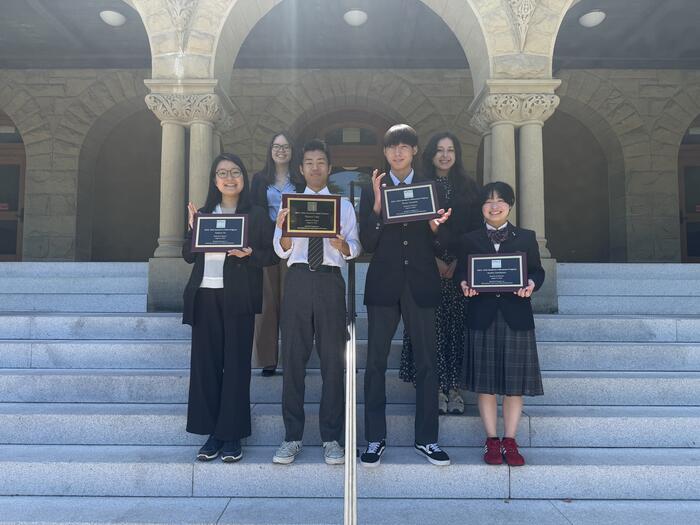
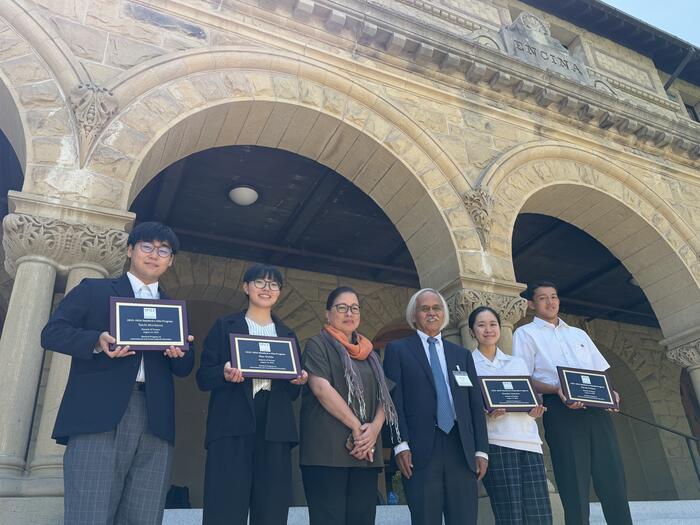
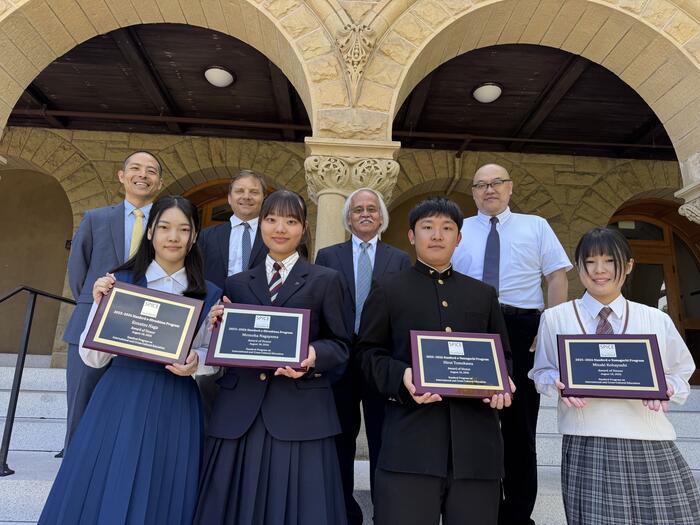
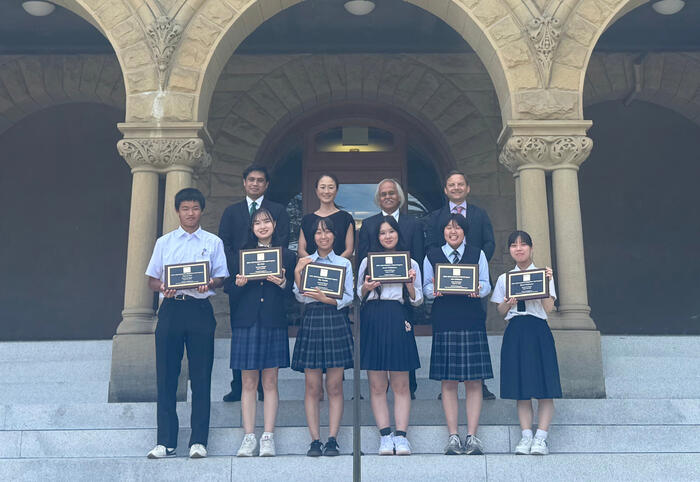
In August 2026, the top honorees of the Spring 2025 and the Fall 2025 Stanford e-Japan courses will be honored through an event at Stanford University. SPICE is most grateful to Mr. Tadashi Yanai and the Yanai Foundation for making Stanford e-Japan, including the ceremony in August 2026, possible.

The three Spring 2025 honorees—Mahono Fuji (Seinan High School), Nagi Matsuyama (Doshisha International High School), and Jinichiro Taguchi (Kaijo High School)—will be recognized for their coursework and exceptional research essays that focused respectively on “From White Flight to Gentrification: Rethinking Urban Spatial Inequality,” “Reconsidering U.S.–Japan Food Trade,” and “Trump’s Policies and the Monroe Doctrine.”

Dion Munasingha (Yaizu Chuo High School) and Natsuka Yamamoto (Keio Girls Senior High School) each received an Honorable Mention for their coursework and research papers that respectively focused on “Language Support for Children of Immigrants in Japan and the United States” and “Future of Natural Disaster Response Management in Japan and the United States.”

The three Fall 2025 honorees—Sawa Ito (Iida High School), Yurino Ohara (Okayama Prefectural Okayama Asahi High School), and Amy Yanai (The British School in Tokyo)—will be recognized for their coursework and exceptional research essays that focused respectively on “A Comparison of Mental Health in the United States and Japan: What Japan Can Learn from the United States,” “Redesigning Japan’s OTC Policy: A Digital Strategy for Fiscal Sustainability and Patient Protection,” and “Community Resilience and Soft Power: Disaster Recovery in the United States and Japan.”

Aiko Nakano (Shizuoka Futaba Senior High School) and Takaki Okada (Musashi High School) each received an Honorable Mention for their coursework and research papers that respectively focused on “A Comparison of Refugee Recognition Systems in Japan and the United States: The Role of Public Awareness” and “‘Anti-Globalism’ Sentiment in the United States: Its Causes and Effects.”

In the Spring 2025 session of Stanford e-Japan, students from the following schools completed the course: Azabu High School (Tokyo); Chiba Prefectural Higashi Katsushika High School (Chiba); Doshisha International High School (Kyoto); Ehime Prefectural Matsuyama Chuo High School (Ehime); Fuji Sacred Heart School (Shizuoka); Gunma Kokusai Academy Secondary School (Gunma); Hiroshima Prefectural Ogaki High School (Hiroshima); International Christian University High School (Tokyo); Kaijo High School (Tokyo); Kanazawa Izumigaoka High School (Ishikawa); Keio Girls Senior High School (Tokyo); Keio Shonan Fujisawa Senior High School (Tokyo); Kyoto Rakuhoku High School (Kyoto);  Meijigakuen Senior High School (Fukuoka); Meikei Gakuen High School (Ibaraki); Nagasaki Nishi High School (Nagasaki); Saitama Municipal Urawa High School (Saitama); Saku Chosei Senior High School (Nagano); Sapporo Kaisei Secondary School (Hokkaido); Seinan High School (Fukuoka); Shibuya Makuhari High School (Tokyo); Suwa Seiryo High School (Nagano); Toin Gakuen Secondary Education School (Kanagawa); Tokyo Gakugei University International Secondary School (Tokyo); Tokyo Metropolitan Kokusai High School (Tokyo); Waseda University Senior High School (Tokyo); Yaizu Chuo High School (Shizuoka); and Yatsushiro High School (Kumamoto).

In the Fall 2025 session of Stanford e-Japan, students from the following schools completed the course: AICJ High School (Hiroshima), Akita Minami Senior High School (Akita), Caritas Senior High School (Kanagawa), Higashiyama High School (Kyoto), Iida High School (Nagano), International Christian University High School (Tokyo), Kaetsu Ariake High School (Tokyo), Katayama Gakuen High School (Toyama), Keio Girls Senior High School (Tokyo), Kindai Toyooka High School (Hyogo), Koshigaya Kita High School (Saitama), Makuhari Senior High School (Chiba), Mita International School of Science (Tokyo), Musashi High School (Tokyo), Nagoya University Affiliated Upper Secondary School (Aichi), Nishiyamato Gakuen High School (Nara), Okayama Prefectural Okayama Asahi High School (Okayama), Okinawa Prefectural Kaiho Senior High School (Okinawa), Ritsumeikan Keisho High School (Hokkaido), Seigakuin High School (Tokyo), Senior High School at Otsuka, University of Tsukuba (Tokyo), Shizuoka Futaba Senior High School (Shizuoka), Shuyukan High School (Fukuoka), Suwa Seiryo High School (Nagano), The British School in Tokyo (Tokyo), Tokyo Metropolitan Hibiya High School (Tokyo), Tokyo Metropolitan Koshikawa Secondary School (Tokyo), and Tsurumaru High School (Kagoshima).


Stanford e-Japan is one of several online courses for high school students offered by SPICE, including the China Scholars Program, the Reischauer Scholars Program, the Sejong Korea Scholars Program, Stanford e-Entrepreneurship U.S., Stanford e-China, Stanford e-Entrepreneurship Japan, as well as numerous local student programs in Japan. For more information about Stanford e-Japan, please visit stanfordejapan.org.

To stay informed of news about Stanford e-Japan and SPICE’s other programs, join our email list and follow us on FacebookX, and Instagram.

Read More

a person in a suit standing
Blogs

Why Stanford e-Japan Still Matters to Me after Five Years

Yuto Kimura, a 2021 Stanford e-Japan Award Winner and 2026 graduate of Waseda University, reflects on the enduring takeaways from his experience in Stanford e-Japan.
Why Stanford e-Japan Still Matters to Me after Five Years
people gathering outside in front of palm trees
Blogs

Japan Day 2025: Recognizing the Highest Performing Students in Stanford e-Japan and the Reischauer Scholars Program

SPICE instructors Waka Takahashi Brown, Naomi Funahashi, and Meiko Kotani recognize their student honorees.
Japan Day 2025: Recognizing the Highest Performing Students in Stanford e-Japan and the Reischauer Scholars Program
people sitting around a table
Blogs

The Yanai Tadashi Foundation and SPICE/Stanford University

Four Stanford freshmen Yanai Scholars reflect on their experiences.
The Yanai Tadashi Foundation and SPICE/Stanford University
Hero Image
cherry blossoms in Kyoto, Japan
Cherry blossoms in Kyoto
Photo Credit: Irene Bryant
All News button
1
Subtitle

Celebrating the students recognized as top honorees and honorable mention recipients for 2025.

Date Label
Display Hero Image Wide (1320px)
No
-
5.18.26 Event Graphic

We meet at a moment of democratic upheaval in the United States, one in which questions of race and identity are at the heart of what many understand to be a crisis for American democracy. Against this backdrop, three scholars of Black politics gather to reflect on the politics of an ever diversifying Black public and what it tells us about the possibilities and limits of democratic life in the United States.

This conversation, presented by the Center on Democracy, Development and the Rule of Law's Program on Identity, Democracy, and Justice, brings together Katherine Tate, Corey Fields, and Hakeem Jefferson to consider how Black politics is understood in the present moment. Rather than treating Black politics as singular or static, the discussion will take seriously the diversity of views, experiences, and political commitments that exist within Black communities, and the ways those differences matter for how people understand political life.

The event will begin with brief opening reflections from Tate and Fields, followed by a conversation with Jefferson, and will conclude with a moderated Q&A with attendees.

About the Speakers

KatherineTate

Katherine Tate

Professor of Political Science, Brown University
Link to bio

Katherine Tate is one of the foremost scholars of Black politics in the United States and a Professor of Political Science at Brown University. She received her Ph.D. in political science from the University of Michigan.

Tate is the author of seven books, including the award-winning Black Faces in the Mirror and From Protest to Politics. Her most recent book, Gendered Pluralism (University of Michigan Press, 2023), is coauthored with Belinda Robnett. She is currently at work on a new manuscript focused on Black voters and the 2024 election. Her research and teaching focus on public opinion, government, and Black and women’s politics.

Corey Fields

Corey Fields

Visiting Fellow, Stanford Center for Advanced Study in the Behavioral Sciences (CASBS); Idol Family Chair & Associate Professor of Sociology at Georgetown University
Link to bio

Corey D. Fields is a sociologist whose work examines how identity shapes social life at both the individual and collective level. He received his Ph.D. in sociology from Northwestern University.

Fields is the author of Black Elephants in the Room: The Unexpected Politics of African-American Republicans (University of California Press, 2016). His research draws on a cultural perspective to explore the relationship between identity, experience, and meaning across a range of domains, including politics, work, and relationships. This year, he is a fellow at Stanford's Center for Advanced Study in the Behavioral Sciences. He is currently at work on projects examining how social and professional identities are constructed and expressed, including a study of African Americans in the advertising industry.

Hakeem2023Headshot

Hakeem Jefferson

Assistant Professor of Political Science & Director, Program on Identity, Democracy, and Justice, Stanford University
Link to bio

Hakeem Jefferson is an assistant professor of political science at Stanford University and faculty director of the Program on Identity, Democracy, and Justice at the Center on Democracy, Development, and the Rule of Law. He received his Ph.D. in political science from the University of Michigan.

His research centers on questions of race, identity, and political behavior in the United States, with a particular interest in the political and social lives of Black Americans. He is the author of Respectability Politics, forthcoming with the University of Chicago Press. The book examines disagreement among Black Americans about how members of their own group should behave, especially around issues of discipline and punishment, and develops a theory of ingroup social control that shows how stigma and status influence those judgments.

Hakeem Jefferson
Hakeem Jefferson

Philippines Conference Room — Encina Hall Central, 3rd Floor
616 Jane Stanford Way, Stanford

This event is in-person and open to the public. Live stream available via Zoom. Registration is required.

Katherine Tate Professor of Political Science Panelist Brown University
Corey Fields Panelist Visiting Fellow, Center for Advanced Study in the Behavioral Sciences, Stanford University; Idol Family Chair in the Department of Sociology, Georgetown University
Panel Discussions
News Feed Image
5.18 IDJ Event_0.png
Date Label
Authors
Melissa Morgan
News Type
Blogs
Date
Paragraphs

Students from the Ford Dorsey Master's in International Policy spent their spring break on the go around the globe working with NGOs, local governments, and international research groups to address policy challenges near and far as part of their capstone project.

The MIP capstone project is designed to give students hands-on experience navigating the uncertainty, bureaucracy, resource constraints, and politics that often dogs policy work in organizations of all kinds. Guided by an innovative problem-solving framework, student teams work with partner organizations to analyze policy problems, craft solutions, and develop implementation plans designed for success. The culminating experience of the Policy Change Studio, the capstone experience builds on the driving philosophy of the MIP program that classroom experience can only go so far in preparing students to be effective policymakers, and that practical experience is essential to help graduates become agents for change in the world.

From the bottom of an air raid shelter in Kyiv, Ukraine, to high adventures in the Philippines, read on to learn more about the impact our students are making on carbon markets, building public trust in local government, addressing AI vulnerabilities, and more.


Philipphines

Amit Sheoran, Jennifer Eyen, Oluwafunmibi Asunmonu, Santiago Paz Ojeda, and Yukiko Ueda partnered with the Asian Development Bank in the Philippines to explore how international climate finance can be mobilized for carbon projects.

Our team traveled to the Philippines in March for a week of fieldwork as part of our capstone project on carbon markets. In partnership with the Asian Development Bank, we are examining how international climate finance can be mobilized for carbon projects under Article 6 of the Paris Agreement, with a focus on agriculture, forestry, and other land use (AFOLU), including rice cultivation, mangroves, and seagrasses. Over five days in Manila and Laguna, we met with government agencies, project developers, investors, startups, and multilateral partners to better understand the opportunities and constraints shaping the country’s emerging carbon market.

The field visit brought our research into direct conversation with on-the-ground realities. Across 21 interviews and three site visits, we found strong interest in the Philippines’ potential for AFOLU carbon projects, but also significant barriers to scaling them. Stakeholders pointed to the fragmented policy framework  for Article 6, unresolved land and carbon rights, limited bankable project pipelines, and continued concerns about carbon credit integrity. We also explored sector-specific challenges in rice, forestry, and biomass management, including emerging technologies such as biochar and biodigesters.

A key takeaway from the trip was that unlocking climate finance for AFOLU projects will require progress on several fronts at once: clearer institutional pathways, stronger support for project development and aggregation, and more credible long-term demand signals from buyers and investors.

To complement our on-the-ground fieldwork, one team member attended CERAWeek in Houston — one of the world's foremost gatherings of energy industry leaders — where engagement with a broad set of energy stakeholders further reinforced the direction of our research. Conversations with executives from major players, some of whom are actively navigating their entry into voluntary carbon markets, highlighted that purchasing decisions are increasingly driven by credibility, policy durability, and the ability to stack economic value across compliance and voluntary mechanisms.

As we move into the final phase of the capstone, we are using these insights to refine practical recommendations for how the Philippines can attract international finance while building a more credible and investable carbon market.

Ukraine

Gabriela Sommer, Haolie Jiang, Ren Jie Teoh, and Sophia Yushchenko travelled to Kyiv, Ukraine, to meet with the Ukrainian Parliament to discuss how to enact municipal-level reconstruction and development for Ukraine's post-war future.

Our five-day fieldwork trip to Kyiv, Ukraine, gave us valuable firsthand insight into how key stakeholders view municipal bonds as a potential tool for municipal-level reconstruction and development. Over the course of the trip, we met with experts, ministry representatives, and municipal actors to better understand existing financing structures and to assess perceptions of municipal bonds as a possible solution for Ukraine’s reconstruction needs. 

We also participated in a roundtable with representatives from the Ministry of Finance, the Ministry for Development of Communities and Territories of Ukraine, the National Bank of Ukraine, the National Securities and Stock Market Commission, as well as our partners NGO EU-LEAP and MP Oleksiy Movchan.

These meetings helped us better understand both Ukraine’s capacity to develop a municipal bond market and the barriers that currently stand in the way. They also highlighted key stakeholder concerns, institutional constraints, and differing perspectives on the viability of this approach. In parallel, we had the opportunity to present several of the more innovative financing ideas we are continuing to refine.

In the coming weeks, we hope to develop a viable policy solution and produce a final report on approaches to expanding sub-sovereign financing for Ukraine’s reconstruction, informed by our updated analysis.

United Kingdom

Ella Smith, Malou van Draanen Glismann, Ran Guo, Shin Haeng Lee, and Tyler Smith hopped the pond to work with the Department for Science, Innovation & Technology of the UK government to close the gap between AI deployment and governance in the United Kingdom's communications sector.

Our team traveled to London to examine the growing gap between rapid AI deployment and governance in the United Kingdom's communications sector. Engaging directly with stakeholders on the ground provided a valuable opportunity to root their research in real-world perspectives and observe how these challenges are unfolding in practice.

While in London, the team met extensively with government, regulatory, industry, and research institutions. We presented initial findings to their partner, the AI Security Institute (AISI), and consulted with experts from Oxford Martin AI Governance Initiative. The trip reinforced the importance of clear guidance and risk frameworks, cross-sector coordination, and adaptive governance as the UK navigates the safe integration of AI into its communications systems.

Scranton, Pennsylvania, USA

Elena Kim, Nik White, and Tennyson Teece went east to Scranton, Pennsylvania to research how local leadership can build public trust amid increasing mis- and disinformation.

We engaged a range of stakeholders in Scranton, Pennsylvania, and Armavir, Armenia to assess how city leadership can build public trust amid increasing mis- and disinformation.

In Scranton, we met with leadership and staff across City Hall, university faculty, community leaders, and local youth center practitioners. We then travelled to Armavir — Scranton's sister city — where we met with the mayor, a local NGO, and a fact-checking organization to better understand how mis- and disinformation spreads and how local actors are responding.

Across both cities, a consistent theme emerged: trust depends on clear, two-way communication with constituents, especially through in-person engagement. We are now developing solutions to operationalize this insight, refining our approach as we identify and integrate new evidence, and building stakeholder alignment ahead of our report to both cities in June.

Japan

Humzah Khan, Luke Anderson, Kylie Jones, and Ashraf Sabkha traveled to Tokyo to examine how the Japanese government adopts emerging climate technologies, partnering with Rainmaker, a U.S. climate tech startup developing drone-based cloud seeding technology.

Over five days in Tokyo, our team met with officials across Japan's Ministry of Agriculture (MAFF), Ministry of Economy, Trade and Industry (METI), Japan Science and Technology Agency (JST), and the Defense Innovation agency (DISTI/ATLA), as well as private sector and public-private institutions including Mitsubishi Corporation, the Development Bank of Japan, JICT Fund, and Deloitte Tohmatsu.

Our fieldwork revealed a persistent gap in Japan's path from research to deployment. The country invests heavily in frontier R&D through programs like its Moonshot Research and Development Program, but startups struggle to commercialize that research, and the broader ecosystem is not set up to help them. Large corporates and government agencies lack clear procurement pathways for working with startups, meaning that even promising technologies stall before reaching operational use.

Understanding where and why that pipeline breaks down became central to our final recommendations for how a foreign climate tech company can position itself within Japan's institutional landscape.

Australia and the United States

Christian Reeves, Chris Cioffoletti, Khalifa Alqaz, and Cosima Zaveta split efforts between Washington D.C., New York, Tampa, and Australia to explore how the U.S. Government can develop more resilient space launch infrastructure and expand its capacity in order to maintain space dominance.

The team divided fieldwork across multiple locations to engage the wide range of stakeholders shaping U.S. space launch resilience and capacity. One team member met with space policy researchers at the U.S. Military Academy at West Point and with U.S. Special Operations Command’s space-related research and development stakeholders in Tampa. Another attended Satellite Show 2026 in Washington, D.C., where he engaged representatives from industry, policy research organizations, government, and other space stakeholders.

A third team member traveled to Australia to meet with officials and commercial space actors about allied partnership opportunities, while another traveled to New York City to speak with representatives from the United Arab Emirates about potential areas for cooperation.

This division of labor allowed the team to examine the policy, operational, commercial, and international dimensions of the U.S. space launch challenge at the same time. Across these engagements, the team explored how coordination gaps, infrastructure constraints, and the interests of allies and private-sector actors affect U.S. launch cadence and resilience.

The fieldwork helped the team refine recommendations focused not only on physical launch infrastructure, but also on the broader network of institutions, partnerships, and policy mechanisms needed to strengthen the United States’ ability to sustain space access in both routine and contested environments.

The Ford Dorsey Master's in International Policy

Want to learn more? MIP holds admission events throughout the year, including graduate fairs and webinars, where you can meet our staff and ask questions about the program.

Read More

The 2027 cohort of the Ford Dorsey Master's in International Policy.
Blogs

Meet the Ford Dorsey Master's in International Policy Class of 2027

Twenty-two students from around the world have landed at Stanford ready to take on pressing issues in international security, space defense, environmental policy, and multilateral reforms.
Meet the Ford Dorsey Master's in International Policy Class of 2027
MIP student Haolie Jiang posing in front of a World Justice Project banner
Blogs

Advancing Global Rule of Law in a Time of Backsliding

Advancing Global Rule of Law in a Time of Backsliding
Meghan Moura
Q&As

Applications and Academics: Recruitment and Admissions Manager Meghan Moura Answers Questions About the Master’s in International Policy Program

The Ford Dorsey Master’s in International Policy (MIP) Program is now accepting applications for the Class of 2028. Meghan Moura answers some frequently asked questions about the admissions process and the program.
Applications and Academics: Recruitment and Admissions Manager Meghan Moura Answers Questions About the Master’s in International Policy Program
Hero Image
A collage of six photos showing students from the 2026 Class of the Ford Dorsey Master's in International Policy doing fieldwork around the world for their capstone projects.
All News button
1
Subtitle

Students in the Ford Dorsey Master's in International Policy program traveled across the globe to work on policy projects addressing AI safety, climate change, public trust in local government, and more.

Date Label
Display Hero Image Wide (1320px)
No
Authors
News Type
Blogs
Date
Paragraphs

The following is a guest article written by Yuki Kihara, who traveled to the San Francisco Bay Area with other graduate students from the University of Tokyo in January 2026, under the leadership of Professor Hideto Fukudome. Yuki is also an administrative staff member at the University of Tokyo. SPICE/Stanford collaborates closely with the Graduate School of Education at the University of Tokyo and met with the students during their visit to the Bay Area.

On the final day of the intensive seminar in the San Francisco Bay Area, we visited the Japanese American Museum of San Jose. When we entered the museum, an elderly woman who happened to be there told us about her experience living in a concentation camp. She said that in the middle of the desert, the barracks’ housing was full of dust, and that every night before falling asleep she would check under the bed to make sure there was no scorpion. This unexpected encounter became a memorable moment that wrapped up what I learned at the intensive seminar.

At first, this story did not have a strong impression on me. However, as we walked through the museum, docent Atsushi Uchida explained in detail about life in the concentration camp, citing the elderly lady’s words. For instance, because the camps were built hastily, undried wood was used for the barracks. Consequently, as the wood dried and shrank over time, gaps appeared, and clouds of dust came into the barracks and rose in the air. These gaps also allowed scorpions to sneak in, which is why the elderly lady had to be cautious every night. Of course, this is a minor memory of that elderly lady which would never be written down in a textbook. It would also perhaps have slipped out of my memory quickly if Atsushi had not shed light on it. But because he pointed it out, her experience was incorporated into my thoughts and has stayed with me for a long time. Photo below of docent Atsushi Uchida at the Japanese American Museum of San Jose, courtesy of Tina Tan.

Image
students gathered around a person in a purple shirt


Atsushi also told us about some remaining words which have been passed down within the Nikkei (Japanese emigrants and their descendants) community in California. Among them is the phrase “Shikata Ga Nai,” meaning “it cannot be helped” in English. In Japan, this expression shows a certain sense of giving up or resignation. On the other hand, the word “Shikata Ga Nai” used in California also contains a slightly positive nuance: It means doing what can be done in the place where one has been put. This story made me focus on the pain that Nikkei people at that time had to face, and the perseverance to overcome the hardship, with a somewhat optimistic outlook on life. Atsushi’s comment on “Shikata ga nai” also made me realize that the nuanced differences between the Japanese and Japanese American interpretation of specific Japanese terminology are not merely subtle linguistic variations, but something I may be able to perceive, perhaps, because I stand both inside and outside of this cultural context.

I believe that the privilege of a researcher is to pass down people’s words, regardless of how many people read them. In this regard, I cannot help but think about what I should write and pass down as a person who specializes in education. The children captured by an official government photographer looked cheerful, even at the concentration camp, but I feel that I must also turn my eyes to the moments of pain that would have been hidden from a master narrative of history.

The explanation from Atsushi extended to the story of Norman Mineta. He was a Nisei (second-generation Japanese American) who served as the United States Secretary of Transportation during the George W. Bush administration. Because of his experience of incarceration in his childhood, he opposed racial profiling after the September 11 attacks. His influence on society was huge, and no one doubts his significant achievement. At the same time, interestingly enough, the recollection of the elderly lady also stayed in my memory. I felt that the defining experiences of the two were the same, and it was not until I visited the museum that I came to realize the link between the two. I learned the importance of actually visiting the site on my own. The story of Norman Mineta and the recollection of this elderly woman formed an interesting contrast, and together they left a deep impression on me.

Speaking of this contrast, I also cannot help looking back on the education I received when I was an elementary school student. As homework for a history class, I interviewed my grandmother about her experiences during World War II. She told me about wartime evacuation and her life at home and school. At that time, somewhere in my mind, I regarded these stories as merely personal experiences, not as history to be learned, and I dismissed them as insignificant. The encounter with the elderly lady brought up this memory again, forming a strong contrast with my elementary school experience. It made me reconsider what history is and for whom it exists.

But then another question comes to my mind. If I once regarded my grandmother’s experience as insignificant because of what I learned in history education, does that mean education itself is meaningless? Of course, now, as an adult, I need to examine critically what I have been taught. Yet it was also education itself, this time through Atsushi’s explanation which functioned as scaffolding, that enabled me to question and shed light on something unseen. Here I found hope in education.

I would like to express my sincere gratitude to Professor Hideto Fukudome for arranging such a wonderful opportunity, to Director Gary Mukai and everyone at SPICE for creating the rich program and welcoming atmosphere, to our Teaching Assistant Mr. Naoya Kobayashi for making the seminar run smoothly in many ways, and to all the classmates who shared thoughtful and engaging discussions with me throughout this intensive seminar. Special thanks to Ms. Anna Marie Rodriguez, my friend and an assistant language teacher (ALT) in Japan under the Japan Exchange and Teaching (JET) Programme, for her proofreading of this article.

To stay informed of SPICE news, join our email list and follow us on FacebookX, and Instagram.

Read More

people gathered in a restaurant, holding red paper bags
Blogs

Experiencing Global Education Firsthand: The Profound Value of In-Person Education Reassessed in an Era of Digitalization

Makoto Nagasawa, a doctoral researcher at the University of Tokyo’s Graduate School of Education, reflects on his experience in the SPICE-linked intensive seminar in the San Francisco Bay Area, led by Professor Hideto Fukudome.
Experiencing Global Education Firsthand: The Profound Value of In-Person Education Reassessed in an Era of Digitalization
a person in gown with flowers
Blogs

Learning Through the Five Senses: A Reflection on the Japantown Study Tour in Downtown San Jose

Yuri Tsutsumi, a graduate of the Graduate School of Public Policy at the University of Tokyo, shares her reflections following a study tour of San Jose Japantown, led by Dr. Gary Mukai, Director of SPICE.
Learning Through the Five Senses: A Reflection on the Japantown Study Tour in Downtown San Jose
Hero Image
a student posing in front of a sign
Yuki Kihara at Stanford VMware Women’s Leadership Innovation Lab
Photo courtesy: Yuki Kihara
All News button
1
Subtitle

Yuki Kihara, a Japanese PhD student at the University of Tokyo’s Graduate School of Education, reflects on her experience during a SPICE-supported intensive seminar in the San Francisco Bay Area.

Date Label
Display Hero Image Wide (1320px)
No
Authors
Khushmita Dhabhai
News Type
News
Date
Paragraphs

On April 2, FSI Center Fellow Didi Kuo opened CDDRL’s Spring Research Seminar Series with a presentation titled “Beyond Policy: The Rise of Non-Programmatic Party Competition in Advanced Democracies.” The seminar examined whether policy continues to serve as the primary basis of political competition and voter-party linkage in advanced democratic systems.

Kuo began by outlining the traditional “programmatic” model of party competition, which assumes that political parties compete by offering distinct policy platforms and that voters make choices based on these policy differences. In this framework, democratic responsiveness emerges from the alignment between public preferences and party positions. Historically, such programmatic competition has been closely associated with democratic consolidation, strong institutions, and effective governance.

However, Kuo challenged this assumption by asking whether policy still plays a central role in contemporary politics. She presented evidence suggesting that political discourse, particularly in the United States, has shifted away from policy-focused communication. For example, recent political speeches were shown to contain fewer policy references and more grievance-based and retrospective language. This shift raised concerns that parties may increasingly rely on alternative strategies to mobilize voters.

The seminar then explored several non-programmatic forms of political competition. These included identity-based appeals, grievance politics, populism, and affective polarization. Kuo explained that these strategies emphasize emotional resonance, group identity, and symbolic representation rather than concrete policy proposals. In such contexts, voters may be motivated less by policy preferences and more by partisan identity or perceived cultural alignment. Importantly, these dynamics do not fully replace programmatic competition but instead reduce its relative importance.

Kuo also discussed theoretical and empirical research showing that many voters possess limited policy knowledge and often hold unstable or weakly structured policy preferences. As a result, factors such as party identification, emotion, and social identity can play a more significant role in shaping political behavior. This complicates the traditional view that democratic accountability operates primarily through policy evaluation.

To assess whether programmatic competition is declining, Kuo introduced new measurement strategies. These included expert surveys evaluating party cohesion and policy salience, as well as analyses of voter responses over time to determine whether individuals reference policy when expressing political preferences. The findings suggested a gradual decline in policy-based reasoning among voters, even in countries like the United States that have historically been highly programmatic.

Kuo concluded by considering the broader implications of this shift. A decline in programmatic competition may weaken democratic accountability, as voters become less likely to evaluate governments based on policy performance. It may also contribute to increased polarization and reduced willingness to compromise, as identity-driven politics tends to be more zero-sum. Ultimately, the seminar suggested that if policy is no longer the dominant mode of political competition, scholars may need to rethink core assumptions about how democracy functions.

In sum, Kuo’s presentation highlighted a significant transformation in advanced democracies: the growing importance of non-programmatic strategies in party competition and the potential consequences this shift holds for democratic governance.

Read More

Hannah Chapman presented her research in a CDDRL and TEC sponsored REDS Seminar on March 12, 2026.
News

The Information Paradox: Citizen Appeals and Authoritarian Governance in Russia

Associate Professor Hannah Chapman explores how the rise of crises affects authoritarian regimes’ ability to gather information from their citizens in the context of Russia.
The Information Paradox: Citizen Appeals and Authoritarian Governance in Russia
Oliver Kaplan presented his research in a CDDRL seminar on February 19, 2026.
News

Assessing Labor Market Discrimination Against Ex-combatants

CDDRL Visiting Scholar Oliver Kaplan explores how stigma shapes hiring decisions for ex-combatants in Colombia and identifies ways education, reconciliation efforts, and employer incentives can reduce discrimination.
Assessing Labor Market Discrimination Against Ex-combatants
Laia Balcells presented her research in a CDDRL seminar on March 5, 2026.
News

Do Transitional Justice Museums Change Minds?

Georgetown scholar Laia Balcells's research finds that museums commemorating past atrocities can shift political attitudes — but the extent of that shift depends on context.
Do Transitional Justice Museums Change Minds?
Hero Image
Didi Kuo presented her research in a CDDRL seminar on April 2, 2026.
Stacey Clifton
All News button
1
Subtitle

Didi Kuo explores how non-programmatic competition is changing the relationship between voters, parties, and democratic institutions.

Date Label
In Brief
  • In an April 2 research seminar at the Center on Democracy, Development and the Rule of Law, Didi Kuo examined whether policy still drives party competition in advanced democracies.
  • Kuo’s seminar showed parties increasingly rely on identity, grievance, and polarization alongside traditional policy-based appeals.
  • The research suggests declining policy-based competition could weaken democratic accountability and reshape how scholars understand democratic governance.
Display Hero Image Wide (1320px)
No
Paragraphs

The crisis in American democracy is inseparable from the failings of our political parties. Parties are essential to organizing citizens’ engagement in democracy, managing debate and compromise, nurturing candidates, and setting out competing national and local agendas. But our major parties have largely failed to fulfill these responsibilities, albeit in different ways.

In October 2025, New America’s Political Reform program brought together 42 political scientists and sociologists, political practitioners, and organizational leaders for a first-of-its-kind convening to consider two questions: What would a healthier system of political parties look like, and how can we build it?

Key Findings
 

  • Rebuild party organizations at the state and local level. Across much of the country, state and local parties no longer function as reliable civic institutions. They appear during election cycles and vanish afterward, leaving little ongoing connection between citizens and the political organizations that claim to represent them.
     
  • Reconstruct the talent pipeline, both for party leaders and candidates. Parties once developed local activists into national leaders. Today, those pathways are unclear or inaccessible. Weak organizations, consultant-driven candidate recruitment, and financial barriers have narrowed opportunities for new candidates and internal leadership.
     
  • Break the cycle of short-term incentives. Modern parties operate in an environment that rewards fundraising and the next election cycle over long-term organizing and institutional development. Predatory small-dollar fundraising tactics weaken trust and reinforce parties’ transactional relationships with voters.
     
  • Strengthen parties as core democratic institutions. Parties are essential to organizing citizens’ engagement, managing debate, nurturing candidates, and translating electoral victories into policy wins. Election reforms and civic engagement matter, but without parties capable of channeling political energy into governing coalitions, democratic renewal will remain incomplete.
     

Acknowledgments


We would like to thank the participants of the “Blueprint for a Healthier Party System” convening hosted by New America’s Political Reform program in October 2025. The convening and resulting report were made possible by the generous support of the William and Flora Hewlett Foundation.

Thanks also to Maresa Strano and Sarah Jacob of the Political Reform program, as well as our New America events and communications colleagues, for their organizational and editorial support throughout the project.

Editorial disclosure: The views expressed in this report are solely those of the authors and do not reflect the views of New America, its staff, fellows, funders, or board of directors.

All Publications button
1
Publication Type
Reports
Publication Date
Subtitle

A convening organized by New America's Political Reform program reveals pathways to rebuild America’s political parties.

Authors
Didi Kuo
Authors
Noa Ronkin
News Type
News
Date
Paragraphs

The Japanese public is largely opposed to dispatching the Japan Self-Defense Forces (JSDF) to the Strait of Hormuz, but framing the issue in terms of Japan’s energy dependence substantially raises support for military involvement in Iran. By contrast, arguments invoking the Japan-U.S. alliance and legal legitimacy for military action have no such effect. These are the findings from a vignette experiment fielded by the Stanford Japan Barometer (SJB) in March, one month after Japan’s February 2026 general election.

The results also reveal that mentioning energy dependence moves opinion in favor of military deployment even among respondents who are told that diplomacy, not deployment, is the right response, suggesting that energy-dependence messaging changes minds regardless of policy recommendation. Alliance- and legal-focused messaging, by contrast, have no measurable effect.

SJB is a large-scale, multi-wave public opinion survey on political, economic, and social issues in Japan. A project of the Japan Program at Stanford University’s Shorenstein Asia-Pacific Research Center (APARC), SJB is led by Stanford sociologist Kiyoteru Tsutsui, the director of APARC and the Japan Program, and political scientist Charles Crabtree. The vignette experiment on the Japanese public's attitude toward military deployment in Iran was part of the final, three-wave panel survey SJB fielded around Japan’s February 2026 snap election, which focused on identifying public attitudes toward immigration.


Sign up for APARC newsletters to receive our scholars' research updates >


A Public Wary of War


The SJB experiment finds that, without any contextual framing, Japanese respondents lean against JSDF dispatch to the Strait of Hormuz, averaging a score of 2.00 on a four-point scale, where 1 represents "strongly oppose" and 4 represents "strongly support." 

This baseline skepticism reflects the Japanese public’s reluctance to deploy military forces abroad, rooted in Article 9 of the postwar constitution, and a broader wariness of entanglement in the Iran conflict. But the crisis in the Middle East has fueled deep economic fears in Japan, which relies on the region for over 90% of its crude oil imports, making it highly dependent on the Strait of Hormuz for energy security.

The SJB team wanted to know: Could this energy security argument shift the public’s baseline opposition to military deployment, and if so, how, compared with other justifications?

The Energy Argument Works Both Directions


The experiment randomly assigned respondents to read one of several short policy statements before answering whether they supported JSDF dispatch to the Strait of Hormuz. Some arguments favored deployment; others opposed it. Each invoked a different rationale: energy security, the Japan-U.S. alliance, and constitutional legitimacy.

The most striking change in attitude came from the energy-dependence framing.

Respondents who read a pro-dispatch energy argument – emphasizing that a blockade of the Strait of Hormuz would devastate Japan's economy and living standards, making military involvement necessary – showed a statistically significant increase in support for JSDF deployment, rising approximately 0.12 points above the control group.

Notably, respondents who read a con-dispatch energy argument – which presented the same energy-dependence facts but concluded that Japan should pursue diplomacy through its own channels with Iran rather than deploy forces – showed an even larger increase in support, rising approximately 0.28 points above the control group.

That is, simply mentioning Japan's vulnerability to an oil supply disruption raised support for JSDF involvement, even when the message explicitly argued against military action. “This pattern suggests that the energy-dependence information itself, rather than the normative conclusion drawn from it, is what moves opinion,” the researchers write on the SJB website.

Alliance and Legal Arguments Fall Flat


In contrast, two other commonly invoked arguments – obligations related to the Japan-U.S. alliance and constitutional authority – had virtually no effect on the Japanese public’s support of JSDF deployment.

The alliance framing emphasized that contributing to U.S. operations in the Strait of Hormuz is essential, given the centrality of the U.S.-Japan security partnership to Japan's defense. A counter-argument noted that many international observers view U.S. strikes on Iran as violations of international law and that most European allies are declining to participate.

Neither version significantly moved opinion on JSDF dispatch.

Similarly, arguments about whether the conflict legally qualifies for the exercise of collective self-defense – with one version arguing that new legislation could authorize dispatch and another arguing that no existing legal basis permits it – produced near-zero effects.

These null results are particularly striking given how frequently alliance obligations and constitutional legitimacy dominate elite debates over JSDF deployment in Japan. The data suggest that, at least in this scenario, these arguments resonate far more in policy circles than with the general public.

The findings carry important lessons for Japanese policymakers, who are walking a tightrope between the United States and Iran: “Concrete economic stakes are more resonant than foreign-policy abstractions,” note the SJB researchers. Still, the Japanese public’s default position is opposition to JSDF deployment in Iran. “The framing experiments shift opinion at the margins, but do not reverse the underlying skepticism toward JSDF dispatch.”

Read More

People cross a road in the Akihabara district in Tokyo, Japan.
News

Japanese Public Sets High Bar for Immigrants

The latest findings of the Stanford Japan Barometer show that the Japanese public’s opinion on immigration depends heavily on applicants' skills, language ability, and country of origin, and on whether politicians emphasize economic benefits or stoke security and cultural anti-immigration rhetoric.
Japanese Public Sets High Bar for Immigrants
A 3D illustration of a checkmark sign on a futuristic, blue pixelated background.
News

Voters Increasingly Use AI as Political Advisor. A New Study Shows the Risks.

In an experiment during Japan’s February 2026 Lower House election, policy stances dominated AI chatbots’ voting guidance, and left-leaning stances caused five AI models to recommend the Japanese Communist Party. The results are driven by which sources models can access and have significant implications for democratic systems as they grapple with the future of elections in the AI era.
Voters Increasingly Use AI as Political Advisor. A New Study Shows the Risks.
Rapidus factory under construction in March 2024 [Wikimedia Commons]
News

A Tale of Two Approaches to Revitalize Japan's Semiconductor Industry

Economist Jun Akabane, APARC visiting scholar and professor at Chuo University, examines the validity of Japan's ongoing semiconductor industry revitalization strategy under the banner of economic security, presenting a comparative analysis of the different outcomes of two major projects: TSMC Kumamoto and Rapidus.
A Tale of Two Approaches to Revitalize Japan's Semiconductor Industry
Hero Image
A woman walks past signs displaying gasoline prices outside a gas station on March 13, 2026, in Kobe, Japan.
A woman walks past signs displaying gasoline prices outside a gas station on March 13, 2026, in Kobe, Japan, after Prime Minister Takaichi Sanae announced Japan would release oil reserves to address the rise in gasoline and other petroleum product prices. The International Energy Agency (IEA) stated that its member countries agreed to release the largest volume of emergency oil reserves in its history, responding to the disruption in energy markets caused by the Middle East War.
Buddhika Weerasinghe/ Getty Images
All News button
1
Subtitle

A Stanford Japan Barometer experiment reveals that invoking Japan's energy dependence on Middle Eastern oil, rather than the Japan-U.S. alliance, increases the Japanese public’s support of deploying the Self-Defense Forces to the Strait of Hormuz, but does not overcome the underlying opposition to military action in the crisis.

Date Label
Display Hero Image Wide (1320px)
Yes
-
Visual of drones, battleships, and the map of the asia-pacific region

This Conference will bring together international relations experts and policymakers with Silicon Valley technology leaders to consider the significant impact of new technologies on U.S. relationships with Japan and other powers in East Asia. Sessions will explore how critical emerging technologies in AI, cyber, defense, and space are forcing new strategies and approaches, requiring world leaders and policymakers to pivot rapidly to harness their benefits and avoid their dangers.

Browse the conference agenda, speaker biographies, parking information, and media advisory using the tabs below. On mobile, toggle the dropdown menu to access these sections.

9:00-9:15 a.m.
Welcome Remarks
Kiyoteru Tsutsui
Director, Shorenstein APARC, Stanford University


9:15-10:30 a.m. 
Panel 1: Pacific Alliances

Victor Cha
Distinguished University Professor, Georgetown University
President of the Geopolitics and Foreign Policy Department and Korea Chair, CSIS
Rui Matsukawa
Member, House of Councilors, The National Diet of Japan
Ambassador J. Thomas Schieffer
Founder and CEO, Envoy International LLC
Former U.S. Ambassador to Australia and Japan

Panel Moderator: 
Katherine Monahan
Adjunct Lecturer, Ford Dorsey Master's in International Policy, Stanford University
Former U.S. Deputy Chief of Mission Japan


10:45-12:00 p.m. 
Panel 2: New Defense Tech

Michael Brown
Partner, Shield Capital
Former Director of the Defense Innovation Unit (DIU), U.S. Department of Defense
Arthur Dubois
Co-Founder and CEO, Grid Aero
Jingo Kikukawa
Director-General of the Innovation and Environment Policy Bureau, Ministry of Economy, Trade and Industry, Japan

Panel Moderator: 
Suzanne Basalla
Partner, Geodesic Capital


12:00-12:30 p.m.
Lunch Break


12:30-1:30 p.m.
Keynote Fireside Chat

Lt. General HR McMaster
Bernard and Susan Liautaud Visiting Fellow, Freeman Spogli Institute for International Studies
Retired U.S. Army Lieutenant General and U.S. National Security Advisor
Masataka Okano
Former Japanese National Security Advisor and Foreign Ministry Vice Minister

Moderated by
Colin Kahl
Director, Freeman Spogli Institute for International Studies, Stanford University


2:00-3:15 p.m.
Panel 3: Cyber and AI Threats

Andrew Grotto
Research Fellow and Co-Director, Program on Geopolitics, Technology, and Governance, Center for International Security and Cooperation, Stanford University
Mihoko Matsubara
Chief Cybersecurity Strategist, NTT Corporation
Michael Sulemeyer
Professor of the Practice and Director of Cyber Programs, Georgetown University
First U.S. Assistant Secretary of Defense for Cyber Policy and the Principal Cyber Advisor to the Secretary of Defense

Panel Moderator: 
Sanjeev Khagram
Visiting Scholar, Center for Democracy, Development and the Rule of Law, Freeman Spogli Institute
Distinguished Visiting Fellow, Hoover Institution, Stanford University


3:30-4:45 p.m.
Panel 4: Space Technologies

Hide Kamiya
Executive Vice President, ispace inc.
General John W. "Jay" Raymond
First Chief of Space Operations, U.S. Space Force
Senior Managing Director, Cerberus Capital Management
Jeff Thornburg
CEO and Co-founder, Portal Space Systems

Panel Moderator: 
Naohiko Kohtake
Professor, Graduate School of System Design and Management, Keio University
Visiting Professor, Center for Design Research, Stanford University


4:45-5:00 p.m.
Closing Remarks

Conferences
News Feed Image
frontiers_of_defense_tech_card_3.jpg
Date Label
Paragraphs

US President Donald Trump’s Iran strategy rests on the premise that economic and military force will eventually compel the regime to back down. But such approaches tend to backfire in societies where preservation of honor and reputation dictates defiance.

All Publications button
1
Publication Type
Commentary
Publication Date
Journal Publisher
Project Syndicate
Authors
Michele Gelfand
Authors
News Type
Blogs
Date
Paragraphs

The following reflection is a guest post written by Yuto Kimura, an alum of the Spring 2021 Stanford e-Japan Program. Earlier this month he graduated from Waseda University’s School of Political Science and Economics.

This is the message I wish to share with high school students considering applying to Stanford e-Japan (or other SPICE programs). As a former participant about to graduate from Waseda University this spring, I can confidently say that the lessons and skills I gained through the program remain invaluable to me, even after five years.

The initial reason I applied for the program was to deepen my understanding of U.S.–Japan relations and U.S. society. Although I was born in the United States, I moved away when I was only a year old and have had little opportunity to engage with U.S. culture since then. While I certainly accomplished that mission through Stanford e-Japan, I came away with so much more. Here are my two biggest takeaways.

The first takeaway is purely skill-based. Throughout the program, we were required to digest a significant amount of reading material to prepare for every class. I vividly remember spending my one-hour train commute focused entirely on these readings. This routine lasted about six months and proved to be an incredible asset during my university studies.

Even at Japanese universities, reference materials are often provided in English; thanks to this program, I was already well-trained to handle them. Beyond reading, the program also honed my ability to write academic papers and deliver presentations. These skills directly contributed to my high grades in university, giving me a head start in areas many of my peers hadn’t encountered until after high school. By dedicating yourself to this program, you are able to sharpen skills that will serve you throughout your future career—a fact that has proven true in countless situations over the last four years.

As a former [Stanford e-Japan] participant about to graduate from Waseda University this spring, I can confidently say that the lessons and skills I gained through the program remain invaluable to me, even after five years.

The second takeaway involves my personal values and perspectives. The most impactful session in the program for me was the one on Japanese American Internment. In Japanese classrooms, we typically learn about the Pacific War through a specific lens—from the Pearl Harbor attack to the invasion of Southeast Asia to the two atomic bombings. However, there is always a flip side to every story.

The program challenged me to look at the war from a U.S. perspective, exploring topics like the rationale behind the atomic bombings through U.S. textbooks, and the internment of Japanese Americans by hearing from some storytellers. You may not necessarily agree with every viewpoint, but acknowledging the existence of differing ones, I believe, is essential to living as a global citizen.

This mindset has stayed with me since then. During my recent solo trip to Malaysian Borneo—an area formerly occupied by Japanese forces—I never missed the opportunity to visit war heritage sites, museums, and Japanese cemeteries in every city. I wanted to reflect on my learning from the program and understand the history through the eyes of the locals.

Lastly, as a proud Waseda alumnus, I also want to highlight the strong, decades-long connection between Waseda and Stanford. From a century-long baseball tradition to Waseda professors of Stanford alumni to countless e-Japan alumni studying here, the bond is deep. If you are considering Japanese universities, I highly recommend Waseda for its rich Waseda–Stanford connections.

Stanford e-Japan is one of several online courses for high school students offered by SPICE, including the China Scholars Program, the Reischauer Scholars Program, the Sejong Korea Scholars Program, Stanford e-Entrepreneurship U.S., Stanford e-China, Stanford e-Entrepreneurship Japan, as well as numerous local student programs in Japan. For more information about Stanford e-Japan, please visit stanfordejapan.org.

To stay informed of news about Stanford e-Japan and SPICE’s other programs, join our email list and follow us on Facebook, X, and Instagram.

Read More

people gathering outside in front of palm trees
Blogs

Japan Day 2025: Recognizing the Highest Performing Students in Stanford e-Japan and the Reischauer Scholars Program

SPICE instructors Waka Takahashi Brown, Naomi Funahashi, and Meiko Kotani recognize their student honorees.
Japan Day 2025: Recognizing the Highest Performing Students in Stanford e-Japan and the Reischauer Scholars Program
a person standing in front of pink flowers
Blogs

Reimagining Peace, One Perspective at a Time

Joan Benedict, an undergraduate student at Waseda University, reflects on her experience participating in the SPICE/Stanford–Waseda intensive course.
Reimagining Peace, One Perspective at a Time
Meiko Kotani with students at Waseda University's School of Social Sciences and Moe Kaneko
Blogs

SPICE Offers Course in Collaboration with Waseda University’s School of Social Sciences

Reflections on an intensive course on sustainable business and social innovation.
SPICE Offers Course in Collaboration with Waseda University’s School of Social Sciences
Hero Image
a person in a suit standing
Yuto Kimura at Waseda University
Photo courtesy of Yuto Kimura
All News button
1
Subtitle

Yuto Kimura, a 2021 Stanford e-Japan Award Winner and 2026 graduate of Waseda University, reflects on the enduring takeaways from his experience in Stanford e-Japan.

Date Label
Display Hero Image Wide (1320px)
No
Subscribe to United States