Authors
Héctor Fuentes
News Type
Blogs
Date
Paragraphs

In October 2025, the Democracy Action Lab (DAL) celebrated its launch in Mexico City, marking the beginning of a bold new initiative by Stanford University’s Center on Democracy, Development and the Rule of Law (CDDRL). Anchored within Stanford’s Freeman Spogli Institute for International Studies (FSI), DAL is co-directed by Professors Beatriz Magaloni, the Graham H. Stuart Professor of International Relations and FSI Senior Fellow, and Alberto Díaz-Cayeros, FSI Senior Fellow at CDDRL.

DAL seeks to bridge rigorous academic research with the practical challenges faced by activists, policymakers, and civic leaders confronting democratic backsliding around the world. Mexico City was chosen for the launch for both symbolic and substantive reasons: it is one of Latin America’s foremost intellectual hubs and home to one of the region’s most vibrant civil society ecosystems.

But the decision to launch DAL in Mexico City also reflects the Lab’s deep commitment to maintaining an active presence in Latin America and to forging meaningful, long-term connections between Stanford and the region. Understanding democratic backsliding and resilience in Latin America requires grounding analysis in rigorous evidence and empirical research, and in close collaboration with local scholars, universities, civil society organizations, and democratic actors. By beginning our public journey in CDMX, Stanford’s Democracy Action Lab signals its intent to co-produce knowledge with regional partners and to engage directly with democracy defenders on the front lines.

Over three days, the DAL team met with one of the newly appointed Supreme Court Justices, members of the board of electoral authorities, a panel of security experts, and held meetings with academics and civil society partners. The centerpiece of the visit was a public inaugural conference with a keynote session by Adam Przeworksi and Beatriz Magaloni at El Colegio de Mexico, one of Mexico’s most prestigious academic institutions. Together, these engagements reflected the Lab’s central mission: to co-create actionable, evidence-based strategies that help societies defend, renew, and reimagine democracy amid the pressures of erosion and authoritarian resilience.

Below are some of the most significant activities from the series of events that marked the Democracy Action Lab’s launch in Mexico. The Lab’s launch is made possible through the support of VélezReyes+ and the Zampa Foundation.


Meeting with Minister Giovanni Figueroa — Supreme Court of Justice of the Nation


On October 29, the DAL delegation, led by Professors Magaloni and Díaz-Cayeros, along with Kim Juárez, a research affiliate at DAL, was received at Mexico’s Supreme Court of Justice by Minister Giovanni Figueroa. Justice Figueroa is one of the nine Supreme Court judges, one of the first ministers to reach the bench under Mexico's new constitutional reform, which, for the first time in the country's history, requires all federal judges to be chosen by direct popular vote.

Minister Figueroa, a distinguished constitutional scholar, has long advocated for a judiciary that is accessible, socially responsive, and attuned to Mexico’s constitutional challenges. The dialogue examined the capacity of constitutional courts to defend democratic principles in increasingly polarized environments, with particular attention to Mexico’s new judicial reform that introduces popular elections for all judges. These developments echo the broader questions explored in DAL’s comparative work on the resilience and design of rule-of-law institutions. The visit to the Mexican Supreme Court also included a tour of the “Un clamor por la justicia. Siete crímenes mayores” by Rafael Cauduro.

For the DAL team, this meeting set the tone for the visit: connecting high-level constitutional debates to the Lab’s broader effort to fortify and reconfigure democratic institutions from within.

Dr. Alberto Díaz Cayeros, Dr. Beatriz Magaloni, Justice Giovanni Figueroa, and Mr. Kim Juarez at the Supreme Court
Dr. Alberto Díaz Cayeros, Dr. Beatriz Magaloni, Justice Giovanni Figueroa, and Mr. Kim Juarez at the Supreme Court. | Manuel Ortiz


Roundtable on Security and the “Bukele Model” — Hosted by Lantia and Eduardo Guerrero


One of the trip’s most dynamic discussions took place at El Colegio de México on October 30, where DAL co-hosted a closed-door roundtable on security and authoritarian drift in Latin America. Organized by Lantia Consultores and security expert Eduardo Guerrero, the session convened some of the leading experts on security in Mexico.

Participants included public security policymakers of the highest level, including police chiefs, cabinet advisors, journalists, and scholars, who debated the appeal and risks of the so-called “Bukele Model” — the Salvadoran government’s aggressive anti-crime strategy — within the Mexican context. The conversation, held under Chatham House rules, examined how citizen demand for security can erode democratic checks and liberties if not balanced by institutional safeguards.

The security meeting discussion centered on Beatriz Magaloni’s presentation of her field research on El Salvador’s “Bukele model” of public security and its broader implications for Latin America. Magaloni explained how President Nayib Bukele’s approach — initially framed as a successful anti-crime policy — rests on prolonged states of exception, mass arbitrary detentions, and fabricated arrests incentivized through police quotas and bounties. She described widespread abuses inside Salvadoran prisons, where thousands of innocent civilians, many poor and rural, are detained without due process and subjected to inhumane conditions.

This exchange epitomized DAL’s commitment to generating cross-sectoral, evidence-based dialogue that bridges policy, academia, and civic engagement — helping Latin American societies navigate the tension between security and democracy.

Participants compared these dynamics to Mexico’s own prison system and warned that similar practices could take root in democracies under pressure. They discussed the popular appeal of punitive “mano dura” policies, the risk of their normalization in fragile democracies, and the absence of credible alternatives in citizen security policy. The group emphasized the need for rights-based, community-centered models of public safety, stronger rule of law, and social prevention measures. The conversation concluded with a shared concern that the Bukele model’s political success could inspire copycat versions across the region — including in Mexico — if democratic actors fail to deliver both security and justice simultaneously.

Dr. Beatriz Magaloni, Tara Hein (DAL research affiliate, PhD Candidate at Harvard, and CDDRL Fisher Family Honors Class of 2023), Tamara Taraciuk (Vice President for Democracy at the VélezReyes+ Philanthropic Platform), and Dr. Alberto Díaz-Cayeros at El Colegio de México.
Dr. Beatriz Magaloni, Tara Hein (DAL research affiliate, PhD Candidate at Harvard, and CDDRL Fisher Family Honors Class of 2023), Tamara Taraciuk (Vice President for Democracy at VélezReyes+), and Dr. Alberto Díaz-Cayeros at El Colegio de México. | Alberto Díaz-Cayeros
Security expert Eduardo Guerrero, Dr. Beatriz Magaloni, Dr. Alberto Díaz-Cayeros, and Dr. Adam Prezworski during the closed-door security roundtable, held under Chatham House rules at El Colegio de México.
Security expert Eduardo Guerrero, Dr. Beatriz Magaloni, Dr. Alberto Díaz-Cayeros, and Dr. Adam Prezworski during the closed-door security roundtable, held under Chatham House rules at El Colegio de México. | Manuel Ortiz


Inaugural Conference at El Colegio de México: “A Half-Century After the Third Wave of Democratization”


The centerpiece of the launch was the public inaugural conference, held in the Alfonso Reyes Auditorium at El Colegio de México (Colmex) on October 30, one of Latin America’s premier academic institutions.

The event was co-hosted by Colmex’s Centro de Estudios Internacionales (CEI) and featured welcoming remarks from Dr. Ana Covarrubias Velasco, President of Colmex, who highlighted that the partnership “marks a new chapter in the internationalization of our work and our shared commitment to the study and defense of democracy.”

Professor Alberto Díaz-Cayeros presented DAL's mission, describing it as “a response to the global democratic crisis — an initiative that seeks to co-create, alongside those on the frontlines of democratic defense, new analytical tools and strategic responses to authoritarian threats.

Tamara Taraciuk, Vice President for Democracy at the VélezReyes+ Philanthropic Platform, one of the initial funders of DAL, emphasized the urgency of moving “from diagnosis to action,” and outlined the foundation’s support for DAL’s mission to connect academic rigor with democratic innovation in Latin America.

The center of the conference was the lectures of professors Adam Przeworski and Beatriz Magaloni, reflecting on “Authoritarianism and Democracy Half a Century After the Third Wave.” 

Adam Przeworski delivered a profound reflection on the conditions under which democracies survive or collapse, drawing on his intellectual journey from witnessing the 1973 coup in Chile to observing today’s democratic crises in the United States. He contrasted two conceptions of democracy: the maximalist vision, which aspires to equality and justice, and the minimalist or procedural one, centered on competition and the peaceful alternation of power.

Based on decades of comparative research, Przeworski explained that democracies tend to endure in wealthy societies with repeated peaceful transfers of power, where political stakes are relatively moderate. Yet, the U.S. case challenges this logic: despite meeting these conditions, its institutions show signs of internal erosion. He called this not only a political crisis but also an intellectual crisis for political science, since classical theories no longer explain contemporary fragility. Przeworski concluded that it is no longer enough to defend democracy; we must reform and reinvent it, combining rigorous inquiry with practical experimentation of the kind advanced by the Democracy Action Lab.

Beatriz Magaloni focused on democratic backsliding in Latin America, emphasizing the cases of El Salvador, Venezuela, and Mexico. She noted that although the region is living through its most democratic era in history, since 2013 it has faced a gradual erosion of liberal institutions — judicial independence, checks and balances, press freedom, and civil rights — driven by democratically elected leaders. Unlike the military coups of the past, today’s threats arise from within the system, through legal reforms and popular mandates that progressively concentrate power.

Magaloni identified the Bukele model in El Salvador as a regional turning point: a democratically elected leader who uses the promise of security to justify authoritarian practices and gains massive popular approval. She argued that citizens’ support for democracy depends not only on normative commitment but also on performance legitimacy — whether democratic regimes deliver security, justice, and economic opportunity. When democracies fail to meet these expectations, authoritarian alternatives gain appeal. Magaloni concluded that defending democracy in Latin America requires restoring citizens’ trust through tangible results, especially in the areas of security, inequality, and public services.

The keynote sessions concluded with a lively exchange between the speakers and the audience, reflecting the strong public interest in the themes of democracy and authoritarianism. Attendees noted that they had rarely seen the Sala Alfonso Reyes so full — an estimated 300 people packed the auditorium, underscoring the significance of the discussion and the enthusiasm surrounding the Democracy Action Lab’s launch in Mexico City.


Reception at Librería and Gallery Miguel Angel Porrúa: A Gathering of Scholars and Civil Society


After the inaugural conference, a special reception was held at Librería Miguel Angel Porrúa, one of the country’s most emblematic cultural spaces and a historic venue for intellectual and civic debate. The event brought together an extraordinary community of scholars, researchers, journalists, civic leaders, and members of civil society organizations working on democracy, human rights, security, and governance across Mexico.

The reception served as more than a celebratory gathering — it was a forum for substantive dialogue. Attendees engaged with DAL’s mission and shared reflections on the urgent challenges facing democracy in Latin America at a time marked by rising political polarization, institutional weakening, and escalating pressures on civic space. The discussions underscored the vital role that empirical research, cross-sector collaboration, and evidence-based policymaking must play in strengthening democratic institutions.

The atmosphere at Porrúa reflected both concern and hope: concern over the democratic erosion sweeping the region, and hope that networks such as DAL can help generate new knowledge, amplify local expertise, and support the resilience of democratic actors in Mexico and beyond. The reception marked an important first step in positioning DAL as a convening platform that listens to, learns from, and engages directly with those shaping the future of democracy on the ground.

Prof. Adam Przeworski talking to reception attendees, including Miguel Ángel Porrúa (front right), founder of the publishing house.
Prof. Adam Przeworski talking to reception attendees, including Miguel Ángel Porrúa (front right), founder of the publishing house. | Manuel Ortiz


Visit to Mexico’s National Electoral Institute (INE)


On October 31, the Democracy Action Lab delegation visited Mexico’s Instituto Nacional Electoral (INE), meeting with Electoral Councilors Carla Humphrey, Claudia Zavala, Martín Faz, Arturo Castillo, and Uuc-kib Espadas Ancon. The dialogue centered on the institution’s enduring role as a cornerstone of Mexico’s democratic transformation.

Created in the wake of Mexico’s transition from single-party dominance to competitive pluralism in the 1990s, INE (formerly IFE) emerged as one of the region’s most trusted electoral authorities — instrumental in ensuring free, transparent, and credible elections after decades of state-controlled contests. Its establishment marked a turning point in Latin America’s third wave of democratization, proving that institutional reform could anchor democratic legitimacy.

During the meeting, participants discussed how INE continues to safeguard electoral independence and citizen trust amid new challenges: political polarization, disinformation, and attempts to weaken autonomous institutions. For the Democracy Action Lab, the visit underscored the importance of institutional integrity as both a historical achievement and a living frontier in the struggle to sustain democracy across the region.

Prof. Adam Przeworski, Prof. Beatriz Magaloni, Prof. Alberto Díaz-Cayeros, Kim Juarez, and Tara Hein in front of the Instituto Nacional Electoral.
Prof. Adam Przeworski, Prof. Beatriz Magaloni, Prof. Alberto Díaz-Cayeros, Kim Juarez, and Tara Hein in front of the Instituto Nacional Electoral. | Manuel Ortiz
Prof. Adam Prezworski and Prof. Beatriz Magaloni at the Instituto Nacional Electoral.
Prof. Adam Prezworski and Prof. Beatriz Magaloni at the Instituto Nacional Electoral. | Manuel Ortiz


Academic Collaborations: Building a Network for Democratic Research


Later that day, the Democracy Action Lab held a working session with the Colmex–Stanford Research Group, bringing together scholars from Colmex. The conversation focused on identifying joint research agendas that could bridge theoretical insights and policy relevance in areas such as democratic resilience, social cohesion, governance, and state capacity. Participants discussed the design of comparative studies on democratic backsliding and institutional trust, as well as methodological strategies — ranging from survey experiments to subnational diagnostics — that could capture how citizens experience and respond to democratic erosion. The session reinforced the shared commitment of Colmex and Stanford to building evidence-based frameworks that inform both academic debate and practical reform.

The visit concluded with a working lunch at ITAM, where the discussion turned toward the economic and institutional dimensions of democratic performance. Faculty members reflected on the intersection between governance quality, inequality, and citizen trust, exploring opportunities for collaboration in the study of fiscal accountability and electoral behavior. These exchanges deepened DAL’s partnerships with Mexico’s leading universities — El Colegio de México and ITAM — and laid the groundwork for a regional academic consortium capable of producing comparative insights and applied tools for democratic renewal across Latin America.

The DAL delegation meets with researchers from ITAM.
The DAL delegation meets with researchers from ITAM. | Manuel Ortiz


Mexico as a Bridge for a Regional Effort


The Mexico City launch of the Democracy Action Lab marked more than the beginning of a new Stanford initiative: it represented a regional call to action.

As Professor Magaloni noted, Latin America today is both a region of growing democratic threats and extraordinary democratic courage. By starting in Mexico, DAL affirms its belief that the defense and reimagination of democracy must be both locally grounded and globally connected.

Through research, dialogue, and partnership, the Democracy Action Lab seeks to build the tools, coalitions, and evidence needed to confront authoritarian resurgence and renew faith in democratic governance, beginning in Latin America and reaching far beyond.

Hero Image
Prof. Adam Prezworski, Prof. Beatriz Magaloni, and Prof. Alberto Díaz Cayeros present during DAL’s Inaugural Conference at El Colegio de Mexico.
Manuel Ortiz
All News button
1
Subtitle

The new initiative from the Center on Democracy, Development and the Rule of Law connects research with frontline efforts to address democratic backsliding across Latin America.

Date Label
In Brief
  • CDDRL’s Democracy Action Lab celebrated its launch in Mexico City in October 2025, signaling a long-term effort to engage directly with democratic actors across Latin America.
  • The Lab brings together scholars, policymakers, and civil society actors to co-develop evidence-based strategies addressing democratic backsliding in Latin America.
  • Through high-level meetings and a public conference, the launch emphasized regional collaboration to strengthen democratic institutions and public trust.
Display Hero Image Wide (1320px)
Yes
-
5.15.26 DAL Event

The Democracy Action Lab (DAL) at the Center on Democracy, Development and the Rule of Law (CDDRL) and the Stanford Society for Latin American Politics (SSLAP) will host a discussion on the evolving crisis of democracy in Peru, centered on the concept of “democratic hollowing,” a form of democratic erosion driven not by the concentration of power, but by its fragmentation and weakening.

Since 2016, Peru has had eight presidents. This is perhaps the clearest indicator of the depth and nature of its political crisis. Over the past decade, Peru has experienced severe democratic instability, marked by political hyperfragmentation, institutional conflict, and social unrest. Rather than following the classic pattern of democratic backsliding driven by the concentration of power, Peru illustrates a different pathway: democratic erosion through the dilution of power. This process, described as democratic hollowing, involves weak parties, fragmented political actors, and the erosion of representation, leading to governance paralysis, short-term political incentives, and an increasing reliance on coercion as a substitute for effective democratic authority. In this conversation with Alberto Vergara, we will explore Peru’s current political landscape, examine the characteristics of this pathway of erosion — described as democratic hollowing — and discuss the institutional interventions that could help steer the country toward democratic renewal.

The event will feature a conversation with Alberto Vergara and will bring together academic and policy perspectives to examine how democracies can decay even in the absence of a dominant authoritarian leader.

SPEAKER

Alberto Vergara - Professor at the Department of Social and Political Sciences at the Universidad del Pacífico (Lima, Peru)

MODERATOR

Alberto Díaz-Cayeros — Senior Fellow at the Freeman Spogli Institute for International Studies, Professor, by courtesy, of Political Science, and Co-Director of DAL

Alberto Díaz-Cayeros

In-person event for Stanford affiliates only: Philippines Conference Room (Encina Hall, 3rd floor)

Livestream available to the public: via Zoom, if prompted for a password, use: 123456

Alberto Vergara Speaker
Panel Discussions
Image
5.15.26 DAL Event
Date Label
-
DAL Event 4.17.26

The Democracy Action Lab (DAL) and the Poverty, Violence, and Governance Lab (PovGov) at the Center on Democracy, Development and the Rule of Law (CDDRL) at Stanford University invite you to a screening and discussion of El Salvador: A Carceral State of Terror, a short video grounded in field research led by Dr. Beatriz Magaloni. The event will bring together scholars and practitioners to examine the consequences of El Salvador’s state of exception, its implications for democratic institutions and civil liberties, and the broader regional resonance of the so-called “Bukele model.”

The session will combine visual storytelling with expert analysis, fostering a conversation that bridges rigorous research with practitioner insights.

BACKGROUND

Nayib Bukele, President of El Salvador, is currently one of the most popular leaders in Latin America. Much of this support stems from the perception that his administration has successfully addressed the country’s most pressing issue: gang-related violence. To achieve this, Bukele implemented a state of exception, repeatedly extended, which allows military and police forces to detain individuals — primarily young men from low-income backgrounds — without judicial warrants. This security strategy has gained international attention and has become a reference point for political actors across the region. However, this apparent success carries significant costs.

Dr. Beatriz Magaloni, together with a research team from the Democracy Action Lab at Stanford University, conducted an in-depth field investigation into the consequences of the state of exception in El Salvador. The study includes fieldwork in both urban and rural areas, over one hundred hours of interviews, and qualitative analysis of testimonies and institutional dynamics.

KEY FINDINGS

The findings align with warnings from national and international human rights organizations, as well as leading media outlets. They point to severe human rights violations, including mass detention of innocent individuals without due process, the systematic use of torture in detention centers, and cases of enforced disappearance. Dr. Magaloni characterizes this system as a “carceral state of terror.” Additionally, the research highlights that the system has created economic incentives that disproportionately affect impoverished families, has become a tool to silence dissent and political opposition, and is contributing to significant democratic backsliding in the country.

SPEAKERS

  • Mr. Noah Bullock —  Executive Director, Cristosal,  a regional human rights organization working across El Salvador, Guatemala, and Honduras

  • Dr. Beatriz Magaloni — Graham H. Stuart Professor of International Relations, Senior Fellow at the Freeman Spogli Institute for International Studies, Director of PovGov, and Co-Director of DAL

  • Mr. Manuel Ortiz — Journalist, sociologist, and Audio Visual Consultant at the Democracy Action Lab
     

MODERATOR

  • Dr. Alberto Díaz-Cayeros — Senior Fellow at the Freeman Spogli Institute for International Studies, Professor, by courtesy, of Political Science, and Co-Director of DAL
Alberto Díaz-Cayeros

In-person event for Stanford affiliates only: William J. Perry Conference Room (Encina Hall, 2nd floor)

Livestream available to the public: via Zoom, if prompted for a password, use: 123456

Noah Bullock Panelist

Dept. of Political Science
Encina Hall, Room 436
Stanford University,
Stanford, CA

(650) 724-5949
0
Senior Fellow at the Freeman Spogli Institute for International Studies
Graham H. Stuart Professor of International Relations
Professor of Political Science
beatriz_magaloni_2024.jpg MA, PhD

Beatriz Magaloni Magaloni is the Graham Stuart Professor of International Relations at the Department of Political Science. Magaloni is also a Senior Fellow at the Freeman Spogli Institute, where she holds affiliations with the Center on Democracy, Development and the Rule of Law (CDDRL) and the Center for International Security and Cooperation (CISAC). She is also a Stanford’s King Center for Global Development faculty affiliate. Magaloni has taught at Stanford University for over two decades.

She leads the Poverty, Violence, and Governance Lab (Povgov). Founded by Magaloni in 2010, Povgov is one of Stanford University’s leading impact-driven knowledge production laboratories in the social sciences. Under her leadership, Povgov has innovated and advanced a host of cutting-edge research agendas to reduce violence and poverty and promote peace, security, and human rights.

Magaloni’s work has contributed to the study of authoritarian politics, poverty alleviation, indigenous governance, and, more recently, violence, crime, security institutions, and human rights. Her first book, Voting for Autocracy: Hegemonic Party Survival and its Demise in Mexico (Cambridge University Press, 2006) is widely recognized as a seminal study in the field of comparative politics. It received the 2007 Leon Epstein Award for the Best Book published in the previous two years in the area of political parties and organizations, as well as the Best Book Award from the American Political Science Association’s Comparative Democratization Section. Her second book The Politics of Poverty Relief: Strategies of Vote Buying and Social Policies in Mexico (with Alberto Diaz-Cayeros and Federico Estevez) (Cambridge University Press, 2016) explores how politics shapes poverty alleviation.

Magaloni’s work was published in leading journals, including the American Political Science Review, American Journal of Political Science, Criminology & Public Policy, World Development, Comparative Political Studies, Annual Review of Political Science, Cambridge Journal of Evidence-Based Policing, Latin American Research Review, and others.

Magaloni received wide international acclaim for identifying innovative solutions for salient societal problems through impact-driven research. In 2023, she was named winner of the world-renowned Stockholm Prize in Criminology, considered an equivalent of the Nobel Prize in the field of criminology. The award recognized her extensive research on crime, policing, and human rights in Mexico and Brazil. Magaloni’s research production in this area was also recognized by the American Political Science Association, which named her recipient of the 2021 Heinz I. Eulau Award for the best article published in the American Political Science Review, the leading journal in the discipline.

She received her Ph.D. in political science from Duke University and holds a law degree from the Instituto Tecnológico Autónomo de México.

Director, Poverty, Violence, and Governance Lab
Co-director, Democracy Action Lab
CV
Date Label
Beatriz Magaloni Panelist
Manuel Ortiz Panelist
Film Screenings
Date Label
Authors
News Type
News
Date
Paragraphs

Overview and Contribution:


The rule of law (RoL) is an important component of democracy, key to protecting individual rights and ensuring that representatives follow the same rules as those being represented. As countries become more democratic, one would expect corresponding increases in the rule of law.

In “Fabricated Justice,” Beatriz Magaloni and Esteban Salmón show how these expectations must be seriously qualified. Beginning in 2008, Mexico gradually implemented RoL reforms. Thereafter, citizens witnessed some important gains in due process and individual rights, in particular, a dramatic decline in torture. However, these changes coincided with rising insecurity, violence, and popular demands for retribution against criminals. Owing to these pressures — as well as their own desire to work with fewer constraints — police and prosecutors found ways to circumvent the new reforms, particularly by planting evidence (drugs and weapons) on suspects, a serious RoL violation. 

However laudable its reforms, Mexican authorities failed to equip justice system officials with the tools and capacities to properly fight crime. Facing similar social and professional pressures as they had prior to the reforms, fabricated evidence struck them as a reasonable adaptation to new procedures. 

Marshalling an impressive array of quantitative and qualitative data, Magaloni and Salmón show how these legal changes can be said to have led to changes in police tactics and in the categories of arrests made. Interviews with police and prosecutors make clear just how much RoL reforms have left justice system officials feeling impotent and compelled to “fabricate justice.”

Marshalling an impressive array of quantitative and qualitative data, Magaloni and Salmón show how these legal changes can be said to have led to changes in police tactics and in the categories of arrests made.

Mexico’s (Staggered) Legal Changes:


Prior to 2008, Mexico’s legal system was an “inquisitorial” one inherited from Spanish colonial rule. This meant that judges largely based their rulings on an often-secretive case file assembled by police and prosecutors. Case files contained confessions frequently obtained by torture, which Mexico’s Supreme Court upheld on multiple occasions. After 2008, however, Mexico adopted an “adversarial” system with greater procedural oversight of detention and the early stages of investigation (when torture was more likely), stricter standards on the use of force and collection of evidence, and so on.

Importantly, Mexico’s RoL constitutional amendment set an 8-year period to fully implement the reforms. This led to a high degree of variation in when individual states adopted the reforms, as well as whether they adopted all of the reforms at once or in a piecemeal fashion. From a statistical point of view, this created a “quasi-experimental” scenario in which outcomes (e.g., whether prisoners reported being tortured) in “treated” states or municipalities (i.e., those that reformed) could be compared with “control” units that had not yet reformed. This helps ensure that other differences between states and municipalities (e.g., levels of economic development or state capacity) do not bias the results.

Quantitative and Qualitative Findings:


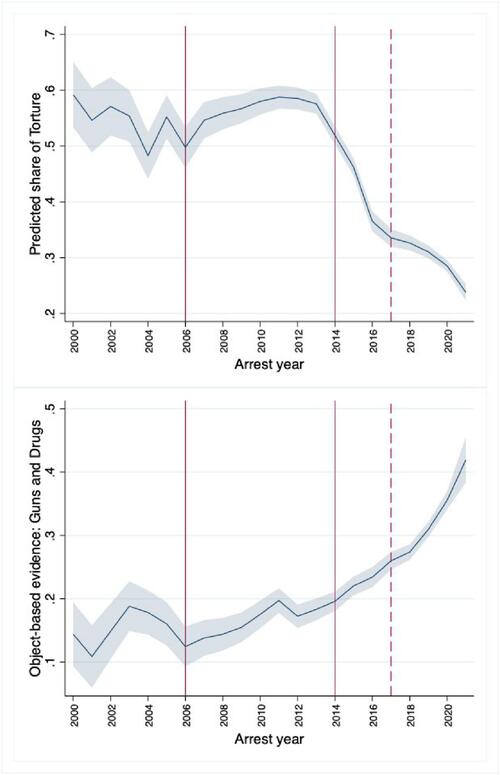
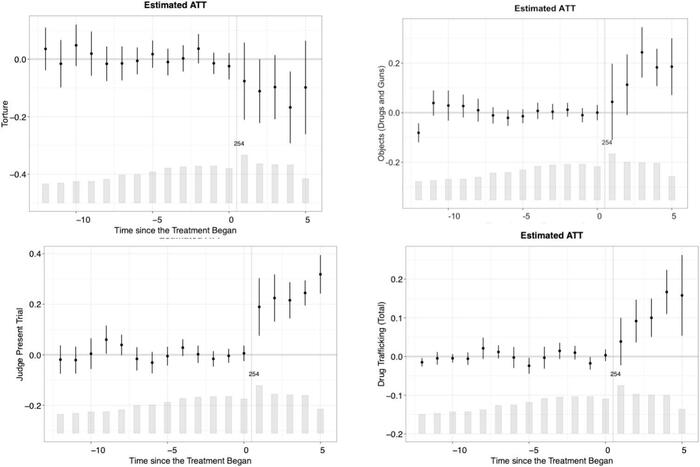
Magaloni and Salmón first draw on a 2021 survey of 60,000 prisoners conducted by Mexico’s National Institute of Statistics and Geography. The authors document (1) a substantial decline in reports of torture after 2014 (when many states and municipalities implemented the RoL reforms), (2) a rise in drug and weapons convictions by 2016 (likely the product of evidence fabrication), and (3) a decline in homicide convictions (because [a] homicide confessions could no longer be elicited through torture and [b] corpses are difficult to fabricate). These findings are largely borne out when the authors conduct their “difference in differences” analysis using the aforementioned geographical and temporal variation. As the authors show, declines in torture are likely driven by greater judicial oversight of cases, a key goal of the 2008 reforms.


Image
Fig. 1. Torture and objects (drugs and weapons).


Fig. 1. Torture and objects (drugs and weapons).


Image
Fig. 4. Event study plots with imputation estimator: torture, objects, judicial oversight, and drug trafficking.


Fig. 4. Event study plots with imputation estimator: torture, objects, judicial oversight, and drug trafficking.


To show that these quantitative findings have some basis in the beliefs of criminal justice actors, the authors conducted extensive fieldwork across Mexico. This included interviewing over 100 police officers and prosecutors, observing the activities of investigative agencies for 18 months, and following dozens of cases from arrest to hearing. This generated some remarkably honest reflections about how arrests are systematically based on false accusations and the planting of evidence on suspects. 

Interviews with police reveal a widespread belief that the RoL reforms profoundly disrupted their work. To be sure, some of these “disruptions” simply concern how police can no longer torture suspects. For example, “With arrests, we used to investigate, we could pressure them, get information. Now we are just transporters. We catch them and deliver them. That’s all” (p.10, italics added). 

Another important aspect of these changes concerns just how much time it takes to complete arrest paperwork to meet new legal requirements. This highlights officers’ limited capacity to perform since the reforms were implemented. Many reported simply not making arrests, while others bluntly admitted:

Before, we pressured the person. Now we pressure the paperwork…chain of custody has to be perfect. If it’s not, the judge will throw it out. So…[w]e fix it. Sometimes that means planting what’s missing, sometimes writing what didn’t happen (p.10). 


Meanwhile, some prosecutors expressed nostalgia for the days when their authority was less constrained and, for example, they could raid homes without warrants. Prosecutors spoke openly about the strains on police capacity and the corresponding need for fabricated evidence: “If the police officers really investigated properly, they could get the criminals for what they actually did. They’ve just been instructed to take them out of circulation no matter what” (p.12). 

Finally, the authors show that evidence fabrication is consistent with the strong desire for retribution held by ordinary Mexicans. There is a widespread perception that the new criminal justice system is too lenient, a source of impunity for criminals. Accordingly, cases that prosecutors deem especially likely to anger the public are classified as “relevant,” compelling prosecutors to resolve them at all costs, especially by encouraging officers to plant evidence. Prosecutors who don’t accept these cases may be demoted or fired. In sum, Magaloni and Salmón deepen our understanding of just how difficult it is to democratize in places where criminal justice systems are poorly resourced and where citizens demand a specific kind of retributive justice that often sidesteps individual rights.

*Brief prepared by Adam Fefer.
 

Hero Image
Evidence at the crime scene. Getty Images
All News button
1
Subtitle

CDDRL Research-in-Brief [4-minute read]

Date Label
Display Hero Image Wide (1320px)
No
Paragraphs

THE QUESTION

On 22 February 2026, Mexican security forces neutralized and killed Nemesio Oseguera Cervantes (El Mencho), founder and leader of the Cartel Jalisco Nueva Generación (CJNG). Within hours, more than 370 violent incidents erupted in 25 states: narco-blockades, arson attacks on OXXO stores and Bancos del Bienestar, and direct ambushes of Guardia Nacional units that killed at least 25 officers. Some observers compared the violence to a nationwide civil war insurgency. The data and its analysis tell a more qualified story.

WHAT THE DATA SHOWS

Using two independent georeferenced incident datasets — DataInt (251 records) and Aliado/Alephri (138 records), merged and deduplicated to 370 events — we mapped the timing, geography, and severity of every reported incident and asked whether the pattern looks like a coordinated national campaign or something else entirely.

All Publications button
1
Publication Type
Policy Briefs
Publication Date
Subtitle

What the CJNG Response to El Mencho's Death Reveals About Cartel Organisational Capacity

Authors
Alberto Díaz-Cayeros
Paragraphs

This paper examines how due process reforms enable evidence manipulation. During the past two decades, most Latin American countries have radically reformed their criminal justice systems, with the aim of strengthening rights protections and curbing abuses. Focusing on Mexico, we uncover a paradox of these institutional reforms: confronted with social pressures to punish crimes, police officers and prosecutors with limited investigation capacities fabricate criminal cases that pretend to conform with stricter judicial standards. Using difference-in-differences designs with a representative prison survey and ethnographic fieldwork among criminal prosecutors, we document a decline in torture and a parallel rise in convictions grounded in fabricated evidence, most commonly planted drugs and weapons. This shift toward what we call “fabricated justice” has fueled an increase in drug trafficking convictions. This recent increase in planted evidence suggests that when rule of law reforms are implemented without corresponding investments in state capacity, they can generate new and unexpected forms of abuse.

All Publications button
1
Publication Type
Journal Articles
Publication Date
Journal Publisher
World Development
Authors
Beatriz Magaloni
Number
March 2026, 107222
-
Venezuela Panel Event

The U.S. military operation known as Operation Absolute Resolve, which resulted in the capture and removal of Nicolás Maduro from Venezuela, represents a watershed moment in hemispheric politics. The operation, characterized by precision targeting, limited duration, and the absence of a formal occupation, has nonetheless created a profound political rupture inside Venezuela and raised far-reaching questions about sovereignty, legitimacy, governance, and democratic reconstruction.

This event convenes scholars and practitioners to examine what comes after such a military intervention, providing an analysis of post-extraction scenarios, drawing on comparative experience, Venezuelan political dynamics, and theories of post-authoritarian and post-conflict transitions.

The discussion does not seek to justify or condemn the intervention itself. Rather, it aims to assess the range of plausible futures now confronting Venezuela and the conditions under which the current rupture could lead to authoritarian rebalancing, prolonged disorder, or democratic recovery.

SPEAKERS:

  • María Ignacia Curiel
  • Héctor Fuentes
  • Dorothy Kronick
  • Harold Trinkunas
  • Diego A. Zambrano
     

MODERATOR: Alberto Díaz-Cayeros 

About the Speakers

Maria Curiel

Maria Ignacia Curiel

Research Scholar, CDDRL; Research Affiliate, Poverty, Violence, and Governance Lab
Link to bio

María Ignacia Curiel is a Research Scholar at the Center on Democracy, Development and the Rule of Law and Research Affiliate of the Poverty, Violence and Governance Lab at Stanford University. Curiel is an empirical political scientist using experimental, observational, and qualitative data to study questions of violence and democratic participation, peacebuilding, and representation.

Her research primarily explores political solutions to violent conflict and the electoral participation of parties with violent origins. This work includes an in-depth empirical study of Comunes, the Colombian political party formed by the former FARC guerrilla, as well as a broader analysis of rebel party behaviors across different contexts. More recently, her research has focused on democratic mobilization and the political representation of groups affected by violence in Colombia, Mexico, and Venezuela.

Hector Fuentes

Héctor Fuentes

Visiting Scholar, Center on Democracy, Development and the Rule of Law at the Freeman Spogli Institute for International Studies
Link to bio

Hector Fuentes is a Visiting Scholar at Stanford’s Center on Democracy, Development and the Rule of Law at Stanford University. His research focuses on Venezuelan elections, exploring the dynamics that led to this semi-competitive election, analyzing the strategic successes of the opposition, and identifying windows of opportunity for fostering a transition to democracy in Venezuela.

Dorothy_Kronick

Dorothy Kronick

Associate Professor of Public Policy, Goldman School of Public Policy at Berkeley
Link to bio

Dorothy Kronick is an Associate Professor of Public Policy at the Goldman School of Public Policy at Berkeley. She studies contemporary Latin American politics, focusing on Venezuelan politics and the politics of crime and policing. Her work has been published in the American Political Science Review, the Journal of Politics, Science, and Science Advances, among other outlets. Her commentary on Venezuelan politics has appeared in the New York Times and the Washington Post.

Harold Trinkunas

Harold Trinkunas

Deputy Director and a Senior Research Scholar at the Center for International Security and Cooperation at the Freeman Spogli Institute for International Studies
Link to bio

Harold Trinkunas is a Senior Research Scholar and the Deputy Director at the Center for International Security and Cooperation at the Freeman Spogli Institute for International Studies at Stanford University. His work has examined civil-military relations, ungoverned spaces, terrorist financing, emerging power dynamics, and global governance.

Diego Zambrano

Diego A. Zambrano

Associate Professor of Law, Stanford Law School & CDDRL Affiliated Faculty
Link to bio

Diego A. Zambrano is a Professor of Law and Associate Dean for Global Programs at Stanford Law School, specializing in the areas of civil litigation and comparative law. He is also the faculty director of the Neukom Center for the Rule of Law and Faculty Affiliate at the Center on Democracy, Development and Rule of Law at Stanford University. 

Alberto Díaz-Cayeros

Alberto Díaz-Cayeros

Senior Fellow, Freeman Spogli Institute (FSI), Affiliated faculty at the Center on Democracy, Development and the Rule of Law (CDDRL), Co-director, Democracy Action Lab (DAL)
Link to bio

Alberto Diaz-Cayeros joined the FSI faculty in 2013 after serving for five years as the director of the Center for US-Mexico studies at the University of California, San Diego. He earned his Ph.D at Duke University in 1997. He was an assistant professor of political science at Stanford from 2001-2008, before which he served as an assistant professor of political science at the University of California, Los Angeles. Diaz-Cayeros has also served as a researcher at Centro de Investigacion Para el Desarrollo, A.C. in Mexico from 1997-1999. His work has focused on federalism, poverty and violence in Latin America, and Mexico in particular. He has published widely in Spanish and English. His book Federalism, Fiscal Authority and Centralization in Latin America was published by Cambridge University Press in 2007 (reprinted 2016). His latest book (with Federico Estevez and Beatriz Magaloni) is: The Political Logic of Poverty Relief Electoral Strategies and Social Policy in Mexico. His work has primarily focused on federalism, poverty and economic reform in Latin America, and Mexico in particular, with more recent work addressing crime and violence, youth-at-risk, and police professionalization. He currently serves as the co-director of the Democracy Action Lab at the Center on Democracy, Development and the Rule of Law (CDRRL) at the Freeman Spogli Institute (FSI).

Alberto Díaz-Cayeros

William J. Perry Conference Room, Encina Hall 2nd Floor 

Virtual to Public. If prompted for a password, use: 123456
Only those with an active Stanford ID with access to the William J. Perry Conference Room in Encina Hall may attend in person.

Encina Hall, Suite 052
616 Jane Stanford Way
Stanford, CA 94305-6055

0
Research Scholar
Research Manager, Democracy Action Lab
Poverty, Violence, and Governance Lab Research Affiliate, 2024-25
CDDRL Postdoctoral Fellow, 2023-24
maria_curiel_2024.jpg

María Ignacia Curiel is a Research Scholar at the Center on Democracy, Development and the Rule of Law and Research Affiliate of the Poverty, Violence and Governance Lab at Stanford University. Curiel is an empirical political scientist using experimental, observational, and qualitative data to study questions of violence and democratic participation, peacebuilding, and representation.

Her research primarily explores political solutions to violent conflict and the electoral participation of parties with violent origins. This work includes an in-depth empirical study of Comunes, the Colombian political party formed by the former FARC guerrilla, as well as a broader analysis of rebel party behaviors across different contexts. More recently, her research has focused on democratic mobilization and the political representation of groups affected by violence in Colombia, Mexico, and Venezuela.

Curiel's work has been supported by the Folke Bernadotte Academy, the Institute for Humane Studies, and the APSA Centennial Center and is published in the Journal of Politics. She holds a Ph.D. in Political Science and dual B.A. degrees in Economics and Political Science from New York University.

Date Label
María Ignacia Curiel Research Scholar Research Manager Panelist Democracy Action Lab (DAL) and CDDRL, Freeman Spogli Institute for International Studies (FSI)
0
hector_fuentes.jpg

Héctor Fuentes is a Visiting Scholar at Stanford’s Center on Democracy, Development and the Rule of Law (2024-25). His research focuses on the critical juncture of the 2024 Venezuelan elections, exploring the dynamics that led to this semi-competitive election, analyzing the strategic successes of the opposition, and identifying windows of opportunity for fostering a transition to democracy in Venezuela. As the Director of EstadoLab, he has co-authored influential pieces on state fragility and democracy in Venezuela, as well as on state fragility across South America.

Héctor holds a Master of Global Affairs from Tsinghua University, where he was a Schwarzman Scholar, and a Master of Public Policy from the University of Oxford, supported by a Chevening Scholarship. His legal training was completed at the Central University of Venezuela, where he graduated as valedictorian. Throughout his career, Héctor has built extensive expertise in institutional capacity building, rule of law strengthening, and natural resource governance.

In addition to his research and academic work, Héctor has been actively involved in democracy promotion efforts in Venezuela. He co-founded EstadoLab, leading national campaigns that reached millions of young people and supported their participation in pro-democracy initiatives. He has also worked on various international projects aimed at rebuilding state capacity and promoting justice reform.

CDDRL Visiting Scholar, 2024-26
Fisher Family Summer Fellow, 2024
Date Label
Héctor Fuentes Visiting Scholar Panelist Freeman Spogli Institute for International Studies (FSI)
Dorothy Kronick Associate Professor of Public Policy Panelist Goldman School of Public Policy, U.C. Berkeley
Harold Trinkunas Senior Research Scholar & Deputy Director Panelist Center for International Security and Cooperation (CISAC) at the Freeman Spogli Institute for International Studies (FSI)

Room N346, Neukom Building
555 Nathan Abbott Way
Stanford, CA 94305

650.721.7681
0
Professor of Law, Stanford Law School
diego-zambrano-3-1024x684_square.jpg

Diego A. Zambrano’s primary research and teaching interests lie in the areas of civil procedure, transnational litigation, and judicial federalism. His work explores the civil litigation landscape: the institutions, norms, and incentives that influence litigant and judicial behavior. Professor Zambrano also has an interest in comparative constitutional law and legal developments related to Venezuela. He currently leads an innovative Stanford Policy Lab tracking “Global Judicial Reforms” and has served as an advisor to pro-democracy political parties in Venezuela. In 2021, Professor Zambrano received the Barbara Allen Babcock Award for Excellence in Teaching.

Professor Zambrano’s scholarship has appeared or is forthcoming at the Columbia Law Review, University of Chicago Law Review, Michigan Law Review, Northwestern University Law Review, Stanford Law Review, and Virginia Law Review, among other journals, and has been honored by the American Association of Law Schools (AALS) and the National Civil Justice Institute. Professor Zambrano will be a co-author of the leading casebook Civil Procedure: A Modern Approach (8th ed. 2024) (with Marcus, Pfander, and Redish). In addition, Professor Zambrano serves as the current chair of the Federal Courts Section of the AALS. He also writes about legal issues for broader public audiences, with his contributions appearing in the Wall Street Journal, BBC News, and Lawfare.

After graduating with honors from Harvard Law School in 2013, Professor Zambrano spent three years as an associate at Cleary Gottlieb in New York, focusing on transnational litigation and arbitration. Before joining Stanford Law School in 2018, Professor Zambrano was a Bigelow Teaching Fellow at the University of Chicago Law School.

CDDRL Affiliated Faculty
Date Label
Diego A. Zambrano Associate Professor of Law, CDDRL Affiliated Faculty Panelist Stanford Law School
Panel Discussions
Date Label
0
manuel_ortiz.jpeg

Manuel Ortiz Escámez has a long-standing career at the intersection of documentary photography, journalism, and social sciences, with a focus on human rights, democracy, and migration. He holds a B.A. in Sociology and an M.A. in Visual Arts with a specialization in documentary film from the National Autonomous University of Mexico (UNAM).

He is the founder and director of Peninsula 360 Press, a community media outlet based in San Mateo County, California. He previously served as Director of International News at Notimex (the Mexican State News Agency) and led the Multimedia Laboratory for Social Research at UNAM. He is the author of Visual Sociology: Photography and Documentary Video as Instruments for the Construction and Dissemination of Knowledge in the Social Sciences (UNAM, 2017). Ortiz also serves on the advisory board of POYLatam, the most recognized documentary photography and multimedia competition in Ibero-America.

He was the Director of Photography for the documentary "Cantadoras, Memory of Life and Death in Colombia" (2017), which received awards at international festivals in England, Nigeria, Chile, and Colombia. In 2021, he received the Prosser Award from the International Visual Sociology Association. His journalism has also been recognized with several awards, the most recent being the Media Innovation Award (2024), granted by Black Media and American Community Media.

His work has taken him to document migratory, democratic, and human rights processes in Brazil, Bolivia, Colombia, Cuba, Ecuador, El Salvador, France, Guatemala, Honduras, Japan, Lebanon, Mexico, Peru, Poland, Spain, the United States, and Ukraine.

Audio Visual Consultant, Democracy Action Lab
Date Label
Authors
News Type
Blogs
Date
Paragraphs

My archival research at Stanford University has focused on the legal and civil rights advocacy of key Mexican American leaders and institutions, including civil rights scholar Ernesto Galarza; voting rights attorney and co-author of the California Voting Rights Act Joaquin Avila; and the organizational records of the Mexican American Legal Defense and Educational Fund (MALDEF) and California Rural Legal Assistance, Inc. (CRLA). These legal organizations have played a critical role to advance the civil and voting rights of Latino communities, utilizing litigation as a strategic tool to secure equal protection under the law and promote equitable political representation through legislation. The collections offer extensive documentation of decades-long legal struggles and grassroots advocacy, illuminating both national and transnational dimensions of Latino American civil rights movements.

My research has also included conducting oral history interviews with prominent legal and civil rights leaders, such as General Counsel Thomas A. Saenz, current MALDEF President; José Padilla, former CRLA Executive Director; Ambassador Vilma Martinez, former General Counsel of MALDEF; and the only oral history ever conducted with the late Joaquin Avila, voting rights attorney and former General Counsel of MALDEF. These interviews, which are archived and publicly available through the Stanford Department of Special Collections and the Stanford Historical Society, offer invaluable firsthand accounts of the legal strategies, institutional histories, and personal commitments that have shaped Latino civil rights advocacy over the past several decades.

During the past 15 years of conducting research at Stanford, I have been consistently inspired by the dedication of lawyers and advocacy organizations working to improve the lives of marginalized communities. One formative moment occurred when I first encountered archival photographs from the 1950s of former braceros, legally contracted guestworkers. The Bracero Program was a binational labor agreement between the United States and Mexico that brought over two million braceros to the United States from 1942 to 1964. These images offered powerful visual narratives of migration, labor, and hope—stories reminiscent of iconic photographs of immigrants arriving at Ellis Island. However, these photographs pointed to a different but equally significant point of entry: The U.S.–Mexico border. This research solidified my commitment to public scholarship and the importance of making archival materials accessible to broader audiences.

Through my research in the Stanford Department of Special Collections and ongoing collaboration with the Stanford Program on International and Cross-Cultural Education (SPICE), as well as through teaching and public engagement, I have developed initiatives aimed at bridging the gap between academic research and public history. I founded the Bracero Legacy Project to share these important histories with wider audiences and have continued this work by designing ethnic studies curricula for school districts and organizing educational events that highlight the contributions and experiences of Latino communities in the United States.

This commitment to public history culminated most recently on June 10, 2025, when I co-organized, alongside Monterey County Supervisor Luis Alejo, a public commemoration marking the 50th anniversary of the banning of the short-handled hoe—a tool that had long symbolized exploitation in agricultural labor. Used for over a century by farmworkers of multiple ethnic backgrounds, the short-handled hoe required workers to remain stooped over for long periods at a time, leading to chronic injuries and long-term disability. Labor leader César Chávez himself suffered from debilitating back pain as a result of such work. The tool was officially banned on April 7, 1975, following the tireless advocacy of local farmworkers Sebastian Carmona and Hector De La Rosa, who, with legal representation from CRLA attorneys Marty Glick and Mo Jourdane, successfully brought the case before the California Supreme Court. The Mercury News opinion piece, [May 30, 2025], “Farmworker victory ending use of ‘El Cortito’ 50 years ago,” noted that the victory provided an “empowering lesson.”

The anniversary event brought together over 200 people and distinguished guests including Glick, Jourdane, and other CRLA alumni, as well as iconic figures such as labor and civil rights leader Dolores Huerta and playwright Luis Valdez, who spoke about the “long civil and labor rights movements.” I also invited the legendary music group Los Tigres del Norte, who hold a special cultural resonance in the Latino community. Their music shaped my immigrant upbringing, reflecting the complexities of navigating bicultural identity, bilingualism, and persistent anti-immigrant sentiment. Their songs—such as “La Jaula de Oro,” “Somos Más Americanos,” “Campesino,” and their tribute to César Chávez—articulate the lived experiences of immigrant communities and assert a counternarrative of dignity, resilience, and resistance in the face of marginalization.

Image
men in suits standing in a room


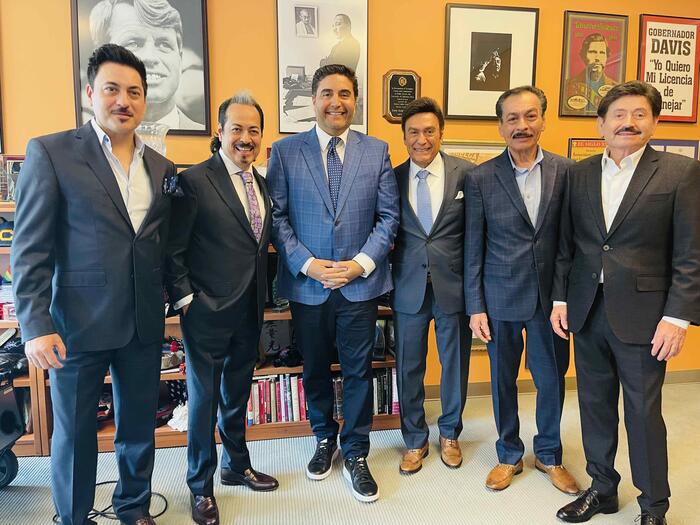
Jorge Hernández, co-founder of Los Tigres del Norte, has often spoken about the group’s first U.S. performance at Soledad Prison in 1968—the same year Johnny Cash played at Folsom State Prison. Since then, they have received multiple Grammy Awards, sold out Madison Square Garden, and, this past summer, were honored with a namesake street in Brooklyn. During the Monterey County event, Supervisor Alejo and the Board of Supervisors presented Los Tigres del Norte with a lifetime achievement award recognizing not only their musical legacy but also their decades-long advocacy on behalf of immigrant and Latino communities. Photo above: Dr. Ornelas (third from the left) pictured with Los Tigres del Norte band members (left to right) Luis Hernández, Hernan Hernández, Jorge Hernández, Eduardo Hernández, and Óscar Lara | photo credit: Pep Jimenez.

As part of our continued collaboration, I have invited Los Tigres del Norte to visit the Department of Special Collections at Stanford to study Ernesto Galarza’s personal papers and bracero correspondence. In particular, we will examine Galarza’s documentation of the 1963 “Tragedy at Chualar,” in which 32 braceros were killed in a devastating collision between a makeshift bus and a train. Galarza served as the principal investigator of the accident, and the archival record he left offers profound insights into the structural neglect and human cost of exploitative labor systems. Our hope is to draw from these materials to inspire a new song that honors the 32 bracero lives lost and continue to educate the public about this overlooked chapter in U.S. history.

This kind of scholarly interdisciplinary and community-based collaboration underscores the vital role of archives and public scholarship in shaping collective memory and advancing civil rights education. As I continue my work with SPICE and within the Stanford Department of Special Collections, I remain committed to collaborating with scholars across disciplines and transnationally to deepen public understanding of Latino American history and to ensure that these stories are not only preserved but heard.

To stay informed of SPICE news, join our email list and follow us on FacebookX, and Instagram.

Read More

person in blue suit with sunglasses receiving a certificate from a person in khaki jacket
Blogs

Historian Dr. Ignacio Ornelas Rodriguez Speaks at the Unveiling of the Bracero Legacy Mural in Chualar, California

The Bracero Program was a series of laws that allowed the United States to recruit temporary guest workers from Mexico.
Historian Dr. Ignacio Ornelas Rodriguez Speaks at the Unveiling of the Bracero Legacy Mural in Chualar, California
screenshot of Zoom meeting
Blogs

Local High School Students Connect with CISAC Security Experts—the Honorable Rose Gottemoeller, Professor Norman Naimark, Dr. Harold Trinkunas, and Visiting Research Scholar Xunchao Zhang—and former Secretary of Defense Leon Panetta

Students from San Jose and Salinas Valley—taught by Dr. Ignacio Ornelas Rodriguez—met on May 22, 2025 for the fourth annual International Security Symposium.
Local High School Students Connect with CISAC Security Experts—the Honorable Rose Gottemoeller, Professor Norman Naimark, Dr. Harold Trinkunas, and Visiting Research Scholar Xunchao Zhang—and former Secretary of Defense Leon Panetta
Hero Image
people and suits and dresses standing in a room
June 10, 2025: Los Tigres del Norte pictured with the Monterey County Board of Supervisors receiving a lifetime recognition from the Board for their decades of contributions advocating for immigrants. Honorary guests include playwright Luis Valdez (front row center in all black), civil rights leader Dolores Huerta (front row in blue suit), co-organizer Dr. Ornelas (back row with blue tie), and Monterey County Supervisor Luis Alejo (front row with white hat).
Photo Credit: Pep Jimenez
All News button
1
Subtitle

SPICE Curriculum Consultant Dr. Ignacio Ornelas Rodriguez shares his research into the legal and civil rights advocacy of key Mexican American leaders and institutions.

Date Label
-
DAL Mexico Launch

Join us in celebrating the launch of the Democracy Action Lab (DAL) at Stanford University.


The Center for International Studies at El Colegio de México and the Center on Democracy, Development and the Rule of Law (CDDRL) at Stanford University are pleased to host keynote lectures by:

  • Dr. Adam Przeworski, Professor Emeritus of Political Science, New York University
  • Dr. Beatriz Magaloni, Graham H. Stewart Professor of International Relations, Stanford University


The session will explore urgent questions at the heart of today’s global democratic challenges:

  • What have we learned — through political science and lived experience — about how democracies emerge, erode, and can be renewed?
  • What knowledge, strategies, and collective action are needed now to halt democratic backsliding and spark a new wave of democratization worldwide?


Open to the public. Especially geared toward those dedicated to strengthening democracy.


DAL Mexico Launch in Spanish

Únete a nosotros para celebrar el lanzamiento del Laboratorio de Acción en Democracia (LAD) de la Universidad de Stanford.


El Centro de Estudios Internacionales de El Colegio de México y el Center on Democracy, Development and the Rule of Law (CDDRL) de la Universidad de Stanford tienen el gusto de invitarlos a las conferencia magistrales a cargo de:

  • Dr. Adam Przeworski, Profesor Emérito de Ciencia Política, Universidad de Nueva York
  • Dra. Beatriz Magaloni, Profesora Graham H. Stewart de Relaciones Internacionales, Universidad de Stanford


El evento abordará preguntas urgentes sobre los desafíos democráticos globales actuales:

  • ¿Qué hemos aprendido —a través de la ciencia política y de la experiencia vivida— sobre cómo surgen, se erosionan y pueden renovarse las democracias?
  • ¿Qué conocimientos, estrategias y acciones colectivas se necesitan hoy para detener el retroceso democrático e impulsar una nueva ola de democratización en el mundo?


Evento abierto al público. Especialmente dirigido a quienes se dedican a fortalecer la democracia.

speakers / Ponentes

Adam Przeworski

Dr. Adam Przeworski

Carroll and Milton Professor Emeritus of Politics at New York University
Profesor Emérito Carroll and Milton de Ciencia Política en la Universidad de Nueva York
website / sito web

Adam Przeworski is the Carroll and Milton Professor Emeritus of Politics and (by courtesy) Economics at New York University. Previously, he taught at the University of Chicago, where he was the Martin A. Ryerson Distinguished Service Professor, and held visiting appointments in India, Chile, France, Germany, Spain, and Switzerland. He is a member of the US National Academy of Arts and Sciences. Among his numerous awards, in 2010, he received the Johan Skytte Prize for "raising the scientific standards regarding the analysis of the relations between democracy, capitalism, and economic development."  He has studied political regimes, democracy, autocracy, and their intermediate forms, as well as the conditions under which regimes survive and change, and their consequences for economic development and income equality. His focus is on the role of elections as a mechanism of managing societal conflicts. His current projects concern the phenomenon of "democratic backsliding" and the historical evolution of constitutional rules for electing chief executives.

Adam Przeworski es Profesor Emérito Carroll and Milton de Ciencia Política y (por cortesía) de Economía en la Universidad de Nueva York. Anteriormente, fue profesor en la Universidad de Chicago, donde ocupó la cátedra distinguida Martin A. Ryerson Distinguished Service Professor, y tuvo nombramientos visitantes en India, Chile, Francia, Alemania, España y Suiza. Es miembro de la Academia Nacional de Artes y Ciencias de Estados Unidos. Entre sus numerosos premios, en 2010 recibió el Premio Johan Skytte por "elevar los estándares científicos en el análisis de las relaciones entre democracia, capitalismo y desarrollo económico." Ha estudiado los regímenes políticos, la democracia, la autocracia y sus formas intermedias, las condiciones bajo las cuales los regímenes sobreviven y cambian, así como sus consecuencias para el desarrollo económico y la igualdad de ingresos. Su enfoque se centra en el papel de las elecciones como mecanismo para gestionar los conflictos sociales. Sus proyectos actuales se refieren al fenómeno del "retroceso democrático" y la evolución histórica de las normas constitucionales para la elección de jefes de ejecutivo.

Beatriz Magaloni

Dr. Beatriz Magaloni

Graham H. Stuart Professor of International Relations and Senior Fellow at the Freeman Spogli Institute for International Studies, Stanford University
Profesora Graham H. Stuart de Relaciones Internacionales y Senior Fellow en el Freeman Spogli Institute for International Studies, Universidad de Stanford
website / sito web

Beatriz Magaloni is the Graham H. Stuart Professor of International Relations at the Department of Political Science and a Senior Fellow at the Freeman Spogli Institute, where she holds affiliations with the Center on Democracy, Development and the Rule of Law (CDDRL) and the Center for International Security and Cooperation (CISAC). She leads the Poverty, Violence, and Governance Lab (PovGov) and co-directs the Democracy Action Lab. In 2023, she was awarded the Stockholm Prize in Criminology for her research on police violence and how it can be reduced, and in 2024, she received the Boris Mints Institute (BMI) Prize for her work on authoritarianism and its return as a global challenge. Her research focuses on the study of authoritarian regimes; violence, public security, and human rights; “non-state” forms of governance; distributive politics and the provision of public goods in Latin America.

Beatriz Magaloni es Profesora Graham Stuart de Relaciones Internacionales en el Departamento de Ciencia Política y Senior Fellow en el Freeman Spogli Institute, donde mantiene afiliaciones con el Centro sobre la Democracia, el Desarrollo y el Estado de Derecho (CDDRL) y el Centro para la Seguridad Internacional y la Cooperación (CISAC). Dirige el Laboratorio de Pobreza, Violencia y Gobernanza (PovGov) y co-dirige el Laboratorio de Acción en Democracia. En 2023 fue galardonada con el Premio de Estocolmo en Criminología por su investigación sobre la violencia policial y cómo puede reducirse, y en 2024 recibió el Premio del Instituto Boris Mints (BMI) por su trabajo sobre el autoritarismo y su retorno como desafío global. Su investigación se centra en el estudio de los regímenes autoritarios; la violencia, la seguridad pública y los derechos humanos; las formas de gobernanza "no estatales"; la política distributiva y la provisión de bienes públicos en América Latina.

Sala Alfonso Reyes del Colegio de México (Ver mapa)
Carretera Picacho Ajusco 20, Col. Ampliación Fuentes del Pedregal, C.P. 14110
Tlalpan, Ciudad de México
Tel.: +52 55 54493000

Adam Przeworski

Dept. of Political Science
Encina Hall, Room 436
Stanford University,
Stanford, CA

(650) 724-5949
0
Senior Fellow at the Freeman Spogli Institute for International Studies
Graham H. Stuart Professor of International Relations
Professor of Political Science
beatriz_magaloni_2024.jpg MA, PhD

Beatriz Magaloni Magaloni is the Graham Stuart Professor of International Relations at the Department of Political Science. Magaloni is also a Senior Fellow at the Freeman Spogli Institute, where she holds affiliations with the Center on Democracy, Development and the Rule of Law (CDDRL) and the Center for International Security and Cooperation (CISAC). She is also a Stanford’s King Center for Global Development faculty affiliate. Magaloni has taught at Stanford University for over two decades.

She leads the Poverty, Violence, and Governance Lab (Povgov). Founded by Magaloni in 2010, Povgov is one of Stanford University’s leading impact-driven knowledge production laboratories in the social sciences. Under her leadership, Povgov has innovated and advanced a host of cutting-edge research agendas to reduce violence and poverty and promote peace, security, and human rights.

Magaloni’s work has contributed to the study of authoritarian politics, poverty alleviation, indigenous governance, and, more recently, violence, crime, security institutions, and human rights. Her first book, Voting for Autocracy: Hegemonic Party Survival and its Demise in Mexico (Cambridge University Press, 2006) is widely recognized as a seminal study in the field of comparative politics. It received the 2007 Leon Epstein Award for the Best Book published in the previous two years in the area of political parties and organizations, as well as the Best Book Award from the American Political Science Association’s Comparative Democratization Section. Her second book The Politics of Poverty Relief: Strategies of Vote Buying and Social Policies in Mexico (with Alberto Diaz-Cayeros and Federico Estevez) (Cambridge University Press, 2016) explores how politics shapes poverty alleviation.

Magaloni’s work was published in leading journals, including the American Political Science Review, American Journal of Political Science, Criminology & Public Policy, World Development, Comparative Political Studies, Annual Review of Political Science, Cambridge Journal of Evidence-Based Policing, Latin American Research Review, and others.

Magaloni received wide international acclaim for identifying innovative solutions for salient societal problems through impact-driven research. In 2023, she was named winner of the world-renowned Stockholm Prize in Criminology, considered an equivalent of the Nobel Prize in the field of criminology. The award recognized her extensive research on crime, policing, and human rights in Mexico and Brazil. Magaloni’s research production in this area was also recognized by the American Political Science Association, which named her recipient of the 2021 Heinz I. Eulau Award for the best article published in the American Political Science Review, the leading journal in the discipline.

She received her Ph.D. in political science from Duke University and holds a law degree from the Instituto Tecnológico Autónomo de México.

Director, Poverty, Violence, and Governance Lab
Co-director, Democracy Action Lab
CV
Date Label
Beatriz Magaloni
Lectures
Date Label
Subscribe to Mexico