-
Event cover image

Israel's Declaration of Independence is its most important political text. It is, in fact, the only official text from Israel's founding moment that speaks to foundational subjects of statecraft: the nature of sovereignty, the relationship between religion and state, and the rights of citizens. This presentation will explore the history of drafting Israel's Declaration of Independence and the sometimes-clashing efforts of its multiple drafters to define Israel's character in 1948. It will pay special attention to the contribution of Israel's first prime minister, David Ben-Gurion, who fundamentally transformed the proposed text of Israel's Declaration, producing a quite different final version in the days before May 14, 1948. Finally, it will consider whether Israel's Declaration of Independence might serve as a text of "civil religion" for Israel today.

ABOUT THE SPEAKER:

Neil Rogachevsky is Assistant Professor in the Hamilton School, having previously taught at Yeshiva University. His research concerns Israeli political thought and history, comparative constitutionalism, and Jewish history.

With Dov Zigler, Rogachevsky is the co-author of Israel’s Declaration of Independence: The History and Political Theory of the Nation’s Founding Moment (Cambridge University Press, 2023), which won that year’s Concordia-Azrieli prize for Best Book in Israel Studies. He is currently at work on a new book on the political thought of David Ben-Gurion, which is slated to appear with Cambridge University Press in 2027.

Rogachevsky’s scholarship has also appeared or is forthcoming in Israel Studies Review, Shofar, The Israel Journal of Foreign Affairs, French History, and edited volumes on Michel Houellebecq’s political thought from Brill and diaspora politics in the United States from NYU Press. Rogachevsky also writes widely for general-interest and policy journals including the Wall Street Journal, Mosaic, Jewish Review of Books, The National Interest, The Jerusalem Post, Haaretz, First Things, and American Affairs.

Amichai Magen
Amichai Magen

Registration required. Virtual to Public. If prompted for a password, use: 123456.
Only those with an active Stanford ID with access to Encina Hall E409 (Goldman Conference Room) may attend in person. 

Neil Rogachevsky
Seminars
Israel Studies
News Feed Image
Neil Rogachevsky seminar (1).png
Image
Event cover image
Date Label
0
Academic Fellow - Law, Law & Business, Rock Center for Corporate Governance, Stanford Law School
4I4A9724.jpg

Dr. Meital Peleg Mizrachi is a Fellow at the Rock Center for Corporate Governance at Stanford Law School. She is an environmental policy scholar whose research examines the intersection of sustainability, public policy, consumer behavior, and global fashion systems. Her work explores how governments, businesses, and consumers shape environmental and social outcomes across global supply chains, with particular interests in sustainable fashion, textile waste, secondhand clothing markets, labor governance, and the circular economy. Her current research includes fieldwork in Ghana examining the governance and environmental consequences of the global secondhand clothing trade, as well as studies of sustainable consumption, fashion regulation, and behavioral responses to environmental policy.

Dr. Peleg Mizrachi serves on the Executive Committee of the Sustainable Fashion Consumption Research Network. Before joining Stanford, she was a postdoctoral fellow in the Department of Economics at Yale University and an Adjunct Professor at the University of Connecticut. Her research has been published in leading academic journals and featured in media outlets including Vogue, the BBC, and AP News. In 2021, she was named one of TheMarker magazine's "40 Under 40" for her work on fashion and the environment.

Date Label
-
Event cover image

On October 27, 2026, Israelis will vote in national elections widely seen as perhaps the most consequential in the country's modern history. Why do Israelis view the 2026 elections in such dramatic, even existential, terms? Who are the main contenders and what are the main issues on which Israel will vote in the first national elections since the October 7, 2023 attack and subsequent wars? And what are the possible scenarios for the outcome of the elections? Join Amichai Magen and Masua Sagiv in conversation about these questions.

ABOUT THE SPEAKER:

Dr. Masua Sagiv is a Senior Faculty member of the Shalom Hartman Institute and the academic advisor of its Center for Shared Society, as well as a senior fellow at the Helen Diller Institute, U.C. Berkeley. Masua’s work addresses the fundamental challenges facing both Israeli society and North American Jewish communities, from rising antisemitism and campus tensions to Jewish peoplehood and the complex relationship between Israel and world Jewry. Masua’s scholarly work focuses on the development of contemporary Judaism in Israel, as a culture, religion, nationality, and as part of Israel’s identity as a Jewish and democratic state. Her research explores the role of law, state actors, and civil society organizations in promoting social change across diverse issues: shared society, religion and gender, religion and state, and Jewish peoplehood.

Masua recently returned to Israel after four years in Berkeley, California, where she was a senior faculty member for the Shalom Hartman Institute of North America and the Koret Visiting Assistant Professor at the Helen Diller Institute at UC Berkeley. Prior to her tenure in the Bay Area, Masua was the Academic Director of the Menomadin Center for Jewish and Democratic Law at Bar-Ilan University and taught at the Schools of Law at Bar-Ilan University and Tel-Aviv University. She co-led a leadership program for high-school students, for which she received the Israeli Hope in Academia Prize from former Israeli President Reuven Rivlin, and was awarded the Gorney Prize for Young Scholar in Public Law. Her book, Radical Conservativism (in Hebrew), on the Halachic Feminist struggle in Israel, was published by Carmel Publishing House in 2024.

Amichai Magen
Amichai Magen

Registration required. Virtual to Public. If prompted for a password, use: 123456.
Only those with an active Stanford ID with access to Encina Hall E208 (Reuben Hills Conference Room) may attend in person. 

Masua Sagiv
Seminars
Israel Studies
News Feed Image
Masua Sagiv 2026 (2).png
Image
Event cover image
Date Label
Authors
News Type
News
Date
Paragraphs

Introduction and Contribution


A burgeoning literature considers the domestic causes and consequences of democratic backsliding for public perceptions of democracy but has yet to fully examine the role of international factors in explaining these perceptions. The effect of democratic backsliding in one

democracy on public support for democratic principles in other countries has, thus far, defied theoretical and empirical investigation. In “U.S. Democratic Backsliding and the Decline of Democratic Support Abroad,” Amnon Cavari, Amichai Magen, and Benjamin Yoel address this gap in knowledge. They propose and test a theory of the effects of backsliding on global opinion, in which information about democratic decline in one country can lead to diminished support for liberal democracy and increased support for authoritarian governance in another. To test this, they deployed an original survey experiment in Israel to examine the effect of two narratives about the 2020 U.S. elections — one signaling democratic decline and one signaling democratic resilience — on support for authoritarian governance. They found that respondents exposed to the narrative of U.S. democratic decline were more supportive of authoritarian governance than those exposed to the narrative of democratic resilience. Moreover, they find marginal evidence that the respondents’ ideological preferences condition the effect of narrative exposure. Cavari, Magen, and Yoel’s findings suggest that the democratic backsliding literature has insufficiently explored the global consequences of domestic events and processes for democratic decline worldwide.

[The authors] propose and test a theory of the effects of backsliding on global opinion, in which information about democratic decline in one country can lead to diminished support for liberal democracy and increased support for authoritarian governance in another.

Democratic erosion is both a supply- and demand-side phenomenon. On the supply side, leaders take anti-democratic actions, such as weakening checks on executive power, which they then justify to the public — on grounds of law and order, threats to the nation, and so on. On the demand side, varied types of social conflict, such as polarization or racial animus, can lead publics to endorse limits on democratic governance. 

Real-life models of democratic erosion have ‘diffused’ across borders. For example, strongmen in countries neighboring Russia, such as Alexander Lukashenko and Viktor Orbán, have borrowed from Vladimir Putin’s playbook of jailing opponents and using anti-Western rhetoric. It is less clear, however, whether authoritarian phenomena in one country can prompt changes in the beliefs of ordinary people in other countries.

In “U.S. Democratic Backsliding and the Decline of Democratic Support Abroad,” Amnon Cavari, Amichai Magen, and Benjamin Yoel present results from a survey experiment conducted among Israelis following the January 6 United States Capitol attack. They find that respondents who were randomly exposed to a narrative about US democracy eroding were significantly more supportive of autocracy in Israel. By contrast, those exposed to a narrative about the resilience of US democracy after January 6 were less supportive. These effects were most pronounced among conservative Israelis, perhaps unsurprising given the associations between right-wing ideologies and authoritarianism.

They find that respondents who were randomly exposed to a narrative about US democracy eroding were significantly more supportive of autocracy in Israel. By contrast, those exposed to a narrative about the resilience of US democracy after January 6 were less supportive.

Readers come away with a sense of the varied ways that democratic erosion can diffuse across borders, particularly at the micro level. That changes in American politics can affect the attitudes of Israelis over 6000 miles away suggests that autocrats can be highly effective in shaping the regime trajectories of their more immediate neighbors. This makes it all the more urgent to combat anti-democratic narratives before they take root and spread.

How Authoritarian Attitudes Diffuse


The authors make a straightforward claim: someone in country A who observes democratic norms or institutions being undermined in country B may well question the value of democracy for A. To see this, consider how Nayib Bukele’s campaign of mass imprisonment without due process in El Salvador has appealed to ordinary people across Latin America. In light of the social and economic problems facing democratic countries, unchecked strongmen — and their purported successes — have come to seem more credible and pragmatic. 

Democratic erosion in country B should be especially likely to affect the beliefs of people in A when (1) B is a close ally of, or is seen as powerful or influential for A, and (2) events in B are widely covered in A’s traditional or social media. For example, coverage of the United Kingdom’s “Brexit” was shown to influence how people in other European Union countries viewed integration or withdrawal. The authors further posit that democratic erosion will have a larger effect on support for autocracy among those who subscribe to right-wing ideologies — these prioritize social order and religious or racial purity, which can conflict with inclusive democracy. 

Backsliding in Israel and Ties to the United States


Israeli democracy has eroded in recent years, particularly as Benjamin Netanyahu’s Likud party has worked to undermine judicial independence and as discrimination against Arab and other ethnic minority Israelis persists. However, Israel’s backsliding also has strong demand-side components: majorities of those surveyed in 2023 agreed that a strong leader — one not limited by the legislature or judiciary — was necessary to solve Israel’s problems, that voting rights should be restricted among those unwilling to declare their loyalty to the state, and that international NGOs should be banned. The authors aim to show that these anti-democratic beliefs stem not only from elite rhetoric or national polarization, but from global backsliding. 

The United States is Israel’s closest ally, and the two countries share much in terms of political and social life. Both were founded by groups fleeing persecution, who established a political culture defined by pioneer settlement and the displacement of indigenous peoples. The US has consistently supported Israel’s wars and military operations in the Middle East. A large majority of Israelis view the US as an exemplar of democracy and freedom. This makes Israel an ideal case for measuring how global democratic erosion affects democratic sentiment at home. 

The Survey Experiment


The survey was fielded in March 2021, a time of acute political crisis in Israel: this marked the fourth election cycle in less than two years, and the prior two elections had resulted in parliamentary stalemates and short-lived governments. In the prior months, Israeli media had extensively covered Donald Trump’s efforts to overturn the 2020 elections and ensuing January 6 attack on the Capitol. 92% of survey participants reported following the US elections, and 43% reported doing so closely. A majority reported believing the US strongly influences Israeli politics.

Participants were randomly assigned to read one of two ‘vignettes’ about the 2020 elections. One emphasized that US democracy had faltered, as evidenced by Trump’s behavior and the Capitol attack. Another emphasized the resilience of US democracy, as evidenced by high turnout and the eventual transfer of power — this vignette did not mention January 6. The authors find that those who read the “US democracy faltering” vignette were significantly less likely to agree the US elections were free and fair. 

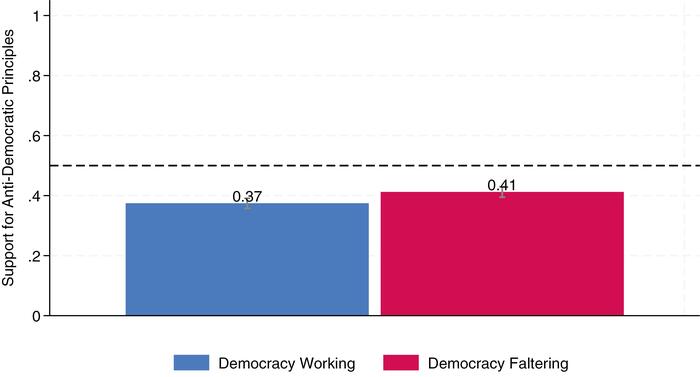
Finally, the authors measure their dependent variable — support for autocracy — in terms of support for restricting speech that is hostile to the government, the permissibility of rule by strongmen, and so on. The key finding is that Israelis exposed to the “US democracy faltering” narrative were significantly more supportive of autocracy.


Image
Figure 3. Support for Authoritative Governance, by Vignette.


Figure 3. Support for Authoritative Governance, by Vignette.


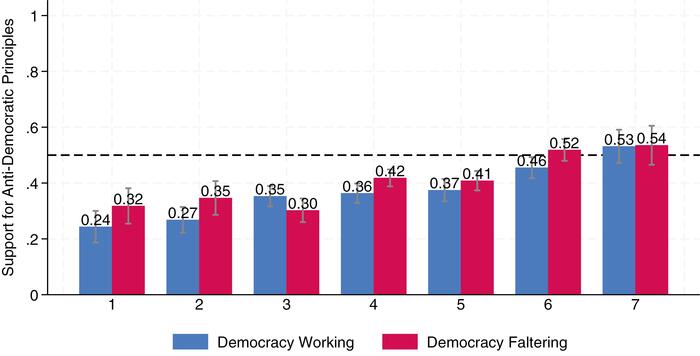
These effects were most pronounced among those on the political right, but the main finding holds even when statistically controlling for ideology. In all, the study demonstrates that when democratic erosion diffuses, it can shape not only elite behavior but mass attitudes as well.


Image
Figure 4. Effect of ideology on support for Authoritative Governance by Vignette.


Figure 4. Effect of ideology on support for Authoritative Governance by Vignette.


*Brief prepared by Adam Fefer.

Hero Image
Israeli and American flags flying in front of brick building in Jerusalem.
Shalev Cohen
All News button
1
Subtitle

CDDRL Research-in-Brief [5-minute read]

Date Label
Display Hero Image Wide (1320px)
No
Paragraphs

In late August 2021, United States President Joseph Biden hosted the newly elected Israeli Prime Minister, Naftali Bennet, at the White House for an official meeting. Shortly after, Israeli journalist Barak Ravid reported that Biden and Bennet ‘reaffirmed the strategic understandings’ between the two allies on Israel’s ‘alleged undeclared military nuclear program’, noting that this reaffirmation of policy has been repeated by every US President since Richard Nixon.1 As shall be explored below, this statement is mostly accurate, with the seemingly glaring exception of President George H.W. Bush. Upon its publication, Ravid’s story became the most recent in a long line of reports detailing this repeated commitment by US presidents to their Israeli counterparts.2

What role does this commitment play in Israel’s long history with the Nuclear Non-Proliferation Treaty (NPT)? The primary aim of this article is to answer this question by charting Israel’s relationship with the NPT and its decades-long fear of American coercion to join it. A secondary aim of this article is to provide a concise primer, or introduction, to this nuanced question for scholars and students alike, by reviewing the existing literature and adding insights from new archival sources to this growing body of work.

The paper proceeds in three parts. The first charts the emergence of Israel’s NPT policy and the technical-diplomatic road which led to the emergence of the policy in the late 1960s and the early 1970s. The second charts how this policy impacted Israel’s nuclear energy policy in the following decades, ultimately preventing it from pursuing its plan of launching a massive civilian nuclear infrastructure program, specifically nuclear power plants for electricity production. The third concludes with charting Israel’s NPT policy at the end of the Cold War. Research for this study was conducted in archives in the US, United Kingdom, Canada, and Israel, and taps both primary and secondary sources; Hebrew translations are by the author, unless otherwise noted.3

All Publications button
1
Publication Type
Journal Articles
Publication Date
Journal Publisher
Cold War History
Authors
Or (Ori) Rabinowitz
Authors
Aleeza Schoenberg Gelernt
News Type
News
Date
Paragraphs

On May 28, 2026, the Jan Koum Israel Studies Program (JKISP) at the Center on Democracy, Development and the Rule of Law hosted a seminar with Yossi Melman, a longtime intelligence and security correspondent for Haaretz and author of ten books on Israel's intelligence community, including the New York Times bestseller Every Spy a Prince. Amichai Magen, Director of JKISP, introduced the talk, and Or Rabinowitz, Visiting Fellow in Israel Studies, led the conversation. Melman said Israel's 2026 war plan against Iran included an attempt to install former president Mahmoud Ahmadinejad as a regime-change figurehead, an idea Mossad had cultivated for years through contacts made during his foreign travels. The plan collapsed when a strike meant only to kill Ahmadinejad's guards wounded him instead, a scheme Melman called "ludicrous," noting that Iranian intelligence already suspected Ahmadinejad of being compromised. He pointed to the assassination of Iran's supreme leader, Ali Khamenei, on the war's first day as an example of the tactical side of Israeli intelligence working exactly as it should. Turning that kind of precision into a lasting strategic outcome is the part Israel keeps failing at, Melman said.

Asked to connect this pattern to October 7th, Melman discussed the 1973 Yom Kippur War, when Egypt staged repeated military drills along the border before its real invasion and trained Israeli intelligence to expect nothing. Melman said the same pattern held in Gaza. Female spotters had warned for weeks about unusual activity along the border, but their commanders told them to report only what they saw, not what they thought it meant, and Hamas had activated and deactivated emergency communications twice in the weeks before the attack, so that when the real signal came, Israeli analysts dismissed it as another drill. Mossad, Shin Bet, and military intelligence were still arguing over who was responsible for Gaza nearly two decades after Israel's 2005 withdrawal, and Melman said that confusion over jurisdiction was part of the failure as well. Asked whether Israel deliberately strengthened Hamas to weaken the Palestinian Authority, Melman said yes, since Hamas, unlike the Palestinian Authority, will never be negotiated with, which made it a useful tool for a government that wanted to keep the Palestinians divided. The biggest threat facing Israel right now, Melman said, is not Iran, Gaza, or Hezbollah, but rather the country's own internal polarization.

Read More

Event cover photo
News

Beyond Gaza: How Regional Rivalries Are Reshaping the Israel–Hamas Conflict

Oded Ailam examines Hamas, Iran, and shifting Middle East alliances in an Israel Insights webinar hosted by the Jan Koum Israel Studies Program.
Beyond Gaza: How Regional Rivalries Are Reshaping the Israel–Hamas Conflict
Sima Shine and Raz Zimmt
News

Iran, Israel, and the Risk of Direct War

In a conversation with Or Rabinowitz, Sima Shine, Senior Researcher at the Institute for National Security Studies (INSS), and Rax Zimmt, Director of the Iran and the Shiite Axis research program at INSS, discussed escalation, regional actors, and regime change.
Iran, Israel, and the Risk of Direct War
Levitt and Magen
News

Matthew Levitt on the Middle East After the Iran War: Tactical Wins, Strategic Limits

Matthew Levitt unpacks proxy warfare, shifting narratives, and the uneasy future of U.S.–Israel relations in a conversation hosted by the Jan Koum Israel Studies Program.
Matthew Levitt on the Middle East After the Iran War: Tactical Wins, Strategic Limits
Hero Image
All News button
1
Subtitle

The veteran Haaretz intelligence correspondent argues that Israel's spy agencies keep winning the battle and losing the war, from a botched Iran regime-change plot to the warnings that went unheeded before October 7th.

Image
Yossi Melman Speaking
Date Label
Display Hero Image Wide (1320px)
No
Authors
Aleeza Schoenberg Gelernt
News Type
News
Date
Paragraphs

On May 26, 2026, the Jan Koum Israel Studies Program (JKISP) at the Center on Democracy, Development and the Rule of Law hosted a panel titled "Cross-Sectoral Mobilization in Defense of Democracy," part of a series on global democratic resistance organized in collaboration with the Ash Center for Democratic Governance at the Harvard Kennedy School; the Cornell Center on Global Democracy; Perry World House at the University of Pennsylvania; the Kellogg Institute for International Studies at the University of Notre Dame; the Democratic Futures Project at the University of Virginia; and the Carnegie Endowment for International Peace.

Amichai Magen, Director of JKISP, moderated alongside Ben Yoel, an incoming postdoctoral fellow at CDDRL for the 2026-27 academic year. They were joined by three founders of Israel's Protest Headquarters, the coordinating body behind the 2023 movement against the government's judicial overhaul: Yossi Kucik, former Director-General of Israel's Prime Minister's Office; Orni Petruschka, a former fighter pilot turned tech entrepreneur; and Advocate Dina Zilber, former Deputy Attorney General of Israel. Zilber said the crisis represented a shift “from policy conflict to regime conflict.” The government's plan would have let politicians pick judges and override Supreme Court rulings, among other changes, and Zilber said that went well beyond a normal reform. Kucik added that the Headquarters decided early on that its founders would act as enablers, not leaders. There were two hundred separate protest groups with their own methods and politics, he said, and no one person could have run all of them. The group adopted the Israeli flag and national anthem as symbols. They branded the government's plan a "judicial coup," and Kucik said they decided early on to stay nonviolent and to fight specific policies rather than try to topple the government outright.

Petruschka said funding came in approximately equal thirds from crowdfunding, Israeli philanthropists, and the Jewish diaspora. Zilber credited a volunteer network of 150 legal academics for writing up plain-language explanations of each proposed law as it came out, which provided “a nationwide civics lesson.” Petruschka said many protests around the world would benefit from the headquarters model. One concern for protest movements worldwide, according to Zilber, is the need to turn civic energy into political power, since voters choose parties, not protests. They also need a governing plan ready for the day after they win; Zilber pointed to Poland as a case where that did not occur. Kucik expressed concern that the Headquarters’s refraining from adopting an explicit goal to topple the government may have cost momentum. However, he noted the protests’ success; for example, an attempt to fire the defense minister over Haredi military conscription brought around a million people into the streets within minutes and pushed coalition partners towards near-defection, leading Netanyahu to draw back on his reforms. Petruschka said the movement's momentum was cut short by October 7th, redirected toward wartime relief, and has since folded into the campaign for Israel's coming elections.

Read More

Event cover photo
News

Beyond Gaza: How Regional Rivalries Are Reshaping the Israel–Hamas Conflict

Oded Ailam examines Hamas, Iran, and shifting Middle East alliances in an Israel Insights webinar hosted by the Jan Koum Israel Studies Program.
Beyond Gaza: How Regional Rivalries Are Reshaping the Israel–Hamas Conflict
Sima Shine and Raz Zimmt
News

Iran, Israel, and the Risk of Direct War

In a conversation with Or Rabinowitz, Sima Shine, Senior Researcher at the Institute for National Security Studies (INSS), and Rax Zimmt, Director of the Iran and the Shiite Axis research program at INSS, discussed escalation, regional actors, and regime change.
Iran, Israel, and the Risk of Direct War
Levitt and Magen
News

Matthew Levitt on the Middle East After the Iran War: Tactical Wins, Strategic Limits

Matthew Levitt unpacks proxy warfare, shifting narratives, and the uneasy future of U.S.–Israel relations in a conversation hosted by the Jan Koum Israel Studies Program.
Matthew Levitt on the Middle East After the Iran War: Tactical Wins, Strategic Limits
Hero Image
All News button
1
Subtitle

Three founders of the movement that halted Israel's 2023 judicial overhaul explain how they organized hundreds of thousands of protesters without a single leader.

Image
Image from Zoom
Date Label
Display Hero Image Wide (1320px)
No
Authors
Aleeza Schoenberg Gelernt
News Type
News
Date
Paragraphs

On May 21, 2026, the Jan Koum Israel Studies Program (JKISP) at the Center on Democracy, Development and the Rule of Law hosted Ambassador Daniel Shapiro for the latest installment of its Israel Insights webinar series. Ambassador Shapiro, a distinguished fellow with the Atlantic Council's Scowcroft Middle East Security Initiative and former U.S. Ambassador to Israel, joined Amichai Magen, Director of JKISP, and Or Rabinowitz, Visiting Fellow in Israel Studies. Ambassador Shapiro described the Trump administration as caught between three unappealing options on Iran's nuclear program: an ongoing stalemate over the closed Strait of Hormuz, military escalation that risks a global economic crisis, or a far weaker nuclear deal than Trump has demanded. He discussed similar issues of refusal to disarm obstructing negotiations in Lebanon, where Hezbollah's refusal to disarm blocks normalization despite new talks among ambassadors in Washington, and Gaza, where Hamas's refusal to disarm has stalled the transition to non-Hamas governance.

On U.S.-Israel relations, Ambassador Shapiro said Israel's standing in American public opinion is the lowest he recalls, primarily due to the toll of the Gaza war, but also due to the rightward drift of Netanyahu's coalition and Netanyahu's history of partisan relationships within U.S. politics. He outlined the difference between legitimate debate over the terms of U.S.-Israel security assistance and arguments that question Israel's existence as a state. Looking ahead to Israel's elections, expected between September and October, Ambassador Shapiro argued that rather than a pro- versus anti-Netanyahu split affecting the outcome, votes will be affected by public opinion on whether the government succeeded against Hamas, Hezbollah, and Iran; Israel's eroded international standing; and the ultra-Orthodox exemption from military service. Asked to close with his thoughts on Israeli-Saudi normalization, Ambassador Shapiro, drawing on his direct involvement in pre-October 7th talks and a return trip to Saudi Arabia in December, explained how the widening Saudi-UAE regional rift and the unresolved Iran war further complicate Riyadh's existing conditions for a deal.

Read More

Event cover photo
News

Beyond Gaza: How Regional Rivalries Are Reshaping the Israel–Hamas Conflict

Oded Ailam examines Hamas, Iran, and shifting Middle East alliances in an Israel Insights webinar hosted by the Jan Koum Israel Studies Program.
Beyond Gaza: How Regional Rivalries Are Reshaping the Israel–Hamas Conflict
Sima Shine and Raz Zimmt
News

Iran, Israel, and the Risk of Direct War

In a conversation with Or Rabinowitz, Sima Shine, Senior Researcher at the Institute for National Security Studies (INSS), and Rax Zimmt, Director of the Iran and the Shiite Axis research program at INSS, discussed escalation, regional actors, and regime change.
Iran, Israel, and the Risk of Direct War
Levitt and Magen
News

Matthew Levitt on the Middle East After the Iran War: Tactical Wins, Strategic Limits

Matthew Levitt unpacks proxy warfare, shifting narratives, and the uneasy future of U.S.–Israel relations in a conversation hosted by the Jan Koum Israel Studies Program.
Matthew Levitt on the Middle East After the Iran War: Tactical Wins, Strategic Limits
Hero Image
All News button
1
Subtitle

Former U.S. Ambassador to Israel argues that Lebanon, Gaza, and Iran all hinge on the same unresolved question, even as Israel's coming election turns on issues closer to home.

Image
Shapiro on Zoom
Date Label
Display Hero Image Wide (1320px)
No
Authors
Aleeza Schoenberg Gelernt
News Type
News
Date
Paragraphs

On April 16, 2026, the Jan Koum Israel Studies Program (JKISP) at the Center on Democracy, Development and the Rule of Law hosted political theorist Tomer Persico for the 20th installment of its Israel Insights webinar series. Persico, a Research Fellow at the Shalom Hartman Institute and Senior Research Scholar at UC Berkeley's Center for Middle Eastern Studies, joined Amichai Magen, Director of JKISP,  and Or Rabinowitz, Visiting Fellow in Israel Studies, to trace liberalism's surprising roots in Zionism's founding — including the once-overlooked fact that Menachem Begin's Herut party, not the ruling socialist left, was Israel's most consistent liberal force in its early decades — through its 1990s peak and into its present crisis. Persico argued that liberalism's troubles stem not from failure but from success: having become "the only game in town" after the Soviet collapse, it lost the ideological competitors that once distracted from its core weakness, namely that liberalism is an arrangement rather than a story, and cannot tell people who they are or where they belong. That vacuum, he said, is now filled by populism on the right and identitarian politics on the left, and in Israel, by religious fundamentalism.

Pressed by Magen on whether liberalism can defend itself against illiberal threats — from autonomy's corrosion of community to AI's challenge to human-centered politics — Persico argued that liberalism must be paired with complementary sources of meaning, such as tradition, religion, and nationalism, rather than trying to supply its own story. Turning to Israel's coming elections, he criticized Finance Minister Bezalel Smotrich and Minister of National Security Itamar Ben-Gvir, calling them fundamentalists pursuing a theocratic "halachic state," and argued the Likud has shifted from a liberal to a populist party under Prime Minister Benjamin Netanyahu since 2015. He said the liberal camp must reclaim patriotism and Judaism itself from the religious right, rather than cede both. "We can have authentic, real Judaism as secular people, or as liberal religious people," he said, warning that failing to do so risks producing "a Jewish Iran."

Read More

Event cover photo
News

Beyond Gaza: How Regional Rivalries Are Reshaping the Israel–Hamas Conflict

Oded Ailam examines Hamas, Iran, and shifting Middle East alliances in an Israel Insights webinar hosted by the Jan Koum Israel Studies Program.
Beyond Gaza: How Regional Rivalries Are Reshaping the Israel–Hamas Conflict
Alon Tal and Amichai Magen
News

Israel's Much Anticipated 2026 Elections: A Guide to the Perplexed

Alon Tal, a former member of the Knesset, discusses Israeli democracy and the upcoming elections with Amichai Magen, Director of the Jan Koum Israel Studies Program at CDDRL.
Israel's Much Anticipated 2026 Elections: A Guide to the Perplexed
Levitt and Magen
News

Matthew Levitt on the Middle East After the Iran War: Tactical Wins, Strategic Limits

Matthew Levitt unpacks proxy warfare, shifting narratives, and the uneasy future of U.S.–Israel relations in a conversation hosted by the Jan Koum Israel Studies Program.
Matthew Levitt on the Middle East After the Iran War: Tactical Wins, Strategic Limits
Hero Image
All News button
1
Subtitle

Political theorist Tomer Persico traces the surprising liberal roots of the Israeli right, and argues that liberalism's current crisis stems from its success, not its failure.

Image
Persico on Zoom
Date Label
Display Hero Image Wide (1320px)
No
-

Stanford affiliates are welcome to join the Freeman Spogli Institute for International Studies (FSI) for "Global Implications of the U.S. Midterm Elections," an examination of how the midterm election results are reverberating across the world.

FSI Director Colin Kahl will moderate a panel of leading institute scholars as they analyze the domestic and international impact of the 2026 midterms. The discussion will feature Jim Goldgeier on international perceptions of the election; Didi Kuo on domestic political rivalries; and Nate Persily on the integrity of electoral institutions.

Don't miss this timely conversation on American democracy and its global consequences as we assess what the midterm results mean for U.S. leadership and international order.

Drinks and hors d'oeuvres will be served following the panel discussion. 

Colin H. Kahl
Colin Kahl

Location available following valid registration

Encina Hall, C150
616 Jane Stanford Way
Stanford, CA 94305

0
Center Fellow, Freeman Spogli Institute for International Studies
didi_kuo_2026.jpg

Didi Kuo is a Center Fellow at the Freeman Spogli Institute for International Studies (FSI) at Stanford University. She is a scholar of comparative politics with a focus on democratization, parties, and institutions. She is the author of The Great Retreat: How Political Parties Should Behave and Why They Don’t (Oxford University Press) and Clientelism, Capitalism, and Democracy: the rise of programmatic politics in the United States and Britain (Cambridge University Press, 2018). She has published in academic and general outlets, and engages in scholarly efforts to understand and advance democratic reforms.

At Stanford, she has been part of research programs including the Program on American Democracy in Comparative Perspective, the Project on Global Populisms, and the Program on Capitalism and Democracy. She was an Eric and Wendy Schmidt Fellow at New America and was a non-resident fellow with the Carnegie Endowment for International Peace. She received a PhD from Harvard University, an MSc in Economic and Social History from Oxford University, where she studied as a Marshall Scholar, and a BA from Emory University.

Date Label
Didi Kuo
Stanford Law School Neukom Building, Room N230 Stanford, CA 94305
650-725-9875
0
James B. McClatchy Professor of Law at Stanford Law School
Senior Fellow, Freeman Spogli Institute
Professor, by courtesy, Political Science
Professor, by courtesy, Communication
headshot_3.jpg

Nathaniel Persily is the James B. McClatchy Professor of Law at Stanford Law School, with appointments in the departments of Political Science, Communication, and FSI.  Prior to joining Stanford, Professor Persily taught at Columbia and the University of Pennsylvania Law School, and as a visiting professor at Harvard, NYU, Princeton, the University of Amsterdam, and the University of Melbourne. Professor Persily’s scholarship and legal practice focus on American election law or what is sometimes called the “law of democracy,” which addresses issues such as voting rights, political parties, campaign finance, redistricting, and election administration. He has served as a special master or court-appointed expert to craft congressional or legislative districting plans for Georgia, Maryland, Connecticut, New York, North Carolina, and Pennsylvania.  He also served as the Senior Research Director for the Presidential Commission on Election Administration. In addition to dozens of articles (many of which have been cited by the Supreme Court) on the legal regulation of political parties, issues surrounding the census and redistricting process, voting rights, and campaign finance reform, Professor Persily is coauthor of the leading election law casebook, The Law of Democracy (Foundation Press, 5th ed., 2016), with Samuel Issacharoff, Pamela Karlan, and Richard Pildes. His current work, for which he has been honored as a Guggenheim Fellow, Andrew Carnegie Fellow, and a Fellow at the Center for Advanced Study in the Behavioral Sciences, examines the impact of changing technology on political communication, campaigns, and election administration.  He is codirector of the Stanford Program on Democracy and the Internet, and Social Science One, a project to make available to the world’s research community privacy-protected Facebook data to study the impact of social media on democracy.  He is also a member of the American Academy of Arts and Sciences, and a commissioner on the Kofi Annan Commission on Elections and Democracy in the Digital Age.  Along with Professor Charles Stewart III, he recently founded HealthyElections.Org (the Stanford-MIT Healthy Elections Project) which aims to support local election officials in taking the necessary steps during the COVID-19 pandemic to provide safe voting options for the 2020 election. He received a B.A. and M.A. in political science from Yale (1992); a J.D. from Stanford (1998) where he was President of the Stanford Law Review, and a Ph.D. in political science from U.C. Berkeley in 2002.   

CV
Date Label
Nate Persily
0
Research Affiliate, CDDRL
Research Affiliate, CISAC
rsd22_056_0268a.jpg PhD

James Goldgeier is a Research Affiliate at the Center for International Security and Cooperation and Professor Emeritus at the School of International Service at American University, where he served as Dean from 2011-17. From 2019-2025, he was a Visiting Fellow at the Brookings Institution. In 2018-19, he held the Library of Congress Chair in U.S.-Russia Relations at the John W. Kluge Center and was a visiting senior fellow at the Council on Foreign Relations. Prior to joining American University, he was a professor of political science and international affairs at George Washington University, where from 2001-05 he directed the Elliott School’s Institute for European, Russian, and Eurasian Studies. He also taught at Cornell University, and has held a number of public policy appointments and fellowships, including Director for Russian, Ukrainian, and Eurasian Affairs on the National Security Council Staff, Whitney Shepardson Senior Fellow at the Council on Foreign Relations, Henry A. Kissinger Chair at the Library of Congress, and Edward Teller National Fellow at the Hoover Institution.

Dr. Goldgeier has authored or edited six books, most recently Evaluating NATO Enlargement: From Cold War Victory to the Russia-Ukraine War (2023), co-edited with Joshua Shifrinson. He is the recipient of the Edgar S. Furniss book award in national and international security and co-recipient of the Georgetown University Lepgold Book Prize in international relations. Dr. Goldgeier is a senior adviser to the Bridging the Gap initiative, which promotes scholarly contributions to public debate and decision making on global challenges and U.S. foreign policy, and is co-editor of the Oxford University Press Bridging the Gap Book Series.

Dr. Goldgeier is past president of the Association of Professional Schools of International Affairs (2015-2017). He received his M.A. and PhD in Political Science from the University of California Berkeley and his A.B., magna cum laude in Government, from Harvard University.

Date Label
Jim Goldgeier
Panel Discussions
Date Label
Subscribe to Israel