Authors
News Type
News
Date
Paragraphs

Introduction and Contribution


Since coming to power in 2002, Recep Tayyip Erdoğan and his Justice and Development Party (AKP) have significantly undermined Turkish democracy. This has most visibly involved police repression, systematic prosecutions of the AKP’s critics, and partisan control and censorship of the media. Although opposition persisted in parliament, municipalities, campuses, and professional associations, the playing field is rigged against the AKP’s opponents.

Yet these visible forms of repression are only part of a broader process of Turkey’s autocratization. In “The Capture of Turkey’s Universities Under the AKP,” Ayça Alemdaroğlu shows how the regime has, through a host of less spectacular but durable mechanisms, used its control over higher education to turn universities into channels for distributing opportunity, disciplining dissent, and cultivating loyal staff and students. These mechanisms — including baseless investigations and dismissals of academics, online citizen reporting against faculty, and patronage around university jobs — have weakened academic life and transformed Turkish higher education into a key instrument of the AKP’s governing project.

Importantly, Turkey’s democratic erosion has accelerated in tandem with the massive, rapid growth in colleges and student enrollment. For Alemdaroğlu, this should temper any assumption that higher education is automatically a space of democratic resistance. Universities can produce critique, organization, and dissent, but the higher education system can also facilitate authoritarian consolidation through appointments, disciplinary procedures, funding, surveillance, and patronage. Comparable processes to subordinate universities have unfolded in India, China, and Russia. Instructors may publish or teach critical material while students may organize against the state, but autocrats can hedge against these risks by capturing the university system writ large. In the United States, where universities have become central to “culture wars,” Alemdaroğlu’s article serves as a cautionary tale about how quickly institutional autonomy can erode, especially in the absence of protections against executive encroachment.

Alemdaroğlu’s article serves as a cautionary tale about how quickly institutional autonomy can erode, especially in the absence of protections against executive encroachment.

The Growth of Turkish Higher Education


The AKP did not eviscerate higher education in one fell swoop but did so incrementally, building on the efforts of its predecessors. For example, after the 1980 coup d'état, Turkey’s military government centralized key aspects of university appointments, which the Erdoğan regime has expanded. In addition, the country’s 1980s neoliberal turn refashioned universities as instruments of profit and efficiency rather than spaces of academic freedom. Since the AKP attained power, higher education has grown at an unprecedented scale: there were 76 universities with 1.7 million enrolled students in 2002, compared to 206 universities and 8 million students in 2020. This has afforded the regime vast new terrain on which to exercise control.

Unsurprisingly, such rapid growth has increased quantity at the expense of quality. From a political standpoint, however, this is not especially costly for the AKP. For example, meager investments in research capacity have served to weaken the independence of academics and their ability to criticize the regime. Meanwhile, university hiring processes reflect the preferences of AKP loyalists, thus expanding the scope of co-optation. These are not unintended consequences but core features of a system geared toward patronage.

University expansion has helped the AKP widen its reach across social groups and economic sectors. Lucrative construction projects, public-sector jobs, faculty appointments and access to scarce resources have become channels through which the party awards supporters and cultivates loyalty.  In other words, higher education has served as a means of patronage, ideological inculcation and political control. The government framed expansion as a democratizing challenge to secular urban privilege and as part of a project to cultivate a more conservative, religiously grounded youth.

Waves of Capture


Alemdaroğlu periodizes the AKP’s higher education agenda into three waves that illustrate the shift from episodic intervention to routinized control. The first wave, which began soon after the AKP came to power, was not immediately visible to international observers as part of a broader authoritarian turn. Though it was clear to those targeted. For example, a 2005 penal code criminalized the “denigration of Turkishness,” which state prosecutors used to target faculty in literature and journalism, particularly those who had published on the Armenian genocide and the systematic mistreatment of Kurds.

By contrast, the second wave, beginning after the failed 2016 Turkish coup d'état attempt, was much more dramatic. The AKP government presented the coup attempt, which it attributed to the Gülen movement, as a national emergency requiring sweeping state action. Faculty and employees were dismissed and suspended en masse, while Gülen-affiliated universities were shuttered and had their assets frozen. In addition, investigations were conducted against those who signed a 2016 “Academics for Peace” document, which called for an end to state violence against Kurds. Turkey’s Constitutional Court found the investigations illegal in 2019, but by which time many academics had already lost their positions, passports, income, and professional standing.

The final, ongoing wave has “shifted toward a permanent institutional model, moving control and coercion into the everyday governance of the university.” Faculty are routinely disciplined for “verbally disrespectful speech” or conduct incompatible with “public morality and decency,” while AKP loyalists are appointed to senior academic posts by direct presidential decree. In addition, online citizen reporting through the state’s communication system has created another channel for targeting faculty. Although the rise from 130,000 applications in 2006 to 6 million in 2020 reflects the system as a whole, it shows how citizen complaints became part of everyday state monitoring, including at universities.

Ultimately, the Turkey case shows how democracy erodes through both dramatic ruptures and quiet, cumulative transformations. Alemdaroğlu emphasizes that the degraded condition of Turkish higher education does not merely reflect AKP’s autocratization but has actively enabled it.

*Brief prepared by Adam Fefer.

Hero Image
University lecture hall
Dom Fou
All News button
1
Subtitle

CDDRL Research-in-Brief [4-minute read]

Date Label
Display Hero Image Wide (1320px)
No
Authors
News Type
News
Date
Paragraphs

Introduction and Contribution:


Tax policy is an important means through which governments reward their (potential) supporters and disadvantage opponents. Adjusting tax rates, subsidies, or audit practices can affect which groups gain economic advantages and, in turn, political power. Yet these dynamics are not always transparent, especially in semi-democratic and authoritarian settings, where selective, ambiguous, and corrupt tax policies are common.

Observers of recent Turkish history have documented sophisticated efforts by Recep Tayyip Erdoğan and the Justice and Development Party (AKP) to deepen its authoritarian rule. These include staging politically motivated trials, spreading fake news, and surveilling its opponents. AKP has also used the tax system to empower or exclude select Turkish foundations (vakıfs). However, the scope of these tax practices, as well as the extent to which the AKP has departed from its predecessors, is unclear. Focusing on one or a few visible cases of regime-friendly vakıfs gaining tax advantages may ignore larger patterns.

In “Mechanisms of privilege,” Elise Massicard and Ayça Alemdaroğlu focus specifically on vakıfs that have received tax exemptions across Turkey’s modern history. Assembling an original dataset on over 300 such vakıfs between 1967 and 2022, the authors show that the AKP is not unique in terms of how it has used exemptions to achieve its political goals. However, and especially since Turkey became a presidential system in 2018, the process has become more centralized, nepotistic, and favorable towards Islamist-aligned vakıfs

Massicard and Alemdaroğlu draw our attention to the important role of tax exemptions in fostering regime support.

The reader comes away with a sense of policy continuity across Turkish regime changes, which are sometimes characterized as dramatic “ruptures.” More generally, Massicard and Alemdaroğlu draw our attention to the important role of tax exemptions in fostering regime support. National and subnational partnerships have considerably enriched Turkish vakıfs, empowering them to advance both secular and religious goals and to substitute for state provision in the face of neoliberal policy reforms. “Mechanisms of privilege” extends our understanding of a shadowy policy lever that has been widely criticized by both the European Union and the Turkish opposition. 

Tax Exemption in Modern Turkey:


Vakıfs have provided a range of services across Turkey, including education, healthcare, and infrastructure projects. A 1967 law stipulated that foundations could gain tax exemption so long as they allocated at least 80% of their income to services included in the state budget, underscoring the law’s clear political objectives. During the 1970s, exempted vakıfs followed state-led efforts at social and economic development. Beginning in the 1980s, neoliberal policies led to an increase in Islamist-aligned vakıfs, which aimed to offset growing inequality and a shrinking state. 

The Turkish government has, on multiple occasions, altered the legal landscape of exemptions to further its interests. For example, a 2003 law excluded human rights-focused vakıfs from exemption, as these were likely to challenge the new AKP government. After 2018, Turkey’s adoption of a presidential system placed exemptions under direct presidential control, and a 2021 law removed the Ministry of Finance from the exemption process. These centralizing measures have rendered tax-exempt vakıfs increasingly unaccountable. 

Only a few hundred foundations are approved for tax exemption (out of several thousand that apply), and these are rarely revoked. This situation contrasts with, e.g., the United States, where foundations are automatically exempted upon meeting clear legal requirements.

Data and Findings:


The authors’ database includes 331 exempted vakıfs since 1967, several of which subsequently lost their status. It also contains information on each foundation’s political orientation, which is drawn from news reports, website descriptions, and original interview data. Massicard and Alemdaroğlu use this data to describe the pace and politics of exemption: Is AKP a glaring outlier in modern Turkish history? And does it, in fact, restrict exemption to a narrow set of Islamist foundations? 

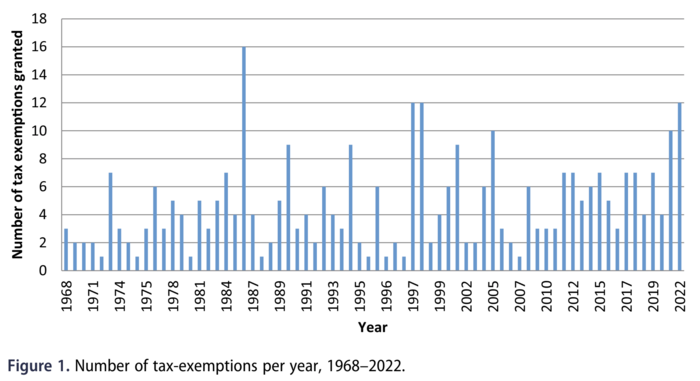
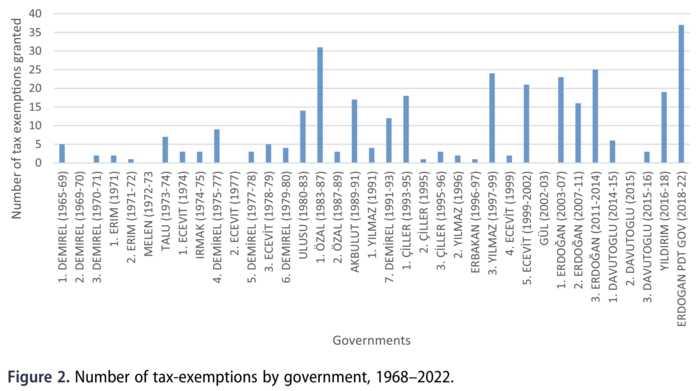
The data reveal that tax exemptions have continuously and gradually expanded over time. Governments have differed considerably from one another, but AKP — at least prior to the transition to a presidential system — has not uniformly granted more exemptions. In fact, AKP governments have importantly differed from one another in this respect. (These findings also hold when considering the duration of each government, given that shorter tenures tend to generate fewer exemptions.)


Image
Figure 1. Number of tax-exemptions per year, 1968–2022.


Image
Figure 2. Number of tax-exemptions by government, 1968–2022.


In terms of the politics of tax exemption, Massicard and Alemdaroğlu document a pattern of growing ambiguity and cronyism. For example, although foundations are legally required to be national in scope, strictly local vakıfs occasionally receive exemptions. Secular governments have tended to limit or reverse exemptions granted to Islamist-aligned foundations, and vice versa. One notable pattern under secular rule between 1997 and 2002 was growing exemptions to foundations representing the highly marginalized Alevi community, which Turkish Sunni leaders have tended to view as heretical. 

Interestingly, AKP’s first term in government was characterized by relatively broad exemptions, not solely to religious organizations. Since 2010, however, not only have Islamist vakıfs received an increasing number of exemptions. There is also a growing pattern of nepotism — foundations linked to Erdoğan’s family members receiving exemptions. 

Despite the growing centralization of exemption policy, AKP rivals at the subnational level have also used their power to undercut national priorities. For example, in 2019, the opposition-led Istanbul government canceled its agreements with AKP-aligned foundations. In sum, Massicard and Alemdaroğlu both deepen our understanding of five decades of Turkish politics and illustrate an overlooked item on the authoritarian “menu of manipulation.”

*Brief prepared by Adam Fefer.

Hero Image
Spread of Turkish Lira bills
Getty Images
All News button
1
Subtitle

CDDRL Research-in-Brief [3.5-minute read]

Date Label
Display Hero Image Wide (1320px)
No
Paragraphs

This paper explores the role of tax exemptions granted to foundations in Republican Turkey. We gathered original data of tax exemptions given to private foundations since 1967 to examine how this seemingly technical fiscal policy has functioned as a critical instrument of governance, facilitating coalition-building and co-optation of civil organizations. Our longitudinal analysis permits us to trace the continuity and evolution both at the level of the practice of tax exemption and the nature of the state’s privileged civil partners. It, therefore, provides a fresh lens to assess whether the AKP period marked a significant shift from previous periods or merely continued or amplified established patterns. Our historical and empirical investigation contributes to a more nuanced comprehension of the interplay between state mechanisms and non-public entities over time. These insights offer broader implications for understanding the mechanisms of state power and influence over civil society beyond the specifics of Turkey.

All Publications button
1
Publication Type
Journal Articles
Publication Date
Journal Publisher
Southeast European and Black Sea Studies
Authors
Ayça Alemdaroğlu
Authors
News Type
News
Date
Paragraphs

Introduction and Contribution


Recep Tayyip Erdoğan and his Justice and Development Party (AKP) continue to deepen their decades-long authoritarian control over Turkish politics, economy, and society. Indeed, repressive tactics once reserved for Turkey’s marginalized Kurdish community have increasingly been applied to AKP’s opponents more generally, including journalists, business elites, and mayors. Key among these opponents is Istanbul mayor Ekrem İmamoğlu, viewed as the face of the opposition Republican People’s Party (CHP). İmamoğlu, seen as the frontrunner to challenge Erdoğan’s presidency in 2028, was arrested in March 2025 on spurious charges of terrorism and corruption.

At the same time, Turkey’s opposition is finding ways to resist Erdoğan’s autocratization. CHP — which traces its roots to Mustafa Kemal Atatürk and his vision for a secular Turkish nation — learned from its disappointing loss in Turkey’s 2023 national elections. By transforming its electoral strategy for the 2024 local elections, the CHP not only bested AKP’s vote share but also won in many areas that are historically AKP strongholds, which are often populated by conservative voters. What explains the CHP’s significant local turnaround under the constraints of Turkey’s ‘electoral authoritarian’ regime? 

In “Turkey's Hard Road to Democratic Renewal,” Ayça Alemdaroğlu, Toygar Sinan Baykan, Ladin Bayurgil, and Aytuğ Şaşmaz caution against the received wisdom that broad, national-level coalitions offer the best hope of undermining authoritarian power. Such coalitions are difficult to sustain in countries like Turkey or Hungary, where authoritarian leaders control major political institutions and the public purse while muzzling their opponents and the media. Instead, the authors point to the surprising benefits of building alternatives to authoritarianism at the local level.

Argument


At first glance, the control of local governments in authoritarian political systems does not seem especially advantageous in terms of autonomy and influence. However, Turkish mayors control many of the policy domains that directly affect ordinary citizens, including transportation, sanitation, and housing. When local services and infrastructure are poor, voters may be willing to switch their partisan allegiance, even in places where the incumbent party works to distribute patronage and to propagandize them. Local governance enables opposition politicians to gain visibility and public support, as well as to demonstrate their administrative competence. 

How exactly did the CHP pull off its impressive local showing in 2024? As noted above, the opposition built a national-level coalition in 2023, fractured by ideological divisions and disputes over its presidential candidate against Erdoğan, ultimately collapsing after the election. It was no match for Erdoğan’s unified messaging around threats to Turkey’s national security — portraying Kurds at home and in Syria as threats — and on nationalist pride in Turkey’s indigenous defense industry.

In 2024, by contrast, the CHP’s campaign strategy emerged from the bottom up: it employed electoral strategists and pollsters across Turkish municipalities, conducted fieldwork in competitive areas, selected mayoral candidates who could win, created local coalitions across ideological lines, and fine-tuned its messaging around service provision. Its flexible and pragmatic strategy appealed to both Turkey’s Sunni majority as well as its minority Alevis and Kurds. Meanwhile, the AKP was highly centralized in its reliance on Erdoğan’s popularity, failing to adapt to the demands of local residents whose support it believed was guaranteed.


In 2024, the CHP's flexible and pragmatic strategy appealed to both Turkey’s Sunni majority as well as its minority Alevis and Kurds. Meanwhile, the AKP failed to adapt to the demands of local residents whose support it believed was guaranteed.


Unpacking the CHP’s Victory


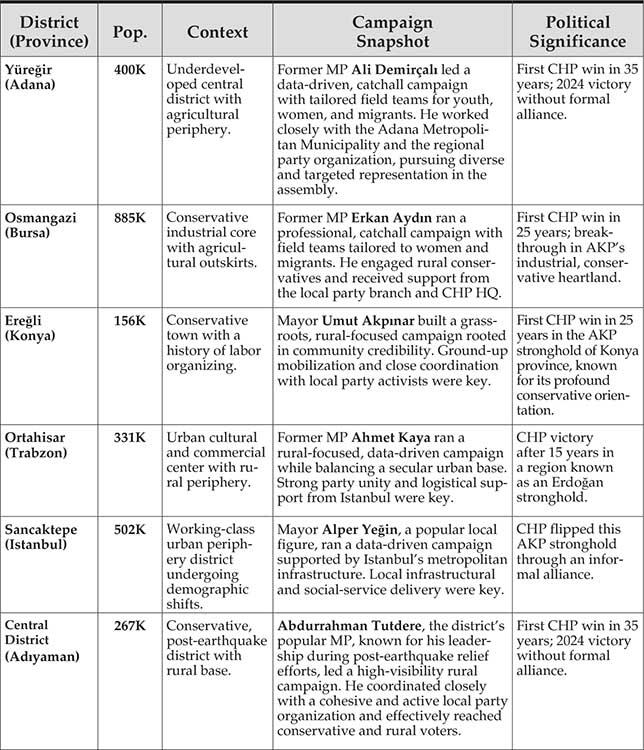
To understand how the CHP won and how it consolidated its electoral gains, the authors conducted interviews with newly elected mayors and vice mayors, CHP party officials, activists, journalists, and political observers. Interviewees were selected from six municipal districts where no opposition-controlled mayor had won an election for at least two decades and where the CHP improved its vote share by five or more points between 2019 and 2024. In these traditional AKP strongholds, voters complained a great deal about the high cost of living in Erdoğan’s Turkey. At the same time, they were becoming less religiously conservative and less supportive of a “majoritarian” style of politics.


Image
Table 1: Six Turkish districts in brief


Table 1: Six Turkish districts in brief


During the campaign, the CHP worked to reverse its image as a party committed to Atatürk’s “aggressive” secularism, sometimes nominating conservative Sunni candidates in otherwise divided districts. It focused not on ideology but on service delivery and other issues that appealed across ethnic and sectarian lines. Incumbent CHP mayors advised prospective mayors, creating intra-party relationships that were complemented by the work of CHP grassroots organizations. 

The authors introduce a number of the CHP’s successful mayoral candidates. Some of them were well-known national-level politicians who realized the benefits they could accrue by leaving Turkey’s toothless parliament and applying their skills to local government. Multiple mayors were of Kurdish and/or Alevi background, but they used these identities to appeal both inside and outside of their in-groups, for example, by attending Friday prayers with their Sunni constituents. One Alevi candidate gave municipal assembly list spots to conservative Sunnis and Kurds. By contrast, the AKP’s mayoral candidates — mainly nominated on the basis of their loyalty to Erdoğan — were perceived by their constituents as corrupt, aloof, and inefficient.

Challenges


Erdoğan’s opponents will likely struggle to reap the benefits of local governance, let alone to mount an effective challenge to AKP rule at the national level. These challenges will be heightened by AKP’s efforts to repress and arrest those whom it finds threatening. What’s more, CHP constituents expect not only the delivery of effective public services, but also patronage, especially public sector jobs, in exchange for their continued support. The AKP recognizes the challenge posed by its mayoral opponents and has responded by slashing municipal budgets. But the CHP is becoming more unified in the face of these common hardships posed by the AKP.

Ultimately, the growth of local-level CHP power opens up possibilities for democratic alternatives to AKP. The authors offer a novel perspective on how pragmatic local election campaigns, centered on service delivery, can serve as a means of undermining the influence of authoritarian leaders.

*Research-in-Brief prepared by Adam Fefer.

Hero Image
Protesters chant slogans during a protest march holding Turkish flags
Protesters chant slogans during a protest march in support of arrested Istanbul Mayor Ekrem Imamoglu on March 21, 2025 in Istanbul, Turkey. | Burak Kara/Getty Images
All News button
1
Subtitle

CDDRL Research-in-Brief [4-minute read]

Date Label
-
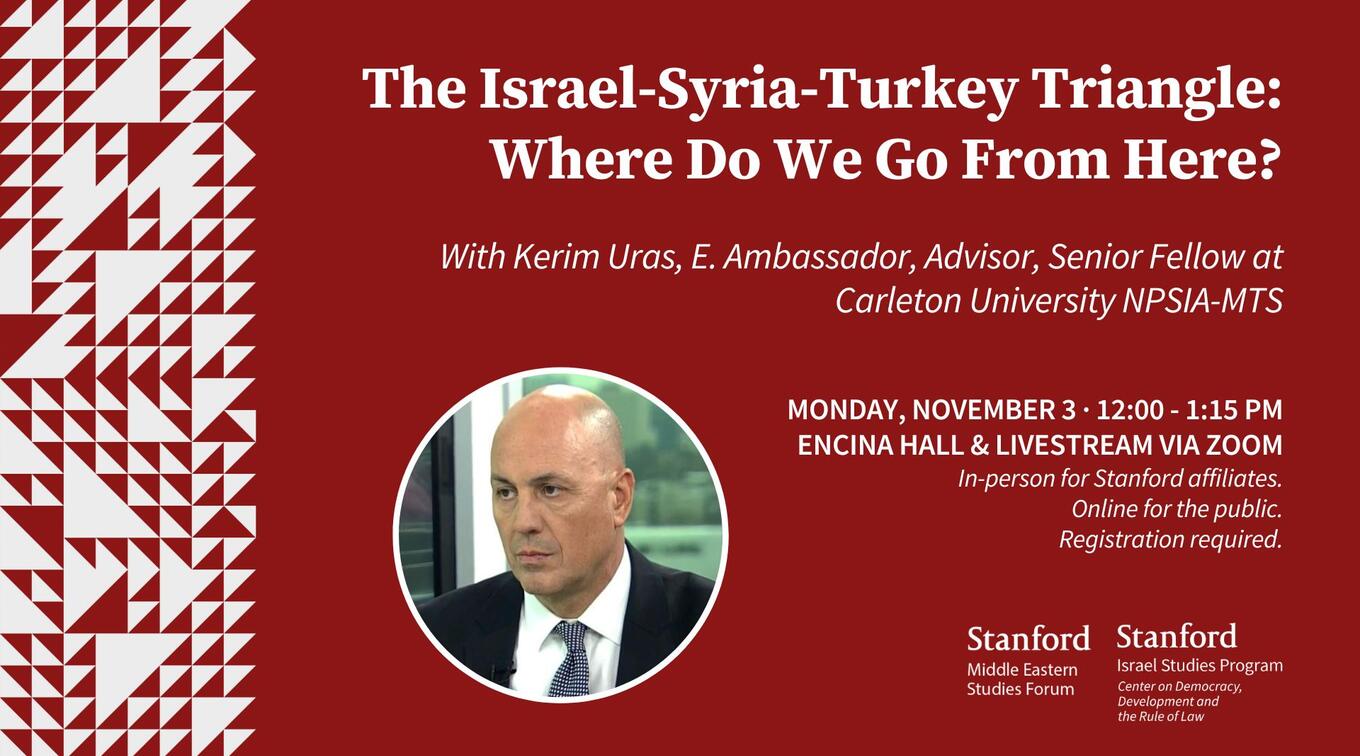
The Israel-Syria-Turkey Triangle: Where Do We Go From Here?

The Israel-Syria-Turkey triangle has long been shaped by a mix of historical grievances, shifting alliances, and pressing security concerns. Today, the region faces overlapping crises—from the Syrian conflict and its humanitarian toll, to Israel’s evolving regional posture, to Turkey’s delicate balancing between strategic interests and domestic imperatives. This seminar will examine the dynamics driving relations among the three states, focusing on how unresolved disputes intersect with new opportunities for dialogue and resolution. Particular attention will be given to the fault-lines, the influence of external powers, energy and water security, and the role of regional normalization efforts. The central question remains: can pragmatic cooperation overcome entrenched mistrust, or will the region remain locked in cycles of confrontation? The seminar will outline potential scenarios and policy pathways to navigate this volatile triangle toward greater stability.

ABOUT THE SPEAKER

Kerim Uras graduated from Ankara University, Political Science Faculty, International Relations Department in 1985 and completed his master's degree from Ankara University on Iraq and its Ethnic Structure in 1987. Starting his career in 1985 in the Cyprus Department of the Ministry of Foreign Affairs in Ankara, Uras carried out various diplomatic missions abroad, in Germany-Hannover, Cyprus, London, and New York UN, in addition to working at the Cyprus-Greece, Middle East, Europe, and NATO Departments in Capital. He served as Ambassador-designate to Israel while residing in Ankara (due to the Mavi Marmara incident) between 2010 and 2011. Kerim Uras served as Turkish Ambassador to Greece between 2011 and 2016. In Ankara, he served as Chief Foreign Policy Advisor to the Prime Minister of Türkiye and as a Member of the Foreign Policy Board from 2016 to 2018. He served as Turkish Ambassador to Canada between 2018 and 2023 and retired from the Ministry of Foreign Affairs. Kerim Uras has been working as Advisor to the Chairman at Çalık Holding and is Honorary Fellow at Carleton University, Ottawa, Canada, in NPSIA-MTS as of 2023. He is married with three children. 

Amichai Magen
Amichai Magen
Ali Yaycioglu

Registration required. Virtual to Public. If prompted for a password, use: 123456.
Only those with an active Stanford ID with access to Encina Hall C231 (William J. Perry Conference Room) may attend in person. 

Kerim Uras
Seminars
Israel Studies
Date Label
0
CDDRL Honors Student, 2025-26
zoya_fasihuddin.jpg

Major: Economics
Minor: Human Rights
Hometown: Karachi, Pakistan
Thesis Advisor: Mona Tajali

Tentative Thesis Title: From Dhabas to Mosques to Walls: A Cross Comparative Analysis of Women’s Campaigns for the Right to Public Spaces in Muslim-Majority Countries

Future aspirations post-Stanford: I’m interested in a variety of different fields, including policy research, strategy, law, and academia, and essentially want to work at the intersection of human rights, business, and international policy. Whether pursuing an MA in International Development or even doing a joint JD-MBA, I definitely want to keep learning and writing.

A fun fact about yourself: I went to 7 weddings this December!

Date Label
Subscribe to Turkey