
Authors
News Type
News
Date
Paragraphs

Introduction and Contribution:


Tax noncompliance — the withholding or underreporting of revenue from goods, services, and assets — may constitute as much as 30% of global GDP. Most people have no illusions about noncompliance: large majorities of Europeans believe that many or even most of their co-nationals cheat or “shirk” on paying taxes. Yet shirking deprives the state of crucial resources that fund the provision of public services, such as policing, education, or healthcare.

From a purely self-interested standpoint, tax cheating by some may well lead others to do the same, a cycle that can lead to the collapse of service provision. In “Filling the tax gap,” however, Simone Paci argues that this inference may be premature. It is true that individuals and businesses may not contribute to state provision efforts when others do not, yet this is not the only kind of provision. Instead, those who perceive tax cheating as prevalent can turn to nongovernmental organizations (NGOs) to fill the gap. These include religious organizations, human rights organizations, sports clubs, and many more.

Paci argues that those who donate to NGOs in the face of prevalent noncompliance can satisfy a range of interests. On the one hand, they may directly and materially benefit from donating, such as when police are more adequately funded, and security improves. On the other hand, donations can yield more indirect and symbolic benefits, such as when individuals see themselves as altruistic or bolster their status as community members. 

Marshalling a wide array of evidence, Paci shows that Slovaks exposed to information about tax cheating were more likely to donate to NGOs than those not exposed. This includes a natural experiment comparing Slovak municipalities in which the names of tax cheaters were released at different times, as well as a survey experiment in which online respondents receive similar information and donate accordingly.

The silver lining of these findings is that tax evasion needn’t spell the death of service provision. Paci challenges a key assumption in standard accounts of economic rationality, namely that free-riding begets free-riding. This may be true if we restrict our focus to the state, but not if we broaden it to all those entities that provide community services.

The silver lining of these findings is that tax evasion needn’t spell the death of service provision.

The Slovakia Experiments:


Paci collects data from Slovakia, a country where “name-and-shame” laws publicize information about taxpayers and businesses that have cheated on their value-added tax (VAT) obligations. In 2012 alone, Slovakia may have lost 40% of its VAT revenue due to tax noncompliance. Another significant aspect of Slovakia’s tax system is that individuals and firms can donate up to 2% of their income tax to local NGOs. In turn, the latter publishes data about their donation drives. Slovakia’s name-and-shame programs seem to have served some of their intended goals, as the noncompliance lists are well-known among Paci’s survey participants. 

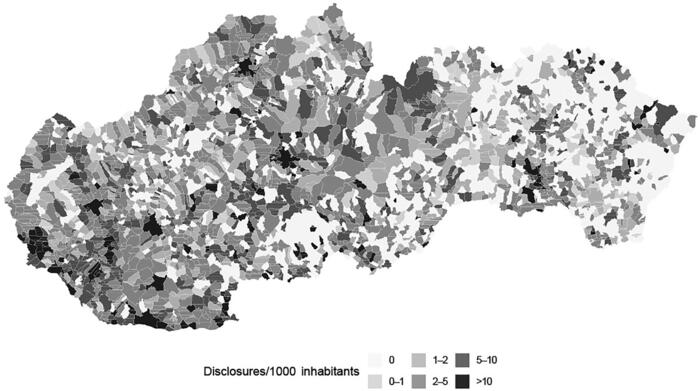
For experimental purposes, there are two important sources of variation as regards the name-and-shame data. First, it is not published in all municipalities. Second, some municipalities that do publish the data do so before the donation deadline. As Paci theorizes the connection between disclosures and donations, the natural experiment thus compares “treated” municipalities with “control” municipalities, whose disclosures were released after the deadline. The experiment’s validity depends on the assumption that name-and-shame data are released at random times, or rather by “nature.” This seems plausible in Slovakia.


Image
Figure 1: Noncompliance disclosures across Slovakian municipalities.


FIGURE 1: Noncompliance disclosures across Slovakian municipalities. Notes: The map visualizes the total number of unique firms involved in VAT noncompliance disclosures per 1,000 inhabitants between 2009 and 2021 for all Slovak municipalities, using the 2009 population.


The natural experiment supports Paci’s argument, as municipalities where disclosures are made prior to the donation deadline are 16% more likely to donate. This is not a small effect, corresponding to a difference of about 20,000 Euros. To reiterate, the intuition here is that pre-deadline disclosures provide critical information to taxpayers about how underfunded state-provided public services will be (due to noncompliance); this, in turn, motivates them to donate to nonstate providers.

Paci then fielded a survey experiment among over 2000 Slovakians online. This presented treated respondents with written “vignettes” that replicate the real-life disclosure lists. By contrast, control group respondents simply received an ordinary list of taxpayers. Afterwards, some respondents played a “dictator game” in which they could choose whether to donate Euros to NGOs. 

The results of these surveys provide additional evidence for Paci’s argument, as respondents exposed to information about noncompliance donated 10% more to NGOs than the control group. In terms of the motives underlying donations, Paci finds evidence for the importance of altruism and reputation. Regarding the former, those who believed their municipality was critically dependent on public services were more likely to donate. Reputation motives were important because survey respondents were less likely to donate if their contributions were kept anonymous.

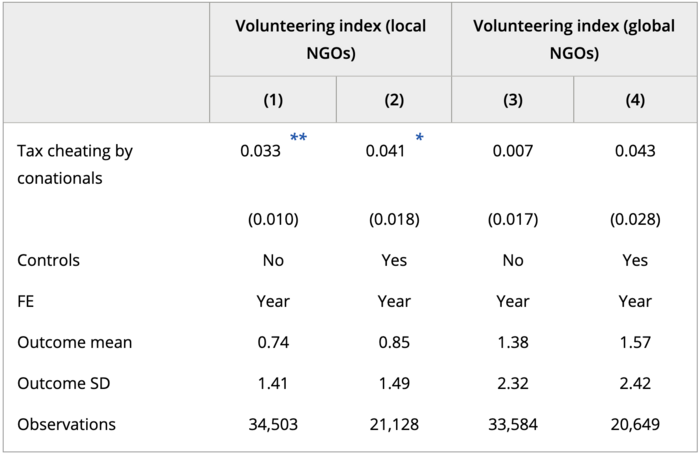
Finally, Paci presents evidence from Europe-wide value surveys conducted in 1999. These interviewed over 40,000 people from 33 countries. Consistent with the Slovakia-specific evidence, there is a strong correlation between respondents’ beliefs about perceived tax cheating and their propensity to volunteer for local NGOs.


Image
TABLE 7: Perceptions of tax cheating and volunteering.


TABLE 7: Perceptions of tax cheating and volunteering. Note: †p < .10; *p < .05; **p < .01.


In all, Paci’s findings caution against drawing simplistic and pessimistic conclusions about free-riding and taxation. Yet readers may wonder how much of a difference name-and-shame policies could really make. On one level, few countries have passed such laws, and few politicians will likely see name-and-shame legislation as a vehicle for advancing their careers. On another level, it is not clear that nonstate service provision can even come close to compensating for just how much the welfare state has retrenched across the Western democratic world. Voluntary donations, whether motivated by self- or other-centered concerns, simply cannot sustain the widening gaps in modern healthcare or mass education systems.

*Brief prepared by Adam Fefer.

Hero Image
A hand holding an iPhone in a yellow case displaying the iOS Calculator app with a black screen, orange operator buttons, and gray function buttons, resting over papers and documents on a dark desk.
Kelly Sikkema / Unsplash
All News button
1
Subtitle

CDDRL Research-in-Brief [4-minute read]

Date Label
Display Hero Image Wide (1320px)
No
Paragraphs

Do individuals contribute to public service provision when others in the community shirk on their taxes? The long-standing literature on conditional cooperation has widely documented a knock-on effect of freeriding. I argue that individuals may turn to civil society as an alternative way to fund public services. First, I leverage a natural experiment in Slovakia, based on the timing of a naming-and-shaming tax policy. Communities exposed to a public disclosure of noncompliance donate 16% more. Second, I replicate this via a survey experiment, showing an increase in charitable giving of 9% as well as eroding faith in the tax system. Highlighting the role of altruism, donations increase the most among respondents who believe their town relies on public services. In a conjoint, treated respondents also preferred public donations, suggesting an additional reputation mechanism. Finally, cross-country survey evidence bolsters external validity, showing a robust correlation between perceived tax cheating and local volunteering.

All Publications button
1
Publication Type
Journal Articles
Publication Date
Journal Publisher
American Journal of Political Science
Authors
Simone Paci
-

The Freeman Spogli Institute for International Studies (FSI) and the The Europe Center (TEC) are pleased to host President Zuzana Čaputová of the Slovak Republic for a fireside chat with Michael McFaul, director of FSI, with welcome remarks by Anna Grzymała-Busse, director of TEC. 

President Čaputová will speak about the impact Russia's war on Ukraine is having on Central European countries.


About President Zuzana Čaputová 


Elected on June 15, 2019, Slovak President Zuzana Čaputová is the first woman to hold the presidency as well as the youngest president in Slovakia's history. President Čaputová's political career began in 1996, after graduating from the Comenius University Faculty of Law in Bratislava. After her studies, Čaputová worked in the local government of Pezinok and then transitioned into the non-profit sector working at the Open Society Foundations. At the Open Society Foundations, she worked closely on the issue of abused and exploited children. In 2017, Čaputová joined the Progressive Slovakian political party and was elected as a Vice-Chairwoman for the party. She also served as the Deputy Chair until 2019, when she resigned to launch her presidential campaign.

In 2016, she was awarded the Goldman Environmental Prize for her work in addressing the toxic landfill in Pezinok. In addition, in 2020, Čaputová ranked #83 on the Forbes’ World's 100 Most Powerful Women list.

Michael A. McFaul
Michael McFaul
Anna Grzymała-Busse
Anna Grzymała-Busse
Zuzana Čaputová President of Slovakia
Lectures
-
Killing of a Journalist film still of roadside memorial for journalist Ján Kuciak and his fiancee, Martina Kušnírová.
"Killing of a Journalist" film-still of a roadside memorial for journalist Ján Kuciak and his fiancee, Martina Kušnírová.

Produced by The Organized Crime and Corruption Reporting Project (OCCRP) and Final Cut for Real, the documentary “The Killing of a Journalist” is about the 2018 murders of Slovak investigative journalist Ján Kuciak and his fiancee, Martina Kušnírová. Underlining the threats journalists face simply for doing their jobs, the killings were a shocking act of violence that directly threatened the EU’s founding principles of freedom of expression and the rule of law.

The film shows how the killings spurred mass protests and investigations in Slovakia that eventually brought down judges, police, and even a government.

Ján was a tenacious reporter and covered one of the most dangerous beats in journalism: the nexus between organized crime and politics. At the time of his death, he was working on a cross border investigation with journalist Pavla Holcová, who helped complete and publish Jan’s stories, including one that connected Slovak Prime Minister Robert Fico’s inner circle to the most powerful Italian mafia, the N’drangheta. The string of revelations would eventually lead to Fico’s resignation.

The film also shows how Pavla received the leaked police files of the Kuciak/Kusnirova murder investigation, containing 70 terabytes of data and evidence that implicated Slovakian oligarch Marián Kočner. That evidence also provided an inside look into the rot at the heart of the country’s judicial system, showing how Kočner secured influence via threats, bribery, and the blackmailing of public officials, sometimes by recording audio and video of meetings with them.

The screening will be followed by a discussion and Q&A with the film's executive producers, Drew Sullivan and Paul Radu, and award winning journalist and current Stanford JSK Fellow Pavla Holcová.

PANELIST BIOS

Drew Sullivan
Executive Producer, “The Killing of a Journalist”
Co-Founder and Publisher, The Organized Crime and Corruption Reporting Project (OCCRP)

Drew Sullivan is a social entrepreneur and co-founder and publisher of OCCRP. He founded the organization in 2007 with Paul Radu and served as editor-in-chief until March 2023. Under his direction, OCCRP has won numerous awards, including the Daniel Pearl Award, the Global Shining Light Award, the Tom Renner Award for Crime Reporting, the European Press Prize, and the Skoll Award for Social Entrepreneurship. Drew also created Reporters Shield, a membership program for media outlets and NGOs that helps defend investigative journalism against SLAPPs and other legal harassment.

Paul Radu
Executive Producer, “The Killing of a Journalist”
Co-Founder and Chief of Innovation, The Organized Crime and Corruption Reporting Project (OCCRP)

Paul Radu is Head of Innovation at OCCRP. He co-founded the organization in 2007 with Drew Sullivan and leads OCCRP’s major investigative projects, scopes regional expansion, and develops new strategies and technology to expose organized crime and corruption across borders.

Paul initiated and led the award-winning Russian, Azerbaijani, and Troika Laundromat investigations, and coined the term “laundromat” to define large scale, all-purpose financial fraud vehicles that are used to launder billions of dollars. He is a co-creator of Investigative Dashboard — a research desk that sifts through datasets to help journalists trace people, companies, and assets.

Paul is an Ashoka Global Fellow and has held a number of other fellowships, including the Knight International Journalism Fellowship with the International Center for Journalists as well as a 2009-2010 Stanford Knight Journalism Fellowship.

Pavla Holcová
Editor in chief, investigace.cz
Central Europe Editor, OCCRP

Pavla Holcová is an investigative journalist and founder of independent outlet investigace.cz in the Czech Republic. Pavla Holcová joined OCCRP in 2013 and is a regional editor for Central Europe. She has contributed to major cross-border projects such as the Panama Papers, the Russian and Azerbaijani Laundromats, the Pegasus Project, the Pandora Papers, and the Russian Asset Tracker. Holcová is a current JSK Fellow at Stanford and the winner of the ICFJ Knight International Journalism Award, the World Justice Project’s Anthony Lewis Prize Award, and the Allard Prize for International Integrity.

Film Screenings
-

*Please note the date has changed from September 23 to September 22*

A talk by Arnold Suppan, author of Hitler - Beneš - Tito: Conflict, War and Genocide in East Central and South East Europe. The monograph explores the development of the political, legal, economic, social, cultural and military “communities of conflict” within Austria-Hungary (especially in the Bohemian and South Slav lands); the convulsion of World War I and the Czech, Slovak and South Slav break with the Habsburg Monarchy; the difficult formation of successor states and the strong discussions at Paris 1919/20; the domestic and foreign policies of Czechoslovakia and Yugoslavia and the question of national minorities (Sudeten Germans, Magyars in Slovakia and the Vojvodina, Danube Swabians, Germans in Slovenia); Hitler’s destruction of the Versailles order; the Nazi policies of conquest and occupation in Bohemia, Moravia, Serbia, Bosnia-Herzegovina, and Slovenia; the genocide committed against the Jews in the Protectorate, Slovakia, the Ustaša-state and Serbia; the collaboration of the Tiso­- and Pavelić-regime with Nazi Germany; the retaliation against and expulsion of the Germans from Czechoslovakia and Yugoslavia; and finally the issue of history and memory east and west of the Iron Curtain as well as in the post-communist states at the end of the 20th century.

Sponsored by The Center for Russian, East European and Eurasian Studies and co-sponsored by The Europe Center and the Department of History.

Free and open to the public.


Pigott Hall (Building 260)
Room113

Arnold Suppan Professor of History University of Vienna
Lectures
-

This Arab Reform and Democracy research seminar will examine Lebanon’s failure to reform the electricity sector against the background of elaborate networks of client-patron relations, failing state institutions, and governance issues. It will explain how the electricity services have become a major element feeding Lebanon’s political and social fragmentation.

The electricity sector reform has featured as a major priority for several consecutive governments in Lebanon. Despite declared attempts at reform and legislative commitments, the state-run Electricité du Liban (EDL) still fails to ensure a reliable electricity supply, and has become a longstanding symbol of the profound political crisis affecting the Lebanese state and its institutions. The consequences of a failing sector and unreliable electricity supplies presents a number of impediments, the most important of which are those affecting Lebanon’s economic and social development and its regional integration. The failure to provide a systematic distribution of electricity also exacerbates inequalities along geographic, socio-economic and confessional lines.  During the summer of 2011, the electricity issue was brought to the public attention due to a major controversy in the current Lebanese government headed by Prime Minister Mikati. A last-minute deal prevented the government's fall and earmarked $1.2 billion of state financing to support some investments in infrastructure. However, practical implementation on the ground is still hindered by the patronage networks benefitting from the current status quo.

Katarina Uherova Hasbani is the Safadi Scholar of the Year at Stanford's Program on Arab Reform and Democracy, and is an energy policy expert focusing on MENA countries and their policies of energy diversification. She has worked for the European Commission, where she held several positions dealing with internal and external aspects of European Union’s energy policy, including the Cabinet of EU’s Energy Commissioner. Previously, she worked for Edelman and Cambridge Energy Research Associates, both consulting companies. She holds a master’s degree from the Institute of Political Studies (Sciences Po) in Paris, a master’s degree in international relations and diplomacy and a bachelor’s degree in finance from Matej Bel University in Slovakia. She is currently based in Beirut where she lectures at the American University for Science and Technology.

 Read more about Katarina’s appointment as a Safadi Scholar of the Year here.

Encina Ground Floor Conference Room

Katarina Uherova Hasbani Safadi Scholar of the Year at Stanford's Program on Arab Reform and Democracy Speaker
Seminars
News Type
News
Date
Paragraphs

To begin his talk, Archon Fung poses the following question: why is there no "killer" ICT platform in politics? After all, there are highly disruptive platforms in social media, commerce and other realms. These so-called "killer" platforms tend to be characterized by three features: notably that many users adopt the ICT platform and abandon the old way of doing something; the new platform improves users' experience by changing how they do some activity; and the organizations using new killer platforms displace those that do not use them.

Fung proceeds to present explanations for this puzzle, following a brief clarification of the scope of his question. When Fung refers to politics, he is not referring to aspects like partisan mobilization, e-government or the public sphere; instead, he examines the potential for ICT platforms in the realms of decision-making, problem solving and accountability. While the typical level of resolution for discussion is on the macro effects of ICT as a social force, Fung's analysis stems from his narrowing in on ICT platforms (such as Facebook, Wikipedia, Ushahidi, and others) themselves.

The first argument Fung presents in answer to his initial question is that both the suppliers and the demanders are different in politics than in other areas (e.g. commerce). Politics is aggregative, characterized by collective action and results, not focused on "individual benefits and gratification" like commerce and social interaction might be.

Second, while it is possible to have parallel, collaborative production in some types of platforms (e.g. Wikipedia), production in politics is characterized by strategic action. Various examples can help illustrate that there are key differences between commerce and politics on the supply side. In commerce, Amazon's customers want books and Amazon wants to sell books. While citizens want influence in the public sphere, however, politicians and officials typically do not want to give citizens power to influence the public sphere. Although there are counterexamples, as in some cities (such as Belo Horizonte) in Brazil, where 10% of the electorate directly influences public spending online through the Participatory Budgeting process, these cases are few and far between.

Another important factor is that there are much more ambiguous benefits in politics than in other spheres. While it is well understood that amassing more Facebook, Amazon or Google users will result in more money or fame, it is less well know what the benefits of more public deliberation or accountability might be. Since the factors that explain platform success in other areas don't translate to politics, Fung concludes, there is less innovation in the supply side.

In order to understand cases in which ICT platforms have nevertheless become important on the local level, Fung and his colleagues carried out a large case study analysis of specific examples from Brazil, Chile, Kenya, India, and Slovakia. Through analyzing these cases, which include such examples as São Paolo's Cidade Democrática, Santiago's Reclamos, Nairobi's Budget Tracking Tool and others, the researchers arrive at three key conclusions.

  1. ICT platforms that have had success within the realm of politics that Fung is interested in have been characterized by the predominance of professionals and organizations among their users. The main users of Cidade Democratica, for example, are organizations and professionals.
  2. Second, ICTs do not necessarily act independently. Instead, journalism and media play an important role, and even make up the main base of users for platforms like Bratislava's Fair Play Alliance and Mumbai Votes. After all, ICT can help journalists reduce research costs and represents a neutral and credible source.
  3. ICT's do not go around or undermine traditional NGOs and government. Instead, at least in the cases examined, they are typically effective because they operate through these existing organizations. Kiirti in Bangalore is one example.

The bottom line from Fung's case study analysis is that getting context right can be more important for an ICT platform's success than getting the technology right. Typically, the uptake of a platform only occurs once all other pieces are in place.

In the final part of his talk, Fung addressed audience questions, many of which related to Fung's chosen standards for a killer platform. One audience member asked why Facebook could not be considered a killer platform, given its many uses for political purposes. After all, Facebook enables a kind of action to occur that would have occurred before, since it can often be accessed even in countries where public gatherings may be restricted. Another questioned why Wikileaks was not considered a killer platform. Fung replied that while Wikileaks does bring together people and information better, a killer platform would need to transform the nature of politics from group to individuals, which no existing platform has yet achieved.


Hero Image
Archon
All News button
1
-

Information and communication technology platforms have transformed many aspects of modern life for many individuals around the world. They have revolutionized the realms of commerce, sociability, and even production. The realm of politics and governance, however, is more resistant to ICT revolutions. In this paper, we argue that there are fundamental dis-analogies between politics and these other realms that make the pace of innovation, and to the incidence of transformative ICT platforms, much lower. Instead of looking for "the next big thing," those who wish to understand the positive contribution of ICT to political problems such as public accountability and public deliberation should focus on incremental rather than revolutionary dynamics. We examine these incremental dynamics at work in six important ICT-enabled political accountability efforts from low and middle-income countries (Kenya, Brazil, Chile, India, Slovakia).

Archon Fung is the Ford Foundation Professor of Democracy and Citizenship at the Harvard Kennedy School. His research examines the impacts of civic participation, public deliberation, and transparency upon governance. His books include Full Disclosure: The Perils and Promise of Transparency (Cambridge University Press, with Mary Graham and David Weil) and Empowered Participation: Reinventing Urban Democracy (Princeton University Press). Current projects examine democratic reform initiatives in regulation, public accountability, urban planning, and public services. He has authored five books, three edited collections, and over fifty articles appearing in journals including American Political Science Review, Public Administration Review, Political Theory, Journal of Political Philosophy, Politics and Society, Governance, Journal of Policy and Management, Environmental Management, American Behavioral Scientist, International Journal of Urban and Regional Research, and Boston Review.

Wallenberg Theater

Archon Fung Ford Foundation Professor of Democracy & Citizenship Speaker Harvard Kennedy School
Seminars
Subscribe to Slovakia