Authors
News Type
News
Date
Paragraphs

The situation between the United States and Ukraine is complex. Three experts on Ukraine recently joined the World Class podcast to break down what you need to know. What happened on the July 25 phone call between President Donald Trump and Ukrainian President Volodymyr Zelensky? Who are Ukraine’s former prosecutors general and how have they impacted the current situation? And what really happened between former Vice President Joe Biden and Ukraine? We’ve got you covered.

On the Trump-Zelensky phone call:

“The majority of people in Ukraine were listening not to what the American president was saying, but what the Ukrainian president was replying. And frankly speaking, I think it was a very tough conversation for our president.” -Sasha Ustinova, Member of the Ukrainian Parliament

“If you look at the context of that July 25 phone call, there were two other things happening in the same time frame. First, about a week before [the call], President Trump had put about $391 million in military assistance on hold that had been authorized by Congress for Ukraine... The second thing is that President Trump had invited Zelensky to come to the United States back at the beginning of June, but they'd not yet set a date. Those are two big things for Zelensky, particularly at the beginning of his term in office.” - Steven Pifer, former U.S. ambassador to Ukraine (1998-2000), and William J. Perry Fellow at the Center for International Security and Cooperation

[Ready to dive deeper? Read Steven Pifer’s recent blog post for the Brookings Institution and Anna Grzymala-Busse’s “The Failure of Europe’s Mainstream Parties" in The Journal of Democracy]

On Ukraine’s former prosecutor general, Viktor Shokin:

“Shokin was clogging up the system such that corruption cases couldn’t go forward because they’d get stuck in a file in a drawer in his office. And so the sense was not only in the U.S. government, but also in the European Union and the International Monetary Fund, that Shokin had become a single point of failure. The notion of getting rid of Shokin didn’t emanate from Joe Biden.” -Colin Kahl, Joe Biden’s National Security Advisor from 2014-2017 and co-director of the Center for International Security and Cooperation

“Shokin was not trying to investigate corruption — he was trying to help a former corrupt state official, Mykola Zlochevsky, escape criminal prosecution. I was actually one of the people who organized demonstrations in front of the general prosecution office because everybody was so sick of Shokin, and so disappointed in him for helping former [corrupt] officials to get back into the country.” -Ustinova

The impact on both countries:

“I believe this is damaging to American diplomatic efforts with Ukraine because you have an embassy there that's trying to pursue American interests. We want Ukraine, for example, to help put pressure on Iran. We want Ukraine to do more on reform. And then you have Giuliani coming in with a very different agenda. Those two agendas are not consistent and send mixed signals to the Ukrainians.” -Pifer

“It's very much in the U.S. interest to advance anti-corruption efforts around the world because corruption is corrosive to stability and it's also something that our authoritarian adversaries exploit. It's definitely not in the U.S. national interests to use official offices to put pressure on foreign countries to investigate political opponents under the fig leaf of corruption. That's what the impeachment inquiry will decide, whether there was an abuse of power in this domain.” -Kahl

“Ukrainians know that Shokin and [former Ukrainian Prosecutor General Yuriy] Lutsenko are the bad guys in our country … And now we’re seeing that the United States president was misinformed in saying that [Shokin was doing a good job]. So of course it was disappointing, but I really hope that getting the facts out and the truth out will help people in both Ukraine and in the United States.” -Ustinova

[Sign up for our newsletter to receive stories like this directly to your inbox]

Hero Image
Donald Trump
President Donald Trump speaks on the phone in the Oval Office. Photo: Alex Wong - Getty Images.
All News button
1
-

Image
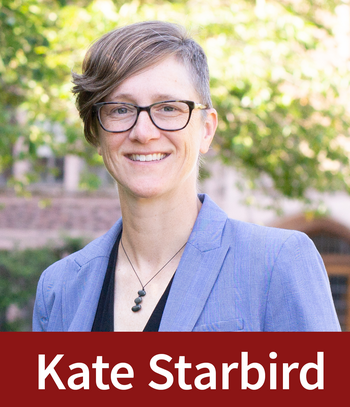
Kate Starbird
Abstract:

This talk describes the disinformation campaign targeting the Syria Civil Defense (or “White Helmets”), a humanitarian response group that works in rebel held areas of Syria. The White Helmets provide medical aid, search, and rescue to people affected by the civil war in Syria. They also document the impacts of atrocities — including airstrikes and chemical weapons attacks — perpetrated by the Syrian regime and their Russian allies. For several years, the White Helmets have been the target of a campaign to undermine and delegitimize their work. In this talk, I describe a multi-study research effort that reveals how this multi-dimensional, cross-platform campaign “works” — including a look at the media ecosystems that support the campaign, the networks of actors who collaborate to produce and spread its narratives (including government agents and “unwitting crowds” of online activists), and the “work” that these actors participate in, using the affordances of social media platforms to connect, recruit, organize, promote their messages, attack opposing messages, and otherwise advance the goals of their campaign. 

Kate Starbird Bio


Authors
News Type
News
Date
Paragraphs

Nearly 30 years after the fall of the Berlin Wall on November 9, 1989, historian Timothy Garton Ash spoke at the Freeman Spogli Institute for International Studies about the long-term consequences of the revolutions and transitions that followed the end of Communist rule in countries such as Poland, Hungary and the Czech Republic.

Garton Ash, a senior fellow at the Hoover Institution and professor at Oxford University, spoke first about the “mixture of reform and revolution” in Hungary, which culminated on June 16, 1989, with the ceremonial reburial of Hungarian politician Imre Nagy.

A young student named Viktor Orbán gave a now-famous speech at that event, which thrust him into the political spotlight after he demanded the withdrawal of Soviet troops from the country, Garton Ash said. Today, Orbán is Hungary’s prime minister.

“The most electrifying moment was the speech of Viktor Orbán, who was totally unknown at the time,” Garton Ash said. “The scene was a bright hope of liberalism and democracy. He gave an electrifying speech, I’ll never forget it.”
 

Many of the problems facing East Central European countries today stem from the difficulties that surrounded those countries’ transitions from communist states to democratic institutions, Garton Ash said. It’s not surprising that democratic institutions in those countries are more fragile than they are in Britain or in the U.S., he added, because they’ve only had 30 years to establish themselves.

“The joke at the beginning of the transition in early 1990 was, ‘We know you can turn an aquarium into fish soup — but the question is, can you turn fish soup back into an aquarium?’” Garton Ash said. “The revolutionary transformation of communism had liquidized the aquarium. It had destroyed the rule of law, and it had destroyed democratic institutions, independent courts, and independent civil society.”
 

One of the biggest problems in East Central Europe today is not immigration — it’s emigration, Garton Ash said. Since the fall of the Berlin Wall, nearly 2 million people out of a population of 17 million have left the former territory of East Germany, he said, and countries such as Latvia and Bulgaria have also seen staggering numbers of their citizens move elsewhere.

“Because of the freedom of movement granted by the European Union, there has been massive emigration of the most dynamic energetic younger people from these countries,” Garton Ash said. “But at the same time, populists win [East Central European] countries’ support by talking about the dangers of immigration as if these countries did not need immigration. There’s a kind of demographic panic in which the knowledge that the native population is being thinned out out under a very low birth rate is complemented by a paranoia.”
 

Hero Image
tga cropped
Timothy Garton Ash, a senior fellow at the Hoover Institution and professor at Oxford University, spoke at the Freeman Spogli Institute for International Studies about post-Communist East Central Europe on October 8, 2019. Photo: The Freeman Spogli Institute
All News button
1
News Type
News
Date
Paragraphs

The Freeman Spogli Institute for International Studies (FSI) at Stanford University is pleased to announce that Rose Gottemoeller has been appointed the next Frank E. and Arthur W. Payne Distinguished Lecturer. She will spend the next three years at Stanford working with FSI’s Center for International Security and Cooperation (CISAC) and will simultaneously be a Research Fellow at the Hoover Institution.

Gottemoeller was the Deputy Secretary General of NATO from 2016 to 2019, where she helped to drive forward NATO’s adaptation to new security challenges in Europe and in the fight against terrorism.  Prior to NATO, she served for nearly five years as the Under Secretary for Arms Control and International Security at the U.S. Department of State, advising the Secretary of State on arms control, nonproliferation and political-military affairs. While Assistant Secretary of State for Arms Control, Verification and Compliance in 2009 and 2010, she was the chief U.S. negotiator of the New Strategic Arms Reduction Treaty (New START) with the Russian Federation.

Prior to her government service, she was a senior associate with the Carnegie Endowment for International Peace, with joint appointments to the Nonproliferation and Russia programs. She served as the Director of the Carnegie Moscow Center from 2006 to 2008.

“I am thrilled that Rose Gottemoeller will be joining FSI next year,” said FSI Director Michael McFaul. “In addition to her most recent senior appointment at NATO, Rose is one of the most experienced arms control experts in the country. Our students and research community will have a truly unique opportunity to learn from this most talented American diplomat.“

George P. Shultz, former Secretary of State and the Thomas W. and Susan B. Ford Distinguished Fellow at the Hoover Institution, added, “As the highest-ranking civilian woman in NATO’s history, Rose has built a career of service promoting peace and security around the world and will provide expertise to some of the most relevant global policy issues facing the world today. We welcome the wealth of knowledge and real-world experience in foreign relations, diplomacy and international affairs she will bring to the Hoover Institution."

At Stanford, Gottemoeller will teach and mentor students in the Ford Dorsey Master’s in International Policy program and the CISAC Honors program; contribute to policy research and outreach activities; and convene workshops, seminars and other events relating to her areas of expertise, including nuclear security, Russian relations, the NATO alliance, EU cooperation and non-proliferation.

"Since CISAC's inception, the Center has focused much of its research and teaching on the causes of great power conflict and strategies to avoid nuclear war,” said Colin Kahl, Co-director of CISAC. “Few people in the world have as much practical experience — or enjoy more widespread respect — tackling these existential challenges as Rose Gottemoeller. We are thrilled to welcome her to the CISAC community."

The Payne Lectureship is named for Frank E. Payne and Arthur W. Payne, brothers who gained an appreciation for global problems through their international business operations. The Payne Distinguished Lecturer is chosen for his or her international reputation as a leader, with an emphasis on visionary thinking; a broad, practical grasp of a given field; and the capacity to clearly articulate an important perspective on the global community and its challenges. 

“For me, this is an exciting opportunity,” Gottemoeller said.  “I love teaching and mentoring students, and I am itching to get some writing done.  It’s an honor to have the chance to dive into this work as the Payne Distinguished Lecturer, with great colleagues at both FSI and the Hoover Institution.”

All News button
1
Authors
News Type
News
Date
Paragraphs

When Colin Kahl came on board as Vice President Joe Biden’s National Security Advisor in 2014, the situation in Ukraine was one of a few “crisis issues” that Biden and his staff were tasked with ameliorating by former President Barack Obama, Kahl told Freeman Spogli Institute for International Studies (FSI) Director Michael McFaul on the World Class podcast.

Less than a year after Ukraine’s Revolution of Dignity, the annexation of Crimea by Russia and the ousting of Ukrainian President Viktor Yanukovych, Biden and his team were focused on curbing corruption, helping Ukraine’s new leaders with the governance of the country and ensuring that the 2014 Minsk agreements were resolved, said Kahl, who is now co-director of the Center for International Security and Cooperation.


“A lot has been made of the corruption piece because of the impeachment inquiry and the false allegations against Biden, but [corruption] was really only one of three major baskets of activity that were going on,” said Kahl of the recent allegations against Biden, which suggest that he had asked the Ukrainian government to fire its former prosecutor general Viktor Shokin because Shokin had been investigating a Ukrainian company on which his son, Hunter Biden, sat on the board.

The real problem with Shokin, Kahl explained, stemmed from the fact that there were people working within Ukraine’s Prosecutor General’s office who wanted to investigate corruption cases, but they were unable to do so because Shokin was marginalizing those people and pushing them out of the office. As a result, no one of significance was prosecuted for corruption during Shokin’s tenure as prosecutor general, Kahl said.

[Get stories like this delivered to your inbox by signing up for FSI email alerts]

“Shokin was clogging up the system such that corruption cases couldn’t go forward because they’d get stuck in a file in a drawer in his office,” Kahl said. “And so the sense was not only in the U.S. government, but also in the European Union and the International Monetary Fund (IMF), that Shokin had become a single point of failure. The notion of getting rid of Shokin didn’t emanate from Biden.”

Biden, Kahl and others on Biden’s staff traveled to Kiev in December 2015 to discuss the conditions for securing a $1 billion loan guarantee from the U.S. and the IMF with former Ukrainian President Petro Poroshenko. Several of the conditions of the loan had to do with deterring corruption in the country, and one of those conditions was the reform of the Prosecutor General’s office, Kahl said. Biden asked Poroshenko to dismiss Shokin during that trip; three months later, Shokin resigned, and Ukraine ultimately received the $1 billion in financial assistance.

“This is not a ‘he’ story, it’s a ‘we’ story,” Kahl explained. “That is, the State Department was all in on this, the White House was all in on this, and so were the Europeans, the IMF and Ukrainian reformers. This isn’t a Biden story — this is a U.S. story.”
 

Hero Image
colin drell cropped
Colin Kahl speaks at an event hosted by the Center for International Security and Cooperation at Stanford University in 2018. Photo: Josh Edelsen.
All News button
1
Authors
Amy Zegart
News Type
Commentary
Date
Paragraphs

Smoking guns are the stuff of spy movies. In real-life intelligence-gathering, they are exceptionally rare. That’s why the business of intelligence typically requires collecting and analyzing fragments of information—putting together secret nuggets with unclassified information—to try to make sense of complex reality. If nothing else, the whistle-blower who filed a complaint against President Donald Trump clearly followed his or her training. SECOND PARAGRAPH I’ve spent 20 years reading intelligence reports and researching the U.S. intelligence community. And I’m not automatically inclined to believe the worst allegations about any administration; everyone has agendas and incentives to reveal information, some more noble than others. Trump and his allies have dismissed the complaint as hearsay and accused the whistle-blower of acting on political motives. But a close reading of the whistle-blower’s lengthy complaint, which accuses Trump of “using the power of his office to solicit interference from a foreign country in the 2020 U.S. election,” yields a lot of concrete leads for investigators to follow.

Here are three things I learned:


Read the rest at The Atlantic

Hero Image
lead 720 405
All News button
1
Paragraphs

The Cold War division of Europe was not inevitable―the acclaimed author of Stalin’s Genocides shows how postwar Europeans fought to determine their own destinies.

Was the division of Europe after World War II inevitable? In this powerful reassessment of the postwar order in Europe, Norman Naimark suggests that Joseph Stalin was far more open to a settlement on the continent than we have thought. Through revealing case studies from Poland and Yugoslavia to Denmark and Albania, Naimark recasts the early Cold War by focusing on Europeans’ fight to determine their future.

As nations devastated by war began rebuilding, Soviet intentions loomed large. Stalin’s armies controlled most of the eastern half of the continent, and in France and Italy, communist parties were serious political forces. Yet Naimark reveals a surprisingly flexible Stalin, who initially had no intention of dividing Europe. During a window of opportunity from 1945 to 1948, leaders across the political spectrum, including Juho Kusti Paasikivi of Finland, Wladyslaw Gomulka of Poland, and Karl Renner of Austria, pushed back against outside pressures. For some, this meant struggling against Soviet dominance. For others, it meant enlisting the Americans to support their aims.

The first frost of Cold War could be felt in the tense patrolling of zones of occupation in Germany, but not until 1948, with the coup in Czechoslovakia and the Berlin Blockade, did the familiar polarization set in. The split did not become irreversible until the formal division of Germany and establishment of NATO in 1949. In illuminating how European leaders deftly managed national interests in the face of dominating powers, Stalin and the Fate of Europe reveals the real potential of an alternative trajectory for the continent.

Wall Street Journal Review

All Publications button
1
Publication Type
Books
Publication Date
Journal Publisher
Belknap/Harvard
Authors
Norman M. Naimark
Authors
News Type
News
Date
Paragraphs

As details about the July 25 phone call between U.S. President Donald Trump and Ukrainian President Volodymyr Zelensky continue to emerge, Oleksandra “Sasha” Ustinova — a member of the Ukrainian parliament who has been fighting corruption in the country for years — said that Ukrainians are reacting to the news differently than Americans are.

For one thing, Ukrainians are paying less attention to what Trump said and more attention to Zelensky’s side of the phone call, Ustinova told Freeman Spogli Institute for International Studies (FSI) Director Michael McFaul on the World Class podcast.


While many Ukrainians acknowledge that the newly-elected Zelensky was in a tough position going into his first conversation with the president of the United States on July 25, many were disappointed to learn that Zelensky promised Trump that the next prosecutor general of Ukraine would be “100 percent my person, my candidate,” especially given the country’s recent controversies surrounding the past two men to serve in that position.

“That is not acceptable,” Ustinova said. “The prosecutor general should be independent. We have already seen many corrupt prosecutor generals.”

Take Viktor Shokin for example, who served as the prosecutor general of Ukraine from 2015 to 2016, explained Ustinova. He is being described by some Americans as an honest man who was forced out of office in part by former Vice President Joe Biden, who supposedly asked the Ukrainian government to fire Shokin because he had been investigating Burisma Holdings, a Ukranian company on which his son, Hunter Biden, sat on the board.

[Get stories like this delivered to your inbox by signing up for FSI email alerts]

That story couldn’t be farther from the truth, Ustinov said.

“Shokin was not trying to investigate corruption — he was trying to help a former corrupt state official, Mykola Zlochevsky, escape criminal prosecution,” she explained. “I was actually one of the people who organized demonstrations in front of the general prosecution office because everybody was so sick of Shokin, and so disappointed in him for helping former [corrupt] officials to get back into the country.”

Shokin’s successor, Yuriy Lutsenko, who was Ukraine’s prosecutor general from 2016 through August 2019, also did not have the Ukrainian people’s best interests at heart, she said. Under Lutsenko, four of the five outstanding criminal cases against Zlochevsky were shut down. Zlochevsky – a Ukrainian oligarch who founded Burisma Holdings — was required to pay a $4 million fine and was ultimately allowed back in Ukraine.

“Ukrainians know that Shokin and Lutsenko are the bad guys in our country,” she said.. “So of course it was disappointing to hear [people speaking about them in a positive way], but I hope that getting the facts and the truth out there will help a lot of people – not only in Ukraine, but also in the U.S. — to understand who is good and who is bad.”
 

Hero Image
sasha ustinova cropped
Member of the Ukrainian parliament Oleksandra “Sasha” Ustinova speaks at an event at the Center for Democracy, Development and the Rule of Law on October 2, 2019. Photo: Rod Searcey
All News button
1
Authors
News Type
News
Date
Paragraphs

Although the first in-person meeting between President Donald Trump and Ukrainian President Volodymyr Zelensky on September 25 at the United Nations General Assembly looked like a “normal first meeting,” the question of whether Trump was pushing Zelensky during a July 25 phone call to investigate former Vice President Joe Biden remains, former U.S. Ambassador to Ukraine Steven Pifer told Freeman Spogli Institute for International Studies (FSI) Director Michael McFaul on the World Class podcast.


It’s important to look at the context of what was happening between the U.S. and Ukraine on July 25, Pifer told McFaul. For one thing, Trump had put nearly $400 million in military aid for Ukraine on hold before the call took place. In addition, the two countries were in the midst of planning a meeting between the two leaders at the Oval Office at the time.

“Those are big things for Zelensky, particularly at the beginning of his term in office,” said Pifer, who is a William J. Perry fellow at the Center for International Security and Cooperation. “If he can show that he delivers on the assistance and also on the photo op with the American president — that looks really good at home. And it’s also a good message to send to the Russians: ‘I’ve got a relationship with the Americans.’”

[Get stories like this delivered to your inbox by signing up for FSI email alerts]

Pifer noted that Trump’s attorney, Rudy Giuliani, has played a peculiar role in this situation. For several months, according to Pifer, Giuliani has been talking about “a story that has long been debunked.” That story — which alleges that in 2015, Joe Biden asked the Ukrainian government to fire its prosecutor general who had at one point been investigating Burisma Holdings, a Ukrainian company on which his son, Hunter Biden, sat on the board  — has “zero evidence” of being true, said Pifer.

“If anything, the Ukrainian prosecutor general offices were hampering investigations into Burisma Holdings,” Pifer pointed out. “And everybody wanted to see [former prosecutor general] Viktor Shokin gone — he was not doing his job. Giuliani has taken these two pieces and has tried to create an appearance of some big scandal, but there really is nothing there.”

Pifer added that he could not recall another instance during the span of his career when a private individual has been so deeply involved in what appears to be a “diplomatic or national security matter.”

“I believe this is damaging to American diplomatic efforts with Ukraine because you have an embassy there that is trying to pursue American interests,” he said. “For example, we want Ukraine to do more on reform, and we want Ukraine to help put pressure on Iran. And you have Giuliani coming in with a very different agenda.”

Related: Read Pifer’s recent blog post for the Brookings Institution: "The Dueling U.S. Foreign Policy Approaches to Ukraine Pose a Risk for Kyiv.”

Hero Image
zelensky cropped
President of Ukraine Volodymyr Zelensky addresses the United Nations General Assembly at UN headquarters on Sept. 25, 2019. Photo: Drew Angerer/Getty Images.
All News button
1
Authors
News Type
Blogs
Date
Paragraphs

Representing 14 different countries, the Ford Dorsey Master’s in International Policy (MIP) first-year class is a diverse group. Of the 8 men and 21 women, some have worked in government, some have served in the military, and others just completed their undergraduate degrees. Their academic interests range from migration; to clean energy; to women’s, children’s and LGBTQIA rights; and they spend their free time woodworking, practicing Kung Fu, and listening to true-crime podcasts.

The Freeman Spogli Institute for International Studies spoke to five of the incoming first-year students about their backgrounds, passions, and dreams for the future. These are their stories.

Serage Amatory, 22. (Chouf, Lebanon) 

Image
serage1

“I’ve been living in Egypt for the last four years and attending American University in Cairo, where I double-majored in political science and multimedia journalism. My background is in human rights, and I plan to keep working in human rights after school. I worked as a journalist at one of the few nonpartisan TV stations in Lebanon, and I also worked at the Ministry of Foreign Affairs in Lebanon.

I’ve also made two documentary films — one is about the transgender community in Cairo, and the second film tells the stories of five male victims of rape and sexual assault in Cairo. I enjoy talking about issues that other people don’t want to talk about. I get a lot of disapproval from people all the time, but that's what motivates me — I want to be speaking about people who don’t have someone speaking about them. Someone has to bring attention to things that aren't in the mainstream, and that's what I like to do.

The Master’s in International Policy program here is amazing, and I love that you have the option to specialize in a topic — I’d like to study something concrete and know exactly what I'm going to be doing with it after I graduate. I studied really general topics in undergrad, and now I feel like it's time to augment my general education with something that's more specific. I came in with the expectation that I'm going to be specializing in governance and development, and while I still want to do that, I also really think I might want to take some cyber classes now. So we’ll see — I’m just really happy to be here.”

Maha Al Fahim, 21. (Vancouver, Canada and Abu Dhabi, United Arab Emirates) 

Image
maha1

“My interest in public policy started when I was 14. I wrote a nonfiction book about child abuse and gender discrimination, and it was based on my mother's story — she grew up in an abusive family. And in publishing that book, I really saw the power of writing to expose policy issues. When I went to Princeton for my undergraduate education, I wanted to hone my communication skills, because I saw communication as a really powerful tool. I wrote for the Daily Princetonian newspaper and Business Today magazine, and I was also chair of Princeton Writes, a program to promote writing among the community and celebrate the power of words.

Now I'm working on a novel. It's called "Shaolina", and it's set in China. The novel explores gender dynamics and financial and physical power. I traveled to China last summer to do research for the book, and I got to train with a Shaolin monk for 8 hours a day — we would wake up at 5 a.m. and run through the mountains, it was crazy. It was so cool to immerse myself in the experience like that. For me, Kung Fu is not just a sport, it’s a way of life. I've learned so many life lessons from Kung Fu: patience, perseverance, and balance, to name a few.

I love how Stanford is focusing on the future of policy, because as issues get more complex, you need not just qualitative skills, but also quantitative skills. And you need to be able to think creatively and innovatively. Our cohort is small — around 30 students — and I really like it. There are people here from very diverse backgrounds, and it has been really cool to hear so many different international perspectives.” 

Angela Ortega Pastor, 25. (Madrid, Spain) 

Image
angela1

“I studied economics at NYU Abu Dhabi, and then I worked for three years in Paris for the Organization for Economic Co-operation and Development (OECD) as an energy data manager in oil and gas topics. I worked a lot with the different countries within the OECD as well as with other organizations to help collect data, and we put all of that data into comprehensive reports so that other people and companies can use it for analysis. I really liked working there. I liked the international dynamic - everybody came from very different backgrounds and different places, so it was very congenial to learn from other people.

I'm an economist by training, and that impacts the way I like to look at the problems within the energy field. Such as, 'How can we get consumers and companies to want to transition to clean energy? Does it mean that we need to put policies in place, or regulate the market? Or are pure economic incentives going to do the trick?' There are a lot of professors at Stanford who have done research in that sphere, so that was also a big push for me to come here.

I really like Stanford so far. I've found that people here are very welcoming and happy to help. I was a bit worried about that - when you move somewhere new, you sometimes worry about cliques and how focused people will be on their own lives. But everyone that I've encountered has been really nice and helpful. It's made feel like, 'OK - I can figure out how this place works and eventually feel at home.'”

Craig Nelson, 37. (Minneapolis, Minnesota) 

Image
craig1

“I'm an infantry officer in the U.S. Army. I graduated from West Point in 2006, and I'm in my 14th year of service. I've done eight deployments across both Iraq and Afghanistan, and I've also spent a good amount of time stationed in Europe. My wife, Michelle, and I just moved to Palo Alto from Vicenza, Italy, with our 2-year-old son, Max. Michelle and I love to travel, we love being stationed abroad, and we think that the best way to complete a 20-year career in the Army is to be abroad as much as possible and see parts of the world that we would not otherwise be exposed to.

Overall what I hope to learn here is a better way for the American Army to help to implement the policy that I was a part of as the U.S. Army's forward-deployed unit in Europe. I was able to see where policy derived by our elected officials is actually implemented at a tactical level. I’d like to go back to the Army and implement that policy with a refined understanding of where it comes from and how it's generated.

Before social media became as ubiquitous as it is now, I think people were in groups based largely on where they're from - a certain area code, or a neighborhood, or a school. Now it's possible to identify with a group completely without respect to geographic location, and I think that's because of social media. I'm interested in how that drives security policy - how does that change cyber security policy, and how does that change the way that my country interfaces with its allies and its partners?

When I go back to the Army, I hope to be in a position of greater responsibility and leadership. And I think that this experience will broaden me in a way that I would not have achieved if I had stayed in the operational Army and done a more traditional job following what I just did in Italy.”

Sievlan Len, 23. (Toul Roveang Village, Cambodia) 

Image
sievlan1

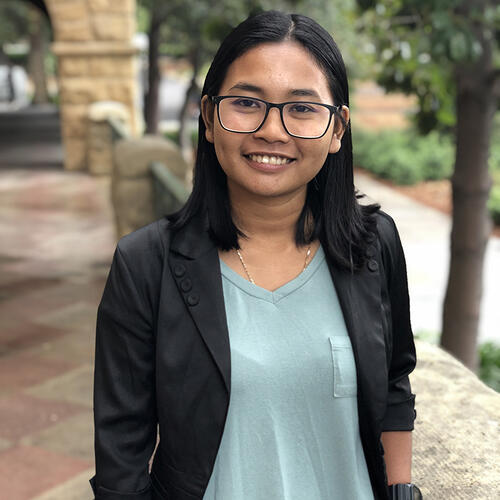
“I earned my bachelor’s degree in global affairs from the American University of Phnom Penh in Cambodia. I did two internships before coming to Stanford: one was with a consulting firm, where I was working mainly on migration research and youth participation initiatives at the sub-national level. I also worked for a foundation that works on strengthening political parties in Cambodia. It was a really interesting experience, and it gave me the idea of doing my bachelor's thesis on migration.

My interests right now are in migration, development, and education. And I’m interested to learn about how the three interact, and how we can make the most out of migration. I'm so excited to explore the interdisciplinary aspects of the Master’s in International Policy program, because I've always felt that you can't separate these issues one from another — migration itself is very interdisciplinary, there is both a political and an economic side to it.

I come from a village in Cambodia, and I'm one of the luckiest in that I had the opportunity to pursue higher education. One of my dreams and goals is that everyone in Cambodia — including girls — have equal access to education, and at least to finish high school, and have the opportunity to pursue their dreams in universities if they’d like to. Where I grew up, I saw a lot of potential not being fulfilled because of people’s circumstances — poverty, or elders not valuing education. I really want to see that change. I want everyone to be able to reach their full potential.”

Hero Image
mipphotocropped
Vienna Exchange student Mourad Chouaki and Ford Dorsey Master’s in International Policy (MIP) first-year students Corie Wieland, Rehana Mohammed and Maria Fernanda Porras Jacobo on the grass of the Stanford Oval in September 2019. Photo: Maria Fernanda Porras Jacobo.
All News button
1
Subscribe to Russia and Eurasia