FOR MORE INFORMATION, CONTACT: Lisa Griswold
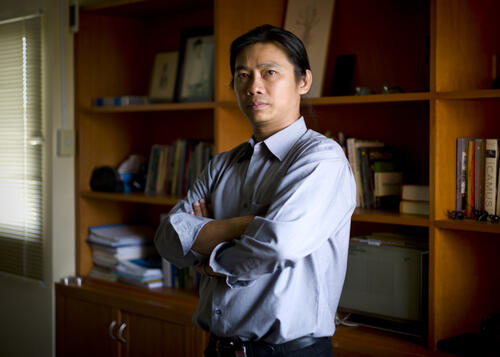
STANFORD, California – Stanford University’s Walter H. Shorenstein Asia-Pacific Research Center (Shorenstein APARC) is pleased to announce Aung Zaw as the 2013 recipient of the Shorenstein Journalism Award. Zaw has been selected for his leadership in establishing independent media in Myanmar (Burma) and his dedication to integrity in reporting on Southeast Asia.

Launched in 2002, the Shorenstein Journalism Award recognizes outstanding journalists who are leaders in constructing a new role for reporting on Asia, including incorporation of Internet-based journalism and social media. The award was originally designed to honor distinguished American journalists for their work on Asia, but since 2011, Shorenstein APARC re-envisioned the award to encompass distinguished Asian journalists who pave the way for press freedom, and have aided in the growth of mutual understanding between Asia and the United States. Shorenstein APARC is delighted to recognize Zaw as the first Burmese recipient of the award.
Aung Zaw’s commitment to independent journalism flows from his long involvement in the struggle against authoritarian military rule in Myanmar and his engagement in the movement for democracy in that Southeast Asian nation. For two decades, Aung Zaw was an active participant in the resistance to military rule and the push for greater press freedom. In 1988, he participated in the mass protests of students, monks, housewives and ordinary citizens against the regime of General Ne Win.
Zaw was arrested, interrogated, and held in the Insein prison for his pro-democracy activities. Upon release, Zaw continued to work with the resistance movement until the military staged a coup in September of that year, whereupon he was forced into exile in neighboring Thailand. From there, he wrote political commentaries for various media outlets and launched The Irrawaddy magazine with a group of fellow Burmese exiles.
Upon the selection of Aung Zaw as the 2013 Shorenstein Journalism Award recipient, jury member Nayan Chanda of Yale University’s Center for the Study on Globalization said:
“In the darkness that descended over Burma in the years following the brutal military crackdown on the democracy movement, former student leader Aung Zaw was one of the few who kept a flickering lamp burning from exile. Nothing was more important than to get news out of the country where fear stalked and jails overflowed with detainees. From his exile perch in Thailand, Aung Zaw published The Irrawaddy which emerged as an important news magazine not only for a muzzled Burma, but it also covered stories from all over Southeast Asia that were often left out by mainstream media. Aung Zaw's contribution to bringing original news and analysis from Southeast Asia to the world cannot be overestimated.”
The Irrawaddy newsmagazine is published in both English and Burmese and features in-depth analysis and interviews with experts from Myanmar and contributors from around the world. As the first independent publication in Myanmar, The Irrawaddy remains a significant resource for current news on the dynamic political and economic environment. In 2012, Zaw returned to his homeland of Myanmar for the first time in 24 years and established a local office for The Irrawaddy in Yangon. This past year, the Burmese government lifted the ban on major media, allowing for readership and distribution of The Irrawaddy throughout the country.
In addition to managing The Irrawaddy, Zaw is a contributor for the New York Times, International Herald Tribune, The Guardian, Bangkok Post, The Nation, and several other publications based in Europe. He has been featured on interviews on CNN, BBC, and Al Jazeera. He is the author of Face of Resistance and has written publications distributed through the Irrawaddy Publishing Group, including ten-installments of The Dictators, a series that analyzes the lives and careers of Myanmar’s main military chiefs and their cohorts.
In 2010, Zaw was awarded the prestigious Price Claus Award for Journalism, which honors journalists who reflect progressive approaches to culturally focused journalism in developing countries. Zaw is currently a visiting scholar at Graduate School of Journalism at the University of California, Berkeley.
On March 6, 2014, Zaw will visit Stanford University to take part in a lunchtime panel discussion on the future of democracy in Myanmar. Zaw will receive the award at a dinner ceremony where he will deliver a talk on his work as a journalist and the role of the media in democratization of Myanmar.
ABOUT THE AWARD
The Shorenstein Journalism Award honors a journalist not only for their distinguished body of work, but also for their promotion of free, vibrant media and for the future of relations between Asia and the United States. The award, which carries a prize of $10,000, is presented to a journalist who consistently creates innovative approaches to unravel the complexities of Asia to readers, among them the use of the Internet and how it can act as a catalyst for change.
The award was named after Walter H. Shorenstein, the philanthropist, activist, and businessman who endowed two institutions that are focused respectively on Asia and the press. The Shorenstein Asia-Pacific Research Center in the Freeman Spogli Institute for International Studies at Stanford University and the Joan Shorenstein Center on Press, Politics, and Public Policy in the Kennedy School of Government at Harvard University. The award honors Shorenstein’s legacy and endows rising journalists with a grant to continue their work.
Originally created to identify journalists based in the U.S. reporting on Asia, the Shorenstein Journalism Award now also recognizes Asian journalists who report on Asian affairs with readers in the U.S. and Asia. Past recipients have included: Barbara Demick of the Los Angeles Times (2012), Caixin Media of Caixin Weekly/Caijing Magazine (2011), Barbara Crossette of The Nation (2010), Seth Mydans of the New York Times (2009), Ian Buruma (2008), John Pomfret (2007), Melinda Liu of Newsweek and The Daily Beast (2006), Nayan Chanda (2005), Don Oberdofer (2004), Orville Schell(2003), and Stanley Karnow (2002).
For the 2013 award, the distinguished selection jury includes:
Nayan Chanda is the director of publications and the editor of YaleGlobal Online Magazine at the Yale Center for the Study of Globalization. For nearly thirty years, Chanda was at the Hong Kong-based magazine, Far Eastern Economic Review. He writes the ‘Bound Together’ column in India’s BusinessWorld and is the author of Bound Together: How Traders, Preachers, Adventurers and Warrior Shaped Globalization. Chanda received the Shorenstein Journalism Award in 2005.
Susan Chira is the assistant managing editor for news and former foreign editor of the New York Times. Chira has extensive experience in Asia, including serving as Japan correspondent for the Times in the 1980s. During her tenure as foreign editor, the Times twice won the Pulitzer Prize for international reporting (2009 and 2007).
Donald K. Emmerson is a well-respected Indonesia scholar and director of Shorenstein APARC’s Southeast Asia Forum and a research fellow for the National Asia Research Program. Frequently cited in international media, Emmerson also contributes to leading publications, such as Asia Times and International Business Times.
Orville Schell is the Arthur Ross director at the Asia Society of New York’s Center on U.S.-China Relations and former jury member for the Pulitzer Prize for international reporting. Schell has written extensively on China and was awarded the 1997 George Peabody Award for producing the groundbreaking documentary the Gate of Heavenly Peace. He received the Shorenstein Journalism Award in 2003.
Daniel C. Sneider is the associate director for research at Shorenstein APARC and was a research fellow at the National Bureau for Asian Research. Sneider frequently contributes to publications such as Foreign Policy, Asia Policy, and Slate and has three decades of experience as a foreign correspondent and editor for publications including the Christian Science Monitor and the San Jose Mercury News.




 Alice Bosley crossing a river near the Dollo Ado UNHCR refugee camp in Ethiopia.
 Ben Rudolph, center, with Sudanese refugees in a UNHCR refugee camp in Ethiopia, March 2013.

